Maybe This Once Summary, Characters and Themes
Maybe This Once by Sophie Sullivan is a contemporary romance about starting over, finding family, and learning how to trust after public humiliation. The story follows Charlotte “Charlie” Ashford, a woman who escapes Los Angeles after a viral scandal destroys the life she had worked hard to build.
In northern Michigan, she meets Grayson Keller, a guarded lodge owner with his own reasons for avoiding love. As Charlie becomes part of the Keller family and the town of Smile, she begins to imagine a life where she is valued for who she is, not for her famous parents or her worst moment online. It’s the 3rd book of the Rock Bottom Love series.
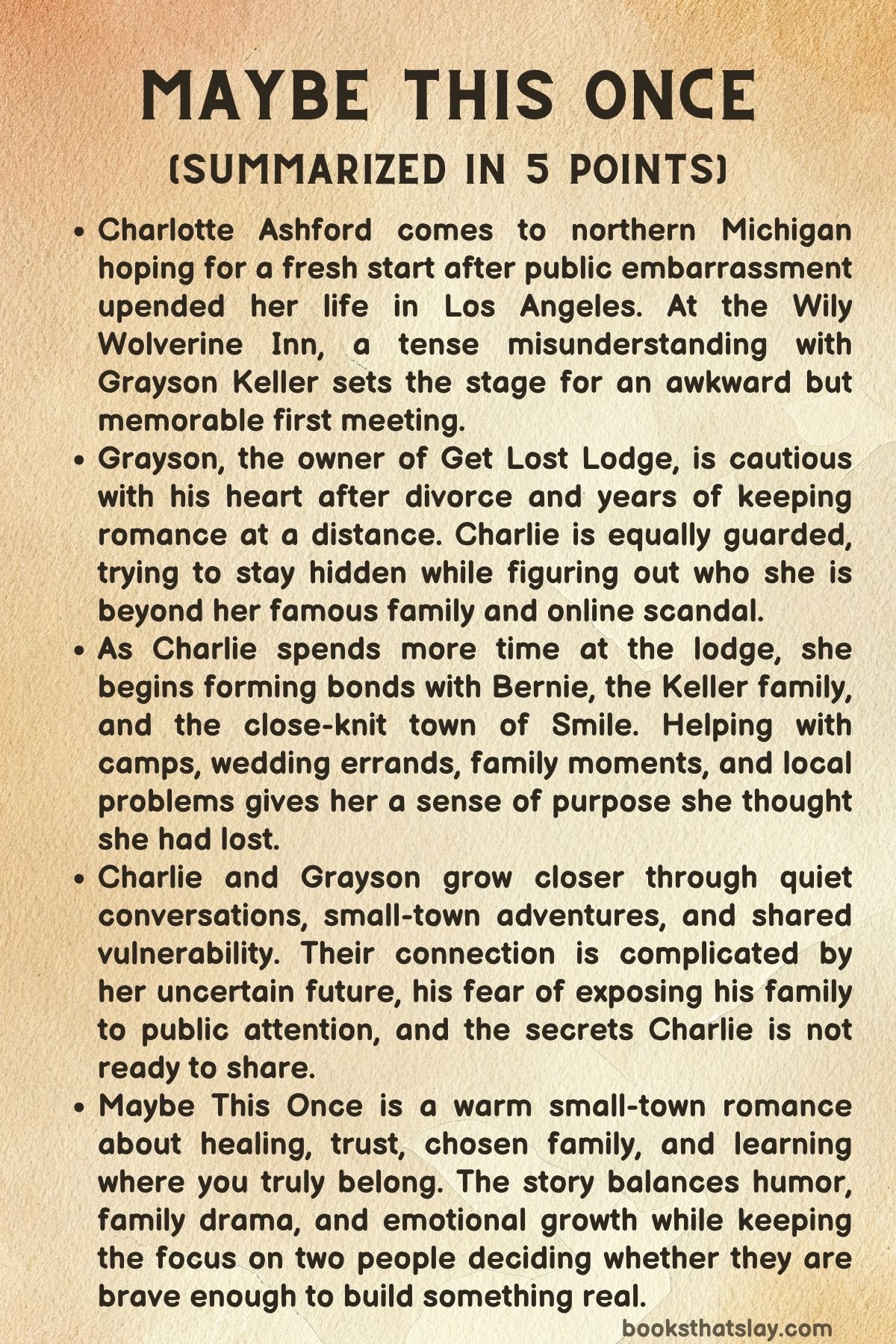
Summary
Charlotte Ashford arrives at the Wily Wolverine Inn in northern Michigan feeling anxious, humiliated, and desperate for a fresh start. She has come for an interview connected to North Michigan Community College, hoping that a teaching position will help her rebuild after a scandal in Los Angeles.
At the hotel front desk, she cannot find her credit card. Already tense from recent public attention, she loses patience when the clerk refuses to check her in without the physical card.
She leaves to search her car, embarrassed and upset.
A man follows her, and Charlie panics. Since a viral video made her recognizable, strangers have been bothering her, and she assumes he is another person trying to harass her.
She hurries into the elevator to get away. Only after the doors close does she realize he was trying to return the credit card she had dropped.
The man is Grayson Keller, owner of Get Lost Lodge. When Charlie returns to the lobby, he gives back her card.
They introduce themselves, and she gives him the nickname Charlie instead of her full name. There is immediate attraction between them, but both hold back.
Grayson is divorced and has avoided dating for years. Charlie is hiding from a public mess that cost her the dream job she had earned at a respected therapy center in Malibu.
The next day, Charlie meets Dean Esher and learns that she will be teaching psychology at the college. Afterward, she sees Grayson again at an outdoor pursuits exhibition.
He awkwardly asks her to get Costco hot dogs with him. Charlie is tempted but says no.
Grayson returns to Get Lost Lodge, where his brother Beckett teases him about the failed invitation. At the lodge, Grayson reconnects with his family, including Beckett, Beckett’s fiancée Presley, his sister Jillian, Jillian’s fiancé Levi, and Jillian’s daughter Ollie.
He also hears that Bernie’s visiting great-niece has arrived. When Bernie introduces her, Grayson realizes the niece is Charlie.
Charlie is staying with Bernie because he is connected to her late father’s side of the family. She wants to know that part of her history, but she is also using the trip as a refuge.
Bernie and the Kellers welcome her with warmth that Charlie does not know how to accept. She is moved by their kindness, but she is also nervous because her attraction to Grayson is growing.
Grayson walks her to the cabin, and they admit the situation is awkward because they have already met. They decide to be friendly.
As the days pass, Charlie begins to settle into life at the lodge. She injures her ankle while walking alone on the trails, and Grayson finds her, helps her, and makes sure she gets back safely.
She also volunteers when Jillian needs help with a confidence-building day camp for girls. Working with the children reminds Charlie of the counseling career she lost, and it gives her back a sense of usefulness.
She spends more time with Jillian and Presley, joins them on wedding errands in Smile, and slowly feels accepted.
Bernie notices that Charlie is hiding more pain than she admits. He gently asks her what really happened, and Charlie finally explains.
Her mother, Vivica Colter, is the widow of rock star Bryce Colter. Vivica announced that she planned to remarry and take part in a reality show that would include Charlie.
Charlie refused. During a heated confrontation, Vivica’s future stepdaughters recorded Charlie, edited the video to make her look terrible, and released it online.
The video went viral, Charlie lost her job, and her ex-boyfriend Isaiah tried to use the attention for his own benefit.
While Charlie tries to move forward, Grayson faces a similar threat. A streaming service wants to film a reality show at Get Lost Lodge.
Because of his divorce and his fierce need to protect the lodge and his family, he is uneasy about letting cameras into their lives. This makes Charlie’s secret even more dangerous, because her own life has already been damaged by people chasing attention.
Charlie and Grayson grow closer through dinners, boat rides, and quiet conversations. He shows her around Smile, and she begins to see the town as a place where she can breathe.
She likes being known as Charlie, not as Charlotte Colter, daughter of famous parents and subject of an ugly viral moment. Grayson, who had convinced himself he did not want marriage, children, or a future with anyone, starts to question everything he thought he knew.
Charlie also becomes involved in town life. At Brothers’ Pub, she sees the odd division between Liam and Leo, two brothers who run separate halves of the same bar because of a long feud.
The town has tolerated the conflict for years, but Charlie suggests that people should stop supporting the pub until the brothers deal with the problem. Grayson and Bernie are unsure at first, but Grayson takes her to Mo at the General Store, and Mo helps rally the town.
Charlie grows especially close to the Keller family. She helps Presley and Ollie with wedding favors and bonds with Jillian, Lainey, Presley, and Ollie.
During a lodge baseball game, Grayson accidentally reveals that Jillian is pregnant before Ollie has been told. Ollie is hurt and runs off.
Jillian asks Charlie to talk to her. Charlie speaks gently with Ollie, sharing her own fears about gaining stepfamily and helping Ollie admit that she is afraid Levi will love the new baby more because the baby will be his biological child.
Ollie returns to Jillian and Levi and asks if she can call Levi “Dad,” bringing comfort to the family.
Grayson and Charlie’s romance deepens during an overnight trip to the mainland. They have dinner, talk honestly about parts of their pasts, and spend the night together.
The next day, Charlie sees an apartment she had planned to consider, but it is awful. Grayson quietly hopes she will stay near Smile.
On the ferry back, Charlie thinks she sees Isaiah, her ex-boyfriend. Her fear proves justified when Isaiah and his friend Jenning arrive as guests at Get Lost Lodge.
Charlie learns that Isaiah tracked her through a phone app. He wants to use her story, her famous parents, and the lodge for a reality-style project.
Charlie panics and briefly runs, even taking Grayson’s boat, but she comes back intending to tell the truth. Before she can fully explain, Isaiah and Jenning expose her identity at breakfast.
Other guests realize she is Bryce Colter’s daughter and mention the viral video. Jenning starts recording, but Levi stops him, and Grayson throws both men out.
Grayson is hurt that Charlie hid the truth from him. He is also afraid that the lodge and his family could be pulled into the kind of public mess that damaged Charlie’s life.
He storms away, leaving Charlie devastated. She stays above the General Store, where Mo comforts her.
Jillian and Presley visit with ice cream and make it clear that they still care about her. They also insist that she come to Beckett and Presley’s wedding.
Vivica arrives in Smile and reconciles with Charlie. She admits that she placed too much emotional weight on her daughter and failed to protect her.
This gives Charlie some peace and helps her stop carrying the blame alone. At Beckett and Presley’s wedding, Grayson and Charlie dance to one of Bryce’s songs.
They finally admit that they love each other.
By Christmas, Charlie has chosen to stay in Smile. She plans to work as a school counselor, see private clients, and keep teaching one class.
Vivica also decides to move there and open a salon. Grayson and Charlie commit to building a future together.
He tells her he wants to marry her someday, and Charlie tells him he is her home. Maybe This Once ends with Charlie no longer running from her past, but choosing a life, a family, and a love that allow her to feel safe and fully known.
Characters
Charlotte Ashford / Charlie / Charlotte Colter
Charlotte Ashford, who introduces herself as Charlie, is the emotional center of Maybe This Once. She enters the book in a state of humiliation, fear, and defensiveness after a viral video has damaged her reputation and cost her the professional future she had worked hard to build.
Her first moments at the inn show how deeply shaken she is: she is anxious, embarrassed, and quick to panic because she has become used to being judged or recognized for the worst version of herself. Yet Charlie is not simply a woman running away from scandal.
She is someone trying to reclaim control over her identity after being defined by her famous parents, her mother’s choices, her ex-boyfriend’s opportunism, and the public’s appetite for drama.
Charlie’s character becomes richer as she settles into Smile and Get Lost Lodge. Her training in psychology is not just a career detail; it shapes the way she notices people’s emotional needs.
This is clear in the way she helps Ollie process her fear about Levi and the new baby. Charlie understands insecurity because she has lived with it herself, especially in relation to family changes, public attention, and feeling emotionally secondary to other people’s ambitions.
Her kindness is practical rather than sentimental. She does not merely comfort Ollie; she gives her language for feelings that the child cannot fully explain on her own.
This shows Charlie’s natural gift as a counselor and reinforces the tragedy of her losing her dream job.
Her central conflict is the struggle between hiding and belonging. Charlie wants the freedom to be known simply as Charlie, not as Charlotte Colter, daughter of Bryce and Vivica.
Her secrecy comes from fear rather than malice. She has learned that her real identity attracts attention, exploitation, and judgment, so she protects herself by withholding it.
However, that same secrecy eventually hurts Grayson because his deepest fear is having his family and lodge exposed to public spectacle. Charlie’s mistake is understandable, but it still has consequences.
This makes her a balanced and believable character: wounded, loving, intelligent, guarded, and capable of growth.
By the end of the story, Charlie’s development comes through her decision to stop running. She chooses Smile not because it is an escape, but because it becomes a place where she can build an honest life.
Her future as a school counselor, private therapist, and teacher shows that she regains her purpose without returning to the exact dream she lost. Her reconciliation with Vivi also allows her to release some of the emotional burden she has carried for years.
Charlie’s ending with Grayson feels earned because she has learned that home is not just a place where no one knows your past; it is a place where people know the truth and still choose you.
Grayson Keller
Grayson Keller is one of the most emotionally guarded characters in Maybe This Once. As the owner of Get Lost Lodge, he is responsible, protective, and deeply tied to his family and community.
His first interaction with Charlie shows both his patience and his quiet decency. He follows her only to return her credit card, waits instead of reacting harshly to her panic, and approaches her with calm curiosity.
This sets the tone for his character: Grayson is steady, but not emotionally simple. Beneath his calm exterior is a man shaped by divorce, disappointment, and a strong need to protect the life he has rebuilt.
Grayson’s reluctance to date is not just about a failed marriage; it reflects his fear of vulnerability. He has convinced himself that romance, marriage, children, and a shared future are no longer things he wants.
His attraction to Charlie unsettles him because it challenges the emotional limits he has placed around himself. The more time he spends with her, the more he begins to imagine possibilities he had closed off.
His secret land near the water becomes an important symbol of this hidden longing. He has a dream of a home, but before Charlie, that dream seems more private than active.
Her encouragement pushes him to admit that he may still want a fuller future.
Grayson’s strongest trait is also the source of his greatest conflict: protectiveness. He cares deeply about the lodge, his siblings, Bernie, Ollie, and the wider family circle.
This is why the reality-show proposal troubles him even before Charlie’s identity is revealed. He understands that cameras can distort private life and turn real people into entertainment.
When Isaiah and Jenning expose Charlie, Grayson’s anger comes not only from feeling deceived but from seeing the exact danger he feared arrive at his breakfast table. His reaction is harsh, but it is rooted in old wounds and genuine fear for his family.
His growth lies in learning to separate Charlie’s fear from betrayal. He has to understand that she did not hide herself to manipulate him; she hid because she had been hurt and used.
By choosing love after the rupture, Grayson shows that he can move beyond defensive control and accept the risks that come with intimacy. His final commitment to building a life with Charlie shows that he has changed from a man who ruled out love to a man willing to imagine marriage, family, and permanence again.
Bernie
Bernie is one of the warmest and most grounding figures in the book. As Charlie’s connection to her late father’s side of the family, he represents heritage, safety, and belonging.
He welcomes Charlie not as a celebrity’s daughter or a scandalized stranger, but as family. His kindness is gentle, but it is not passive.
Bernie notices when Charlie is hiding from the truth and lovingly presses her to explain what really happened. This makes him an important emotional guide for her.
Bernie’s role is especially meaningful because Charlie arrives in Smile feeling disconnected from family. Her relationship with her mother is strained, her father is gone, and her public identity has become painful.
Bernie offers a different kind of family connection, one without performance or pressure. He gives Charlie space, but he also gives her roots.
Through him, she begins to understand that she belongs to more than the chaos of her mother’s world or the shadow of her father’s fame.
He also functions as a bridge between Charlie and the Keller family. Because Bernie is already loved and respected at the lodge, his acceptance of Charlie helps others welcome her naturally.
His presence adds emotional stability to the story. He is not a dramatic character in the same way Charlie, Grayson, or Vivi are, but he is essential because he creates the conditions that allow healing to begin.
Beckett Keller
Beckett Keller brings warmth, humor, and brotherly teasing into the story. His teasing of Grayson after the awkward Costco hot dog invitation shows his easy familiarity with his brother and his ability to notice what Grayson would rather hide.
Beckett understands that Grayson is interested in Charlie before Grayson is fully ready to admit it. This makes him a light but perceptive presence in the family dynamic.
As Presley’s fiancé, Beckett also represents stability and forward movement. His wedding becomes one of the emotional gathering points of the story, bringing together family, community, reconciliation, and romance.
Unlike Grayson, who is still cautious about love, Beckett is already moving toward commitment. His relationship with Presley creates a contrast that helps highlight Grayson’s emotional hesitation.
Beckett’s importance lies less in personal conflict and more in the family atmosphere he helps create. He is part of the reason Get Lost Lodge feels alive and welcoming.
Through him, the reader sees the Kellers as a family that jokes, supports, celebrates, and occasionally interferes with affection. His character strengthens the sense that Charlie is entering not just a romantic relationship, but an entire chosen family.
Presley
Presley is kind, inclusive, and emotionally generous. As Beckett’s fiancée, she is already becoming part of the Keller family, and this gives her a special connection to Charlie.
She knows what it means to be welcomed into an existing family circle, so her warmth toward Charlie feels natural. By inviting Charlie into wedding errands, favor-making, and friendships with the women of Smile, Presley helps Charlie experience belonging in ordinary, domestic ways.
Presley’s character is important because she shows that acceptance can be quiet and consistent. She does not need grand speeches to make Charlie feel included.
Her actions communicate care. When Charlie’s identity is exposed and her place in the community becomes uncertain, Presley’s later visit with Jilly reassures Charlie that affection does not disappear because of scandal.
This matters deeply to Charlie, who is used to love being complicated by fame, image, and public judgment.
Presley also helps create the emotional setting for the final reconciliation. Her wedding becomes the place where Charlie and Grayson are able to reconnect honestly.
In that sense, Presley’s happiness with Beckett becomes part of the larger healing movement of the story. She is a supporting character, but her warmth helps shape the book’s central idea that love grows best in a community where people make room for one another.
Jillian / Jilly
Jillian, often called Jilly, is Grayson’s sister and one of the key figures in the Keller family. She is loving, practical, and emotionally aware, but she is also navigating a major transition in her own life.
Her engagement to Levi, her daughter Ollie’s adjustment, and her pregnancy all create a layered family situation. Jilly’s character shows the complexity of building a blended family with care and patience.
Her trust in Charlie becomes especially important when Ollie runs away after learning about the pregnancy in an upsetting way. Jilly asks Charlie to speak with her daughter because she recognizes Charlie’s emotional intelligence and counseling instincts.
This moment shows Jilly’s humility as a mother. She does not let pride prevent her from accepting help.
Instead, she prioritizes Ollie’s emotional safety, which reveals her strength and love.
Jilly also becomes one of Charlie’s important female connections in Smile. Along with Presley, she reassures Charlie after the truth about her identity comes out.
This shows that Jilly’s loyalty is not shallow. She may be surprised by Charlie’s hidden past, but she does not reduce Charlie to it.
Her character adds warmth to the story and reinforces the importance of women supporting one another through fear, change, and vulnerability.
Levi
Levi is a steady and loving presence in Jilly and Ollie’s lives. As Jilly’s fiancé, he represents the possibility of chosen fatherhood and blended family love.
His relationship with Ollie is central to understanding him. Ollie’s fear that Levi will love the new baby more because the baby is biologically his reveals the emotional stakes of his role.
Levi must prove that fatherhood is not only biological, but also relational, patient, and chosen.
His most emotional moment comes when Ollie asks if she can call him Dad. This moment confirms the trust he has built with her.
Levi’s love has clearly been consistent enough for Ollie to want to claim him in that way, even though she is afraid of being replaced. His character therefore represents quiet devotion rather than dramatic action.
Levi also shows protectiveness when Jenning begins recording after Charlie’s identity is exposed. By stopping him, Levi defends Charlie’s dignity and the privacy of the family space.
This action aligns him with the Keller family’s values. He is not just marrying into the family; he already acts as someone who protects its people.
Ollie
Ollie is one of the most emotionally important younger characters in the story. As Jilly’s daughter, she brings innocence, honesty, and vulnerability into the book.
Her reaction to the news of Jilly’s pregnancy is not childish in a shallow sense; it is emotionally understandable. She fears being replaced, especially because Levi is not her biological father.
Her fear reveals how deeply she loves him and how much she wants to feel secure in her family.
Ollie’s conversation with Charlie is one of the strongest examples of Charlie’s gift for counseling. Through Ollie, the story explores how children often experience family change with both excitement and terror.
Ollie does not simply need to be told that everything will be fine. She needs someone to help her name the fear underneath her reaction.
Charlie gives her that help, and Ollie responds with courage.
Her decision to ask Levi if she can call him Dad is emotionally powerful because it shows growth, trust, and hope. Ollie moves from fear of losing love to actively claiming the love that is already there.
Her character adds tenderness to the story and helps reveal the healing power of honest conversation.
Vivica Colter / Vivi
Vivica Colter, called Vivi, is a complicated mother figure. She is glamorous, emotionally demanding, and shaped by life in the public eye.
Her decision to announce a new marriage and involve Charlie in a reality show without truly respecting Charlie’s wishes shows how deeply she has blurred the line between family and performance. For Charlie, Vivi’s choices are not merely annoying; they are part of a long pattern in which Charlie’s emotional needs are overshadowed by her mother’s public life.
At the same time, Vivi is not portrayed as purely cruel. Her later arrival in Smile and reconciliation with Charlie reveal a woman capable of recognizing her mistakes.
She admits that she placed too much emotional weight on her daughter, which is an important step in repairing their relationship. This admission matters because Charlie has often been forced into the role of emotional caretaker.
Vivi’s growth begins when she acknowledges that this burden was unfair.
Vivi’s decision to move to Smile and open a salon suggests that she, too, is seeking reinvention. Like Charlie, she must step away from the performance-driven world that damaged their relationship.
Her character adds complexity to the family conflict because she is both a source of pain and a person capable of change. Her reconciliation with Charlie helps complete Charlie’s emotional arc in Maybe This Once, allowing mother and daughter to imagine a healthier bond.
Bryce Colter
Bryce Colter is deceased before the main action, but his presence strongly shapes Charlie’s identity. As a famous rock star, he represents both legacy and pressure.
Charlie is known publicly as his daughter, which means his fame continues to define her even after his death. This connection brings attention she does not want and makes it harder for her to be seen as an individual.
Bryce also functions as an emotional absence. Charlie’s desire to connect with Bernie and her father’s side of the family suggests that she is searching for a part of herself linked to him but separate from celebrity culture.
Through Bernie and Smile, Charlie finds a quieter connection to her father’s memory. This allows Bryce’s role in the story to become more than fame; he becomes part of Charlie’s search for roots.
His music also carries emotional meaning, especially when Charlie and Grayson dance to one of his songs at the wedding. That moment brings Charlie’s past into her present in a gentler way.
Instead of Bryce’s fame being a burden, his song becomes part of a scene of love, reconciliation, and belonging.
Isaiah
Isaiah is Charlie’s ex-boyfriend and one of the clearest antagonistic forces in the book. He represents exploitation disguised as personal connection.
Rather than supporting Charlie after the viral scandal, he tries to use the attention for himself. His later decision to track her through a phone app is invasive and controlling, showing that he does not respect her boundaries or her need for safety.
Isaiah’s arrival at Get Lost Lodge threatens everything Charlie has begun to build. He brings with him the world she tried to escape: fame, manipulation, recording, exposure, and the transformation of private pain into entertainment.
His interest in her story, her famous parents, and the lodge reveals that he sees people as material. He does not care about Charlie’s healing; he cares about opportunity.
As a character, Isaiah is important because he clarifies what Charlie is rejecting. He embodies the shallow, opportunistic version of love and attention that has wounded her.
By standing against him, the story also strengthens the contrast between Isaiah and Grayson. Grayson may be hurt and angry when the truth comes out, but he protects Charlie from being filmed and exploited.
Isaiah exposes; Grayson defends.
Jenning
Jenning is Isaiah’s friend and an extension of the same exploitative world. His role is especially disturbing because he immediately turns Charlie’s private crisis into content by recording.
This makes him a symbol of public humiliation and the cruelty of viral culture. He does not need to know Charlie deeply to harm her; he only needs a camera and a willingness to treat her pain as entertainment.
Jenning’s behavior at breakfast intensifies the conflict between Charlie and Grayson. His recording makes Grayson’s fears about public exposure suddenly real.
It also forces the Keller family to confront the outside world’s intrusion into their private space. Levi stopping him and Grayson throwing him out show that the lodge community rejects this kind of exploitation.
Though Jenning is not deeply developed, he is effective as a secondary antagonist. He represents the people who participate in scandal without caring about the human being at the center of it.
His presence helps the story criticize the culture that turned Charlie’s worst moment into a public spectacle.
Dean Esher
Dean Esher plays a practical but important role in Charlie’s new beginning. By confirming her teaching position at North Michigan Community College, he gives Charlie a path back toward professional purpose.
After losing her dream job in California, Charlie needs more than emotional refuge; she needs work that reminds her of her competence and value. Dean’s role helps make that possible.
He represents institutional acceptance at a time when Charlie fears rejection. The college opportunity allows her to rebuild her identity outside the scandal.
Teaching psychology also keeps her connected to the field she loves, even while she adjusts to a different version of her career.
Dean is not a major emotional figure, but his presence matters because he helps anchor Charlie’s future in Smile. Through him, the town becomes not only a romantic or familial refuge, but also a place where Charlie can contribute professionally.
Mo
Mo, who works at the General Store, is one of the key community figures in Smile. She is practical, loyal, and quietly influential.
When Charlie suggests that the town stop accommodating Liam and Leo’s feud, Grayson takes the idea to Mo because she is someone who can help organize people. This shows that Mo has social authority within the town, even if she exercises it informally.
Mo also becomes a source of comfort for Charlie after her identity is exposed. By giving Charlie a place above the General Store and offering emotional support, Mo shows the town’s capacity for protection and care.
She does not treat Charlie as a scandal. She treats her as a person who needs shelter and kindness.
Her character helps define Smile as a community. Mo is not simply background; she is part of the network of people who make the town feel emotionally real.
Through her, the story shows that belonging is built through small acts of loyalty.
Liam
Liam is one half of the feuding brother pair at Brothers’ Pub. His conflict with Leo has become so long-running that the entire town has learned to work around it.
This makes Liam part of the book’s comic community texture, but the feud also reflects a deeper theme: unresolved conflict can become normalized when people stop challenging it.
Liam’s character is important because he helps reveal Charlie’s outsider perspective. The residents of Smile have accepted the strange division of the pub as just the way things are, but Charlie immediately sees that accommodating the feud only allows it to continue.
Her response shows her directness and her instinct for confronting emotional avoidance.
Although Liam is a minor character, his situation with Leo mirrors larger conflicts in the story. Like Charlie and Vivi, or Charlie and Grayson after the exposure, the brothers need to face the problem rather than build their lives around silence and avoidance.
Leo
Leo, Liam’s brother, completes the divided dynamic at Brothers’ Pub. Like Liam, he is part of a feud that has become a town habit.
The split between the two halves of the bar is humorous, but it also suggests stubbornness, pride, and emotional stagnation. Leo’s inability or unwillingness to resolve the conflict keeps the community trapped in an unnecessary pattern.
His role becomes meaningful because Charlie challenges the town’s passive acceptance of the brothers’ behavior. By suggesting a tougher plan, she shows that care sometimes requires refusing to enable dysfunction.
Leo, like Liam, represents the kind of conflict that survives because everyone around it adapts instead of insisting on change.
Leo’s character may be secondary, but the feud adds depth to Smile as a setting. It shows that even a warm and welcoming town has its own unresolved tensions.
This makes the community feel more believable and gives Charlie a chance to contribute to it rather than merely receive comfort from it.
Lainey
Lainey appears as part of the circle of women who help Charlie feel included in Smile. Her presence matters because Charlie’s healing is not limited to romance with Grayson.
She also needs friendship, female support, and ordinary social belonging. Lainey contributes to that atmosphere of inclusion.
Through the wedding preparations and time spent with Jilly, Presley, and Ollie, Lainey helps create a softer world around Charlie. This is important because Charlie has come from a life where relationships were often complicated by fame, ambition, and exposure.
In Smile, companionship can be simple and sincere.
Lainey is a minor character, but she helps reinforce the community’s warmth. Her role supports one of the story’s central emotional movements: Charlie gradually becoming part of a group rather than standing alone.
Eddie
Eddie is Vivi’s new partner and a catalyst for Charlie’s crisis, even though he is not as directly active in the events in Smile. His engagement to Vivi and the planned reality show create the situation that pushes Charlie into conflict with her mother.
To Charlie, Eddie represents another major life decision made around her, but not truly with her.
His importance lies in the way his presence changes Charlie’s family structure. The announcement of his marriage to Vivi, along with the involvement of his daughters, makes Charlie feel cornered.
Her reaction is not just about Eddie himself; it is about being forced into a public family narrative she did not choose.
Eddie functions more as a plot-driving figure than a fully developed emotional character. Still, his role matters because his relationship with Vivi exposes the unhealthy patterns between Vivi and Charlie, especially Vivi’s assumption that Charlie can be pulled into public plans without real consent.
Eddie’s Daughters
Eddie’s daughters are important because they are responsible for recording and editing Charlie’s angry reaction into the viral video. Their actions turn a private emotional outburst into public humiliation.
This makes them part of the larger culture of manipulation and spectacle that the book criticizes.
They represent the danger of selective storytelling. By editing the confrontation, they create a version of Charlie that damages her reputation and strips away context.
This is why the scandal is so painful: Charlie is not only judged, but judged through a distorted image of herself.
Although they are not deeply developed as individuals, their role is significant. They help explain why Charlie is so afraid of being recorded, recognized, and exposed again.
Their betrayal shapes her guardedness throughout the story and makes Isaiah and Jenning’s later behavior feel even more threatening.
Themes
Rebuilding Identity After Public Shame
Charlie’s journey in Maybe This Once centers on the painful process of separating who she truly is from the humiliating version of herself that strangers have judged online. The viral video reduces her to one angry moment, ignoring the fear, family pressure, and emotional exhaustion behind it.
In Smile, she is not immediately treated as a scandal or a celebrity’s daughter; she is allowed to be Charlie, someone capable, kind, funny, and useful. This shift matters because her confidence has been badly shaken by losing her job, being mocked publicly, and feeling betrayed by people close to her.
Her work with the girls’ camp, her bond with Ollie, and her return to counseling-related work help her remember that her skills and compassion still exist beyond the scandal. The theme shows that identity can be rebuilt through honest relationships, meaningful work, and the courage to stop letting public opinion define private worth.
Belonging and Chosen Family
Smile and Get Lost Lodge become more than a temporary hiding place for Charlie; they become the first spaces where she feels received without conditions. The Keller family, Bernie, Mo, Jilly, Presley, Ollie, and others gradually give her the kind of warmth she has lacked in her more public, unstable life.
Their acceptance is not dramatic or forced; it appears through meals, errands, conversations, teasing, wedding preparations, and small acts of care. This makes belonging feel practical rather than abstract.
Charlie’s connection to Bernie also lets her reach toward her father’s side of the family, filling an emotional gap left by loss and fame. The theme is powerful because belonging is shown as something built through repeated trust, not just blood ties.
By the end, Charlie does not simply fall in love with Gray; she finds a community where she can stay, contribute, and be loved as a whole person.
Trust, Secrecy, and Emotional Risk
Charlie’s decision to hide her identity is understandable, but it also creates the central emotional conflict of Maybe This Once. She has learned that truth can be used against her, so secrecy becomes a form of self-protection.
Gray, however, has his own fears about exposure, especially with the proposed reality show and his need to protect the lodge after past hurt. Their relationship grows because both feel seen by the other, yet the truth Charlie withholds makes that closeness fragile.
When Isaiah exposes her, Gray’s anger comes not only from the secret itself but from the fear that his family, home, and peace could be turned into entertainment. The theme shows that trust requires more than affection; it demands the courage to share painful truths before outsiders weaponize them.
Their reconciliation matters because both must choose vulnerability over fear, proving that love cannot survive on attraction alone.
Home as Safety, Choice, and Future
Home in the story is not just a house, a lodge, or a town; it is the feeling of being safe enough to imagine a future. Gray’s secret land near the water represents a dream he has kept private, partly because divorce and disappointment have made him cautious about wanting too much.
Charlie’s arrival changes that. She encourages him to think about building, while he helps her see that staying does not mean giving up her independence or career.
Smile offers Charlie work, friendship, family connection, and emotional steadiness, which makes it different from the public chaos of California. The final commitment between Charlie and Gray is meaningful because neither is simply escaping the past.
They are choosing a place and a life with intention. Home becomes something created through love, honesty, community, and shared plans, not something handed to them by circumstance.