Nightshade and Oak Summary, Characters and Themes
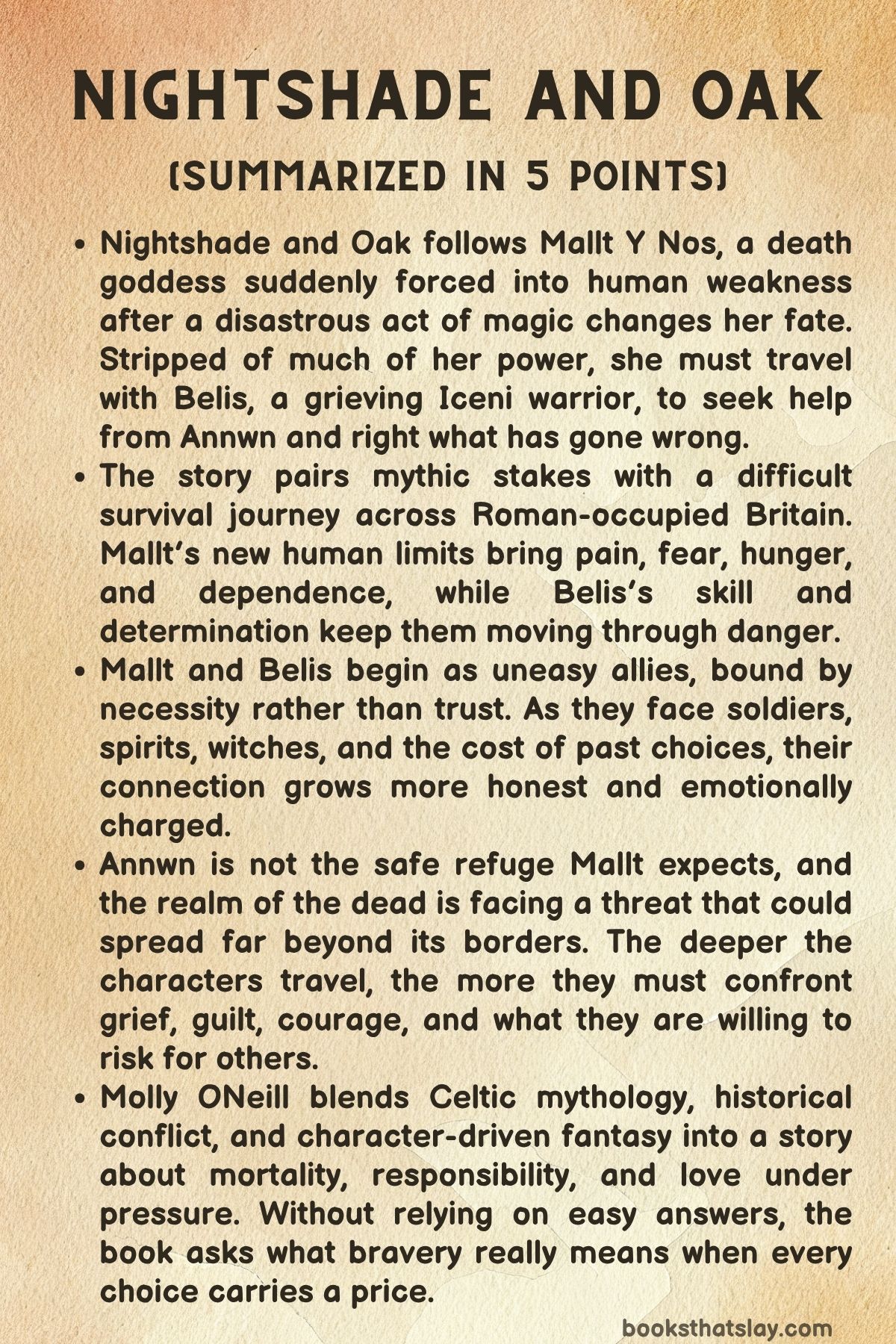
Nightshade and Oak by Molly O’Neill is a fantasy novel rooted in Celtic myth, Roman Britain, grief, sacrifice, and uneasy loyalty. The story follows Mallt Y Nos, a death goddess who is forced into human weakness after a desperate spell goes wrong.
Bound to Belis, a warrior carrying guilt over her sister’s fate, Mallt must travel from the blood-soaked aftermath of Boudica’s rebellion into Annwn, the realm of the dead. The book explores what happens when divine purpose meets mortal pain, and when courage means admitting fear rather than denying it.
Summary
After the Romans crush Boudica’s rebellion, Mallt Y Nos, the Nightshade and guide of dead souls, walks the battlefield with her hounds. Her duty is clear: free the trapped spirits of the slain and guide them toward Annwn, the otherworld ruled by Arawn.
She moves among the bodies with the calm certainty of an immortal being, sending Roman souls toward their own afterlife and gathering the dead who belong to her path. Her closest hound, Dormath, remains at her side as she works through the wreckage of war.
At dawn, Mallt senses one final dying soul nearby. She follows it into a sacred glade and finds a terrible scene.
Boudica is dead. Beliscena of the Iceni, known as Belis, is alive, frantic, and determined to save her younger sister, Cati.
Cati is close to death, and Belis is attempting forbidden witchcraft to heal her. Mallt reaches for Cati’s soul, but Belis’s spell breaks apart with violent force.
The magic drains Mallt’s divine power, restores Cati’s body, and leaves Cati alive but soulless, unable to wake.
When Mallt regains consciousness, everything has changed. She is trapped in a weak human body.
Her immortality, strength, sharp senses, and command over most of her hounds are gone. Only Dormath remains, and he too has been made mortal.
Mallt is horrified by the limits of flesh: pain, cold, hunger, fear, nausea, exhaustion, and breathlessness. Belis, meanwhile, is furious and desperate.
She demands that Mallt retrieve Cati’s soul. Mallt wants only to reach Annwn and regain her powers before unguided dead souls become dangerous spirits.
The two women make an uneasy bargain. Belis will protect Mallt and supply her on the journey west, and Mallt will ask Arawn to release Cati’s soul.
Mallt leaves Dormath behind to guard Cati’s body in the hidden glade, takes Cati’s boots and Boudica’s cloak, and sets out with Belis.
Their journey begins with hardship and resentment. Mallt has no idea how to live as a human.
She suffers from blisters, hunger, sickness, cold, and fear. Belis, a trained warrior and survivor, becomes the practical force keeping them alive.
She finds food, builds fires, hunts, cooks, carries supplies, and pushes Mallt onward when Mallt wants to stop. The balance between them is tense.
Mallt has lost nearly everything that made her powerful, while Belis is burdened by grief, guilt, and responsibility.
They cross the Chalk and see the White Horse, but danger follows them. Roman soldiers are still active in the land, including a centurion named Croser.
He lost his family in Londinium and is hunting Belis with personal rage. Mallt and Belis evade patrols, but the threat remains close.
They also encounter a wight, a sign of what happens when lost souls are not guided properly. The encounter proves that Mallt’s absence from her role is not only personal disaster; it is a danger to the living and dead alike.
In the Cotswolds, they find shelter with Vatta, a powerful witch who lives in a hidden treehouse. Vatta gives them food, safety, advice, supplies, healing magic for Mallt’s wounded feet, and directions to a farmer who can sell them horses.
During this pause, Mallt begins to see Belis more clearly. Vatta helps her understand the depth of Belis’s grief and the guilt beneath her anger.
Belis is not simply demanding help; she is trying to undo the worst moment of her life.
As Mallt and Belis ride west, they begin to trust each other despite their arguments. Their closeness grows through shared danger and small acts of care.
Near the coast, Belis admits the truth about the spell. In terror, she clung to life and power, and that fear helped cause Cati’s soul to be lost.
Mallt is shaken by the confession and unsure whether she should continue helping Belis. Before she can decide, Croser’s patrol finds them.
Belis nearly sacrifices herself, but Mallt stops her by jumping into the sea. The two escape by boat and row along the coast until they reach Caer Sidi, the entrance to Annwn.
Inside Annwn, they find Arawn among the dead. Mallt expects restoration, but he tells her the truth: she has truly become human, and he cannot return her divine nature.
Worse, Annwn itself is under threat. A shadow is spreading through the realm, twisting souls into shadowbitten monsters.
To prevent the corruption from escaping into the mortal world, Arawn has sealed the way back, trapping Mallt and Belis inside.
Annwn’s greatest hope is Arawn’s seneschal, a powerful dead witch lost inside a corrupted forest labyrinth. Without her magic, Annwn may fall.
Mallt panics at the scale of the danger, but Belis steadies her. Together, they realize that because they are living humans, they may be able to resist dangers that overwhelm the dead.
Arawn first tests them by sending them to clear black brambles. They succeed after discovering that suffering changes the flow of time in Annwn, allowing their painful labor to stretch longer than ordinary time should permit.
Arawn then sends them into the ancient forest to find the missing witch. The forest tests them with illusions.
Belis sees a child version of Cati and nearly follows, but Mallt reminds her that Cati’s soul cannot truly be there. Later Belis sees her dead mother, Boudica, calling from another path.
Mallt cannot prove whether the vision is real, but warns that following it means abandoning their mission. Belis turns away, though the choice wounds her deeply.
An eagle guides them to a huge oak filled with birds. There, Belis faces another vision: an older crowned version of herself rising from the water, accusing her of cowardice and lovelessness.
The figure becomes a swarm of flies, but Mallt pulls Belis into the water and saves her. Inside the oak, they find the hidden witch: Rhiannon, the ancient half-fae Queen of Dyfed.
She sealed herself inside the tree to avoid corruption. Rhiannon agrees to return with them, warning that the shadowbitten will try to stop them.
The escape is brutal. Pale corrupted figures stalk them through the forest.
Rhiannon uses magic to topple trees and slow the attackers, while Belis fights with spear and knife. Mallt helps as best she can in her weakened human state.
They reach the arch and return to Arawn, bringing Rhiannon back safely.
Annwn pauses for Calan Gaeaf, its great festival. Mallt and Belis are honored and asked to cook meat in the Giant’s Cauldron, which boils only for the brave.
At first, it stays cold. Belis believes this proves she is a coward.
Mallt tries to force it through anger, but they come to understand that bravery is not fearlessness. It is facing fear honestly.
Belis admits she fears failing to save Cati, but fears even more that she may succeed and have to confess what she did. Mallt reassures her, and the cauldron heats.
For one night, the dead celebrate with food, music, and dancing. Mallt dances with Belis and briefly forgets the danger around them.
At dawn, news arrives that a great white dragon has crossed from the borderlands, corrupted by shadow. Rhiannon argues that they must not only fight the effects of the corruption.
They must go to its source and heal it. Arawn agrees to create a diversion while Belis, Rhiannon, and Mallt travel south.
They cross a canyon into the corrupted lands. A monstrous serpent attacks before Belis reaches them.
Mallt nearly dies defending Rhiannon, but Belis leaps down and kills it with her spear. The three continue through ash-filled wastes.
Monsters pursue them, and Belis risks herself as a decoy so Mallt and Rhiannon can hide. The corrupted air weakens Mallt so badly that Belis has to carry her.
At the heart of the shadow, they find an island surrounded by dark water and eel-like creatures. Rhiannon begins a spell while Mallt and Belis fight.
Both are bitten and poisoned, but Rhiannon releases light that destroys the creatures and clears the venom. She discovers the source of the corruption: old protective spells around Britain were broken during the Roman invasion.
To repair them, royal blood is required. Since Rhiannon is dead, Belis is the only one who can give it.
Mallt begs her not to do it, but Belis agrees. She asks Mallt to save Cati if she dies.
Rhiannon cuts Belis’s wrist and channels her blood into the spell. The restoration of Annwn begins, but the cost may be Belis’s life or the loss of her magic.
Characters
Mallt Y Nos
Mallt Y Nos is the central supernatural figure of Nightshade and Oak, and her journey is built around a painful fall from divine certainty into human vulnerability. At the beginning, she is the Nightshade, a goddess whose duty is to guide dead souls to Annwn.
She moves through death with authority, familiarity, and purpose, treating the battlefield not as a place of horror but as a place where her work must be done. This makes her powerful, but also emotionally distant.
She understands souls, endings, and cosmic order better than she understands living fear, grief, hunger, or attachment. When Belis’s forbidden spell strips Mallt of her immortality and traps her in a weak human body, the book forces her into the very condition she has always stood outside of.
Her blisters, exhaustion, vomiting, fear, and helplessness are not minor inconveniences; they are the beginning of her transformation.
Mallt’s humanity changes the way she sees others. At first, she is angry, impatient, and focused mainly on reaching Annwn so she can regain her power and restore her role in the balance between the living and the dead.
However, the longer she travels with Belis, the more she begins to understand the emotional weight behind human choices. Belis’s grief, guilt, loyalty, and terror gradually become real to her, not simply obstacles to her mission.
Mallt is still sharp-tempered and proud, but she becomes increasingly capable of compassion. Her bond with Belis grows out of conflict, dependence, shared danger, and the slow discovery that bravery can exist inside weakness.
Mallt is also important because she represents a changing idea of power. As a goddess, her strength came from immortality, supernatural senses, and command over death.
As a human, she has to learn a different kind of strength: endurance, trust, emotional honesty, and the willingness to act even when she is afraid. In Annwn, she can no longer rely on divine authority, so she must rely on Belis, Rhiannon, and her own developing courage.
Her attempts to save others despite her reduced state show that she is not only powerful because she is a goddess. She becomes admirable because, even when frightened and physically weak, she still chooses to continue.
Beliscena of the Iceni
Beliscena, usually called Belis, is one of the most emotionally complex characters in the book. She is introduced in the aftermath of terrible loss: Boudica is dead, the rebellion has been crushed, and her younger sister Cati is dying.
Belis’s attempt to save Cati through forbidden witchcraft reveals both her love and her desperation. Her mistake does not come from cruelty but from panic, grief, and the instinct to hold on to life.
This makes her guilt especially painful. She knows that her actions helped leave Cati alive in body but without a soul, and much of her journey is driven by the need to repair what she has done.
Belis is a warrior, survivor, and protector. While Mallt struggles with the ordinary realities of being human, Belis keeps them alive.
She gathers food, makes fires, cooks, hunts, carries supplies, finds practical solutions, and protects Mallt from soldiers, monsters, and the land itself. Her competence often hides her emotional wounds.
She appears stern, capable, and determined, but the story gradually reveals that she is full of fear: fear of losing Cati, fear of admitting the truth, fear that she is a coward, and fear that even success will force her to face what she did. Her strength is therefore not the absence of fear.
Her strength is that she keeps moving while carrying fear, shame, and grief.
Belis’s deepest conflict is between sacrifice and confession. She is willing to suffer and even die for Cati, but she is terrified of being known fully by the sister she wants to save.
This becomes especially clear during the cauldron scene, where the test of bravery is not physical combat but emotional truth. Belis must admit that she fears saving Cati because saving her would mean facing her honestly.
By the time she agrees to give her royal blood to heal Annwn, Belis has become a figure of tragic courage. She is not trying to look heroic.
She is trying to make right what has been broken, even if the cost is her life or magic.
Cati
Cati is physically absent for much of the journey, but she remains one of the most important forces in the story. Her wounded, soulless body is the reason Mallt and Belis are bound together.
She represents innocence, family love, and the terrible consequences of desperate magic. Because Cati is young and near death when Belis attempts the spell, she becomes the emotional center of Belis’s guilt.
Belis does not simply want to complete a mission; she wants to restore her sister to herself.
Cati’s condition also gives the book one of its central moral questions: what does it mean to save someone if the saving itself damages them? Her body is healed, but her soul is trapped away from it, leaving her alive yet unwaking.
This makes her a symbol of incomplete rescue. Belis’s love preserves Cati’s life but also creates a new form of suffering.
Mallt’s duty to guide souls is disrupted by the same act, tying Cati’s fate to the larger disorder affecting the dead and Annwn.
Even when Cati is not present in person, she appears through Belis’s memories, fears, and illusions. The childlike vision of Cati in Annwn tests Belis’s longing and vulnerability.
Belis wants so badly to reach her sister that she nearly follows what cannot truly be Cati. This shows how powerful Cati’s hold is over Belis’s heart.
Cati is less an active adventurer than an emotional anchor, but her role is essential because nearly every major choice Belis makes is shaped by love for her.
Boudica
Boudica stands over the book as a powerful figure of rebellion, motherhood, and loss. By the time Mallt finds the sacred glade, Boudica is already dead, but her presence still shapes the living.
Her failed rebellion against Rome has left devastation behind, and her death marks the collapse of a political and personal world for Belis and Cati. She is not only a queen and warrior; she is also Belis’s mother, which means her legacy is both public and intimate.
For Belis, Boudica represents strength, expectation, and unresolved grief. The vision of Boudica in Annwn is especially painful because it tempts Belis with the possibility of reunion and approval.
Whether the apparition is real or false, it exposes Belis’s longing for her mother and her struggle to choose duty over desire. Turning away from Boudica is not a rejection of love; it is a devastating act of commitment to the quest.
Belis has to accept that following the dead, even beloved dead, could mean abandoning the living sister she still hopes to save.
Boudica also intensifies the theme of inheritance. Belis carries not only her own guilt but the burden of being Boudica’s daughter.
Her royal blood becomes crucial later when Rhiannon explains that repairing the broken protections around Britain requires a royal sacrifice. In that sense, Boudica’s legacy continues through Belis’s body, courage, and pain.
The rebellion may have failed in the mortal world, but its consequences reach even into Annwn.
Dormath
Dormath is Mallt’s closest hound and one of the clearest symbols of loyalty in Nightshade and Oak. At first, he belongs to Mallt’s divine existence, accompanying her as she guides souls from the battlefield.
When the spell strips Mallt of her immortality, Dormath is also made mortal, which makes his loyalty more moving. He is no longer simply a supernatural companion protected by divine power.
Like Mallt, he becomes vulnerable.
Dormath’s role is especially important because he connects Mallt to who she was before her transformation. When most of her hounds are lost to her, Dormath remains.
His presence reminds the reader that Mallt has not merely lost powers; she has lost a whole way of being. Leaving him behind to guard Cati’s body is a practical decision, but it is also emotionally significant.
Mallt must separate from one of the last pieces of her old life in order to move forward into uncertainty.
Though Dormath does not drive the plot through speech or complex choices, he deepens Mallt’s character. Her care for him reveals that she is not purely cold or detached even before her human transformation.
His loyalty also mirrors the growing loyalty between Mallt and Belis. In a story full of broken bodies, trapped souls, and corrupted lands, Dormath represents faithful guardianship.
Vatta
Vatta is a wise and powerful witch who gives the journey a much-needed pause from danger. Her hidden treehouse offers shelter, food, healing, supplies, and direction, but her importance goes beyond practical help.
She serves as a guide into emotional understanding. Mallt, who is still learning what it means to suffer and grieve as a human, begins to understand Belis more clearly through Vatta’s insight.
Vatta’s power is calm, domestic, and rooted in knowledge. Unlike Belis’s desperate forbidden spell, Vatta’s magic feels controlled and integrated into daily life.
She heals Mallt’s blisters, provides useful advice, and points the travelers toward horses, helping the journey continue. Her presence shows that witchcraft is not only dangerous or corrupting; it can also be protective, wise, and generous when used with care.
She also functions as a contrast to both Mallt and Belis. Mallt has supernatural authority but lacks human experience.
Belis has practical courage but is overwhelmed by guilt. Vatta understands people, pain, and survival in a quieter way.
Her role is brief, but she helps shift the emotional direction of the story by encouraging Mallt to see Belis not merely as the cause of her suffering but as a grieving person trapped by love and remorse.
Croser
Croser is the main Roman human antagonist in the mortal-world portion of the book. He is a centurion hunting Belis, and his pursuit gives the journey urgency and danger.
However, he is not presented as a simple faceless enemy. The fact that he lost his family in Londinium gives him a personal motive, making him a mirror to Belis in some ways.
Both characters are shaped by grief, violence, and the aftermath of rebellion.
Croser’s grief has hardened into pursuit and vengeance. Where Belis’s grief drives her toward saving Cati, Croser’s drives him toward capturing or destroying Belis.
This contrast matters because the story is deeply concerned with what suffering does to people. Croser shows one possible result of loss: a narrowing of the self until justice and revenge become difficult to separate.
His Roman identity also keeps the consequences of Boudica’s rebellion present in the plot. The conflict is not abstract history; it has produced widows, orphans, corpses, hatred, and cycles of retaliation.
As an antagonist, Croser forces Belis to confront the cost of survival. His pursuit brings her close to self-sacrifice, especially near the sea, where she nearly gives herself up.
Mallt’s decision to stop her marks an important development in their relationship. Croser therefore matters not only because he threatens them physically, but because he pressures Belis’s guilt and Mallt’s growing attachment to her.
Arawn
Arawn, Lord of Annwn, is a ruler burdened by a crisis that even divine authority cannot easily solve. When Mallt reaches him, she expects restoration, answers, and perhaps command.
Instead, Arawn reveals that Mallt’s transformation into a human is real and cannot simply be undone. This makes him a sobering figure.
He is powerful, but not all-powerful, and his limitations reshape Mallt’s understanding of the world.
Arawn’s main concern is the protection of Annwn and the mortal world from corruption. By sealing the way back, he traps Mallt and Belis inside, but he does so to prevent the shadow from escaping.
This decision makes him cautious and responsible, though also frustrating to characters who want immediate action. His conflict with Belis comes from their different instincts.
Arawn wants containment and careful judgment, while Belis argues for direct action before the corruption grows stronger.
He also represents a different kind of leadership from Boudica. Boudica’s legacy is rebellion and battle, while Arawn’s is stewardship over the dead.
His world is not merely a place of endings; it is a community of souls, harvest, festival, music, and order. The corruption of Annwn is therefore not just a supernatural problem but an attack on rest, memory, and the peace of the dead.
Arawn’s dependence on Mallt, Belis, and Rhiannon shows that even a lord of the underworld needs help from those who can act outside the rules that bind him.
Rhiannon
Rhiannon is one of the most powerful and significant later characters in the book. She is the ancient half-fae Queen of Dyfed and Arawn’s seneschal, a dead witch whose magic is essential to Annwn’s survival.
When Mallt and Belis find her sealed inside the oak, she appears as someone who has chosen containment over corruption. This immediately establishes her as both powerful and vulnerable.
She has enough knowledge to resist the shadow, but not enough freedom to defeat it alone.
Rhiannon’s connection to the oak, birds, magic, and ancient kingship gives her a mythic quality. She belongs to older layers of Britain’s spiritual and royal past, which becomes crucial when the source of the corruption is revealed.
Her knowledge allows the group to understand that the Roman invasion has broken old protective spells around Britain. Through Rhiannon, the story links personal grief with national and spiritual damage.
The wounds in Annwn are not separate from the violence in the mortal world.
Rhiannon is also practical, brave, and strategic. During the escape from the forest, she uses magic to slow the shadowbitten.
At the island, she performs the spell that reveals the truth of the corruption and begins the restoration. Yet her power comes with a terrible demand: royal blood.
Because she is dead, she cannot pay that price herself, and Belis must become the sacrifice. Rhiannon therefore becomes a character of knowledge and necessity.
She does not create the cruelty of the situation, but she understands it and acts within it.
Themes
Grief, Guilt, and the Burden of Survival
Grief drives much of Nightshade and Oak, but it is never shown as a simple sadness. Belis carries the loss of her people, her mother, and almost her sister, yet her deepest wound is the knowledge that fear shaped the spell that saved Cati’s body while costing her soul.
Her guilt makes her harsh, restless, and willing to risk herself because she believes suffering is the price she must pay. Mallt begins outside ordinary human grief, used to guiding the dead rather than mourning them, but mortality forces her to understand pain as something lived in the body and not merely witnessed.
The visions in Annwn sharpen this theme by offering Belis the people and versions of herself she most wants to follow. Each refusal becomes an act of grief accepted rather than escaped.
The story suggests that survival is not innocent, but it is also not shameful. Belis must learn that living after loss does not make her a coward or a traitor.
Mortality and the Humbling of Power
Mallt’s fall into a human body changes power from something natural into something fragile. As a goddess, she understands duty, death, and the movement of souls, but she does not understand hunger, cold, blisters, vomiting, fear, or exhaustion until she is forced to live through them.
This loss does not simply weaken her; it educates her. She becomes dependent on Belis for food, shelter, movement, and protection, which overturns her old certainty that divine authority is enough.
Dormath’s mortality deepens this change, showing that even ancient bonds are vulnerable when placed inside human limits. In Annwn, Arawn confirms that Mallt cannot simply be restored, which turns her journey from a quest to recover old power into a test of what she can become without it.
Her courage grows not from invincibility but from continuing despite pain. The theme shows that mortality does not erase greatness.
It changes greatness into endurance, humility, and choice.
Courage as Honesty Rather Than Fearlessness
Courage in the story is measured not by the absence of fear but by the willingness to face fear truthfully. Belis believes bravery should look like sacrifice, combat, and control, so she reads every hesitation as cowardice.
The Giant’s Cauldron challenges that belief by refusing to respond to force or anger. It heats only when Belis admits what truly frightens her: not only failing to save Cati, but succeeding and having to confess the truth.
This moment redefines bravery as moral honesty rather than heroic performance. Mallt also learns this lesson.
She begins as someone who expects obedience from the world, but she repeatedly has to act while afraid, weak, and unsure. Their journey through Annwn proves that courage can be quiet: turning away from illusions, choosing the mission over comfort, accepting help, and telling the truth when silence would be easier.
The story treats fear as proof that something matters, not as proof of failure.
Love, Sacrifice, and Moral Responsibility
Love in Nightshade and Oak is powerful, but it is also dangerous when joined with desperation. Belis’s love for Cati leads her to attempt forbidden magic, and that act creates the central wound of the story.
Her mistake is not that she loves too much, but that fear turns love into possession: she clings to Cati’s life without fully accepting the cost. As the journey continues, love becomes more responsible.
Belis protects Mallt, Mallt grows attached to Belis, and both begin to make choices that consider more than their own need. The final demand for royal blood brings this theme to its hardest point.
Belis’s sacrifice is not a reckless wish to punish herself, because it is tied to the restoration of Annwn and the protection of countless souls. Mallt’s plea for her to live matters because love also resists unnecessary loss.
The story leaves sacrifice morally complex: noble when freely chosen, tragic when demanded by a broken world.