Queen of Faces Summary, Characters and Themes
Queen of Faces by Petra Lord is a young adult dystopian fantasy about survival, identity, and power in a society where bodies can be bought, sold, and replaced. In Caimor, the wealthy treat physical form as a luxury product, while the poor are trapped in failing, unwanted bodies.
At the center is Anabelle “Ana” Gage, a brilliant trans girl stuck in a decaying male-coded chassis and running out of time. Her fight for a body that matches her true self pulls her into academy politics, rebellion, assassination plots, and a brutal class system built on exploitation.
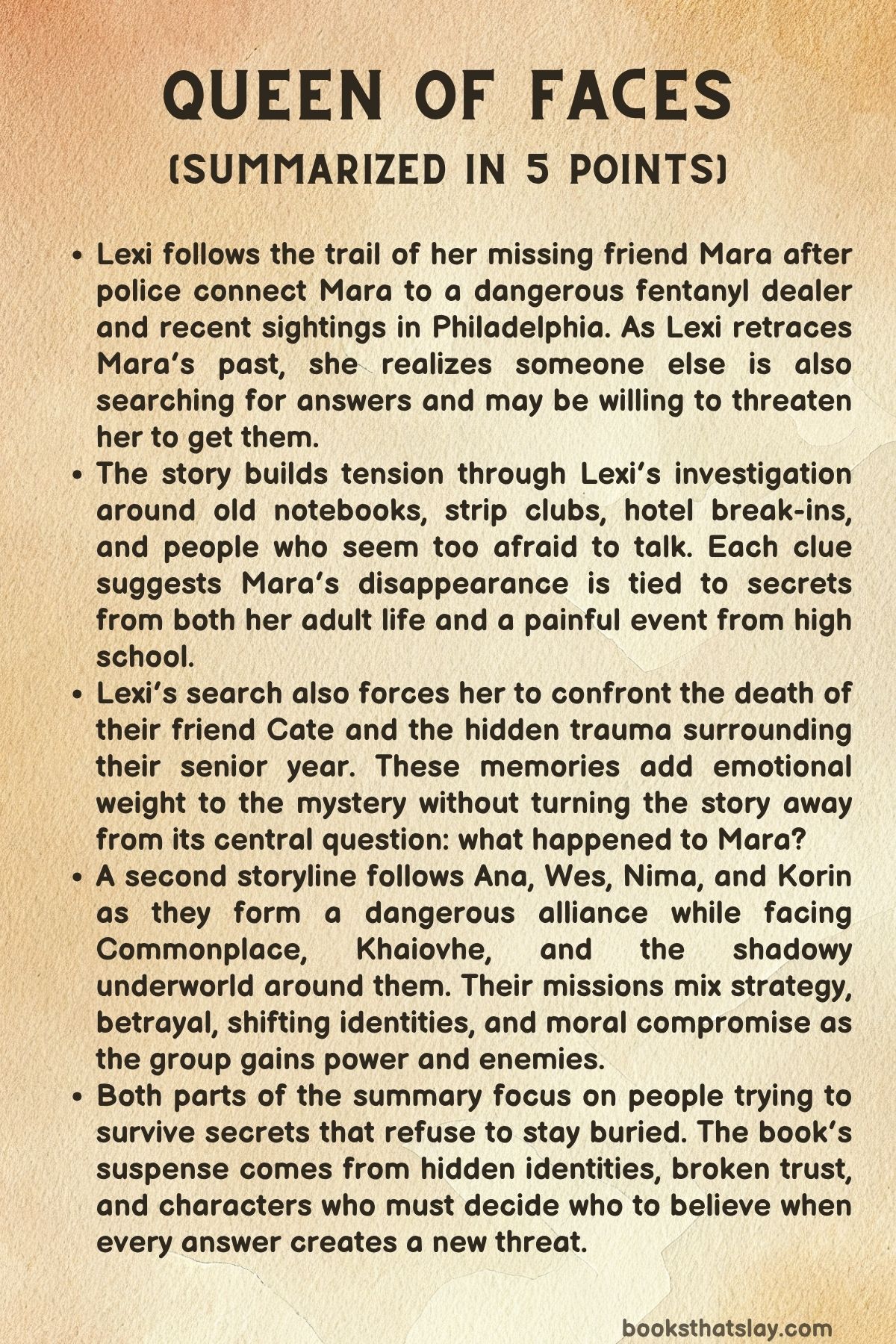
Summary
Queen of Faces follows Anabelle “Ana” Gage, a seventeen-year-old girl living in the harsh nation of Caimor, where the body has become a commodity. In this world, a person’s true self exists in the Pith, the seat of consciousness, soul, and magic.
The Pith can be removed from one body and placed into another, allowing the rich to change bodies for beauty, status, health, or pleasure. These bodies, known as chassis, are a privilege of wealth.
For Caimor’s elite, changing form is fashion. For the poor, it is a matter of life and death.
Ana is trapped at the bottom of this system. After losing her home and becoming gravely ill, her Pith was placed inside an Edgar chassis, one of the cheapest replacement bodies available.
Edgars are grey, low-quality, male-coded bodies, and Ana, who is a girl, is forced to live in a form that feels wrong in every possible way. Her chassis is also defective and rotting from within.
Doctors give her only a year unless she can obtain a better body. For Ana, survival and bodily autonomy are the same goal: she needs a body that will let her live and let her exist as herself.
Her best chance is Paragon Runic Academy, Caimor’s elite magic school. Students accepted into Paragon receive resources, training, protection, and access to superior bodies.
Ana is not wealthy, but she is gifted. She has a rare talent for Whisper magic, the blue school of magic tied to psychic influence, illusion, and subtle control over perception.
She studies obsessively, using the Whisper Codex to strengthen her abilities and sharpen her mind. Her frail Edgar body limits her physically, so she survives through strategy, deception, and magical precision.
The entrance exam for Paragon is brutal, lasting more than a day and designed to test applicants beyond exhaustion. Ana gives everything she has, believing that her talent should be enough.
But when the results arrive, she is rejected. The rejection crushes her not only because it denies her education, but because it may have sentenced her to death.
The delay in the letter’s arrival makes the rejection even more bitter, emphasizing how little the system cares about people like her.
Desperate and furious, Ana decides that if Caimor will not give her a body, she will steal one. She uses her Whisper abilities to attempt a heist, targeting an expensive star-woven chassis that could save her life.
The plan fails. Ana is caught by Nicholas Carriwitch, the powerful and calculating headmaster of Paragon Runic Academy.
Instead of turning her over immediately, Carriwitch reveals that he has been watching her. He knows she has extraordinary potential, and he sees a use for her.
Carriwitch offers Ana a terrible choice. She can be executed for her crime, or she can work for him in secret.
If she obeys him and completes his missions, he will give her the body she needs. Ana has no real freedom in the decision.
Her failing chassis leaves her cornered, and Carriwitch understands this perfectly. He recruits her not as a student, but as a weapon.
Ana is pulled into a dangerous world of covert missions, political violence, and mercenary work. She joins a small crew of talented but damaged people operating under Carriwitch’s command.
Among them is Weston “Wes” Brown, an exiled noble and assassin trying to win back the life he lost. Wes comes from privilege, but he has been cast out and forced into survival.
He and Ana clash from the start. Ana sees him as arrogant and entitled, while Wes sees her as reckless and difficult.
Their tension grows from hostility into reluctant trust as they are forced to rely on each other during deadly assignments.
Carriwitch’s central target is Khaiovhe, known publicly as the Black Wraith. The government and elite media describe her as a terrorist responsible for destruction and death.
She leads a rebel faction called Commonplace, also known as the Black Arrows, and uses weapons such as Voidsteel bullets and Darkfire explosives. Ana is told that killing the Black Wraith will protect Caimor and secure her own future.
As Ana and her allies investigate, the official story begins to break apart. Her Whisper magic allows her to uncover hidden thoughts, buried fears, and secrets that powerful people want erased.
She learns that Khaiovhe was once Sophie, a member of the Eldritch Guard, one of the regime’s own elite protectors. Sophie defected after discovering a horrific truth: the Caimorian government has been operating secret camps to imprison, experiment on, and eliminate the Shenti people.
This revelation changes everything for Ana. Her mother was Shenti, and Ana has always lived with the burden of being both poor and racially marginalized in a society that values elite Caimorian blood, wealth, and magic.
The regime that offers to save her body is also built on the suffering and murder of people like her mother’s family. The chassis economy, the academy, and the military order are not separate systems; they are connected parts of one structure that treats some bodies as precious and others as disposable.
Ana begins to understand that Sophie is not the simple villain Caimor claims she is. The Black Arrows are violent, but their violence comes from desperation against a state that hides its own brutality behind law and order.
Sophie has used explosions and attacks to expose and destroy evidence of genocide. The government has blamed her for atrocities in order to protect itself and turn public fear against the rebellion.
Ana is now trapped between survival and conscience. Carriwitch can give her a new body, the one thing she needs most.
But accepting his bargain means helping the same power structure that destroys the Shenti and controls the poor. Her dream of reaching safety through Paragon is exposed as part of the lie Caimor sells to people beneath the elite: work hard, obey, prove yourself, and you may be allowed to live.
Ana’s own rejection proves that merit is never enough when the system is designed to preserve privilege.
The conflict erupts into open unrest. Protests led by the Black Arrows spread through the streets, and Caimor becomes a battlefield of magic, smoke, fire, and political rage.
Ana must decide whether to complete her mission or turn against Carriwitch. Her decision is complicated by the world’s body-swapping technology, which makes identity itself unstable.
Faces can no longer be trusted. Allies and enemies can wear stolen bodies, and physical appearance becomes another tool of manipulation.
In the climax, Ana’s greatest strength is not brute force but perception. She must look past bodies and read the truth of the Pith beneath them.
Her Whisper magic, her knowledge of illusion, and her growing understanding of power help her survive betrayals and false appearances. The final conflicts test everything she believes about identity, loyalty, and freedom.
By the end of Queen of Faces, Ana is no longer merely a desperate girl trying to avoid death. She has seen the machinery behind Caimor’s beauty, wealth, and immortality, and she understands the cost paid by the poor and the oppressed.
Her fight for a body of her own expands into a larger fight against a world that decides whose bodies matter. The novel closes with Ana changed by survival, betrayal, rebellion, and self-recognition, leaving her ready to challenge the forces that tried to use her as a pawn.
Characters
Anabelle “Ana” Gage
Anabelle “Ana” Gage is the emotional and moral center of Queen of Faces, a protagonist shaped by desperation, intelligence, dysphoria, and political awakening. She lives in an Edgar chassis, a cheap, male-coded, defective body that denies her both comfort and identity.
Her struggle is not only about staying alive; it is about claiming a body that reflects who she is at the level of her Pith. Ana’s brilliance lies in her ability to survive through thought rather than strength.
Because her body is weak and decaying, she learns to depend on Whisper magic, illusion, manipulation of perception, and careful reading of people. This makes her both vulnerable and dangerous.
She is not written as a flawless rebel from the beginning. At first, her goal is personal survival, even if that means breaking the law or working for a corrupt institution.
Her arc becomes powerful because she slowly recognizes that her private suffering is connected to a much larger system of oppression. The same world that traps her in a dying body also treats the Shenti as disposable and protects the rich through violence.
Ana’s growth comes from understanding that freedom cannot be fully personal if it depends on ignoring the suffering of others.
Nicholas Carriwitch
Nicholas Carriwitch functions as one of the book’s most chilling portraits of institutional power. As the headmaster of Paragon Runic Academy, he represents education, refinement, magical mastery, and elite authority, but beneath that polished surface is a ruthless strategist who views people as tools.
His Praxis magic reinforces his role in the story because it is tied to intellect, self-control, and calculation. Carriwitch does not need to appear openly monstrous to be dangerous; his cruelty is controlled, articulate, and practical.
He sees Ana’s talent clearly, but he does not reward it through fairness. Instead, he waits until she is desperate, criminalized, and cornered, then offers her survival in exchange for obedience.
This makes him more than a villainous authority figure. He is the face of a system that knows exactly how gifted people from the lower classes can be used without ever being truly accepted.
In Queen of Faces, Carriwitch’s manipulation exposes the false promise of meritocracy. He does not want Ana to rise as an equal.
He wants her to serve as a weapon while believing she has been given a chance.
Weston “Wes” Brown
Weston “Wes” Brown is a character caught between privilege and punishment. As an Ousted noble, he knows the comforts of elite life, but he has been thrown out of that world and forced into the dangerous margins of Caimor.
His exile gives him a complicated position in the story. He is not oppressed in the same way Ana is, because his background still carries the memory and assumptions of class privilege.
Yet he is also not secure, because his fall has made him dependent on Carriwitch’s missions. Wes begins as brooding, physical, impulsive, and trained for violence, which contrasts with Ana’s reliance on mental discipline and illusion.
Their tension comes from class resentment as much as personality. Ana sees in him the arrogance of someone who once belonged to the world that excluded her, while Wes sees in Ana a reckless survivor who threatens the fragile path he believes might restore him.
Over time, their relationship becomes more layered because both are being used by the same machinery of power. Wes’s arc is important because it shows how privilege can be lost without producing immediate moral clarity.
He must learn that reclaiming status is not the same as becoming free.
Ori
Ori serves as a rare source of steadiness and humane connection within the brutal environment surrounding Paragon Academy. Unlike characters who see Ana only as a tool, threat, servant, or mistake, Ori responds to her with a degree of respect and friendship.
This makes Ori important not because they dominate the plot through power, but because they reveal what ordinary kindness can mean in a world built on hierarchy. Ori’s treatment of Ana, while she is known publicly as David, gives her a space where she is not only evaluated by usefulness or status.
In a novel where identity is constantly distorted by chassis, class expectations, and political propaganda, Ori’s presence offers a quieter form of resistance: the refusal to participate in cruelty simply because the institution permits it. Ori also helps balance the story’s darker forces.
Characters like Carriwitch manipulate, Wes clashes, and Sophie radicalizes the political stakes, but Ori reminds the reader that solidarity can begin in smaller gestures. Their role suggests that oppression survives not only through violence, but also through everyday cowardice, and that standing beside someone at the right moment can carry real moral weight.
Khaiovhe “Sophie” / The Black Wraith
Khaiovhe, also known as Sophie and the Black Wraith, is one of the most morally charged figures in Queen of Faces. At first, she appears through the language of state propaganda: terrorist, murderer, extremist, threat.
The power of her character lies in how that image collapses once the truth emerges. Sophie was once part of the Eldritch Guard, meaning she belonged to the very structure she later fights.
Her rebellion is not born from ignorance of the system, but from intimate knowledge of its crimes. After discovering the secret camps used against the Shenti, she chooses defection and violence over complicity.
This makes her both heroic and unsettling. She is not a gentle symbol of justice; she uses Voidsteel bullets, Darkfire, and organized rebellion.
The book uses her to ask whether moral purity is possible under a genocidal state. Sophie’s actions cause fear and destruction, but the regime’s quiet violence is far worse and far more hidden.
Her character forces Ana to question the difference between terrorism and resistance when those labels are controlled by the powerful. Sophie is dangerous because she has abandoned the comfort of innocence, and the story treats that choice with seriousness rather than easy approval.
Clementine
Clementine represents the casual cruelty of privilege in a society where bodies have become status objects. She is not described as a central villain, but her presence matters because she embodies the everyday normality of the chassis economy.
While Ana is trapped in a cheap, rotting Edgar body, Clementine proudly displays a pristine fabricated body as though it were an accessory. This contrast makes her a symbol of the emotional violence produced by wealth.
She does not need to personally design the system in order to benefit from it. Her comfort depends on the same economy that leaves people like Ana desperate, humiliated, and dying.
Clementine’s importance lies in how ordinary she seems within Caimor’s elite culture. Her behavior shows that oppression is not maintained only by headmasters, admirals, and soldiers.
It is also maintained by fashionable indifference, by people who treat another person’s deepest need as a luxury they themselves can enjoy without thought. Through Clementine, the book sharpens its critique of class privilege.
She reminds the reader that inequality becomes especially cruel when the privileged mistake their advantages for normal life.
Vice Admiral Rentis / Ebbridge
Vice Admiral Rentis, also identified with the name Ebbridge, represents the militarized arm of Caimor’s oppression. Where Carriwitch embodies institutional manipulation through education and elite patronage, Rentis or Ebbridge represents state violence more directly.
This character is associated with the hidden machinery behind the persecution of the Shenti, especially the camps that expose the regime’s genocidal logic. The importance of this figure comes from the way official power hides atrocity beneath order, rank, and national security.
A vice admiral is not merely an individual villain; the title itself suggests command, bureaucracy, and sanctioned force. Through this character, the story shows how mass violence depends on administration.
Camps do not exist by accident. They require planning, secrecy, guards, documents, chains of command, and leaders willing to treat targeted people as problems to be removed.
Rentis or Ebbridge also helps explain why Sophie’s rebellion becomes so extreme. Against a state that has already chosen extermination, polite resistance may no longer be possible.
This character’s role is therefore essential to the novel’s political conflict, because they reveal the true face of Caimor beneath its refined magical society.
Ana’s Mother
Ana’s Shenti mother is not presented as an active central figure in the events described, but her presence shapes Ana’s identity and the moral force of the book. Through her, Ana is connected to a persecuted people whose suffering is not abstract or distant.
The revelation of the Shenti camps matters to Ana not only as political information, but as a personal wound. Her mother’s heritage places Ana inside the violence of Caimor’s racial order, even when Ana is also struggling with her own body and survival.
This connection complicates Ana’s choices. She cannot treat the regime’s crimes as someone else’s tragedy once she understands that the same contempt aimed at the Shenti has always shaped the conditions of her life.
Ana’s mother also gives emotional depth to the novel’s treatment of mixed identity. Ana is caught between Caimorian and Shenti inheritance, but the dominant society does not allow that complexity to protect her.
Instead, it marks her as lesser. Even in absence, her mother’s identity becomes a source of truth, reminding Ana that survival without memory or loyalty can become another form of surrender.
Ana’s Father
Ana’s Caimorian father is important because he places Ana within two unequal worlds at once. Through him, she has a connection to the dominant society, but that connection does not grant her real safety or acceptance.
Her mixed background exposes the limits of belonging in Caimor. The society may recognize elite Caimorian identity as valuable, but Ana’s poverty, Shenti heritage, trans identity, and failing chassis override any partial claim she might have to legitimacy.
Her father’s side of her identity therefore sharpens the book’s interest in hierarchy. Ana is not simply outside Caimor; she is partly of it, which makes her exclusion more painful and more revealing.
The world she seeks entry into through Paragon is not foreign to her, yet it treats her as unworthy. This tension helps explain why Ana initially wants access rather than revolution.
She has been taught that survival may come from entering elite structures, proving herself, and earning recognition. Her arc later challenges that belief, but her father’s Caimorian connection helps establish why the promise of acceptance has such power over her in the first place.
Themes
Bodily Autonomy and the Right to Selfhood
The chassis system turns the body into property, fashion, medical treatment, and social currency all at once. For the wealthy, this creates freedom without consequence: they can change bodies for beauty, longevity, pleasure, or status.
For Ana, the same system becomes a prison. Her Edgar chassis is not merely uncomfortable; it is an attack on her sense of self, because it forces her to live in a male-coded form while knowing herself to be female.
The decay of the chassis intensifies this conflict by making her body both alien and fatal. Her need for a new body is not vanity, and the novel makes that distinction clear.
She is fighting for survival, dignity, and the ability to exist honestly. Queen of Faces uses this premise to examine bodily autonomy as something controlled by wealth, law, medicine, and political power.
Ana’s condition reflects how cruel a society becomes when it treats the right body as a privilege rather than a basic human need. The story also criticizes the elite’s empty version of freedom.
Their endless body-swapping looks liberating, but it depends on an economy that denies people like Ana even one livable form.
Class Privilege and the False Promise of Merit
Paragon Runic Academy appears to offer a path upward through talent, discipline, and achievement, but Ana’s rejection exposes the lie beneath that promise. She is gifted, hardworking, and powerful, yet none of that is enough because the system is not designed to reward merit fairly.
It is designed to preserve control. Carriwitch’s later interest in Ana proves that her talent was never invisible.
The elite saw her ability, but they had no desire to welcome her as an equal. She becomes valuable only when she can be used secretly, dangerously, and without public recognition.
This reveals one of the story’s sharpest criticisms of class structure: institutions often praise excellence while denying opportunity to those who lack the correct background, money, body, or obedience. The chassis economy deepens this theme because even physical survival is tied to wealth.
Rich people can purchase health and beauty, while poor people rot in defective bodies. Class privilege is therefore not just about comfort; it determines whose life can be extended, whose identity can be honored, and whose suffering can be ignored.
Ana’s journey shows how easily ambition can become a trap when the ladder upward belongs to the people standing above you.
State Violence, Propaganda, and Rebellion
Caimor’s government survives by controlling not only bodies, but also stories. Sophie is introduced to the public as the Black Wraith, a terrorist figure blamed for chaos and civilian suffering.
That image allows the state to present itself as protector while hiding its own crimes against the Shenti. The discovery of the camps destroys the moral simplicity of the official narrative.
The regime’s violence is systematic, secretive, and bureaucratic, while the rebellion’s violence is visible, explosive, and easy to condemn. This contrast forces the reader to question how power defines legitimacy.
When the state imprisons and eliminates a people in silence, and rebels respond with force, the language of law and order becomes suspect. Sophie’s character does not make rebellion clean or painless.
Her methods are frightening, and the story does not erase the danger of political violence. Instead, it asks what choices remain when peaceful truth has been buried by those with armies, academies, and media power.
The Black Arrows become a response to a society where justice has no official channel. The theme is powerful because it refuses to confuse calm with innocence or disorder with evil.
Identity, Appearance, and the Unreliability of Faces
A world where bodies can be exchanged cannot treat appearance as truth. Faces, gender presentation, beauty, age, and physical strength can all be purchased, stolen, assigned, or faked.
This makes identity one of the novel’s central conflicts. Ana knows better than anyone that the body others see may not reflect the self within.
Her Pith carries her true identity even when her chassis misrepresents her. At the same time, the body-swapping system creates political and personal danger because anyone can hide behind another form.
Trusting the face becomes a weakness. The climax uses this idea dramatically, as characters exploit chassis exchange to impersonate, deceive, and attack.
Beneath the action, however, the theme is deeply emotional. The story separates identity from surface while still insisting that the surface matters because people are forced to live through their bodies.
Ana’s desire for a fitting body is valid precisely because the inner self and outer form are not casually interchangeable for everyone. The elite pretend bodies are costumes because they have endless choices.
Ana understands that a body can be home, prison, weapon, disguise, or death sentence, depending on who controls it.