Stolen Midnights Summary, Characters and Themes
Stolen Midnights by Katherine Quinn is a fantasy romance about privilege, stolen power, family corruption, and the painful search for truth. Set in Aurilia, a society where magical gifts are treated as signs of divine approval, the story follows Wren Hayes after her expected gift fails to arrive on her eighteenth birthday.
Her shame soon turns into suspicion when she learns the gift was stolen by Damien, a thief from the neglected district called the Void. As Wren and Damien are forced into an uneasy alliance, they uncover secrets tied to the Fates, missing gifts, and Wren’s powerful father.
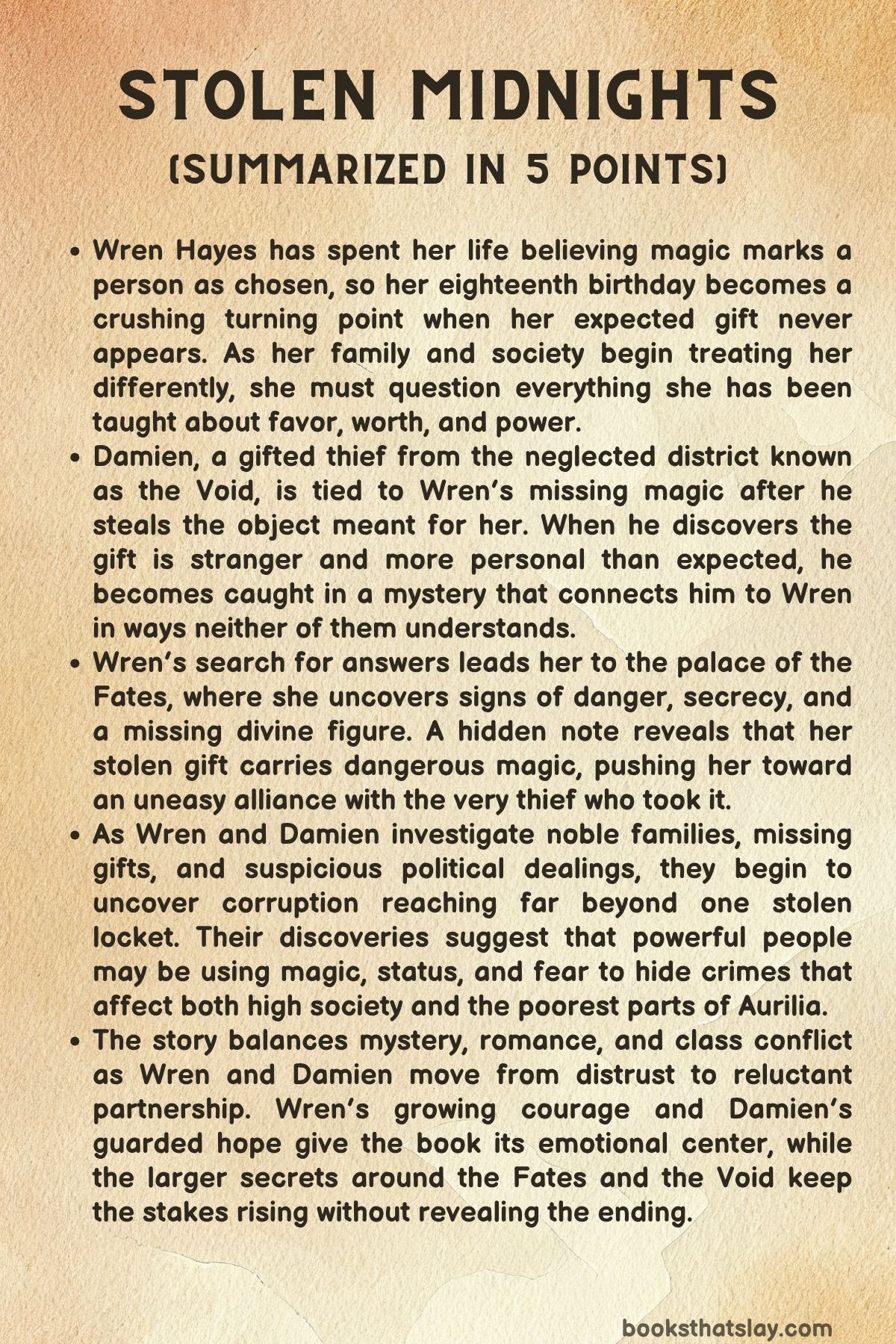
Summary
Wren Hayes has always believed that magic marks a person as chosen. In Aurilia, every citizen waits for their eighteenth birthday, when the Fates send a magical object through one of their black hounds.
The gift a person receives can shape their future, status, and sense of worth. Wren comes from a family known for powerful blessings.
Her father, Cameron Hayes, owns a persuasive pen that helped him rise as Representative of Ward One. Her mother, Lenore, has enchanted dancing slippers, while her sister Callie has earrings that can influence emotions.
Surrounded by such gifts, Wren expects her own midnight arrival to prove she belongs.
But midnight comes, and no hound appears. Wren searches the house in panic, then runs into the garden, unable to accept what has happened.
Her family’s quiet pity only deepens her humiliation. In a world where gifts are treated as divine approval, being giftless feels like a public curse.
Wren fears she has become the shame of the Hayes family.
What Wren does not know is that her gift did arrive. Damien, a thief from the poor southern district known as the Void, intercepted the Fate’s hound and stole the blue box meant for her.
Damien has a magical object of his own: a mirror that makes him invisible. He does not understand why someone from the Void received a gift, since people like him are rarely treated as worthy.
He plans to sell Wren’s stolen gift to a mysterious buyer, but when he opens the box, he finds a silver locket. Inside it is a photograph of himself.
Disturbed by this discovery, Damien refuses to hand it over and keeps it.
Wren’s disgrace follows her into society. At the season’s opening ball at the Lovett mansion, people who once accepted her now avoid her or whisper behind her back.
She meets Ruby, who seems friendly, but later retreats into the garden after overhearing cruel gossip. There, she bumps into Lord Everett Sinclair.
A supposed waiter appears to clean up the spilled drink, but Wren notices that he has stolen Everett’s magical watch. She chases him through the garden and discovers the thief is Damien.
Wren tackles him in the mud and threatens him with a letter opener, even injuring him before he escapes over the fence with Ruby’s help. Damien later realizes the locket is missing from his pocket.
He suspects Wren took it during their fight, though Wren knows nothing about it.
Seeking answers, Wren goes to the palace of the Fates to ask why her gift never came. The guards unexpectedly allow her inside, but instead of taking her to Day, they send her to Dusk’s garden.
There, Wren finds tea laid out and a folded note marked with her initials. Before she can read it properly, she notices blood on the pavilion floor and signs that someone has been dragged away.
An alarm sounds, and Wren runs, terrified that she will be blamed for Dusk’s disappearance.
In the woods, Wren reads the note. Dusk reveals that Wren’s intended gift was made from Dusk’s own dangerous magic and that it was stolen.
The note tells her to find someone cunning and deceptive enough to recover it, someone Dusk has already placed in her path. Wren understands that this means Damien.
She destroys the note as instructed, then lets the guards find her while pretending to be a frightened noblewoman who fainted.
At the guard station, Wren is questioned about Dusk’s disappearance. Damien hears that guards are looking for a highborn girl and sneaks inside using his mirror.
While invisible, he confronts Wren and accuses her of taking something from him. She denies it.
Damien notices that his mirror works perfectly near Wren but weakens when she leaves, suggesting that their magic is linked. Wren’s father arrives and secures her release, angry about the scandal.
Wren now knows that her gift exists, that Dusk is missing, and that Damien is tied to both mysteries.
Their uneasy partnership grows more complicated at another ball. Damien interrupts Wren’s dance with Everett after seeing them nearly kiss.
Wren introduces Damien under his false noble identity, but Everett becomes suspicious. Damien pulls Wren into a dance, and their irritation turns into charged closeness.
As they dance, they discuss possible suspects connected to missing gifts and Dusk’s disappearance, including Lizzy Saridon, Adrian Hockley, and Olivia Waterstone.
During the ball, Wren and Damien see Cameron Hayes leaving with Lord Hockley and follow them. Damien uses his mirror, and to their surprise, Wren becomes invisible with him.
This proves she can share his magic. They sneak into Hockley’s study and overhear Cameron threatening Hockley for failing to satisfy Day.
Cameron implies that Adrian’s missing gift was a warning and mentions plans to visit Day that night before going somewhere important the next day. Wren is shaken by the possibility that her father’s actions may have caused her own gift to disappear.
While Hockley rages nearby, Damien comforts Wren, and their closeness leads to a passionate kiss. Afterward, Damien is frightened by the depth of his feelings and pulls away coldly.
When the rose Wren had tucked into his jacket withers into ash, Damien realizes dark magic may be involved.
Wren is hurt by Damien’s sudden distance. She thinks about the kiss, her father’s cruelty, and the lie that he searched the Registry for her gift.
Callie visits and reveals that she has been handling irregular shipments for their father. She suspects Cameron is deliberately blocking aid meant for the Void.
Wren tries to tell her what she overheard, but Cameron summons Callie away before she can explain.
As Wren investigates further, she studies a mysterious blue book about the Fates. The book suggests that Dusk, not Day, may have created the first gift.
A pressed red poppy falls from its pages, adding another strange clue. Wren also searches her parents’ room and finds her mother’s magical dancing shoes hidden away.
When her mother briefly returns home, she treats Wren coldly, making Wren feel more alone. Later, Wren reads about Dusk’s reapers and notices an illustration showing shoes, a goblet, and a necklace, which seems important.
Damien keeps coming to Wren’s window to apologize, but she refuses to let him in. She tells him their partnership is over and that she will investigate alone.
Damien, guilty and worried, starts looking into the original buyer of Wren’s locket. He spots the buyer’s carriage outside the Broken Wing Tavern and asks Ruby to check inside.
Ruby finds nothing suspicious, but after she leaves, Damien has a horrifying vision of her dead on a metal table, similar to other visions that have troubled him. Before he can act, a hooded figure stabs him.
Badly wounded, Damien makes his way across the city to Wren’s window. Wren pulls him inside, stitches his wound, cleans him, and stays beside him through the night.
In his fever, Damien admits that he likes her and sees her as safety, light, and hope. When he wakes, they speak more honestly.
He thanks her for saving him, admits their kiss mattered, and tells her more about his life, his struggle to survive, and his dream of starting over in the west. Wren admits she is struggling to accept that her father may be a villain.
Damien comforts her but later leaves another note and sneaks away, frustrating her again.
Grayson Hockley then visits Wren and reveals that he saw her leaving his father’s study. He suspects his father is involved in corrupt dealings and shows her a note signed by Cameron Hayes demanding “fifty more souls” to repay a debt.
Grayson says his father goes to the docks at midnight and asks for Wren’s help. She agrees.
That night, Wren and Damien break into Lizzy Saridon’s home. Though they argue over Damien’s habit of leaving, their attraction remains strong.
In Lord Saridon’s study, Wren finds hidden papers inside a rug. The documents show that Saridon falsely claimed a lost shipment and received a threatening note from Cameron about failing to deliver the required amount.
Wren realizes her father has been blackmailing powerful families and that Lizzy’s missing gift may have been punishment.
The truth overwhelms Wren. The father she once trusted is tied to missing gifts, corrupt bargains, and suffering in the Void.
Damien comforts her and reminds her that she is not responsible for Cameron’s crimes. Before they part, he gives her a book about flowers and their meanings, a quiet gesture that begins to mend the hurt between them.
Through stolen magic, dangerous secrets, and a bond neither of them expected, Wren and Damien move closer to uncovering the truth behind Dusk’s disappearance and the dark forces controlling Aurilia.
Characters
Wren Hayes
Wren Hayes is the central character of Stolen Midnights, and her journey begins with humiliation, rejection, and a deep crisis of identity. She has grown up in Aurilia believing that magic is not only power but proof of divine approval, so when no hound appears on her eighteenth birthday, she does not simply feel disappointed; she feels spiritually condemned.
Her family’s history of blessed gifts makes her apparent giftlessness even more painful because she sees herself as the first failure in a perfect line. This moment exposes how much of Wren’s confidence has been shaped by society’s approval, her father’s expectations, and the belief that worth must be confirmed by the Fates.
Wren’s character becomes stronger because she refuses to remain passive after her public disgrace. Although she is hurt by society’s cruelty, she does not collapse into helplessness.
She chases Damien after recognizing him as a thief, goes to the palace to demand answers, reads Dusk’s hidden note, and begins investigating the mystery of her stolen gift. Her courage is not effortless; it often comes through fear, anger, and desperation.
This makes her bravery feel more human. She is not fearless, but she acts even when she is terrified.
A major part of Wren’s development comes from learning that the world she trusted is corrupt. Her father, who once represented authority and family pride, becomes connected to blackmail, missing gifts, debts, and possibly the suffering of people in the Void.
This forces Wren to separate herself from the values she inherited. Her pain is especially intense because she wants to believe in her family, yet the evidence against Cameron grows stronger.
Wren’s emotional conflict gives her depth: she is not only solving a mystery but also grieving the collapse of the life she thought she knew.
Wren’s relationship with Damien reveals another side of her personality. With him, she is sharp, defensive, proud, vulnerable, and drawn to danger all at once.
Their connection begins through theft and distrust, but it becomes emotionally charged because both of them understand rejection in different ways. Wren’s ability to share Damien’s invisibility suggests that her magic and destiny are tied to his, but their bond is not only magical.
Damien sees in her a kind of light and safety, while Wren sees in him a person who is far more wounded and loyal than he first appears. Through Damien, Wren becomes less bound by class prejudice and more willing to confront the injustice around her.
Damien
Damien is one of the most morally complex figures in the book. He is introduced as a thief from the Void, someone who steals magical objects and survives by deception, but the story quickly shows that his criminality is shaped by poverty, exclusion, and desperation.
Unlike the wealthy Aurilians, Damien has not been protected by privilege. His invisibility mirror is both a practical tool and a symbol of his social position: he is someone the powerful would rather not see, yet he moves through their world more perceptively than they realize.
His decision to steal Wren’s gift sets much of the plot in motion, but his reaction to the locket complicates his role. When he opens the box and finds his own photograph inside, he becomes unsettled rather than greedy.
He refuses to sell the locket, which shows that he is not merely a selfish thief. He understands that the gift is connected to him in a way he cannot explain.
This moment reveals one of Damien’s strongest traits: beneath his sarcasm and survival instincts, he is deeply sensitive to fate, mystery, and emotional danger.
Damien’s emotional guardedness is central to his character. He is drawn to Wren but repeatedly pulls away because intimacy frightens him.
After their kiss, he abandons her coldly, not because he feels nothing, but because he feels too much. His fear of attachment comes from a life in which survival has depended on not needing anyone.
Yet his actions constantly betray his care for Wren. He risks entering the guard station to confront her, comforts her when she learns more about her father, returns to her window even after she rejects him, and eventually reaches her when he is wounded because she has become his place of safety.
His visions, his connection to the locket, and the weakening of his mirror away from Wren all suggest that Damien is tied to a larger magical design. He is not simply Wren’s accomplice or romantic interest; he is one of the keys to understanding the stolen gift, Dusk’s disappearance, and the deeper corruption in Aurilia.
Damien’s power of invisibility also reflects his inner struggle. He hides from guards, nobles, and emotional honesty, but the story gradually forces him to become visible, especially to Wren and to himself.
Cameron Hayes
Cameron Hayes is one of the most powerful and threatening characters in the novel. As Representative of Ward One, he represents public authority, political success, and the polished respectability of Aurilian high society.
His magical pen, which gives him persuasive power, fits his personality perfectly because his influence depends on control, manipulation, and the ability to make others obey or believe him. At first, he appears to be a stern but important father, but the story gradually reveals a darker figure beneath the public image.
Cameron’s treatment of Wren exposes his cruelty in intimate ways. After she appears to be giftless, he is furious not simply because she is suffering, but because her situation threatens the family’s reputation.
His anger over scandal matters more to him than his daughter’s fear and humiliation. This shows that his love, if it exists, is deeply conditional.
He values status, obedience, and usefulness, and Wren’s apparent rejection by the Fates makes her inconvenient to him.
His connection to Hockley, Saridon, missing shipments, and the phrase “fifty more souls” makes him one of the central figures in the wider corruption of Aurilia. Cameron seems to use fear and debt to control other powerful families, and his dealings may be linked to the punishment of children through missing gifts.
This makes him frightening because his villainy is not impulsive; it is organized, political, and hidden behind respectability. He benefits from a system that treats magic as divine favor while secretly exploiting those below him.
Cameron also functions as a symbol of the false moral order Wren must reject. She was raised to believe her family was blessed because it was worthy, but Cameron’s actions prove that blessing and goodness are not the same.
His character forces Wren to confront the possibility that the world’s most honored people may be the most corrupt. In that sense, Cameron is not only an antagonist but also the embodiment of Aurilia’s hypocrisy.
Lenore Hayes
Lenore Hayes is Wren’s mother, and although she appears less directly involved in the central crimes than Cameron, her emotional distance makes her an important figure in Wren’s isolation. Lenore possesses enchanted dancing slippers, a gift that suggests beauty, grace, performance, and social elegance.
Yet those shoes are hidden away, which hints that her own relationship with magic, marriage, and public life may be more complicated than it first seems.
Lenore’s cold treatment of Wren is painful because Wren needs comfort from her mother after the disaster of her eighteenth birthday. Instead, Lenore responds with distance.
This makes Wren feel even more abandoned within her own home. Lenore’s behavior suggests a woman who has either accepted the family’s harsh values or learned to survive by withdrawing emotionally.
She may not be as openly domineering as Cameron, but her silence still wounds Wren.
Her hidden shoes may also carry symbolic importance. They connect her to the recurring imagery of magical objects and possibly to Dusk’s reapers, since Wren later notices an illustration involving shoes, a goblet, and a necklace.
Lenore may therefore represent a hidden part of the mystery that has not yet fully surfaced. Even when she is not physically present, her gift and her emotional absence shape Wren’s understanding of the Hayes household.
Lenore’s character is marked by restraint and secrecy. She does not explain herself, does not protect Wren openly, and does not offer the warmth Wren longs for.
This makes her unsettling in a quiet way. She may be complicit, powerless, afraid, or all three, but her role in the family dynamic shows how emotional neglect can be as damaging as open cruelty.
Callie Hayes
Callie Hayes is Wren’s sister and one of the more sympathetic members of the Hayes family. Her magical earrings allow her to influence emotions, which gives her a subtle but powerful ability.
This gift suits her position in society because she seems to operate within the expectations placed on her while also becoming aware that something is wrong beneath the surface. Unlike Cameron, Callie does not simply enjoy power; she begins to question the work she is being asked to do.
Callie’s importance grows when she reveals that she has been handling irregular shipments for their father and suspects he is deliberately blocking help meant for the Void. This shows that she is not blind to corruption.
Although she has benefited from the Hayes name and its privileges, she is beginning to recognize that her father’s actions may be harming vulnerable people. Her suspicion also helps Wren understand that Cameron’s wrongdoing is not limited to private cruelty; it has political and social consequences.
As Wren’s sister, Callie provides a brief but meaningful possibility of trust within the Hayes family. Wren tries to tell her what she overheard, which shows that she still wants connection and support.
However, Cameron’s interruption prevents full honesty between them, reminding the reader how tightly he controls the household. Callie’s presence therefore highlights both the possibility of family loyalty and the danger of family control.
Callie is also interesting because her gift involves emotions, yet her own emotional position is uncertain. She may be compassionate, conflicted, and frightened by what she knows.
Her role suggests that she could become an ally to Wren, but she is still trapped within Cameron’s influence. This tension makes her character important even when she is not at the center of the action.
Ruby
Ruby is a lively and ambiguous character whose friendliness makes her stand out in a society that quickly turns against Wren. At the Lovett ball, she seems kinder than many of the other guests, offering Wren a moment of social relief when most people treat her as ruined.
This first impression makes Ruby appear approachable and warm, especially in contrast to the cruel gossip surrounding Wren.
However, Ruby’s later role in helping Damien escape complicates her. She is connected to Damien’s world and appears willing to assist him, suggesting that her friendliness may not be entirely simple.
She moves between social spaces in a way that makes her useful and unpredictable. Ruby may be loyal to Damien, but she also seems capable of hiding her intentions when needed.
Damien’s vision of Ruby dead on a metal table gives her character a darker significance. Until that moment, she may seem like a supporting figure in Damien’s network, but the vision suggests she could become a victim of the same violent forces tied to Dusk’s disappearance, stolen gifts, and dangerous magic.
This turns Ruby from a side character into someone who may be deeply vulnerable within the larger conspiracy.
Ruby’s character works because she carries both charm and uncertainty. She represents friendship, street-level survival, and danger all at once.
Her connection to Damien shows that he is not completely alone, while the threat surrounding her reminds the reader that the mystery reaches beyond Wren and Damien’s romance.
Lord Everett Sinclair
Lord Everett Sinclair represents the polished, respectable world Wren was expected to belong to. He is a nobleman, socially acceptable, and connected to the kind of future Wren might have imagined before her gift was stolen.
His near-kiss with Wren suggests that he may have genuine interest in her, or at least that he offers a version of romance that fits within society’s rules.
Everett’s role becomes especially important because of how Damien reacts to him. Damien’s jealousy during Wren’s dance with Everett reveals the depth of Damien’s feelings before he is ready to admit them.
Everett therefore functions partly as a romantic contrast. He represents safety, status, and public approval, while Damien represents danger, secrecy, and emotional intensity.
At the same time, Everett is not shown as foolish. He becomes suspicious when Wren introduces Damien under a false noble identity, which suggests that he is observant.
His suspicion may make him a potential obstacle for Wren and Damien, especially because their investigation depends on lies and concealment. Everett belongs to the world they are trying to deceive, and his awareness could become dangerous.
Everett’s character adds tension because he is not simply a romantic rival. He is a reminder of the life Wren is leaving behind.
The more she becomes involved with Damien and the truth about Aurilia, the less compatible she becomes with the neat social future Everett represents.
Grayson Hockley
Grayson Hockley is important because he shows that corruption among the powerful families does not mean every child of those families is corrupt. Like Wren, he appears to be trapped inside a household shaped by secrecy and wrongdoing.
His father is connected to Cameron Hayes and dangerous dealings, but Grayson does not blindly protect him. Instead, he seeks Wren’s help because he suspects something is deeply wrong.
His decision to approach Wren after seeing her leave his father’s study shows both intelligence and courage. He does not dismiss what he saw, and he does not pretend that family loyalty should matter more than truth.
By showing Wren the note demanding “fifty more souls,” Grayson helps confirm that the conspiracy is larger than one family. He becomes a source of evidence and a possible ally.
Grayson’s character also mirrors Wren’s position. Both are children of powerful fathers.
Both are forced to confront the possibility that their families are involved in cruelty. This parallel makes Grayson more than a convenient helper; he represents another young person trying to break away from inherited corruption.
His presence suggests that the next generation may not be willing to preserve the lies of the old one.
Although Grayson’s role is quieter than Damien’s, he adds moral balance to the story. He proves that nobility does not automatically equal villainy, just as Damien proves that poverty and theft do not erase goodness.
Through Grayson, the book complicates its social world and avoids making class identity too simple.
Dusk
Dusk is one of the most mysterious and significant figures in Stolen Midnights. As one of the Fates, Dusk should seem distant, divine, and untouchable, but the blood in the garden and the hidden note reveal vulnerability and danger.
Dusk’s disappearance changes the entire direction of the story because it suggests that even the beings who control magical gifts can be attacked, threatened, or silenced.
Dusk’s note to Wren reveals that Wren’s intended gift was made from Dusk’s own dangerous magic. This immediately sets Wren apart from ordinary Aurilians.
Her missing gift is not a simple accident or social embarrassment; it is part of something rare and powerful. Dusk’s instruction that Wren find someone cunning and deceptive enough to retrieve it also shows that Dusk understands Damien’s importance and has deliberately placed him in Wren’s path.
Dusk’s character is associated with secrets, danger, and hidden truth. While Aurilian society seems to value Day most openly, Wren’s discoveries suggest that Dusk may have played a much deeper role in the origin of magical gifts.
This challenges the official version of history and makes Dusk a figure of suppressed power. The blue book, the pressed red poppy, and the references to Dusk’s reapers all deepen the sense that Dusk’s influence has been hidden or misunderstood.
Even while absent, Dusk drives the plot. The mystery of what happened in the garden, why Wren’s gift was dangerous, and why Dusk trusted Wren and Damien shapes the central investigation.
Dusk is not merely a divine background figure but a force whose choices may expose the truth behind Aurilia’s magic.
Day
Day appears as one of the Fates and represents the bright, official, publicly honored side of Aurilian belief. Cameron’s connection to Day is especially important because it suggests that the political corruption in Aurilia may be tied to divine or semi-divine authority.
When Cameron threatens Hockley for failing to satisfy Day, Day becomes associated not only with blessing but with debt, punishment, and fear.
This makes Day a disturbing figure. In a society that treats magic as divine favor, Day should symbolize justice, order, and approval.
Instead, the references to Day suggest that the system of gifts may be far more corrupt than ordinary people believe. If powerful families are trying to satisfy Day through shipments, souls, or other hidden payments, then the divine structure of Aurilia may be built on exploitation.
Day’s importance also lies in contrast to Dusk. Wren initially expects to approach Day’s part of the palace, but she is directed to Dusk’s garden instead.
This shift suggests that the truth Wren needs is not found in the most publicly celebrated source of power, but in the darker, more secretive one. Day therefore represents the official story, while Dusk represents the hidden truth.
Although Day does not appear directly in the provided events, the character’s shadow hangs over the conspiracy. Day may be a true antagonist, a manipulated authority, or a misunderstood force, but the fear surrounding Day makes this Fate central to the political and magical mystery.
Dawn
Dawn is the least directly developed of the three Fates in the provided events, but Dawn remains important because the Fates together form the foundation of Aurilian society. Dawn, Day, and Dusk are believed to send magical gifts through black hounds on each person’s eighteenth birthday, which means Dawn is part of the divine structure that determines status, identity, and opportunity.
Dawn’s relative absence is meaningful because it leaves questions about balance among the Fates. Day appears connected to power and obligation, while Dusk appears connected to hidden danger and forbidden truth.
Dawn may represent another side of the magical order that has not yet been fully revealed. The lack of direct information about Dawn creates uncertainty about whether all three Fates are equally involved in Aurilia’s corruption or whether the system has been distorted by one faction.
As a symbolic figure, Dawn suggests beginnings, birth, and possibility. This matters in a story centered on eighteenth birthdays and the beginning of magical adulthood.
Every gift marks a new social identity, and Dawn’s association with beginnings may connect to the hope people place in the gift ceremony. However, Wren’s stolen gift exposes how fragile and manipulated that hope can be.
Dawn’s character currently functions more as part of the world’s sacred structure than as an individual personality. Still, Dawn’s presence in the triad of Fates is essential because the mystery of the gifts cannot be understood through Day and Dusk alone.
Lord Hockley
Lord Hockley is one of the powerful men caught in Cameron Hayes’s web of intimidation. His private meeting with Cameron reveals that he is involved in dealings connected to Day and that he has failed to meet whatever demand has been placed upon him.
His fear and rage after Cameron leaves show that he is not in control, even though he belongs to the ruling class.
Hockley is important because he proves that corruption in Aurilia operates through pressure and debt. He may be guilty, but he is also being threatened.
Cameron uses Adrian’s missing gift as a warning, which suggests that Hockley’s family has already paid a personal price. This makes Lord Hockley morally compromised and vulnerable at the same time.
His study becomes a place where hidden truths surface. Wren and Damien overhear enough to connect missing gifts, Day, Cameron, and powerful families.
Hockley’s role is therefore not only personal but structural. He shows how fear travels through elite households and how public respectability hides private panic.
As a father, Hockley also reflects Cameron. Both men are powerful, secretive, and connected to harm that affects their children.
Grayson’s suspicion of him creates a family conflict that parallels Wren’s conflict with Cameron. Through Lord Hockley, the story expands its critique of parental authority and inherited power.
Adrian Hockley
Adrian Hockley is significant because his missing gift appears to have been used as a warning. Though he is not developed through direct action, the mention of his lost gift places him among the young people harmed by the conspiracy.
His situation suggests that magical gifts can be stolen, blocked, or manipulated as punishment against families.
Adrian’s character matters because he helps Wren understand that her own missing gift may not be unique. At first, Wren experiences her giftlessness as personal shame, but Adrian’s case reveals a pattern.
This shifts the meaning of her suffering from individual rejection to evidence of a larger crime. Adrian becomes part of the hidden group of victims whose lives have been altered by the actions of powerful adults.
He also reveals something about Cameron’s methods. If Adrian’s missing gift was a warning to Lord Hockley, then Cameron or those connected to him are willing to punish children for their parents’ failures.
This makes the conspiracy especially cruel. The young are used as leverage in adult bargains.
Adrian’s role is therefore quiet but important. He represents the unseen damage caused by Aurilia’s corrupt magical politics.
Even without appearing prominently, he helps expose the pattern Wren and Damien must uncover.
Elizabeth “Lizzy” Saridon
Elizabeth “Lizzy” Saridon is another young person connected to the mystery of missing gifts. Like Adrian, she appears to be a victim of the larger conspiracy involving powerful families, failed deliveries, and Cameron’s threats.
Her missing gift may have been punishment for her family’s inability to meet demands, which places her in the same tragic pattern as Wren and Adrian.
Lizzy’s importance grows through Wren and Damien’s break-in at the Saridon home. The hidden documents in Lord Saridon’s study reveal that her family falsely claimed a lost shipment and received a threatening note from Cameron.
This makes Lizzy’s situation more than gossip or coincidence. Her missing gift becomes evidence of blackmail, fear, and punishment.
As a character, Lizzy represents how young women in this world can become bargaining pieces in systems controlled by older men. Her personal future, social standing, and magical identity may have been damaged because of her father’s dealings.
This connects her strongly to Wren, whose own life has been thrown into chaos by forces she did not create.
Lizzy’s role also deepens Wren’s emotional burden. When Wren realizes that her father may be responsible for harming others like Lizzy, she breaks down.
Lizzy therefore becomes part of Wren’s moral awakening. She is not only a clue but a reminder that the conspiracy has real victims.
Olivia Waterstone
Olivia Waterstone is mentioned as a possible suspect connected to the mystery of missing gifts and Dusk’s disappearance. Though little is revealed about her directly, her inclusion among the names Wren and Damien discuss suggests that she belongs to the network of people who may have knowledge of the conspiracy or may have been affected by it.
Her role is important because the investigation is still uncertain. Wren and Damien do not yet know who can be trusted, who is guilty, and who is being used.
Olivia’s name adds to the atmosphere of suspicion surrounding Aurilian high society. In this world, status does not make anyone innocent; it often makes people more likely to be connected to hidden wrongdoing.
Olivia also helps widen the scope of the mystery. The problem is not limited to Wren’s family, Damien’s theft, or one missing gift.
Multiple names, families, and social circles may be involved. Olivia’s presence in the suspect list suggests that the truth may be spread across several households and that Wren must learn to read the behavior of people she once knew socially.
Because Olivia has not yet been fully revealed through action, her character remains open-ended. She may become an antagonist, a victim, a witness, or a misleading suspect.
For now, she functions as part of the uncertainty that drives the investigation forward.
Lord Saridon
Lord Saridon is another example of the compromised elite in the story. His hidden documents reveal that he falsely claimed a lost shipment and then received a threat from Cameron Hayes.
This places him within the same corrupt network as Lord Hockley and shows that Cameron’s influence reaches across multiple powerful families.
Saridon’s actions suggest fear and dishonesty. By hiding documents inside a rug, he shows that he knows the dealings are dangerous and must be concealed.
His false claim about the shipment implies that he is willing to lie, but the threatening note also suggests he may be trapped by obligations he cannot satisfy. Like Hockley, he appears both guilty and pressured.
His importance is tied closely to Lizzy’s missing gift. If her gift was taken or blocked because of her father’s failure, then Lord Saridon’s choices have directly harmed his child.
This strengthens one of the story’s central ideas: the sins of powerful parents are being forced onto their children. Wren’s horror comes from realizing that her father may be one of the people enforcing this punishment.
Lord Saridon expands the conspiracy beyond rumor. His documents provide concrete evidence that Cameron is blackmailing influential families.
Through him, the book shows that corruption is not isolated but systematic.
Themes
Divine Favor and Social Worth
In Stolen Midnights, magic is treated as more than a personal blessing; it becomes the public proof of value, status, and destiny. Wren’s eighteenth birthday exposes how cruel this belief system is, because the absence of a gift instantly changes how others see her.
Society does not ask whether she is intelligent, brave, or kind; it judges her by whether the Fates have marked her as worthy. Her family’s silence wounds her because it confirms the same prejudice inside her own home.
The gift system also protects class inequality, since powerful families use their magic to strengthen their influence while people in the Void are treated as lesser even when they are blessed. Damien’s stolen mirror challenges the official story because his magic proves that divine favor is not limited to the rich or respected.
Through Wren and Damien, the story questions whether worth can ever be decided by sacred symbols, inherited privilege, or public approval.
Power, Corruption, and Hidden Violence
The polished world of balls, noble families, and political titles hides a system built on threats, debt, and exploitation. Cameron Hayes appears respectable because he holds office and owns a persuasive magical pen, yet his influence is tied to fear and manipulation.
His letters demanding souls and punishing families through missing gifts suggest that power in Aurilia is not maintained by law or justice but by secret bargains. The highborn families are not simply elegant social figures; many of them are trapped in corrupt arrangements that connect them to the suffering of poorer districts.
Wren’s investigation forces her to see that comfort and status may be paid for by people who have no protection. This theme becomes especially painful because corruption is not distant from Wren; it lives inside her family.
Her struggle is not only to uncover the truth but to accept that someone she was taught to trust may be responsible for harm on a large scale.
Identity Beyond Family Legacy
Wren begins with a strong need to belong to the Hayes legacy, where each family member’s gift confirms their place in society. When she believes she has been left giftless, she feels not only disappointed but erased, as though her identity depended entirely on the family’s blessed reputation.
Her journey pushes her away from that inherited image and toward a self shaped by choice, courage, and moral judgment. She starts by wanting respect from her family and society, but the mystery around her stolen gift forces her to ask harder questions about what kind of person she wants to become.
Callie’s doubts about their father also show that family loyalty is not the same as moral loyalty. Wren’s pain comes from realizing that love, blood, and duty can conflict with truth.
By choosing to investigate rather than protect her family’s image, she begins to separate herself from the Hayes name and build an identity based on action rather than approval.
Trust, Vulnerability, and Unequal Worlds
The bond between Wren and Damien grows from suspicion, theft, and anger, which makes their trust slow and fragile. They come from opposite sides of Aurilia: Wren has wealth, public standing, and family influence, while Damien has learned to survive through deception, secrecy, and speed.
Their connection matters because neither can fully understand the mystery alone. Wren needs Damien’s cunning and knowledge of the city’s shadows, while Damien needs Wren’s link to the stolen locket and the world of the powerful.
Their shared invisibility becomes a strong symbol of emotional closeness, because it shows that their fates are connected even before they are ready to admit it. Yet trust is repeatedly tested by fear.
Damien runs when his feelings become too real, and Wren pulls back when she feels abandoned. Their relationship shows that vulnerability is risky, especially for people shaped by betrayal, but it also becomes a source of strength in Stolen Midnights.