The Epicenter of Forever Summary, Characters and Themes
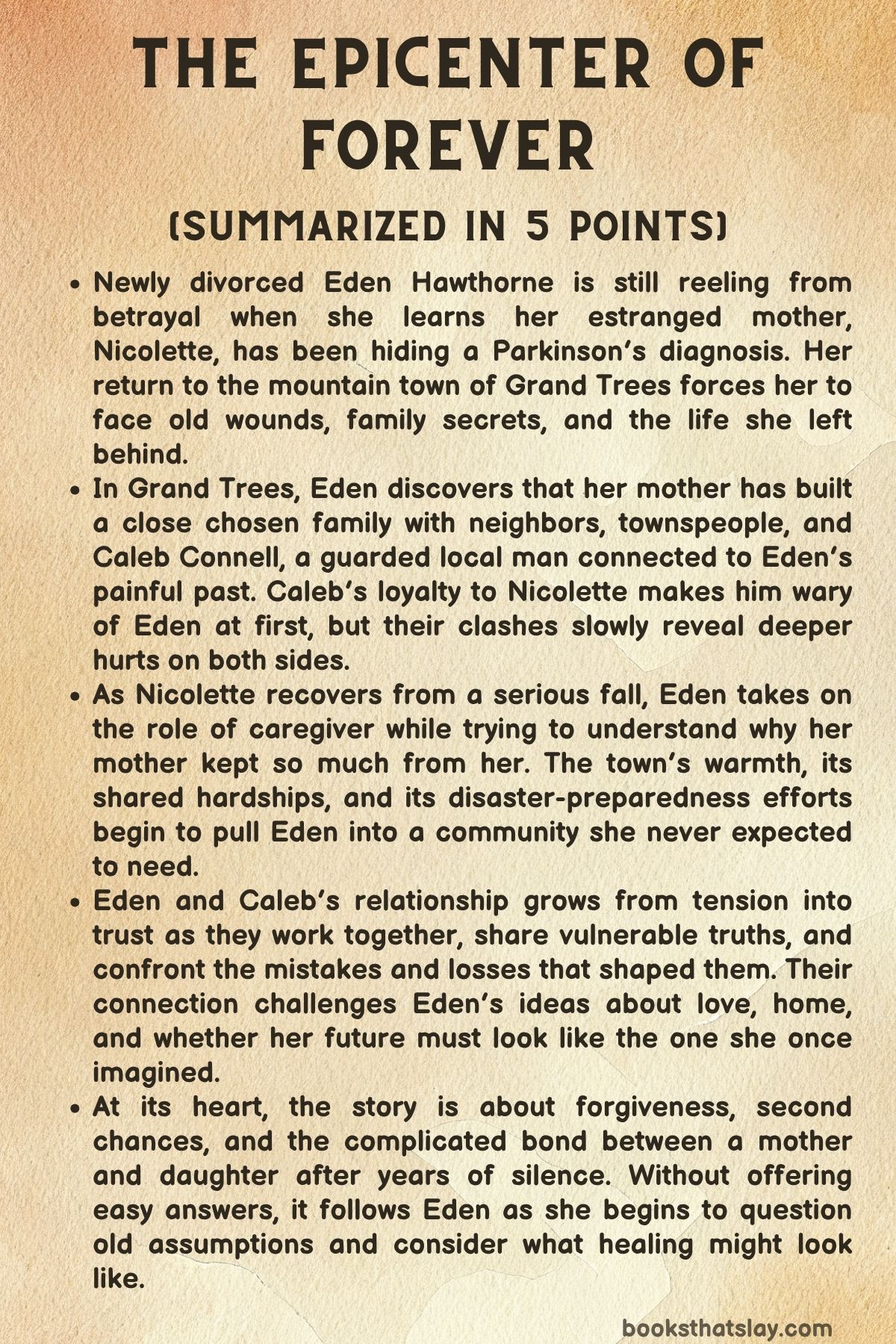
The Epicenter of Forever by Mara Williams is a contemporary romance about family damage, second chances, and the frightening work of letting people care for you. The story follows Eden Hawthorne, a newly divorced woman whose life is already raw when she learns that her estranged mother, Nicolette, has been hiding a Parkinson’s diagnosis.
Eden returns to the mountain town of Grand Trees, expecting duty and old resentment, but finds a community that has claimed her mother as family. Through Nicolette, Caleb, Abby, and the town itself, Eden is forced to face the past she has avoided and reconsider what home can mean.
Summary
Eden Hawthorne is trying to keep herself together after a painful divorce when she sees her ex-husband, Jeff, at a San Francisco café with Nadia, his pregnant girlfriend. The sight lands like a second betrayal.
Eden quickly realizes that Jeff’s relationship with Nadia must have begun before their marriage ended, and the knowledge makes the divorce feel even uglier. Her best friend Cassie reacts with open anger, but Eden works hard to stay calm, even as the scene confirms that the life she thought she was building with Jeff has already been replaced by someone else.
During brunch, Eden receives a call from Adelaide, a neighbor from Grand Trees, the mountain town Eden left behind years ago. Adelaide tells her that Eden’s mother, Nicolette, has Parkinson’s disease and has been refusing treatment.
Eden is shocked, hurt, and angry that Nicolette never told her. Their relationship has been broken for years, ever since Nicolette left Eden’s father for Sonny, a man connected to Eden’s childhood and to the accident that ended Eden’s dream of becoming a ballet dancer.
Still, the news forces Eden to return to Grand Trees.
On the way, Eden stops at Nowhere Saloon, where a drunk tourist named Darren bothers her. A local man steps in and pretends to be with her, saving her from the situation.
He buys her food and disappears before she learns much about him. When Eden reaches Nicolette’s house, she discovers that the man is Caleb Connell, Sonny’s nephew.
Caleb is close to Nicolette and deeply protective of her, which puts him immediately at odds with Eden. He believes Eden abandoned her mother for years, while Eden feels judged by someone who does not understand the old wounds between her and Nicolette.
Inside the house, Eden finds that Nicolette has built a warm life without her. Caleb, his teenage daughter Abby, their chaotic dog Houdini, Adelaide, and many neighbors are part of Nicolette’s everyday world.
Nicolette is thrilled to see Eden and pulls her into family game night as if the years of distance can be set aside. Eden is unsettled by the ease and affection around her mother, because it shows how much she has missed and how much Nicolette has shared with others instead of with her.
The next day, Eden attends an emergency preparedness festival in Grand Trees. The town is isolated and vulnerable to earthquakes, fires, landslides, and blocked roads, so disaster planning is a constant concern.
Eden speaks with Abby and begins to see how much the girl loves Nicolette. She also confronts Caleb about the Parkinson’s diagnosis, and he reveals that Nicolette has known for three years.
Before Eden can absorb the fact that so many people knew before she did, Nicolette falls from the gazebo steps and is taken to the hospital.
Nicolette’s injuries are serious enough to require constant care while she heals. Eden and Caleb both offer help, which leads to another argument over who has the right to care for Nicolette.
Eden insists that she will stay in Grand Trees for three months, and Caleb reluctantly agrees to check on them daily. When Nicolette returns home, the town arrives with food, supplies, and practical help.
Eden begins the difficult work of caregiving while also speaking with her father, whose pain over Nicolette’s departure is still alive.
As Eden settles into Grand Trees, she and Caleb continue to clash, but their tension slowly changes. Caleb takes Eden to Camp Colibri, a summer camp tied to Eden’s childhood, because Adelaide has pushed them to work together on funding for disaster prevention and camp improvements.
During a storm and a small earthquake, Eden, Caleb, and Houdini become trapped overnight in a maintenance cabin. Forced into close quarters, Eden and Caleb talk more honestly than they have before.
Eden opens up about her lost ballet career and the injury that changed her future, while Caleb shares pieces of his past, his failed marriage, and his own regrets.
Their attraction grows after they are rescued, though Eden tries to deny it. She argues with Nicolette about treatment and suggests that Nicolette move to San Francisco, but Nicolette refuses.
Caleb takes Eden on a walk so she can cool down, and they kiss near the house. The kiss shakes both of them because it is not casual, and because Eden is supposed to leave when her caregiving commitment ends.
During an awkward evening with Nicolette and Abby, Eden tries to hide what happened, but it becomes clear that she no longer wants to avoid Caleb.
Eden’s feelings become more complicated when she sees social media posts from Nadia showing Jeff with their newborn baby. The images hurt because they show the marriage, child, and future Eden once believed would be hers.
Caleb finds her in this state and takes her to an overlook near Grand Trees Lake. There, he speaks honestly about his marriage to Lina, Abby’s mother.
He explains that they married because Lina became pregnant, but they were never truly suited for each other. When Lina later fell in love with Ian, Caleb felt hurt, guilt, and relief all at once.
His honesty helps Eden look at her own marriage differently. Maybe she and Jeff had not been right for each other either.
The emotional closeness turns physical, and Eden and Caleb sleep together in his truck. Afterward, Caleb admits he wants more than secrecy and confusion, though they agree to keep the relationship private for Abby’s sake, for Nicolette’s sake, and because Eden is still expected to return to San Francisco.
Over the following days, Eden becomes more involved in the rhythm of Grand Trees. She, Caleb, and Abby spend evenings at Nicolette’s house while working on grant applications.
Nicolette and Eden begin to repair their relationship in small, cautious ways. Nicolette apologizes for resisting Eden’s help and admits that she does not want to become a burden.
Eden, in turn, begins to soften, though she still wants her mother to take her illness seriously. Caleb and Eden continue stealing kisses, even at Nowhere Saloon, where Adelaide catches them and teases them.
Adelaide quietly creates an opportunity for them to spend Saturday together, and Cassie encourages Eden to stop overthinking and allow herself something good after Jeff’s betrayal.
Caleb takes Eden to Camp Colibri, where he shows her a mural of Sonny. Eden’s anger over Sonny and Nicolette’s affair remains strong, and Caleb’s loyalty to Sonny causes friction between them.
Still, Caleb also gives Eden something important: a chance to try the ropes course she had wanted to do as a child. Terrified but determined, Eden climbs, crosses the course, and jumps while Caleb belays her.
The experience gives her a rush of courage and trust. Afterward, Caleb takes her to the cottage he built with Sonny.
The home is small, safe, and full of care, including Abby’s messy, happy room. Eden and Caleb become intimate again, and Caleb tells her he does not want her to leave Grand Trees.
As weeks pass, Eden’s bond with Caleb deepens, and her relationship with Nicolette improves. Nicolette thanks Eden for staying, and Eden asks her again to consider treatment.
Nicolette admits that her doctor made the disease sound hopeless, but she agrees to think about seeking another appointment. Eden begins to believe that she and her mother might truly find their way back to each other.
That fragile hope is tested when Eden’s father calls with his own research and insists that Nicolette should move to San Francisco. He still thinks of Nicolette as his wife, even after everything, and his unresolved grief frustrates Eden.
Nicolette overhears Eden saying that her mother left because she no longer wanted their family, and the old conflict finally breaks open. Nicolette tells Eden that after Eden’s accident, Eden and her father shut her out for a year.
Eden insists that Nicolette abandoned them. Both women speak from years of pain.
Eden reveals how rejected she felt, while Nicolette explains that she left because she felt hated, broken, and unable to survive in that house.
After the confrontation, Eden runs outside, and Caleb follows. She finally tells him the full story of the accident.
As a child, she snuck out during camp, saw Nicolette and Sonny together, ran away in shock, fell in the dark, and later revealed the affair from her hospital bed. Eden has carried guilt for years, believing her actions helped destroy her family and her own future.
Caleb reassures her that she was a child, not the cause of everyone else’s choices. His comfort helps Eden begin to separate her injury from blame, and her mother’s choices from her own worth.
By this point, The Epicenter of Forever has become a story about more than Eden’s return home. It is about a woman facing the ruins of the life she expected, the truth of the family she lost, and the possibility that love can arrive through honesty rather than perfection.
Grand Trees, with all its danger, gossip, care, and stubborn loyalty, becomes the place where Eden must decide whether she can forgive the past without denying it, accept love without controlling its ending, and imagine a future that is different from the one she once planned.
Characters
Eden Hawthorne
Eden Hawthorne is the emotional center of The Epicenter of Forever, and her journey is built around betrayal, grief, anger, guilt, and the difficult work of healing. At the beginning of the book, she is newly divorced and still trying to hold herself together after the collapse of her marriage to Jeff.
Seeing him with Nadia, pregnant with his child, forces Eden to realize that her marriage may have been built on deeper dishonesty than she had allowed herself to admit. This moment wounds her pride and her sense of security, but it also pushes her toward the larger emotional reckoning waiting for her in Grand Trees.
Eden is not simply a woman recovering from divorce; she is someone who has spent years trying to survive by staying away from the place where her childhood broke apart.
Her return to Grand Trees reveals how much unresolved pain she still carries toward Nicolette. Eden’s anger at her mother is not shallow resentment but the result of feeling abandoned at the moment she most needed comfort.
The accident that ended her ballet dreams is tied directly to the discovery of Nicolette and Sonny’s affair, so Eden’s physical injury, emotional trauma, and family collapse are all fused together in her memory. This makes her guarded and defensive, especially when she sees how deeply Caleb, Abby, Adelaide, and the town love Nicolette.
Eden feels displaced in her own mother’s life, as though strangers have taken the place that once belonged to her.
As the story develops, Eden becomes more compassionate without losing her complexity. Caring for Nicolette forces her to see her mother not only as the woman who left, but also as a frightened, ill, aging person who has built a fragile life out of pain and survival.
Eden’s relationship with Caleb also helps her confront the idea that not every broken relationship can be understood in simple terms of villain and victim. Through Caleb, she begins to question whether her marriage to Jeff was ever truly right, and through Nicolette, she begins to understand that abandonment can sometimes come from despair rather than lack of love.
Eden’s growth lies in her willingness to stay, listen, care, and finally admit how deeply she has been hurt.
Nicolette Hawthorne
Nicolette Hawthorne is one of the most layered and painful figures in the book. At first, she appears through Eden’s wounded memory as the mother who betrayed her family and left after the accident.
Because Eden’s childhood was shattered by Nicolette’s affair with Sonny, Nicolette initially seems like a source of damage rather than comfort. Yet when Eden returns to Grand Trees, the story reveals a more complicated woman: someone living with Parkinson’s disease, refusing treatment out of fear, pride, and hopelessness, while still trying to preserve the independence and dignity she has left.
Nicolette’s found family in Grand Trees shows that she is loving, valued, and deeply connected to the people around her. Caleb, Abby, Adelaide, and the townspeople do not treat her as a scandalous figure from Eden’s past; they treat her as someone who has earned their loyalty.
This contrast forces Eden to confront the possibility that her mother’s life did not stop at the moment of betrayal. Nicolette became part of a community, offered affection to Abby, and created bonds that sustained her when her relationship with Eden remained broken.
Her confrontation with Eden is especially important because it reveals that Nicolette’s departure was not as emotionally simple as Eden believed. Nicolette felt shut out after Eden’s accident, hated by her daughter and husband, and unable to survive inside a home filled with grief and blame.
This does not erase the harm she caused, but it gives emotional depth to her choices. Nicolette is a character shaped by guilt, illness, love, and fear.
Her refusal of treatment reflects both denial and exhaustion, while her gradual openness to Eden’s care suggests that she still wants connection, even if she does not always know how to ask for it.
Caleb Connell
Caleb Connell is introduced as a protective, rugged local man who rescues Eden from an uncomfortable situation at Nowhere Saloon, but his role quickly becomes much deeper. He is loyal to Nicolette, devoted to Abby, and emotionally tied to Grand Trees in a way that makes him suspicious of Eden’s sudden return.
His hostility toward Eden comes from his belief that she abandoned Nicolette for years, leaving others to care for her. This makes Caleb appear judgmental at first, but his anger comes from fierce protectiveness rather than cruelty.
Caleb is also a man who has lived through romantic disappointment without becoming bitter. His past with Lina and Ian shows emotional maturity, because although he was hurt by the end of his marriage and by Lina’s relationship with Ian, he can still recognize that he and Lina were not truly right for each other.
This honesty helps Eden rethink her own marriage and see that Jeff’s betrayal does not necessarily mean she lost a perfect life. Caleb’s ability to hold pain and acceptance at the same time becomes one of his most attractive qualities.
His relationship with Eden is built through conflict, vulnerability, physical attraction, and emotional trust. The storm, the earthquake, the cabin, the ropes course, and their private moments all reveal different sides of him: practical, tender, teasing, passionate, and deeply rooted.
Caleb wants Eden to stay, but he also understands that her life in San Francisco and her responsibilities to Nicolette complicate everything. He represents not an escape from Eden’s pain, but a possible future built on honesty, courage, and belonging.
Abby Connell
Abby Connell brings warmth, youth, and emotional clarity to the story. As Caleb’s teenage daughter, she is caught between households and family arrangements, yet she remains openhearted and perceptive.
Her affection for Nicolette shows how important Nicolette has become in the life of the town and especially in Caleb’s family. Abby does not see Nicolette through the lens of past betrayal; she sees her as a loving, familiar presence who gives comfort and stability.
Abby also helps Eden understand Caleb more fully. Through Abby, Eden sees Caleb not only as an attractive and frustrating man, but as a devoted father whose life is shaped by care and responsibility.
Abby’s desire to spend more time at Caleb’s house because it feels more like home reveals her emotional honesty. She is young, but she understands where she feels safe, loved, and accepted.
Her interactions with Eden soften the emotional atmosphere of the book. Abby’s presence prevents the story from focusing only on adult regret and romance; she represents the next generation and the possibility that family can be remade in healthier forms.
She also adds stakes to Eden and Caleb’s relationship, because their secrecy is partly motivated by the need to protect Abby from confusion or disappointment.
Jeff
Jeff is important because he represents the life Eden thought she had and the future she believed she was building. His appearance at the café with pregnant Nadia is emotionally devastating because it confirms that his betrayal was not only romantic but also deeply humiliating.
Eden realizes that Nadia was likely part of Jeff’s life before the marriage ended, making her divorce feel even more painful and dishonest.
Although Jeff is not emotionally present in Grand Trees, his shadow follows Eden there. The images of him with Nadia and their newborn child force Eden to grieve the marriage, children, and security she imagined for herself.
He becomes less of a romantic rival and more of a symbol of Eden’s broken expectations. His betrayal pushes her to question whether she truly lost the right life or whether she had been clinging to a version of happiness that was never real.
Jeff’s role in the book is not to grow or redeem himself, but to expose the emptiness of Eden’s old life. Through him, Eden begins to separate humiliation from heartbreak and betrayal from destiny.
He wounds her, but he also indirectly clears the path for her to rediscover who she is outside of marriage.
Nadia
Nadia is a small but significant presence in The Epicenter of Forever because she embodies the reality of Jeff’s betrayal. As Jeff’s pregnant girlfriend and former physical therapist, she represents the life that replaced Eden’s marriage.
Eden does not know Nadia deeply, but that almost makes Nadia more painful as a figure, because she exists mainly as proof that Jeff moved on before Eden was allowed to understand what had truly happened.
Nadia’s pregnancy intensifies Eden’s grief. The baby is not only Jeff’s child; it is the visible sign of the future Eden thought she might have had.
When Eden sees Nadia’s social media posts, the pain becomes fresh again. Nadia’s happiness with Jeff and their newborn forces Eden to confront envy, loss, and the fear that she has been left behind.
Still, Nadia is not presented as the central villain. Her function in the story is emotional rather than moral.
She helps reveal Eden’s insecurity and heartbreak, while also pushing Eden toward a deeper understanding of what she actually wants. Through Nadia, Eden faces the difference between the life she imagined and the life that may still be possible.
Cassie
Cassie is Eden’s loyal best friend and one of the clearest sources of emotional support in the book. Her angry confrontation with Jeff shows that she is protective, outspoken, and unwilling to let Eden’s pain go unanswered.
Where Eden tries to remain composed, Cassie expresses the fury Eden may not yet be able to fully show. This makes her an important contrast to Eden’s restraint.
Cassie also serves as a grounding voice when Eden becomes overwhelmed by her feelings for Caleb. Instead of encouraging Eden to retreat into fear, Cassie urges her to experience joy and desire without immediately turning everything into a problem to solve.
This advice matters because Eden is used to protecting herself through control, distance, and overthinking.
Her presence reminds the reader that Eden is not entirely alone, even before she repairs her relationship with Nicolette or grows closer to Caleb. Cassie represents chosen friendship, loyalty, and the kind of blunt love that helps Eden face uncomfortable truths.
She may not be central to the Grand Trees community, but she is central to Eden’s emotional survival.
Adelaide
Adelaide is a neighbor, caretaker figure, and community organizer whose influence reaches far beyond her first phone call to Eden. By contacting Eden about Nicolette’s Parkinson’s disease, Adelaide becomes the person who sets the central reunion in motion.
She understands that Nicolette cannot continue without help, even if Nicolette herself refuses to admit it.
Adelaide is practical, observant, and gently meddlesome in the best sense. She helps organize support for Nicolette, brings the town together, and later notices the attraction between Eden and Caleb.
Her teasing response to catching them together shows her warmth and humor, but it also reveals her emotional intelligence. She sees what is happening before Eden and Caleb are ready to speak openly about it.
In the larger life of Grand Trees, Adelaide represents community care. She is one of the people who proves to Eden that Nicolette has not been living in isolation, but in a network of affection and responsibility.
Her role is maternal without replacing Nicolette, wise without becoming solemn, and helpful without being passive.
Sonny
Sonny is mostly present through memory and legacy, but he has a powerful impact on the story. He was the man Nicolette left Eden’s father for, making him central to Eden’s childhood trauma and her anger toward her mother.
For Eden, Sonny is connected to betrayal, the accident, the end of her ballet dreams, and the collapse of her family.
Yet the book complicates Sonny through Caleb’s memories and the mural at Camp Colibri. To Caleb, Sonny was not merely the man involved in an affair; he was family, a builder, a mentor, and someone whose presence shaped the camp and Caleb’s home.
This difference in perspective forces Eden to confront how one person can be remembered in completely different ways by different people.
Sonny’s importance lies in how he divides memory. To Eden, he belongs to the worst night of her childhood.
To Caleb, he belongs to love, craftsmanship, and belonging. He remains absent, but the emotional consequences of his choices continue to shape the living characters.
Eden’s Father
Eden’s father is a wounded and complicated figure whose grief never fully ended. His reaction to Nicolette’s illness reveals that he still feels connected to her, even after years of separation and pain.
When he says that Nicolette is still his wife, it shows that he has not emotionally released the marriage, even though the family has long been fractured.
His relationship with Eden is shaped by shared hurt. Eden absorbed much of his grief after Nicolette left, and together they formed a version of the past in which Nicolette was the one who abandoned them.
However, Nicolette later reveals that both Eden and her father shut her out after the accident, creating a more complicated picture. Eden’s father is therefore both a victim of betrayal and someone whose pain contributed to the emotional environment that drove Nicolette away.
He represents the danger of grief becoming frozen in place. His desire to move Nicolette to San Francisco may come from concern, guilt, or lingering love, but it also ignores Nicolette’s own life in Grand Trees.
Through him, the story explores how love can remain even after damage, but also how unresolved pain can distort care into control.
Lina
Lina, Caleb’s ex-wife, is important because she helps reveal Caleb’s emotional maturity and the realistic nature of his past. Her marriage to Caleb began after she became pregnant with Abby, which suggests that their relationship was shaped by responsibility as much as romance.
Caleb’s admission that they were never truly right for each other makes Lina part of a larger theme: not every ended relationship is a failure in the same way.
Lina’s later relationship with Ian could have made her a source of bitterness, but the story uses her differently. Through Caleb’s reflections, Lina becomes evidence that love can change form and that people can move toward better-fitting lives, even if the transition hurts.
Caleb’s ability to remain friendly with Ian shows that he has processed the situation with unusual honesty.
Lina also matters because of Abby. Even though Lina is not shown as deeply as Caleb or Eden, her choices affect Abby’s sense of home and belonging.
Her presence helps create the family structure in which Abby is learning where she feels most secure.
Ian
Ian is connected to Caleb’s past and to the emotional complexity of blended relationships. As the man now with Lina, Caleb’s ex-wife, Ian could easily have been positioned as an enemy.
Instead, Caleb’s friendship with him shows that the book is interested in emotional nuance rather than simple rivalry.
Ian’s role becomes especially meaningful when Eden asks Caleb how he can remain friendly with him. Caleb’s answer helps Eden understand that relationships can end for reasons more complicated than betrayal alone.
Ian therefore becomes part of the conversation that allows Eden to reinterpret her marriage to Jeff and question whether compatibility, not just loyalty, matters.
Ian also participates in the rescue after Eden and Caleb are trapped, which places him within the helpful network of Grand Trees. He is not defined by romantic conflict alone.
Instead, he belongs to the wider community that acts when people are in danger.
Darren
Darren is a minor character, but his scene at Nowhere Saloon is useful because it introduces Caleb as protective and capable. As a drunken tourist who bothers Eden, Darren represents the kind of immediate, physical discomfort that Eden faces before she has reentered the emotional chaos of Grand Trees.
His behavior creates a moment in which Caleb steps in without needing to know Eden’s full story.
Darren’s role is brief, but it establishes the first dynamic between Eden and Caleb: she is guarded and alone, while he intervenes with quiet confidence. This encounter also contrasts outsiders and locals.
Darren is intrusive and careless, while Caleb understands the space, the people, and the need to protect someone without making a spectacle of it.
Houdini
Houdini, Caleb’s unruly dog, adds humor, chaos, and warmth to the book. His behavior creates awkward moments, especially when he embarrasses Eden, but he also helps soften the tension between characters.
In a story filled with illness, divorce, betrayal, and old wounds, Houdini brings physical comedy and everyday messiness.
He also reflects Caleb’s home life. Caleb’s world is not polished or controlled; it is lived-in, affectionate, unpredictable, and full of responsibility.
Houdini becomes part of the atmosphere that draws Eden toward Caleb’s life. He is not merely comic relief, because his presence helps make Grand Trees feel tangible and domestic.
Through Houdini, the story gives Eden moments where she cannot maintain perfect composure. That matters because Eden often tries to protect herself through control.
Houdini disrupts that control in harmless, funny ways, allowing vulnerability to enter before Eden is ready to name it.
Themes
Healing After Betrayal
Eden’s emotional wound begins with Jeff’s betrayal, but her pain quickly expands beyond the divorce. Seeing Jeff with Nadia and their child forces her to face the loss of the future she imagined for herself: a stable marriage, motherhood, and a sense of being chosen.
In The Epicenter of Forever, betrayal is not treated as one event that can be neatly blamed on one person. Eden slowly recognizes that her marriage to Jeff may have been fragile even before his affair, just as her family had been damaged long before Nicolette left.
This theme gains depth because Eden’s healing does not come from pretending the betrayal did not matter. It comes from understanding that betrayal can distort memory, identity, and self-worth.
Through Caleb’s honesty about his own failed marriage, Eden begins to see that endings are not always proof of personal failure. They can also reveal truths that were hidden by routine, fear, or denial.
Mother-Daughter Estrangement and Forgiveness
Eden and Nicolette’s relationship carries years of silence, anger, and misunderstanding. Eden believes her mother abandoned the family after the affair, while Nicolette reveals that she felt rejected, blamed, and emotionally trapped after Eden’s accident.
Their conflict is painful because both women are partly right, yet neither has had the full truth. Eden’s return to Grand Trees forces them into daily closeness, where caregiving becomes more than a duty.
It becomes a difficult form of communication. Nicolette’s illness makes avoidance impossible, but forgiveness does not arrive easily.
Eden still has to confront the childlike hurt of feeling unwanted, and Nicolette has to admit that her choices caused lasting damage. The strength of this theme lies in its refusal to make reconciliation simple.
Love exists between them, but it has been buried under years of resentment. Their progress depends on listening without immediately defending themselves, which allows old wounds to become speakable.
Found Family and Community Support
Grand Trees becomes a place where family is not defined only by blood, marriage, or history. Nicolette has built a life surrounded by Adelaide, Caleb, Abby, and neighbors who show up with food, cleaning supplies, care, and practical help.
For Eden, this is unsettling at first because she sees these people as replacements for the family Nicolette left behind. Over time, she begins to understand that this community did not erase her; it helped Nicolette survive.
Caleb’s protectiveness, Abby’s affection, and Adelaide’s steady involvement show how chosen family can provide stability when traditional family structures fail. This theme is especially important because Eden arrives feeling isolated by divorce and old grief.
The town’s warmth challenges her guarded independence and reminds her that needing others is not weakness. In The Epicenter of Forever, community is shown through action rather than sentiment.
People cook, drive, repair, check in, organize, argue, and stay. Care becomes visible through presence.
Trust, Risk, and Beginning Again
Eden’s relationship with Caleb grows through conflict, vulnerability, and the gradual rebuilding of trust. At first, Caleb represents everything Eden resents about Grand Trees: Nicolette’s new life, Sonny’s legacy, and the years Eden missed.
Yet he also becomes someone who sees her clearly without reducing her to her past. Their connection deepens when Eden shares the truth about the accident and Caleb refuses to let her blame herself for adult choices made around her.
The ropes course captures this theme strongly because Eden must trust Caleb with her safety while facing a fear tied to childhood loss. Her jump becomes more than a physical act; it marks her willingness to move beyond the version of herself shaped by injury, abandonment, and divorce.
Beginning again does not mean Eden forgets what happened. It means she allows herself to want love, home, and courage without demanding certainty first.
Trust becomes a choice made while fear is still present.