The Ex-Perimento Summary, Characters and Themes
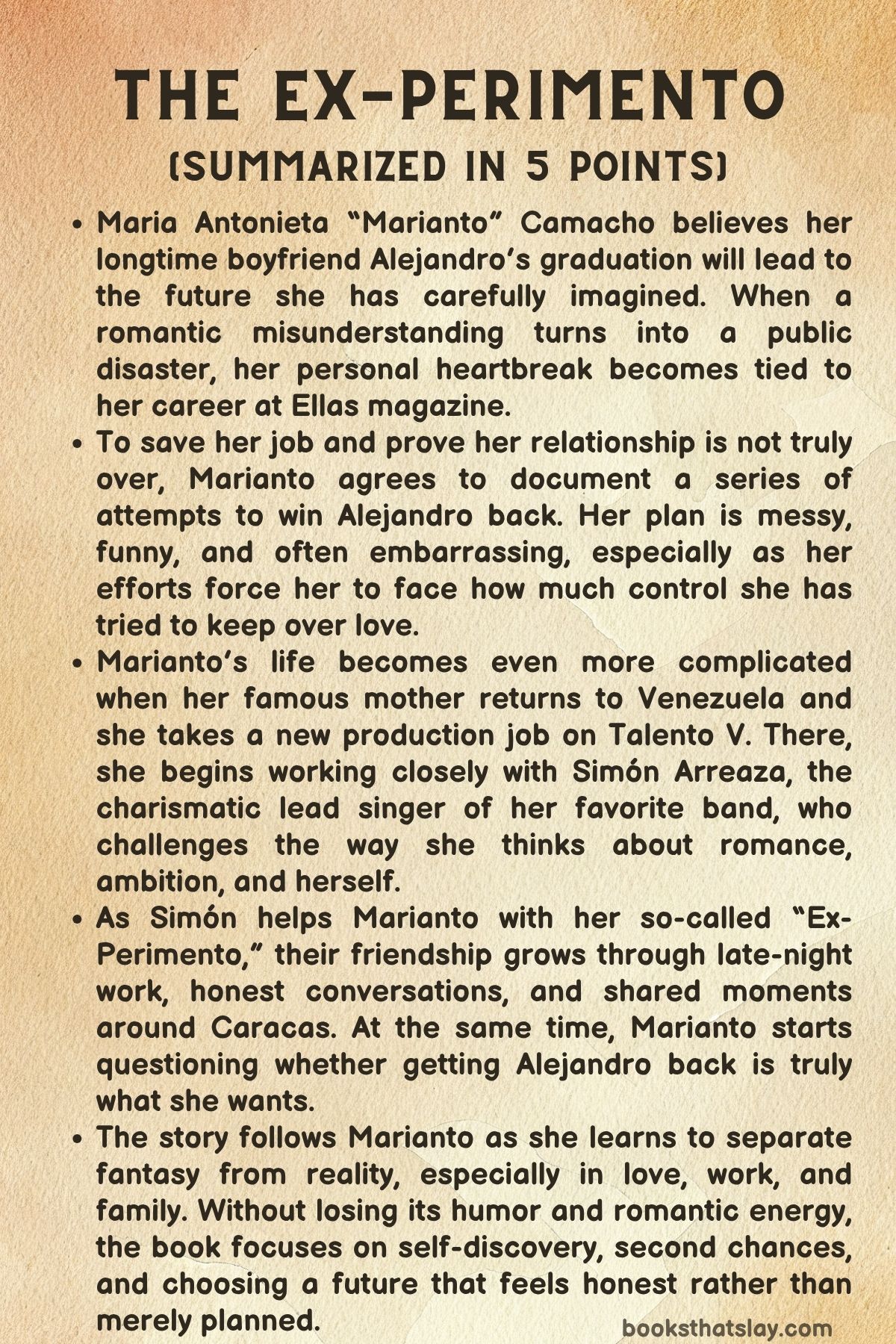
The Ex-Perimento by Maria J Morillo is a contemporary romantic comedy about a woman whose perfectly planned future falls apart in the most public way possible. Set in Caracas, the story follows Marianto Camacho after her boyfriend Alejandro asks for a break instead of proposing.
When her breakup video goes viral, she turns the disaster into a magazine project about winning him back. What begins as a career-saving stunt becomes a journey of self-questioning, messy choices, friendship, ambition, and unexpected love. The novel uses humor, media chaos, and romantic tension to explore what happens when a person stops chasing a life that no longer fits.
Summary
Maria Antonieta “Marianto” Camacho believes she is standing at the edge of the future she has always wanted. Her boyfriend, Alejandro, is graduating from medical school in Caracas, and she sees his achievement as the beginning of their next stage together.
In her mind, their path is clear: marriage, a house in La Lagunita, children, and a dog. She has imagined the shape of their life so carefully that it feels almost inevitable.
At Alejandro’s graduation celebration, Marianto tries to enjoy herself, but she feels watched and judged by his mother, Bárbara. Wanting a moment away from the pressure, she wanders to a gazebo and starts imagining it as the perfect place for a wedding.
While there, she sees Bárbara hand Alejandro a small box. Since it looks like a ring box, Marianto convinces herself that he is about to propose.
When Alejandro later finds her and asks her to dance, she takes it as another sign that a romantic moment is coming.
But three days pass, and there is no proposal. Marianto grows anxious and confides in her best friend, Blanca, at work.
She works for Ellas magazine as the anonymous voice behind a relationship-advice column, though she dreams of moving into Arts and Culture. She wants to ask her boss, Eugenia Fajardo, for a promotion, but she hesitates because she thinks an engagement may tie her more firmly to the role she already has.
That night, Alejandro takes her to dinner. Marianto prepares as though it will be one of the most important nights of her life.
She dresses carefully and secretly sets up her phone to record what she thinks will be a proposal. Instead, Alejandro tells her he needs a break.
He explains that she has planned their future without truly asking what he wants. He feels trapped by her expectations and is considering taking a job in Barinas.
Marianto is shocked and humiliated. The small box, she learns, did not contain an engagement ring at all.
It held Alejandro’s grandfather’s graduation ring.
After the breakup, Marianto goes home and breaks down while listening to Caballo de Troya, her favorite band. In her emotional state, she accidentally posts the recorded breakup video to Ellas’ account instead of the scheduled relationship Q&A. By morning, the video has gone viral.
It has gathered hundreds of thousands of views, thousands of comments, many missed calls from Eugenia, and only one calm message from Alejandro asking whether she got home safely.
Marianto rushes to the office, where Eugenia fires her for damaging the credibility of the magazine’s relationship-advice brand. Desperate to save her job, Marianto insists that she and Alejandro are only on a break.
Eugenia gives her a way back: she can write about trying to win Alejandro back. Marianto turns the idea into “El Ex-Perimento,” a series of attempts to repair the relationship, and negotiates for a possible move to Arts and Culture if the article succeeds.
Alejandro is angry about the video and refuses to meet. Marianto admits she recorded the dinner because she thought he was going to propose, but he tells her they should not see each other for a while.
At the same time, her mother, Viviana, returns to Venezuela. Viviana is a famous former beauty queen and television personality who has come back to host Talento V. She moves into Marianto’s apartment, bringing glamour, tension, and old family wounds with her.
Marianto begins her experiments. First, she posts an old romantic photo, hoping Alejandro will react.
He does not. Then she tries to be unpredictable by showing up at a sushi restaurant where he is eating.
The plan fails badly, and because of her seafood allergy, the encounter ends with her needing an EpiPen. Her professional life is not improving either.
She searches for temporary journalism work but is repeatedly rejected and told to return to social media. Hoping for a new opportunity, she applies to manage the social accounts for Talento V. After an awkward interview, she is rejected, then suddenly hired as a production assistant instead.
On her first day, Marianto discovers she will be assisting Simón Arreaza, the lead singer of Caballo de Troya. She is embarrassed because she has already met him in a very awkward situation, but Simón treats her with warmth and humor.
As she drives him around and helps him with work, she eventually asks him to help her win Alejandro back. Simón reviews her plan and reshapes it.
Instead of chasing Alejandro directly, he tells her to stay busy, be herself, make Alejandro jealous, and enjoy life without him. He agrees to coach her in exchange for a future magazine profile of his band.
As Marianto spends more time with Simón, Alejandro begins to notice. Her posts about Talento V and Simón make him jealous, and he eventually calls, asking about her and hinting at dinner.
Marianto should feel thrilled, but she is increasingly confused by how easy and alive she feels around Simón. She still tries to repair her connection with Alejandro’s world, even attending Pilates with Bárbara.
The attempt ends with an injury, but Bárbara offers unexpected advice: winning someone over should not have to be so hard.
Simón’s lessons become less about Alejandro and more about Marianto herself. He pushes her to describe Alejandro honestly, examine what she wants, and release some of her need for control.
At karaoke with Blanca and Simón, Marianto lets herself drink, sing, and have fun. The next day, she sees photos Simón sent from the night before and realizes she wants to keep them.
The thought unsettles her, so she ignores his messages and focuses on the article.
Blanca reads Marianto’s draft and quickly notices the truth Marianto is avoiding: Simón appears in the piece far more than Alejandro. Blanca warns that readers will probably assume Marianto is falling for him.
Marianto denies it, but the comment stays with her. She also shows Blanca the profile she has written about Caballo de Troya, and Blanca loves it.
She encourages Marianto to apply to Ethos, a rising magazine where her voice might be appreciated. Marianto applies, though she still hopes Eugenia will restore her place at Ellas.
One late night after a shoot, Marianto is ordered back to the office to proofread and reprint scripts. Simón gives up dinner with the others to help her.
In the empty office, they work, eat, joke, and play with paper balls while asking each other personal questions. Marianto admits she avoided dating anyone in entertainment because her mother’s career left her feeling abandoned as a child.
Simón shares his fear that he may fail in music after sacrificing so much for it. They comfort each other, hold hands briefly, and take a suggestive photo for the experiment, meant to make Alejandro jealous.
The next day, Marianto takes Simón to El Ávila and shows him Caracas from above. They drink hot chocolate, walk to Hotel Humboldt, and watch the sunset.
The time together feels calm and intimate. Simón tells her that his safe haven is not a place but people, including her.
Marianto admits he helps her too.
During Talento V eliminations, Simón struggles with sending children home. Marianto supports him and organizes the children to make him a thank-you card.
Later, when the hotel restaurant is closed, Simón invites her to order room service in his room. While he showers, Marianto imagines what life with him might look like.
Then Alejandro texts her about watching You’ve Got Mail, her favorite movie. Instead of happiness, she feels clarity: she no longer truly wishes she were with him.
When Simón plays a song for her on guitar, she finally admits to herself that she may be falling in love with him.
Marianto still meets Alejandro for dinner, but he arrives late and does not apologize. Their conversation shows her how little has changed.
Alejandro says he misses her and is not ready to let her go, but he is also not ready for marriage. He accuses her of being controlling and suggests they get back together without plans, simply seeing what happens.
Marianto realizes that this is not enough for her. She tells him she does not want to get back together and leaves feeling relieved rather than broken.
That night, she returns home and finds Simón sleeping in her apartment because Viviana let him stay there. Later, Simón finds her on the couch and insists she take the bed.
In the quiet, Marianto tells him she and Alejandro are finished. Simón reassures her and tells her about choosing his band over an ex-girlfriend who wanted him to quit music.
He tells Marianto she deserves someone who loves every part of her.
On Monday, Marianto tells Eugenia that the article is dead because she and Alejandro are over. Eugenia responds coldly, making it clear that Marianto no longer belongs there.
Soon after, Marianto receives an interview invitation from Ethos. Simón helps her get away from work, prepares her apartment for the Zoom call, and stays nearby for support.
The interview goes well, and Marianto celebrates by hugging him and taking him out for cake.
Their celebration turns into a full day together: a walk, dinner, and time by the hotel pool. Sitting with their feet in the cold water, they tease each other and grow increasingly aware of what is happening between them.
When Simón looks at her lips and says her name, they kiss. The moment is intense, but someone interrupts them.
Panicked by the reality of what she has done, Marianto apologizes and runs away.
She goes to Blanca’s house and confesses everything. Blanca reassures her that she has not done anything terrible.
Marianto is single, Simón is single, and their feelings have been obvious for a while. The next morning, Marianto arrives early at work hoping to talk to Simón, but he is gone.
Irina tells her he has unexpectedly flown to Colombia. Hurt, Marianto sees his absence as proof of one of her oldest fears: loving someone in entertainment may mean waiting for a person who might not show up.
Later, the crew travels to Margarita for Talento V press events, and Marianto prepares herself to face Simón again.
Characters
Maria Antonieta “Marianto” Camacho
Maria Antonieta “Marianto” Camacho is the emotional center of The Ex-Perimento, and her journey is built around love, self-deception, ambition, public embarrassment, and gradual self-discovery. At the beginning of the story, she is deeply invested in a future she has already imagined with Alejandro.
Her dream is detailed and complete: marriage, a house in La Lagunita, children, and a dog. This shows that Marianto is romantic and hopeful, but it also reveals one of her main flaws: she often treats her desires as if they are shared realities.
She does not simply hope Alejandro will propose; she convinces herself that a small box must contain a ring, that a dance must be leading to an engagement, and that silence after the graduation party is only a delay before the moment she expects. Her imagination is powerful, but it also traps her inside expectations that Alejandro has not clearly agreed to.
Marianto is also a character who struggles with control. She wants her personal life, career, and future to follow a clear plan, and when something disrupts that plan, she panics.
Alejandro’s request for a break hurts her not only because she loves him, but because it destroys the structure she had built around their relationship. Her reaction to the breakup is impulsive and chaotic, especially when she accidentally posts the breakup video to Ellas’ account.
This mistake exposes her private humiliation to the public and becomes the turning point of the story. Yet even after this disaster, Marianto clings to the idea that she can repair everything if she follows the right strategy.
Her “experiment” to win Alejandro back reflects both her desperation and her need to turn heartbreak into something she can manage.
Professionally, Marianto is ambitious but insecure. She wants to move beyond being Ellas magazine’s anonymous relationship-advice persona, but she is afraid that an engagement would keep her stuck in that role.
This creates an interesting contradiction in her character: she wants marriage with Alejandro, but she also wants independence and creative growth. Her work with Eugenia shows that she is capable and determined, but it also shows how much she depends on approval from people who do not fully value her.
When Blanca praises her profile of Caballo de Troya and encourages her to apply to Ethos, Marianto begins to see that her voice may belong somewhere else. Her career arc mirrors her romantic arc: she must stop begging to be chosen by people and institutions that limit her.
Marianto’s relationship with Simón becomes important because it challenges the version of herself she has been performing. With Alejandro, she often acts like someone trying to secure a future.
With Simón, she becomes more spontaneous, honest, playful, and emotionally open. He encourages her to be busy, have fun, and stop chasing someone who is unsure about her.
Through their conversations, Marianto begins to examine what she actually wants instead of what she thinks she should want. Her growing feelings for Simón frighten her because they are not part of the original plan, but they also reveal that love can feel supportive rather than exhausting.
By the time she rejects Alejandro’s offer to get back together without real commitment, Marianto has begun to understand her own worth. Her development is not about replacing one man with another; it is about realizing that she deserves a life and love that make room for all of her, not just the version of her that fits someone else’s comfort.
Alejandro
Alejandro is Marianto’s longtime boyfriend and the person around whom her original dream of the future is built. He is a medical school graduate, and his achievement at the beginning of the story represents success, adulthood, and stability in Marianto’s mind.
To her, his graduation seems like the natural step before engagement and marriage. However, Alejandro’s own feelings are much less certain.
His decision to ask for a break instead of proposing reveals that he feels trapped by Marianto’s expectations. He believes she has planned their future without truly asking him what he wants, and this makes him feel pressured rather than loved.
Alejandro is not presented as cruel, but he is emotionally cautious and often frustrating. After the breakup dinner, he sends only a calm text asking whether Marianto got home safely, which shows that he still cares about her basic well-being.
At the same time, he refuses to meet her after the video goes viral and tells her they should not see each other for a while. His anger is understandable because Marianto recorded and accidentally shared a private moment, but his response also shows his tendency to withdraw when conflict becomes uncomfortable.
He does not seem able to offer Marianto the clarity or reassurance she needs.
His jealousy over Simón adds complexity to his character. Alejandro becomes more interested when Marianto appears to be moving on, especially when her posts show her working with Simón.
This suggests that Alejandro may not fully appreciate Marianto until he feels the possibility of losing her. However, his later conversation with her proves that jealousy is not the same as readiness.
He says he misses her and is not ready to let her go, but he still does not want marriage or concrete plans. He wants the relationship back on uncertain terms, asking to “see where things go,” while Marianto has already realized that uncertainty is not enough for her.
Alejandro functions as a contrast to Simón. He represents the future Marianto once wanted, but also the emotional limitations of that future.
He may care for her, but he does not embrace her intensity, ambition, romantic imagination, or need for commitment. His accusation that she is controlling is not entirely baseless, but his inability to meet her with equal honesty and decisiveness makes the relationship feel stagnant.
By the time Marianto walks away from him, Alejandro becomes less the villain of the story and more the symbol of a love that once mattered but no longer fits who she is becoming.
Simón Arreaza
Simón Arreaza is the lead singer of Caballo de Troya and one of the most important figures in Marianto’s transformation. At first, he enters the story through embarrassment and coincidence, especially because Marianto has already encountered him while hiding in the men’s bathroom.
Instead of humiliating her or keeping distance, Simón responds with warmth and amusement. This immediately separates him from the more judgmental or demanding people in Marianto’s life.
He is famous, talented, and admired, but he does not behave as if his fame makes him unreachable. His easy humor and kindness allow Marianto to relax around him in ways she rarely does elsewhere.
Simón’s role as Marianto’s “coach” begins as part of her attempt to win Alejandro back, but his advice actually moves her away from Alejandro. He edits her list of strategies and tells her not to chase, but to be herself, have fun, stay busy, and make Alejandro jealous by living well.
This advice is playful, but it also contains emotional wisdom. Simón understands that attraction cannot be forced through desperation.
More importantly, he sees that Marianto has made Alejandro the center of her life and gently pushes her to rediscover herself. His lessons are not just romantic tactics; they are lessons in self-respect and freedom.
Simón is also vulnerable beneath his charm. In the deserted office scene, he confesses that he fears failing in music after sacrificing so much for it.
This admission gives him depth beyond his public image as a singer. He is not simply a confident celebrity; he is someone who has chosen a difficult path and worries about whether that choice will be worth it.
His story about choosing his band over an ex-girlfriend who wanted him to quit music further reveals his values. He believes love should not require someone to abandon the most essential parts of themselves.
This belief becomes central to his connection with Marianto, because he encourages her to want someone who loves all of her.
His bond with Marianto grows through small acts of care. He helps her proofread scripts late at night, gives up dinner to stay with her, shares food and jokes, holds her hand, supports her before her Ethos interview, and spends ordinary time with her in ways that feel emotionally intimate.
Their trip to El Ávila is especially meaningful because it shows how peaceful and natural their connection has become. When he says his safe haven is not a place but people, including her, he reveals that Marianto has become emotionally important to him.
Simón helps Marianto feel seen, not managed. His sudden flight to Colombia after their kiss complicates this image, because it awakens Marianto’s old fear of loving someone in entertainment who may disappear.
This makes him imperfect rather than idealized. He offers Marianto a healthier kind of love, but the story still allows tension around whether he can be present consistently enough for her to trust him.
Blanca
Blanca is Marianto’s best friend and one of the most grounded characters in the story. She serves as Marianto’s emotional sounding board, truth-teller, and source of practical perspective.
At the beginning, Marianto shares her suspicion that Alejandro has a ring with Blanca, which shows how deeply Blanca is woven into Marianto’s personal life. Blanca listens, but she is not simply there to validate every fantasy.
Her role becomes increasingly important as Marianto’s life spins out of control after the breakup video goes viral.
Blanca’s greatest strength is her honesty. When she reads Marianto’s article about the experiments to win Alejandro back, she notices what Marianto is trying not to admit: Simón appears in the piece far more than Alejandro does.
Blanca understands the emotional truth beneath Marianto’s denial. She warns that readers will probably assume Marianto is falling for Simón, and although Marianto dismisses the idea, Blanca’s observation plants an important seed.
This shows that Blanca sees Marianto clearly, even when Marianto cannot see herself.
Blanca also supports Marianto’s professional growth. When she reads the profile of Caballo de Troya, she loves it and encourages Marianto to apply to Ethos.
This is a crucial moment because Blanca recognizes that Marianto’s talent deserves a better platform than Ellas. She does not let Marianto remain trapped in the hope that Eugenia will restore her old position.
Instead, she points her toward a future where her voice might be valued. Blanca’s friendship is therefore not only comforting but also constructive; she pushes Marianto toward choices that serve her long-term happiness.
When Marianto panics after kissing Simón, Blanca again becomes her place of refuge. Marianto runs to Blanca’s house, overwhelmed by guilt and confusion, and Blanca reassures her that she is not awful.
She reminds Marianto that both she and Simón are single and that their feelings are obvious. This moment shows Blanca’s emotional maturity.
She does not dramatize the situation or shame Marianto. Instead, she helps her separate real wrongdoing from fear.
Blanca is the kind of friend who gives both comfort and clarity, making her one of the most stabilizing presences in the book.
Eugenia Fajardo
Eugenia Fajardo is Marianto’s boss at Ellas magazine, and she represents professional authority, ambition, and emotional coldness. She is demanding and image-conscious, especially when the accidental breakup video damages the credibility of the magazine’s relationship column.
Her decision to fire Marianto is harsh but understandable from a professional standpoint: Marianto has publicly exposed a private romantic disaster through the magazine’s account. However, Eugenia’s response also reveals that she values the brand more than the person behind it.
Marianto’s pain matters less to her than the public-relations crisis.
Eugenia’s offer to let Marianto earn her way back by documenting the process of winning Alejandro back is one of the most morally complicated professional decisions in the story. On the surface, it gives Marianto a second chance.
In reality, it turns Marianto’s heartbreak into content. Eugenia recognizes the viral potential of Marianto’s humiliation and uses it as an opportunity for the magazine.
This makes her a sharp portrait of a media figure who understands attention, clicks, and audience curiosity, but who may lack empathy for the emotional cost of turning personal pain into a public narrative.
Her relationship with Marianto is also tied to power. Marianto wants a promotion to Arts and Culture, and Eugenia becomes the gatekeeper of that dream.
Even when Marianto negotiates for the possibility of advancement, Eugenia keeps control of the terms. She does not nurture Marianto’s talent in the way Blanca does; instead, she pressures Marianto to produce a marketable story.
This makes Eugenia an obstacle not only in Marianto’s career but also in her emotional recovery, because the article encourages Marianto to keep chasing Alejandro long after her heart has begun moving elsewhere.
When Marianto finally tells Eugenia that the article is dead because she and Alejandro are over, Eugenia responds coldly by saying it could have been an email. This reaction captures her character perfectly.
She is efficient, unsentimental, and uninterested in Marianto’s personal breakthrough. For Marianto, ending the article is a major act of self-respect.
For Eugenia, it is merely an inconvenience. Eugenia’s importance lies in how she forces Marianto to recognize that returning to Ellas may not be the victory she once imagined.
Bárbara
Bárbara is Alejandro’s mother, and her presence at the graduation party immediately makes Marianto feel judged. She represents the social and familial pressure surrounding Marianto and Alejandro’s relationship.
Marianto’s discomfort around Bárbara suggests that she sees her as someone whose approval matters, perhaps because Marianto has imagined herself becoming part of Alejandro’s family. Bárbara’s simple act of giving Alejandro a small box becomes the spark for Marianto’s mistaken belief that a proposal is coming.
Although Bárbara may not intend to mislead her, her role in that moment shows how easily Marianto interprets external signs according to her own hopes.
At first, Bárbara appears intimidating because Marianto reads her as critical and difficult to impress. This makes her seem like a traditional future mother-in-law figure, someone whose judgment adds tension to the romance.
However, the later Pilates scene gives her more dimension. Marianto tries to reconnect with her as part of the effort to win Alejandro back, but the attempt goes badly and Marianto injures herself.
Instead of functioning only as an obstacle, Bárbara gives Marianto unexpected advice: winning someone over should not be so hard.
This advice is significant because it comes from someone connected to Alejandro, not from Blanca or Simón. Bárbara’s words challenge Marianto’s belief that love must be earned through performance, effort, and strategy.
She indirectly points out the imbalance in Marianto’s pursuit of Alejandro. If Marianto has to exhaust herself trying to be chosen, perhaps the relationship is not as right as she wants it to be.
Bárbara therefore becomes a surprising voice of realism in the story.
Bárbara’s character also helps reveal the difference between Marianto’s imagined future and the reality of the relationship. Marianto has pictured marriage, family, and belonging, but her interactions with Bárbara are uncomfortable and strained.
The family world she wants to enter does not feel naturally welcoming to her. Through Bárbara, the book shows that Marianto’s dream of marrying Alejandro is not just about love; it is also about fitting into a life she has idealized.
Bárbara’s quiet wisdom helps loosen that fantasy.
Viviana
Viviana, Marianto’s mother, is a famous former beauty queen and television personality whose return to Venezuela adds pressure to Marianto’s already unstable life. She is glamorous, public, and connected to the entertainment world, which makes her very different from the stable maternal figure Marianto may have needed growing up.
Her decision to move into Marianto’s apartment disrupts Marianto’s private space at a time when Marianto is already dealing with heartbreak, career humiliation, and emotional confusion. Viviana’s presence therefore intensifies the chaos around her daughter.
Viviana’s fame is important because it shapes Marianto’s fears about relationships and the entertainment industry. Marianto admits to Simón that she avoided dating people in entertainment because of her mother’s absence while she was growing up.
This confession shows that Viviana’s career affected Marianto deeply. Marianto does not simply dislike the entertainment world; she associates it with being left behind.
This fear later influences her reaction when Simón suddenly flies to Colombia. His absence seems to confirm an old wound: that people tied to fame and performance may not stay.
Viviana is not portrayed only as a source of pain, though. Her connection to Talento V is also part of what brings Marianto into Simón’s orbit.
Because Viviana returns to host the show, Marianto becomes involved with the production world and eventually works as a production assistant. In this way, Viviana indirectly pushes Marianto toward the very environment she has avoided.
The entertainment world that once represented abandonment becomes the place where Marianto discovers new professional possibilities and unexpected love.
As a character, Viviana embodies the complicated influence of a parent whose public success may have come at a private cost. She is charismatic and significant, but her history with Marianto carries emotional consequences.
Her decision to let Simón sleep in Marianto’s apartment also shows her casual boundary-crossing, adding humor and awkwardness while pushing Marianto and Simón into closer emotional proximity. Viviana’s role is therefore both disruptive and catalytic: she unsettles Marianto, but she also helps move the story into the world where Marianto begins to change.
Mileidy
Mileidy is connected to the production side of Talento V, and she represents the demanding, exhausting reality behind the glamour of television. Her role becomes clear when she orders Marianto to return to the office late at night to proofread and reprint scripts after a long shoot.
This moment shows that Marianto’s new job is far from the social media position she originally wanted. Instead of creative control or professional recognition, she is given tiring assistant work with little regard for her time or comfort.
Mileidy’s character helps reveal the hierarchy of the workplace. Marianto is new, vulnerable, and trying to prove herself, while Mileidy has the authority to assign inconvenient tasks.
This adds to Marianto’s sense of being undervalued. At Ellas, Eugenia exploits Marianto’s personal pain for content; at Talento V, Mileidy treats her as someone who must absorb practical burdens.
In both spaces, Marianto has to navigate professional environments where her needs are secondary to the demands of the job.
However, Mileidy’s order also creates one of the most intimate scenes between Marianto and Simón. Because Marianto has to work late, Simón gives up dinner with the others to help her.
The deserted office becomes a space where they talk, joke, play, and share personal fears. Without Mileidy’s demanding instruction, Marianto and Simón might not have had that private opportunity to grow closer.
This makes Mileidy function as an indirect catalyst in the romantic development of the story.
Mileidy is not explored as deeply as the central characters, but her presence is useful because she grounds the television setting in labor and pressure. She reminds the reader that behind celebrity performances, press events, and public excitement, there are people doing stressful, unglamorous work.
For Marianto, dealing with Mileidy is part of learning that reinvention is not immediately elegant or easy. Her new life requires exhaustion, humility, and persistence before it can become freeing.
Irina
Irina is a smaller but important character because she delivers information that strongly affects Marianto’s emotional state. After Marianto kisses Simón and then runs away in panic, she arrives at work hoping to talk to him and repair the awkwardness between them.
Instead, Irina tells her that Simón has unexpectedly flown to Colombia. This news lands painfully because Marianto is already frightened by her feelings and uncertain about whether she can trust a relationship with someone like him.
Irina’s role in this moment is brief, but it triggers one of Marianto’s deepest fears. Simón’s absence reminds Marianto of the emotional pattern she associates with her mother: loving someone connected to entertainment may mean waiting for someone who might not show up.
Because Irina is the person who informs her of his departure, she becomes part of the story’s emotional turning point. The message she gives is simple, but Marianto interprets it through years of insecurity and disappointment.
As a supporting character, Irina also helps build the world of Talento V. She appears as part of the crew environment, where information travels quickly and people’s schedules change suddenly. Her presence reinforces the unpredictability of the entertainment industry, a world where flights, events, shoots, and appearances can interrupt personal conversations.
For Marianto, this unpredictability is not just inconvenient; it is emotionally threatening.
Irina does not have the same depth as Marianto, Simón, or Blanca, but she serves an important narrative purpose. She creates the gap between what Marianto hopes will happen and what actually happens.
Marianto wants immediate clarity from Simón, but Irina’s news leaves her with silence instead. This silence forces Marianto to confront whether her growing feelings are strong enough to survive uncertainty, and whether Simón is truly different from the disappearing figures she fears.
Themes
The Pressure of Imagined Futures
Marianto’s heartbreak begins long before Alejandro asks for a break, because she has already built an entire life around a future he has not fully agreed to. Marriage, a house, children, and social approval become so vivid in her mind that she mistakes a graduation ring for an engagement ring and prepares herself for a proposal that never comes.
This theme shows how love can become distorted when one person treats expectation as certainty. Marianto is not wrong for wanting commitment, but her desire for a planned future makes her overlook Alejandro’s hesitation and silence.
His complaint that she has arranged their lives without truly asking him reveals a painful imbalance: she has been loving not only the person in front of her, but also the version of him that fits her dream. In The Ex-Perimento, the collapse of that fantasy forces Marianto to confront the difference between wanting love and trying to control its outcome.
Her growth begins when she stops chasing the picture she created and starts asking what she genuinely needs.
Public Humiliation and Personal Reinvention
The viral breakup video turns Marianto’s private pain into public entertainment, stripping her of control at the exact moment she feels most vulnerable. Her mistake costs her job, damages her professional identity, and forces her into a humiliating arrangement where she must turn her heartbreak into content.
Yet this public failure also becomes the beginning of her reinvention. At first, she tries to recover the life she lost by winning Alejandro back and proving Eugenia wrong.
Gradually, however, the experiment exposes how limited her old life had become. Her anonymous advice-column role had trapped her in a voice that no longer reflected her full talent, while the chance to write about Simón’s band reveals a sharper, more honest version of her as a journalist.
The theme suggests that embarrassment can become transformative when it pushes a character out of familiar roles. Marianto’s public mistake does not define her permanently; instead, it forces her to rebuild her identity on stronger terms, away from performance and closer to truth.
Love as Acceptance Rather Than Correction
Marianto’s relationships with Alejandro and Simón reveal two very different ideas of love. With Alejandro, affection is tied to pressure, timing, and negotiation.
He misses her, but he also wants her to accept uncertainty without offering the commitment she clearly desires. Their dinner shows that even after jealousy and distance, the central problem remains unchanged: Alejandro wants her back without truly meeting her emotional needs.
Simón, by contrast, encourages Marianto to become less controlled, not by dismissing her feelings, but by helping her see herself more clearly. He listens to her fears, supports her career, shares his own doubts, and tells her she deserves someone who loves all of her.
This contrast makes the theme powerful because Marianto’s choice is not simply between two men; it is between being tolerated in fragments and being accepted as a whole person. The Ex-Perimento presents love as something that should make self-knowledge easier, not harder.
Marianto’s emotional shift toward Simón grows from being seen without needing to shrink herself.
Self-Discovery Through Letting Go
Marianto’s journey depends on learning that letting go is not the same as losing. At first, she treats the breakup as a problem to solve, designing experiments to regain Alejandro’s attention and restore her old life.
Each attempt fails in some way, but those failures slowly redirect her toward experiences that feel freer and more honest: singing karaoke, writing the Caballo de Troya profile, applying to Ethos, supporting Simón during the show, and admitting that Alejandro no longer feels like home. Her self-discovery is gradual because she resists it; even when Blanca points out that Simón fills more of her article than Alejandro, Marianto refuses to accept what is obvious.
By the time she rejects Alejandro’s offer to restart without commitment, she is not acting out of anger but clarity. The relief she feels afterward proves that letting go has created space for a better understanding of herself.
This theme shows that growth often begins with disappointment, but it becomes meaningful only when a person stops trying to return to who they were.