A Perfect Hand Summary, Characters and Themes
A Perfect Hand by Ayelet Waldman is a historical romance and social novel set in Victorian England, where domestic service, class privilege, marriage, and women’s political awakening shape every important choice. At its center is Alice Lockey, a talented lady’s maid whose love for Charlie Wells first appears to offer a path toward security and companionship.
Yet as Alice encounters reformers, suffragists, factory workers, and women damaged by unequal laws, she begins to question whether personal happiness can exist without freedom. The book balances romance, social comedy, political awakening, and tragedy while showing how affection can be sincere even when it carries the assumptions of an unequal society.
Summary
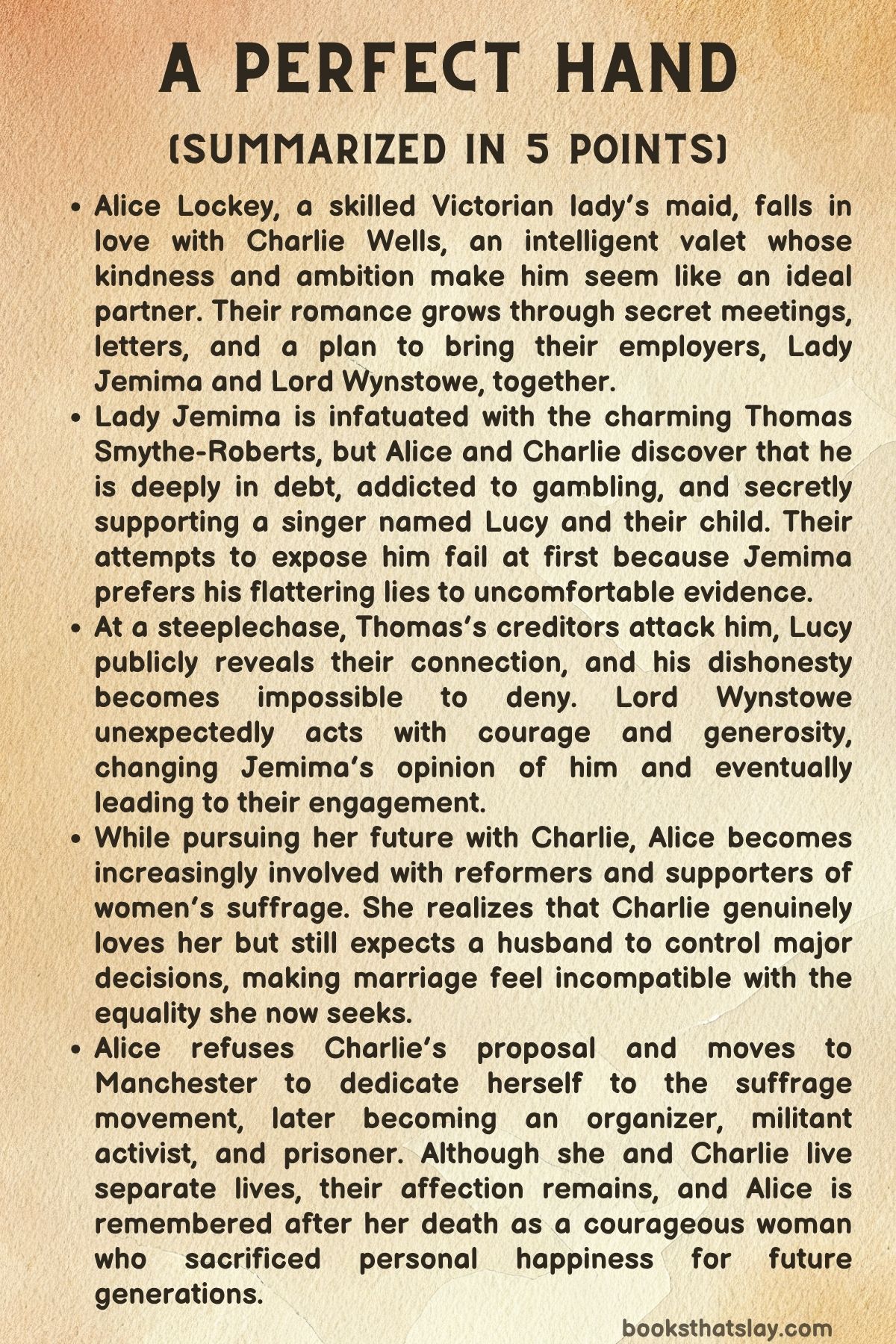
Alice Lockey has risen far above the position expected of a tenant farmer’s daughter. Through intelligence, discipline, and exceptional skill with clothes, hair, sewing, and cosmetics, she has become lady’s maid to Lady Jemima Alderwick at Marlecombe Park.
Her position is better than that of many servants, but it still depends entirely on Jemima’s moods. Alice must hide her beauty, intelligence, and opinions because a servant who attracts too much attention risks being judged insolent, ambitious, or improper.
During a country-house gathering, Alice meets Charlie Wells, valet to the wealthy Lord Wynstowe. Charlie first catches her attention when he defends a maid from the bullying under-butler, Mr. Symes, and later impresses her by repairing a watch with steady, skillful hands.
Their early conversations reveal a shared love of reading and an ability to speak honestly with one another. Alice is surprised to find that Charlie listens without mockery when she questions the injustice of servants laboring constantly while their employers enjoy comfort simply because of birth.
Aunt Sarah Bennett has also given Alice reformist writings about women’s legal position. Knowing that marriage can place a woman’s property and freedom under her husband’s control, Alice does not regard matrimony as an automatic reward.
Although she fears Charlie may report her radical opinions, he assures her that he would never betray her. Their friendship becomes flirtation through private conversations, shared errands, winter walks, flowers gathered in the fields, and dances at the Boxing Day servants’ ball.
Their growing attachment is interrupted when Lady Jemima drives Lord Wynstowe away from Marlecombe Park. Jemima dislikes him despite his wealth because she finds him sickly, strange, and obsessed with physiognomy, while she prefers the charming Thomas Smythe-Roberts.
Charlie must leave with his employer, but he secretly sends Alice a note asking her to meet him at the Zoological Gardens in London. Alice invents an errand involving Jemima’s damaged fan, travels alone by train, and risks her reputation to keep the appointment.
At the zoo, Charlie explains that his father’s alcoholism sent the family into the workhouse, smallpox killed several relatives, and his wages now support his mother and sister, Mary. Alice responds without judgment, though their discussion of marriage reveals her fear that poor women often exchange one form of dependence for another.
They arrange another meeting, but Charlie does not appear because Lord Wynstowe suddenly leaves for the Lake District. Alice waits for hours at Lambeth Pier, believing she may have been abandoned, until a letter arrives explaining what happened and asking her to wait for him.
Their correspondence becomes an intimate courtship, but practical barriers remain because Charlie supports his family and neither servant controls where an employer chooses to live. Charlie manipulates Lord Wynstowe into returning to London, while Alice encourages Lady Jemima to visit the city by suggesting that Thomas may be spending time with Caroline Mountjoy.
The lovers recognize that they are using their employers’ weaknesses, but they justify the scheme as necessary for their own future. In London, Alice stays with Jemima at Aunt Sarah Bennett’s house, where she learns that Thomas may be keeping an older singer in Ladbroke Grove.
After reuniting at a music hall, Charlie and Alice share their first kiss and develop an ambitious plan: if Jemima marries Wynstowe, they can serve in the same household and eventually marry. The plan appears nearly impossible because Jemima considers Wynstowe absurd.
At a musicale, his terror of germs humiliates a sneezing woman, while Thomas publicly defends her and appears brave. Charlie decides that destroying Jemima’s faith in Thomas is easier than making her admire Wynstowe.
Charlie follows Thomas through London and discovers gambling, drinking, heavy debts, and a connection to Signora Luciana di Galtieri. She is actually Lucy Jones, a woman Charlie knew in the workhouse.
Lucy confirms to Alice that Thomas is the father of her baby, Tommy. She lends Alice a locket containing a miniature, locks of hair, and an inscription that can serve as evidence of the relationship.
Alice asks Aunt Sarah to reveal the truth, but Jemima rejects the evidence and accuses her aunt of jealousy. Thomas denies everything, and Jemima chooses the flattering man she desires over facts that threaten her pride.
While the scheme stalls, Alice’s political education advances. At Sarah’s reformist gathering, Emmeline Goulden condemns a society that dismisses pregnant servants while excusing men, leading Alice to see suffrage as a practical answer to injustice.
Charlie’s personal life changes when his mother becomes seriously ill. He returns home, holds her hand as she dies, and is deeply comforted when Alice unexpectedly attends the funeral.
Mary refuses Charlie’s continued support and chooses factory work in London. Alice defends her right to decide, forcing Charlie to confront the limits of protective love.
Meanwhile, Lord Wynstowe’s foolish interest in measuring faces unexpectedly helps the matchmaking plot. He flatters Lord Alderwick by declaring his proportions nearly perfect, and the two men become friends.
Thomas’s conduct grows more suspicious. He fails to approach Lord Alderwick properly, flatters Caroline’s wealth, and cannot resist gambling, so Alice and Charlie arrange for all the important figures to attend a steeplechase at Alexandra Park.
At the races, Lucy exposes Thomas’s lies, and a creditor attacks him over a debt of fifteen hundred pounds. His dishonesty, irresponsibility, and financial ruin become impossible to hide.
Lord Wynstowe surprises everyone by protecting Jemima during the violence and offering money to settle Thomas’s debt. His courage and generosity reveal qualities hidden beneath his eccentric habits.
Jemima’s opinion changes completely. She dismisses Thomas, moves into Wynstowe’s house with her father’s approval, and begins to see the viscount as earnest, secure, intelligent, and capable of devotion.
Alice and Charlie believe their plan has succeeded, and living under the same roof allows them to become lovers and speak openly about marriage. Their hopes diverge when Charlie assumes they will live in the country and follow the traditional pattern in which a husband chooses and a wife adjusts.
Alice loves him, but his confidence in male authority alarms her. She asks Charlie to attend a suffrage lecture, where anti-suffrage men attack the meeting.
Alice joins a barrier protecting the speakers, an assailant sexually attacks her, and Charlie violently defends her before being injured by a policeman. Afterward, Charlie orders Alice never to attend another meeting.
His fear comes from love, but Alice understands that marriage would make her freedom dependent on his permission. Jemima accepts Lord Wynstowe’s proposal, and Thomas eventually marries Caroline Mountjoy, whose money and firm control restrain his worst habits.
The household marriage that Alice and Charlie engineered now makes their own marriage possible. Yet Alice refuses Charlie’s proposal and chooses to go to Manchester to work for women’s suffrage.
She also refuses his offer to follow because his loyalty would be to her rather than to the cause. Alice becomes a famous militant suffragist, organizer, arsonist, and prisoner.
Charlie marries another woman, raises children, and eventually becomes steward of Wynstowe Manor, though he and Alice never lose their deep affection. The narrator is finally revealed as Lady Jemima Wynstowe, who later becomes Alice’s friend and political ally.
After force-feeding in Holloway Prison ruins Alice’s health, Jemima nurses her at Wynstowe Manor, where Charlie visits shortly before her death in 1910. Alice dies before women gain the freedom for which she sacrificed her health, but later generations of Wynstowe women honor her grave with purple pansies on election days.
Characters
Alice Lockey
Alice is the intellectual and moral center of A Perfect Hand, beginning as a highly capable servant who knows how to survive by making her intelligence useful without making it threatening. Her skill as a lady’s maid gives her pride, status, and a degree of independence, but it also teaches her that excellence does not erase class subordination.
Her early attraction to Charlie is rooted in recognition. He sees her as thoughtful, talented, and worthy of conversation, offering a kind of respect that is rare in a social order built on rank.
Alice’s political development does not cancel her romantic feelings; instead, it forces her to examine what love would require her to surrender. She discovers that a kind man can still carry assumptions that make equality impossible, especially when he believes protection naturally gives him authority.
Her final refusal of marriage is painful because Charlie is not a villain. Alice chooses purpose over comfort, accepting loneliness, danger, imprisonment, and physical suffering because she can no longer separate her private future from the condition of women as a whole.
Charlie Wells
Charlie is intelligent, loyal, resourceful, and emotionally generous, with a strong sense of responsibility shaped by childhood poverty and family loss. His devotion to his mother and sister shows that he understands sacrifice not as an ideal but as a daily obligation.
He also possesses practical ingenuity. Whether repairing a watch, manipulating Lord Wynstowe’s fears, following Thomas through London, or designing the marriage scheme, Charlie repeatedly turns intelligence into action.
His love for Alice is sincere and unusually respectful by the standards of his society. He admires her strong will, listens to her opinions, and is proud of her abilities, yet he still assumes that a husband should decide where a couple lives and what risks a wife may take.
This contradiction makes him one of the novel’s most effective figures. Charlie proves that personal decency does not automatically free someone from the values of an unequal culture, and his tragedy lies in loving Alice deeply without fully understanding the freedom she needs.
Lady Jemima Alderwick Wynstowe
Jemima begins A Perfect Hand as vain, selfish, impulsive, and almost entirely unaware of the labor that sustains her comfort. She treats Alice’s time, clothing, and emotional life as extensions of her own convenience, often reversing decisions without recognizing the trouble she causes.
Her attraction to Thomas reveals how strongly she values admiration. He flatters her beauty and encourages her belief that she is uniquely fascinating, so she rejects evidence that would force her to admit she has been deceived.
Her judgment improves when Wynstowe acts courageously at the races. Although her shift is partly based on status and spectacle, she gradually recognizes his steadiness, generosity, sobriety, and sincerity.
The revelation that Jemima narrates the story transforms her significance. She later becomes Alice’s friend and ally, suggesting that privilege does not make moral growth impossible, although that growth requires humility, experience, and the willingness to see a servant as a full human being.
Lord Wynstowe
Lord Wynstowe is eccentric, wealthy, socially awkward, and consumed by hypochondria and pseudoscientific ideas. His obsession with germs, illness, and facial measurements often makes him ridiculous, while his sheltered position allows him to insult others without understanding the harm he causes.
Yet his absurdity coexists with generosity and an absence of malice. He gives Charlie leave during his mother’s illness, permits Mary to stay in his house, and responds warmly when treated with patience rather than contempt.
At Alexandra Park, Wynstowe reveals courage that neither Jemima nor the reader expects. He places himself in danger, protects Jemima, and uses his wealth to resolve Thomas’s debt rather than merely condemning him.
His development shows that character cannot be measured by appearance, manner, or social performance. The man obsessed with reading faces is repeatedly unable to read people accurately, yet when action matters, his instinct is kinder and braver than that of the charming Thomas.
Thomas Smythe-Roberts
Thomas is attractive, witty, socially confident, and skilled at making women feel specially chosen. His appeal depends on performance because he studies what others want and reflects it back to them with practiced ease.
Behind that charm lies dishonesty, selfishness, debt, gambling, sexual irresponsibility, and cowardice. He keeps Lucy while courting Jemima, neglects his child, denies clear evidence, and relies on wealthier people to rescue him from consequences.
Thomas is not merely a romantic rival. He represents a culture that excuses male misconduct when it is wrapped in good manners, noble birth, and physical attractiveness.
His eventual marriage to Caroline suggests that he does not fundamentally reform. Instead, he moves into another arrangement in which a wealthy, forceful woman imposes limits on behavior he has never learned to govern himself.
Aunt Sarah Bennett
Sarah Bennett serves as Alice’s first guide into political thought. Through books and pamphlets, she gives Alice the language to question marriage law, women’s property rights, education, and employment.
She is generous, unconventional, and intellectually serious, but she also carries the limitations of a privileged reformer. She can advocate equality while still hesitating to include a servant fully within her social world.
Her attempt to warn Jemima about Thomas shows courage, though she underestimates her niece’s pride. Sarah’s greatest influence is indirect because the materials she provides allow Alice to develop ideas that eventually exceed Sarah’s cautious reformism.
Mary Wells
Mary is scarred by smallpox, hardened by poverty, and determined not to remain dependent on her brother. Her bluntness reflects a life in which sentiment has rarely provided security.
She refuses Charlie’s financial protection because she understands that dependence can become a form of confinement even when offered lovingly. Factory work is dangerous and exhausting, yet it gives her control over her evenings, wages, education, and movement.
Mary’s independence helps Alice see that status within domestic service is not the same as freedom. Her decision also tests Charlie’s beliefs, forcing him to confront a woman who loves him but rejects his right to decide for her.
Lucy Jones
Lucy, who performs as Signora Luciana di Galtieri, is clever, theatrical, resilient, and unsentimental. Her invented identity allows her to survive by converting beauty, sexuality, and performance into economic resources.
Her relationship with Thomas reveals the vulnerability beneath the glamour. He neglects their child, leaves her exposed to creditors, and treats her body as available even after childbirth.
Lucy’s cynicism about men comes from repeated violence and betrayal, yet Alice’s practical kindness wins her cooperation. By lending the locket and later appearing at the races, Lucy helps expose Thomas while refusing to pretend that respectability is a reliable measure of moral worth.
Emmeline Goulden
Emmeline is energetic, confident, politically ambitious, and impatient with gradual change. She treats women’s equality as an obvious truth rather than a distant philosophical possibility.
Her conversations challenge Alice to think beyond individual kindness. Emmeline asks whether Charlie’s respect for Alice extends to women collectively and whether personal goodness is enough without political commitment.
She also reveals the class limits of reform circles. Her invitation to Alice to visit Manchester is generous, but it initially overlooks the fact that a servant cannot simply leave employment without serious consequences.
Richard Pankhurst
Richard Pankhurst represents a form of male allyship based on principle rather than romance. He takes Alice’s intelligence seriously and asks what kind of work might satisfy her abilities instead of assuming domestic service or marriage must define her future.
His questions are unsettling because they expose Alice’s habit of measuring ambition only by the next available step. He helps her understand that improvement within a restrictive system may still leave the system itself unchallenged.
Lord Alderwick
Lord Alderwick is proud, status-conscious, and emotionally distant, but he is not entirely foolish. He disapproves of Thomas because the young man lacks income, profession, discipline, and purpose, even before the full extent of his debts becomes public.
His vanity allows Wynstowe’s facial measurements to flatter him into friendship. This comic weakness helps create the social alliance that makes Jemima’s marriage possible.
He remains a beneficiary of class privilege and rumored sexual double standards, yet his judgment of Thomas is more practical than Jemima’s. He understands that charm cannot support a household or protect a family from scandal.
Caroline Mountjoy
Caroline functions first as Jemima’s rival and later as Thomas’s wife. Her wealth makes her attractive to a man whose debts require rescue, while her confidence and social position allow her to bargain from strength.
She does not receive enough attention to become fully sympathetic, but her marriage to Thomas suggests a transactional arrangement rather than romantic fulfillment. Her role underlines how marriage among the wealthy can operate as financial management, reputation control, and social exchange.
Mrs. Wells
Mrs. Wells embodies the long consequences of male violence, alcoholism, and poverty. Her injuries, workhouse experience, and final illness show how little protection existed for poor women trapped within destructive marriages.
Her life shapes Charlie’s intense need to protect the women he loves. At the same time, his memory of her helplessness contributes to the paternalism that later drives him to command Alice for her own safety.
Mrs. Lockey
Mrs. Lockey wants security for Alice but understands security in conventional economic terms. By promoting Fred Harris as a suitable husband, she treats Alice’s wages and domestic skill as assets in a practical marriage negotiation.
Her behavior is not simply cruel or foolish. It reflects the narrow choices available to rural women, for whom a prosperous widower may appear safer than lifelong service or uncertain romance.
Fred Harris
Fred Harris represents the respectable marriage Alice is expected to accept. He is prosperous enough to satisfy her mother, but his unpleasant manner makes clear that financial safety would come at the cost of affection and autonomy.
Alice’s firm rejection of him is an early declaration that she would rather remain unmarried than enter a life chosen by others. This decision prepares the ground for her later, more painful refusal of Charlie.
Mr. Symes
Mr. Symes uses his limited authority to bully servants below him. His behavior demonstrates how hierarchy reproduces itself because people who are oppressed within one level of service may still seek power over those beneath them.
His early conflict with Charlie also helps establish Charlie’s instinctive dislike of cruelty. Symes is a minor figure, but he represents the everyday humiliations that make domestic service morally corrosive.
Lizzie
Lizzie is vulnerable to Jemima’s impatience and insults, yet she shows quiet courage when she urges Alice not to miss her London meeting. Her willingness to absorb extra work gives Alice a rare chance at personal happiness.
She also reminds the reader that Alice’s comparatively elevated role does not free her from complicity. Alice sometimes benefits from a hierarchy that shifts difficult labor onto younger and less protected servants.
Mrs. Goodenough and Cook
Mrs. Goodenough and Cook create a warmer model of domestic authority than Mrs. Sweet or Mr. Symes. They recognize Alice and Charlie’s affection, make room for their reunion, and respond with humor rather than punishment.
Their kindness does not abolish class divisions, but it shows that people can exercise household power without humiliation. They provide brief spaces in which the lovers are treated as human beings rather than merely as extensions of their employers.
Themes
Love, Authority, and Equality
A Perfect Hand treats love as emotionally genuine but politically complicated. Alice and Charlie share affection, intellectual companionship, sexual desire, loyalty, and a willingness to sacrifice, yet these qualities do not automatically produce equality.
Charlie admires Alice’s intelligence and strength, but he assumes that marriage will give him the final word about where they live and what risks she may take. His command after the suffrage riot comes from fear for her safety, making the moment more difficult because control arrives through tenderness rather than cruelty.
Alice’s refusal shows that benevolent authority is still authority. She does not reject Charlie because he lacks goodness; she rejects a structure in which her freedom would depend on his continued generosity and willingness to listen.
The theme also appears in Charlie’s relationship with Mary. He believes financial support gives him the right to direct her life, while Mary insists that affection must allow independence.
The book therefore distinguishes being loved from being free. A relationship may contain warmth, respect, and devotion while still preserving assumptions that place one person above the other.
Class, Service, and Invisible Labor
Domestic service depends on making labor disappear. Alice’s careful work allows Jemima to appear naturally beautiful and effortlessly elegant, while the exhaustion, sewing, cleaning, planning, and emotional restraint behind that appearance remain unseen.
The arbitrary nature of service is shown when Jemima demands buttons removed from a dress and then gives the dress away the next morning. Alice’s time has no recognized value because her employer’s passing preference automatically becomes her duty.
Class also controls access to knowledge and political participation. Sarah can attend reform dinners, Emmeline can imagine studying law, and wealthy women can travel for a cause, while Alice risks dismissal merely by taking time away from work.
The novel does not romanticize every form of independence outside service. Mary’s factory position offers wages and personal time, but it also threatens her health, showing that working-class women often choose between different kinds of exploitation rather than between oppression and freedom.
Alice’s journey therefore involves more than leaving one job. She learns to see the economic structure that converts women’s talent into service while reserving education, leisure, and public influence for those born into privilege.
Women’s Political Awakening and Collective Freedom
Alice’s political development begins with private reading and gradually becomes a public commitment. Barbara Bodichon, Mary Wollstonecraft, John Stuart Mill, Emmeline Goulden, and the Pankhursts give her concepts that connect personal frustration to law, property, employment, education, and voting rights.
At first, Alice thinks mainly about her own prospects. She wants better work, a loving marriage, perhaps a shop, and enough independence to avoid men like Fred Harris.
Her encounters with Lucy, Mary, dismissed pregnant servants, factory workers, and women attacked at a political meeting broaden her understanding. She recognizes that individual escape cannot correct a system that repeatedly exposes women to economic dependence, sexual danger, public punishment, and legal obedience.
The suffrage riot marks the point where belief becomes action. Alice chooses to protect the speakers even when doing so places her body in danger, demonstrating that political identity has become stronger than her instinct for personal safety.
Her later militancy, imprisonment, and damaged health show the terrible cost of collective struggle. She dies before benefiting from the rights she seeks, but later women vote because people like her refused to accept freedom as a private privilege.
Appearance, Performance, and Moral Judgment
Many characters survive or advance through performance. Alice makes discarded clothing appear fashionable, Jemima presents beauty as natural, Thomas performs romantic devotion, Lucy performs Italian glamour, and Wynstowe believes faces reveal moral worth.
The story repeatedly exposes the failure of outward signs. Thomas looks courageous and honorable but is dishonest, indebted, neglectful, and cowardly, while Wynstowe appears ridiculous yet acts bravely when real danger arrives.
Jemima’s development depends on learning to revise judgments built on charm and embarrassment. She first values Thomas because he makes her feel desirable and rejects Wynstowe because his awkwardness threatens her social image.
Alice also performs obedience. Her self-effacing manner protects her employment, but it conceals an ambitious mind that is becoming politically radical.
Lucy’s invented identity shows performance as both deception and defense. She creates Signora Luciana because society offers more value to an exotic singer than to a former workhouse girl, making theatricality a means of survival.
The theme finally challenges the idea that character can be read from beauty, manners, clothing, class, or respectability. Moral truth appears through choices under pressure, especially when no audience can guarantee admiration or reward.