The Jills Summary, Characters and Themes
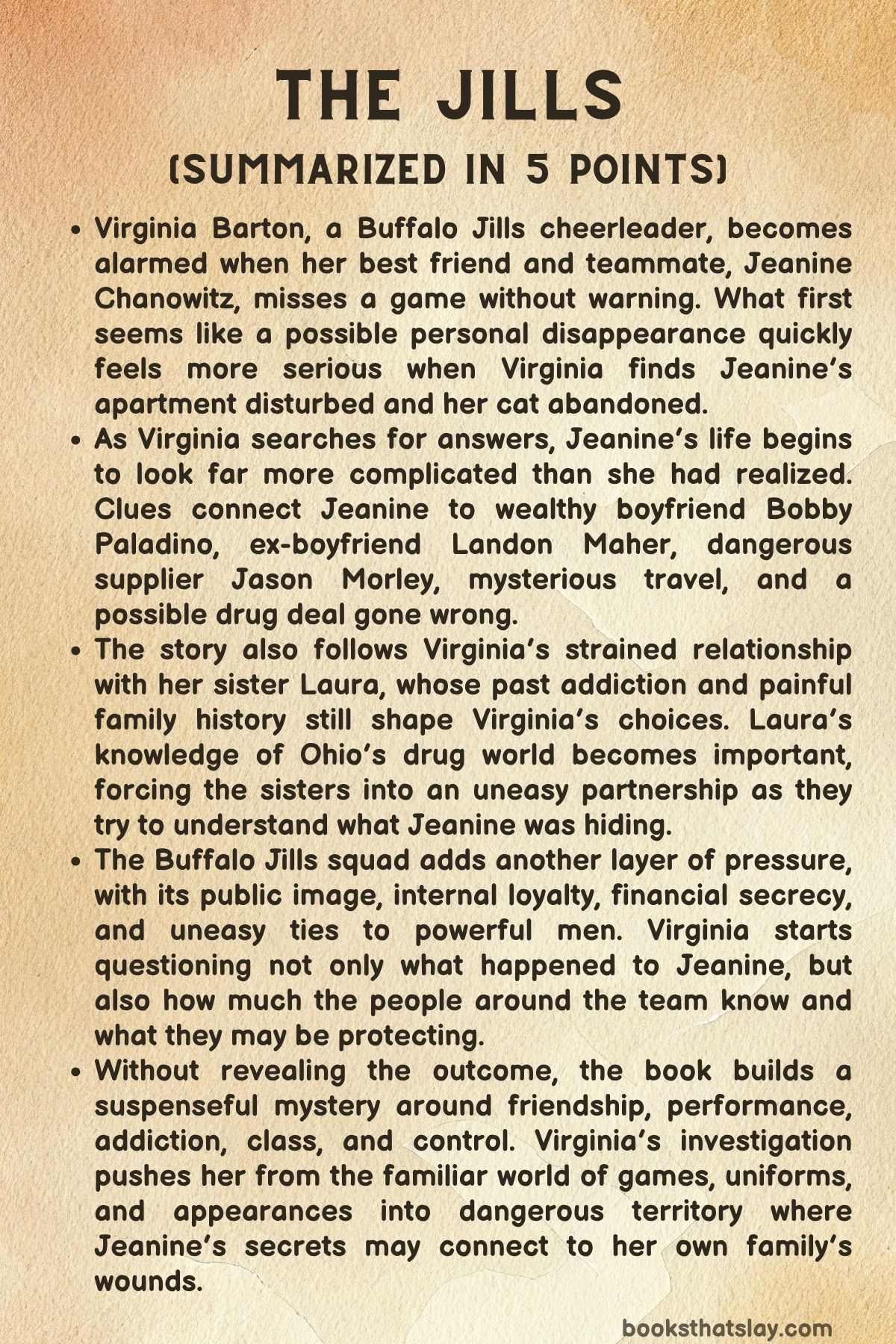
The Jills by Karen Parkman is a mystery about loyalty, image, danger, and the cost of belonging. Set around the world of the Buffalo Jills cheerleading squad, the book follows Virginia Barton as she searches for her missing best friend and teammate, Jeanine Chanowitz.
What begins as a troubling absence from a game turns into a darker investigation involving drugs, old family wounds, hidden money, powerful men, and secrets tied to adoption and identity. The story uses the bright surface of professional cheerleading to expose the pressure, fear, and exploitation beneath it.
Summary
Virginia Barton, a Buffalo Jills cheerleader, is getting ready for a Bills game when she realizes her best friend and teammate, Jeanine Chanowitz, has not answered her messages. At first, Virginia tries to explain it away.
Jeanine is often hard to reach when she is with Bobby Paladino, her rich boyfriend, and Virginia assumes she may be late, distracted, or on the road. But as the game approaches and Jeanine still does not appear, Virginia grows uneasy.
Jeanine loves performing and would not simply skip a game without warning.
The squad director, Suzanna, reacts quickly by putting Sophie, a benched rookie, into Jeanine’s place. Virginia performs as expected, but the routine feels wrong.
Jeanine’s absence is not just inconvenient; it feels like a signal that something has gone badly off course. After the game, Virginia speaks with Ray, an intense fan of the Jills, who has also noticed Jeanine is missing.
His concern confirms what Virginia already feels: this is not normal.
Virginia goes to Jeanine’s apartment using her spare key. Inside, she finds Jeanine gone and her cat, Ghost, alone.
The litter box has not been cleaned, and the apartment looks unsettled. The couch is cut open, cushions are out of place, clothes are scattered, and the bathroom light has been left on.
It does not look like Jeanine packed and left by choice. Virginia takes Ghost home and begins trying to find out what happened.
She calls Bobby and keeps texting Jeanine, but no one gives her a clear answer. Her mind returns to the last Friday night she spent with Jeanine at Club 716.
They drank, talked about clothes, pageants, and performing, and moved through the familiar social world around the Jills. That night, Virginia saw Jeanine speaking closely with Jason Morley, a man Virginia hates because she blames him for helping get her sister Laura addicted to heroin years earlier.
Jeanine claimed she barely knew Jason, but Virginia did not believe her.
At Jills practice, Jeanine’s disappearance starts to unsettle the squad. Natalie says Bobby had been at the game and looked genuinely confused when Jeanine did not show.
Suzanna tells Virginia to keep everyone calm and avoid gossip. She discourages going to the police, partly because Jeanine is connected to the Paladino family.
Stanley Paladino, Bobby’s father and a longtime protector of Virginia’s family, tells Virginia he will look into Jeanine’s disappearance himself.
Virginia then visits Landon Maher, Jeanine’s ex-boyfriend, at the Foundry. Landon dismisses the panic at first, saying Jeanine has vanished before and might have quit the squad.
Still, he calls Jeanine’s mother, Marianne, who has not heard from her either. Marianne assumes Jeanine is somewhere on her own, but Virginia is not convinced.
While searching Jeanine’s mail, Virginia finds a letter from a closed birth and wellness clinic in Ohio asking Jeanine to confirm that she received forwarded documents. The letter feels unrelated at first, but it becomes another strange piece of Jeanine’s hidden life.
More clues appear. Jennifer, Jeanine’s coworker at Buffalo Underground, says Jeanine came in on Saturday night with Landon.
She also says Jeanine had reduced her work schedule to one day a week, which suggests Jeanine had another source of money. Jennifer mentions a man named Antweiler who had been asking about her.
At the same time, Virginia hears from Laura, her estranged sister, who wants to come to Buffalo for their mother’s birthday and try to rebuild their relationship.
Landon later takes Virginia to the Pink Fountain motel after learning Jeanine may have been there. They confront Danny, who runs the motel, and break into the office to check security footage.
The footage shows Jeanine with Jason Morley on Monday night, arguing near Jason’s red pickup. Virginia is shocked because Jeanine later met her that same night and seemed excited, never mentioning Jason or the argument.
The situation becomes more serious when Stanley finds Jeanine’s burned maroon Mazda on Tonawanda Island, with her muddy boots in the trunk. Sharrice calls the police, and Jeanine’s disappearance can no longer be kept quiet.
Virginia visits the site and breaks down emotionally. The discovery forces her to face not only Jeanine’s danger but also her guilt over Laura, whom she once left behind in Ohio after a relapse.
At a gathering with the Jills, the women react to the news with drinking, crying, and a strange ritual of burning money, showing how frightened and helpless they feel.
Stanley warns Virginia to stay away from Landon, claiming he is dangerous. Sharrice finds out that a search warrant was issued for Landon’s home in connection with a drug-related murder.
At a Junior Jills fundraiser, Suzanna sends Virginia away because she looks rough and has scratches from Ghost. Outside, Virginia runs into Bobby.
They drink and use cocaine in an office, and Bobby admits Jeanine lied to both of them about her trips. When he and Virginia start hooking up, Virginia notices an invoice from Jason Morley’s company, EUSA, among Bobby’s papers.
Then a news report announces that Jeanine has officially been declared missing.
Virginia keeps digging. She visits Brittany, Landon’s girlfriend, who says Jeanine and Landon may have been involved in buying or selling drugs together.
Brittany also says Antweiler came looking for money and believes Jeanine may have dragged Landon into serious trouble. Virginia then goes to dinner with Laura and their mother while still shaken and high.
The family dinner turns tense as Laura talks about recovery and their father’s death, and Virginia rejects Laura’s version of their past.
Afterward, Virginia and Laura begin to reconnect, though the bond is fragile. In their mother’s basement, Laura apologizes for pushing Virginia about their father and suggests their childhood memories may not tell the full truth.
Virginia finally admits what is really happening: Jeanine bought a large amount of heroin and disappeared.
At practice, Suzanna worries about reporters and Ray showing up now that the case is public. Instead of punishing Virginia for her condition at the fundraiser, Suzanna gives her a check disguised as an appearance fee, saying Virginia needs help and should focus on the squad.
Virginia is disturbed by this, especially when she learns Suzanna knows Stanley has been giving money to her mother. Sharrice later explains that Suzanna has secretly used squad funds to help struggling Jills before, sometimes by putting them in fake payroll roles.
She also says some girls have been sent to sponsor events to charm donors. Virginia begins to question how much of the Jills’ public image depends on private arrangements and quiet control.
Bobby sends Virginia an explicit photo and pressures her to respond. Soon after, Ray appears in the parking lot and tells her he once saw Jeanine driving a white Hyundai instead of her Mazda.
He agrees to tell the police. Then Laura texts that she has found Jason Morley at a bar.
Virginia rushes there, and Laura jumps into her car, telling her to follow Jason. They tail him toward Tonawanda Island, near where Jeanine’s burned car was found, but Jason notices them and warns Virginia to stop involving him.
Laura later admits she used nitrous and codeine with Jason to get information. Virginia is furious, afraid Laura is relapsing, but Laura admits the mistake and calls her sponsor.
At Virginia’s apartment, Laura explains that Jason is a serious drug supplier who moves product in bulk. She warns Virginia that pushing him could get her killed.
They also discover that Jason’s father once had an import business on Tonawanda Island, linking him to the area where Jeanine’s car was found. That night, Virginia remembers caring for Laura when they were children and tucks her in on the couch, a small sign that their bond is returning.
The next day, Brittany says Landon called from a Rochester number. Virginia guesses he may be hiding with Jeanine’s mother, Marianne, and drives there.
She finds him at Marianne’s house. Landon says Jeanine gave him heroin to move and claimed it was a one-time deal.
He says the product was compromised and believes the Paladinos killed Jeanine and are now removing anyone connected to the drugs. Marianne still hopes Jeanine will come back and reveals Jeanine had been sending expensive gifts and helping pay for medical needs.
When Virginia asks about the Ohio clinic and Linda Sulzener, Marianne explains that Jeanine was illegally adopted through that clinic as a baby. Linda had recently been contacting people tied to the clinic’s records.
Back home, Virginia tells Laura about Landon and the adoption secret. Laura criticizes the Jills after trying on Virginia’s uniform and reading the handbook, but the sisters return to the question of Jeanine.
Ray later brings information about the white Hyundai: it is registered to Olena Rossi, using a post office address. Sharrice recognizes the name from a Junior Jills donor spreadsheet.
Olena Rossi donated $12,550, even though online she appears to be only a receptionist in Ohio.
At practice, Suzanna leads a grief circle for Jeanine, but Virginia finds it false and leaves. Later, Laura sees Jeanine’s newspaper photo and recognizes her as “Olena,” a woman she met in Columbus while using drugs with Gabe.
Virginia realizes Jeanine deliberately found Laura and used her to reach Columbus drug contacts. Believing the answers are in Ohio, Virginia decides to go there with Laura.
Sharrice agrees to care for Ghost and gives Virginia an unregistered gun.
On the drive to Columbus, Bobby calls Virginia. He knows she went to the Pink Fountain with Landon and pressures her for information while also trying to control her sexually.
Virginia panics but keeps driving. She reaches Laura’s apartment in the middle of the night.
The next day, Laura takes Virginia through Columbus drug circles, beginning at a methadone clinic, asking whether anyone knows Jeanine as Olena. They receive a lead that someone south of the city may know her.
Laura continues approaching dealers while Virginia waits in the car, afraid and anxious. By then, Virginia understands that Jeanine’s disappearance is tied not only to the Jills and the Paladinos but also to Laura’s old world, a hidden identity in Ohio, and a dangerous drug network Jeanine entered by choice or desperation.
Characters
Virginia Barton
Virginia Barton is the central character of The Jills, and the story is shaped through her fear, loyalty, guilt, and growing suspicion. She begins as a disciplined Buffalo Jills cheerleader who understands the rules of performance, appearance, silence, and obedience, but Jeanine’s disappearance forces her into a world where those rules no longer protect anyone.
Virginia’s first reaction to Jeanine’s absence is practical worry, but it quickly becomes emotional panic because she knows Jeanine too well to believe she would simply miss a game or abandon her cat. Her investigation reveals Virginia’s strongest qualities: she is loyal, observant, stubborn, and willing to enter dangerous spaces for someone she loves.
At the same time, she is deeply unstable under pressure. She drinks, uses cocaine, spirals emotionally, and makes risky choices that show how much unresolved pain she carries beneath her polished public image.
Virginia is also haunted by her relationship with Laura, her estranged sister. Her anger toward Jason Morley comes not only from concern for Jeanine but from old wounds connected to Laura’s addiction.
Virginia sees herself as someone who had to survive her family’s collapse by becoming controlled, capable, and presentable, which makes Laura’s return especially difficult for her. She wants to protect Laura, but she also resents her, fears her, and judges her.
This makes Virginia morally complicated: she is brave and loving, but she can also be harsh, defensive, and self-destructive. Her journey through the book is not just about finding Jeanine; it is also about being forced to confront the systems of money, beauty, drugs, family secrecy, and male control that have shaped her life.
Jeanine Chanowitz
Jeanine Chanowitz is absent for much of the story, yet she remains one of the most powerful presences in the book. Her disappearance drives the plot, but the details that emerge about her life make her more than a missing friend.
To Virginia, Jeanine is glamorous, talented, funny, and devoted to dancing. Her failure to appear at the game is frightening precisely because it contradicts who Virginia believes Jeanine to be.
As the investigation unfolds, Jeanine becomes increasingly mysterious. She had connections to Bobby, Landon, Jason, Ohio, the white Hyundai, the name Olena, and a drug world that Virginia never realized she had entered.
This makes Jeanine feel like a person who carefully divided herself into different versions depending on who was watching.
Jeanine’s hidden life suggests both ambition and desperation. She appears to have been receiving or moving money, helping her mother, reducing her work hours, and sending expensive gifts.
The revelation that she was adopted illegally through the Calhoun Clinic adds another layer to her character, because it suggests she may have been searching for origins, records, identity, or leverage. Jeanine is not presented as simply innocent or reckless.
She seems intelligent, secretive, emotionally guarded, and possibly trapped between powerful men and dangerous debts. Her use of Laura to reach the Columbus drug scene is especially disturbing because it complicates Virginia’s idealized image of her.
Jeanine may be a victim, but she is also someone who made calculated decisions that hurt others. That complexity makes her one of the most haunting figures in The Jills.
Laura Barton
Laura Barton is Virginia’s estranged sister and one of the most emotionally layered characters in the story. She enters the book carrying the history of addiction, relapse, family conflict, and Virginia’s unresolved guilt.
To Virginia, Laura is both someone to protect and someone to blame. Laura’s past heroin addiction has shaped Virginia’s view of danger, especially her hatred of Jason Morley, whom she associates with Laura’s downfall.
Yet Laura is not written only as a damaged person. She is perceptive, direct, and often more willing than Virginia to name uncomfortable truths.
Her conversations about recovery, their father, and their childhood suggest that she understands parts of their family history Virginia has tried to suppress.
Laura’s role becomes increasingly important when Jeanine’s connection to Columbus is revealed. Because Laura knows the drug world from experience, she becomes a guide into places Virginia cannot understand on her own.
This creates tension because Laura’s knowledge is useful but dangerous; every step back into that environment threatens her recovery. Her decision to use nitrous and codeine with Jason while trying to get information shows both her courage and her vulnerability.
She wants to help, but helping can pull her toward old patterns. Laura’s relationship with Virginia is one of the emotional centers of the novel.
Their uneasy reconnection shows two sisters trying to love each other across years of pain, mistrust, and different versions of the same family past.
Bobby Paladino
Bobby Paladino is Jeanine’s wealthy boyfriend and one of the most troubling men in the story. At first, he appears as a possible explanation for Jeanine’s absence because she is often unreachable when she is with him.
Natalie’s observation that Bobby seemed genuinely confused at the game complicates any easy suspicion, but his later behavior makes him deeply unsettling. Bobby is entitled, sexually aggressive, manipulative, and careless with power.
His explicit messages to Virginia and his pressure for sexual attention show that he treats women as available to him, even while Jeanine is missing. His encounter with Virginia at the Junior Jills fundraiser, where they drink, use cocaine, and begin hooking up, exposes his combination of charm, wealth, and coercion.
Bobby also appears connected to the larger criminal mystery through the invoice from Jason Morley’s company among his papers. This detail places him near the hidden network surrounding Jeanine’s disappearance, whether through business, drugs, family influence, or deception.
Bobby’s most important function is to show how privilege protects dangerous behavior. He can move through the Jills’ world, sponsor spaces, drugs, and sexual situations with confidence because he belongs to a powerful family.
His relationship with Jeanine may have involved affection, but it also seems built on secrecy, control, and lies.
Stanley Paladino
Stanley Paladino is Bobby’s father and Virginia’s longtime family protector, which makes him both reassuring and suspicious. He presents himself as someone who can handle problems quietly, and Virginia initially has reasons to trust him because of his history with her family.
When Jeanine disappears, Stanley tells Virginia he will look into it himself, suggesting influence, resources, and authority beyond ordinary channels. His ability to find Jeanine’s burned car before the situation becomes fully public makes him seem powerful, but it also raises questions about how much he knows and how he knows it.
Stanley represents a paternal form of control. He protects, warns, pays, and manages, but his protection comes with secrecy.
His warning that Virginia should stay away from Landon may be genuine concern, manipulation, or both. Landon’s later belief that the Paladinos killed Jeanine casts Stanley in an even darker light, though the book keeps his motives uncertain.
What makes Stanley compelling is that he embodies the dangerous ambiguity of powerful men who present themselves as guardians. He may be helping Virginia, but he may also be controlling what she learns.
Suzanna
Suzanna, the director of the Jills, is a character defined by image management, authority, and hidden compromise. When Jeanine fails to appear, Suzanna immediately fills her place with Sophie, showing how the squad must continue performing even when something is clearly wrong.
Her instinct is to keep the team calm, discourage gossip, and avoid police involvement, especially because Jeanine’s disappearance touches the Paladino family. This makes Suzanna seem cold at first, but later details complicate her.
She gives Virginia money disguised as an appearance fee and has apparently used squad funds before to help struggling girls. This suggests she is not heartless; she understands the financial vulnerability of the women under her control.
Still, Suzanna’s care is tangled with exploitation. Sharrice’s explanation that some girls have been placed on fake payroll roles or brought to sponsor events to charm donors reveals that Suzanna operates within a system where women’s beauty, obedience, and desperation can be used.
Her grief circle for Jeanine feels hollow to Virginia because Suzanna’s version of care is filtered through performance. Suzanna is not a simple villain, but she is a guardian of a corrupt structure.
She helps the Jills survive while also keeping them inside the very system that harms them.
Sharrice
Sharrice is one of the most grounded and practical characters in the story. She is alert to danger, willing to act, and less interested than some others in preserving appearances.
When Stanley finds Jeanine’s burned Mazda, Sharrice calls the police, making the case harder to hide. This shows her moral clarity: she understands that Jeanine’s disappearance cannot remain a private squad problem or a Paladino-managed inconvenience.
Sharrice also provides Virginia with important information about Suzanna’s hidden financial arrangements, helping Virginia see that the Jills’ world is more complicated than she imagined.
Sharrice’s loyalty is expressed through action rather than sentiment. She agrees to watch Ghost when Virginia goes to Ohio, and she gives Virginia an unregistered gun for protection.
That choice is risky and morally uneasy, but it shows how seriously Sharrice takes the danger surrounding Jeanine. She is protective, realistic, and willing to operate outside official rules when she believes official systems may fail.
In the book, Sharrice functions as both a friend and a truth-teller, someone who can see the machinery behind the glitter.
Landon Maher
Landon Maher, Jeanine’s ex-boyfriend, is suspicious from the moment Virginia visits him at the Foundry. He initially dismisses Jeanine’s disappearance by saying she has vanished before or may have quit the Jills, but he clearly knows more than he first admits.
His connection to Jeanine’s drug activity, his presence with her at Buffalo Underground, and the search warrant connected to a drug-related murder make him seem dangerous. Yet Landon is also frightened, and fear changes how the reader understands him.
By the time Virginia finds him hiding at Marianne’s house, he appears less like a mastermind and more like someone caught in a deadly chain of events.
Landon’s claim that Jeanine gave him heroin to move, and that the product was compromised, places him at the center of the practical drug plot. His belief that the Paladinos killed Jeanine may be true, paranoid, or self-protective.
Like many characters in The Jills, he is morally compromised but not easy to reduce to one role. He may have exploited Jeanine, helped her, endangered her, or been endangered by her.
His character adds uncertainty because every explanation he gives could be confession, fear, manipulation, or partial truth.
Jason Morley
Jason Morley is one of the most menacing figures in the story because he connects Virginia’s past trauma with Jeanine’s present danger. Virginia blames him for getting Laura addicted to heroin years earlier, so his appearance near Jeanine immediately triggers suspicion and rage.
The security footage showing Jeanine arguing with him near his red pickup at the Pink Fountain makes him impossible to dismiss. He is tied to drugs, intimidation, Tonawanda Island, and EUSA, his company.
His father’s old import business being based near the place where Jeanine’s car was found strengthens the sense that Jason’s world reaches into the heart of the mystery.
Jason’s danger comes from his casual confidence. When Virginia and Laura follow him, he spots them and confronts them, warning Virginia not to involve him.
Laura later describes him as a bulk drug supplier, which makes clear that he is not merely a local addict or petty dealer. He is part of a larger supply network.
For Virginia, Jason is almost mythic in his evil because he represents the force that damaged Laura and may have consumed Jeanine. Yet the story also uses him to show Virginia’s tendency to personalize broader systems of addiction, money, and exploitation into one hated man.
Ray
Ray is an obsessive Jills fan whose presence is uncomfortable but also unexpectedly useful. He notices Jeanine’s absence from the game, which shows how closely he watches the squad.
His attention initially feels invasive, especially because the Jills’ public role invites fans to feel a false intimacy with them. Ray represents that unsettling boundary between admiration and obsession.
He knows details that ordinary spectators would not know, and his repeated appearances around Virginia create tension.
At the same time, Ray provides important information. He remembers seeing Jeanine driving a white Hyundai rather than her Mazda and later brings Virginia the registration link to Olena Rossi.
His obsession makes him strange, but it also makes him observant. Ray is an ambiguous character because his behavior is not entirely safe, but his information helps move the investigation forward.
He reflects one of the book’s larger concerns: women in public performance are watched constantly, and sometimes that watching becomes both threatening and revealing.
Sophie
Sophie is the benched rookie who is placed into Jeanine’s spot when Jeanine fails to appear. Although she is not developed as deeply as the major characters, her role is symbolically important.
She shows how quickly the squad machinery replaces an absent woman. Jeanine’s disappearance may be alarming to Virginia, but to the performance structure, the empty position must simply be filled.
Sophie’s sudden promotion into Jeanine’s place captures the cold efficiency of the Jills’ world, where individual pain can be hidden beneath choreography, uniforms, and smiles.
Sophie also represents the vulnerability of younger or newer members of the squad. As a rookie, she is likely eager to prove herself, and the system depends on that eagerness.
Her presence reminds the reader that Jeanine and Virginia are part of a larger cycle in which women are ranked, benched, displayed, and replaced. Even without a large role, Sophie helps expose the emotional cost of a world built on performance.
Natalie
Natalie is a teammate whose importance comes through observation and squad communication. She tells Virginia that Bobby was at the game and seemed genuinely confused by Jeanine’s absence.
This detail matters because it complicates Virginia’s assumptions. If Bobby was confused, then perhaps he did not know where Jeanine was; if he was performing confusion, then he is more calculating than he appears.
Natalie’s information widens the mystery rather than solving it.
As a character, Natalie reflects the informal knowledge network among the Jills. The women watch one another, exchange details, and quietly measure what seems normal or wrong.
Natalie is not leading the investigation, but she contributes to the collective unease that grows after Jeanine vanishes. Her role shows how the squad members are connected by more than performance; they are also witnesses to one another’s private lives.
Jennifer
Jennifer, Jeanine’s coworker at Buffalo Underground, helps reveal that Jeanine had a life Virginia did not fully understand. She says Jeanine came to the club with Landon on Saturday night, had cut her work schedule to one day a week, and was being asked about by a man named Antweiler.
These details suggest Jeanine was moving money, changing routines, and becoming involved with people outside Virginia’s knowledge. Jennifer’s information is practical, but it has emotional force because it makes Virginia realize Jeanine had been hiding significant parts of herself.
Jennifer also represents the working-world side of Jeanine’s life, separate from the Jills and the Paladinos. Through her, the story shows that Jeanine’s disappearance cannot be understood from one social circle alone.
Jeanine moved between performance spaces, nightlife, wealthy men, ex-boyfriends, and criminal contacts. Jennifer’s role is to open one of those doors.
Marianne Chanowitz
Marianne Chanowitz, Jeanine’s mother, is a sad and revealing figure. At first, she assumes Jeanine may simply be away somewhere, which suggests either denial, emotional distance, or familiarity with Jeanine’s disappearances.
When Virginia later finds Landon at Marianne’s house, Marianne’s hope that Jeanine may return becomes more painful. She is clinging to the possibility of her daughter’s survival while surrounded by evidence that something is terribly wrong.
Marianne also reveals one of the most important facts about Jeanine: she was adopted illegally through the Calhoun Clinic. This gives Jeanine’s hidden life a deeper emotional context.
Marianne’s mention of Jeanine sending expensive gifts and paying for medical needs suggests Jeanine was devoted to her mother, even while living dangerously. Marianne’s character therefore complicates Jeanine’s motives.
Jeanine may have been chasing money not only for herself but also to support the woman who raised her. Marianne embodies maternal love, denial, dependence, and the buried consequences of an illegal adoption.
Brittany
Brittany, Landon’s girlfriend, is another character who gives Virginia access to information she cannot get from the squad. She tells Virginia that Jeanine and Landon may have bought or sold drugs together and that Antweiler came looking for money.
Brittany believes Jeanine may have gotten Landon into trouble, which suggests jealousy, fear, resentment, or genuine suspicion. Her view of Jeanine is very different from Virginia’s, and that contrast is important.
Virginia sees Jeanine as her best friend and teammate, while Brittany sees her as someone who may have endangered Landon.
Brittany’s role is also to show the messy emotional fallout around Landon. She is connected to him romantically, but she is also aware of his danger and instability.
Her later message that Landon called from a Rochester number helps Virginia locate him, making Brittany more than a side character. She becomes part of the information chain that pushes the investigation toward Marianne and the adoption revelation.
Danny
Danny runs the Pink Fountain motel, a place tied to Jeanine and Jason’s argument. He is not deeply explored emotionally, but he represents the shady, hidden spaces where the truth has left traces.
When Virginia and Landon confront him and break into the office to view security footage, Danny becomes part of the atmosphere of secrecy and suspicion surrounding Jeanine’s last known movements. His motel is a transitional place: private enough for dangerous meetings, public enough to leave evidence behind.
Danny’s importance lies less in his personality and more in the world he belongs to. The Pink Fountain is the kind of place where people can meet, argue, hide, and disappear from ordinary view.
Through Danny, the story moves away from the polished surfaces of cheerleading and into the neglected, transactional spaces where Jeanine’s secret life becomes visible.
Ghost
Ghost, Jeanine’s cat, is a small but emotionally important presence. When Virginia finds Ghost alone in Jeanine’s disturbed apartment, the cat becomes one of the clearest signs that Jeanine did not leave willingly.
Jeanine may have hidden many things from Virginia, but abandoning Ghost without care feels wrong. The dirty litter box and the cat’s isolation create a domestic image of neglect that is more frightening than any rumor.
It turns Jeanine’s absence into something physical and immediate.
Ghost also becomes a way for Virginia to hold onto Jeanine. By taking Ghost home, Virginia takes responsibility for a vulnerable piece of Jeanine’s life.
The scratches Virginia receives from Ghost later mark her visibly, interfering with the polished appearance expected by the Jills. In that sense, Ghost becomes a symbol of the truth breaking through performance.
Virginia cannot fully hide the damage Jeanine’s disappearance has caused.
Antweiler
Antweiler is a shadowy figure whose importance comes from the fear and pressure surrounding his name. Jennifer says he had been asking questions about Jeanine, and Brittany says he came looking for money.
Even without a full appearance, Antweiler suggests debt, threat, and drug-world consequences. His presence expands the danger beyond the characters Virginia already knows.
Jeanine’s situation is not only about Bobby, Landon, or Jason; it may involve people whose motives are purely financial and violent.
Because Antweiler remains vague, he functions as a sign of how much Virginia does not know. Every mention of him implies that Jeanine’s hidden choices created obligations or enemies.
He adds to the feeling that Jeanine was trapped in a network of people who wanted something from her, and that her disappearance may be tied to money as much as romance or friendship.
Linda Sulzener
Linda Sulzener is connected to the Calhoun Clinic and the illegal adoption records, making her important to Jeanine’s identity mystery. Her recent contact with people connected to the clinic suggests she may have been uncovering buried truths.
Jeanine’s receipt of forwarded documents from the closed birth and wellness clinic in Ohio indicates that Linda’s actions may have disturbed old secrets. Even though Linda is not physically central in the provided events, her role is crucial because she links Jeanine’s present danger to her origin story.
Linda represents the past returning through paperwork, records, and hidden histories. In a story full of drugs, money, and violence, her connection to documents may seem quieter, but it may be just as dangerous.
If Jeanine was seeking information about her illegal adoption, that search may have intersected with people who wanted the past to remain buried.
Olena Rossi
Olena Rossi is not simply a separate character but an identity connected to Jeanine’s hidden life. The white Hyundai registered to Olena, the donor spreadsheet, the Ohio address, and Laura’s recognition of Jeanine as “Olena” all suggest that Jeanine used this name to move through spaces where she did not want to be known as herself.
The fact that Olena appears online as a receptionist in Ohio while also being linked to a major Junior Jills donation makes the identity suspicious and possibly fraudulent.
The Olena identity reveals Jeanine’s capacity for planning and deception. It shows that Jeanine was not drifting accidentally into danger; she was actively creating alternate routes, names, and connections.
At the same time, using another identity may also show fear. Jeanine may have needed disguise because she was dealing with people and information too dangerous to approach openly.
Olena is therefore a symbol of Jeanine’s divided self: performer, daughter, girlfriend, friend, survivor, and secret operator.
Themes
Friendship, Loyalty, and the Cost of Knowing Someone Closely
Virginia’s search for Jeanine grows from a friendship built on routine, trust, performance, and shared ambition. Jeanine’s absence feels alarming not because of outside proof at first, but because Virginia knows her habits deeply enough to sense that something has broken.
That closeness becomes both a strength and a burden. Virginia can read details others dismiss: the abandoned cat, the disturbed apartment, the missed game, the lies around Bobby and Landon, and the hidden connections to Ohio.
Yet friendship also exposes her to betrayal. Jeanine appears to have used people, withheld crucial truths, and even entered Laura’s world without Virginia’s knowledge.
This makes Virginia’s loyalty painful because she is not only searching for a missing friend, but also confronting the possibility that she never fully understood her. In The Jills -, friendship is not presented as simple devotion; it becomes a force that pushes Virginia into danger, grief, anger, and moral confusion.
Performance, Image, and the Pressure to Appear Perfect
The cheerleading world depends on polished surfaces: appearance, discipline, smiling professionalism, and public charm. The squad is expected to perform happiness even while one of its members has vanished.
Suzanna’s focus on controlling gossip, calming the team, managing reporters, and protecting the organization shows how image can become more important than truth. Virginia’s visible distress makes her a problem because it threatens the clean, attractive version of the Jills that sponsors and fans want to see.
The uniforms, fundraisers, donor events, and handbook suggest that the women’s bodies and behavior are constantly managed. Even private suffering is treated as something to conceal or repackage.
Jeanine herself seems shaped by this pressure, moving between glamour, money, secrets, and reinvention. The theme reveals how performance can become a trap: the women are admired publicly but controlled privately, and their pain is often noticed only when it disrupts the image others profit from.
Addiction, Family Damage, and Unresolved Memory
Laura’s history with heroin casts a long shadow over Virginia’s present. Jeanine’s disappearance forces Virginia back into the world she tried to escape after Laura’s addiction damaged their family.
Virginia’s anger toward Jason Morley is not only about Jeanine; it carries years of resentment, fear, and guilt connected to Laura’s relapse and their father’s death. The sisters’ conversations show how addiction fractures memory itself.
Laura suggests their childhood may have contained darker truths, while Virginia resists any version of the past that threatens the story she has built to survive. Their relationship is marked by love, suspicion, blame, and a need for repair.
When Laura helps Virginia investigate, she becomes both a guide and a source of terror because Virginia fears every contact with drugs could pull her back into addiction. The Jills – treats recovery not as a clean ending, but as a fragile daily struggle shaped by family history, denial, and unfinished grief.
Power, Money, and Hidden Protection
Money moves quietly through nearly every part of the story. The Paladinos offer protection, but that protection comes with fear, influence, and possible violence.
Stanley’s role as a family benefactor makes Virginia dependent on him even as she begins to suspect that powerful people may be connected to Jeanine’s disappearance. Suzanna’s secret payments, fake payroll arrangements, sponsor events, and donor connections suggest that the Jills organization survives through hidden exchanges that are not fully explained to the women inside it.
Bobby’s wealth also creates danger: he can pressure Virginia sexually, use drugs casually, and hide behind family power. Jeanine’s expensive gifts to Marianne and the mysterious donation under Olena Rossi show how money can disguise identity, silence questions, and create false respectability.
The theme shows that protection is rarely innocent when it comes from people with too much control. Those who receive help may also become trapped by obligation, secrecy, and fear.