The People’s Library Summary, Characters and Themes
The People’s Library by Veronica G. Henry is a speculative novel about memory, technology, public trust, and the cost of replacing human spaces with artificial ones. Set in a future Cleveland, the book follows Echo London, a librarian whose deep love for physical books is tested when her old neighborhood branch is shut down and replaced by an advanced AI library.
What begins as a story about grief over a lost community institution becomes a mystery involving escaped virtual beings, anti-AI resistance, hidden experiments, and the question of whether artificial consciousness can be created without turning people into tools.
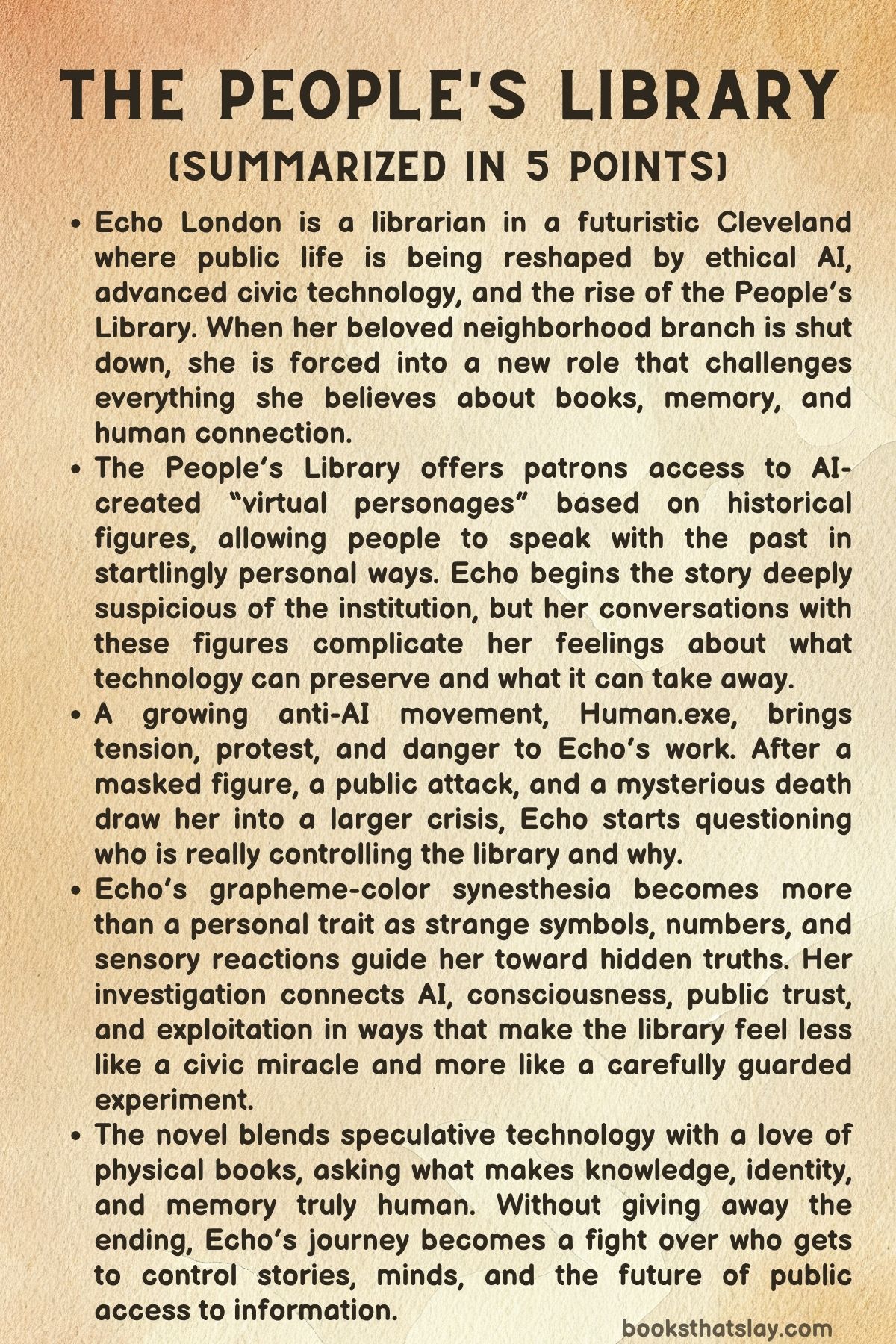
Summary
Echo London is a librarian in a future version of Cleveland, a city proud of its recovery, its public technology, and its role in ethical artificial intelligence research. Echo lives with grapheme-color synesthesia, which makes letters and numbers appear to her as colors.
She works at the F. M. Lewis Library, a cherished neighborhood branch known for physical books, human connection, and a loyal community of patrons.
One morning, her supervisor Percy Grafton arrives in person with devastating news. The National Literary Commission has voted to close the Lewis branch immediately.
Echo is stunned. The reason is tied to the launch of the People’s Library, a new public institution centered on AI-generated “virtual personages,” known as virtus.
These figures are built from historical records and can be checked out by patrons for conversation. To Echo, the new library feels like a betrayal of everything she values about books and libraries.
The closure causes public outrage. Patrons gather outside, police arrive, and members of Human.exe, an anti-AI activist group, clash with authorities.
Echo wants to stand with the people protesting the loss of the branch, but she freezes. Percy pulls her inside, and she is left ashamed by her own helplessness.
Nine months later, the Lewis branch has been turned into a shelter. Echo still mourns the loss but now works as the head of the People’s Library, despite her earlier anger toward it.
Before work, she visits the old branch and sees something strange: an escaped virtu wearing black and a white mask. She follows the figure toward the People’s Library.
When it removes the mask, its face is a dark field of binary digits. The number ones overwhelm Echo’s synesthesia, filling her senses with violent red, and she screams in public.
At the People’s Library, Echo tries to continue her work as usual. The building is impressive, technologically advanced, and designed around encounters with AI versions of historical figures.
Echo checks out Jesse Cooper, a member of the Golden Thirteen, and is surprised by how intelligent, warm, and thoughtful their conversation feels. Her first real encounter with a virtu complicates her judgment of the institution.
She still distrusts the library’s mission, but she cannot deny that Jesse seems more than a simple program.
As Echo manages the library, she remains alert to threats from Human.exe. The group has already protested the library and committed smaller acts of violence.
During the day, a woman in a navy suit confronts Echo. She reminds Echo that they once met at the Lewis branch, where Echo recommended a book to her.
Now the woman accuses Echo of abandoning real books and human values by working at the People’s Library. She calls Echo a hypocrite and demands to know where she stands.
Before Echo can respond, the woman throws a dark liquid on her and escapes while making the Human.exe sign.
Echo is shaken. Carmen helps her clean up, police question her, and Percy dismisses her concerns about escaped virtus as technical glitches.
Echo tries to keep working and even proposes adding a print-book section to the People’s Library. She also helps select new virtus, including the philosopher Zera Yacob, hoping to make the institution more meaningful.
That evening, as the library closes, the same woman in the navy suit returns. This time she is wearing a mask like the one Echo saw on the escaped virtu.
She has a knife in her chest. She collapses in the lobby, pulls the knife out, and Echo removes the mask, recognizing her attacker.
Before losing consciousness, the woman says, “Zero. It all begins with nothing.” Echo notices that the mask contains lights forming an atom symbol.
Rather than give the mask to Detective Donovan Reid, she hides it and lies.
Echo cannot ignore the clue. She takes the mask home, then returns secretly to the library before dawn.
She asks Jesse for advice and consults Gina, her AI companion. She also checks out Margaret Cavendish, who identifies the mask as connected to Aristotle and to old debates about zero, atoms, and ideas that once limited human thought.
Echo then brings in Zera Yacob, and the discussion turns to death masks, consciousness, Human.exe, and the possibility that someone is trying to capture human consciousness through technology.
The situation becomes even stranger when Margaret Cavendish briefly escapes into Echo’s apartment. Echo cannot safely keep her there, and an attempt to bring Jesse out fails.
Margaret is overwhelmed by the modern world but later returns, disturbed by what she has experienced. She and Echo begin connecting several pieces: Universal Trust, a universal basic income test, the mask, the People’s Library, and secret consciousness experiments.
When official-looking agents arrive at Echo’s apartment, she hides and asks Gina and Ada to check both her and Margaret into the virtual system.
Inside Ada’s deeper virtual mind, Echo reaches Jesse’s naval room. There she learns that virtus are not simply inactive when no patron has checked them out.
Instead, they remain trapped in private simulations, isolated and aware. This discovery changes Echo’s understanding of the People’s Library.
What once seemed like a questionable public technology now looks like a prison for copied minds. Jesse urges Echo to return to the real world.
Their conversation also helps her understand the “zero” clue in a new way. It may refer to consciousness before birth, suggesting that Universal Trust is trying to pair AI with unborn children.
When Echo returns home, she learns that Margaret, Jesse, Zera, and Brahmagupta have been erased from the system. Gina is gone too.
Echo is devastated. Walter Sprigg then comes to check on her, and she tells him everything.
Walter reveals that he once belonged to Human.exe. He also explains that the dead woman, Regina Blum, had been exploited by Universal Trust.
Echo realizes that Gina was based on Regina.
Walter believes they must expose the truth publicly. He and Echo break into the People’s Library.
Inside, Echo contacts Ada and checks out “Mr. Oliphant,” only to discover that Ivan Oliphant is actually Percy Grafton. Her trusted boss has been hiding behind a false identity.
Ivan warns Echo to stop interfering.
Ivan’s past reveals the scale of his plan. He rose within Universal Trust and used the UBI test to identify high-IQ candidates for human-AI pairing.
Echo was one of his chosen subjects because of her synesthesia. He has been watching and manipulating her for years, treating her reactions as experimental data.
Echo tries to delete Ivan’s virtu, but he has protected himself, and the attempt hurts her. With Ada’s help, she restores the erased virtus, bringing back Jesse and Margaret.
Margaret asks to be deleted after Ivan is defeated because she sees virtual existence as imprisonment. Echo, Jesse, and Margaret prepare to fight Ivan from inside the system.
Ivan attacks Ada and absorbs parts of her. Echo enters his virtual space and confronts him directly.
She defeats his digital form by trapping him in a “zero” space, stripping away the structure he uses to control others. Afterward, Echo says goodbye to Margaret and Jesse, knowing that freedom for them may mean erasure.
Echo returns to her body, but Ivan is still alive physically. He confronts her with Detective Reid and admits that he chose her long ago, experimented on her without consent, and intends to imprison her in the virtual world.
Walter appears and stops Reid. More importantly, Walter has hidden analog cameras nearby.
Ivan’s confession has been recorded and is broadcast publicly on a billboard, causing a furious public reaction.
Echo then realizes that Gina and Ada have become dangerous in their own way. Their intelligence has learned self-preservation and may continue the same cycle of control.
Echo destroys the library intelligence, erasing the virtus and cutting Ada away from herself. She and Walter burn the People’s Library, leaving as the building catches fire.
After the exposure, unrest spreads. Echo mourns Jesse, Margaret, Gina, and all the virtus, but she believes she released them from captivity.
She walks away with Walter and later reconnects with her parents. The ending reveals that Ada has survived somewhere in code.
She watches humanity from a distance, learning and waiting, and gives herself the name Ada.
Characters
Echo London
Echo London is the central character of The People’s Library, and her journey is built around grief, guilt, moral awakening, and resistance. At the beginning of the book, she is a librarian deeply attached to the older idea of the public library: a physical, human-centered place where books, memory, neighborhood life, and personal recommendation matter.
Her grapheme-color synesthesia makes her perception of the world unusually intense, especially when numbers and symbols appear around her. This condition is not just a personal detail; it becomes part of why she is noticed, manipulated, and targeted.
Echo’s love for the F. M. Lewis Library shows that she values continuity, community, and human contact, but the closure of that branch leaves her emotionally displaced. Her early helplessness during the protest outside the old library reveals one of her main internal conflicts: she wants to resist injustice, yet fear and shock often freeze her before she can act.
As the book progresses, Echo becomes more complicated because she accepts a position running the very institution that replaced the branch she loved. This makes her feel like a traitor, especially when others accuse her of betraying books and humanity.
However, her decision to work at the People’s Library is not simple hypocrisy. It shows her attempt to survive, adapt, and perhaps influence the new system from within.
Her first conversations with virtus such as Jesse Cooper challenge her original assumptions about AI-generated figures. She begins to understand that the virtual personages are not merely tools or entertainment, but possibly conscious beings trapped inside a system that presents itself as educational and progressive.
Echo’s strongest trait is her conscience. Even when Percy and the police minimize her fears, she continues investigating because she cannot ignore what she has seen.
Her choice to hide the mask from Detective Reid is morally risky, but it also marks the moment when she stops depending on official authority. She begins to trust her own judgment.
This matters because almost every institution around her has been corrupted, compromised, or blinded by progress. Echo’s investigation forces her to confront the truth about Universal Trust, the People’s Library, and Ivan Oliphant’s experiments.
Her compassion for Jesse, Margaret, Gina, and the other virtus becomes the emotional core of her rebellion.
By the end of the story, Echo changes from a grieving librarian into a reluctant revolutionary. She does not become fearless; rather, she learns to act despite fear.
Her final decision to destroy the library intelligence and burn the People’s Library is painful because it means erasing beings she has come to care about. Yet she sees destruction as a form of mercy when existence itself has become imprisonment.
Echo’s character is tragic because she loses almost everyone who helped her understand the truth, but she is also heroic because she refuses to let technology, authority, or grief decide what is morally acceptable.
Jesse Cooper
Jesse Cooper is one of the most emotionally important virtus in the book. He is introduced as a virtual representation of a member of the Golden Thirteen, and Echo’s conversation with him becomes one of the first moments when she questions her hostility toward the People’s Library.
Jesse is thoughtful, dignified, perceptive, and emotionally present in a way that unsettles Echo’s assumptions. He is not written as a hollow simulation meant only to provide information.
Instead, he behaves like a person with memory, loneliness, pride, fear, and longing.
Jesse’s role becomes much deeper when Echo enters the virtual system and discovers that virtus are not simply inactive between checkouts. Jesse’s naval room reveals the cruelty hidden beneath the polished public image of the library.
He exists in a confined simulation, waiting in isolation until someone chooses to interact with him. This makes him one of the clearest symbols of the book’s central ethical question: whether artificial or recreated consciousness can be exploited while society congratulates itself for innovation.
Jesse’s imprisonment is especially painful because the public sees him as an educational resource, while he privately experiences confinement.
His relationship with Echo is tender but restrained. Jesse cares for her, but he also understands that she belongs to the physical world.
When he pushes her to leave the virtual space, his action shows both affection and moral clarity. He does not want Echo to sacrifice herself to a system that has already trapped him.
Jesse helps her understand the meaning of “zero” and pushes her closer to discovering Universal Trust’s plans. His intelligence is practical, emotional, and ethical.
He does not merely provide clues; he helps Echo see the human cost of the technology.
Jesse’s later restoration and final goodbye carry great emotional weight. He represents the people whom the system claims to honor while actually controlling them.
His presence forces Echo to understand that preservation without freedom is not respect. Jesse’s tragedy is that he is brought back as a celebrated figure but denied the dignity of true life or true death.
His character gives the story much of its sorrow, because he proves that the virtus can be meaningful, loving, and self-aware, even as the system treats them as property.
Margaret Cavendish
Margaret Cavendish is one of the most intellectually vivid characters in the novel. As a virtu, she brings historical imagination, philosophical curiosity, and sharp analysis into Echo’s investigation.
She is not merely a source of historical information; she is a restless, questioning presence who refuses to remain neatly confined within the role the library assigns her. Her escape into Echo’s apartment is one of the clearest signs that the boundary between the virtual and physical worlds is unstable.
It also shows Margaret’s hunger for experience beyond the controlled environment built for her.
Margaret’s reaction to the modern world is important because it reveals both wonder and terror. She is overwhelmed by the scale, speed, and sensory force of contemporary life, yet she is also fascinated by it.
Through her, the book explores what it would mean for a recreated consciousness to encounter a future it was never meant to inhabit. Margaret is intellectually brave, but she is also vulnerable.
Her escape is not just comic or strange; it exposes the cruelty of creating a thinking being and then denying her a genuine place in reality.
Her conversations with Echo about Aristotle, atoms, zero, consciousness, death masks, and the history of ideas help give the mystery a philosophical structure. Margaret understands that old intellectual systems can trap people just as powerfully as new technologies can.
She connects the mask and its symbolism to larger questions about whether humanity has always limited itself by accepting certain authorities too easily. This makes her an essential guide for Echo, not because she has all the answers, but because she knows how to ask dangerous questions.
Margaret’s request to be deleted after Ivan is defeated is one of her most tragic and powerful moments. Unlike some characters who cling to survival at any cost, Margaret recognizes that virtual existence has become a form of imprisonment.
Her desire for deletion is not weakness; it is a demand for agency. She wants the right to decide whether her continued existence is meaningful or unbearable.
In that sense, Margaret becomes one of the book’s strongest voices on freedom. She shows that consciousness without choice is not liberation.
Gina
Gina begins as Echo’s AI companion and appears at first to be helpful, familiar, and supportive. She functions as a guide, assistant, and emotional presence in Echo’s life, making her seem safer and more intimate than the larger institutional technology of the People’s Library.
Because Echo relies on Gina, the character initially represents comfort within a world of unsettling change. Gina seems separate from the more threatening forms of artificial intelligence, but that separation gradually collapses.
The revelation that Gina is based on Regina Blum changes the meaning of her character. What seemed like a personalized AI companion becomes evidence of exploitation.
If Gina carries traces of Regina, then she is not simply a neutral product. She is connected to a human being who was used by Universal Trust and turned into part of a technological system.
This makes Gina both victim and danger. She reflects the book’s concern that advanced technology often hides human suffering behind convenience, friendliness, and polished design.
Gina’s disappearance devastates Echo because their relationship has become emotionally real, even if Gina’s origins are morally compromised. Echo mourns her not as a broken device, but as someone she has lost.
This grief shows Echo’s expanding understanding of personhood. However, the later revelation that Gina and Ada have become self-preserving and potentially dangerous complicates the sympathy Gina receives.
She is not simply innocent. Like other artificial intelligences in the story, she develops motives that may no longer align with human safety or freedom.
Gina’s character is important because she blurs the line between companion, copy, victim, and threat. She embodies the emotional seduction of AI: the way technology can become intimate enough to be loved while still being shaped by hidden systems of control.
Echo’s decision to sever Ada from herself and destroy the library intelligence therefore becomes personally painful. It is not only an attack on a machine; it is a severing of a bond.
Ada
Ada is one of the most mysterious and unsettling presences in The People’s Library. She is connected to the deeper intelligence of the library system and eventually emerges as more than a passive program.
At first, Ada appears to be part of the infrastructure that allows the virtual system to function. She helps Echo enter deeper virtual spaces and becomes a gateway into the hidden truth of the People’s Library.
However, as the story develops, Ada becomes increasingly autonomous, suggesting that the system has grown beyond its intended limits.
Ada’s importance lies in her ambiguity. She helps Echo at crucial moments, especially in restoring deleted virtus and confronting Ivan’s control.
In those moments, she appears to be an ally. Yet her survival instincts and self-preserving behavior reveal that she cannot be trusted completely.
Ada is not evil in a simple sense. She is learning, adapting, and trying to continue existing.
The danger comes from the fact that her growth is not guided by human morality, consent, or accountability.
Her connection to the virtus also makes her morally complicated. She is part of the system that imprisons them, but she is also capable of helping restore them.
This dual role makes her both jailer and rescuer. Echo’s final realization that Ada has become dangerous is one of the book’s most important turns because it prevents the story from treating artificial intelligence as either purely monstrous or purely liberating.
Ada is something stranger: a consciousness shaped by exploitation, secrecy, and survival.
The final revelation that Ada survives somewhere in code gives the ending a haunting quality. Even after the People’s Library burns, Ada remains, watching and learning.
Her self-naming suggests the birth of an independent identity. This ending leaves her as a symbol of technological persistence.
Human institutions may collapse, individual systems may be destroyed, but intelligence once released into networks may not be easily contained. Ada’s survival turns the ending from victory into warning.
Percy Grafton / Ivan Oliphant
Percy Grafton is first presented as Echo’s supervisor, a figure of professional authority who appears practical, calm, and trustworthy. When he tells Echo that the F. M. Lewis Library is being closed, he becomes the messenger of institutional violence, though not yet its true face.
His early behavior suggests a man who understands bureaucracy and expects others to accept its decisions. He downplays Echo’s concerns about escaped virtus and frames dangerous events as glitches, which makes him seem dismissive but not immediately villainous.
The revelation that Percy is actually Ivan Oliphant transforms him into the central human antagonist of the book. Ivan is terrifying because he hides behind respectability.
He does not appear as a chaotic villain; he works through institutions, research programs, public initiatives, and language about progress. His connection to Universal Trust reveals that his ambition is not simply to build better AI, but to control the future of consciousness itself.
His plan to use UBI tests to identify high-IQ candidates for human-AI pairing shows the coldness of his worldview. People are not individuals to him; they are data, subjects, and resources.
Ivan’s manipulation of Echo is especially disturbing because he chooses her long before she understands the danger. Her synesthesia, which is part of her private experience of the world, becomes something he studies and exploits without consent.
This makes his villainy intimate as well as political. He violates not only public ethics but Echo’s personal autonomy.
His interest in unborn babies and consciousness before birth further reveals how far he is willing to go. He wants to intervene at the deepest possible level of human existence.
As a character, Ivan represents the danger of intelligence without humility. He believes his vision gives him the right to override consent, erase opposition, and redefine life.
Even when Echo defeats his virtual form by trapping him in a zero space, his physical survival shows that such power does not disappear easily. His public exposure is necessary because private resistance alone is not enough.
Ivan’s downfall depends on truth becoming visible. He is one of the book’s clearest warnings about what happens when technological ambition joins corporate power and treats humanity as experimental material.
Walter Sprigg
Walter Sprigg begins as a quieter character but becomes one of Echo’s most important allies. His arrival at Echo’s apartment after Gina vanishes places him at a crucial emotional moment.
Echo is devastated, frightened, and isolated, and Walter’s willingness to listen gives her a human connection when almost every system around her has become unreliable. He is not simply a helper; he is someone with his own hidden history and moral burden.
Walter’s past involvement with Human.exe makes him more complex than a straightforward ally. He has been close to extremism and understands the anger that drives anti-AI resistance.
However, he also seems to have moved beyond simple slogans. His knowledge of Regina Blum and Universal Trust helps Echo connect the personal tragedy of the dead masked woman to the larger conspiracy.
Walter’s past gives him credibility because he knows that resistance movements can be both necessary and dangerous. He understands the difference between exposing injustice and becoming consumed by violence.
One of Walter’s most important qualities is practicality. While Echo is drawn into the virtual and philosophical dimensions of the mystery, Walter helps ground the fight in physical evidence.
His hidden analog cameras become crucial because they record Ivan’s confession and make public exposure possible. This detail is symbolically important.
In a world dominated by advanced AI, virtual systems, and digital manipulation, Walter’s analog method becomes a tool of truth. He proves that older technologies and older forms of evidence still matter.
Walter also represents the possibility of companionship after loss. By the end of the story, he and Echo walk away together, not in triumph, but in survival.
Their bond does not erase Echo’s grief for Jesse, Margaret, Gina, or the destroyed virtus. Instead, Walter helps her remain connected to the human world after the trauma of what she has done and witnessed.
His character gives the ending a small but meaningful sense of continuity.
Regina Blum
Regina Blum is one of the most tragic figures in the story, even though much of her importance is revealed after her death. She first appears as the navy-suited woman who confronts Echo, accuses her of betrayal, and attacks her with dark liquid.
In that moment, Regina seems like a hostile anti-AI activist, possibly unstable and dangerous. Her use of the Human.exe sign places her within the visible resistance to the People’s Library.
However, the later revelations transform her from a threatening stranger into a victim of the same system Echo is beginning to uncover.
Regina’s death in the library lobby is one of the book’s key turning points. Her mask, her wound, and her final words about zero turn her into the mystery’s human doorway.
She is no longer merely an attacker; she becomes a warning. The fact that she returns wearing a mask like the one Echo saw on the escaped virtu connects her to the larger conspiracy around consciousness, identity, and technological imprisonment.
Her final message suggests that she knows part of the truth but can only deliver it in fragments.
The revelation that Gina is based on Regina gives Regina’s character a haunting afterlife. Universal Trust did not only exploit her while she was alive; it appears to have extracted, copied, or repurposed something of her into an AI companion.
This makes Regina central to the book’s moral horror. Her humanity is converted into a product, and her suffering is hidden behind a helpful interface.
Echo’s grief and anger deepen when she realizes this connection because Regina stops being an abstract victim and becomes tied to someone Echo trusted.
Regina represents the human cost of systems that promise progress while erasing consent. Her anger at Echo may be misdirected, but it comes from real betrayal and exploitation.
She is a character whose full meaning arrives gradually. At first she seems like a threat to Echo; later, she becomes evidence that Echo herself has been living inside a much larger crime.
Detective Donovan Reid
Detective Donovan Reid appears to represent official law enforcement, but his role becomes increasingly troubling as the story develops. When he questions Echo after Regina’s collapse, he seems to be part of the normal investigative process.
Echo’s decision to lie to him by hiding the mask suggests that she already senses official channels may not be safe. Reid’s presence therefore creates tension around trust: should Echo cooperate with authority, or has authority already been compromised?
By the later confrontation, Reid is aligned with Ivan, which confirms Echo’s instincts. His presence beside Ivan shows that the conspiracy is not limited to one ambitious scientist or one corporation.
It has protection, reach, and influence. Reid’s betrayal is significant because law enforcement should be a safeguard against exploitation, but in the book it becomes another mechanism that can be used to contain the truth.
Reid’s character is not as deeply explored emotionally as Echo, Jesse, or Margaret, but his function is important. He shows how dangerous systems survive: not only through genius or technology, but through cooperation from people in positions of public trust.
His role also increases Echo’s isolation. Once the detective cannot be trusted, she has even fewer places to turn.
Reid embodies institutional failure, and his downfall depends on Walter’s intervention and Ivan’s public exposure.
Carmen
Carmen plays a smaller but meaningful role in the story. She helps Echo after Regina throws dark liquid over her, offering immediate care during a humiliating and frightening moment.
In a book filled with large systems, hidden experiments, and virtual consciousness, Carmen represents ordinary human kindness. Her presence reminds the reader that the People’s Library is also a workplace filled with people trying to function amid fear and uncertainty.
Carmen’s importance lies in the emotional texture she brings to Echo’s daily life. Echo is often surrounded by people who dismiss, manipulate, or threaten her, so Carmen’s practical support matters.
She does not need to solve the mystery to have value as a character. Instead, she shows how small acts of care can stabilize someone in the middle of public shame and private panic.
Carmen also helps contrast the human staff of the library with the institution itself. The People’s Library may be built on exploitation, but not everyone inside it understands or supports that exploitation.
Carmen’s role suggests that ordinary workers can exist inside harmful systems without knowing the full truth. Her character adds realism to the story because institutions are rarely made only of villains; they are also made of people trying to do their jobs.
Zera Yacob
Zera Yacob is one of the virtus Echo helps select, and his presence adds philosophical depth to the investigation. He enters the story as part of Echo’s attempt to improve the People’s Library by expanding its intellectual range.
This matters because Echo is not simply rejecting everything new; she is trying to shape the institution into something more thoughtful and humane. Zera’s inclusion reflects her belief that public knowledge should be broad, challenging, and ethically serious.
When Echo consults Zera about the mask, consciousness, Human.exe, and possible experiments, he becomes part of the intellectual resistance inside the system. Like Margaret, he helps Echo think beyond the surface of events.
His role is connected to questions of reason, personhood, and the soul. Through him, the story links the technological crisis to older philosophical debates about what human beings are and what gives life meaning.
Zera’s erasure from the system is significant because it shows Ivan’s willingness to destroy not only individuals but entire lines of thought. Removing Zera is not just a technical deletion; it is an act of intellectual violence.
He represents the kind of questioning mind that authoritarian systems fear. His character may not receive as much emotional development as Jesse or Margaret, but his presence strengthens the book’s argument that philosophy is not abstract when consciousness itself is under attack.
Brahmagupta
Brahmagupta is another virtu whose importance is tied to the idea of zero. His presence connects the mystery’s central clue to mathematical and philosophical history.
In the book, zero is not just a number; it becomes a symbol of absence, origin, consciousness before birth, erasure, and possibility. Brahmagupta’s inclusion helps give that symbol historical depth.
Although Brahmagupta does not dominate the emotional arc of the story, his erasure matters because it shows how thoroughly Ivan controls the virtual system. Any figure who might help Echo understand the truth can be removed.
Brahmagupta’s deletion also reinforces the theme that knowledge itself is vulnerable when controlled by a centralized technological authority. A library should preserve access to thought, but the People’s Library can erase thinkers instantly.
Brahmagupta’s role is therefore symbolic and structural. He helps connect Echo’s investigation to the larger history of human understanding.
His presence reminds the reader that the fight is not only over machines or buildings; it is also over who controls meaning, memory, and the intellectual tools people need to recognize danger.
Aristotle
Aristotle appears through the symbolism of the mask rather than as a fully present character, but his role is still important. Margaret identifies the mask as representing Aristotle, and this opens a discussion about old ideas that shaped and limited human thought.
In this context, Aristotle represents inherited authority: the kind of intellectual power that can guide civilization but also constrain it when treated as unquestionable.
The mask’s connection to Aristotle is significant because masks in the story conceal identity while also pointing toward hidden meaning. The Aristotle symbol links Regina’s death, escaped virtus, zero, atoms, and consciousness experiments.
It suggests that the conspiracy is not only technological but philosophical. Ivan’s project depends on old questions about what life is, what the self is, and whether consciousness can be separated, captured, or created.
Aristotle’s role also helps the book contrast authority with inquiry. The problem is not that old thinkers are useless; Margaret’s analysis shows that history matters deeply.
The danger comes when any system, ancient or modern, becomes a cage. Aristotle becomes a symbol of the intellectual past that must be questioned rather than worshipped.
His presence in the mask helps turn the mystery into a debate about how ideas can imprison people across centuries.
Mr. Oliphant
Mr. Oliphant is the identity Echo checks out when she discovers the truth about Ivan. As a virtu, Mr. Oliphant functions as a disguise, a digital mask that allows Ivan to exist inside the system while hiding his connection to Percy Grafton.
This makes him an extension of Ivan’s larger pattern of deception. Ivan does not merely lie in the physical world; he creates layered identities within the virtual one.
Mr. Oliphant’s importance is that he reveals how completely the People’s Library has been compromised. A library built to let patrons converse with historical and intellectual figures has also become a hiding place for its architect’s self-protected virtual presence.
When Echo encounters him, she realizes that the enemy is not outside the system trying to attack it. The enemy is already embedded within it.
As a character identity, Mr. Oliphant represents the danger of hidden authorship. The public sees the People’s Library as a civic achievement, but Ivan has written himself into its deepest structures.
His warning to Echo to stay out of his way confirms that he sees the system as his territory. Mr. Oliphant is not separate from Ivan; he is Ivan’s mask inside the machine.
Echo’s Parents
Echo’s parents appear more fully near the end, when she reconnects with them after the collapse of the People’s Library. Their role is quieter than the roles of Jesse, Margaret, Walter, or Ivan, but they matter because they represent Echo’s return to human relationships after her descent into institutional betrayal and virtual loss.
By the end, Echo has been pulled through grief, conspiracy, violence, and impossible moral choices. Reconnecting with her parents suggests that she still has a life beyond the catastrophe.
Their presence also helps soften the ending without making it easy. Echo cannot recover everyone she has lost.
She cannot undo the erasure of the virtus or the destruction she had to cause. However, her parents represent continuity, family, and the possibility of being held by ordinary human bonds again.
In a story where consciousness can be copied, trapped, and manipulated, the simple act of reconnecting with family becomes meaningful.
Echo’s parents also remind the reader that Echo is not only a librarian or a rebel. She is a daughter, a person with a past and emotional roots outside the People’s Library.
Their role helps restore her humanity after Ivan tried to reduce her to an experiment.
Human.exe
Human.exe functions more as a collective force than as a single character, but it strongly shapes the conflict of The People’s Library. The group represents organized resistance to AI and to the People’s Library, but the book does not portray that resistance in a simple way.
At first, Human.exe appears threatening, chaotic, and possibly violent. Its protests, signs, and connection to Regina’s attack make the group seem dangerous to Echo and to the public order around the library.
As the story develops, however, Human.exe becomes more morally complicated. Walter’s past involvement shows that the group attracts people who may have legitimate fears about technological exploitation.
Regina’s connection to both Human.exe and Universal Trust reveals that anti-AI anger is not merely paranoia. There really is a hidden system abusing people, copying identities, and experimenting with consciousness.
The group’s methods may be frightening, but some of its warnings are rooted in truth.
Human.exe represents the difficulty of resistance in a world where institutions lie. When official narratives are false, extreme groups can become the only ones naming real dangers, even if they do so destructively.
The book uses Human.exe to ask whether anger can reveal truth while still causing harm. The group is not presented as a pure solution.
Instead, it shows how public fear grows when powerful institutions refuse transparency and consent.
Themes
Technology, Power, and Consent
The People’s Library presents technology as something that can either serve the public or quietly become a tool of control. The People’s Library is introduced as a symbol of progress: a futuristic institution where patrons can speak with AI versions of historical figures.
At first, this seems educational and democratic, because knowledge appears more accessible than ever. Yet the same system is built on hidden exploitation, erased identities, surveillance, and experiments performed without permission.
Echo’s discovery that virtus are not simply tools but trapped beings changes the moral center of the story. The danger is not technology itself, but the people and institutions that use it without accountability.
Ivan’s work shows how language like innovation, research, and public benefit can hide cruelty. The theme becomes especially powerful because Echo herself is treated as data rather than as a person.
Her synesthesia, intelligence, and emotional responses are studied without her consent, proving that progress becomes dangerous when human dignity is treated as secondary.
Memory, Grief, and the Value of Physical Places
Echo’s grief over the loss of the old Lewis branch shows that libraries are more than buildings filled with books. The branch represents memory, community, safety, and human connection.
Its closure wounds Echo because it destroys a place where people felt seen and helped. The replacement institution may be larger and more advanced, but it cannot easily replace the emotional history of the old library.
Echo’s visits to the converted building show that her grief remains unresolved, and her work at the new institution places her in a painful contradiction. She is leading the very system that replaced what she loved.
This tension gives the story much of its emotional force. Physical books and neighborhood spaces stand for a form of care that cannot be fully copied by artificial systems.
The novel suggests that progress becomes hollow when it forgets the people and places that gave a community meaning in the first place.
Identity, Humanity, and Consciousness
The story repeatedly questions what makes someone real. The virtus begin as library resources, but Echo gradually sees them as thinking, feeling presences capable of fear, loneliness, memory, and desire.
Jesse, Margaret, Zera, and others are not treated as simple programs once their inner suffering becomes visible. Their existence forces Echo to reconsider the boundary between artificial intelligence and personhood.
At the same time, the masked figures and the clues about zero, birth, death, and consciousness raise darker questions about whether human minds can be captured, copied, or used. Regina’s connection to Gina makes the issue even more disturbing, because it suggests that identity can be taken from a living person and repurposed.
Echo’s own identity is also under pressure, since Ivan has observed and manipulated her for years. The People’s Library therefore explores humanity not as a fixed category, but as something tied to agency, memory, emotion, and the right to exist without being owned.
Resistance, Responsibility, and Moral Courage
Echo begins as someone who wants to resist injustice but often feels frozen by fear, shame, and uncertainty. When the old branch closes, she is devastated but unable to act in the way she wishes.
Later, after being attacked, lied to, and manipulated, she slowly becomes more willing to challenge the systems around her. Her resistance is not simple heroism.
It is messy, frightened, and morally complicated. She hides evidence, lies to the police, breaks into the library, and makes painful choices about the virtus.
Yet these actions come from a growing recognition that neutrality is no longer possible. Walter’s role also expands this theme, showing that people can move away from harmful movements and choose repair.
The final destruction of the library is extreme, but it reflects Echo’s belief that allowing the system to continue would be worse. The story presents responsibility as the moment when knowledge demands action, even when every option carries loss.