The Elsewhere Express Summary, Characters and Themes
The Elsewhere Express by Samantha Sotto Yambao is a contemporary fantasy about what happens when people drift so far from themselves that they slip out of ordinary life. Raya Sia, a burned-out medical student carrying old grief and a buried love for music, suddenly boards a strange train that runs on human thoughts—daydreams, memories, plans, and songs made solid.
There she meets Q, a portrait painter losing his sight, and a shape-shifting conductor who insists the train is both refuge and test. As Raya searches for a way back, she’s forced to face what she believes she was made for—and what she still wants to become.
Summary
Raya Sia enters the world with a purpose assigned before she can choose one. Born prematurely and named Hiraya, she is conceived as a genetic match to help save her older brother, Jace, who lives with thalassemia major.
Her parents, Jason and Cristina, raise her carefully—healthy food, strict routines, constant reminders to stay ready—because her body is treated like a promise that must be kept. Yet her childhood with Jace is not only obligation.
They share secret jokes and midnight cookie raids, and he treats her like a real sister, not a medical solution. Through it all, Raya clings to music.
A nurse’s lullaby becomes the foundation of her songwriting and a private mantra: “Live. Breathe.
Be.” Her parents dismiss music as a phase, insisting she will eventually grow into a more practical dream.
Years later, Jace dies in a way Raya cannot forgive herself for. He becomes brain-dead after a drunk-driving accident, not from the disease that shaped their family’s life.
The loss shatters the story Raya was built around. A decade after his death, she is twenty-five and in her first year of medical school, moving fast through every day as if speed can keep guilt from catching up.
She lives on candy, gummies, and energy drinks, carries an overloaded tote everywhere, and keeps an old purple notebook of songs she refuses to open. Inside her, a single thought repeats: she failed at the one reason she existed.
Without that purpose, she sees herself as leftover material.
In anatomy lab, Raya’s group studies an anonymous cadaver they name “Claire,” an elderly woman with purple hair. At first, Raya treats the work like a checklist item, keeping herself distant.
But naming the body changes the feeling in the room. Claire’s face stops being an object and starts looking like proof of a full life—choices made, time survived, joys and disappointments carried quietly.
The recognition unsettles Raya, and later, alone in a subway station, she breaks down and blames the sting of formaldehyde on her skin, because it’s easier than admitting how fragile she’s become.
On her commute, Raya watches other passengers vanish into their own inner worlds. She senses their thoughts as vivid images: an animal sanctuary built from hope, an ex-lover replayed like a loop, a tree filled with glowing numbers.
Raya tries to keep her own mind locked down, but the scent of rose-and-mint perfume and a flash of wildflowers slip past her defenses. She closes her eyes to the static of her noise-canceling earbuds.
When she opens them, the subway car is gone. In its place is an empty, vintage train carriage.
A uniformed conductor approaches and introduces herself as Lily. She welcomes Raya aboard the Elsewhere Express and explains that her face is borrowed from passengers’ daydreams—tonight, she’s wearing the Lily imagined by someone Raya saw on the subway.
Raya panics and demands to get off, but Lily tells her the train makes no stops and has no normal doors. Raya assumes this means death, but Lily corrects her: Raya isn’t dead; she has “floated away” from her life because she became “too light,” untethered by purpose.
Lily produces Raya’s ticket, a black slip marked with a living golden knot and Raya’s name, along with the station and time she boarded. When Raya crumples it, it melts into her palm, leaving the golden knot imprinted like a tattoo.
Lily shows Raya what “real” means here by making a picture frame hover in midair. Inside the frame is a meadow so vivid it looks touchable, and then a bird flies out into the carriage.
The frame expands into a doorway, and Lily leads Raya through into a grassland that is actually the décor of the boarding car—assembled from multiple commuters’ thoughts.
Lily explains the rules as Raya struggles to believe any of it. Thoughts don’t simply vanish when people return to their routines.
They go somewhere, and the Elsewhere Express is built from that overflow: daydreams, plans, memories, poems, and songs shaped into working parts of a moving world. Doors exist, but they shift, and many passengers cannot perceive them.
Raya can find one only by looking through a frame that reveals golden threads—strands of thought spun from truth, memory, and self-deception. With effort, she finally sees an exit: a circle of glowing wildflowers.
Lily says the doors “sing” to each other, and she can hear them.
Raya passes through and lands in the Lotus, a massive lotus-shaped space under a purple sky where luminous whale sharks drift through clouds. It’s a rice wine bar, and Lily insists welcome drinks are tradition, but Raya refuses.
The door they came through has transformed into a black ceramic bottle and only works in one direction. The bartender, Aki, offers drinks and jokes about distilling emotions.
The moment is interrupted by a crash: a disoriented man has broken a chair in the shadows. He is tall, striking, and confused, with cracked glasses and mismatched sneakers.
Lily calls him a stowaway and demands his ticket. He claims he has none, but Raya notices black paper in his pocket.
Lily reads the slip and abruptly welcomes him as Mr. Philips. Like Raya’s, his ticket dissolves into his palm and leaves the golden knot mark.
The man calls himself Q. He is a celebrated portrait painter who has been losing his vision to a degenerative eye disease. Dreams matter to him because, in them, he can still see.
He also carries a childhood wound: at thirteen, he lost his father to suicide and shortened his name to “Q” so his mother wouldn’t have to speak his father’s name aloud. Q suspects Lily is masked in more ways than one, and he lies easily, as if truth is something that might collapse him if he holds it too long.
Lily forces Raya and Q into life vests and pushes them through another doorway—this time a gold kettle that opens into darkness. They surface on the deck of a huge vessel with crimson sails stamped with golden knots.
The sky is split between morning and night, and beneath the sea, silver train tracks shimmer as if laid on water. Lily says the train travels in loops and doesn’t follow ordinary time because it is made from waking thoughts.
A storm begins, thick with sorrow, and faces rise from the ocean: hollow-eyed figures whispering together. Lily calls them Echoes—passengers who fell from the train after refusing to release excess baggage.
She introduces Mr. Goh, the onboard pharmacist who makes a remedy meant to remove unnecessary memories. Raya and Q refuse it, unwilling to surrender any more of themselves.
Lily warns them that their golden knot marks can unravel if they cling too hard to what weighs them down. To stay anchored, they must find their own compartments.
If they stop moving forward, look back, or force locked doors, they risk losing their bond and falling into the sea to become Echoes. Before she can guide them further, lightning strikes the sail and the storm worsens.
Lily orders them off the deck through an emergency exit—a clay pot that might send them anywhere.
They tumble out into a room filled with paint supplies, ropes, and pulleys, where a painter named Astrid assumes they’ve arrived for a workshop. Astrid explains the crew paints the world outside: oceans, skies, sunrises poured through square openings to become real.
Thoughts used in this way can also drift out and reach people beyond the train as sudden inspiration. Raya and Q need to reach an island below where the only exit door is, but the ladders are risky and they are out of painted stars that can serve as safe slides.
With Raya’s knot fraying, Q paints a star in midair, capturing it in a jar. Astrid releases it through a hole, and it becomes a stardust trail to the beach below.
On the pale-pink shore, they meet Dev, a maintenance worker and photographer, who explains that songs arrive encased in glowing spheres because they are fragile. The train can be repaired with many kinds of thoughts, but songs work best because they last and restore what they touch.
Raya, who has avoided music for years, hesitates—yet she feels the knot on her palm steady slightly. At Dev’s urging, she cracks open a sphere with tools.
A butterfly made of music bursts free, then lands on a withered palm leaf and turns it healthy again. When Raya opens another, a love song settles on Q’s bruised elbow and clears the injury.
Dev tells them everyone aboard has a job, and the simplest purpose is keeping the Elsewhere Express running—because if it fails, everyone aboard fails with it.
A loudspeaker summons “Mr. Philips Jr.” and “Ms. Sia” to meet the conductor. On their way, they climb a surreal spiral stairway inside a dictionary where definitions slide along the walls.
Their guarded conversation turns more honest. Q admits how close he came to stepping off a platform in his old life and how the Elsewhere Express feels like a second chance—especially because he can see clearly here.
Raya refuses to accept that this place is meant to replace her life, insisting she must return, even if she doesn’t know how to live without guilt.
They cross a bridge spun from commuter anxieties and resentments, held by buzzing golden dragonflies. Raya grips the railing and gets stuck, and a huge man with an eyepatch, Other Rasmus, frees her and explains the bridge tightens the longer you hold on.
He also hints at a deeper strangeness: the train’s looping path can collect more than one version of a passenger.
In a private space called the Stew—built from unspoken thoughts where spoken words cannot leak—Lily reveals the real danger. It has begun to rain on the Elsewhere Express, something that should not happen unless the train needs to erase something.
Lily and Rasmus admit they wiped a past incident from memory because fear and doubt can crack the train and eventually break it. They preserved only a warning word: “Rain.” Using a memory serum, they recover fragments: a stowaway, the destruction of a dining car called the Lake, rot spreading, Echoes swarming as they burned the coupler to detach the ruined car and save the rest of the train.
The serum fails to show how it ended, and the loss of the Lake means they cannot easily make more.
They suspect the stowaway has returned, and Lily wants to keep panic from spreading. She assigns Raya and Q to search the route between the art gallery and the opera house, instructing them to get a map from the Archive with Rasmus’s help.
As they move into the Missed and Misplaced Department—a vast lost-and-found for longings, abandoned objects, and paths not taken—the atmosphere darkens. They see piles of wedding rings, discarded tracks, and forgotten stationery.
Q finds a scrap of paper bearing a single word: “Once.” Raya fears she’ll find relics of her own past, and when Q points out a guitar that resembles hers, she denies it could be true. She insists she destroyed her guitar after Jace’s funeral, but Q argues that longing recreates things whole.
Near a massive whirlpool, they encounter Olly—both real and not. Their fingers pass through him, and he explains he is the version of Olly that split away when the original Olly’s old life became distant.
He lingers near the whirlpool because it’s where he feels closest to his other self. Olly warns them the whirlpool is not a door but a drain, and he reveals a secret: memories removed by Mr. Goh’s serum are flushed away through a drain in the pharmacy, and discarded memories can become Echoes.
Faces spiral in the water like the last stage of a terrible cycle. He tells them not to stare, because the pull is strong and the noise of those lost thoughts can overwhelm a person.
Raya and Q escape a rain of dropped phones and watches and hide under a piano, shaken by what they’ve learned. Raya begins to piece together a new idea.
She has a bag of shattered crystal from a miniature train Rasmus once showed them, and she suspects music can repair what is broken here. In the valley of abandoned things, she finds her sticker-covered guitar, restored.
She plays a new song, and its glow gathers the broken crystal, rebuilding the miniature train perfectly. The act proves something Raya has avoided admitting: her music still exists, and it still matters.
Soon after, they arrive at the Wandering City, a shifting river city that never rains, guided by a calm sampan pilot named Alain. He explains that questions are used as currency here because passengers forget how to ask them.
The city changes constantly, formed from fleeting thoughts that reshape docks and buildings like living creatures. Alain agrees to take them where they need to go, but asks them to deliver a basket of rubies to a perfumer, Madame Manon de Lambilly.
Manon’s hidden perfumery sits behind a locked door, and inside, time stops—Raya and Q’s palm-knots freeze in place. The shop is vast, centered around a blooming jacaranda tree and murals that respond like memory itself.
Manon demonstrates that her perfumes hold lived moments: with a spritz, Raya experiences a fragment of Manon meeting her husband. Manon admits she refused the memory tonic because she needed her memories to make perfume and because she refused to lose her husband twice.
She offers Raya and Q a trade: their rare scent—rain—in exchange for any fragrance they want, including a single dose that can restore lost memories. Q accepts, despite Manon’s warning that buried memories can rot when neglected.
When they return to the Archive office, they find Rasmus collapsed, blank and mind-eaten, while Lily tries to help him. As a last resort, Raya and Q offer Manon’s memory-restoring perfume.
Lily uses it on Rasmus—then collapses herself. Rasmus jolts awake in a violent confusion, briefly attacking Q before recognizing Lily and stopping.
He apologizes, horrified by what surged through him. His memories return in unstable shards, mixed with what Echoes have touched.
Still, he recalls key images: cracks spreading from a place called the Belvedere, swarms of moths, and a sense of being overwhelmed.
Desperate to explain what he knows, Rasmus unlocks a drawer and reveals a dusty jar. Inside, something eight-legged and silver stirs—alive with strange purpose.
Rasmus introduces it as Abbie, the Archivist of the Elsewhere Express, hinting that the train’s secrets, its missing memories, and the truth of the rain are about to surface whether Lily wants them to or not.
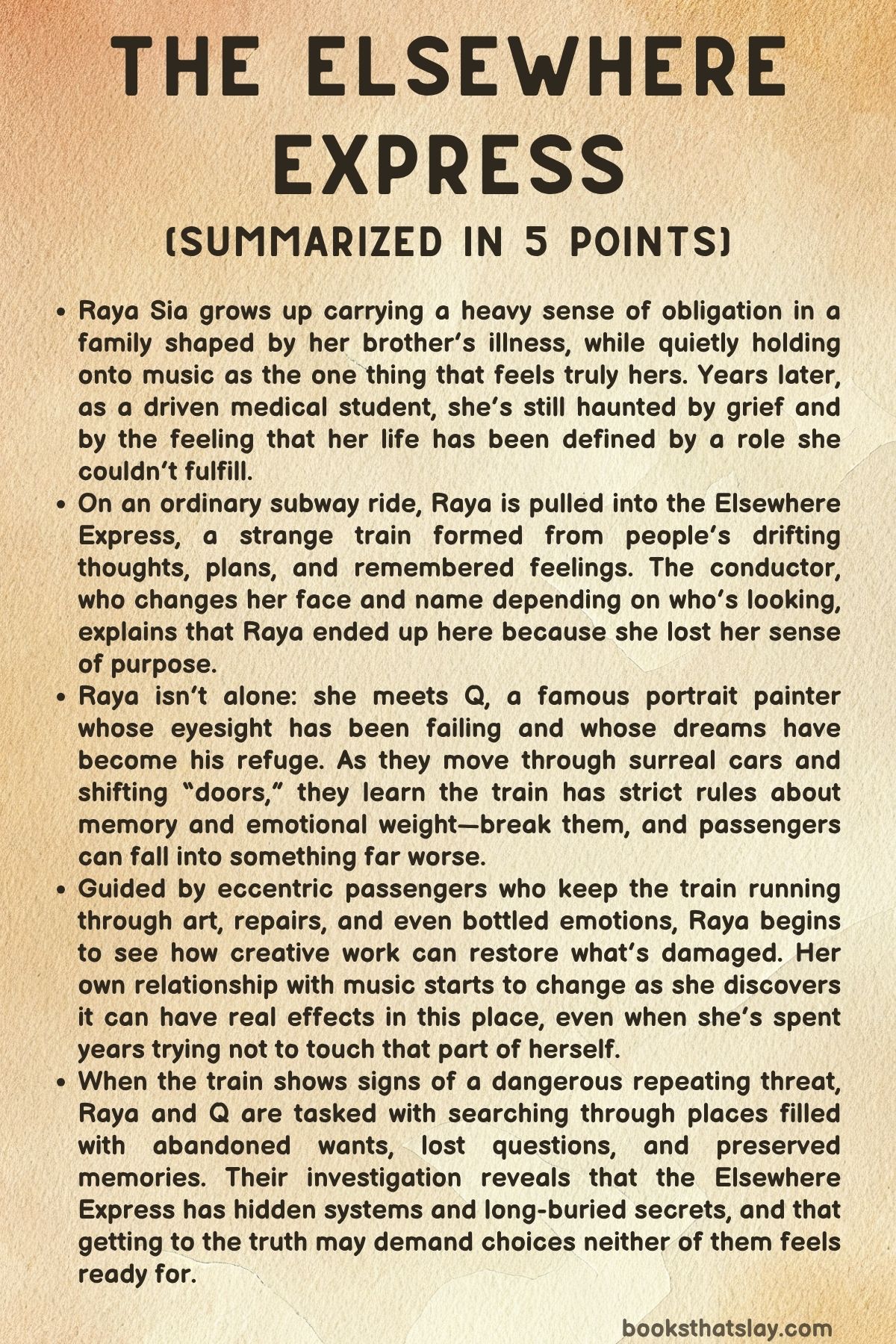
Characters
Raya Sia (Hiraya)
Raya begins life as “Hiraya,” a name that quietly carries her parents’ hope and intention, but she grows up understanding—often too clearly—that her body was conceived as an answer to someone else’s emergency. In The Elsewhere Express, that origin shapes her deepest wound: she measures her worth in usefulness, not in personhood, and when her brother dies in a way she couldn’t prevent or “solve,” she interprets it as proof that she failed her only job.
Her coping becomes speed and avoidance—medical school as self-punishment, sugar and caffeine as fuel, and a rigid refusal to open the purple notebook of songs that once made her feel real. On the train, the logic of her life is challenged by a world where thoughts become architecture and meaning is not assigned by family roles but generated from within; the train forces her to confront that she “floated away” not because she was weak, but because she had been made too light by living as an instrument instead of a self.
Music is her truest language—buried under guilt—yet it repeatedly returns as her private compass (“Live. Breathe.
Be.”), and when she finally uses song as an act of repair rather than nostalgia, it reveals her central arc: transforming from “spare parts” into an agent who can mend, choose, and belong on her own terms.
Jace Sia
Jace is both the gravitational center of Raya’s early life and the source of the belief that later crushes her: that love is conditional on what you can give. As a child with thalassemia major, he is surrounded by medical vigilance and family fear, yet the summary shows him most vividly through warmth—shared cookies, mischief, sibling closeness—suggesting he is not merely “the sick brother” but Raya’s first friend and co-conspirator.
His death is especially devastating because it is not the expected outcome of illness but a random cruelty caused by a drunk driver, which breaks the narrative the family built around careful control and preparation. That randomness leaves Raya with nowhere to place her training and sacrifice, so she turns inward and blames herself anyway, as if guilt can restore a sense of causality.
Even after death, Jace functions as Raya’s internal judge and missing audience: the person she believes she owes a life to, and the reason her music becomes both sacred and forbidden.
Jason Sia
Jason represents the parental face of necessity—pragmatic, future-oriented, and shaped by crisis thinking. His decision to conceive Hiraya as a matched donor is not framed as villainy so much as the kind of morally complicated choice that medical desperation can force, but the long-term impact is that he raises Raya inside a system of implied debt.
His supervision—healthy food, constant readiness, the expectation of donation—teaches Raya that love equals preparedness and that childhood is something you postpone until the emergency passes. His dismissal of music as “impractical” reinforces a family value hierarchy where survival and respectable ambition outrank inner life, which helps explain why Raya becomes a medical student even when it hollows her out.
Jason’s character is therefore less about cruelty than about how fear can become a parenting style—and how that fear can quietly turn a daughter into a contingency plan.
Cristina Sia
Cristina mirrors Jason’s protective intensity but carries a distinct emotional texture: she names Hiraya, shapes the household’s discipline, and lives with the constant awareness that one child’s life may depend on another child’s body. Her role highlights the quiet violence of turning motherhood into management—food monitored, reminders repeated, dreams evaluated for practicality—because she is trying to keep everyone alive and keep the family from falling apart.
At the same time, her stance toward Raya’s music reveals a deeper anxiety: if Raya chooses a life defined by art, unpredictability, and feeling, Cristina can’t guarantee safety the way she can with schedules and medical plans. Cristina becomes a portrait of love constrained by terror, a parent who likely believes she is doing what must be done, even as the cost is Raya’s sense of being allowed to want anything for herself.
Quentin Chen Philips Jr. (Q)
Q’s identity is built around disappearance—his father vanishes through suicide, and Q attempts to make the father’s name vanish too by insisting on “Q,” protecting his mother from daily verbal injury while also severing part of himself. In The Elsewhere Express, his artistry is both weapon and confession: as a portrait painter, he specializes in capturing what people hide, which implies an obsessive relationship with truth even as he lies reflexively when he feels cornered.
His degenerative eye disease gives his inner conflict a physical shape—his world narrowing to a pinhole while his work demands seeing more than others want seen—and his resentment of his inherited gray eyes shows how grief can attach itself to the body. The recurring dream woman and the half-remembered face he cannot finish make him a man haunted by an incomplete truth, and the shared song (“Live.
Breathe. Be.”) ties him to Raya in a way that feels fated but also psychologically resonant: both of them are survivors who equate living with burden.
Q’s arc on the train balances relief and denial—he experiences it as miracle because it restores sight and possibility, yet he fears the truth of why he boarded; his bond with Raya becomes the place where he can practice honesty without collapsing under it.
Lily (The Conductor)
Lily is the story’s most deliberately unstable identity: she borrows faces and names from passengers’ daydreams to remind herself she was once a passenger, which makes her both empathetic guide and living warning about what long residence on the train does to the self. Her authority is practical—she knows doors, frames, rules, and the threat of Echoes—but it is also theatrical, because she manages panic by controlling narrative, keeping the train “normal” even when rain falls and cracks threaten.
Lily’s morality is complicated: she enforces the baggage policy, offers memory-erasing serum as “remedy,” and has participated in erasing a catastrophic past incident, implying she believes stability is worth the cost of truth. Yet her care is real in its own guarded way; she shepherds newcomers through disorientation, teaches them survival mechanics, and still carries the vulnerability of someone who once got lost in her own life.
Lily embodies the theme that leadership aboard the train is less about power than about containment—of fear, of memory, of the dangerous knowledge that could crack everything if spoken too widely.
Aki (The Bartender of the Lotus)
Aki brings levity and menace in equal measure, because his bar is welcoming while his craft—distilling spirits, including emotions—suggests an economy built from human interiority. He appears as a convivial artisan with “trade secrets,” but the stowaway incident exposes a more fragile side: he panics, retreats under Lily’s scrutiny, and becomes implicated in how easily boundaries can fail.
Aki’s presence also reinforces the train’s core principle: what people feel and imagine becomes material, tradable, and even intoxicating. He is less a fully explored backstory than a functional symbol of the train’s seductive comforts—warmth, ritual, and the soft temptation to stay.
Mr. Goh (The Pharmacist)
Mr. Goh represents the train’s institutional solution to pain: reduce excess baggage by removing memories. His remedy is presented as poetic serum, almost gentle in concept, but its implications are severe—memory becomes something you can dose away, and identity becomes negotiable.
The later revelation of drains and flushed-away memories darkens his role, turning him into an agent, willing or not, of a system that exports discarded pasts into oblivion where they may become Echoes. Even when he isn’t physically present, Mr. Goh’s work hangs over every choice passengers make: whether healing means forgetting, whether survival requires self-erasure, and whether “excess” is defined by safety or by control.
Astrid (Painting Crew)
Astrid is an embodiment of the train as workshop: a place where the world is literally made by passengers’ hands. She treats danger as routine—waivers, high-risk painting, oceans poured through holes—suggesting she has adapted to a life where imagination is infrastructure and consequences are immediate.
Astrid’s casual competence contrasts with Raya’s panic and Q’s awe, showing what it looks like when someone finds purpose inside the train’s logic rather than resisting it. She also functions as a mirror for Q: her world values creation even under risk, and Q’s ability to paint a star in midair becomes proof that his art is not merely a career but a survival skill that can carry both of them forward.
Dev (Maintenance Photographer)
Dev is the train’s pragmatic believer, the kind of person who has replaced existential questions with job clarity. He sees maintenance as the only morality that matters: keep the train running or everyone perishes, and he’s blunt about the stakes.
His explanation that songs are better repairs than recipes is quietly profound—songs endure because they are purpose made audible, not just instructions, and his “song spheres” make music into both tool and tenderness. Dev’s photography preserves what would otherwise vanish, which feels like his personal resistance to the train’s constant forgetting; even if he claims not to remember his old life and says he has no regrets, his impulse to document suggests a longing to keep something stable.
For Raya, Dev is a gateway back to music without sentimentality; he frames it as maintenance, letting her touch her old self through usefulness rather than grief.
Other Rasmus (Rasmus)
Rasmus is both protector and paradox: physically gentle and helpful—freeing Raya from the sticky bridge with inventive tools—yet also burdened by leadership secrets and the consequences of buried memory. His explanation that the train can collect multiple versions of the same passenger expands the story’s psychological language: people can split, repeat, or return in altered forms depending on how time and longing loop.
Rasmus’s collapse into blankness and his violent, confused awakening after the memory-restoring perfume reveal how fragile the self becomes when memory is treated like baggage to be regulated; he is living evidence that erasing fear doesn’t remove it, it displaces it. His later unveiling of Abbie, and his role within the Archive, position him as a custodian of what the train tries to control—records, keys, and the dangerous truth that someone must remember even when remembering hurts.
Olly (The Sous-Chef) and Olly (The Lost Thought-Self)
Olly’s split existence is one of the clearest illustrations of the train’s metaphysics: a person can have an “original” living on the train and a separated remainder formed from the thoughts that got left behind when the old life became distant. The Olly in the Dragonfly space, calmed by stirring pots, suggests trauma translated into ritual—motion as a way to keep panic from spilling over.
The other Olly, near the whirlpool drain, is a haunting figure of abandonment: intangible, lingering, drawn to the place where flushed memories spiral away. His story reframes locked doors not as mere safety measures but as censorship—barriers designed to keep passengers from learning what the conductor hides, especially the drains and what becomes of erased memories.
Olly therefore becomes both witness and warning: what you discard can return as a shadow-self, and what an institution calls “remedy” may be a pipeline that creates monsters out of what people were forced to forget.
Alain (Sampan Pilot)
Alain is calm in a city made of flicker, a guide who treats curiosity as currency because the biggest danger on the train isn’t violence—it’s the slow death of questioning. His Wandering City, constantly reshaped by fleeting thoughts like hummingbirds, makes Alain a kind of philosopher-navigator: he doesn’t just move people through space, he tries to keep their minds awake.
By requesting a delivery to Manon, he also reveals himself as an agent within a network of trade and favors, suggesting that even in a realm built of daydreams, relationships and economies form around rare resources—like the scent of rain or the act of asking the right question.
Madame Manon de Lambilly
Manon is memory turned into craft, a perfumer who refuses the train’s dominant ethic of forgetting because her work depends on preserved pasts and because love, for her, is sustained through remembrance. Her shop’s time-freeze—where the palm-knots stop—marks her as someone who has carved out sovereignty against the train’s rules, creating a pocket where consequence pauses and desire can be negotiated.
The perfumes that make Raya relive another person’s memory position Manon as both healer and temptress: she offers restoration, but at a price, and she understands that scent can bypass defenses the way music can. Her warning about rotting buried memories suggests she knows the danger of repression intimately; she is not selling comfort, she is selling exposure.
Manon’s role complicates the moral landscape of the story: she offers an alternative to Mr. Goh’s erasure, but her method is not gentle—it brings the past back with teeth.
Abbie (The Archivist)
Abbie’s reveal—an eight-legged silver creature in a jar—signals that the Archive is not just a library but a living intelligence. As the train’s Archivist, Abbie implies that memory has its own biology: it can be contained, it can stir, and it may not be fully controlled by any human authority.
The fact that Abbie is introduced through Rasmus, amid a crisis of returning memories and hidden drains, suggests Abbie will represent the inescapable record—the part of the train that remembers what others tried to wash away. Even without much action yet, Abbie’s presence shifts the story’s stakes from personal survival to institutional truth: if the train is cracking because of what was buried, the Archivist is the entity most likely to know where the rot began.
Echoes
The Echoes are the train’s moral consequence made visible: the hollow-eyed faces in the sea and the spectral figures in the whirlpool embody what happens when people cannot let go, when the knot unravels under the weight of unresolved life. They are described as former passengers who fell after refusing the baggage policy, but later revelations complicate that, implying some Echoes may also be formed from purged memories—pain discarded by serum and flushed into drains until it becomes a haunting force.
Echoes are not merely monsters; they are the story’s argument that repression doesn’t disappear suffering, it transforms it into something that hunts the system that produced it.
Claire (The Cadaver in Anatomy Lab)
Claire is not a speaking character, yet she catalyzes Raya’s first major emotional crack in the waking world. Naming the cadaver pulls Raya out of numb professionalism and forces her to recognize the dignity of a lived life even in death; Claire becomes a mirror that reflects Raya’s own fear—that she has been living as an object, not a person.
The purple hair detail also quietly echoes the train’s palette of purples and surreal skies, making Claire a bridge between worlds: the moment Raya begins to feel the personhood of someone she cannot save is also the moment she becomes vulnerable to a train that collects what people lose when they stop inhabiting their own lives.
Mustard (The Cat in the Daydream)
Mustard appears briefly, but the orange cat and the animal sanctuary dream serve a thematic function: they show how tender, ordinary wishes generate real landscapes on the train. Mustard is part of the proof that longing is not trivial here; even a small, affectionate gesture on a subway becomes architecture elsewhere.
In that sense, Mustard represents the innocence of desire—the kind of gentle purpose Raya has denied herself by insisting only duty counts.
Themes
Identity Beyond Assigned Purpose
Raya’s life begins with an identity that was written for her before she could choose anything for herself: she exists because her parents needed a genetically matched donor for Jace. That origin story doesn’t just shape her childhood routines and restrictions; it becomes the lens through which she measures her right to take up space.
Even after Jace dies for reasons unrelated to his illness, the role never truly leaves her—she interprets the tragedy as proof that she failed the single purpose that justified her birth. That’s why medical school, rather than feeling like a freely chosen path, reads as an attempt to replace one assigned identity with another that still centers usefulness.
The Elsewhere Express exposes how fragile that borrowed self-definition is. Lily’s explanation that Raya “floated away” because she became “too light” isn’t simply fantasy logic; it frames purpose as something that stabilizes a person, and it forces Raya to confront how her sense of purpose has been hollowed out by guilt.
The tattooed knot on her palm makes the stakes physical: when her sense of self is reduced to obligation and self-erasure, her bond frays. What’s striking is that the train doesn’t reward her for being “good” or “selfless.” It responds to clarity—what she values, what she fears, what she refuses to admit.
Raya’s overstuffed tote and her avoidance of music act like proof that she is still living as if she must carry evidence of usefulness at all times, while denying the parts of her that aren’t easily measurable. By placing her in a world where thoughts become structure, the story turns identity into something built in real time: what she clings to weighs her down, what she denies returns as a threat, and what she creates—especially through music—begins to anchor her in a self that isn’t limited to being someone else’s remedy.
Grief, Guilt, and the Hunger to Rewrite the Past
Loss in this story doesn’t sit quietly in the background; it behaves like a force that edits memory and distorts decision-making. Raya’s grief over Jace is fused to guilt because she cannot separate what happened from what she believes she was meant to prevent.
The drunk driver becomes almost secondary in her inner accounting—she treats the event like a test she failed rather than a tragedy that happened to her family. That mindset explains her numbness in the anatomy lab at first.
Detachment becomes survival: if she lets the humanity of “Claire” fully register, she risks acknowledging that bodies hold entire lives that can vanish without reason. Naming the cadaver breaks her protective distance, and her tears later in the subway station show how grief leaks out when it can’t be metabolized in a healthy way.
The train gives this emotional logic a setting where grief isn’t just felt; it becomes weather, architecture, and hazard. Echoes—passengers who fell because they couldn’t let go—turn grief into a cautionary figure.
They aren’t presented as monsters; they are what happens when pain becomes the only identity left. The existence of Mr. Goh’s memory serum complicates this further.
The promise of removing “excess baggage” is tempting precisely because grief is exhausting, but the story refuses the easy fantasy that forgetting equals healing. The drain in the Missed and Misplaced Department reveals a darker cost: discarded memories do not disappear, and the attempt to purge them may create new forms of suffering.
Manon’s perfumes offer another version of the same temptation—memory as something you can dose, store, and trade—yet even that carries warnings about what happens when buried memories rot. Through these systems, the story frames grief as something that demands relationship rather than removal.
Raya’s movement toward music is crucial here: music doesn’t erase her past; it lets her transform what she carries into something that can repair rather than poison. The theme ultimately argues that guilt tries to make the past negotiable—“If I had done X, then…”—but healing requires accepting the past as real and still choosing a future that isn’t a punishment.
Truth, Concealment, and the Ethics of Forgetting
The train runs on imagination, but the tension that keeps cracking its stability comes from truth—especially the truth that people fear will change how they are seen. Q’s career as a portraitist who captures what clients try to hide positions him as someone trained to notice concealment, yet his own instinct is to lie reflexively when questioned.
That contradiction matters: it shows how truth-telling can be both an art and a threat, depending on whose reality is at stake. His failing eyesight adds another dimension.
As his physical vision narrows, his emotional defenses widen; he can claim he “can’t see” details he doesn’t want to face. On the train, however, perception isn’t limited to eyes.
Dreams, songs, and daydream fragments carry truths that slip past conscious control, which is why Q’s recurring song and his unfinished painting feel like messages he cannot fully translate. The rules about locked doors and “not looking back” are presented as safety measures, but later revelations suggest they also function as governance—structures that limit what passengers can discover about how the train is maintained.
Lily and Rasmus admitting that they erased a past incident to prevent fear and doubt from cracking the train raises a sharp ethical question: is it ever justified to remove knowledge to preserve a community? The story refuses to give an easy answer.
The rain becomes a signal that something hidden must be washed into the open, and the return of the stowaway threat shows that suppressed truth doesn’t stay suppressed; it returns as instability. The drain system is the most unsettling example.
If the serum turns memories into waste, then the train’s “healing” tools are also disposal tools, and disposal creates consequences—Echoes spiraling away, remnants accumulating, people like Olly splitting into versions of themselves. Here, forgetting is never neutral.
It can be mercy, it can be control, and it can be an act of violence against the self. The theme’s power comes from how it links personal denial to institutional secrecy: the same instinct that makes a person hide pain also makes a system hide its cracks, and both eventually demand payment.
Creativity as Repair and as a Way Back to Living
Music and art are not decorative elements here; they operate like a language the world obeys. Raya’s lullaby phrase—“Live.
Breathe. Be.”—functions as a private mantra, but it also becomes a bridge between two lives that should not naturally intersect: her songwriting and Q’s dream-song are aligned long before they meet.
That alignment matters because it suggests creativity can carry meaning across distance, time, and even different forms of consciousness. Raya’s long avoidance of her purple notebook and her destroyed guitar shows how creativity becomes dangerous when it is tied to grief.
For her, music isn’t simply a hobby her parents dismissed; it is a doorway back into the part of herself that existed outside her assigned purpose and outside her guilt. The train externalizes that conflict by making songs literally fragile and protected, arriving encased in spheres.
Dev’s explanation that songs are better repairs than practical fixes like pastry recipes reframes creativity as durability rather than indulgence: some materials patch surfaces, but songs heal what’s living underneath. The train’s infrastructure supports this argument with concrete demonstrations—songs restoring a withered palm leaf, a love song soothing a bruise, lavender seeds calling comfort when needed.
These moments are not just whimsical; they show that care on the train is relational and responsive, not mechanical. Q painting a star under urgency expands the theme into visual art: creation becomes immediate survival, yet it also carries risk because thoughts become real.
That risk is important because it rejects the idea that creativity is safe escapism. In this world, making something has consequences, responsibilities, and potential harm if done carelessly.
When Raya later uses a newly made song to rebuild Rasmus’s shattered crystal train, creativity becomes a form of restoration that doesn’t deny brokenness—it acknowledges damage and still produces wholeness. The movement toward creating again is the movement toward choosing life again.
Creativity becomes the method by which Raya starts believing she is more than a tool and more than a loss, and it becomes the method by which the world itself avoids decay. Repair, in this sense, isn’t only fixing objects; it is repairing the relationship between a person and their own right to want, to dream, and to continue.