The Castaways Summary, Characters and Themes | Lucy Clarke
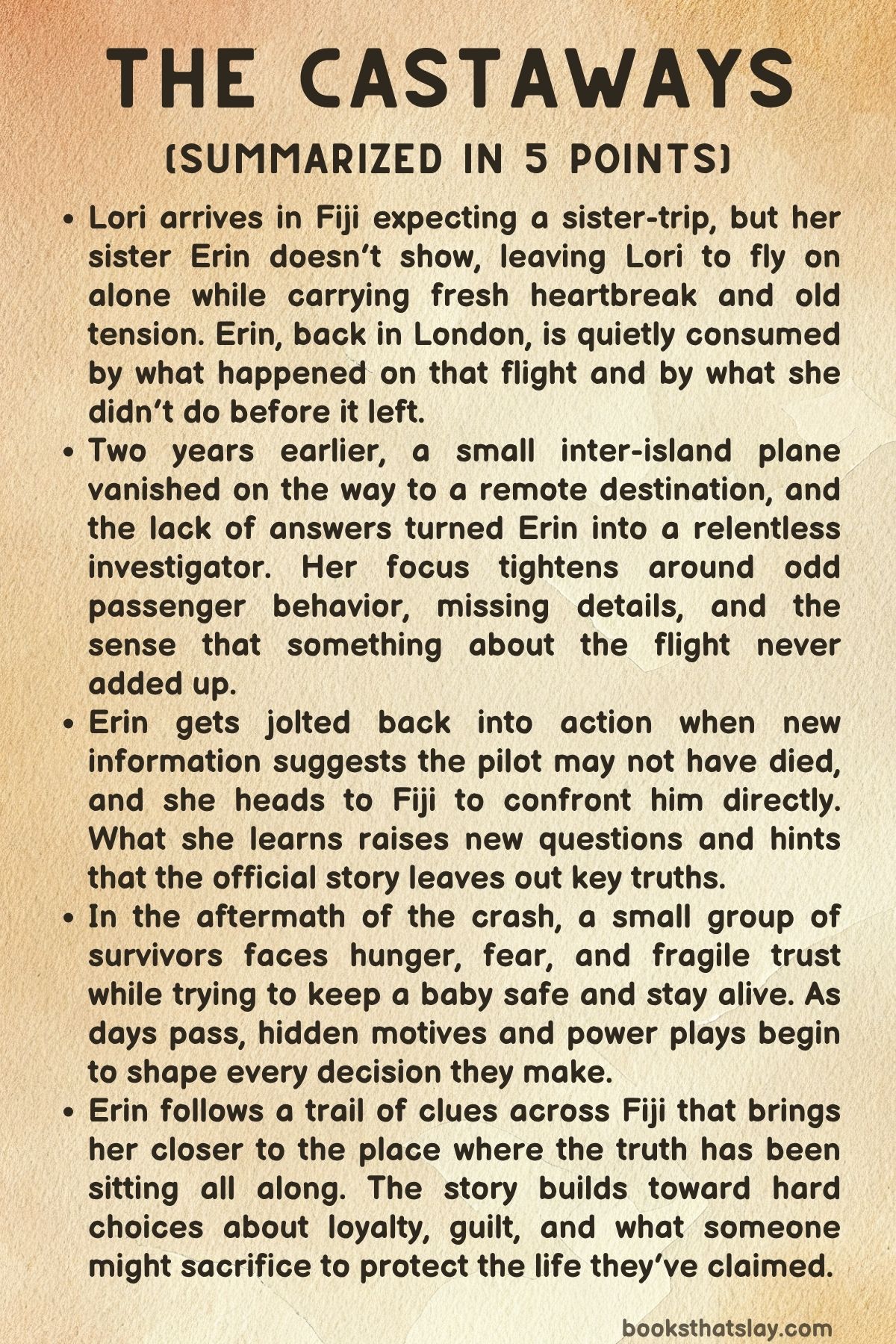
The Castaways by Lucy Clarke is a suspense novel set between London and Fiji, built around a sister’s disappearance and the long shadow it leaves behind. Lori Holme arrives in Fiji for a promised holiday with her sister Erin, only to board a small inter-island flight alone when Erin doesn’t show.
The plane vanishes, and the world moves on without answers. Erin doesn’t. Two years later, a shocking discovery about the pilot reopens the case and pulls Erin back to Fiji, where grief, guilt, and determination push her toward a truth that is far stranger—and more personal—than the official story ever allowed.
Summary
Lori Holme lands at Nadi airport in Fiji for a short flight to a remote island called Limaji. The trip was meant to be a reset: two sisters together, away from London, away from the mess Lori’s life became after her husband Pete cheated and left.
Lori booked the holiday impulsively in the middle of a sleepless night, using money that remained in a joint account. She framed it as something she and Erin would do “together,” and Erin agreed.
But as departure time closes in, Erin is nowhere to be seen. No call, no message, no reply.
Lori’s frustration turns into panic. She leaves Erin an angry voicemail, then boards the plane alone, sitting beside Erin’s empty seat and trying to breathe through her fear of being trapped.
The story also shows Erin in London the night before, drinking and bringing a stranger back to her flat. The place is untidy and lonely, and the man’s curiosity leads him into a spare room that used to be Lori’s.
The walls are covered with newspaper clippings, maps, passenger lists, and photographs, all connected to the disappearance of flight FJ209. Erin lies that it’s for work, but it’s clear she has turned the missing flight into an obsession.
After the man leaves, Erin drinks alone and stares at evidence she has gathered for two years—especially details about a passenger named Felix Tyler, whose forged qualifications and suspicious history suggest secrets he never wanted uncovered.
Back at the airport two years earlier, Lori notices unsettling things before boarding. The pilot looks unwell, with bloodshot eyes.
Ground staff inspect something under the aircraft and then walk away without explanation. A well-dressed passenger named Daniel argues on the phone, sounding unsure about travelling.
Another passenger—a dark-haired man—destroys his phone and SIM card and reacts sharply when Lori looks his way. Lori begs the staff to delay the flight for Erin, but the gate closes.
Erin is officially “too late.”
Once airborne, Lori watches the passengers more closely: Daniel; the dark-haired man; an American couple; and a young mother travelling alone with her four-month-old baby, Sonny. Lori’s anxiety spikes when she sees the pilot slumped before forcing himself into a smile.
The weather turns quickly, and turbulence begins to hammer the cabin. Daniel tries to get off the plane, arguing they still have time because they haven’t left the ground long, but the plane is already committed.
In the air, the jolt becomes violent. Lori hears fragments from the cockpit about an engine behaving erratically and switching fuel tanks.
The stewardess emerges pale and frightened, announcing a fuel issue and an emergency landing—then the plane drops hard. People scream.
Loose items slam around the cabin. Through a gap in the clouds, Lori sees land rushing up, and then everything goes dark.
In the present, Erin lives with guilt and recurring nightmares of the crash. Her fixation has never eased; if anything, it has hardened.
One evening she sees a headline that turns her world over: Captain Mike Brass, officially dead, has been found alive in Fiji under an alias after collapsing and being recognized in hospital. Erin immediately contacts the British Embassy and pushes for information.
A transcript of Mike’s police interview arrives, revealing he has a brain tumour affecting memory. He confirms he captained the flight, admits there was “a problem,” claims he doesn’t know where the plane is, and insists no one else survived.
Erin is crushed, not just by the idea that Lori truly died, but by the bitter truth that she herself wasn’t on the flight—because she didn’t show up.
Erin decides she has to go to Fiji and speak to Mike directly. Once there, she checks into the same hotel that holds painful memories of waiting for a plane that never arrived.
She tracks Mike down to a hospice behind a hospital. Slipping past staff, she finds him unconscious, hooked up to tubes and monitors, and tries to wake him.
When he finally focuses, he recognizes her. Erin demands answers about Lori and the crash site.
Mike says it was “an island,” but can’t identify which. Erin forces him to address whether Lori is alive.
He says Lori is dead. Erin presses him about the bodies.
Mike hesitates, then admits they put the bodies into the sea because they could not bury them and could not bear leaving them in the heat. Erin catches the word “we.” Mike said “we had no choice,” not “I had no choice.” Erin challenges him, but before she can get more, a nurse arrives with Mike’s son Nathan and his wife.
Nathan drags Erin away, and Mike slips back into sedation.
The narrative returns to the island aftermath in the past. Lori wakes inside the crashed plane, injured and bleeding, surrounded by smoke and death.
The American couple near her are dead. The stewardess lies dying and, before fading, says she “should’ve stopped him,” a statement that lodges in Lori’s mind.
Lori manages to free herself and crawl out. A long-haired man—Felix—appears among the survivors.
The pilot, Mike Brass, emerges injured from the cockpit. There is also Daniel, alive and focused.
They find Sonny alive in a bassinet, but Sonny’s mother is dead. Lori carries the baby out into the jungle and collapses from pain and shock.
The survivors assess their situation. Phones have no signal.
Mike explains they diverted around dangerous weather, which took them far off route among countless islands. He sketches a rough map in the sand to show how huge the possible search area is.
The island appears deserted. They salvage supplies from luggage and the plane: flares, first aid, rope, a lighter, desalination tablets.
The life raft is unusable. Felix’s belongings include a dive knife and spearfishing gear, which makes the others wary.
Lori focuses on keeping Sonny alive, finding formula and mineral water, and making feeding routines work with limited resources.
Days pass in hunger and heat. Rules form around shared food and shared tasks, but tension keeps rising.
Lori admits she was meant to travel with her sister Erin, and Mike reacts oddly when he hears Erin’s name. At night, Lori returns to the wreck for supplies and catches Mike in the cockpit using a phone torch, working on something he quickly tries to hide.
He claims he was looking for painkillers, but Lori doesn’t believe him.
On the island, Lori grows closer to Felix. Their connection becomes physical during a private moment near a stream while Sonny sleeps nearby.
Afterwards, both understand it will not stay secret for long. The atmosphere at camp grows increasingly unsafe.
Daniel’s behaviour turns intimate and unsettling, and Lori begins to feel watched in the trees. She also senses Felix’s temper, and when she tries to ask about the airport message and the destroyed phone, he shuts down.
In the present, Erin escapes the hospice and is confronted outside by Nathan. Erin tells him what Mike admitted and why the word “we” matters.
Nathan admits he believes his father lied for years, letting his family mourn him while he lived under another name. Erin tries calling relatives of other passengers but gets nowhere.
She also relives the fight with Lori the night before the flight: Erin had revealed she once caught Pete cheating and kept it secret; anger escalated, and Lori told Erin to go home. Erin’s last words were cruel, telling Lori she wasn’t brave enough to travel alone.
Erin has carried that moment like a weight ever since.
Erin searches for new leads and learns from Nathan that Mike spent years living “in the hills” and working for a German-run resort. Erin tracks down the Hibiscus Crest Resort and learns Mike lived there as “Charlie.” In his old cabin she finds a hidden tin with his captain badge, a family photo, and a tourist leaflet marked with a hand-drawn map.
The flight path is drawn, and a second diverted line ends at a tiny circled speck covered in question marks. Erin pockets the map and lies to Nathan about finding nothing.
Back on the island in the past, hunger becomes desperate. Daniel offers Lori a hidden Snickers bar from his luggage and pushes her to keep it secret, then kisses her.
Lori recoils and flees. The wrapper is later discovered, and Felix confronts Daniel about hoarding food.
The conflict nearly turns violent. Felix eventually admits the airport message was from his father, and his attack on his stepmother is why he fled.
Soon after, Felix’s dive knife goes missing. Suspicion spreads.
Lori searches Daniel’s bag and confronts him, and Daniel suggests she should blame Mike—the man responsible for bringing them down.
Erin follows the map’s clue by chartering a boat to a remote island. She climbs to a ridge and finds a filthy pilot’s cap.
She is in the right place.
On that same ridge in the past, Daniel confronts Mike, accusing him of hiding rescue opportunities. Mike snaps and uses binoculars to choke Daniel, demanding to know Daniel’s real motives for travelling.
Lori tries to stop it, and Sonny’s presence keeps the worst from happening. Then, through binoculars, they see Felix in the water by the reef, floating face down with blood spreading nearby.
Felix is dead, and the spear gun is gone.
What follows is the turning point. Lori wakes later with severe pain at the back of her skull and Daniel pinning her down.
She realizes he has the knife and intends to assault her. She fights, but her strength is limited.
Nearby, Sonny starts choking on a shard of driftwood. Lori manages to strike Daniel with a jagged rock until he goes still, then rushes to Sonny and clears the wood from his throat, saving his life.
When she returns to Daniel, she finds no pulse. Fear hits her immediately: if she is rescued, she could be arrested, imprisoned, and separated from Sonny.
She tries to drag Daniel toward the water to make his death look like part of the crash aftermath. When Daniel suddenly revives, Lori panics and pushes him underwater, holding him down until he stops fighting.
This time, he does not come back.
Mike appears and admits he saw everything. He tells Lori that the drowning was not self-defence, and he makes it clear he can use that truth against her.
He also reveals that Daniel was Sonny’s father. A boat arrives—local islanders returning.
Lori begs Mike to protect her with a lie. Mike offers a different solution and produces the dive knife, revealing he had taken it earlier for control.
Lori understands that Felix died without it, exposed while spearfishing.
Mike proposes a plan: they will disappear. He carves names into a tally tree used to mark the dead.
He adds Daniel, then carves Lori and Sonny too, creating the illusion that both of them died on the island. He does not carve his own name because the story needs to be one short: he will be the “last man standing.” He admits the crash was pilot error—he failed to switch fuel tanks—and hints he had been drinking.
He refuses to face investigation and prison. Lori is trapped by her own choices and by her fear of losing Sonny.
She agrees.
Lori boards the boat with Sonny and Mike. They leave their belongings behind to support the story.
The islanders mention another man, but Mike pays them and demands silence. Lori realizes Mike’s escape was always possible through bribery.
As they leave, Lori sees Daniel’s body floating nearby, eyes open. Mike distracts the boatmen until the body drifts away from view.
Lori lets the world believe she is dead.
In the present, Erin finally reaches Lori and learns the truth face-to-face. Lori explains she made it back to the main island, disappeared inland with Sonny, and lived off-grid with little money while Mike vanished separately.
Lori now rents a small shack and sells paintings, keeping her identity buried. Erin sees Sonny asleep and is overwhelmed by rage that Lori never came back, never told families the truth, never gave anyone closure.
Lori admits she wrote letters and even called but couldn’t go through with it. Erin admits she wouldn’t have let Lori disappear with Sonny if she’d known.
Erin runs back to her hotel, but Lori follows, trying to explain that she chose Sonny and will not go to the police. Lori believes the island evidence will support the story that they died there, especially once wreckage is found.
Erin leaves Fiji and returns to London, exhausted and changed.
Weeks later, police locate the island and the wreck. Evidence supports pilot error: the fuel tank is mostly full, and the unswitched gauge fits the explanation.
Media attention surges. Lori stays hidden, haunted by Daniel’s death and waiting for Erin to respond.
Erin dismantles her life, quits her job, and prepares to leave for Perth. She sends Lori a final message saying she needs to find her own island, choosing distance over reunion and accepting that some truths, once known, can’t be undone.
Characters
Lori Holme
Lori is the emotional engine of The Castaways, a woman whose need for certainty and togetherness is both her strength and her undoing. She arrives in Fiji determined to force reconciliation with Erin through a trip she books in a sleepless, impulsive burst after Pete’s betrayal, and that origin matters: Lori’s “together” isn’t just a holiday preference, it’s a coping mechanism for abandonment.
On the plane she reads as visibly anxious—hyper-attuned to details, trapped by the physical reality of takeoff, and already rehearsing worst outcomes—yet that same sensitivity becomes survival intelligence after the crash, when she can assess danger quickly, improvise care for Sonny, and keep moving while others freeze. On the island, Lori’s moral world narrows under hunger, fear, and the constant pressure of being watched; the need to keep Sonny alive becomes her new “together,” an absolute she will protect at any cost.
Her secret intimacy with Felix reveals another side—her longing for connection and warmth even in catastrophe—but it also isolates her and creates new vulnerabilities in a tiny social ecosystem where privacy doesn’t exist. Lori’s defining turn is how she handles Daniel: first as a threat she stops to survive, and then as a living problem she chooses to erase, not only to protect herself from prison but to protect her claim to Sonny and her chance at a life beyond punishment.
By the end, Lori is not written as a simple victim or hero; she is a person who decides that legality and communal truth are secondary to a single, fiercely guarded bond, and she accepts lifelong haunting—blood under her nails, a body in the sea, families without answers—as the price of that choice.
Erin Holme
Erin is the investigator, the witness, and the wound that refuses to close. Her story is driven by absence—she is not on the flight, and that absence becomes the central fact of her identity for two years: guilt, obsession, and the relentless need to replace uncertainty with narrative.
Erin’s messy flat, her drinking, and her impulsive hookups aren’t just “damage”; they show how her private life has collapsed into a single obsession board of clippings and string, where grief masquerades as purpose. She is also deeply controlling in a way that reads as care from the outside and coercion from the inside: she wants truth, but she also wants a version of truth that restores her role as the sister who holds things together, the one who shows up, the one who fixes.
That is why her confrontation style is so forceful—she pushes officials, impersonates police to get access, barrels past reception, corners a dying man—because waiting feels like complicity. Yet Erin’s sharpness is matched by vulnerability; her flashbacks to the final argument with Lori reveal that she carries a second betrayal besides the flight: she hid Pete’s cheating from Lori, and she knows that secrecy helped poison the bond.
When she finally finds Lori alive, Erin’s rage is not simply moral outrage on behalf of the dead—it is grief for the version of sisterhood she believed still existed, and humiliation that Lori chose a world where Erin could not follow or control the terms of reunion. Erin’s final break—quitting, leaving, choosing her own “island”—is less an escape than a belated act of self-definition: she stops living as the person orbiting a disappearance and starts living as someone who can move forward without permission from the past.
Captain Mike Brass
Mike Brass embodies concealed responsibility, a man whose authority is inseparable from cowardice. Before the crash, he is marked by subtle alarm bells—bloodshot eyes, a slumped posture, small signs that something is wrong—yet he performs competence because that is what pilots do, and everyone else wants to believe it.
After the crash, he tries to control the group through explanations, maps in sand, and the language of inevitability, but his most consistent pattern is selective truth: he discloses enough to sound plausible while withholding whatever would expose him. His later life—surviving under an alias, letting his family believe he died, hiding in the hills—shows that what he fears isn’t death but consequence, and the brain tumour complicates this without absolving him; memory loss becomes a fog he can hide inside, but his phrasing (“we had no choice”) betrays that his story is shaped, not simply forgotten.
On the island, Mike’s moral corrosion is clearest in how he treats leverage: he keeps knowledge about Daniel’s affair as a tool, he keeps the dive knife to maintain power, and he weaponizes Lori’s fear of losing Sonny to recruit her into his exit plan. His worldview is brutally transactional—truth is only valuable if it protects him—and his “last man standing” logic turns survival into a narrative he can sell to the world.
Mike is terrifying not because he is monstrous in a loud way, but because he is ordinary in the way he rationalizes: a man who makes an error, panics, and then spends two years building a life around avoiding the moral weight of saying, plainly, “I did this.”
Daniel
Daniel is the story’s most unsettling illustration of entitlement sliding into predation. Initially, he appears as a well-dressed passenger with “second thoughts,” a man whose anxiety reads like conscience, but that early discomfort becomes less about morality and more about self-preservation once the island strips away social protections.
In the survival group, Daniel gravitates toward secrecy and manipulation—hiding food, attempting to buy intimacy with scarcity, testing boundaries with suggestive remarks—and his behavior toward Lori becomes a pattern of escalation, from unwanted closeness to a forced kiss to outright physical domination. The revelation that he is Sonny’s father deepens the character in a bleak way: fatherhood does not soften him; instead, it becomes another axis of control and claim, a fact Mike later uses as leverage and Lori later experiences as threat.
Daniel’s violence is not written as a sudden twist but as something seeded in his private opportunism and his comfort with coercion when he thinks he can get away with it. His death is narratively important because it forces Lori into irreversible moral territory—self-defence transforms into chosen erasure—and Daniel becomes less a person the moment he becomes a problem to solve.
In that sense, Daniel functions as both antagonist and catalyst: he externalizes danger, and then, through Lori’s decision to drown him, he permanently alters who she is allowed to be in the world.
Felix Tyler
Felix is danger wrapped in charisma, a man whose unpredictability keeps everyone around him slightly off balance. Erin’s early fixation on him is telling: his forged qualifications and shadowed background make him the easiest passenger to imagine as “the secret,” and the narrative uses that suspicion to show how grief looks for a villain when reality is messy.
On the island, Felix is simultaneously practical and threatening—capable with survival tasks, strict about shared rules, and quick to anger when those rules are broken—suggesting a person who survives by control because he doesn’t trust his own emotional containment. His private history, revealed through Kiera’s account, reframes him: the rage is not theatrical, it is violent and intimate, and it makes clear that the charm has always had teeth.
Yet his connection with Lori complicates him further; their sexual encounter is not framed as romance but as an eruption of need, and it exposes Felix’s capacity for tenderness without making him safe. He is also a victim of the group’s power games: the missing knife and Mike’s hoarding of it turns Felix’s competence into vulnerability, and his death in the water reads as both tragic accident and indirect consequence of Mike’s manipulation.
Felix ultimately represents a particular kind of human contradiction—someone who can be both magnetic and frightening, both helpful and harmful—and the story refuses to settle him into a single category, which is exactly why Erin’s obsession with decoding him says as much about Erin as it does about Felix.
Sonny
Sonny is not a character in the traditional sense of agency and choice, but he is the gravitational force that reorganizes every adult’s morality in The Castaways. As a baby, he functions as pure dependency—hunger, choking, crying, the constant demand for care—and that dependency becomes the island’s most brutal test because it cannot be negotiated with.
For Lori, Sonny becomes purpose, identity, and justification; he is the reason she keeps moving after the crash, the reason she endures fear, the reason she chooses disappearance, and, in her mind, the reason the worst choices become acceptable. For Daniel, Sonny is a claim that does not translate into care; fatherhood becomes entitlement rather than responsibility.
For Mike, Sonny is leverage, because he understands that a child can be used to corner Lori into complicity. Sonny’s presence also exposes the fragility of social ethics: food-sharing rules, leadership, and trust all become harsher when a baby’s survival sits in the middle of adult conflict.
By the end, Sonny is the living proof that survival is not only about staying alive, but about what kind of life you believe you are allowed to keep—and who you are willing to disappear to protect it.
Nathan Brass
Nathan is a secondary character who matters because he punctures the pilot’s myth from the inside. As Mike’s son, he carries a unique kind of betrayal: grief for a father he thought was dead, anger at the deception, and the dawning realization that the story he inherited is manufactured.
His confrontation with Erin shows him as protective—physically pulling her away—yet not blindly loyal; he admits his doubts and shares fragments that help Erin move forward, suggesting he is trying to be ethical even while defending his family’s boundaries. Nathan represents the collateral damage of Mike’s choices: the way a single act of avoidance can infect an entire family with shame, confusion, and unanswered questions.
He also functions as a moral mirror to Erin; both are children of a story they didn’t choose, both are desperate for truth, but Nathan’s approach is quieter, restrained by the need to keep living among the ruins of someone else’s wrongdoing.
Kiera
Kiera appears briefly but leaves a deep impression because she reveals Felix’s capacity for domestic violence with terrifying clarity. Her account is not gossip; it is fear speaking, the kind that lingers after someone’s hands have been on your throat.
Kiera is also morally complicated in her own way—she admits she gave Felix warnings and then disposed of his stored possessions, including items tied to his late mother, which suggests she was trying to force resolution through provocation and consequence. That does not justify Felix’s violence, but it does place their relationship in a tense emotional landscape where resentment and unresolved grief were already present.
Kiera’s role is to shift the reader’s understanding of Felix from mysterious passenger to real-world threat, and to show Erin that “missing” does not always mean “gone.” She embodies the ripple effect of Felix’s instability long before the plane ever left the ground.
Pete
Pete never steps onto the island, yet he shapes the sisters’ emotional architecture throughout the story. His cheating and departure create the financial and psychological conditions that push Lori toward the trip, making him the indirect trigger of the entire plot.
More importantly, Pete becomes the toxin in Lori and Erin’s relationship: Erin’s confession that she once caught him cheating and kept it from Lori reframes their bond as one built on withheld truth, and it explains why Lori’s insistence on “together” is laced with desperation—she has already been abandoned once, and she suspects betrayal can live right beside you unnoticed. Pete functions as a symbol of the everyday betrayal that feels small compared to a plane crash but is actually foundational; the catastrophe does not create the sisters’ fractures, it exposes and enlarges them.
Steven Wills
Steven Wills represents institutional limits and the frustration they provoke. He is not a villain so much as the voice of procedure—careful language, controlled expectations, the promise of processes that move slowly and do not bend to one person’s urgency.
His presence highlights Erin’s central conflict with authority: she believes truth is being actively concealed, while institutions often behave as if uncertainty is acceptable as long as paperwork is consistent. Steven’s role is to show the gap between emotional reality and bureaucratic reality, and how that gap can drive a grieving person toward riskier, more obsessive tactics.
By refusing Erin the catharsis of immediate action, he inadvertently pushes her deeper into solitary investigation, where she becomes both sharper and more reckless.
Themes
Survival as a moral breaking point
Heat, injury, hunger, and fear narrow the characters’ choices until “right” and “wrong” stop being abstract ideas and become immediate calculations about staying alive. On the island, Lori’s priorities reduce to breath, water, shelter, and keeping Sonny safe, and that reduction changes what she is willing to do.
The moment with Daniel shows how survival can slide from defence into something darker without a clean dividing line. She reacts to a real threat, then faces a second decision when the threat returns in a weaker form, and she chooses finality.
The island doesn’t create violence out of nowhere, but it strips away the buffers that would normally slow a person down—witnesses, laws, distance from consequences—and replaces them with a single urgent question: what happens if I hesitate? That question keeps returning in smaller ways too, like the arguments over food, the missing knife, and the rule that everyone must share supplies.
A community formed by disaster needs cooperation, yet scarcity pushes people to hoard, bargain, or intimidate. Daniel’s secret stash becomes more than candy; it becomes proof that even within a group, some people will protect themselves first and justify it later.
Mike’s control of the knife intensifies this idea because it turns survival equipment into a political tool. By withholding it, he increases everyone’s dependence and makes safety conditional on obedience or silence.
In The Castaways, survival is not presented as heroic endurance; it is a pressure chamber that tests who gets protected, who gets sacrificed, and which actions can be lived with afterwards. The cost of staying alive is not only physical hardship but the gradual redefinition of what a person can do and still recognise themselves.
Guilt as a force that drives obsession and secrecy
Erin’s life after the disappearance is shaped by the kind of guilt that cannot be resolved through apologies because the person she needs to apologise to is gone. Her behaviour—collecting clippings, mapping routes, chasing inconsistencies—doesn’t read like curiosity.
It reads like a need to keep the story unfinished, because a finished story would mean accepting her last conversation with Lori as permanent. That guilt also explains why Erin’s search becomes personal and selective: she latches onto suspicious details like Felix’s forged qualifications and Mike’s contradictions because they suggest the ending might be reversible.
If there is a conspiracy or a hidden survivor, then Erin’s absence from the flight might still be redeemed by discovery. Yet guilt doesn’t only motivate truth-seeking; it also distorts it.
Erin breaks ethical boundaries—impersonating police, forcing her way into the hospice—because guilt convinces her that normal rules no longer apply. She is not simply investigating; she is trying to pay a debt.
Lori, meanwhile, carries a different guilt: the guilt of choosing a life that requires other people to remain in grief. Her silence is not a lack of feeling; it is an active decision to let Erin and the other families believe in death because the alternative threatens prison, separation from Sonny, and exposure of what happened to Daniel.
The story shows guilt operating in opposite directions: Erin turns guilt into action that demands an answer, while Lori turns guilt into containment, a sealed life built around avoiding one confession. Mike’s guilt is the most corrosive because it mixes shame with self-preservation.
He hides not to protect others but to protect himself from accountability for pilot error, drinking, and the chain of decisions that follow the crash. Guilt becomes a kind of engine: it keeps people moving, but it also pushes them into deception, coercion, and choices that create new guilt layered over the old.
Power and control inside crisis groups
Once the crash removes formal authority, a new hierarchy forms quickly, and it forms around who controls information, tools, and fear. Mike begins with institutional authority as the captain, and even after the crash that authority echoes because he can explain the aircraft, the route, the odds of rescue, and the reasons the search might fail.
Daniel challenges him because Daniel understands that narratives are power: if Mike is hiding a rescue chance or a truth about the crash, then Mike is not simply a leader but a gatekeeper. The confrontation on the ridge reveals how quickly leadership can become domination when a person feels exposed.
Mike’s use of physical force is not only anger; it is a method of shutting down questions and reasserting the idea that he decides what is said aloud. Felix represents another form of power: the capacity for violence and the threat of unpredictability.
His weaponry, his temper, and his willingness to confront others make him dangerous in a way that forces the group to accommodate him even before they fully understand his past. Lori’s position is more complicated because she has moral influence through caregiving.
Keeping Sonny alive makes her essential, but it also makes her vulnerable; anyone who wants leverage can target her fear of losing the baby. Mike understands this and uses it with precision after Daniel’s death.
His argument is not “you did nothing wrong,” but “the world will punish you,” and then he offers himself as the only person who can manage the consequences. That is coercion disguised as assistance.
The tally tree, the carving of names, and the decision to leave bags behind are ritual acts that convert power into an official story. Mike isn’t only escaping; he is authoring a record that will steer the police narrative and protect him by making contradiction difficult.
Even the bribery of the rescuers is part of this pattern: money becomes one more tool to manufacture silence. Power is not a stable trait possessed by one character; it shifts according to who can shape reality for everyone else—through threats, through resources, through stories, and through the ability to decide which truths will survive.
Sisterhood, resentment, and the struggle to let each other be free
The relationship between Lori and Erin is defined by closeness that has curdled into pressure. They know each other’s weak points too well, and that knowledge becomes ammunition.
The trip is meant to repair something, but it is also a demand: Lori insists on “together,” not as a gentle invitation but as a corrective to betrayal and loneliness after Pete’s cheating. Erin agrees, yet her agreement carries reluctance, and the night before the flight shows how resentment leaks out when affection feels like obligation.
Erin’s confession that she once knew about Pete’s cheating and stayed silent is not just a plot reveal; it exposes a long imbalance in their bond. Erin has held information that could have protected Lori, while Lori has assumed Erin’s loyalty without questioning what it costs Erin to provide it.
After the crash, the sisters become mirrors of each other’s need for control. Erin cannot accept Lori’s disappearance because it forces Erin to confront her own limits: she cannot fix what happened, cannot rewrite the last argument, cannot retrieve the sister she believes she failed.
Lori cannot return because she believes Erin would not allow her to choose the morally compromised path that kept Sonny. When Lori asks whether Erin would have let her go, the point is not permission in a literal sense; it is about whether their love contains space for choices that violate Erin’s values.
The ending makes this conflict explicit when Erin chooses to dismantle her old life and leave, framing it as finding her “own island.” That line is both grief and rebellion. Erin refuses to remain trapped in a role where her identity is built around Lori’s absence, and she refuses to be the person who exists only to chase or judge her sister.
At the same time, the choice is not clean liberation; it is another form of exile, shaped by damage. Sisterhood is shown as a bond that can sustain, accuse, protect, and suffocate.
Love persists, but it does not guarantee reconciliation, because love alone cannot undo the consequences of secrecy, fear, and the different kinds of survival each sister chooses.