The Briars Summary, Characters and Themes
The Briars by Sarah Crouch is a suspense novel set in the shadowy forests around Lake Lumin near Mount St. Helens. When a game warden named Annie Heston arrives in town to start over after a personal betrayal, she steps straight into a community on edge—there’s a dangerous cougar in the area, and soon there’s something worse: a murdered woman left for the wilderness to erase.
Annie’s work pulls her into a tightening circle of small-town loyalties, rumors, and hidden histories, especially after she meets Daniel Barela, a reclusive young man living alone at the lake’s edge behind a wall of NO TRESPASSING signs.
Summary
Ben Gannon takes his ten-year-old daughter, Layla, to a rocky overlook near Mount St. Helens to spot a bald eagle he has been tracking. As fog thins in the gorge below, Ben sees the eagle on a ledge across the gully, apparently eating.
A gust reveals the truth: the “meal” is a woman’s hair, and her body lies face down on the rocks. Ben blocks Layla from looking and calls for help, but there’s no one nearby and no sign of an accident on the trail above.
Fearing the woman might still be alive, he decides he has to reach her quickly. He leads Layla down a steep animal path, across icy river water, and up the far side to the rock face.
Ben climbs to the ledge and confirms she is dead—neck twisted, one eye fixed open. Her back is torn open with deep marks that look like a large predator’s work.
As her hair lifts again in the wind, Ben notices bruises along her throat that resemble finger marks. He climbs back down, shaken, and finally tells Layla the woman is dead.
Four weeks earlier, Annie Heston drives north from Bend, Oregon, after her husband Brendan’s betrayal blows up her life. She pushes her Jeep too fast, half running from grief and humiliation, half trying to outpace her own thoughts.
Traffic and rainy memories of her wedding in Astoria hit her hard, and she has to fight to stay composed. She crosses into Washington and stops at a Mount St. Helens overlook, where the beauty and the emptiness make her break down.
She forces herself forward anyway—she has a new job in a small town called Lake Lumin, and she starts in the morning.
At the Lake Lumin Municipal Department, Annie learns quickly how small the town is. The “department” is a shared office, and the local police officer, Jake Proudy, seems to do a bit of everything.
Jake is surprised the new game warden is a woman, but he’s also relieved to have help. He talks fast, fills Annie in on local routines, and finds her a cheap room above his parents’ garage.
On the drive to their place along Lake Lumin Road—an area locals call “the briars”—Jake tells her about a cougar moving south from Warner Lake. Campers lost a dog, a hunter reported being charged, and no one has the animal tagged.
If Annie wants to prove herself immediately, she’ll have the chance.
Jake’s parents welcome Annie with warmth. Laura Proudy feeds her pie and fusses over her.
Walt Proudy is steady and quiet, a man people trust. Laura offers Annie one warning: don’t drive all the way to the end of Lake Lumin Road.
A strange young man lives alone in an old boathouse out there and keeps to himself. Annie bristles at the caution and insists she can handle herself.
That young man is Daniel Barela, and he is living like someone who expects trouble. One night he wakes to shattering glass.
Terrified that someone has found him, he grabs a copper pipe and moves toward the broken window. He sees blood drops and hears movement.
In panic, he attacks the intruder in the dark, hitting again and again until it stops moving. When he turns on the light, he discovers he has killed an unusually large fox—except it isn’t a fox at all.
Meanwhile, Annie begins tracking the cougar. She hikes down a muddy trail from a Forest Service road, finds scat with fur, then a clear print leading toward Lake Lumin.
The trail brings her near the lake and into a stretch of trees covered in NO TRESPASSING signs. She hears a scraping sound and feels watched.
Annie retreats, deciding she’ll approach by road and assert her authority directly—both to warn the landowner about the cougar and to secure access for her work.
Jake visits Daniel during the day and explains the dead “fox” was actually a maned wolf that escaped from Ronnie Boyd’s illegal exotic-animal operation. Daniel admits it burst through his window and he reacted without thinking.
Jake treats it as an odd accident more than a crime. He invites Daniel to fish, and they take a skiff out on Lake Lumin.
Daniel notices a bald eagle gathering branches. He hooks a big fish, but the line snaps and he falls back hard, hitting his head.
Jake offers medical help; Daniel refuses, exhausted and wary.
Annie drives the rough road past the long line of warning signs and reaches a locked gate. Beyond it, she sees the lake, the boathouse, a sagging dock, and a battered green Ford Ranger.
She calls out and leans on her horn until a young man appears. He’s in his mid-twenties, not the older figure Annie expected.
She introduces herself as the game warden and explains the cougar situation—likely a male animal denning near the lake. Daniel asks if it belongs to Ronnie Boyd, then shuts down emotionally again.
Annie requests access through his property to track and tag the cougar. When he hesitates, she tells him plainly she can legally enter private land while on duty; she’s only asking out of courtesy.
Daniel agrees to leave the gate unlocked and points her toward a trail on the west side. Annie tries to place why he seems familiar, and before she leaves he gives his name: Daniel Barela.
She drives away watching him in the mirror, turning her contact card over in his hands.
Annie’s first weeks become a grind of fieldwork and paperwork, especially after she helps shut down Ronnie Boyd’s illegal exotic setup. Animals are moved, released, or transported, and the town watches Annie closely.
Jake tries to get to know her beyond the job. Over coffee and a maple bar, Annie shares her past: her mother died of cancer when Annie was nine, and her father responded by pushing them into the wilderness constantly.
He later left twelve-year-old Annie alone to summit South Sister Mountain over a weekend, and the experience shaped her. Annie pursued a wilderness education and chose a career that put her outdoors and in control.
She also admits she left Bend because her husband cheated with a younger woman. Jake shares that he knows what heartbreak feels like too, and for a moment Annie feels the comfort of being understood.
That moment ends when Jake gets a frantic call from Ben Gannon: a dead woman has been found near a ridge trail. The body is torn and there are bruises on her neck.
Jake and Annie race to the site, where Ben shows them the body far below. They take his statement and send him home, then hike down a difficult route to reach the rocks.
Up close, Annie identifies the tearing as cougar damage, but she also sees the bruise marks on the throat. The cause wasn’t the fall.
Annie estimates the woman has been dead less than a day and a half. There’s no ID, and it looks like she was already dead when she went over.
Annie finds a cougar print with an uneven shape that suggests a limp—the same animal she has been tracking. Jake asks Annie to keep quiet while they figure out what they’re dealing with, and he tells her to find the cougar, even if only to rule it out.
Not long after, Daniel hears a scream across the lake at dusk. He thinks of Annie’s warning and her contact card, and after wrestling with his fear of attention, he calls her.
Annie arrives with gear—tranquilizer gun, darts, snares, radio equipment, scent, and lights. Daniel meets her at the unlocked gate and offers to row her across the lake.
She agrees. On the south shore they search with headlamps but don’t spot the animal.
Annie sets scented snares and Daniel agrees to check them daily. On the return row, the lake glows blue with bioluminescence as their oars disturb the water.
Daniel explains the plankton and the reason for Lake Lumin’s name. Annie plays with the glowing water, and the tension between them shifts into something warmer, surprising both of them.
Soon, the autopsy confirms the ridge victim died from asphyxiation—strangled, then dumped. Annie sees the town continuing as normal, unaware.
Daniel notices Annie walking with Jake, sees Jake’s hand at Annie’s back, and assumes they are together. Around the same time, Jamie Boyd—Ronnie’s daughter—asks Daniel for a ride and then asks to swim in his lake to train for a lifeguard test.
Daniel hesitates, then agrees, weighing the risk of letting anyone into his isolated world. Jamie starts showing up at the lake, and Daniel tries to keep distance while still watching out for her safety.
Daniel builds a narrow cedar canoe by hand. He and Annie use it to cross the lake and check traps, laughing as the canoe wobbles.
Daniel begins to feel safe with Annie in a way he hasn’t felt in years, and guilt pushes him to tell her the truth about his past. He admits that the “attempted murder” story tied to his name had a real origin.
The night before he disappeared years ago, he set a lethal trap in his basement by cutting wires and pouring water on the floor so that touching live electricity while standing in water would kill someone. Annie demands to know who he meant to kill.
Daniel says it was meant for himself—he planned suicide. His stepfather Gary came downstairs drunk, believed the trap was meant for him, slipped, and knocked himself unconscious.
The shock of seeing Gary down snapped Daniel out of his plan. Daniel tied Gary up and forced a confrontation in the morning with his mother, then fled.
He later filed a claim on the Lake Lumin land under a false identity, posted NO TRESPASSING signs, and survived doing electrical work and selling charcoal sketches. Annie warns Daniel that if he lies again, she’s gone.
Then the case escalates. Police suspect Justin Grimes, a boyfriend linked to the dead girl on the ridge, and Jake tells Daniel to stay alert.
At a rodeo, Daniel agrees to drive Jamie. As she gets out, she kisses him—awkwardly meant for his cheek but brushing his mouth.
Daniel panics, and he notices Jake watching.
One morning Daniel reports a cougar in Annie’s snare. Annie and Jake cross the lake, tranquilize the animal, and discover an infected paw wound.
They transport it for treatment. On the way back, Annie and Daniel exchange a small, private smile—until Jake comments that Daniel seems happier lately and says he thinks Daniel is involved with Jamie.
Jake claims he saw them kissing. Annie is stunned and tries not to show it, but it hits hard.
Soon after, Daniel wakes at night to splashing and laughter in the lake and finds Jamie swimming in the glowing water. Angry and frightened, he tells her to leave, warns her about a killer on the loose, and hints at the rumors now circulating.
Jamie tries to pull him closer, suggesting he join her, but Daniel refuses.
Then Annie and Jake return to the south shore to retrieve snares and search. They find a body: Jamie Boyd.
At first, it looks like strangulation again, with bruises around the neck—until they learn Justin Grimes was arrested the night before and confessed to other crimes, which means he couldn’t have killed Jamie. The autopsy shows Jamie died by drowning, and the bruising suggests someone held her under from behind.
The doctor also finds cedar shavings near her shorts and a dark smudge on her thumb that looks like charcoal. Samples are sent to a lab.
When Jake and Annie tell Jamie’s parents, Ronnie Boyd erupts, drunk and furious, and immediately accuses Daniel. The town starts to turn, and suspicion grows louder at the bar and on the street.
Jake and Annie search Daniel’s property and find the unfinished cedar canoe. Annie finds Daniel’s sketchpad and a drawing of Jamie swimming; a smeared charcoal mark suggests Jamie touched the drawing with a wet thumb.
Lab results confirm cedar shavings and willow charcoal—details that point right back to Daniel’s work.
Daniel disappears, apparently hiding. Pressure builds.
Annie, still unable to accept the idea that Daniel killed Jamie, continues investigating. She recreates the lake crossing in Daniel’s canoe, capsizes, and returns to the boathouse soaked.
Daniel gives her clothes. At that moment, Jake arrives and arrests Daniel, calling him by another name and treating him as a liar who has manipulated the town for years.
Jake sees Annie inside in Daniel’s clothes, and the arrest becomes harsher and more personal.
Annie tries another angle and confronts Ian Ward, who provides an alibi and a receipt. He also hints that Annie should look closer to home, pointing out that Jamie had mentioned dating someone “from her road.” That comment sticks.
Annie starts replaying everything Jake said and did—how he led her to certain places, how he pushed certain assumptions, and how one small detail keeps appearing: a cheap orange lighter found near the path used around the lake.
Annie visits Daniel in a crude basement cell beneath the church. He insists he didn’t take Jamie out in the canoe and says she only touched his sketch, leaving charcoal on her thumb.
Annie starts to voice her fear that the real threat might be closer than they think, but Daniel refuses to believe Jake could do it. Daniel is set to be transferred, and Annie promises she will get him out.
Later, Annie climbs Daniel’s gate with Walt Proudy—Jake’s father—trying to locate the orange lighter and confirm Daniel’s story. She finds the lighter behind the nightstand, tangled in cobwebs, and feels brief relief.
Then Walt casually mentions he lost his own orange lighter and replaced it that morning. Annie looks at Walt’s tattooed wrists: “SEMPER” and “FI.” The puzzle clicks into place.
Jake, handling the lighter back at the station, has his own moment of recognition: he remembers Walt using a nicked orange lighter at Daniel’s place on the day they worked with cedar, when Jamie appeared. Jake panics and races home.
At the dock, Walt realizes Annie understands. He admits it.
He claims he is a good man and that sleeping with Jamie was a “mistake,” but says she wouldn’t stay quiet. He describes drugging Laura with sleeping pills so he could leave unnoticed.
He also admits he moved bodies and shaped the situation so blame would land where it was easiest—on an outsider like Daniel, and on a known suspect like Justin Grimes. Annie understands Walt intends to kill her to protect himself and his standing.
She runs. Walt throws a propane tank that strikes her head, and she collapses.
Jake arrives, learns Walt went walking with Annie, and tells Laura the truth, ordering her to lock the house and keep Walt out. Jake smashes through Daniel’s gate and sees Walt rolling Annie’s limp body into the lake with a propane tank tied to her ankle to sink her.
Jake shoots Walt and dives into the water. He finds Annie underwater, fights the knots, frees her, and drags her to shore.
He performs rescue breaths and compressions until she coughs water and breathes again as sirens approach.
Jake goes to Daniel’s cell and releases him, admitting he was wrong. Daniel is too drained to celebrate.
Jake begs forgiveness. After a pause, Daniel takes Jake’s hand.
He only asks to be taken to Annie.
Annie wakes in a Portland hospital with injuries and exhaustion. She overhears Jake and Daniel outside her room; Daniel has been there, waiting, but Jake sends him home to sleep.
When Annie is fully awake, Jake sits with her and tells her Walt confessed and will spend life in prison. Annie thanks Jake for saving her and tells him he deserved a better father.
She asks him to do one last thing before she calls Daniel: she sends Jake to check on Gary in Redmond, the man Daniel has feared for years. Jake learns Gary died of a heart attack a year earlier.
Back at the lake, Daniel removes the NO TRESPASSING signs and burns them, opening the clearing as if he is finally willing to be seen. Annie returns and runs into his arms.
They tell each other they love each other, and when Annie shares the news about Gary’s death, Daniel feels the last thread tying him to fear finally snap. Together, they sit on the dock as evening settles over Lake Lumin, and Daniel allows himself to believe the place can be home in a real way.
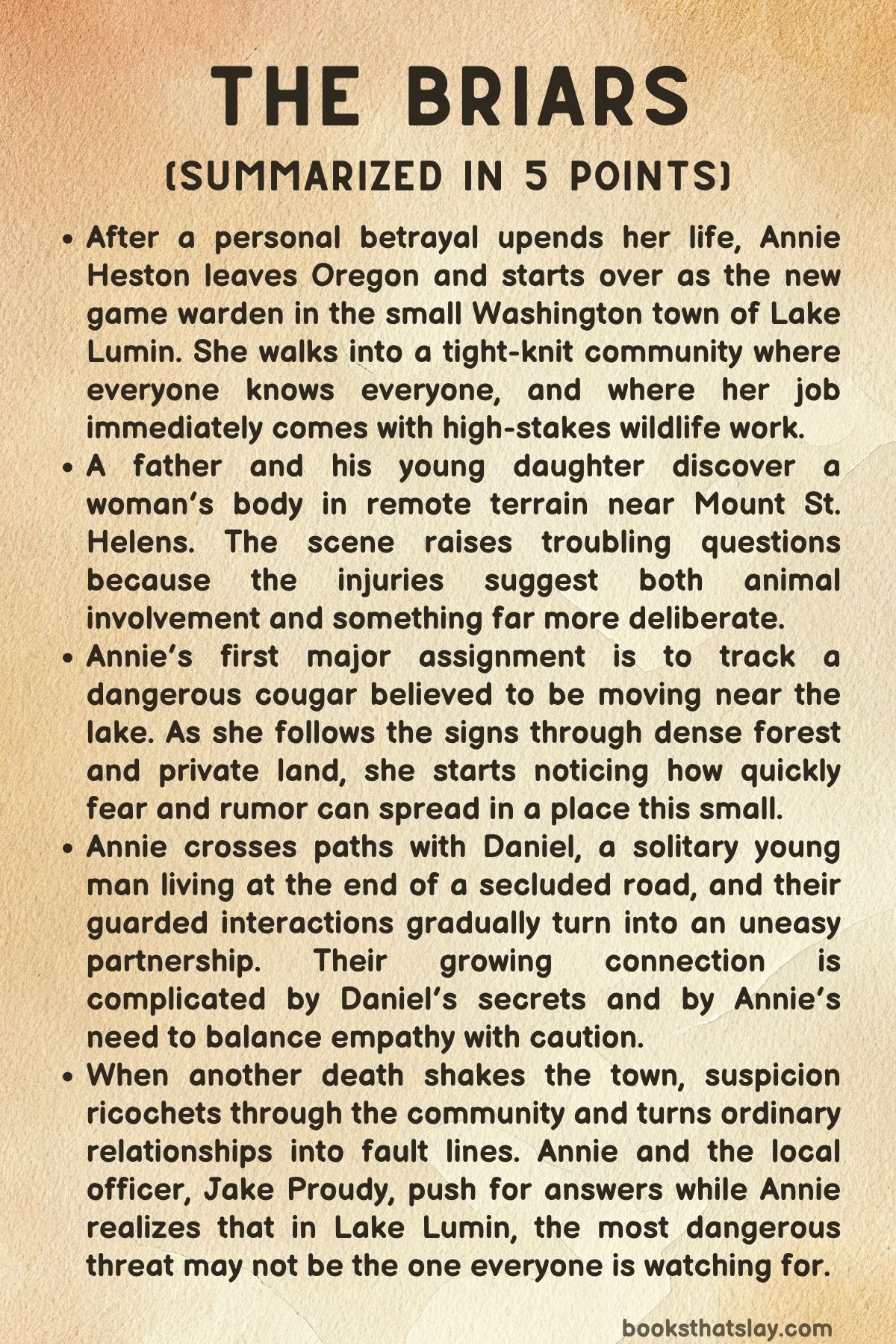
Characters
Ben Gannon
Ben is introduced as a steady, outdoors-competent father whose first instinct is protection: the moment he realizes the bald eagle is feeding on a human body, he physically blocks Layla’s view and tries to control what she sees and knows. That protectiveness is paired with a decisive, almost ruthless practicality—he chooses a dangerous crossing because time matters more than comfort if there is even a slim chance the woman is alive.
The discovery of bruising that resembles fingerprints jolts him out of the “wildlife incident” frame and into moral alarm, revealing how quickly he can read a scene and how deeply violence unsettles him. Ben’s role is that of the accidental witness who opens the story’s central wound: he does not drive the investigation, but his judgment, urgency, and the care he takes with his daughter establish the book’s early themes of innocence, exposure, and the thin boundary between nature’s brutality and human cruelty.
Layla Gannon
Layla functions as the emotional counterweight to the grim discovery—present, curious, and trusting, but also vulnerable to what adults decide to reveal. Her questions press against Ben’s attempts to shield her, showing a child’s instinct to seek clarity even when the truth is frightening.
She also demonstrates quiet resilience: she follows Ben’s demanding instructions across dangerous terrain, suggesting she has grown up in a world where outdoor hardship is normal and where her father’s authority is a kind of safety rope. Layla’s presence raises the stakes by turning the crime scene into a test of parenting and honesty, and she embodies what the adults are trying to preserve—a sense that the world can still be understood and kept safe, even when it cannot.
Annie Heston
Annie is the novel’s moral and investigative spine: she arrives in Lake Lumin with fresh heartbreak, a raw sense of displacement, and a job that forces her to read the land like a living document. Her competence is not abstract; it is physical, solitary, and learned through grief—her mother’s death and her father’s harsh wilderness lessons shaped her into someone who can endure fear, discomfort, and isolation without collapsing.
That same self-reliance makes her blunt with authority and unafraid to push into spaces marked as forbidden, yet her emotional life complicates that toughness: she is intensely affected by Daniel, and the lake’s bioluminescent moment becomes a symbol of how quickly she can feel wonder again despite betrayal. Annie’s arc in The Briars is a tug-of-war between intuition and evidence, between desire and duty—she keeps choosing the harder truth even when it threatens her relationships, her safety, and her standing in town.
Jake Proudy
Jake begins as the town’s friendly, talkative young officer—the connector who smooths Annie’s entry into a closed community and gives her the practical scaffolding to function there. Beneath that warmth is a person shaped by small-town visibility and family expectations; he knows everyone, which is both his strength and his blind spot.
As the investigation darkens, Jake’s need for control shows up in his insistence on secrecy and in how he manages information flow, suggesting he understands how fast a town can turn into a mob. His most revealing conflict is internal: he is torn between professional duty and the gravitational pull of family loyalty, and the case forces him to confront the possibility that the danger is not an outsider but something rooted in his own home.
Jake is also a study in wounded decency—his jealousy, assumptions, and quickness to arrest Daniel expose immaturity, but his willingness to correct himself, free Daniel, and risk everything to save Annie reveals a core of courage and integrity that survives the collapse of his illusions.
Laura Proudy
Laura is presented as the town’s welcoming heart—open, generous, and instinctively protective in a way that feels maternal rather than controlling. She offers Annie warmth and belonging at a moment when Annie is emotionally unmoored, and her home becomes one of the story’s key spaces where comfort and danger uneasily coexist.
Her warning about the “strange young man” in the boathouse reads as local caution, but it also hints at how the community labels outsiders to keep its internal stories tidy. Laura’s deeper tragedy is that her kindness exists alongside her vulnerability: she is close to Walt, trusts him, and can be manipulated by him, which makes her an unwitting participant in the town’s false sense of safety.
Laura represents the human desire to believe in familiar goodness—and the pain of learning that goodness can be used as camouflage.
Walt Proudy
Walt is the novel’s most chilling figure because his violence is wrapped in respectability: he is positioned as a deacon and “pillar of the community,” which grants him social armor and makes suspicion slide away from him and toward easier targets. His psychology is marked by entitlement and image-management; when confronted, he frames harm as mistake, blame-shifts onto Jamie, and rationalizes murder as a necessary act to preserve his standing and protect the town’s narrative.
He is also calculating in a specifically domestic way—drugging Laura with sleeping pills to move unseen shows that his threat is not only public but intimate, built into routines others consider normal. Walt’s actions reveal one of the novel’s central arguments: the most dangerous predator is not the cougar in the woods but the man who understands exactly how community trust can be weaponized.
Daniel Barela
Daniel is defined by contradiction: he is capable, gentle, and deeply attuned to the natural world, yet he lives in isolation behind barriers he built to survive his past. His fear is not theatrical; it is ingrained, demonstrated in the panic that leads him to kill an escaped maned wolf and in the rigid precautions of locked gates and NO TRESPASSING signs.
Daniel’s backstory reframes him as someone shaped by trauma and shame—his suicidal plan, the accidental harm to his stepfather, and the resulting flight create a life organized around avoidance, secrecy, and self-punishment. What makes him compelling in The Briars is how love becomes both risk and remedy: Annie draws him into connection, but connection also threatens exposure, and his confession is an attempt to replace secrecy with earned trust.
The tragedy of Daniel’s arrest is that it exploits his outsider status; the town’s suspicion latches onto the visible difference of his solitude, proving how easily community fear can translate into scapegoating.
Brendan
Brendan’s role is largely catalytic, but his impact on Annie is foundational: his betrayal cracks her life open and forces her into motion before she is ready. He functions as a symbol of the ordinary, social kind of harm—deception inside a marriage—that parallels the book’s larger pattern of violence hidden behind familiar faces.
Brendan is not present to argue his case; instead, he exists as the sharp absence that redefines Annie’s self-image and makes her more sensitive to truth, lies, and the cost of misplaced trust.
Ronnie Boyd
Ronnie embodies the town’s messy underside: he runs an illegal exotic-animal operation and lives close to chaos even before the murders ignite collective paranoia. His reaction to Jamie’s death is fueled by grief, alcohol, and rage, and he turns those feelings outward into accusation, helping the town’s suspicion congeal around Daniel.
Ronnie’s significance is not simply that he is volatile, but that he demonstrates how moral compromise and emotional instability can become accelerants in a crisis—he does not need to be the killer to make the town more dangerous.
Debra Boyd
Debra is quieter in the plot than Ronnie, but she represents a different kind of parental grief—less explosive, more observant, and tinged with helplessness. Her mention of overhearing Jamie discussing a breakup becomes a small but important thread in the investigation, showing how intimate household details can become evidence once tragedy strikes.
Debra’s presence highlights how families are forced to translate private life into public narrative after violence, even when doing so feels like a betrayal of the person they lost.
Jamie Boyd
Jamie is written as both vulnerable and willful: she seeks refuge from her father’s drinking, pursues independence despite limited resources, and tests boundaries with a mix of youth, confidence, and need. Her interactions with Daniel carry ambiguity that the town later exploits; she wants attention, safety, and autonomy, but she also underestimates the danger surrounding her and the stories others will tell about her choices.
Jamie’s death becomes the book’s emotional and investigative hinge because it fractures Annie’s trust, pushes Jake into reckless certainty, and gives Walt an opportunity to redirect blame. Jamie also symbolizes how easily a community can rewrite a young woman’s final days into something convenient—flattening her into rumor while ignoring the structures that made her exposed.
Ian Ward
Ian presents as polished and controlled, and that composure becomes suspicious precisely because it contrasts with the town’s raw panic. His locked-door “privacy,” careful alibi performance, and suggestive hints are forms of social manipulation—he does not need to be the murderer to behave like someone who benefits from steering attention elsewhere.
Ian’s narrative function is to embody misdirection and the danger of plausible authority; he demonstrates how a confident tone, tidy records, and insinuation can distort an investigation and intensify Annie’s sense that the truth is being fenced in.
Becca
Becca, the waitress at the Sky High café, appears briefly but meaningfully as a portrait of ordinary life continuing alongside hidden horror. Her presence forces Jake and Annie to conceal information in plain sight, reinforcing the theme that the town’s normal routines are built on what people do not yet know.
Becca represents the community’s innocence in the early stages of crisis—the everyday world that will soon be altered by suspicion and revelation.
Doc Porter
Doc Porter functions as the procedural anchor who translates the body’s story into facts the living must confront. The autopsy conclusions shift the case from speculation about wilderness predation to certainty about human violence, and that pivot is crucial to the plot’s moral logic.
Doc Porter stands for the grim clarity of evidence—neutral, clinical truth that cuts through rumor, fear, and the town’s desire for simpler explanations.
Justin Grimes
Justin is positioned as the obvious villain the town wants—a suspect whose arrest briefly offers relief because it allows everyone to believe the danger has been contained. His confession, followed by the discovery that he could not have killed Jamie, exposes how fragile that relief is and how easily certainty can be manufactured when people are desperate.
Justin’s role is to show how a community can stop thinking once it finds a name to attach to fear, and how that shortcut endangers the innocent when the real predator is still free.
Gary
Gary is a haunting offstage presence whose influence explains Daniel’s long isolation. Whether he was truly a monster or a man who became one through alcohol and power, the relationship left Daniel with fear, guilt, and a belief that returning home would destroy him.
Gary’s “hero narrative” in town underscores one of the book’s bleakest insights: communities often preserve comforting myths about men like Gary, and those myths become cages for the people harmed by them. His later death removes the last external chain binding Daniel to the past, but the emotional damage remains as something Daniel must outlive, not simply escape.
Themes
Protection, Risk, and the Weight of Care
Ben’s first instinct when he realizes the “prey” beneath the eagle is a dead woman is not curiosity but control: he physically blocks Layla’s view, issues precise commands, and chooses action over waiting for help. That opening choice sets a pattern that keeps resurfacing—adults trying to protect, sometimes by lying, sometimes by forcing decisions, and often by carrying consequences alone.
Ben lies to Layla about not knowing whether the woman is dead because he wants to postpone the moment when a child must absorb cruelty that cannot be undone. Annie carries a similar impulse, shaped by her childhood grief and her father’s harsh version of preparation.
Being left to summit alone didn’t only teach self-reliance; it trained her to treat fear as something to work through privately, even when companionship or backup would be safer. She repeats that learned logic in Lake Lumin, taking on the cougar, the bureaucracy, and then the murders with a kind of disciplined isolation that reads as strength but also functions as self-punishment after her marriage collapses.
This theme sharpens in the triangle between Annie, Jake, and Daniel because each of them expresses care through risk in a different register. Jake protects through proximity and procedure: arranging housing, managing information, keeping order, pushing for quiet until facts arrive.
Annie protects through competence and confrontation: entering private land, tracking predators, insisting she will get to the truth, refusing to be managed. Daniel protects by withdrawing, posting barriers, and limiting contact, but that withdrawal is also a protective shell for his own fragile safety.
The story keeps asking what protection costs when it becomes a reflex rather than a choice. Ben’s decision to cross the gorge might have saved a life in another version of events, but here it exposes Layla to danger and leaves Ben with knowledge he cannot share cleanly.
Annie’s refusal to accept town warnings about Daniel lets her meet someone important, yet her insistence on handling threats alone nearly gets her killed. The pattern suggests that protection is never neutral; it can preserve innocence, but it can also create blind spots, isolate people, and invite precisely the harm it hoped to prevent.
Identity, Reputation, and the Violence of Assumptions
From Annie’s first day at the municipal office, identity is treated as something the town assigns before it listens. Jake is surprised the new game warden is a woman, and the surprise matters because it signals how quickly authority is gendered and doubted in Lake Lumin.
Annie has to earn legitimacy repeatedly, not through her title but through her willingness to do hard, uncomfortable work—tracking, tagging, confronting landowners, and reading scenes with clinical clarity. Daniel lives at the opposite end of the identity problem: the town already “knows” who he is through rumor and a story fossilized by distance and fear.
He is the young man at the end of the road, the one behind the signs, the one with the “attempted murder” headline that drowns every nuance. Even when Jake is kind to him, Daniel senses how thin that kindness could become once the community needs a culprit.
The murder investigation exposes how reputation becomes a weapon. Jamie’s death produces panic, and the town reaches for the easiest narrative: the outsider did it.
The evidence that points toward Daniel—cedar shavings, charcoal smudge, the sketch—works not only because it is plausible, but because it matches the identity the town prefers for him. The same objects that show Daniel’s tenderness and attention become proof of predation once the community frames him as a threat.
That dynamic mirrors Daniel’s earlier life, where his truth was flattened into a single monstrous interpretation. His confession about the basement setup is crucial here: the act looks like violence directed outward, yet its target was himself.
The story insists that surface facts can be accurate while meaning is completely wrong, and that communities often stop at the version that confirms what they already believe.
Jake’s arc adds another layer by showing how even “good” authority can slip into assumption. He thinks he is following evidence, but he is also defending a mental model of his world: his father as moral center, his town as fundamentally decent, Daniel as complicated but suspect.
When those models crack, Jake’s crisis is not only professional; it is existential. The theme lands with Walt, whose identity is built on public virtue—deacon, steady father, local pillar—while he privately uses that status as camouflage.
The community’s assumptions don’t merely misread Daniel; they protect Walt. In that way, the story treats identity as a battleground where some people are forced to prove their humanity and others are granted innocence they have not earned, with deadly results.
Predators, Scapegoats, and the Comfort of Simple Explanations
A cougar moves through the forest while a human killer moves through the town’s social life, and the narrative keeps them in uneasy proximity. Annie’s job is to interpret signs—tracks, scat, asymmetry in a print—and to separate what seems frightening from what is actually responsible for harm.
That skill becomes a metaphor for the larger crisis: Lake Lumin wants the cougar to be the explanation because a wild animal fits a familiar story about danger. Even with bruises that suggest strangulation, people cling to the simpler fear because it asks nothing of them except avoidance.
The cougar becomes a convenient container for anxiety, a way to name threat without confronting what threat looks like when it wears a friendly face and attends church.
The investigation repeatedly shows how the desire for a clean narrative can distort reality. The first victim’s injuries allow a blended explanation—strangulation plus scavenging—so it’s easy for people to mentally prioritize the claws over the hands.
The second death escalates that craving for clarity: Jamie’s bruises around the neck appear to confirm the same pattern, and a confessed murderer exists nearby, so the town can point outward and feel safer. When that external villain collapses—Justin is arrested too early, drowning is the cause—Lake Lumin does not accept complexity; it simply searches for a new “other.” Daniel, already isolated by the signs and the past, becomes the substitute predator.
The town’s logic is less about evidence than about emotional relief. It needs the threat to be locatable and socially acceptable to hate.
This theme is also visible in how objects are interpreted. The canoe, the wood shavings, the charcoal sketch are ambiguous until fear assigns them a single meaning.
Annie understands that physical clues matter, but she also recognizes how easily investigators can mistake correlation for causation when the community is demanding closure. Walt manipulates that weakness expertly.
He stages the scene to feed an existing story: Daniel is strange, Justin is violent, predators are out there. By moving a body and planting direction, he doesn’t just hide; he authors a narrative the town wants to read.
The result is a portrait of collective psychology where “predator” becomes a label that people apply in whichever direction protects their sense of normal life. The book’s unsettling point is that the most dangerous predator may not be the one leaving obvious marks, but the one who understands how badly everyone wants those marks to belong to someone else.
Belonging, Freedom, and the Long Work of Coming Home
Lake Lumin is more than a setting; it functions as a test of what it means to belong somewhere without being owned by it. Annie arrives in flight, not just from betrayal but from a life that no longer feels like hers.
Her relationship to wilderness has always been tied to grief and endurance, so the forest initially offers familiarity rather than comfort. She isn’t seeking peace so much as a place where her pain will not be observed and judged.
Daniel, in contrast, has turned the forest into both refuge and prison. The “NO TRESPASSING” signs are not merely defensive; they are a physical expression of a life organized around avoiding harm and avoiding being seen.
He can survive there, but survival is not the same as living, and his isolation keeps the past in control even when the immediate threat is gone.
The gradual opening between Annie and Daniel shows belonging as a practice rather than a feeling. Their connection grows through shared work—boats, traps, night searches—because both of them trust actions more than promises.
The bioluminescent lake scene matters because it interrupts their guarded patterns: Annie laughs, Daniel explains, and for a moment the world offers wonder instead of threat. That moment does not erase the hard truths; it simply proves that joy is still possible, which is a different kind of evidence both of them need.
Daniel’s confession about his suicidal plan reframes his guardedness as a history of self-directed violence and shame, and Annie’s response draws a boundary that is also an invitation: tell the truth, stay present, risk being known.
Belonging is challenged most brutally when the town turns on Daniel. The speed with which he becomes disposable shows that “community” can be conditional and cruel.
Yet the ending of The Briars insists that home can be rebuilt on different terms. Jake’s handshake with Daniel is not a perfect repair, but it is a refusal to keep living inside a false story.
Annie’s survival, and her decision to return to Daniel, signals that her life is no longer defined by running. Daniel burning the signs is the most concrete symbol of this theme: he is not only removing barriers for others, he is rejecting the identity of the hunted man who must constantly defend his ground.
When Annie arrives, the dock becomes a place of chosen connection rather than enforced solitude. The final sense of home is not sentimental; it is earned through confronting truth, rejecting easy scapegoats, and deciding that safety built from secrecy is not safety worth keeping.