The Bookbinder’s Secret Summary, Characters and Themes
The Bookbinder’s Secret by A D Bell is a historical mystery set in Edwardian England, where the craft of bookbinding becomes the doorway to a dangerous hunt for truth. Lilian Delaney, a skilled young binder working in Oxford, lives a careful life split between her mentor’s workshop and her father’s struggling rare-book shop.
When she’s handed a fire-damaged oddity—an alleged novel by the elusive Abel Bell—she discovers hidden marks, concealed pages, and a message that hints at long-buried violence. What begins as professional curiosity turns into a high-stakes search involving collectors, thieves, and a secret history sealed inside books.
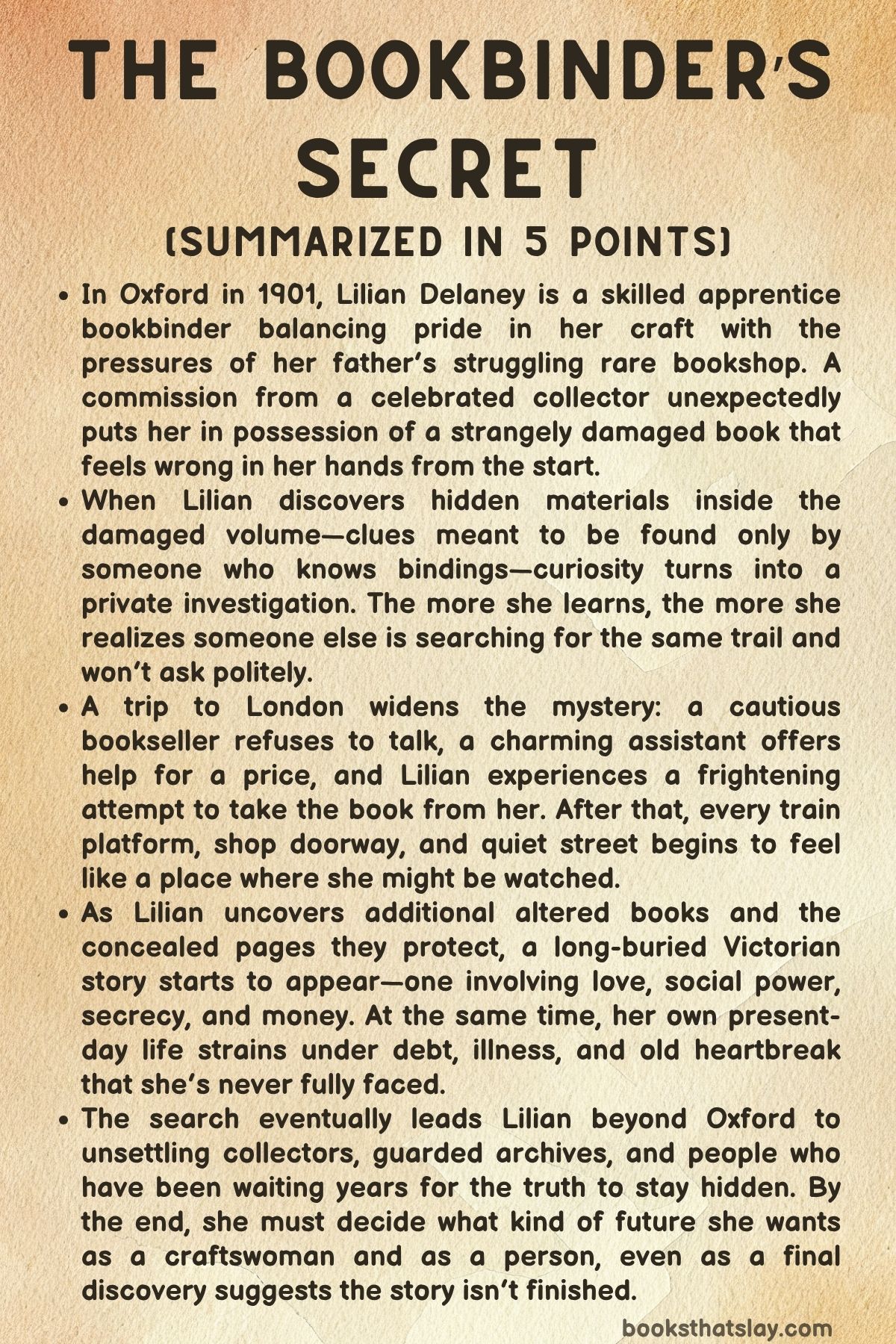
Summary
Lilian Delaney is twenty-five, talented, and quietly ambitious, apprenticed in John Caxton’s Oxford bindery. Her days are steady and precise: leather, paper, paste, gold tooling—work that rewards patience and sharp eyes.
Home is only a few streets away, above her father’s rare bookshop, where her life has always felt controlled by routine and duty. Caxton admires her skill and hints she could rise in the trade, even recommending her to the Guild of Women Binders.
Lilian wants more than survival, but she also fears stepping outside the narrow path she’s known.
At her father’s shop, she proves she can spot value by identifying rare books in a newly purchased stock, including a suppressed Shelley volume. Her lie—that her knowledge came from Caxton—wins her father’s approval, but it also reveals the pressure she lives under.
Money is tight, and her father’s pride is fragile. When he gives her a “finder’s portion” from the sale, it feels like a rare moment of generosity—until she discovers evidence of serious debt and quietly returns most of the cash, sensing that the shop is closer to collapse than he admits.
Lilian’s working life changes when Dr W. Ashburn, a wealthy collector near Bath, requests her specifically to rebind a modern medical botany book as a gift for his wife. Caxton sends her alone to Ashburn’s estate, where Lilian steps into a grand library filled with rare medical works and an air of authority she isn’t used to challenging.
Ashburn gives her the commission and a strict deadline. Before she leaves, a smell of smoke leads her attention to a crate of recently purchased books—one of which has been badly burned.
Ashburn considers it useless and offers it to her as a scrap curiosity. The damaged volume is titled A Song for a Knave, attributed to “Abel Bell,” dated 1851, with the publisher’s details destroyed by fire.
On the train back to Oxford, Lilian examines the burned book and notices details that don’t match its cheap binding: rough red endpapers, strange layers beneath, and hints of concealed material. A fellow passenger mentions how some binders hide their marks under endpapers, which sharpens Lilian’s suspicion.
A jolt on the journey tears the fragile cover, and a charred scrap slips free with a handwritten line: “I wish you had not killed him.” The sentence rattles her. This isn’t just a damaged book; it feels like a message that survived on purpose.
That evening, her father’s health falters, and his finances look worse than she feared. Still, Lilian can’t leave the burned book alone.
She carefully strips it down and discovers a partially burned letter hidden under the board, addressed “To my Knave” and signed “Your Queen.” The letter speaks of love, confinement, money that cannot be taken while she lives, and a man who is “gone” in a way that suggests murder. Lilian also finds a binder’s stamp: “FFG,” and notices pinprick patterns on the cover as if they were part of a code.
Caxton is skeptical but agrees to ask discreet questions. Lilian throws herself into work—designing an elaborate binding for Ashburn’s botany book and taking extra commissions to help steady the shop—but the mystery won’t release her.
One night, she runs into Harry, her childhood friend and once her first love. Their reunion is warm, complicated, and full of old history.
She tells him some of what she found, and his doubts plant an uncomfortable thought: what if she’s building a story out of coincidence? Even so, she keeps going, because the book feels deliberately altered, like a container for something someone wanted hidden.
A lead emerges: the bookseller who supplied Ashburn is Edmund Grieves of Cecil Court in London, known for acquiring hard-to-get volumes. Lilian travels to London under the cover of other errands and enters Grieves’s shop.
He’s immediately wary, and when she asks about Abel Bell, his reaction is sharp and fearful. He refuses to examine her copy and calls such books “cursed.” He admits there was another similar Bell volume, now sold, but won’t reveal to whom, and he tells Lilian to burn her book and forget it.
Leaving shaken, Lilian is attacked outside by a man in a bowler hat who tries to steal her satchel. She fights back, is injured, and nearly loses everything—but Grieves’s assistant, Charlie, chases the attacker and recovers the bag.
Over whisky and adrenaline, Lilian confesses why the satchel matters. Charlie then reveals something crucial: Grieves lied.
There were three altered Abel Bell books, not two, and a mysterious buyer once paid heavily for Grieves to find them. The arrangement turned sour, and Grieves tried to get rid of the books by sending them away to collectors.
Charlie offers to retrieve the third volume for Lilian in exchange for dinner and a show.
On the train home, Lilian makes a horrifying discovery: the board holding the hidden letter is gone. The thief didn’t want her money—he wanted the evidence.
Back in Oxford, Harry is waiting for her, concerned by her injuries, but Lilian keeps the deeper truth to herself. At home she finds her father drunk and surrounded by bank letters, and the sense of danger grows: someone is tracking the books, and her family is vulnerable.
Lilian returns to London and meets Charlie, who delivers an intact altered Bell volume titled He Sings His Devotion, dated 1850, bound in dark purple leather with blood-red endpapers. The book carries the same sense of intentional oddness.
Over dinner and too much gin, Charlie explains that the buyer communicated by letters and paid an enormous sum, growing threatening as months passed. Lilian’s loneliness and fear collide with Charlie’s charm, and she spends the night with him—an impulsive choice that leaves her both comforted and ashamed.
When she returns to Oxford late the next day, the household is in uproar, and her father’s anger is more about business than her safety.
Curiosity overrides caution. Lilian lifts the endpaper of He Sings His Devotion and finds thin pages hidden inside, numbered as if part of a longer manuscript and signed with multiple sets of initials.
The pages tell of a young titled woman’s restricted upbringing and her first season in London in 1851, where she secretly visits the theatre and meets a young man, William Heathfield, carrying an Abel Bell book. Their meeting turns into a private bond, and the story cuts off mid-thought.
Lilian realizes she’s holding part of a larger confession divided across multiple books, likely six in total, with codes embedded in the bindings.
Lilian visits the Guild of Women Binders after an invitation, expecting opportunity, but finds a harsh system that treats women’s labor as cheap production. She refuses the offer and recommits to Caxton’s mentorship.
When Caxton confronts her about her lies and the missing commission, she finally tells him the truth about the attacks, Grieves, and the hidden pages. Caxton is surprisingly kind and urges her to focus on her craft and her safety.
Lilian completes the botany rebinding in spectacular fashion, earning professional respect, while her father continues to slide into drink and denial.
Trying to mend another fracture, Lilian reconnects with Harry and allows hope to return. But that hope is shattered when she comes home to find the bowler-hatted attacker inside the shop, knife in hand, demanding the books.
The threat is no longer abstract. Lilian’s pursuit has brought violence to her doorstep.
Her search takes her north to the Abel Bell publisher, Montague and Cliff, where she learns a shocking fact: the titles A Song for a Knave and He Sings His Devotion don’t exist in Bell’s official records. The altered books are real objects with false title pages, built to deceive—or to hide something behind the pretense of a “new” Bell discovery.
The publisher’s secretary, Dotty, remembers a collector who once demanded authentication for a similarly strange Bell and left vowing revenge. The collector is Ambrose Fane, owner of the notorious Burford Collection.
Lilian takes Fane’s address and travels to Birmingham, determined to confront the person most likely behind the hunt.
Fane’s mansion is extravagant, unsettling, and saturated with control. He admits the altered books matter and suggests there may be six.
He shows Lilian one of the set, Love’s Last Aria, dated 1851, and watches her closely. Needing privacy to extract what’s hidden, Lilian injures her own palm to create a distraction.
While Fane collapses, she quickly lifts the endpaper, removes concealed pages, hides them, and reseals the book. On the journey home, she reads more of the confession: the young woman and William fall in love, try to gain permission, are refused, and elope to Gretna Green to marry.
They plan to flee to America and discuss money and survival. The stakes sharpen—there’s a pregnancy, a fortune, and men with reasons to erase evidence.
Back in Oxford, Lilian’s father collapses into a coma, and she consents to a risky surgery. Bailiffs arrive to seize stock for debts, stripping the shop.
Harry helps her, admitting the bowler-hatted man has been watching him too. Even in crisis, the attacker returns and forces Lilian to hand over one of the Bell volumes, extracting information about Fane.
The pressure breaks something inside her, dredging up painful memories of her past with Harry and a secret abortion that once ended their relationship.
Lilian follows another lead to Bath, believing Dr Ashburn’s family is connected to the old story. Ashburn confirms his father served the Chatton family and gives Lilian access to Walter Ashburn’s journal.
The journal reveals the hidden truth behind the confession pages: Isabel Chatton bore a child, Isaac, and Ashburn helped remove the baby for safety. Isabel’s husband, William Heathfield, was hunted and beaten to death after saving a smouldering book from flames—one of the altered Bell volumes.
Ashburn protected the child, who later became a doctor and left for New York. Ashburn also finds the missing volume in his own house: The Lyre’s Broken String.
Inside are the final pages and the legal documents—birth certificate and marriage certificate—proving Isaac’s legitimacy and his right to inherit.
Lilian realizes the modern threat is tied to inheritance and identity, and that the woman who first mentioned binder’s marks—Mrs Chand—has been close to her from the start. The truth clicks into place: Mrs Chand is Julia Chatton, connected to the old family conflict, and she has used men like Devlin to pursue the books and silence anyone in the way.
Lilian sets a trap and arranges a meeting at a Belgravia townhouse. The confrontation is brutal: Julia burns evidence, threatens Lilian with a pistol, and the struggle ends in a roaring fire that kills Julia.
Lilian, injured and terrified, returns to Oxford and wakes in the infirmary. The shop is empty, her father gone, and her future uncertain—until Caxton reveals he has paid the bank debt as an “investment,” offering to merge the bindery and bookshop and make Lilian his partner.
Lilian solves the last clue embedded in the book set, pointing to “ATHLOW GRANGE,” and travels there to meet Isabel herself—still alive after decades of waiting. Lilian brings the saved certificates and confirms Isaac is alive in New York, finally giving Isabel the ending she has been denied.
Back in Oxford, Lilian begins rebuilding her life and her work. Harry, after time and regret, returns and asks for forgiveness.
They reconcile, older and more honest than before. Then, just as stability returns, Harry reveals he has found yet another hidden, silver-covered book under a floorboard—proof that secrets still linger, and that Lilian’s world of paper and leather can still carry truths powerful enough to change lives.
Characters
Lilian Delaney
In The Bookbinder’s Secret, Lilian is both artisan and investigator, a young woman whose identity is shaped by precision, patience, and the quiet pride of craft. Her apprenticeship under Caxton gives her a moral center: she believes work should be done properly, beautifully, and with integrity, yet the story repeatedly tests that belief with temptation, danger, and the lure of secrets hidden in paper and glue.
Lilian’s curiosity is not a casual hobby; it becomes a coping mechanism and a form of agency in a world that offers her limited power. When her father’s health and finances collapse, she’s forced into adult responsibility overnight, and her careful self-control fractures into risk-taking—lying to protect her status at home, hiding evidence, carrying a knife, and making impulsive choices with Charlie.
Her emotional life is equally knotted: guilt about her past with Harry, shame about what she kept hidden, and the persistent need to prove she can stand alone. By the end, Lilian’s arc is not simply “solving” a mystery; it is learning how to claim a future that isn’t defined by her father’s shop, by male collectors’ threats, or by a romantic past she never properly mourned.
John Caxton
Caxton represents the steady, principled version of the world Lilian wants to belong to: skilled work, earned reputation, and mentorship that is demanding but humane. His teasing early on establishes a paternal warmth, yet he never treats Lilian as fragile; he trusts her with commissions, sends her out alone, and expects competence.
His skepticism about the burned book is not dismissiveness so much as professional caution—he knows how easily obsession can ruin a craftsperson’s judgment. What makes Caxton particularly important is that his care becomes concrete rather than sentimental: he bandages Lilian, calls her back to focus, and later offers her a future—his bindery, partnership, investment—on the condition that she value herself and her work.
He stands as a counterpoint to exploitative “opportunity,” showing that real support doesn’t require a person to shrink their standards or trade their dignity.
Mr Delaney
Lilian’s father is a study in pride, secrecy, and slow unraveling. He is capable of genuine generosity—he gives Lilian a finder’s portion and takes pride in her sharp eye—yet his approval is also a tool of control, a way of keeping her tethered to the shop and to his version of success.
His decline is not just physical but moral and financial: debt, denial, and alcohol hollow him out until Lilian becomes the adult in the room, quietly returning money to the cash box and managing crises he refuses to face. He embodies the danger of living by reputation alone, because he cannot admit weakness without feeling annihilated.
His deterioration forces Lilian into painful compromises, and his vulnerability becomes one of the story’s emotional engines: the mystery escalates, but so does the intimate tragedy of watching a parent collapse while still craving their respect.
Harry
Harry is the past that never properly stayed in the past, and his presence pulls Lilian into a conflict between who she was and who she is trying to become. He carries the tenderness of childhood familiarity, but also the sharp edge of old wounds, especially as their earlier romance is revealed to include a secret pregnancy and an abortion that shattered trust.
Harry’s frustration—his desire to marry, to “fix” things, to be included—collides with Lilian’s instinct to manage alone and to hide what she fears will destroy her. At his best, he is protective and practical, helping during the bailiffs’ crisis and offering steadiness when Lilian is spiraling.
At his worst, he becomes a mirror of the era’s expectations, wanting commitment on his timeline and interpreting her secrecy as personal failure. Their eventual reconciliation matters because it comes after truth-telling: the relationship is no longer a fantasy of returning to innocence, but an attempt to build something adult out of damage and forgiveness.
Dr W. Ashburn
Dr Ashburn begins as a figure of intimidating privilege—a wealthy collector whose library and bearing make Lilian feel small—yet he becomes one of the story’s more complicated moral presences. His initial commission is ordinary on the surface, but his home becomes the doorway into the central conspiracy, and his willingness to hand Lilian the “worthless” burned book shows both carelessness and an unintentional generosity that changes her life.
Later, he proves capable of integrity: he listens, corroborates, and risks involvement by exposing his father’s connection to the old scandal. He is a man shaped by inheritance—books, money, reputation—but unlike the predatory collectors, he doesn’t treat knowledge as pure possession.
Through him, the story suggests that wealth can either protect secrets or help unseal them, depending on the person holding the key.
Lady Ashburn
Lady Ashburn is mostly seen through the purpose she serves in the plot—recipient of the rebinding gift—and that absence is meaningful. She symbolizes the polite surface of elite domestic life: tasteful objects, presentable gestures, and the aesthetic of refinement.
The commission aimed at pleasing her becomes ironic because it is surrounded by darker truths hidden in bindings and estates. Even without extensive direct presence, she functions as a reminder that women in this world are often treated as recipients and ornaments, while Lilian insists on being the maker, the solver, and the actor.
Edmund Grieves
Grieves is fear disguised as cynicism. As a bookseller who deals in rare and hard-to-get volumes, he understands the shadow economy of collecting, and his refusal to engage with the Abel Bell books reveals that he believes some objects come with consequences.
His insistence that the books are “cursed” reads less like superstition and more like survival strategy: he has brushed against someone powerful and dangerous and wants distance at any cost. Grieves is also defined by evasions—locking doors, withholding names, minimizing what he knows—which makes him an engine of paranoia for Lilian.
He represents the world where knowledge is traded, hoarded, and weaponized, and where the safest stance is plausible deniability.
Charlie
Charlie is charm with sharp edges: quick, opportunistic, and emotionally more involved than he pretends. He rescues Lilian in the immediate aftermath of violence, which forges an intense bond—part gratitude, part adrenaline, part loneliness.
His deal-making (“dinner and a show”) signals that he lives by bargaining, yet he also shows conscience by revealing Grieves’s lies and helping Lilian access the third book. Charlie’s resentment later—his sense that Lilian wants information more than him—exposes his vulnerability: he wants to be chosen, not merely used.
Their night together is less a romance than a collision of needs: Lilian’s desire to feel alive and unafraid for one night, and Charlie’s desire to matter to someone brave and bright. He embodies the messy truth that comfort can be real even when it’s temporary and ill-timed.
Mrs Chand
Mrs Chand enters as a talkative fellow passenger, seemingly incidental, and that disguise is the point. She plants the idea of binder’s marks hidden under endpapers, nudging Lilian’s attention toward concealed identities in objects, while also positioning herself near the very trail Lilian will later follow.
Her later revelation as Julia reframes every early moment with a sinister clarity: what looked like coincidence becomes surveillance; what felt like friendly chatter becomes manipulation. As Mrs Chand, she demonstrates how easily a woman can move unseen in public spaces precisely because she is underestimated, turning social invisibility into strategic camouflage.
Mohan Chand
Mohan Chand is mostly known through reputation and mark—an artisan whose practice of hiding identifying stamps becomes a thematic hinge. He represents the professional reality that binders leave signatures even when the world doesn’t credit them, and that craft can carry secret messages more reliably than spoken promises.
His connection to Julia makes him part of the story’s moral ambiguity: the same skills that can preserve beauty and knowledge can also facilitate concealment, theft, and power plays. Even at a distance, he stands for the idea that in this world, makers are never purely neutral; technique always has implications.
Devlin
Devlin is menace given human shape: the bowler-hatted attacker who turns the book mystery into bodily danger. His violence is purposeful rather than chaotic—he steals specific components, sets deadlines, pressures Lilian into revealing names, and returns repeatedly, suggesting he is not merely a thug but an instrument of someone else’s long obsession.
What makes him especially frightening is his calm insistence; he doesn’t just want objects, he wants compliance and fear. Devlin’s role clarifies the stakes of the narrative: secrets in bindings are not quaint literary puzzles, but leverage that can destroy lives, families, and futures.
Ambrose Fane
Fane is obsession elevated into lifestyle and architecture. As owner of the Burford Collection, he treats books as trophies and fear as entertainment, surrounding himself with erotic art, occult symbolism, and theatrical displays that transform collecting into domination.
He is not merely wealthy; he is hungry—hungry for authenticity, power, revenge against those who refused him, and the intoxicating idea that he can own what history tried to bury. His willingness to trap Lilian overnight and his voyeuristic control over access to his shelves show a collector who sees people as extensions of acquisitions.
Yet his squeamishness and fainting reveal an emptiness under the performance: he can curate darkness, but he cannot withstand real blood. Fane embodies the story’s critique of collecting as a moral sickness when possession matters more than truth or human cost.
Bentham
Bentham is the quiet witness inside a dangerous house, a servant whose exhaustion hints at what it means to survive under a master like Fane. He performs duty, but his actions carry subtle resistance: he helps Lilian, arranges her departure, and speaks in a way that suggests he understands more than he is allowed to say.
Bentham’s presence underscores that oppressive power is rarely sustained by a single villain alone; it requires entire households of people managing the damage. His small kindnesses matter because they show that even within corrupt systems, individuals can choose moments of decency.
Henry Montague
Montague is abrasive, practical, and protective of his authority as a publisher. His first instinct is to reduce Lilian’s discovery to fraud—altered title pages, a scam to inflate value—because his worldview depends on ledgers and known facts.
That rigidity makes him useful but limited: he can confirm what officially exists, but he cannot easily admit how unofficial stories survive. He also represents gatekeeping in the literary marketplace, dismissing what he doesn’t control and mistaking certainty for wisdom.
In contrast to Dotty, Montague’s skepticism is a shield that keeps him safe, but it also blinds him.
Dotty
Dotty is the underestimated keeper of truth. Though presented as an elderly secretary in a chaotic office, she is the one who remembers the letter, the earlier disturbance, and the name that matters.
Her willingness to contradict Montague shows quiet courage, and her help to Lilian—offering the address, agreeing to pass a letter onward—demonstrates a moral imagination that values protection over procedure. Dotty illustrates a recurring theme: real knowledge often survives in the margins, held by people the powerful overlook.
Bess
Bess, the bookshop owner in Manchester, is a small but telling portrait of community knowledge. She doesn’t offer grand solutions; she offers what she can—context, gossip, an address—yet that practical help becomes a turning point.
She represents a different kind of authority than collectors or publishers: local, relational, grounded in people rather than prestige. Through Bess, the story shows that networks of ordinary workers can move a mystery forward more effectively than elite institutions.
Frank Karslake
Karslake personifies professional advancement that comes with a hidden cost. By inviting Lilian to the Guild of Women Binders and offering her a role, Karslake appears to open doors—status, paid work, influence—but the guild’s production-line approach reveals exploitation disguised as empowerment.
Karslake’s “agent” posture suggests control over women’s labor rather than genuine respect for their artistry. Lilian’s refusal becomes a defining moral decision: she chooses craftsmanship and mentorship over a system that flattens skill into output, even if that choice is harder.
Officer Bolton
Officer Bolton is the face of public accountability hovering at the edges of private crisis. His involvement after Lilian disappears overnight signals how a young woman’s mobility is policed by social concern, suspicion, and propriety.
He is not portrayed as cruel, but his presence increases pressure, reminding Lilian that danger isn’t only criminal; it is also reputational. Bolton functions as a quiet reminder that a woman’s story can be rewritten by authorities if she cannot control the narrative herself.
Agnes
Agnes appears as part of the supportive human web Lilian desperately needs. Her willingness to engage with Lilian, share information, and ask only for the ending reveals a hunger for meaning rather than profit.
She represents the readerly impulse within the story: the desire to know what happened not to own it, but to understand it. Agnes helps frame Lilian’s quest as something that can serve empathy, not just survival.
Deidre
Deidre, alongside Agnes, reinforces the theme of chosen community. She participates in the sharing of pages and in the request that Lilian return to tell the ending, emphasizing storytelling as a bond rather than a commodity.
Deidre’s role shows how the mystery creates temporary families—people connected by trust, curiosity, and the hope that truth can be rescued before it burns away.
Isabel Chatton
Isabel is the story’s hidden heart: a woman whose life is fragmented across bindings, reduced to stolen pages and coded titles, yet whose voice remains fiercely alive. Her narrative reveals the brutal constraints placed on women of status—control of movement, marriage, money, and bodily autonomy—and the consequences of resisting those constraints.
Isabel’s love for William is not romantic ornament; it is defiance, a claim to choose her own life even when the cost is exile, loss of her child, and decades of waiting. Her long survival, and her final meeting with Lilian, transform the mystery from puzzle into reckoning: Isabel is not a legend or a victim in a collector’s tale, but a living person who endured the aftermath of violence and inheritance wars.
Silas Chatton
Silas is cruelty justified by entitlement. His violence is personal—toward Isabel, toward rivals, toward anyone who threatens the family’s control of money and reputation—and he represents a version of masculinity that treats women and heirs as assets.
His alleged murder of Malcolm and his pursuit of the child underscore how inheritance can become a motive for annihilation. Silas’s presence lingers even after his direct actions, because he sets the template for later predation: the idea that secrets must be buried and that the vulnerable must be silenced.
Malcolm Chatton
Malcolm is authority as obstacle. As the father figure in Isabel’s past, he embodies the social order that refuses love, controls fortune, and decides legitimacy by power rather than truth.
Whether he is killed by Silas or “gone” through darker means, Malcolm functions as the patriarchal barrier that triggers the lovers’ flight and the desperate measures around pregnancy and money. His role shows how a single gatekeeper can force an entire chain of violence into motion.
Julian Chatton
Julian is the tragic spark that ignites catastrophe. His death in a duel with William turns romance into blood feud and transforms a private relationship into a public scandal that powerful men can exploit.
Julian’s presence also highlights how male honor culture destroys lives: a misty pistol duel becomes the hinge on which Isabel’s future, William’s survival, and Isaac’s safety all swing.
William Heathfield
William is the romantic figure stripped of romantic protection. He is earnest, poor, and passionately committed, yet those qualities offer no defense against a system designed to crush him.
His love for Isabel is portrayed through choices—meeting, planning, marrying, trying to secure money—rather than poetic declarations, which makes him feel grounded and vulnerable. His brutal death, clutching a smouldering book, connects him permanently to the motif of truth hidden in bindings: even as he is beaten and burned out of the world, the story he helped create refuses to die.
William’s tragedy is that he is punished not only for loving above his station, but for surviving long enough to threaten the wrong people’s control.
Walter Ashburn
Walter Ashburn, the elder doctor, represents moral courage under impossible pressure. His journal reveals a man torn between professional duty, human compassion, and fear of powerful retaliation.
He acts decisively—protecting the baby, trying to safeguard Isabel and William, interpreting danger before others will admit it—yet his efforts cannot stop the violence that reaches William. Walter’s story adds ethical weight to the mystery: he is proof that not everyone in proximity to privilege is corrupted, and that quiet, careful choices can still be acts of rebellion.
Isaac
Isaac is the living proof that truth matters. As Isabel and William’s legitimate child, he is the center of the inheritance fight, the reason secrets are hunted, and the person most threatened despite having done nothing but exist.
The fact that he becomes a doctor in New York suggests a life built away from the poison of the old family, yet his continued vulnerability shows how inheritance can chase someone across decades and oceans. Isaac’s survival gives the narrative its sense of justice: the heir the villains tried to erase is not only alive, but thriving beyond their reach.
Daisy
Daisy functions as the human bridge to the final revelation, a presence at Athlow Grange that leads Lilian to Isabel. She represents continuity—the ordinary life that persists around hidden histories—and underscores that secrets are rarely locked in vaults; they are often guarded by people, routines, and quiet loyalties.
Through Daisy, the ending becomes less about spectacle and more about arrival: the mystery resolves because someone still remained in place to keep the last thread intact.
Julia Chatton
Julia is ambition sharpened into ruthlessness, a woman who weaponizes both social expectations and the invisibility afforded to her. Her motives are framed around security—she has a child, she wants the fortune—but the story never lets that become innocence; she chooses extortion, manipulation, arson, and murder-by-proxy logic to get what she wants.
Julia is chilling precisely because she is not an outsider: she is family, lineage, entitlement, and fear of losing status condensed into one person. Her confrontation with Lilian turns the book mystery into a moral duel between two women shaped by different kinds of constraint: Lilian fighting to free the truth, Julia fighting to bury it so her own future cannot be threatened.
Abel Bell
In The Bookbinder’s Secret, Abel Bell is both person and myth, a name that functions like a lock and a lure. The world talks about him as a recluse-author no one has seen, and that absence creates space for fraud, obsession, and projection—collectors and publishers arguing over what is “real,” while the altered books carry a different reality entirely.
Bell’s importance is less about his direct actions and more about his symbolic role: his name becomes camouflage for Isabel’s confession, and his supposed authority is exploited by those trying to authenticate, sell, or destroy what they don’t understand. Whether he is reachable or not, the story uses him to show how authorship can be treated as ownership, and how a famous name can be used to hide a woman’s truth in plain sight.
Themes
Books as power, evidence, and leverage
From the first moment Lilian handles a damaged volume that everyone else dismisses, The Bookbinder’s Secret treats books as objects that can alter a person’s safety, status, and future. A book is not just something to read; it is a storehouse of value and a container for proof.
Lilian’s daily life is already shaped by this reality in her father’s shop, where recognizing editions and scarcity can mean money, security, or approval. That early lesson becomes sharper when the burned Abel Bell volume turns out to carry a hidden letter and a binder’s stamp, and when later books hold pages, codes, and legal documents.
The physical structure of the book—boards, endpapers, pasted layers—becomes a kind of vault, and the craft of binding becomes an investigative skill. Lilian is uniquely equipped to see what others can’t because she understands how objects are made and how secrets can be placed inside them without being visible.
The story also shows how a book’s meaning changes depending on who holds it. For collectors like Ashburn and Fane, books can be trophies, social currency, or fetish objects, and the urge to possess them can override ethics.
For Grieves, the books are danger: he calls them cursed not because of superstition, but because ownership pulls violence into his shop. For Julia, the books are a pathway to wealth and control, and her willingness to burn pages confirms that for some characters the truth matters only if it can be owned.
As the hunt escalates, the books function like a portable battlefield: whoever controls the volumes controls the narrative of the past and, by extension, inheritance, reputation, and life chances in the present. Even Lilian’s professional triumph—creating a beautiful binding for Lady Ashburn—sits beside the uglier truth that the same skills used to make beauty can also hide incriminating history.
The theme lands hardest when the documents proving Isaac’s legitimacy appear alongside the final pages, because the plot insists that paper, signatures, and certificates can be as life-changing as any weapon. In this world, evidence is physical, theft is targeted, and craftsmanship becomes a means of both protection and exposure.
Women’s agency inside tight social and economic limits
Lilian’s choices are rarely “free” in the modern sense; they are negotiated inside pressures from work, family duty, money, and a society that expects a young woman to be obedient and contained. She is ambitious and skilled, yet her position remains precarious: she lives above her father’s shop, depends on male gatekeepers for commissions, and must constantly prove that her expertise is real.
That pressure explains why she lies about how she identified the Shelley volume—she knows that being believed can matter as much as being right, and she senses her father’s approval is conditional. When his health fails and debt surfaces, her independence narrows further; even the “finder’s portion” becomes complicated because she sees the cost behind the gift.
Her decision to return most of the money is not just honesty, it is survival thinking, because she understands the household can collapse.
The Guild of Women Binders provides a pointed contrast. It sounds like a doorway to progress, but what Lilian finds is a system that uses women’s labor while limiting women’s autonomy, turning craft into production and talent into a resource to be managed.
Her refusal is important because it is not a rejection of women’s work; it is a rejection of being placed where her standards and growth will be traded away. That decision aligns her with Caxton’s mentorship, but it also shows that even “helpful” institutions can replicate exploitation under a respectable label.
This theme echoes backward through Isabel Chatton’s story, where a titled young woman’s life is shaped by confinement, permission, and property rules that treat her body and choices as family assets. The hidden pages describe romance and elopement, but the deeper tension is that Isabel’s life becomes a legal battleground: marriage certificates, birth certificates, and the legitimacy of a child determine who owns wealth.
The violence surrounding that inheritance demonstrates how quickly a woman’s personal life becomes a target when money is at stake. In the present timeline, Julia’s determination to secure a fortune “for her son” shows a different angle on agency: she is not powerless, but she operates through intimidation, manipulation, and destruction because the system rewards whoever can control the paperwork and silence threats.
Lilian’s arc pushes against these constraints with skill, courage, and stubborn moral lines, yet the story never pretends that bravery alone dissolves the limits. Instead, agency is shown as costly: it requires secrecy, calculated risk, alliances, and sometimes decisions that damage relationships.
Desire, trust, and the emotional price of secrecy
Lilian’s investigation is not only a mystery; it is a stress test on intimacy. The narrative keeps placing her between the comfort of being known and the perceived safety of withholding the truth.
With Harry, history complicates every conversation: affection exists, but so do old wounds and unresolved shame. When he offers stability and a future, Lilian cannot fully accept it because she is carrying danger and because her past includes a private decision that still shapes her self-image and her sense of what she deserves.
Her choice to cancel lunch and hide the real reason is not simple avoidance; it reflects how secrecy becomes a habit when a person has learned that confession can bring punishment, abandonment, or social ruin.
Charlie represents a different kind of pull: immediacy, charm, and the relief of being wanted without being examined too closely. Their night together comes after assault, fear, and the loss of the stolen board, and that timing matters.
It shows how desire can function as anesthesia. The decision is reckless, but it also reads as a human attempt to reclaim the body and the present moment when the world feels unsafe.
At the same time, the dynamic exposes imbalance: Charlie has access and information, Lilian has need, and both risk turning each other into instruments. When he grows resentful that she is focused on the books, the story highlights a truth about trust—people want to be valued as ends, not as means—yet it also acknowledges that in a crisis, priorities become brutal.
Caxton’s role complicates the theme further. He begins as a teasing mentor, but gradually becomes a figure of steadiness who offers Lilian respect without demanding emotional intimacy she cannot give.
When he confronts her and then forgives her, the moment stands out because it shows trust as a deliberate act rather than a romantic reward. He does not need her confession for control; he needs it for safety and honesty in their work.
That is a rare relationship in her life: one where truth is linked to competence and care rather than punishment.
Secrecy, however, keeps producing costs. It isolates Lilian, increases her vulnerability, and strains bonds that could protect her.
The violence she faces is intensified because she cannot freely coordinate with others, and the story makes clear that hiding information does not stop danger; it only changes who is prepared for it. The eventual moment when she tells Harry everything is framed as emotional risk equal to any physical confrontation, because it forces her to be seen without guarantees.
By the end, reconciliation is possible not because the past disappears, but because honesty becomes the foundation for rebuilding. This theme gives the mystery plot an emotional engine: the real question is not only who hid the pages, but what it costs to carry them alone.
Greed, obsession, and the corruption of collecting
The novel draws a sharp line between loving books and consuming them as a form of domination. Collecting can be admiration, but here it frequently becomes hunger: a drive that narrows empathy and justifies harm.
Dr Ashburn, while proud and controlling, still values craft and scholarship; his library is a display of status, yet he can be moved toward responsibility when the truth becomes personal through his father’s journal. Grieves is a smaller figure, but his fear shows what obsession does at street level: he learns that rare objects attract predators, and his refusal to engage suggests a man who has watched curiosity turn lethal.
Ambrose Fane embodies the theme’s ugliest face. His home is staged like a private theatre of power—wealth, erotic artifacts, occult symbols, a curated environment designed to intimidate visitors and elevate his desires into something “special.” His collection includes forbidden works not simply for learning but for control and thrill, and the chained books and altar-like presentation turn reading into ritual submission.
The point is not that unusual items are inherently evil; it is that Fane’s relationship to them is about possession, exclusivity, and self-worship. He treats objects as proof that he is untouchable, and he treats people as accessories to his appetite.
Lilian’s need to injure herself to create a distraction shows how dangerous his attention is; in that room, she cannot simply ask for privacy because privacy is what he refuses to grant.
Julia’s obsession is more pragmatic but no less destructive. Her goal is inheritance, and the books are obstacles and tools.
She is willing to burn pages, threaten with a pistol, and let a house become a death trap because she prioritizes winning over truth. What makes her chilling is that she rationalizes her actions through family duty: she frames her violence as protection for her child.
The narrative uses that justification to show how greed often wears respectable clothing. Devlin and the bowler-hatted enforcer represent the outsourced violence of obsession—people hired or unleashed to retrieve objects.
Their presence indicates that collecting has an economy with muscle behind it, and that rare books can function like contraband when they carry secrets worth killing for.
Against these figures, Lilian’s relationship to books is defined by making and understanding rather than owning and hoarding. She values the craft, the story, and the lives bound up in the pages.
The story’s moral tension comes from the fact that she is also compelled; she cannot easily walk away. The difference is that her compulsion moves toward restoration—returning names, documents, and history to those who were erased—while the antagonists’ compulsion moves toward erasure, silence, and control.
The book ultimately argues that obsession is not measured by passion alone, but by what a person is willing to destroy to satisfy it.