Without a Clue Summary, Characters and Themes
Without a Clue by Melissa Ferguson is a light mystery-romance set aboard a luxury book cruise, where publishing chaos, staged danger, real fear, and emotional growth all collide. The story follows Penelope “Pip” Dupont, an overworked assistant to a famous mystery writer, as she tries to manage a cruise full of bestselling authors, devoted readers, and increasingly strange clues.
What begins as a professional assignment turns into a test of courage, trust, creativity, and self-worth. The book blends a murder-mystery setup with romantic tension and comic confusion, while centering Pip’s journey toward becoming the writer she has long doubted she could be.
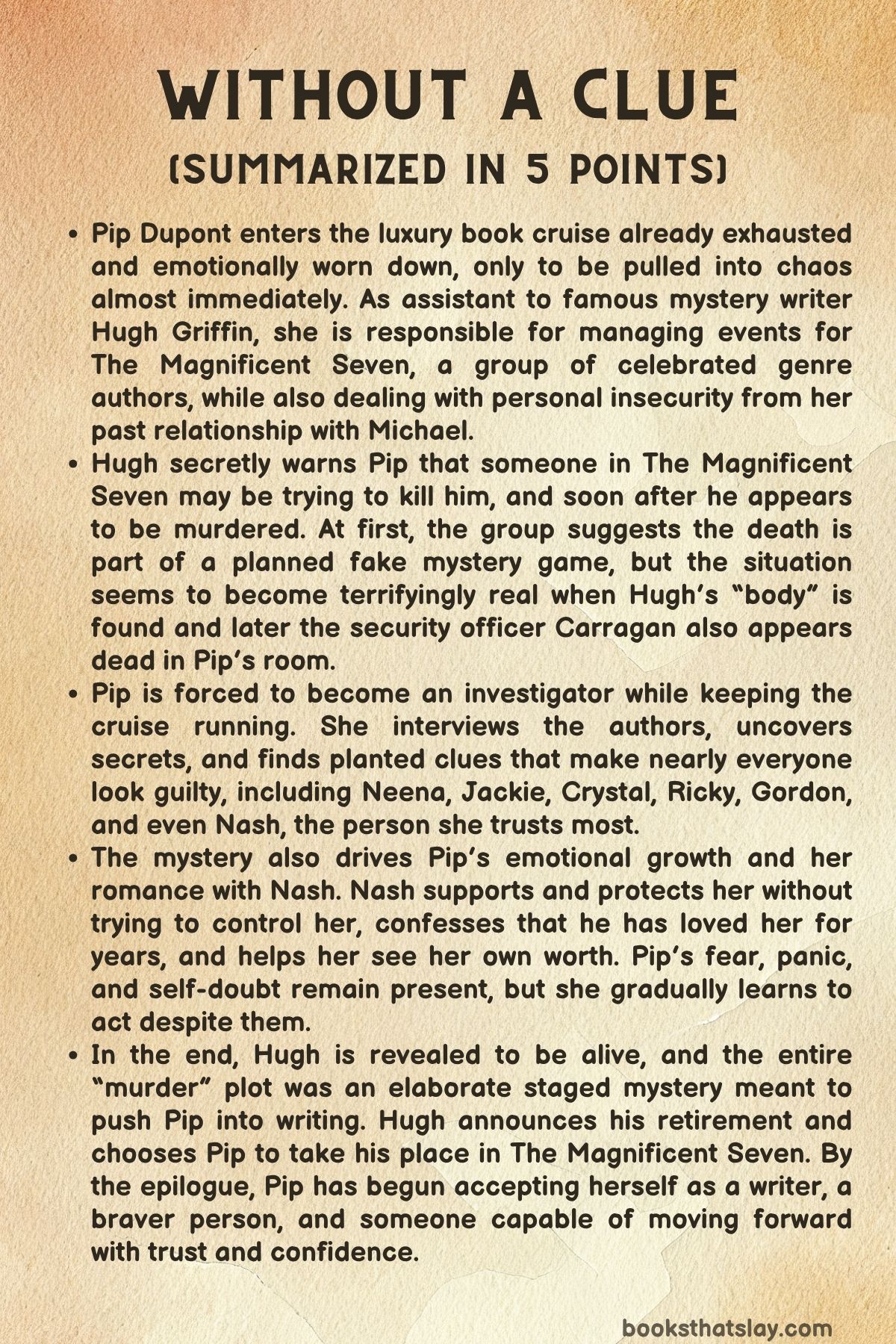
Summary
Penelope “Pip” Dupont arrives in Miami after a miserable trip, hoping for one calm moment before she boards the inaugural book cruise for The Magnificent Seven. She is tired, emotionally strained, and still carrying the damage left by her former relationship with Michael.
Instead of peace, she is confronted by a drunk man in pineapple swim trunks who insults her body and ruins the beach atmosphere with loud music. Pushed beyond her limit, Pip carries his boom box into the water and threatens to throw it into the sea.
The members of The Magnificent Seven step in before the scene becomes worse, and Neena gently talks her down. Hugh Griffin, Pip’s employer and a celebrated mystery writer, proudly claims her as part of their group.
The Magnificent Seven are a famous circle of genre authors who have supported one another for decades. Pip has spent years working for Hugh and helping manage the group’s appearances, events, schedules, and crises.
The cruise is meant to be a grand promotional celebration, full of reader events, workshops, and author activities that Pip has spent a year planning. Once aboard the ship, she is impressed by the luxury around her but has little time to enjoy it.
Her job begins immediately, and the pressure of keeping everyone organized weighs heavily on her.
Nash Eyre, a Western author and Pip’s closest work friend, arrives late after a long writing retreat in Idaho. His appearance is a relief to Pip, who has missed his calm humor and steady presence.
He sends her a rhubarb-and-rosewater mocktail, and their reunion restores some of her confidence. Nash jokes with her, understands her exhaustion, and quickly becomes the person she trusts most on the ship.
Their easy friendship has a warmth that Pip does not fully know how to name.
That night, Hugh privately pulls Pip aside and makes a shocking confession. He says he believes someone in The Magnificent Seven is trying to kill him.
He claims he found a knife stabbed through one of his books in a secret room at his office, along with a threatening note signed “Of The Seven.” Pip thinks Hugh may be stressed or paranoid, especially since Nash has mentioned Hugh’s writer’s block, but Hugh insists she take him seriously. He makes her promise not to tell anyone and tells her to retrieve the note from his desk if anything happens to him.
Later, Pip meets Nash on deck to watch a meteor shower. The night is quiet, and for a short time she feels safe enough to sit beside him under the dark sky.
She almost tells him about Hugh’s warning but stops herself because she promised Hugh secrecy. Nash walks her back and assures her that she can always count on him.
The moment deepens their bond, even though Pip remains anxious about what Hugh told her.
The next morning, Hugh does not appear at the group meeting. Pip goes to check on him and finds what appears to be his bloodied body lying face down in bed.
Horrified, she runs back screaming. The group first reveals that Hugh had planned a fake murder mystery game and that they had agreed to participate, making Pip feel cruelly tricked.
But when she mentions the blood, the others realize something has gone terribly wrong. Security officers bring out Hugh’s actual body on a stretcher, and the mood shifts from theatrical confusion to real terror.
Chief security officer Ralph Carragan gathers the remaining authors and explains that Hugh has been murdered. Since the private hall was locked and only The Seven had keys, he believes the killer is one of them.
The ship will continue its voyage to avoid alarming the passengers, and Pip must somehow keep the scheduled cruise activities running. While grieving and frightened, she scrambles to replace Hugh’s events, make excuses for his absence, and keep the fans from discovering the truth.
As suspicion spreads, the group becomes increasingly nervous. At dinner, even a dropped roll causes panic.
Carragan later questions Pip privately and treats her as a possible suspect. Pip defends herself sharply, using the kind of logic she has absorbed from Hugh’s mysteries.
Carragan claims he knows who killed Hugh and tells Pip to lock her door. That warning only increases her fear.
After two in the morning, Nash knocks on Pip’s door carrying bedding and his computer. He sleeps on her floor to protect her, giving her a sense of safety when she feels completely exposed.
During the night, Pip sees Neena in the hallway through the peephole, whispering to someone. When Pip and Nash investigate, the hallway is empty.
Returning to the room, Nash notices unfamiliar shoes near Pip’s bed and discovers Carragan’s body. Now there is a second death, and it has happened inside Pip’s room.
The next morning, Pip moves into Nash’s room while her own is sealed off. Carragan’s inexperienced subordinate, Cedar Pogache, questions the group badly and seems unable to manage the case.
Pip realizes that if anyone is going to make sense of the danger, it may have to be her. She orders the authors to stay in pairs or groups, keep track of their locations, and allow her to interview them.
Nash insists on helping, though his comments about Michael’s poor treatment of Pip briefly embarrass her. He later reassures her that she deserves someone who recognizes her worth every day.
Pip begins interviewing the authors. Neena admits she and Hugh were once engaged and that he badly hurt her by ending it.
Her odd cheerfulness seems tied to pills and drinks, though Pip wonders if the medication could explain her strange hallway appearance. Jackie tells Pip about her long history with Hugh and the group, but during a walk, Pip finds her in a dark lounge holding a steak knife for protection.
Jackie’s polished talk about her books also raises another suspicion: she may not have written her own work. When Pip confronts her, Jackie denies any connection to murder and threatens legal action if Pip exposes her.
Pip later interviews Nash, who admits he joined the group partly because of her. He remembers the first time he saw her manage The Seven’s chaos and help solve a story problem.
Then he confesses that he has loved her for four years but stayed silent because of Michael. The moment overwhelms Pip, and the crowded bar triggers a panic attack.
Nash helps her outside, gives her space, and asks only that she not choose someone else before considering him.
As the mystery grows, Pip and Nash find a blood-covered knife hidden in Crystal’s room. Pip faints, but once she recovers, she decides they must get security to discover it without revealing that they broke in.
She starts a small fire near a curling iron as a diversion, but Pogache misses the knife and instead confiscates Crystal’s hoverboard. Crystal later tells Pip that her real name is Mary Alice Givens Griffin and that she is Hugh’s secret daughter.
She resents Hugh for supporting Pip more openly than he supported her, but denies killing him. She suggests Jackie may have planted the knife because Crystal knew Jackie’s secret.
Ricky then gives Pip a sealed letter from Hugh, written before the supposed murder. The letter warns her not to overlook the person who seems most innocent: Nash Eyre.
Terrified, Pip searches Nash’s belongings and finds another bloodied knife. For a while, she thinks Nash may have killed Hugh and Carragan and framed Crystal.
She hides her fear, but the discovery nearly breaks her trust in him.
At dinner, Pip notices Neena and Gordon behaving like lovers and realizes they may have hidden ties. Searching Neena’s purse, she finds what she thinks are pills but discovers they are only peppermints.
This changes everything. Pip starts to understand that the clues are too obvious and too evenly placed.
When she and Nash search Ricky’s room, they find another bloody knife, confirming that the evidence has been planted in a pattern. Pip realizes everyone is being made to look guilty.
The final clue leads her to The Blue Lagoon Lounge, a place she has avoided because its underwater portholes trigger her fear of the ocean. Forcing herself through panic, she finds a note from Hugh congratulating her and telling her that she will find him when she gives him what he wants: their story.
Pip and Nash conclude that Hugh is alive and that the entire murder was staged. Pip is relieved but also angry, while Nash is furious at Hugh’s manipulation.
Pip eventually realizes Hugh wants her to write the story of the cruise. He has pushed her into the role of mystery writer by making her solve and narrate a mystery of her own.
She opens her old manuscript, sees that it lacks life, and begins again. This time, she writes freely for eighty-six minutes, producing a full first chapter and an outline for the rest.
Nash finishes his own book as well, and Pip sends her chapter to trusted people for safekeeping before going to confront Hugh.
At The Blue Lagoon, Pip finds Hugh alive onstage, performing for the passengers. He has been secretly present throughout the cruise, giving shows and events while Pip believed he was dead.
Many passengers had been told not to reveal the truth. Hugh brings Pip onstage, reads her completed chapter aloud, and presents her as a future mystery writer.
The fake detectives are revealed as Hugh’s friend Bob Moore and Bob’s son Trent, and the knives were planted so each author would appear guilty. Neena, Jackie, Crystal, Ricky, and the others all played suspicious roles under Hugh’s secret “Rule of Yes,” which required the group to help when asked.
Hugh finally reveals that he is retiring and has chosen Pip to take his place in The Magnificent Seven. His elaborate game was meant to force her to believe in her own writing ability.
In the epilogue, Pip is officially part of the group. Two months later, she travels with them and Nash to the Amazon, where Crystal is doing research.
Facing a terrifying zipline, Pip asks Nash to push her from the platform, and he does. The moment shows how far she has come: still afraid, but willing to move forward with trust, courage, and a new sense of who she is.
Characters
Penelope “Pip” Dupont
Pip is the emotional and narrative center of Without a Clue, and her journey is built around fear, competence, and self-belief. At the beginning, she is exhausted, reactive, and carrying shame from a past relationship that made her doubt her own worth.
Her beach confrontation with the rude man shows how close she is to breaking, but it also shows that she has a strong sense of justice and refuses to remain passive when humiliated. As Hugh’s assistant, Pip is highly capable.
She understands schedules, author egos, public events, reader expectations, and crisis management, yet she does not fully respect her own talent. The staged mystery forces her to act as investigator, organizer, protector, and storyteller all at once.
Her fear of enclosed spaces, the ocean, and emotional vulnerability makes her courage more meaningful because she does not act from fearlessness; she acts despite fear. Her growth is clearest when she realizes she loves Nash but also says she loves herself.
By the end, Pip accepts that she is not only someone who supports writers. She is a writer herself.
Nash Eyre
Nash is Pip’s closest ally and romantic counterpart in Without a Clue, but his role is more than that of a love interest. He represents steadiness in a world full of theatrical suspicion and hidden motives.
His late arrival immediately changes Pip’s emotional state because he understands her rhythms, respects her limits, and notices when she is overwhelmed. Nash’s confession that he has loved her for four years is important because it does not pressure her into an immediate response.
Instead, he asks for a chance and continues to care for her without demanding control. He sleeps on her floor to protect her, helps her think through clues, and supports her writing breakthrough.
The false suspicion placed on him by Hugh’s letter and the planted knife tests Pip’s trust, but it also reveals how dangerous manipulation can be when it targets the person she relies on most. Nash’s own writing struggle mirrors Pip’s creative block, and their balcony brainstorming scene shows a partnership based on mutual encouragement.
He helps Pip see herself as worthy, not because he rescues her, but because he consistently treats her as capable.
Hugh Griffin
Hugh Griffin is one of the most complicated figures in Without a Clue because he is loving, brilliant, theatrical, selfish, and manipulative at the same time. As a famous mystery author, he understands structure, suspense, clues, motives, and dramatic revelation, and he turns those tools into a real-life test for Pip.
His decision to fake his death and involve the entire group is extreme, especially because it causes Pip genuine terror and places her under intense emotional pressure. Yet his motives are not purely cruel.
He sees Pip’s talent before she can see it herself, and he wants to force her past the fear that has kept her from writing. His “Rule of Yes” shows the power he holds over The Magnificent Seven, since they participate in his plan even when it becomes morally questionable.
Hugh’s greatest flaw is that he assumes a good outcome justifies emotional harm. His greatest strength is that he recognizes hidden potential and refuses to let it remain unused.
He is both mentor and trickster, and the book allows both sides to remain visible.
Neena
Neena is presented as gentle, glamorous, emotionally fragile, and suspiciously unpredictable. Her history with Hugh gives her one of the clearest possible motives because they were once engaged, and his decision to end that relationship caused her deep pain.
Her behavior after the supposed murders adds uncertainty to her role. At times she seems drugged, cheerful, detached, or strangely calm, which makes Pip question whether medication, alcohol, or sleepwalking might explain her actions.
The later discovery that her “pills” are actually peppermints changes the meaning of her behavior. Neena is not merely a fragile woman reacting badly to stress; she is performing a part in Hugh’s staged mystery.
Her relationship with Gordon adds another hidden layer, suggesting that she has built a life beyond the old wound Hugh left behind. Neena’s character shows how easily emotional pain can be used as a believable motive in a mystery.
She also shows how performance and truth can sit close together, since her past hurt is real even when her present behavior is partly staged.
Jackie
Jackie is one of the older members of the author circle and carries the authority of long experience. Her connection to Hugh goes back decades, and her story about the early days of The Magnificent Seven gives the group a sense of history.
She seems practical, sharp, and protective of her reputation. The steak knife scene makes her appear dangerous, but it also reflects the fear spreading among the authors.
Jackie’s larger secret is tied not to murder but to authorship. Pip realizes that Jackie can recite polished summaries of her books but cannot speak naturally about details, which suggests she may rely on a ghostwriter.
This secret gives Jackie a strong reason to fear exposure, especially in a world where her public image depends on literary identity and long-term success. Her threat to sue Pip shows how defensive she becomes when that image is challenged.
Jackie’s character examines the gap between public reputation and private insecurity. She may not be a killer, but she has something significant to protect.
Crystal Griffin
Crystal, whose real name is Mary Alice Givens Griffin, brings family resentment into the mystery. At first, she seems chaotic, dramatic, and careless, surrounded by clutter, books, snacks, clothes, and tools in her room.
The bloody knife found there makes her look deeply suspicious, but her later confession changes how the reader understands her anger. She is Hugh’s secret daughter, forced to use a pen name and denied the open support Pip received.
Her resentment is personal and painful because she sees Pip as receiving the encouragement and professional affection that should have belonged to her. Crystal’s jealousy is not simple selfishness; it comes from feeling hidden, undervalued, and pushed aside by her own father.
Her claim that Jackie may have planted the knife also shows her awareness of other people’s secrets. Crystal’s character adds emotional cost to Hugh’s charm.
Through her, the story shows that mentorship can wound when it is given freely to outsiders while withheld from family.
Ricky
Ricky is designed to unsettle both Pip and the reader. His behavior is morbid, evasive, and difficult to read, making him an ideal suspect in a mystery built around misdirection.
He seems to know more than he says, and his warning that Pip has failed to notice what is in front of her pushes her into deeper doubt. By giving her Hugh’s letter about Nash, Ricky becomes the person who places suspicion directly on the one man Pip trusts most.
His role depends on discomfort: he does not need to appear openly violent because his strange calm and cryptic remarks create enough unease. In the larger design of Hugh’s staged game, Ricky functions as a human red herring, someone whose personality makes guilt feel plausible even when evidence is artificial.
Yet he also helps move Pip toward the solution by forcing her to question assumptions. His character shows how genre expectations work; readers are trained to suspect the eerie person, and Hugh uses that expectation against Pip.
Gordon
Gordon is quieter than some of the other suspects, but his position is important because he has a clear financial motive. If he inherits Hugh’s fortune, then Hugh’s death could benefit him directly.
His calm denial during Pip’s interview makes him difficult to read, especially because he encourages her to think like a narrator rather than only as a frightened participant. That advice is more revealing than it first appears.
Gordon understands story logic, and his guidance nudges Pip toward recognizing patterns rather than isolated clues. His secret closeness with Neena adds another layer of concealment, showing that he, too, has private loyalties and hidden emotional connections.
Gordon is not as loud or theatrical as some of the others, but he contributes to the sense that everyone has a possible motive and everyone is withholding something. In the book’s mystery structure, he represents the suspect who appears reasonable enough to be trusted but still benefits from doubt.
Ralph Carragan
Ralph Carragan appears to be the authority figure who will bring order to Hugh’s murder, but his role is unstable from the start. As chief security officer, he gathers the suspects, explains the locked-hall problem, and treats the situation as a real investigation.
His aggressive questioning of Pip makes him seem competent but also unfair, especially when he pushes possible motives onto her. Carragan’s claim that he knows who killed Hugh raises the stakes because it suggests the truth may soon be revealed.
His supposed death in Pip’s room then turns the mystery more frightening and personal. Since his body appears in the one place where Pip should be safest, the event destroys her sense of security and forces her closer to Nash.
Later, the reveal that the detectives are part of Hugh’s plan reframes Carragan’s function. He is not a true investigator but a device used to intensify fear, mislead Pip, and give the staged mystery official weight.
Cedar Pogache
Cedar Pogache provides comic frustration and practical danger because he appears unprepared for the responsibility placed on him. After Carragan’s supposed death, Pogache becomes the person who should control the investigation, but his questioning is poor, his judgment is weak, and his inspection of Crystal’s room misses the most important evidence.
His decision to confiscate a hoverboard while overlooking a hidden knife captures his incompetence perfectly. Yet his failure is useful to the plot because it forces Pip to investigate for herself.
If Pogache were skilled, Pip could remain an assistant and observer. Because he is ineffective, she must step into the role of detective.
His character also contributes to the absurd humor of the cruise setting, where serious danger and ridiculous mistakes exist side by side. Pogache may not be emotionally central, but he is structurally important because his weakness creates space for Pip’s strength.
Michael
Michael does not appear as an active figure in the shipboard mystery, but his influence shapes Pip’s emotional life. He represents the relationship that damaged her confidence and made her feel lesser than she is.
Nash’s anger about how Michael treated her reveals that the harm was visible to people who cared about Pip, even if Pip still feels embarrassed by it. Michael’s importance lies in the shadow he leaves behind.
Pip’s reluctance to accept Nash’s love, her discomfort with being valued, and her tendency to doubt her own worth are all connected to the way Michael treated her. The story does not need him physically present because Pip is still carrying the effects of his behavior.
Her growth requires more than solving Hugh’s staged mystery; it requires rejecting the inner voice that Michael helped create. By the end, Pip’s declaration that she loves herself marks a direct break from that past.
Melody
Melody is a minor character, but she helps reveal Nash’s public world and Pip’s private feelings. As Nash’s moderator, she exists around his professional obligations and fan interactions, reminding the reader that Nash is not simply Pip’s protective friend but also a successful author with responsibilities of his own.
The scene in which Nash speaks with Melody while keeping Pip close becomes important because it shows how naturally he prioritizes Pip without dismissing his work. Melody’s presence also helps create social pressure around Pip and Nash’s relationship.
Their bond is not developing in isolation; it is happening in crowded public spaces, under the gaze of fans, authors, and staff. Though Melody does not drive the mystery, she supports the cruise atmosphere and helps place Nash between his public identity and his private loyalty to Pip.
Bob Moore and Trent
Bob Moore and his son Trent become important near the end when the truth behind the fake investigation is revealed. They are not genuine ship detectives but participants in Hugh’s elaborate plan.
Their presence gives the staged murders the appearance of official seriousness, making Pip believe she is trapped inside a real criminal investigation. Bob’s friendship with Hugh explains why he would participate, while Trent’s involvement expands the deception across more than one person.
These characters matter because they show how large Hugh’s scheme truly is. It is not a small prank by a few authors but an organized performance involving outsiders, passengers, false authority figures, planted clues, and controlled information.
Bob and Trent also sharpen the ethical problem at the center of Hugh’s plan. Their cooperation helps Pip reach her writing breakthrough, but it also helps sustain a lie that causes her fear and emotional distress.
Themes
Fear as Something to Move Through, Not Erase
Fear shapes Pip’s choices from the beginning, but the story does not treat courage as the absence of fear. Pip is frightened by emotional exposure, public failure, enclosed spaces, the dark ocean, and the possibility that people she trusts may betray her.
The cruise setting makes these fears harder to escape because she is physically trapped on a ship, surrounded by suspects, readers, and constant demands. Her fear of The Blue Lagoon Lounge is especially important because it connects the mystery to a personal test.
Hugh places a clue there because he knows she will avoid it, forcing her to decide whether solving the mystery matters more than staying comfortable. Pip’s final zipline scene in the Amazon extends the same idea beyond the cruise.
She is still afraid, but she asks Nash to push her forward. That moment does not make her suddenly fearless.
It shows that growth means acting with fear still present. Without a Clue presents bravery as motion: one difficult step, one honest confession, one page written, one leap taken before confidence fully arrives.
The Difference Between Support and Control
The book repeatedly examines the thin line between helping someone and controlling them. Hugh believes deeply in Pip’s talent, and his desire to push her toward writing comes from real faith in her ability.
Yet his method is manipulative. He frightens her, isolates her from the truth, lets her believe people have died, and turns her private fears into parts of his game.
His support produces a result, but the emotional cost is serious. Nash offers a contrast.
He also believes in Pip, but he does not force her into a response or design her growth for her. When he confesses his love, he gives her space.
When she panics, he helps her breathe and move to safety. When she writes, he supports the moment without claiming ownership of it.
This contrast gives the story moral tension. Hugh’s plan may help Pip discover her voice, but the book does not fully excuse the way he gets there.
Real support respects agency. Control may produce action, but it risks damaging trust.
Authorship, Identity, and the Right to Tell a Story
Writing in the book is not only a profession; it is a question of identity. Pip has spent years near successful authors, solving problems, managing events, and understanding stories from the inside, yet she does not see herself as worthy of being one of them.
Hugh recognizes that she thinks like a mystery writer before she accepts it herself. Jackie’s possible ghostwriter secret complicates the same theme from another direction.
Her public identity depends on being seen as the author of her books, even when that identity may not be fully honest. Crystal’s hidden name and pen name add another layer, showing how authorship can be shaped by family control, branding, and secrecy.
The command to “tell our story” becomes the key to Pip’s transformation because it asks her to stop living as an assistant inside other people’s careers and begin claiming narrative authority. When she writes her first real chapter, she is not simply completing Hugh’s challenge.
She is naming her experience, shaping chaos into meaning, and accepting that her voice belongs in the room.
Trust Under Pressure
Trust is tested through almost every relationship in the story. Pip trusts Hugh as a mentor, then feels betrayed by the scale of his deception.
She trusts The Magnificent Seven as a professional family, then must consider each of them as a possible killer. Most painfully, she trusts Nash, only to find a letter and planted knife that make him appear guilty.
The mystery works because trust becomes unstable. Every secret can be read as a motive, every kindness as performance, and every clue as proof.
Pip’s task is not only to solve the case but to learn how to judge people when fear distorts her thinking. Her temporary suspicion of Nash shows how easily trust can be damaged when evidence is arranged to exploit insecurity.
Yet her eventual realization restores more than romance; it restores her ability to believe in her own perception. The book suggests that trust is not blind certainty.
It is a choice made after fear, doubt, evidence, and instinct have all been faced. Pip’s final trust in Nash feels earned because it survives suspicion rather than avoiding it.