You Better Believe I’m Gonna Talk About It Summary and Analysis
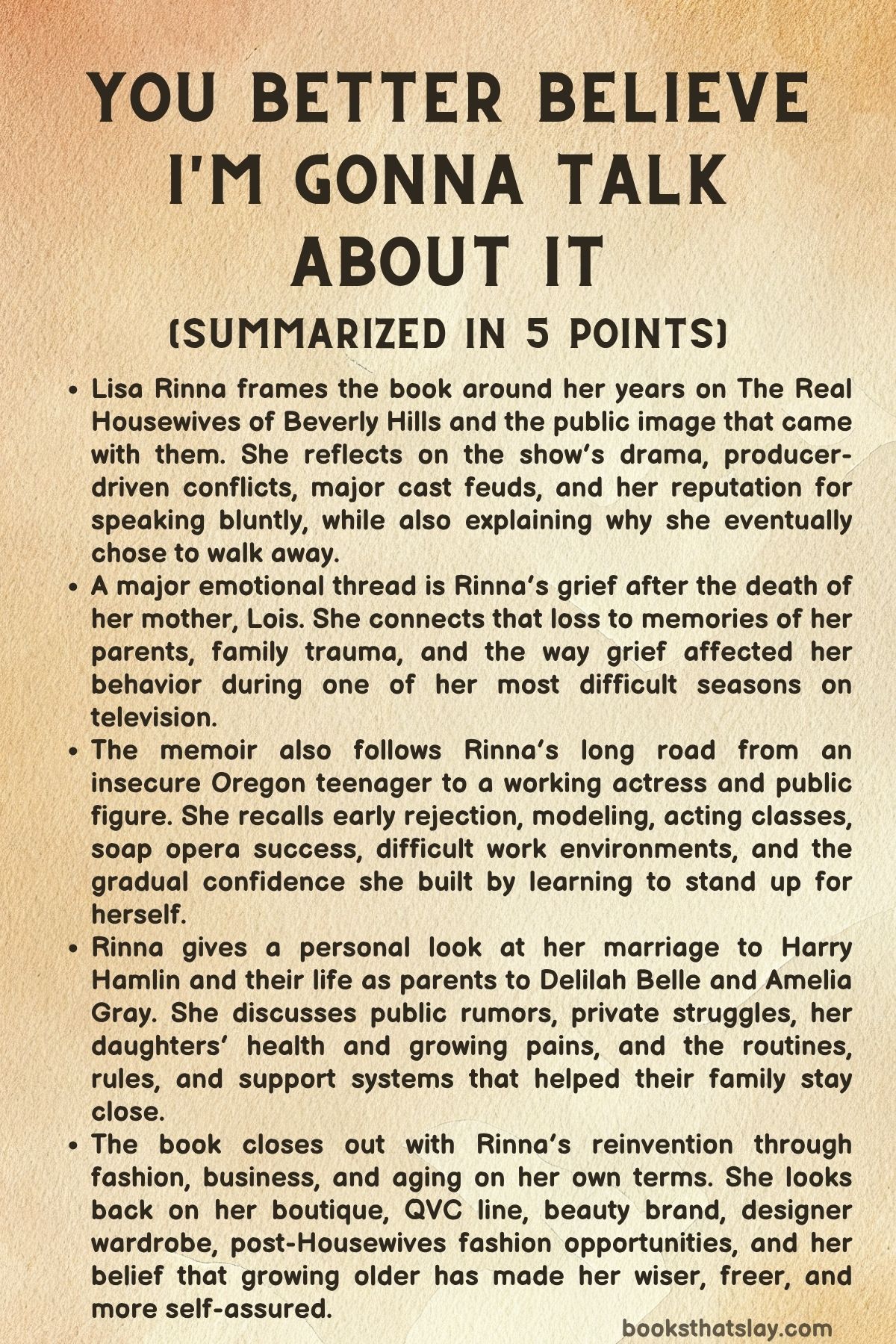
You Better Believe I’m Gonna Talk About It is Lisa Rinna’s memoir about fame, family, survival, and the cost of being seen. Written in a direct, sharp, self-aware voice, the book looks back on her years as an actress, reality TV personality, wife, mother, businesswoman, and fashion figure.
Rinna reflects on her time on The Real Housewives of Beverly Hills, her exit from the show, her grief after losing her mother, and the public judgment that followed her. At its center, the book is about resilience, reinvention, ambition, and choosing to keep speaking even when people want silence.
Summary
You Better Believe I’m Gonna Talk About It opens with Lisa Rinna recalling one of the early moments that defined her experience on The Real Housewives of Beverly Hills. Brandi Glanville arrived at a scene in dramatic fashion, admitted that producers thought the show had become boring, and then threw wine in Eileen Davidson’s face.
For Rinna, that moment captured the strange rules of reality television: conflict was expected, emotions were pushed, and cast members were rewarded for saying or doing things that kept the cameras rolling. She presents herself as someone who believed in being honest, even when that honesty made her unpopular.
Rinna then moves into the most painful period of her life: the death of her mother, Lois. In late 2021, she learned that Lois had suffered a major stroke in Oregon.
Rinna flew to her side and found her mother unable to communicate. Lois was moved into hospice in Medford, where she died about a week later.
Rinna remembers her mother as strong, funny, glamorous, and full of life. She also shares the darker parts of Lois’s history, including her survival after being attacked by David Carpenter, later known as the Trailside Killer.
Lois had lived through terror and still remained lively, social, and optimistic.
Rinna also reflects on other losses in her family. Her father, Frank, chose assisted death years earlier under Oregon’s Death with Dignity Act, and Rinna remembers that experience with sadness but also respect.
Her half-sister Loreen died young, and that loss deeply affected her father, leaving him emotionally distant. These family stories give context to Rinna’s grief after Lois’s death.
She was not only mourning her mother; she was carrying old pain, unresolved sorrow, and the weight of being expected to return to work almost immediately.
Only days after Lois died, Rinna felt pressured to film The Real Housewives of Beverly Hills in Mexico. She was angry, raw, and overwhelmed, and those emotions later came out on camera and online.
She fought with Sutton Stracke over Elton John Oscar party tickets, took part in the video of Garcelle Beauvais’s memoir being thrown in the trash, and lashed out on social media. The backlash was severe.
She received threats, was doxed, and felt that Bravo and some of her castmates did not support her when things became frightening.
The pressure continued through BravoCon, where the crowd booed her. Rinna responded by flipping them off, a gesture that became another public flashpoint.
The season also included her conflict with Kathy Hilton after Rinna said she witnessed Kathy having an intense meltdown in Aspen. Rinna believed she was telling the truth, but by the reunion she felt isolated and attacked.
Erika Jayne, one of her closest friends on the show, advised her not to return. Rinna eventually resigned after eight years, later feeling hurt by how Andy Cohen and Bravo discussed her private messages and exit publicly.
After leaving the show, Rinna had no firm plan. Yet her post-Housewives life quickly shifted toward fashion.
She attended Paris fashion events, modeled, appeared in editorials, and found herself welcomed by designers and magazines. Her daughters, Amelia Gray and Delilah Belle, were also building careers in fashion and entertainment.
What first looked like an ending became a new opening.
Rinna then looks back on her childhood and early ambition. She was born in Newport Beach but moved with her family to Medford, Oregon.
There, classmates mocked her appearance, her skin tone, and her clothes. Wanting to belong, she joined cheerleading, performed in talent shows, acted in musicals, and began shaping the confidence that would later define her public image.
Fashion became an early source of fantasy and power for her, encouraged by magazines and shopping trips with her mother.
Her path to acting was uneven. She left home for Emerson College with her boyfriend Bob but panicked and returned.
She briefly attended the University of Oregon, then dropped out after rejection in an acting class shook her confidence. She modeled for Nike, spent time in San Francisco and Japan, and eventually made her way to Los Angeles with Bob’s support.
Acting classes helped her find her voice. After commercials and failed soap auditions, she cut her hair before a callback, took a risk, and landed the role of Billie Reed on Days of Our Lives.
Soap work was demanding, fast, and often difficult. Rinna describes long shooting days, tough male costars, and the need to stand up for herself.
She later joined Melrose Place, gaining more visibility and learning how Hollywood could both reward and dismiss women. Over time, she became tougher, more practical, and more willing to fight for her place.
A large part of the memoir centers on her Housewife years. Rinna explains how producers shaped storylines and encouraged conflict.
She believes Lisa Vanderpump influenced her during the Yolanda Hadid Lyme disease storyline and later says Puppy Gate exposed Vanderpump’s methods. She revisits major feuds with Denise Richards, Sutton Stracke, Garcelle Beauvais, Camille Grammer, Kim Richards, and Kathy Hilton.
At the same time, she describes real friendships with Erika Jayne, Eileen Davidson, Teddi Mellencamp, Dorit Kemsley, Kyle Richards, and others. One of the most famous moments she revisits is the Amsterdam fight, when Kim Richards hinted at secrets about Harry Hamlin and Rinna smashed a glass in anger.
Rinna’s marriage to Harry Hamlin is another major focus. Harry initially resisted her joining The Real Housewives of Beverly Hills but agreed once he understood the business opportunities.
He set limits, including how much he would appear and how she should manage drinking on camera. Rinna describes their courtship, their 1997 wedding, money arguments, therapy, work ethic, and separate interests.
Their relationship, as she presents it, is built on respect, honesty, independence, attraction, and humor.
She also addresses long-running rumors about Harry, especially speculation about his sexuality and their marriage. Rinna says they trust each other completely and have learned to laugh at gossip.
Harry supported her through emotional lows during her reality TV years and often helped her understand other people through his interest in psychology. As empty nesters, they are now adjusting to a quieter home, planning travel, considering new projects, and starting a podcast together.
Rinna also jokingly thanks Michael Bolton because his former relationship with Nicollette Sheridan indirectly led to Rinna meeting Harry.
The memoir then turns to their daughters, Delilah Belle and Amelia Gray. Rinna knows they grew up with privilege and public attention, but she also describes serious challenges.
Delilah was bullied in school and later diagnosed with PANDAS, a condition linked to strep infections that caused panic, obsessive behavior, and severe distress. The illness shaped family life for years.
Harry sometimes sat outside classrooms, drove Delilah to hospitals, or calmed her by a duck pond. Amelia sometimes felt overlooked because so much attention went to Delilah, but other women in Rinna’s life helped support her.
The family also faced Amelia’s eating disorder, teenage rebellion, curfew fights, sneaking out, and tension between the sisters. Rinna and Harry tried to keep their daughters grounded through routines such as Sunday dinners at California Pizza Kitchen, trips to Disneyland, clear rules, and jobs at a local deli.
As adults, both daughters are presented as strong and successful. Delilah is singing, acting, modeling, and healing after years of illness.
Amelia has become a successful model. The sisters, once distant and jealous, have grown close again.
Fashion becomes one of the book’s most joyful subjects. Rinna describes her love of designer clothes and the emotional value of her vintage collection.
Harry bought her pieces by Hervé Léger, Alaïa, Halston, Versace, Donna Karan, and Tom Ford. During her Housewives years, she spent large amounts on clothing because cast members had no wardrobe allowance but were expected to look extravagant.
She bought Hermès bags, reunion gowns, shoes, and designer outfits, sometimes spending more than she should. After leaving the show, fashion became a serious career space for her, especially after she appeared on covers, walked runways, and felt recognized by the fashion world.
Rinna also recounts her business ventures. During a difficult financial period, she and Harry opened Belle Gray, a boutique named after their daughters’ middle names.
The store became successful and was even featured by Oprah, but recession, theft, break-ins, and money pressure eventually forced them to close it. Belle Gray led to other opportunities, including reality television, Celebrity Apprentice, and Rinna’s QVC clothing line.
That line became highly successful before problems with manufacturing, COVID, politics, and controversy contributed to its collapse. She later launched Rinna Beauty, though she remains frustrated by partners who do not match her drive.
The book closes with Rinna reflecting on aging. Turning sixty made her think about each decade of her life: her twenties were anxious, her thirties were shaped by postpartum depression, her forties gave her physical confidence, and her fifties were difficult because of menopause.
Hormone replacement therapy helped her feel like herself again. Her Cosmopolitan “Sex After 60” cover made her feel visible, powerful, and alive.
In the end, Rinna embraces age as a source of wisdom. She would rather be older, clearer, and stronger than young and unsure.
Key Figures
Lisa Rinna
Lisa Rinna is the central figure of the book, and she comes across as energetic, self-aware, combative, vulnerable, ambitious, and deeply shaped by both public performance and private pain. She presents herself as someone who has spent much of her life learning how to be seen, heard, and taken seriously.
Her early experiences in Oregon, where she felt mocked and out of place, help explain her hunger for transformation and visibility. She is not shown as naturally confident from the beginning; rather, her confidence is something she builds through acting, modeling, fashion, and sheer persistence.
Her career journey reveals a woman who repeatedly turns rejection into reinvention, whether by changing her appearance before a soap-opera callback, surviving difficult work environments, or finding new opportunities after leaving reality television.
Emotionally, Lisa is one of the most layered figures in the book because she often combines boldness with insecurity. Her grief after Lois’s death exposes how raw and unstable she can become when pain is unresolved.
Her outbursts, social media spirals, and conflicts with castmates are not presented simply as dramatic behavior, but as signs of a woman under immense emotional pressure. At the same time, she does not fully excuse herself.
She appears aware that her anger, sharp tongue, and public reactions have consequences. Her identity as a “truth-teller” is complicated because the book shows both the power and danger of that self-image.
Lisa wants honesty, but her honesty can become explosive, especially when mixed with grief, reality-TV pressure, or a need to defend herself.
Lisa is also portrayed as a survivor of industries that reward image while punishing emotional messiness. Acting, soaps, fashion, QVC, reality television, and beauty all require her to package herself for public consumption.
Yet she keeps insisting that behind the image is work, discipline, instinct, and resilience. Her love of fashion is not shallow in the book; it becomes a language of identity, memory, status, and rebirth.
By the later parts of the story, Lisa appears less like someone trying to prove she belongs and more like someone claiming the right to evolve. Her reflections on aging, menopause, sexuality, and visibility make her a figure of defiance.
She refuses to disappear simply because she is older, and that refusal becomes one of her strongest character traits.
Harry Hamlin
Harry Hamlin is presented as Lisa’s grounding force, a steady contrast to her speed, intensity, and emotional volatility. He is intelligent, private, disciplined, and somewhat cautious about public exposure, especially when it comes to reality television.
His initial hesitation about Lisa joining the show suggests that he understands the cost of fame and spectacle. Yet he is also pragmatic, recognizing the business value of the opportunity.
This balance between caution and practicality defines much of his role in the book. He does not appear as someone who seeks chaos, but as someone who learns how to live beside it without losing his own center.
As a husband, Harry is shown as supportive without being overly sentimental. He gives Lisa advice, helps her think through difficult people, and stands by her during emotional breakdowns.
His interest in psychology makes him a kind of interpreter of behavior, helping Lisa understand conflict from a more analytical distance. Their marriage is not portrayed as perfect or effortless; the book mentions financial arguments, therapy, separate interests, and long-term adjustment.
This makes Harry feel less like a decorative celebrity spouse and more like a real partner in a complicated, enduring marriage. His steadiness matters because Lisa’s world is often unstable.
Harry also carries his own history of career risk and public judgment. The discussion of his role in Making Love and the rumors about his sexuality show how he, too, has lived under public speculation.
His response to rumors is presented as calm and secure, which strengthens the sense that he and Lisa survive because they trust each other more than they trust public narratives. In the book, Harry represents loyalty, independence, intelligence, and emotional structure.
He is not simply Lisa’s husband; he is one of the people who helps define the private foundation beneath her public life.
Lois Rinna
Lois is one of the emotional anchors of the book. She represents warmth, strength, survival, and maternal influence.
Lisa remembers her not only as a beloved mother but as a woman who endured extraordinary violence and continued living with grace. Her survival of an attack by David Carpenter gives her character a quiet heroism.
Lois is not portrayed as loud or fame-seeking; instead, her power comes from resilience, kindness, and the lasting emotional imprint she leaves on Lisa.
Lois’s death becomes one of the most important turning points in Lisa’s story. The hospice scenes reveal Lisa’s helplessness and grief, especially because Lois can no longer communicate.
For someone like Lisa, who depends so much on expression, speech, and emotional force, her mother’s silence is devastating. Lois’s decline also exposes the cruelty of professional pressure, as Lisa is expected to return to filming almost immediately after losing her.
This makes Lois’s death more than a family tragedy; it becomes the emotional wound behind much of Lisa’s later behavior.
Lois also functions as a source of Lisa’s taste and selfhood. Lisa’s love of fashion, shopping, and glamour is linked to her mother, which gives those interests emotional depth.
Through Lois, the book connects personal style with maternal memory. Lisa’s admiration for her mother shows that beneath her public toughness is a daughter still seeking comfort, approval, and connection.
Lois is therefore one of the most tender figures in the story.
Frank Rinna
Frank, Lisa’s father, is portrayed as a man marked by loss, emotional withdrawal, and a complicated relationship with death. His assisted death under Oregon’s Death with Dignity Act is described with seriousness and reflection, suggesting that Lisa sees his final choice as part of a larger family history of pain, control, and dignity.
Frank’s character carries sadness, especially because the death of his daughter Loreen changed him emotionally. He seems to have retreated inward after that loss, becoming less available in ways that affected the family.
Frank’s importance lies in how his grief shaped the emotional atmosphere around Lisa. He is not presented with the same warmth and vividness as Lois, but his pain matters because it shows how death can alter a family long before another loss occurs.
Through him, the book explores a quieter form of suffering: the kind that does not explode publicly but hardens privately. Frank’s story helps explain Lisa’s sensitivity to abandonment, silence, and emotional distance.
Loreen
Loreen, Lisa’s half-sister, appears briefly but has a lasting emotional presence. Her early death is important because it changes Frank and therefore affects the family Lisa grows up in.
Loreen’s character is less developed through direct action and more through consequence. She represents a loss that happened before much of Lisa’s public life but continued shaping the emotional lives of those around her.
In the book, Loreen functions as a reminder that family histories often contain invisible wounds. Even when a person is not physically present for much of the story, their absence can become a defining force.
Loreen’s death helps explain the emotional withdrawal of Frank and adds another layer to Lisa’s lifelong awareness of grief, fragility, and survival.
Delilah Belle Hamlin
Delilah is portrayed with tenderness and concern, especially through the description of her struggles with bullying and PANDAS. Her childhood and adolescence are marked by fear, panic, obsessive behavior, and medical uncertainty, making her one of the most vulnerable figures in the book.
Lisa presents Delilah’s illness as something that dominated family life for years, affecting not only Delilah but everyone around her. This gives Delilah’s character emotional weight because her suffering becomes a central family challenge.
At the same time, Delilah is not defined only by illness. Her growth into singing, acting, modeling, and recovery shows resilience.
She moves from being a child overwhelmed by forces she cannot control to a young woman building a creative and professional identity of her own. The book treats this transformation with pride.
Delilah’s story also reveals Lisa and Harry as parents under pressure, trying to protect a child whose pain is difficult for outsiders to understand.
Delilah’s relationship with Amelia adds another important dimension. The sisters experience jealousy, distance, and tension, partly because Delilah’s needs often require so much family attention.
Yet their later closeness suggests healing. Delilah becomes a figure of endurance, creative promise, and emotional recovery.
Amelia Gray Hamlin
Amelia is presented as ambitious, sensitive, rebellious, and deeply affected by the family dynamics around Delilah’s illness. As a younger daughter, she sometimes feels overshadowed, which gives her character a quiet emotional struggle.
Her experience shows how one child’s crisis can unintentionally shape another child’s sense of attention, fairness, and belonging. Lisa acknowledges that other women in her life helped support Amelia, which suggests that Amelia needed emotional care beyond what her parents could always provide during the hardest years.
Amelia’s eating disorder and teenage rebellion add complexity to her character. She is not portrayed as simply glamorous or privileged, even though she grows up as a celebrity child in Hollywood.
Instead, her story includes vulnerability, defiance, and the difficult process of becoming independent. Her later success as a model shows discipline and transformation.
Like Lisa, Amelia learns how to live inside public attention, but she also has to navigate the pressure that comes with beauty, fame, and comparison.
By adulthood, Amelia appears as a professional and capable young woman. Her renewed closeness with Delilah gives her character a sense of emotional maturity.
In the book, Amelia represents both the burden and opportunity of growing up in a famous family.
Brandi Glanville
Brandi Glanville appears as a symbol of reality-TV chaos and unpredictability. Her arrival overdressed and her wine-throwing incident with Eileen Davidson introduce the kind of dramatic world Lisa is entering.
Brandi’s role is important because she helps set the tone for the show environment: heightened, performative, confrontational, and producer-influenced. She is less central as a deeply explored person and more important as a force of disruption.
In the book, Brandi represents the shock value that reality television often rewards. Her behavior shows how quickly a social scene can become spectacle.
For Lisa, this moment becomes part of her initiation into a world where conflict is not incidental but central to the format.
Eileen Davidson
Eileen Davidson is presented as a friend and fellow actress who becomes part of Lisa’s early reality-TV experience. The wine-throwing incident positions her as someone caught in the violence of televised drama, but her broader role in Lisa’s life appears warmer and more supportive.
Lisa includes Eileen among the people with whom she maintains close bonds, suggesting trust and loyalty.
Eileen’s character is significant because she shares Lisa’s soap-opera background. This gives them a professional kinship and likely a shared understanding of performance, cameras, and public judgment.
In the book, Eileen represents steadiness and friendship within a world often defined by betrayal and shifting alliances.
Erika Jayne
Erika Jayne is shown as one of Lisa’s closest allies in the reality-TV world. Her advice that Lisa should not return after a difficult season suggests that Erika understands both the emotional cost of the show and Lisa’s deteriorating relationship with it.
Erika’s role is not merely that of a castmate; she appears as someone who can recognize when Lisa has reached a breaking point.
Erika’s character is associated with loyalty, toughness, and survival within the public eye. Lisa’s closeness with her suggests that both women share an understanding of being judged harshly and performing strength under pressure.
In the book, Erika functions as a confidante who sees the danger of staying too long in a toxic environment.
Garcelle Beauvais
Garcelle Beauvais is presented through conflict, especially around the incident involving her memoir being thrown in the trash. This moment becomes part of Lisa’s post-grief spiral and one of the actions that intensifies public criticism against her.
Garcelle’s presence in the book highlights the emotional and social consequences of Lisa’s behavior during that period.
As a character in the story, Garcelle represents a castmate whose conflict with Lisa cannot be separated from public perception. The incident involving her memoir becomes larger than a private disagreement because audiences interpret it morally and emotionally.
Garcelle’s role therefore helps reveal how reality television turns gestures into symbols and conflicts into reputational turning points.
Sutton Stracke
Sutton Stracke is portrayed as a major source of conflict for Lisa, especially through the argument about Elton John Oscar party tickets. Lisa’s explosion at Sutton comes during a period of intense grief, which makes the conflict feel emotionally charged rather than merely petty.
Sutton’s role in the book is important because she becomes the person onto whom Lisa’s anger is visibly released.
Sutton represents the kind of castmate who can trigger Lisa’s defensiveness and sense of injustice. Their conflict shows Lisa at one of her least controlled moments.
At the same time, Sutton’s presence helps expose how grief, pride, and reality-TV pressure can turn a disagreement into a defining public scene.
Kathy Hilton
Kathy Hilton is one of the most important conflict figures in Lisa’s reality-TV storyline. Lisa describes witnessing Kathy’s Aspen meltdown and then feeling cornered at the reunion.
Kathy’s character is tied to power, reputation, denial, and social influence. In Lisa’s version of events, Kathy is not simply another castmate but someone whose status changes how conflict around her is handled.
Kathy’s role helps develop one of the book’s major themes: the difficulty of telling the truth when powerful people want a different version of events accepted. Lisa seems to view the Kathy conflict as a moment when her truth-teller identity was tested and punished.
Whether readers fully accept Lisa’s perspective or not, Kathy becomes a figure through whom the book explores status, fear, loyalty, and the politics of public storytelling.
Lisa Vanderpump
Lisa Vanderpump is portrayed as clever, strategic, and manipulative in Lisa Rinna’s account. The Yolanda Lyme disease storyline and Puppy Gate are presented as examples of Vanderpump shaping events from behind the scenes.
Vanderpump’s character is important because she represents a more subtle kind of power than open confrontation. While Lisa Rinna often explodes directly, Vanderpump is described as someone who influences conflict indirectly.
In the book, Vanderpump functions almost as a master strategist within the reality-TV world. Her presence helps contrast different styles of control: Lisa Rinna’s blunt and emotional style versus Vanderpump’s polished and tactical one.
This makes Vanderpump one of the most significant figures in Lisa’s understanding of how the show operated.
Denise Richards
Denise Richards appears as another castmate with whom Lisa experiences conflict. Her role in the book is tied to the breakdown of friendship and trust under the pressure of reality television.
Because Lisa and Denise had a relationship before their televised conflict, the tension between them carries a personal sting.
Denise represents one of the painful realities of the show: preexisting relationships can become material for public drama. Her character matters because she shows how reality television can turn private history into conflict and make reconciliation difficult.
In Lisa’s story, Denise is part of the larger pattern of friendships tested or damaged by the demands of the format.
Kim Richards
Kim Richards is one of the most memorable conflict figures in Lisa’s reality-TV history. The Amsterdam fight, where Kim hints at secrets about Harry and Lisa smashes a glass, reveals Lisa’s fierce protectiveness and volatility.
Kim’s role is powerful because she knows exactly where to strike: Lisa’s marriage and family.
Kim represents provocation, vulnerability, and danger within the social world of the show. Her comment about Harry becomes more than gossip; it threatens Lisa’s deepest private loyalty.
Lisa’s reaction shows how quickly she can move from verbal conflict to physical aggression when she feels her family is being attacked. Kim’s character therefore exposes the intensity of Lisa’s boundaries.
Kyle Richards
Kyle Richards is presented as one of Lisa’s closer bonds within the cast world. While not explored as deeply as some conflict figures, Kyle’s inclusion among Lisa’s maintained friendships suggests familiarity, loyalty, and shared history.
Kyle also matters because of her connection to Kathy Hilton, which complicates the Aspen storyline and reunion dynamics.
In the book, Kyle represents the difficulty of being connected to both sides of a conflict. Her presence shows how reality-TV relationships are rarely simple.
Friendship, family loyalty, cast obligation, and public perception overlap, making every reaction meaningful.
Teddi Mellencamp
Teddi Mellencamp appears as part of Lisa’s trusted circle rather than as a major antagonist. Her role is tied to loyalty and friendship within the wider cast network.
Lisa’s mention of Teddi among her close bonds suggests that Teddi represents one of the relationships that survived the instability of the show.
Teddi’s character helps balance the book’s many conflicts. Not every cast relationship is presented as betrayal or rivalry.
Through figures like Teddi, the story shows that Lisa did find allies and genuine connections inside an environment built to produce tension.
Dorit Kemsley
Dorit Kemsley is also included among Lisa’s close bonds, making her part of the support system Lisa identifies within the reality-TV world. Dorit’s character in this account is less defined by a specific dramatic incident and more by her place in Lisa’s circle.
She represents glamour, social connection, and continuity within the cast.
Dorit matters because Lisa’s reality-TV experience is not portrayed only as hostile. The presence of friends like Dorit shows why leaving the show could be emotionally complicated.
Lisa was not merely walking away from a job; she was leaving a social ecosystem that included real attachments as well as conflict.
Camille Grammer
Camille Grammer appears as one of the figures with whom Lisa clashes. Her role in the book contributes to the broader picture of a reality-TV environment where past grievances and sharp personalities repeatedly resurface.
Camille’s character functions as another reminder that the show’s social world is built on memory: conflicts do not disappear easily, and old tensions can return at any moment.
As part of the book’s cast landscape, Camille represents confrontation and unresolved history. Her presence adds to the sense that Lisa’s time on the show was a constant negotiation between alliance, rivalry, and reputation.
Andy Cohen
Andy Cohen is portrayed as a powerful figure connected to Bravo and the public handling of Lisa’s departure. Lisa later resents him and the network for publicizing private messages and her resignation.
His character is important because he represents the institutional side of reality television rather than the cast side.
Andy’s role in the book highlights the imbalance between performer and platform. Lisa may be famous and outspoken, but Bravo and its public-facing figures still have power over how her exit is framed.
Andy therefore becomes a symbol of media authority, control, and the complicated relationship between talent and network.
Bravo Producers
The Bravo producers function almost like collective characters in the book. They shape storylines, encourage conflict, decide what is confusing or usable, and pressure Lisa to film soon after Lois’s death.
Their influence is crucial because the book repeatedly suggests that reality television is not simply reality; it is guided, edited, and intensified.
The producers are especially important in relation to Delilah’s PANDAS and Lisa’s grief. Their decision not to focus on Delilah’s illness protects her privacy in hindsight, but their pressure on Lisa after Lois’s death appears emotionally damaging.
As a group, they represent the machinery behind the spectacle. They are not merely observers; they help create the conditions in which the cast behaves.
Bob
Bob, Lisa’s early boyfriend, plays an important role in her journey toward independence and acting. He supports her during the uncertain period when she leaves school, models, and eventually reaches Los Angeles.
His presence belongs to the earlier, formative part of Lisa’s life, before her major fame.
Bob represents youthful support and transition. He is connected to the version of Lisa still trying to discover who she is and where she belongs.
While he does not remain central to the later story, his role matters because he helps Lisa move toward the career and identity that define her adult life.
David Carpenter
David Carpenter, later known as the Trailside Killer, is a dark and frightening presence in the family history because of his attack on Lois. He is not a developed character in the emotional sense, but his violence shapes how Lois’s strength is understood.
His presence gives the book one of its starkest reminders that real danger and trauma exist beneath celebrity storytelling.
Carpenter’s role is significant because he indirectly reveals Lois’s courage. The focus is not on him as an individual but on the survival of the woman he attacked.
In that sense, he functions as a symbol of threat, brutality, and the kind of trauma that families carry long after the event itself.
Michael Bolton
Michael Bolton appears briefly but memorably because Lisa credits his past relationship with Nicollette Sheridan as indirectly leading to her meeting Harry. His role is light, almost comic, compared with the heavier family and reality-TV figures.
He represents the strange chain of events through which relationships form in Hollywood.
Michael’s presence also adds to the book’s sense of celebrity interconnectedness. Lives, romances, careers, and social circles overlap in unexpected ways.
Though he is not central, his mention helps show how Lisa understands her marriage to Harry as the result of unlikely timing and circumstance.
Nicollette Sheridan
Nicollette Sheridan is significant because her past relationship with Michael Bolton indirectly connects to Lisa’s eventual meeting with Harry. Like Michael, she appears more as part of the background web of Hollywood relationships than as a deeply explored figure.
Still, her role matters because she is part of the sequence that leads to one of Lisa’s most important relationships.
Nicollette’s presence also reinforces the book’s interest in rumor, romance, and public narrative. Her connection to Harry’s past and Michael Bolton’s past adds another layer to the celebrity world Lisa describes, where personal histories often become public knowledge.
Themes
Public Image and Personal Cost
Lisa Rinna presents fame as something that gives visibility, money, and opportunity, but also demands emotional payment. In You Better Believe I’m Gonna Talk About It, reality television is shown as a space where private grief, anger, loyalty, and conflict become public entertainment.
Her reputation as someone who “owns it” gives her power, but it also traps her inside a role that audiences and producers expect her to keep performing. After her mother’s death, her grief does not remain private; it leaks into filming, arguments, social media, and public appearances.
The backlash she receives shows how quickly a television personality can be reduced to a storyline rather than treated as a person. The theme becomes especially strong when she feels unsupported by the network and castmates, despite having given years of emotional material to the show.
Fame here is not only glamorous; it is exhausting, exposing, and often unfair. Rinna’s exit from reality television becomes an act of self-protection, allowing her to reclaim identity beyond conflict.
Grief, Survival, and Emotional Inheritance
Loss shapes Rinna’s understanding of strength, family, and emotional damage. Her mother Lois’s death becomes one of the central emotional turning points because it forces Rinna to face grief while still being expected to work, perform, and entertain.
Lois is remembered not only as a loving mother but as a survivor whose life had already been marked by violence and endurance. This makes grief more layered: Rinna is mourning a parent, but also reflecting on the kind of resilience she inherited from her.
Her father’s assisted death and her half-sister’s early death add to this pattern of family pain, showing how trauma can silence people or change the emotional atmosphere of a household. Rinna’s anger after Lois’s death is not presented as random drama; it comes from unresolved sorrow, pressure, and the shock of losing a stabilizing figure.
The theme suggests that grief rarely appears neatly. It can show up as rage, impulsiveness, defensiveness, or public breakdown, especially when someone is denied time to process it privately.
Reinvention and Self-Belief
Rinna’s life is marked by repeated reinvention, often after rejection, embarrassment, or uncertainty. She begins as a girl trying to fit into a new town, then becomes a performer, model, soap actor, reality star, businesswoman, fashion figure, and older woman claiming new visibility.
Her confidence is not presented as something she always had; it is something built through risk, failure, and persistence. The acting-class rejection, failed auditions, financial struggles, business setbacks, and public criticism all become part of a larger pattern: each disappointment pushes her toward another version of herself.
Her haircut before landing a major role becomes symbolic because it shows her willingness to make bold choices when conventional effort is not working. After leaving reality television, she has no clear plan, yet fashion opens a new path.
This theme is especially powerful because it refuses the idea that a woman’s professional peak must come early. Rinna’s later success argues that reinvention can happen at any age, especially when self-belief survives public judgment.
Marriage, Motherhood, and Private Stability
Behind the public persona, Rinna presents family as the structure that keeps her grounded. Her marriage to Harry Hamlin is shown as imperfect but durable, built on honesty, therapy, independence, humor, and practical support.
Their relationship works because they allow each other separate identities while still functioning as a team. Harry’s cautious attitude toward reality television, his emotional advice, and his support during difficult periods show that stability does not always look dramatic; sometimes it appears as boundaries, patience, and clear expectations.
Motherhood adds another layer to this theme. Rinna’s experiences with Delilah’s illness, Amelia’s eating disorder, sibling conflict, school struggles, and teenage rebellion show parenting as demanding and often frightening.
The family’s routines, rules, jobs, and shared meals become attempts to create normalcy inside Hollywood pressure. In You Better Believe I’m Gonna Talk About It, private stability does not mean a perfect home.
It means returning to the people who know the full story, not just the edited public version.