You & Me and You & Me and You & Me Summary, Characters and Themes
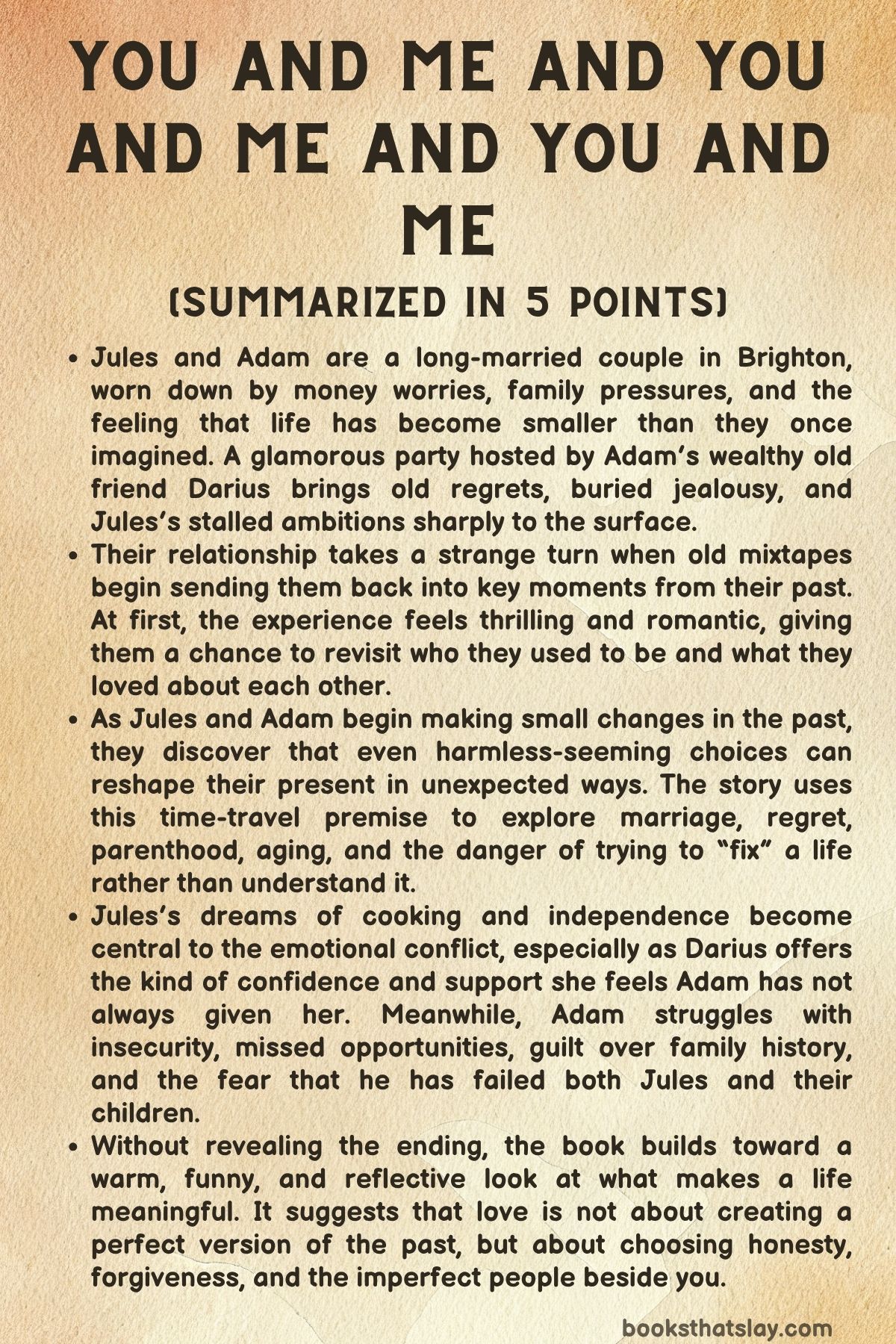
You & Me and You & Me and You & Me by Josie Lloyd and Emlyn Rees is a warm, comic, time-travel romance about marriage, regret, family, and the dangerous appeal of fixing the past. At its center are Jules and Adam, a long-married Brighton couple whose life has become crowded with money worries, old resentments, adult children still at home, and dreams that never quite came true.
When a strange connection between old mixtapes and time travel gives them access to earlier versions of their lives, they begin changing small details, then larger ones. The result is a funny, thoughtful story about choosing an imperfect present over a perfected fantasy.
Summary
Jules wakes from a dream in which she is a famous chef in San Francisco, admired, successful, and dancing with Adam in a glamorous restaurant. Reality is far less polished.
She is back in her shabby Brighton bedroom beside her snoring husband, worried about age, sex, money, and the party they are due to attend at Darius’s mansion. Darius, Adam’s old best friend, has returned from America after making a fortune from gaming, and his success makes Jules and Adam feel the weight of every choice they did not make.
Their morning begins badly when Jules tries to improve her marriage by initiating sex, only for their daughter Nelly to interrupt with news that the robot vacuum has smeared the elderly dog’s mess across the kitchen. The mess becomes a symbol of everything Jules resents: her grown children still relying on her, her son Liam drifting after leaving university, Adam’s impractical birthday present, and the household’s casual dependence on her.
Before Darius’s party, Jules and Adam sort through the loft. Old wedding clothes, Star Wars toys, diaries, and mixtapes bring back their younger selves.
Adam is sentimental about the past, especially a cassette he made for Jules in 1989, while Jules sees clutter and disappointment. Tension rises again when Adam argues with Liam, who wants to start a band.
Adam sees the idea as hopeless because Liam lost two fingers in a childhood accident, an event Adam secretly blames himself for. Jules thinks Liam should be allowed to try.
At Darius’s party, the couple is dazzled and unsettled by the money around them. Adam feels inferior and wonders what his life would have been if he had joined Darius in America years earlier.
Jules is drawn into Darius’s charm, especially when he encourages her dream of running a pop-up restaurant. During karaoke, Adam hides instead of joining Jules for their old duet, leaving Darius to take his place.
Jules feels humiliated and abandoned. On the walk home, she and Adam almost reconnect, but a question about happiness turns into a fierce argument.
Jules says she feels trapped in a rut. Adam cruelly suggests that her old ambitions helped cause his parents’ deaths, because they died after driving the couple to the airport when Jules and Adam once planned to emigrate.
Jules, devastated, says she would change everything.
Adam retreats to his shed, drinks, plays the old 1989 mixtape, and is suddenly thrown into the past. He wakes inside his teenage body in October 1989, able to observe and partly influence young Adam.
He sees his dead parents alive, meets teenage Juliet, and gives her the mixtape. He also causes a tiny change involving a mocking boy named Mickey Ratty.
When Adam returns to the present, he insists the journey was real, but Jules thinks he is drunk and deluded.
Soon after, Adam convinces Jules to try the machine. Using her 1993 mixtape, she travels back to the night she first got together with Adam at the Zap Club.
She relives the thrill of youth, music, friends, and first love, but accidentally changes the past by making her younger self say she dislikes beards. Back in the present, Adam’s beard has vanished, and the old photos have changed too.
They realize the tapes allow them to alter timelines. They promise not to interfere again, especially because any change might affect Nelly and Liam.
Their promise does not last. Darius reappears in their lives, impressing the family, offering Nelly office space, encouraging Liam’s music, and proposing support for Jules’s restaurant idea.
Adam feels threatened, especially when Darius buys Quark Studios, Adam’s workplace. Jules, meanwhile, becomes fascinated by the past and the chance to repair old frustrations.
Using a 1995 tape, Jules returns to their first flat and sees her younger self full of hope. She remembers her old ambitions to cook, travel, and build a bigger life.
Despite promising caution, she influences young Jules to train Adam into better habits around the house and in bed. Adam is upset when he discovers the changes through Jules’s diary, but Jules argues that she improved their marriage.
Adam then travels to a 1998 party and relives the night he proposed. He sees how he once helped Darius gain confidence as a DJ and realizes he had also encouraged Jules’s dream of moving abroad, a dream tied in his mind to his parents’ fatal accident.
He still proposes to Jules, and when he returns, he and Jules feel newly connected. For a while, the time travel seems to be restoring desire and closeness.
Then the changes become more selfish and risky. Jules tests a newly recorded tape and goes back only one day.
She prevents a cooking disaster and leaves herself a clue to bet on a horse called Carpe Diem, winning enough money to clear her secret credit-card debt. Later, she returns to 2004 and sees herself as an exhausted young mother with toddler Nelly and baby Liam.
She is ashamed by her impatience and by how much she took the children’s need for affection for granted.
Adam travels to a 2009 Mallorca holiday, where he sees young Liam sing instinctively with a busker and realizes his son has real musical talent. But he also feels humiliated by drunk men on the beach, so he leaves his younger self a note urging him to lose weight and become tougher.
In the altered present, Adam is muscular, fitness-obsessed, and closer to Nelly through cycling. He hides the change from Jules.
Jules makes another major change by traveling to 2012 and forcing her younger self to take French cooking and language lessons. She returns fluent, trained, and better equipped to impress Darius’s investors.
Her dinner is a success, and Darius offers to fund her pop-up. He nearly kisses her afterward, and although she pulls away, Adam sees enough to become jealous.
Adam then secretly makes an even larger change. He travels to 2014 and destroys the zip wire before Liam’s accident can happen.
In the new present, Liam has all his fingers and is touring Japan with his successful band, Grass Stain. Adam also saves valuable Star Wars figures, sells them, buys Jules her dream car, and offers to fund her restaurant himself.
At first, this seems like a victory. Adam and Jules reconcile, but the altered life soon reveals new damage.
Darius tells Jules that Adam has been made redundant and suggests Adam may be close to Meredith, a colleague. Jules finds flirtatious messages, then catches Adam preparing to time travel again.
Their secrets come out: Adam changed his body, Liam’s injury, and the Star Wars figures; Jules changed her cooking skills and cleared hidden debt. Jules is horrified that they have rewritten their children’s lives and demands they destroy the tapes.
Instead, Adam makes another reckless trip. Angry at Darius, he goes back to 2016 and forces his younger self to sign the gaming deal he once refused.
This creates a rich, successful future, but it is empty. Adam is consumed by work, Jules has left him for Darius, and the children are distant.
Terrified, Adam undoes the choice.
Then Max calls from Japan: Liam has overdosed but survived. Jules blames Adam for creating the dangerous timeline.
She burns the tapes but keeps one final CD and travels back to 2016, hoping to save Liam. In pain and confusion, she kisses Darius at the moment when he first showed romantic interest.
This creates a future where she married Darius, lives in luxury, and has a daughter named Phoebe. But Nelly and Liam hate her for leaving them, and Adam has moved on with Meredith.
Jules realizes that the life she wanted has cost her the family she loves.
Desperate, Jules asks this version of Adam for help. He eventually gives her one remaining tape, “Jules Rules!
1989,” and the Sony player. Jules travels back to 1989 and writes an anonymous letter to her future self and Adam, arranging for it to arrive decades later.
She then prevents the mixtape tradition from beginning, hoping to stop the time machine from existing at all.
In the restored present, Adam and Jules receive the mysterious letter after Adam’s redundancy. It urges them to pursue Adam’s Dadass Dudes project and Jules’s Chez Jules restaurant, while being honest about Meredith and Darius.
They finally confess their mistakes, reject Darius’s influence, and choose each other without trying to perfect the past. Months later, Adam’s game project is growing, Jules’s restaurant is gaining attention, Liam is making music, and Nelly is traveling happily with Eva.
Adam and Jules end the story together in their ordinary home, dancing in the kitchen and accepting their messy, imperfect life as the one worth keeping.
Characters
In You & Me and You & Me and You & Me, the characters are shaped by regret, domestic pressure, lost ambition, temptation, and the dangerous fantasy of correcting the past. Each major figure adds something different to the book’s central question: whether a life becomes better when old mistakes are changed, or whether love depends on accepting the imperfect life that actually happened.
Jules
Jules is one of the emotional centers of the book, and her character is defined by the painful tension between love for her family and frustration with the life she has ended up living. At the beginning, she feels trapped by domestic mess, money worries, aging, a struggling catering career, and the sense that everyone in the house depends on her without truly seeing her.
Her glamorous dream of being a successful chef in San Francisco reveals how strongly she still longs for recognition, romance, beauty, and personal achievement. Jules is not presented as selfish in a simple way; instead, she is a woman who has spent years caring for others while quietly feeling that her own ambitions have been postponed or swallowed by family life.
Her journey through the past exposes both her tenderness and her flaws. When she revisits younger versions of herself, she sees how much hope she once had, but she also has to confront moments when she was impatient, resentful, or emotionally absent, especially with her children when they were small.
These scenes deepen her character because they show that her dissatisfaction is not only caused by Adam or circumstance; she has also contributed to the emotional distance in her family. Her attempts to improve the past, such as learning French cooking, paying off debt through the horse bet, and later choosing Darius in an alternate life, come from understandable desires, but they also reveal how easily self-improvement can turn into control.
By the end, Jules becomes wiser because she learns that the fantasy of a perfect life can destroy the real bonds that matter most. Her final growth lies in choosing honesty, partnership, and gratitude over glamour and escape.
Young Jules
At the same time, young Jules is equally important because she embodies the ambition, sensuality, confidence, and openness that older Jules fears she has lost. At the Zap Club and in the early flat, Young Jules is full of possibility.
She loves Adam, but she also wants travel, cooking, adventure, and a bigger life. Older Jules’s contact with her younger self is painful because it reveals both what has been lost and what has survived.
When older Jules interferes with Young Jules’s habits, skills, and choices, the book shows how tempting it is to reshape the self from the inside. Yet Young Jules also proves that Jules’s dreams were always real; the task is not to erase the life that followed, but to carry those dreams forward more honestly.
Adam
Adam is a deeply conflicted character whose insecurity drives much of the book’s emotional and comic tension. He begins as a man who feels he has missed his chance at greatness.
Darius’s wealth and success force Adam to confront the old decision not to go to America, and this comparison makes him bitter about his job, his body, his marriage, and his role as a father. Adam is loving, but he is also defensive and afraid of failure.
His anger during arguments with Jules often comes from guilt he has never properly faced, especially the death of his parents and Liam’s childhood accident.
His time-travel experiences reveal how much he is haunted by responsibility. Seeing his parents alive again breaks through his ordinary sarcasm and resentment, showing the grief he carries underneath.
His later decision to stop Liam’s accident comes from love, but it also shows his dangerous belief that he can repair pain by rewriting events. Adam’s desire to become fitter, richer, and more successful exposes his shame about being ordinary.
Yet each improved version of his life creates new emotional losses, proving that his dissatisfaction is not solved by wealth, strength, or status. Adam’s strongest development comes when he realizes that supporting Jules, being honest about Meredith, and investing in his own creative future matter more than trying to become the man he thinks he should have been.
By the end, he becomes more humble, more present, and more willing to build a future with Jules instead of competing with the past.
Darius
Darius functions as both a real person and a symbol of the life Adam and Jules think they might have had. Wealthy, charismatic, confident, and newly returned from America, he represents risk, success, glamour, and temptation.
To Adam, Darius is a walking reminder of failure: the friend who took the opportunity Adam rejected and turned it into a fortune. To Jules, he represents excitement and possibility, especially because he once nearly offered her an alternative life.
His mansion, Ferrari, business power, and ability to encourage Nelly, Liam, and Jules make him appear generous and magnetic.
However, Darius is not simply a romantic hero or a villain. His charm is often mixed with manipulation.
He knows how to flatter Jules’s ambitions, provoke Adam’s insecurity, and present himself as the person who understands everyone better than Adam does. His interest in Jules is tied not only to affection but also to ego and unfinished desire.
When Jules enters an alternate future with him, the luxury of that life exposes its emotional emptiness. Darius can offer comfort, money, and status, but he cannot replace the messy history Jules shares with Adam and their children.
His role in the book is to test whether the characters truly want a different life or whether they are merely seduced by the appearance of one.
Nelly
Nelly is Adam and Jules’s adult daughter, and her character reflects the consequences of family dynamics across time. In the present, she is dependent on the household, working from home and still relying heavily on Jules.
This initially makes her seem part of the domestic burden that frustrates Jules, but the time-travel episodes reveal a more layered picture. As a child, Nelly needed affection, patience, and reassurance, and Jules’s painful return to bath time in 2004 shows how easily parental exhaustion can leave emotional marks.
Nelly also changes across timelines, which makes her one of the clearest measures of how Adam and Jules’s choices affect their children. In the athletic Adam timeline, she becomes closer to her father through fitness, while her bond with Jules weakens.
This shift hurts Jules because it shows that improving one area of life can damage another. Nelly’s old desire to travel and do meaningful work also suggests that she has inherited some of Jules’s longing for a larger life, but in a younger and less bitter form.
By the end, Nelly’s happier path with Eva shows the restored family moving toward independence rather than dependence. She represents the future Adam and Jules must learn not to control, but support.
Liam
Liam is one of the most important emotional stakes in the book because his life changes dramatically through Adam’s interventions. At first, he is a drifting twenty-one-year-old who has dropped out of university, smokes weed, and wants to start a band with Max.
Adam sees this dream as unrealistic partly because Liam lost two fingers in childhood, an accident Adam secretly blames himself for. This guilt makes Adam overprotective and dismissive, while Jules is more willing to let Liam try.
Liam’s musical ambition, therefore, becomes a test of whether parents can believe in a child even when the path looks uncertain.
When Adam changes the past and prevents the accident, Liam becomes a successful guitarist touring Japan with Grass Stain. On the surface, this seems like one of the book’s great improvements, but it soon becomes frightening when Liam overdoses.
His altered success does not make him safe or emotionally whole. This is crucial to Liam’s character because he is not merely a problem to be solved; he is a person whose life cannot be perfected from outside.
His talent is real, as shown in the Mallorca memory when he instinctively sings along to “Ventura Highway,” but talent still needs care, stability, and freedom. Liam’s final position, performing music in the restored future, suggests a healthier version of support: Adam and Jules no longer need to rewrite his past in order to believe in him.
Meredith
Meredith is Adam’s colleague and later a source of jealousy and suspicion in his marriage. She represents the kind of easy connection Adam feels is missing at home: relaxed, admiring, and separate from the pressures of family life.
Their rapport at Darius’s party and later their flirtatious closeness in the altered athletic timeline show how vulnerable Adam is to feeling seen by someone outside his marriage. Meredith’s role is not mainly to replace Jules, but to expose the emotional distance between Adam and Jules.
In alternate timelines, Meredith becomes even more significant because Adam’s changed lifestyle brings them closer. This creates ambiguity around his loyalty and makes Jules confront her fear that Adam is also escaping the marriage in his own way.
In the future where Jules leaves Adam for Darius, Adam ends up with Meredith, which shows that she is a possible path for him, but not necessarily his deepest one. Her character works as a mirror to Darius: both are tempting alternatives, but both reveal more about the weaknesses in Adam and Jules’s marriage than about true destiny.
Max
Max is Liam’s friend and bandmate, and although he is a supporting character, he plays an important role in Liam’s storyline. He is connected to Liam’s desire to start a band and later becomes the person who calls from Japan to report Liam’s overdose.
Through Max, the book shows that Liam’s musical dream is not just a passing fantasy inside the family home; it connects him to a wider world of friendship, risk, performance, and instability. Max also helps reveal the limits of Adam and Jules’s control.
Even when Liam’s life is altered into apparent success, danger still reaches him through the adult world he inhabits.
Rose
Rose is a grounding presence in Jules’s working life. When Jules goes to the Peregrine after her fight with Adam, Rose comforts her, giving Jules a space outside the family where she can be heard.
Rose’s role is small but meaningful because she belongs to Jules’s everyday reality rather than the glamorous fantasy of San Francisco, Darius’s world, or the time-travel past. She represents ordinary kindness and practical emotional support, reminding the reader that not all help has to be dramatic or life-changing to matter.
Eva
Eva is important mainly through her connection to Nelly. Jules asks Eva to reconnect with Nelly, and by the end Nelly is traveling happily with her.
Eva helps draw Nelly outward into independence and meaningful experience, which is especially important because Nelly begins the book still tied closely to the family home. Eva’s presence suggests that the younger generation’s growth depends not on Adam and Jules constantly managing them, but on allowing them to form their own attachments and futures.
Ngozi
Ngozi is part of Jules’s past and present emotional world. When Jules travels back to the Zap Club, seeing young Ngozi helps restore the atmosphere of youth, friendship, music, and possibility.
In the present, Jules struggles to keep the time machine secret from her, which shows how isolated Jules becomes once she and Adam begin changing the past. Ngozi represents a more stable thread of friendship and identity, connecting Jules to who she was before marriage, children, regret, and domestic exhaustion narrowed her life.
Doodles
Doodles is linked to Adam’s professional and creative world. His inspection of the Sony boom box is significant because he finds nothing unusual, and when he plays a tape, nothing happens.
This confirms that the time machine is not an ordinary mechanical device and that its power is strangely personal to Adam and Jules. Doodles also matters in the restored future because he and Adam’s Dadass Dudes project is thriving.
This makes him part of Adam’s healthier future, where Adam finally pursues creativity without trying to become Darius or rewrite his entire life.
Groucho Barx
Groucho Barx, the elderly family dog, brings comic chaos into the opening domestic scene, but his role is more than just humorous. The robot vacuum spreading his mess across the kitchen immediately exposes the strain inside the household: Jules’s frustration, the family’s dependence on her, and Adam’s misguided attempt to solve housework with a birthday gadget.
Groucho belongs to the shabby, imperfect reality that Adam and Jules eventually learn to value. His presence helps make the family home feel lived-in, messy, and real.
Adam’s Parents
Adam’s parents are central to his guilt and grief even though they appear mainly through memory and time travel. Their deaths are tied to the failed plan to emigrate, and Adam weaponizes that tragedy during his argument with Jules by implying her ambitions caused it.
When he travels back to 1989 and sees them alive, his reaction reveals how raw his loss still is. His mother offers emotional warmth, while his father connects him to childhood, memory, and the older version of family life he has lost.
They shape Adam’s fear of risk because, for him, bold choices are associated not with freedom but with catastrophe.
Mickey Ratty
Mickey Ratty appears in the 1989 past as someone who mocks young Adam. His role is brief, but he helps show how Adam’s older self is tempted to interfere even in small humiliations.
When older Adam makes young Adam insult Mickey, the scene becomes an early example of how satisfying it feels to correct the past. Mickey therefore helps introduce the moral problem of the book: even tiny acts of interference can change identity, memory, and relationships.
Chef Marcel
Chef Marcel represents Jules’s professional ambition and the fantasy that one missed opportunity could have transformed her life. When Jules travels back to the 2012 food festival and forces her younger self to sign up for his French cooking course, she turns an old regret into a new skill set.
In the altered present, she becomes fluent in French cooking and far more confident as a chef. Yet Chef Marcel’s importance also lies in the cost of that improvement.
Jules gains expertise, but her relationship with Nelly suffers because time and ambition had to come from somewhere. He symbolizes the seductive idea that talent can be unlocked by changing one decision, while the book reminds us that every gain has consequences.
Anna
Anna, who teaches French, is connected to the same altered path as Chef Marcel. Through Anna’s lessons, Jules becomes fluent in French, which helps her succeed at Darius’s investor dinner and strengthens her professional confidence.
Anna is not a major emotional character, but she represents the practical steps behind Jules’s dream. Her role shows that Jules’s desired transformation is not magic alone; it is also training, discipline, and time.
The problem is that Jules obtains this growth by rewriting the past rather than honestly building from the present.
Phoebe
Phoebe exists in the alternate future where Jules chooses Darius and builds a luxurious new life with him. She is Jules’s daughter in that timeline, and her presence makes Jules’s choice emotionally complicated.
Phoebe is innocent and real within that version of events, which means Jules’s decision to return to her original family is not painless. Saying goodbye to Phoebe is one of Jules’s most morally difficult moments because it forces her to accept that alternate lives are not just fantasies; they contain people with their own emotional reality.
Phoebe represents the cost of wanting a different life too strongly. She shows Jules that every path creates love and loss, and that choosing one family means giving up another.
Young Adam
Young Adam is not a separate person in the usual sense, but the book treats him as an important version of Adam. He is romantic, insecure, awkward, hopeful, and still unmarked by many of the disappointments that shape his older self.
Through him, older Adam sees how much of his identity was formed by small moments of courage, embarrassment, friendship, and love. Young Adam’s proposal, his mixtapes, and his early tenderness toward Jules remind older Adam that he was not always stuck or defeated.
At the same time, the older Adam’s attempts to influence him show how dangerous it is to treat a younger self as a project to be corrected.
Themes
Marriage, Routine, and the Need for Renewal
Marriage is shown as something shaped not only by love, but also by years of chores, disappointments, money worries, parenting pressure, and unspoken resentment. Jules and Adam are not strangers to each other; they know each other deeply, yet familiarity has made them careless.
Their arguments reveal that the real danger to their relationship is not a single betrayal, but the slow build-up of feeling unseen. Jules feels trapped in domestic responsibility, while Adam feels judged for the life he did not build.
Their time travel initially seems like a chance to repair the marriage by improving old habits, reviving desire, or correcting past failures. However, every attempted correction exposes a deeper truth: love cannot survive through nostalgia alone.
The past may remind them why they chose each other, but it cannot replace honesty in the present. Their final renewal comes when they stop trying to perfect history and begin supporting each other’s future with patience, kindness, and shared responsibility.
Regret and the Temptation to Rewrite Life
Regret drives much of the conflict, because both Adam and Jules are haunted by versions of life they almost lived. Adam measures himself against Darius’s wealth and success, imagining that one missed decision cost him status, confidence, and security.
Jules carries regret about travel, career, motherhood, and the restaurant dream she postponed for years. The time machine gives these regrets physical power, allowing them to test whether a better choice in the past would create a better present.
Yet each change proves that regret is often selective. Adam’s success with Darius brings wealth but costs him his marriage and closeness with his children.
Jules’s life with Darius gives her luxury but leaves her emotionally isolated from the family she truly values. The story argues that regret can distort memory by making alternative lives look cleaner than they are.
Instead of freeing them, rewriting the past traps them in new forms of loss. Real growth begins when they accept that no life is untouched by sacrifice.
Parenthood, Guilt, and Letting Children Become Themselves
Parenthood is presented as a source of fierce love, but also fear, guilt, and over-control. Jules’s journey into the past with young Nelly and Liam forces her to confront the pain of tired, overwhelmed parenting.
She sees that love was always there, but not always expressed with the tenderness her children needed. Adam’s guilt is even sharper because Liam’s childhood accident has shaped the way he sees his son’s future.
His attempt to prevent the accident seems loving, but it also shows his inability to accept pain, risk, and uncertainty as part of his children’s lives. When Liam becomes successful in the altered timeline, Adam assumes he has improved things, but Liam’s later crisis reveals how dangerous it is to treat a child’s life as a problem to be fixed.
Nelly’s distance from Jules also shows that ambition and family cannot be balanced by shortcuts. The healthier ending allows both children to move forward on their own terms, while their parents learn to guide without controlling.
Imperfection, Gratitude, and Choosing the Present
The ending of You & Me and You & Me and You & Mey places value on an imperfect life that is fully chosen. Throughout the story, Adam and Jules are tempted by cleaner, richer, more glamorous versions of existence: a successful business empire, a luxury marriage, professional achievement, physical transformation, and freedom from old mistakes.
Each version looks attractive from a distance, but none gives them the emotional wholeness they are seeking. The shabby house, difficult finances, aging bodies, demanding children, and unfinished dreams are not romanticized, yet they become meaningful because they belong to a life built through shared history.
Gratitude does not mean pretending everything is fine. It means seeing that their ordinary life contains love, memory, humor, and possibility, even after failure.
By rejecting Darius’s glamour and choosing each other again, Adam and Jules accept that happiness is not found by escaping the present. It is created by acting differently within it, with more courage, honesty, and care.