Bed of Roses Summary, Characters and Themes
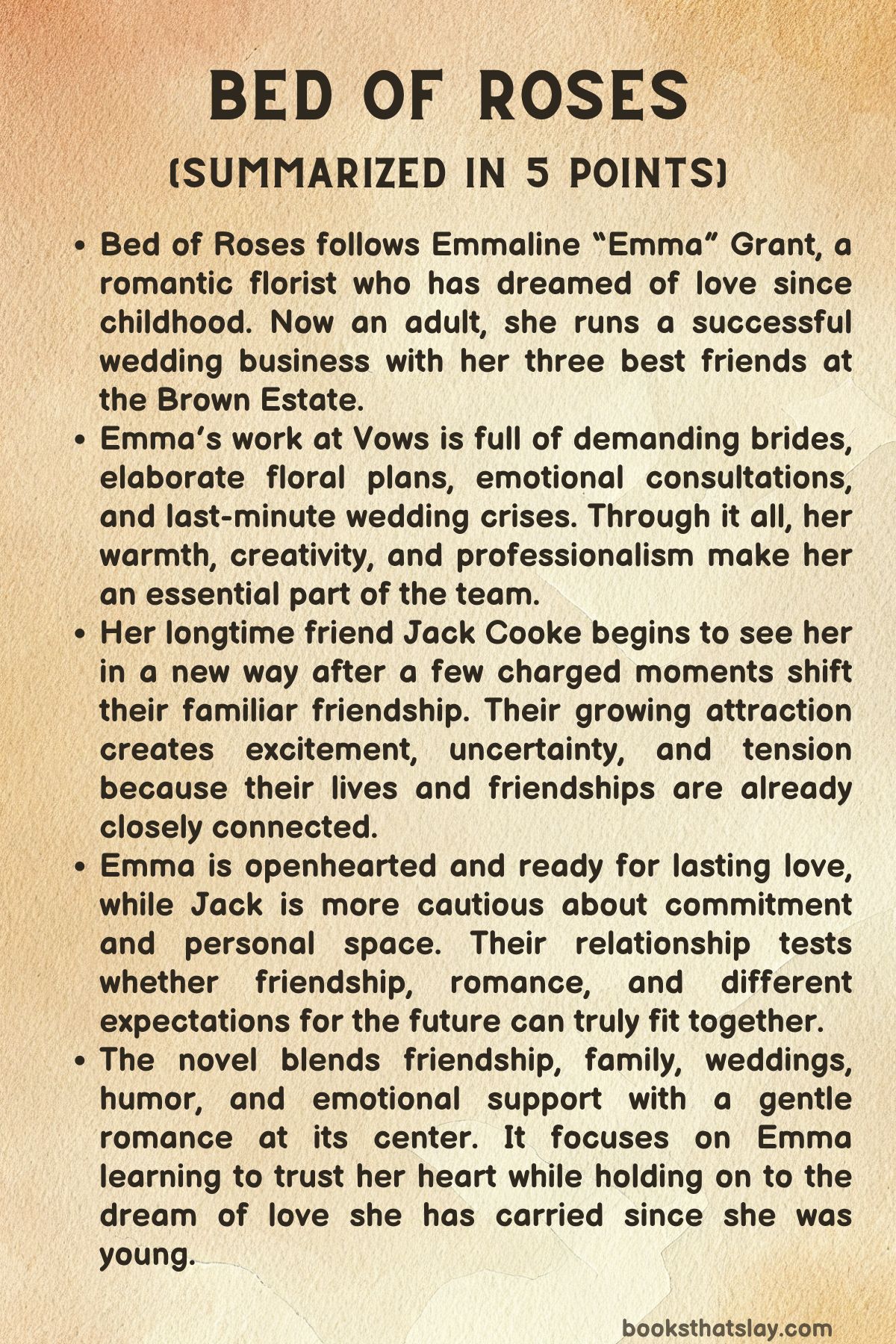
Bed of Roses by Nora Roberts is a contemporary romance about friendship, work, and the risk of wanting more from someone already woven into everyday life. The novel follows Emmaline Grant, the florist in a wedding business she runs with her three lifelong friends at the Brown Estate.
Emma has always believed in grand romance, but her own love life becomes complicated when she falls for Jack Cooke, a close family friend with a fear of permanence. Through weddings, family tensions, private doubts, and the loyal support of her friends, Emma must decide whether love is worth asking for completely. It’s the 2nd book of the Bride Quartet series.
Summary
As a girl, Emmaline Grant dreams of romance in its most beautiful form. At eleven, she imagines moonlit gardens, music, flowers, dancing, and the perfect kiss.
These dreams are shared during sleepovers with her closest friends, Parker, Laurel, and Mackensie, at the Brown Estate. The girls talk about boys, make plans, play games, and fall asleep together, surrounded by the kind of setting that already feels magical to Emma.
Even then, she quietly believes that one day she will have the romance she imagines.
Years later, the four friends have turned the Brown Estate into Vows, a successful wedding business. Each woman brings her own talent to the company.
Parker handles planning and coordination, Mac works as the photographer, Laurel creates cakes and desserts, and Emma designs flowers through her business, Centerpiece. Their work is demanding, beautiful, and often chaotic, but they know how to support one another under pressure.
Emma’s spring season is full of consultations, floral sketches, orders, and weddings. She helps brides translate vague ideas into flowers, colors, textures, and moods that suit their ceremonies.
One bride, Miranda, becomes emotional when Emma guides her toward a refined bouquet and elegant floral details. Emma understands that flowers are not only decoration.
They help create a feeling, and she takes pride in giving couples something memorable.
Vows also faces difficult clients. Whitney Folk, a demanding bride, had earlier rejected Laurel’s cakes, but when her chosen pastry chef disappears, she returns needing help.
Laurel is furious, but the partners agree to save the wedding because they are professionals. The event tests their patience, but it also shows how well the women work as a team.
Emma, hauling flowers and handling last-minute pressures, proves again that she is practical as well as romantic.
Around this time, Emma’s personal life begins to shift. She attends a party at Vicki and Adam’s house after Sam, a man she no longer wants to date, pressures her into going.
Emma tries to redirect Sam’s attention toward her cousin Addison, but Jack Cooke notices what she is doing. Jack is a longtime family friend, an architect, and Del Brown’s best friend.
He has always been part of Emma’s wider circle, but that evening she starts to see him differently.
On the way home, Emma’s neglected car breaks down in the snow. Jack stops to help, gives her his jacket, jump-starts the car, and follows her home to make sure she arrives safely.
A moment between them under the hood of the car leaves both of them unsettled. Emma later realizes that Jack creates a stronger spark in her than anyone she has dated recently.
Their attraction continues to build. Jack comes by to retrieve his jacket while Emma is working on flowers for a fiftieth-anniversary celebration, but he leaves without taking it again.
During Whitney’s wedding, he helps Emma with flowers and sees the skill and stamina required to keep Vows running. Later, on a back staircase, he brings her wine and massages her shoulders.
Their tension turns into an intense kiss, but work interrupts them when Parker’s beeper goes off. Emma rushes back to her duties, and Jack leaves.
The kiss leaves Emma confused. She talks to Laurel, then goes to Jack’s house to confront him.
Their conversation becomes an argument about what happened, who started it, and why he disappeared afterward. The argument turns physical, and they nearly have sex before Emma stops them.
She reminds him that they are friends, that their lives are connected, and that they need to think before acting carelessly. Emma then tells Mac, Parker, and Laurel what happened.
Her friends respond with teasing, surprise, concern, and advice. Emma and Jack begin exchanging flirtatious emails while trying to decide what their next step should be.
Other stories unfold around them. Parker retrieves Emma’s repaired car from Malcolm Kavanaugh, a mechanic who mistakes Parker for Emma and sharply criticizes the car’s poor condition.
Mrs. Grady later explains more about Malcolm’s background. Mac tries on wedding dresses, consultations continue, and Vows remains busy.
Jack, meanwhile, plays poker with Del, Carter, and others, but Emma stays on his mind.
Eventually, Emma prepares her house for Jack with candles, flowers, wine, music, and dinner. Laurel sees what she is doing and quickly guesses that Emma has planned a romantic night.
When Jack arrives, he and Emma speak honestly. They agree that their friendship must survive whatever happens between them.
They spend the night together, and afterward they agree not to date anyone else.
Their new closeness soon becomes obvious during a group dinner. Del realizes what is happening between his best friend and Emma, who is like family to him, and he reacts with anger.
Jack follows him, and the two men fight before talking. Del feels betrayed because Jack did not tell him.
Jack argues that Emma is an adult and that their relationship belongs to them. Del warns Jack not to hurt her.
Del later talks with Parker about whether he has been unfair and whether he tries to control people. Parker reassures him, and Del visits Emma to make peace.
He tells her he is not angry with her, though he is still irritated with Jack. Jack and Del slowly repair their friendship, even making plans to attend a Yankees game together.
Emma and Jack keep dating, trying to balance their long friendship with their new romance. Parker notices before Emma wants to admit it that Emma is already in love with Jack.
Emma resists the truth because she knows Jack avoids commitment, but privately she understands that Parker is right. On one date, Jack takes her to an art opening hosted by Kellye, a former fling.
Kellye creates a scene by throwing herself at Jack and accusing him of bringing Emma to hurt her. Emma refuses to be shaken.
She laughs it off, and she and Jack leave, have dinner, talk easily, and return to Emma’s house.
Emma continues to shine professionally. She helps lead a major consultation for the Seaman wedding and impresses the bride’s family with plans for flowers and gardens.
The women of Vows decide to clear the entire wedding week to handle the event properly. Emma’s friends tease her about Jack, especially after Laurel admits she saw them return home in a highly romantic mood.
Emma later talks with her mother, Lucia, who already knows her daughter is in love. Lucia tells Emma about how she once won Emma’s father’s heart and encourages her to enjoy love with courage.
At the Grant family’s Cinco de Mayo party, Jack feels slightly uncomfortable being there as Emma’s date. He becomes jealous when Emma kisses an old friend named Marshall, only to learn that Marshall is married and has a baby.
Emma later stays at Jack’s place, but in the morning she notices his discomfort when her makeup and belongings are spread around his bathroom. His reaction hurts her.
It makes her feel as if there is no true room for her in his life. She leaves a brief note and calls Parker for a girls’ night.
Her friends help her understand that Jack’s boundaries, even if unconscious, make her feel unwelcome.
Jack tries to do better. He visits Emma during a storm, watches her work, sketches improvements for her shop, and gives her a bracelet made of jewel-toned roses.
During a messy wedding filled with hung-over bridesmaids, fighting mothers, and a pregnant maid of honor having false contractions, Jack helps the women of Vows keep things moving. He and Emma grow closer, and he later takes her to New York for a romantic overnight date with dinner, champagne, and a hotel suite.
Emma decides it is time to tell Jack she loves him. She plans a surprise at his apartment, brings flowers, buys groceries, decorates the entrance with planters, and cooks dinner.
But Jack has had a bad day, and when he finds her there with borrowed keys, he reacts badly. Emma is humiliated and hurt.
To her, his reaction proves that he still has not made space for her. She tells him she loves him and wants marriage, children, and a future, but she cannot accept less than that.
Then she leaves and tells him to stay away.
Jack is forced to face the truth. After talking with Del, he realizes he is in love with Emma.
He tries to apologize, but Parker, Mac, Laurel, and Mrs. Grady protect Emma and refuse to let him see her before she is ready. After several painful days, Parker finally allows him to come.
Jack meets Emma in the moonlit garden, the same kind of romantic setting she dreamed of as a child. He tells her he loves her, admits she means everything to him, dances with her, and asks her to marry him.
Emma accepts.
From the terrace, her friends and Mrs. Grady watch as Emma receives the love she once imagined. The story closes with a preview of Laurel’s path, showing her as a teenager receiving money from Mrs. Grady to attend culinary school, and later as an adult at Vows, working late on wedding cakes while silently struggling with her long-standing love for Del.
Characters
Emmaline Grant
Emmaline Grant, usually called Emma, is the emotional heart of Bed of Roses. From childhood, she is shown as someone who believes deeply in romance, beauty, flowers, music, moonlight, and the idea of a lasting love.
Her childhood dreams are not shallow fantasies; they reveal her generous spirit, her emotional openness, and her desire for a life filled with warmth and commitment. As an adult, Emma turns that love of beauty into a profession through Centerpiece, her floral business within Vows.
Her work shows her creativity, discipline, and sensitivity because she does not simply arrange flowers; she understands what people want to feel on their wedding day and translates those feelings into color, shape, scent, and atmosphere.
Emma is loving, affectionate, and deeply connected to her friends and family. She is not afraid of emotion, but she is also not foolish about it.
Her relationship with Jack proves that she can feel passion strongly while still thinking about consequences. She understands that their friendship, their shared circle, and Jack’s connection to Del make the romance complicated.
This shows her maturity. Even when she is overwhelmed by desire, she pauses because she does not want something careless to damage what already matters.
Her central struggle is between what she wants and what she fears she may not receive. Emma wants love, marriage, children, and a future.
She is brave enough to admit this, but she also has enough self-respect not to accept a relationship where she feels like an outsider in Jack’s life. Her pain after the apartment incident comes from realizing that love alone is not enough if the other person refuses to make emotional room for her.
Emma’s strength appears most clearly when she tells Jack the truth and walks away, even though it breaks her heart. By the end of the story, she receives the romantic dream she has always imagined, but the happiness feels earned because she has demanded honesty, commitment, and respect.
Jack Cooke
Jack Cooke is a longtime family friend, an architect, and Del Brown’s closest friend. He is charming, intelligent, helpful, and emotionally guarded.
At first, Jack seems comfortable in Emma’s world because he already belongs to the larger circle around Vows and the Brown Estate. He helps when Emma’s car breaks down, assists during weddings, spends time with Del, Carter, and the others, and naturally fits into the rhythm of their shared lives.
Yet his ease is partly misleading because, emotionally, Jack keeps certain boundaries firmly in place.
His attraction to Emma unsettles him because it threatens the comfortable order of his life. He is drawn to her warmth, beauty, confidence, and passion, but he also knows that being with her is not casual.
Emma is not just someone he can date and leave behind without consequences. She is tied to Del, Parker, Mac, Laurel, Mrs. Grady, and the entire emotional family he has built around the Brown Estate.
This makes Jack hesitate, joke, retreat, and sometimes behave badly when he feels cornered.
Jack’s flaw is not cruelty but fear of permanence. His discomfort when Emma’s belongings appear in his bathroom and his angry reaction when she surprises him at his apartment show how fiercely he protects his private space.
He does not immediately understand that his boundaries make Emma feel unwanted. His emotional growth comes when he recognizes that keeping Emma at a distance is not independence but cowardice.
Once he admits that he loves her, his proposal in the moonlit garden becomes meaningful because he is finally choosing the future he once avoided.
Parker Brown
Parker Brown is the organizer, manager, and strategic mind behind Vows. She is efficient, polished, practical, and deeply responsible.
Her role in the business reflects her personality: she coordinates, anticipates problems, manages clients, and keeps everyone moving toward success. Parker’s calm control is especially important during difficult weddings and demanding consultations.
She does not panic easily, and she often sees both the emotional and practical sides of a situation before others do.
As a friend, Parker is protective and observant. She notices Emma’s feelings for Jack before Emma fully admits them, and she is direct enough to say what others might avoid.
Her loyalty is not soft or passive; it is active, organized, and sometimes firm. When Jack hurts Emma, Parker becomes one of the people who shields her, making sure he cannot simply rush in before Emma is ready.
This shows that Parker believes love must be handled with responsibility, not just emotion.
Parker also plays an important role in Del’s emotional adjustment. When Del worries about whether he manipulates people or has been unfair about Jack and Emma, Parker helps him look at the situation honestly.
She is not only a business leader but also a stabilizing emotional force within the group. Her intelligence lies in understanding people, timing, and consequences, which makes her one of the most grounded characters in the story.
Laurel McBane
Laurel McBane is sharp, talented, loyal, and emotionally guarded beneath her sarcasm. As the pastry chef of Vows, she brings artistry and discipline to cakes and desserts.
Her frustration with Whitney Folk shows her pride in her work and her unwillingness to be treated as a backup option. Yet Laurel still participates in saving the wedding because she understands professionalism and loyalty to the business.
This balance between temper and responsibility defines much of her character.
Laurel’s friendship with Emma is honest and teasing. She is one of the first people Emma confides in after the kiss with Jack, and her reaction mixes surprise, humor, and concern.
Laurel often expresses care through blunt comments rather than sentimental speeches. She sees through situations quickly, such as guessing that Emma’s carefully prepared evening with Jack is a planned romantic encounter.
Her sharpness makes her funny, but it also protects her from exposing too much vulnerability.
The preview of Laurel’s own story reveals a deeper emotional layer. Her connection to Mrs. Grady and her long-standing love for Del suggest that Laurel has carried private hopes and insecurities for years.
She is ambitious and hardworking, but she is also someone who has known what it means to need help and to build a life through talent and determination. In this book, she functions as both comic relief and emotional support, while the ending hints that her own unresolved love will become central later.
Mackensie Elliot
Mackensie Elliot, often called Mac, is the photographer at Vows and one of Emma’s closest friends. Her role as a photographer suits her because she captures emotional moments, beauty, and memory.
Within the friendship group, Mac is warm, teasing, expressive, and dependable. She is someone Emma can turn to when the situation with Jack becomes confusing, and her presence helps Emma process both excitement and fear.
Mac also represents one of the existing romantic successes within the group because she is engaged to Carter. Her wedding dress scenes remind the reader that the women of Vows are not only creating weddings for others but also experiencing love, change, and commitment in their own lives.
Mac’s relationship with Carter provides a contrast to Emma and Jack’s uncertain beginning. Where Jack struggles with permanence, Carter’s devotion to Mac feels steady and reassuring.
As a friend, Mac helps maintain the emotional balance of the group. She reacts to Emma’s romance with surprise and humor, but she does not dismiss Emma’s feelings.
Her loyalty is clear when she joins Parker, Laurel, and Mrs. Grady in protecting Emma after Jack hurts her. Mac’s importance lies not only in her individual personality but also in the way she strengthens the sisterhood at the center of the novel.
Delaney Brown
Delaney Brown, usually called Del, is Parker’s brother, Jack’s best friend, and a protective figure in Emma’s extended circle. His reaction to Emma and Jack’s relationship is one of the major emotional complications in the story.
Del feels betrayed not because Emma is incapable of making her own choices, but because Jack did not tell him. His anger comes from loyalty, protectiveness, and the shock of seeing two people he loves cross a boundary he had not expected.
Del can be controlling, though not always intentionally. His concern for Emma sometimes makes him act as if he has the right to approve or disapprove of her romantic life.
However, the book does not present him as unreasonable without growth. His conversations with Jack, Parker, and Emma show that he is capable of reflection.
He eventually admits that he is not angry with Emma, which suggests he recognizes her independence even if he still struggles with Jack.
Del’s relationship with Jack is also important. Their fight and later reconciliation show that male friendship in the story is built on honesty, confrontation, and forgiveness.
Del warns Jack not to hurt Emma, but he also slowly accepts that Jack’s feelings are real. His protectiveness can be frustrating, yet it comes from deep affection.
By the end, Del is still adjusting, but he is no longer simply resisting the relationship.
Carter Maguire
Carter Maguire is Mac’s fiancé and one of the quieter, steadier figures in the story. His presence adds warmth and stability to the group.
Unlike Jack, Carter is already comfortable with commitment, which makes him a useful contrast. He represents the kind of dependable love that has already found its place within the Vows family.
Carter’s interactions with Jack and Del during poker and home-planning scenes show that he belongs naturally among the men connected to the Brown Estate. He is not dramatic or forceful, but his steadiness matters.
He supports Mac, participates in the group’s social life, and helps show that love can be gentle, settled, and secure rather than always conflicted.
Although Carter is not central to Emma’s romantic conflict, he helps shape the emotional environment of the story. His relationship with Mac offers a model of partnership that is less turbulent than Emma and Jack’s.
Through Carter, the novel shows that commitment does not have to feel like a trap; it can feel like home.
Mrs. Grady
Mrs. Grady is a nurturing, wise, and quietly powerful figure in the lives of the Vows women. She represents family, memory, guidance, and emotional shelter.
Her presence at the Brown Estate gives the story a sense of continuity, as if the younger women are building their adult lives within a space already shaped by care and tradition.
She is observant and protective without being intrusive. When Malcolm is introduced, Mrs. Grady provides background that helps others understand him better.
When Emma is hurt by Jack, Mrs. Grady stands with Parker, Mac, and Laurel in protecting her. This shows that her love is practical as well as emotional.
She does not merely comfort; she helps guard the people she cares about.
Her connection to Laurel in the preview adds another layer to her character. By giving Laurel money for culinary school, Mrs. Grady becomes someone who helps young women claim their futures.
She recognizes talent and need, and she acts. In Bed of Roses, she is one of the moral anchors of the story, offering quiet wisdom and steady affection.
Lucia Grant
Lucia Grant is Emma’s mother and a strong influence on Emma’s understanding of love. She is warm, perceptive, romantic, and confident.
When Emma speaks with her, Lucia already knows that her daughter is in love, which shows how well she understands Emma’s heart. Their conversation reveals that Emma’s belief in romance is not accidental; it comes partly from a family culture where love is valued, celebrated, and pursued with courage.
Lucia’s story about deliberately winning Emma’s father’s heart gives her a lively and determined quality. She does not treat love as something that simply happens to a person.
Instead, she sees it as something that may require confidence, intention, and bravery. This advice encourages Emma to enjoy love rather than fear it.
As a character, Lucia helps connect Emma’s childhood dreams with her adult choices. She represents a mature version of romantic faith, one that includes both passion and determination.
Her role is brief but meaningful because she reassures Emma that wanting love fully is not weakness. It is part of who Emma is.
Malcolm Kavanaugh
Malcolm Kavanaugh is the mechanic who repairs Emma’s neglected car and mistakenly lectures Parker, thinking she is Emma. His entrance is sharp, direct, and slightly comic because he immediately challenges the careless condition of the vehicle.
He is practical, blunt, and not easily impressed by appearances or social polish.
Though he has a limited role in this part of the story, Malcolm stands out because of his forceful personality. Mrs. Grady’s explanation of his background suggests there is more to him than the first impression reveals.
He seems like a character with rough edges, shaped by experience, and likely to become more important later.
Malcolm also creates an interesting contrast with the refined world of Vows. While the women work with flowers, cakes, photography, and elegant events, Malcolm belongs to a more mechanical and direct world.
His bluntness cuts through social niceties, making him memorable even in a short appearance.
Whitney Folk
Whitney Folk is a demanding bride who creates stress for the Vows team. She rejects Laurel’s cakes, only to need Vows again when her original pastry chef disappears.
Her behavior makes her appear entitled and difficult, especially because she treats the team’s work as something she can dismiss and then reclaim when convenient.
Whitney’s main function in the story is to test the professionalism of the Vows women. Laurel is understandably furious, but the group chooses to save the wedding anyway.
Through Whitney, the book shows that the women’s business succeeds not because clients are always pleasant, but because Parker, Emma, Laurel, and Mac know how to deliver excellence under pressure.
Whitney is not deeply developed emotionally, but she is important as an example of the demanding clients the women must handle. She helps reveal the discipline behind the beauty of their work.
Weddings may look romantic from the outside, but Whitney’s storyline shows the labor, patience, and restraint required behind the scenes.
Miranda
Miranda is one of Emma’s brides, and her consultation reveals Emma’s gift for understanding people. Miranda comes in with ideas, but Emma gently guides her toward a more elegant bouquet and floral design.
The fact that Miranda becomes emotional over Emma’s vision shows how deeply the right details can affect a bride.
Miranda’s role is brief, but she helps display Emma at her professional best. Through Miranda, the story shows that Emma is not merely decorative in her work.
She listens, interprets, adjusts, and creates something that feels personal. Miranda’s happy tears confirm that Emma’s talent lies in emotional translation as much as design.
As a character, Miranda represents the sincere bride, the kind of client who reminds the Vows team why their work matters. Unlike Whitney, she responds with gratitude and feeling.
Her scene helps balance the business side of weddings with the genuine romance that Emma believes in.
Sam
Sam is a man Emma is no longer interested in, but he still tries to persuade her to attend a party. His role is small, yet he helps show that Emma is socially graceful and not cruel.
Instead of directly humiliating or rejecting him, she redirects his attention toward her cousin Addison.
Sam also helps create the circumstances that bring Jack’s awareness of Emma into sharper focus. Jack notices what Emma is doing, and this moment adds to the subtle tension between them.
Sam therefore functions less as a romantic possibility and more as a contrast. He is someone Emma does not feel strongly about, which makes her later reaction to Jack much more significant.
Addison
Addison is Emma’s cousin, and she appears when Emma redirects Sam toward her. Her role is minor, but she helps show Emma’s quick social thinking.
Addison becomes part of Emma’s attempt to manage an awkward situation without unnecessary confrontation.
Although Addison is not deeply explored, her presence also reflects the larger family and social network around Emma. Emma does not exist in isolation; she is surrounded by relatives, friends, clients, and community ties.
Addison’s brief appearance helps create that broader world.
Kellye
Kellye is a former fling of Jack’s who creates a public scene at her art opening. She throws herself at Jack and accuses him of bringing Emma to hurt her.
Her behavior is dramatic, possessive, and emotionally uncontrolled, making her an uncomfortable reminder of Jack’s past.
Kellye’s scene is important because it tests Emma’s confidence. Instead of becoming insecure or humiliated, Emma laughs it off and leaves with Jack.
This response shows Emma’s poise and self-assurance. She recognizes the absurdity of the scene and refuses to give Kellye power over her.
Kellye also exposes one of the risks of Jack’s romantic history. He has avoided permanence, and people from his past can still appear with unresolved feelings.
Her role helps clarify the difference between Jack’s old casual relationships and his deeper bond with Emma.
Marshall
Marshall is an old friend Emma kisses at her family’s Cinco de Mayo party, briefly triggering Jack’s jealousy. His role is small but revealing because Jack misreads the kiss as a possible romantic threat.
Once Jack learns that Marshall is married and has a baby, the jealousy looks unnecessary.
Marshall’s function is to expose Jack’s growing emotional investment. Jack may try to act casual, but his reaction to Marshall proves that he already cares deeply and possessively about Emma.
The scene also shows Emma’s natural affection with people from her past. She is warm and demonstrative, and Jack must learn to understand that her openness does not mean disloyalty.
Themes
Romantic Idealism and Emotional Maturity
Emma’s idea of love begins in childhood as something beautiful, graceful, and almost perfectly staged: flowers, music, moonlight, and dancing. As an adult, she still believes in that kind of romance, but her relationship with Jack forces her to understand that love is not only atmosphere or desire.
It also requires honesty, timing, vulnerability, and the courage to ask for what she truly needs. In Bed of Roses, Emma’s romantic nature is not treated as foolish; instead, it becomes part of her strength.
She knows she wants marriage, children, commitment, and a shared future, and she refuses to shrink those hopes just to keep Jack comfortable. Her growth lies in realizing that romance must be matched by emotional respect.
Jack’s final declaration matters because it answers not only her dream of love, but also her demand to be fully chosen. The theme shows that real romance is not weakened by practical expectations; it becomes stronger when both people are willing to meet each other honestly.
Friendship as a Source of Strength
The friendship between Emma, Parker, Laurel, and Mac forms the emotional center of the story. Their bond began in childhood play, but as adults it has become a powerful support system built on trust, humor, loyalty, and shared work.
They do not simply comfort one another; they challenge one another when needed. When Emma is confused about Jack, her friends help her see the truth without taking away her freedom to decide.
When she is hurt, they protect her space, giving her time to recover before Jack is allowed back into her life. Their friendship also strengthens their business, because Vows succeeds through cooperation, clear roles, and deep knowledge of one another’s talents.
The women face demanding clients, chaotic weddings, and personal crises, yet they continue to function as a team. This theme suggests that lasting friendship can be as important as romantic love.
It gives Emma the confidence to take emotional risks because she knows she is not facing heartbreak, uncertainty, or change alone.
Fear of Commitment and the Need for Change
Jack’s conflict comes from his desire for Emma combined with his fear of being claimed by a permanent relationship. He enjoys their attraction, respects their friendship, and cares for her deeply, but he keeps invisible boundaries around his personal life.
His discomfort when Emma leaves her things in his bathroom and his angry reaction when she prepares a surprise at his apartment reveal how strongly he guards his independence. The problem is not that he does not love Emma; it is that he has not yet learned how to make room for love.
Emma’s refusal to accept less than a full commitment becomes the turning point. She does not beg, soften her needs, or pretend casual love is enough.
Her honesty forces Jack to face the emotional limits he has placed on himself. By the end, his proposal is meaningful because it shows active change.
He chooses not only passion, but responsibility, openness, and a future shaped with Emma rather than around his fears.
Work, Creativity, and Professional Identity
Emma’s work with flowers is more than decoration; it is an expression of who she is. Through her designs, she translates emotion into color, shape, scent, and atmosphere.
Her consultations show her ability to listen carefully, understand a bride’s personality, and turn scattered wishes into a clear vision. The success of Vows depends on this kind of creative professionalism, where beauty is supported by discipline, planning, and endurance.
The story repeatedly shows that weddings may look effortless to guests, but behind them are long hours, physical labor, emotional management, and quick problem-solving. Emma’s talent is therefore both artistic and practical.
In Bed of Roses, work also becomes a way of showing love: Jack sees Emma’s skill more clearly when he watches her under pressure, and his respect for her grows through that understanding. This theme presents creative work as serious, demanding, and deeply personal.
Emma’s professional identity strengthens her romantic identity because she is not waiting to be completed; she already has purpose, talent, and a life she loves.