Ash by Malinda Lo Summary, Characters and Themes
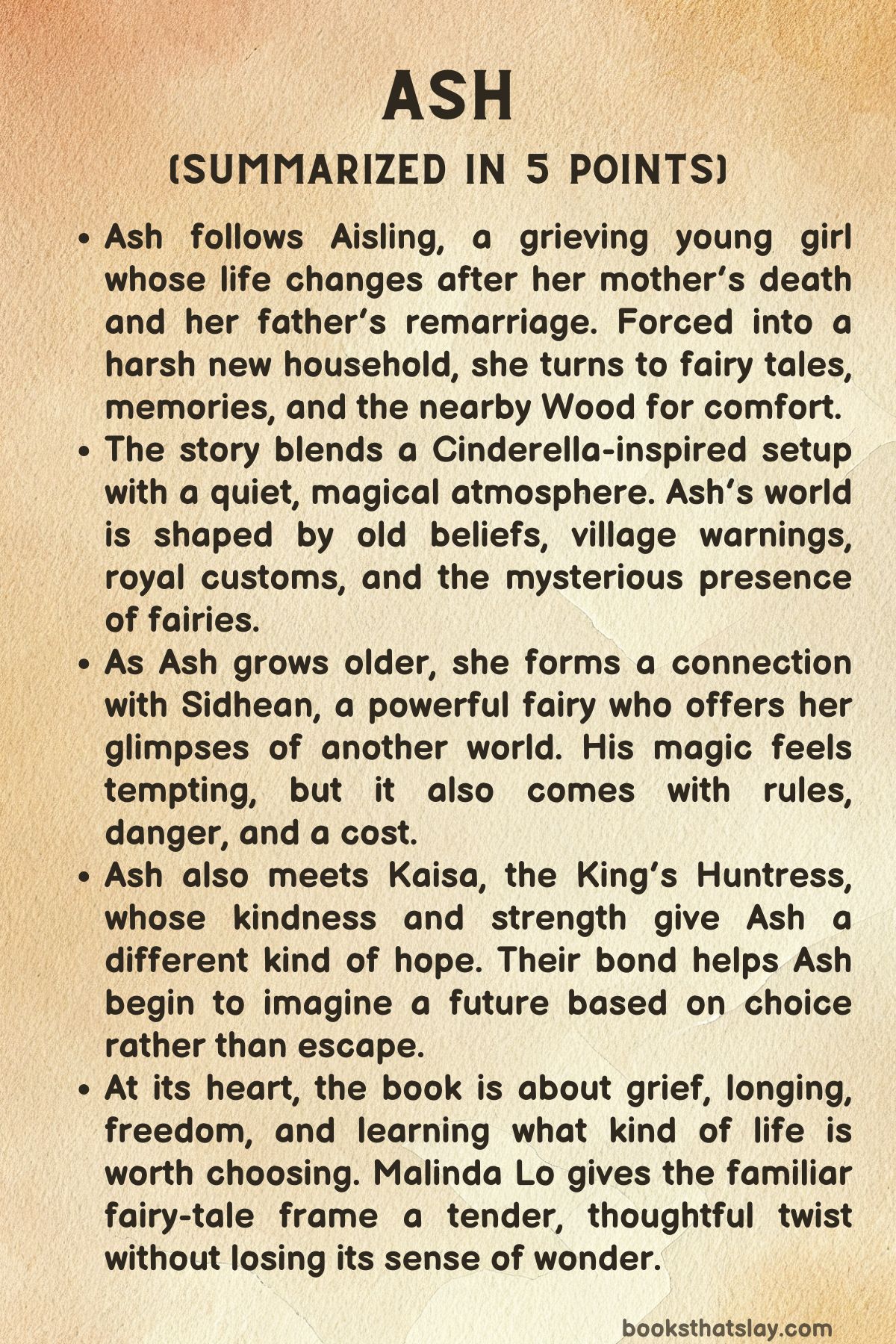
Ash by Malinda Lo is a retelling of Cinderella shaped by fairy lore, grief, class hardship, and a quiet romance between two young women. The novel follows Aisling, known as Ash, after the death of her mother and then her father leaves her trapped under the control of a cruel stepmother.
Instead of centering only on a prince or a magical rescue, the story focuses on Ash learning what she truly wants: escape, love, or a life that belongs to her. It is a fantasy about mourning, desire, freedom, and choosing the living world.
Summary
Ash begins with Aisling, called Ash, living with her parents in a world where old beliefs still linger beside newer doubts. Her mother, Elinor, believes in the old ways, including charms, greenwitches, fairies, and ancient rites.
Ash’s father is more skeptical, but he loves his family and respects some of the customs that matter to his wife. When Elinor suddenly dies at midsummer, Ash is shaken by a loss she can barely understand.
Her father allows the old burial rites to be performed, even though he is uncertain about their power. That night, Ash dreams of the Fairy Hunt calling for her mother.
When she wakes, she sees signs that make the dream feel less like imagination and more like something that truly passed through the night.
After Elinor’s death, Ash’s home changes. Her father travels to the Royal City and returns with a new wife, Lady Isobel, and two stepdaughters, Ana and Clara.
Ash feels displaced almost at once. Lady Isobel takes charge of the household and fills the space Elinor once occupied, but without warmth or understanding.
Ana and Clara become part of the family, yet Ash remains lonely. She misses her mother deeply and becomes more drawn to stories of fairies and to the Wood beyond the house.
The forest seems to hold a promise of escape, mystery, and connection to the old world her mother believed in.
Maire Solanya, the village greenwitch, warns Ash’s father that Ash may be in danger from the fairies. He dismisses the warning, refusing to accept that such forces might be real.
But Ash has already begun sensing that the boundary between the human world and the fairy world is thinner than most people believe. One moonlit night, she enters the forest and encounters the Fairy Hunt.
There she sees a powerful fairy man, who commands her to go home. The encounter frightens and fascinates her.
It confirms that the stories she has cherished may not be only stories.
Soon afterward, Ash’s father becomes seriously ill. Maire tries to help with traditional remedies, but Lady Isobel rejects her assistance and takes him south to her own house near the Royal City.
Physicians are called, but they cannot save him. His death leaves Ash without either parent and without protection.
Lady Isobel claims that Ash’s father left behind debts and says Ash must work as a servant to repay them. Whether the debt is real or exaggerated, Ash has no power to challenge her.
She is moved into a life of labor at Quinn House, where she cooks, cleans, serves, and obeys.
At Quinn House, Ash becomes trapped in a harsh routine. Lady Isobel treats her as a burden and a servant, not as family.
Ana is vain and ambitious, while Clara is less cruel but still part of the household that benefits from Ash’s work. Ash finds comfort in fairy tales and in secret visits to the Wood.
The old stories become a refuge, and the thought of the fairy world begins to feel more appealing than the human life that has been forced on her.
During the season of her thirteenth birthday, Ash runs away through a strange enchanted path and reaches her mother’s grave at Rook Hill. There she meets the fairy man again.
She hopes he might restore what she has lost, but he refuses to bring her mother back. Instead, he returns her to Quinn House, where Lady Isobel punishes her by locking her in the cellar.
Later, Ash seeks him again and learns his name: Sidhean. He gives her a magical silver-white cloak, a gift that proves his world is real and that he has a special interest in her.
As years pass, Ash continues serving Lady Isobel while secretly holding on to the possibility that Sidhean might one day take her away. His appearances are rare, but each meeting strengthens her attachment to him.
He is beautiful, dangerous, and connected to the fairy realm she imagines as an escape from pain. Ash begins to think of leaving the human world behind, not only to escape servitude but also to escape grief itself.
Meanwhile, Ana is brought into society in the hope that she will marry well. Prince Aidan has returned from war, and Lady Isobel sees his presence as an opportunity.
During a royal Yule celebration, Ash sees Kaisa, the King’s Huntress. Kaisa is skilled, confident, and at ease in the forest in a way that draws Ash’s attention.
Later, Ash meets her in the Wood. Their conversations begin quietly, without grand declarations.
Kaisa teaches Ash to ride, and Ash starts to feel something different from what she feels for Sidhean. Kaisa represents not disappearance, but life: movement, skill, companionship, and a possible future in the human world.
When Kaisa invites Ash to join the royal hunt, Ash wants to go but cannot do so openly. She asks Sidhean for help.
He grants the wish, but there is a price: when the time comes, she will belong to him. Ash, still believing that the fairy world may be her true escape, accepts.
A fairy servant disguises her, and she joins the hunt with Kaisa. The experience gives her a taste of freedom, and her bond with Kaisa grows stronger.
After the hunt, Prince Aidan announces that he will choose a bride, and all eligible young women are invited to a Souls Night masquerade. Ash asks Sidhean for another favor so she can attend.
At the ball, she appears in a magical gown and mask. Prince Aidan dances with her and becomes interested in her, but Ash is not truly there for him.
She slips away and seeks Kaisa instead. Her time with Kaisa makes her understand that her feelings for the huntress are more powerful than her longing for Sidhean’s realm.
When Ash returns home after midnight, the disguise fades. Lady Isobel and Ana discover her.
Ana tears her dress and cuts her hair, and Lady Isobel locks her in the cellar. Sidhean comes to her there and tells her a hidden truth: Elinor once cursed him to fall in love with a human girl after he tried to lure her away.
Ash realizes that Sidhean’s desire for her is tied to this curse. What seemed like destiny is also a binding placed on him long before Ash understood any of it.
This revelation changes Ash. She begins to see that leaving with Sidhean would not be pure freedom.
It would mean surrendering her life to a world shaped by bargains, old wounds, and enchantment. She decides she wants to live.
She wants choice, love, and a future that is not built only on grief.
At Yule, Ash goes secretly to the palace again and asks Kaisa to dance. This act is simple but brave: she steps toward the person she truly wants.
Afterward, she meets Sidhean in the Wood. She offers herself to him for one night only, using his love for her to persuade him to release her from their bargain.
Sidhean agrees. Ash wakes in the fairy realm with dim memories and a scar on her hand, but she is free.
In the end, Ash returns to the human world and leaves Lady Isobel’s house behind. She finds Kaisa and tells her she is free.
Their kiss marks Ash’s final choice. She does not choose the prince, and she does not choose to vanish into fairyland.
She chooses Kaisa, the living world, and a future she can claim for herself.
Characters
Aisling / Ash
Aisling, called Ash, is the emotional center of Ash, and her character is shaped by grief, longing, servitude, and eventual self-liberation. At the beginning of the book, she is a child who loses her mother suddenly, and this loss leaves her spiritually unmoored.
Her grief is not ordinary sadness alone; it becomes a doorway into fairy tales, old beliefs, and the dangerous comfort of another world. Ash’s attachment to the Wood and to stories shows how deeply she wants escape from the cruelty and loneliness of her human life.
After her father remarries and then dies, Ash is reduced to a servant in her own household, and this injustice makes her life feel almost ghostlike. She works, obeys, and endures, but inwardly she remains connected to memory, magic, and desire.
Ash’s complexity comes from the fact that she does not simply want rescue; she wants release. For much of the story, Sidhean and the fairy world seem to offer her a way out of pain, duty, and humiliation.
Her attraction to fairyland is closely tied to death and disappearance, especially because she first turns toward magic while mourning her mother. This makes her early longing dangerous, because it suggests that she is tempted not just by wonder, but by the possibility of leaving life behind altogether.
However, Ash changes as her bond with Kaisa grows. Through Kaisa, she begins to experience the human world not only as a place of suffering, but also as a place of tenderness, beauty, skill, and chosen love.
By the end of the story, Ash’s most important transformation is her decision to live. She refuses to remain trapped by Lady Isobel’s abuse, refuses to become only the object of Sidhean’s cursed love, and refuses to let grief define her future.
Her final choice of Kaisa is not merely romantic; it is a choice of agency, embodiment, and hope. Ash becomes powerful not because she defeats others through force, but because she understands what she truly wants and acts on it.
Her journey moves from mourning to awakening, from escape to choice, and from being claimed by others to claiming her own life.
Elinor
Elinor, Ash’s mother, is physically absent for most of the book, but her influence is one of the strongest forces in the story. Her death begins Ash’s emotional descent into grief and sets the entire plot in motion.
Elinor represents warmth, memory, old customs, and a connection to beliefs that others either fear or dismiss. The fact that Ash’s father allows the old burial rites to be performed shows that Elinor belonged to a world where magic and tradition still mattered, even if that belief had become uncertain or controversial.
Elinor is also important because her past is tied directly to Sidhean. The revelation that she once cursed him after he tried to lure her away changes the meaning of his relationship with Ash.
Elinor is not simply a dead mother idealized by her grieving daughter; she was a woman with power, will, and the ability to resist fairy enchantment. Her curse creates one of the book’s central conflicts, because Sidhean’s love for Ash is not entirely free.
Through this connection, Elinor remains active in the story even after death, shaping both Ash’s grief and Sidhean’s fate.
As a character, Elinor represents the complicated inheritance Ash receives. She gives Ash a connection to love, family, and memory, but also leaves behind unresolved magical consequences.
Ash’s longing for her mother is one reason she becomes vulnerable to fairyland, yet Elinor’s own resistance to Sidhean also helps Ash understand the danger of surrendering herself to him. In this way, Elinor is both a lost source of comfort and a hidden model of resistance.
Ash’s Father
Ash’s father is a well-meaning but deeply flawed figure whose choices expose Ash to danger and suffering. After Elinor’s death, he appears uncertain and emotionally distant, caught between old beliefs and practical doubt.
He permits the old rites for his wife, but he does not fully accept the warnings that follow. When Maire Solanya tells him that Ash is in danger from the fairies, he refuses to believe her, and this refusal becomes one of his most serious failures as a parent.
His disbelief does not come from cruelty, but it leaves Ash unprotected at a crucial moment.
His remarriage to Lady Isobel is another turning point in Ash’s life. By bringing a new wife and stepdaughters into the household so quickly after Elinor’s death, he unintentionally deepens Ash’s grief and displacement.
Lady Isobel’s presence replaces Elinor’s role in the home, but without tenderness or understanding. Ash’s father may believe he is securing stability, yet his decision instead places Ash under the control of someone who later exploits her.
His illness and death then remove the last barrier between Ash and Lady Isobel’s cruelty.
Ash’s father is therefore a tragic character because his weakness has lasting consequences. He is not portrayed as evil, but his inability to see clearly harms his daughter.
His doubt toward magic, his misplaced trust in Lady Isobel, and his failure to protect Ash all help create the conditions of her servitude. In the story, he represents the danger of passive love: affection that exists, but does not act strongly enough to defend the vulnerable.
Lady Isobel
Lady Isobel is the main figure of domestic oppression in the book. After marrying Ash’s father, she takes control of the household and gradually strips Ash of status, comfort, and freedom.
Her cruelty is practical rather than dramatic; she uses debt, social authority, and household power to turn Ash into a servant. This makes her especially threatening because her abuse is disguised as order and obligation.
She claims that Ash must work to repay her father’s debts, presenting exploitation as responsibility.
Lady Isobel’s rejection of Maire’s remedies during Ash’s father’s illness also reveals her distrust of local tradition and her desire to impose her own authority. She removes Ash’s father from familiar surroundings and brings in physicians, but her decisions do not save him.
After his death, she becomes harsher and more controlling. She punishes Ash through confinement, labor, and humiliation, showing that she sees Ash less as a stepdaughter than as a burden to be managed.
As a character, Lady Isobel embodies a loveless version of social respectability. She cares about appearances, marriage prospects, class position, and obedience, but she lacks compassion.
Her control over Ash is rooted in the human world rather than the fairy world, which is important because the story does not present magic as the only danger. Human cruelty is just as destructive.
Lady Isobel’s role is to make Ash’s ordinary life so unbearable that fairyland seems tempting, yet her harshness also makes Ash’s final departure feel necessary and morally justified.
Ana
Ana is one of Ash’s stepsisters and is more openly cruel than Clara. She is closely aligned with Lady Isobel’s values, especially ambition, status, and social advancement.
Ana’s introduction to society and her hopes of marrying well show that she has been raised to measure worth through rank and desirability. Prince Aidan’s return makes marriage even more important to her, and she becomes part of the social competition surrounding his choice of a bride.
Ana’s treatment of Ash reveals jealousy and entitlement. When Ash’s magical disguise is discovered after the masquerade, Ana reacts violently by tearing Ash’s dress and cutting her hair.
This moment shows that Ana is not merely spoiled or careless; she is capable of deliberate humiliation. Her anger likely comes from the shock of seeing Ash, whom she considers beneath her, appear beautiful, mysterious, and desired.
Ash’s transformation threatens Ana’s sense of superiority, so Ana tries to reduce her again through physical and emotional degradation.
Ana represents the cruelty produced by privilege and insecurity. She has more freedom than Ash, yet she is also trapped within expectations of marriage and social success.
Unlike Ash, however, Ana responds to that pressure by dominating someone weaker. Her character helps expose the ugliness beneath polished society.
She wants elevation, but her behavior reveals smallness of spirit.
Clara
Clara, Ash’s other stepsister, is less sharply defined than Ana, but she still belongs to the household structure that oppresses Ash. Her presence reinforces Ash’s displacement after Lady Isobel enters the family.
Alongside Ana, Clara becomes part of the new domestic order in which Ash is pushed out of daughterhood and into servitude. Even when Clara is not as actively cruel as Ana, she benefits from Ash’s labor and from Lady Isobel’s control.
Clara’s character is important because she shows how injustice can continue through passivity. She does not need to be the loudest or most violent person in the household to participate in Ash’s suffering.
By accepting Ash’s lowered position, Clara becomes part of the same system of entitlement. Her relative quietness makes her a contrast to Ana, but not a true moral alternative.
In the story, Clara helps complete the image of Ash’s stepfamily as a social unit built on hierarchy. Lady Isobel commands, Ana asserts superiority, and Clara occupies a more passive but still privileged role.
Through Clara, the book suggests that cruelty can exist not only in direct action, but also in comfortable acceptance of another person’s mistreatment.
Maire Solanya
Maire Solanya, the village greenwitch, represents old knowledge, intuition, and the wisdom of traditions that others dismiss. Her warning that Ash is in danger from the fairies is one of the earliest signs that the magical world is not simply beautiful or harmless.
Unlike Ash’s father, Maire understands that the boundary between the human world and the fairy world is real and dangerous. Her insight places her in the role of guardian, even though her warning is ignored.
Maire’s importance lies in her connection to healing and protective knowledge. When Ash’s father becomes ill, her remedies offer a different kind of care from the physicians Lady Isobel later chooses.
Lady Isobel’s rejection of Maire’s help is not only a medical decision; it is also a rejection of local female knowledge, folk practice, and spiritual caution. Maire’s marginalization shows how easily wisdom can be dismissed when it does not fit the beliefs of those in power.
As a character, Maire stands between the ordinary and the supernatural. She does not romanticize fairy magic, and she does not treat grief as harmless.
Her presence deepens the world of the novel by showing that magic has rules, histories, and risks. She also serves as an early counterpoint to Ash’s desire for fairyland, reminding the reader that what Ash longs for may also consume her.
Sidhean
Sidhean is one of the most mysterious and morally complex figures in Ash. He is powerful, alluring, dangerous, and sorrowful, and his relationship with Ash carries both tenderness and threat.
When Ash first encounters him, he appears as a commanding fairy figure who belongs to a world beyond human rules. He refuses to bring back her mother, but he also continues to return to Ash, leaving her the silver-white cloak and making the fairy world undeniable.
To Ash, he becomes a symbol of escape from grief, servitude, and the limits of ordinary life.
Sidhean’s attachment to Ash is complicated by the curse Elinor placed on him. His love is real in its effects, but it is not entirely free from enchantment, punishment, and repetition.
This makes him tragic as well as dangerous. He wants Ash, but his desire is entangled with an old wound caused by his attempt to lure Elinor away.
His relationship with Ash therefore repeats a pattern of fairy seduction, human resistance, and emotional bondage. He offers Ash beautiful things, but every gift carries a price.
By the end of the story, Sidhean becomes less a romantic destination than a test of Ash’s self-knowledge. Ash once expects that he will take her away, but she later understands that leaving with him would mean surrendering the life she has only just begun to want.
His release of Ash after their final bargain gives him a measure of dignity and sorrow. He is not simply a villain; he is a being trapped by desire, curse, and fairy law.
His role is essential because he embodies the seductive pull of disappearance, while Ash’s rejection of him marks her choice to live freely in the human world.
Kaisa
Kaisa, the King’s Huntress, is the character who awakens Ash’s desire for life, freedom, and human connection. She is skilled, composed, independent, and deeply associated with the natural world, but unlike Sidhean, her connection to the forest does not require Ash to vanish from herself.
Kaisa moves through the Wood with knowledge and confidence, making her a bridge between danger and belonging. When she teaches Ash to ride, she gives her not only a practical skill, but also a new sense of strength and bodily freedom.
Kaisa’s relationship with Ash develops through conversation, trust, and shared experience rather than enchantment. This makes her love fundamentally different from Sidhean’s.
With Kaisa, Ash is not being claimed by magic or pulled away from life; she is being invited into mutual recognition. Kaisa sees Ash as a person, not as a servant, debt, curse, or prize.
Her calm presence allows Ash to imagine a future that is neither Lady Isobel’s household nor the fairy realm.
Kaisa also represents an alternative form of female power. She is not powerful through marriage, wealth, or social manipulation, but through competence, discipline, and closeness to the hunt.
Her position as Huntress gives her authority in a world where many women are judged by marriage prospects. For Ash, loving Kaisa becomes part of choosing a different life.
Kaisa is therefore not only Ash’s romantic partner, but also the figure who helps make survival feel desirable.
Prince Aidan
Prince Aidan functions less as Ash’s true romantic possibility and more as a symbol of the traditional fairy-tale path the story chooses to revise. His return from war creates excitement among eligible young women, especially Ana, because marriage to him would mean status, security, and social triumph.
His announcement that he will choose a bride turns the masquerade into a scene of expectation, competition, and conventional romance.
When Prince Aidan dances with Ash, he is intrigued by her mystery and beauty, fulfilling the familiar role of the prince drawn to the unknown girl at the ball. However, Ash’s emotional focus does not remain with him.
She slips away and seeks Kaisa instead, which reveals that the prince is not the center of her desire or destiny. His importance lies in what he represents: the life Ash is expected, by fairy-tale logic, to want.
As a character, Prince Aidan is not cruel or deeply antagonistic. Rather, he is a narrative contrast.
He shows how the story moves away from the usual reward of royal marriage and toward a more personal, self-chosen form of love. His presence helps clarify Ash’s desires because she is given access to the expected fantasy and discovers that it is not what she truly wants.
Themes
Grief and the Search for Escape
Ash’s grief begins as a private wound but soon becomes the force shaping how she sees the world. Her mother’s sudden death leaves her emotionally unprotected, and each later loss deepens her desire to leave ordinary life behind.
The fairy world attracts her because it seems to offer what human life cannot: reunion, beauty, distance from pain, and freedom from humiliation. Her longing for Sidhean is tied less to romance at first and more to the hope that he can carry her beyond suffering.
Yet Ash shows that escape can become dangerous when it asks a person to surrender the future. Ash’s attraction to fairyland is understandable because her human home becomes cruel and loveless, but the story gradually reveals that vanishing would not truly heal her.
Her growth comes from recognizing that grief should not erase her desire to live. By choosing the human world, she accepts sorrow as part of life rather than letting it become the reason to disappear.
Power, Debt, and Control
Lady Isobel’s control over Ash is built through money, status, and emotional cruelty. After Ash’s father dies, the claim of unpaid debts turns Ash from a daughter into a servant, stripping her of comfort, choice, and dignity.
This creates a harsh picture of how power can hide behind respectable language. Lady Isobel does not simply mistreat Ash openly; she justifies the mistreatment as repayment, duty, and household order.
That makes Ash’s oppression feel especially cruel because it is treated as reasonable by the person enforcing it. The debt becomes more than a financial burden; it becomes a tool used to trap Ash in a role she never chose.
Her labor keeps the household running, but she receives no gratitude or recognition. This theme also connects to Sidhean’s bargains, since fairy magic offers freedom while creating another kind of debt.
Ash must learn that escape bought through surrender is not freedom. Real freedom requires her to reject both human and magical forms of ownership.
Love as Choice Rather Than Enchantment
Love in Ash is tested against magic, obligation, and fantasy. Sidhean’s bond with Ash carries mystery and beauty, but it is also shaped by an old curse and by bargains that limit her freedom.
His attraction to her is powerful, yet it is not fully free, and Ash’s early attachment to him grows from loneliness and her desire to escape. Kaisa offers a different kind of love.
Her connection with Ash develops through conversation, trust, riding lessons, shared time in the Wood, and quiet recognition. This love does not demand that Ash vanish or give herself away.
Instead, it draws her toward life, courage, and self-knowledge. The contrast between Sidhean and Kaisa helps show that love is not proved by intensity alone.
A bond can feel magical and still be dangerous if it reduces choice. Ash’s final decision matters because she chooses a love that allows her to remain herself.
The story presents love as something rooted in freedom, not possession.
Identity, Self-Discovery, and Reclaiming Life
Ash spends much of the story being defined by others: as an orphan, a servant, a debtor, a burden, or a girl marked by fairies. These labels narrow her life until she almost believes that her only meaningful future lies outside the human world.
Her journey is a slow process of reclaiming the right to decide who she is. The forest becomes important because it is the one place where she can move beyond the identity forced on her by Lady Isobel’s household.
Yet self-discovery does not come only through solitude or magic. It also comes through Kaisa, who sees Ash with respect and gives her space to act with confidence.
Riding, hunting, dancing, and speaking honestly all help Ash imagine herself as someone capable of desire and choice. Cutting her hair and locking her away are attempts to shame and control her, but they fail to destroy her sense of self.
By the end, Ash chooses not only Kaisa but her own life, voice, and future.