The Witch Summary, Characters and Themes | Marie NDiaye
The Witch by Marie NDiaye, originally published as La Sorcière in French, is a strange, unsettling novel about inherited female power, family collapse, and the thin line between magic and ordinary disappointment. The story follows Lucie, a modest woman with a weak supernatural gift, as she tries to pass this ability to her twin daughters while her own life falls apart.
Her husband abandons her, her daughters outgrow her, her mother’s hidden powers turn destructive, and Lucie is left unsure whether witchcraft is a real force or simply another form of family damage. The book presents magic in a dry, domestic world where cruelty, shame, and abandonment feel just as powerful as spells.
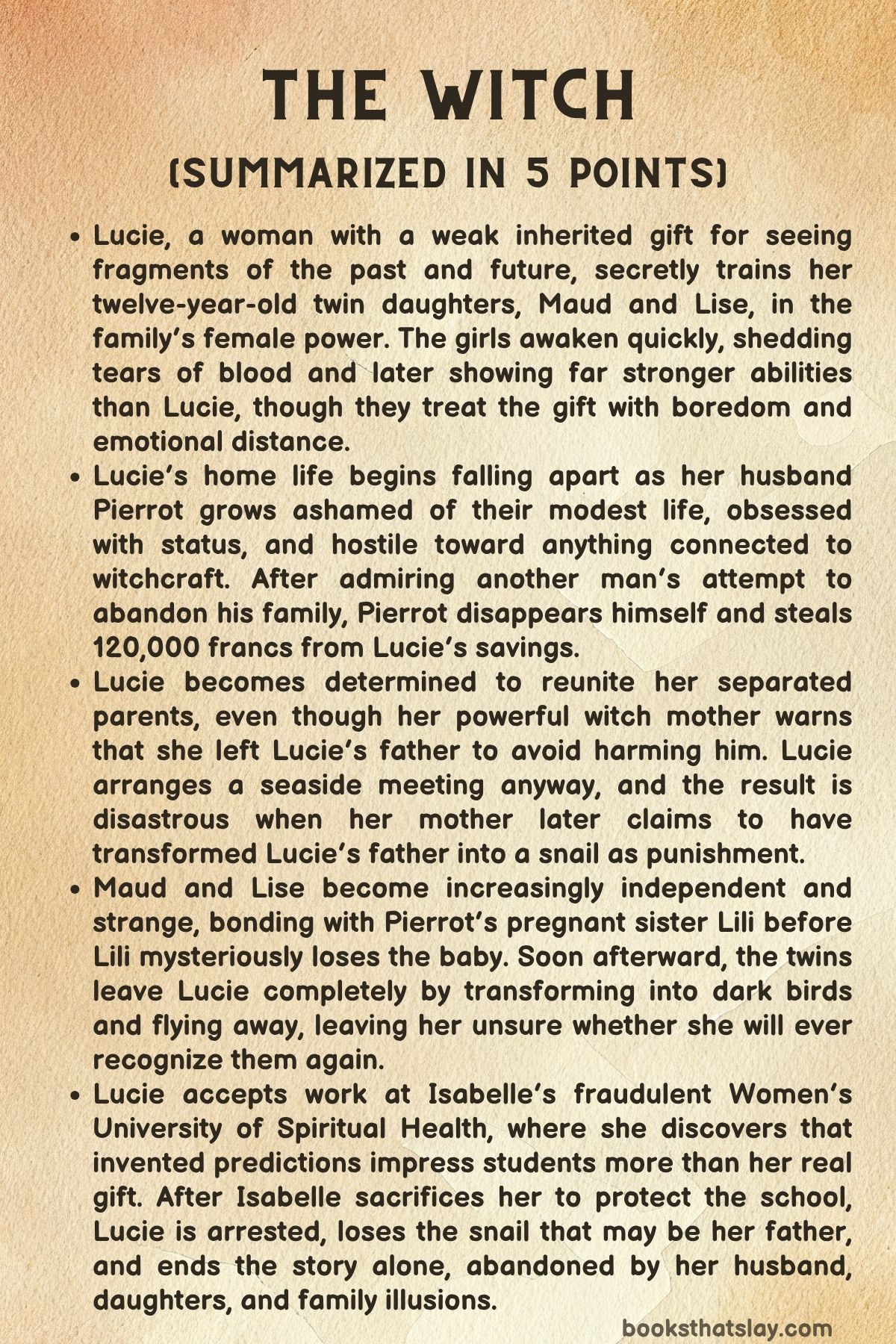
Summary
Lucie begins the story as a woman trying to preserve a strange family inheritance. She has a weak, uncertain gift that allows her to see fragments of the past and future, though the visions usually come with difficulty and often show small, useless details rather than anything grand.
The power has passed through the women of her family, and Lucie feels responsible for initiating her twelve-year-old twin daughters, Maud and Lise, into the same tradition. She trains them secretly in the basement of their home because her husband, Pierrot, dislikes the gift and wants nothing to do with it.
He finds it disturbing and embarrassing, and Lucie keeps the lessons hidden from him.
After months of instruction, Maud and Lise finally show signs that their abilities have awakened. They begin crying tears of blood, a sign that the power has taken root in them.
Lucie sees this as a serious and important moment, but the girls react with cool indifference. They do not seem awed by the family gift and treat it as something ordinary, boring, and faintly foolish.
Their attitude unsettles Lucie because they appear far more talented than she is, yet they have none of her reverence for the tradition. They soon begin using their powers casually, making small predictions with little effort.
Lucie’s marriage is already troubled. Pierrot works at the Garden-Club, where he sells vacation memberships to wealthier clients.
His work has made him obsessed with appearances, money, and social advancement. He becomes ashamed of Lucie’s plain habits and their modest domestic life.
He wants luxury and status, and he resents the ordinary reality around him. Their household is also affected by Isabelle, a domineering neighbor who controls the subdivision through gossip and threats.
Isabelle knows about Lucie’s gift and pressures her to predict whether her young son, Steve, will one day enter an elite school. Lucie tries to look into Steve’s future but sees only a sad, defeated version of him.
She hides the worst of the vision from Isabelle, though she can already see how cruelly Isabelle treats the boy and how frightened he has become.
One evening, Pierrot unexpectedly brings home Monsieur Matin, a former Garden-Club client who has left his wife and child. Pierrot admires him at first and treats his decision to abandon family life as brave and admirable.
Maud and Lise also observe Monsieur Matin with interest. Monsieur Matin explains that his son, Nounou, is too attached to his mother and makes him feel useless.
He presents himself as a man who has escaped a suffocating domestic situation. Lucie, however, pushes him to call his wife.
When Madame Matin arrives with Nounou, the image Monsieur Matin has created collapses. Nounou is not a small child but an older boy, and Monsieur Matin panics.
Unable to face his wife and son, he runs away through the back garden. Pierrot immediately loses interest in him once his supposed courage is exposed as weakness.
Soon after this, Pierrot himself disappears. Lucie uses her power and sees him in Poitiers at his mother’s house.
At first, she is almost relieved by his absence because his dissatisfaction and contempt have weighed on her. Then she discovers that he has taken 120,000 francs from their savings, money that originally came from her father.
The theft forces her to confront the practical damage of his departure. Around the same time, Lucie becomes increasingly fixated on reuniting her own separated parents.
Her mother, a powerful witch who has mostly suppressed her abilities, lives in a shabby Paris apartment with a new companion named Robert. Her father has reinvented himself in a luxurious apartment, but he is secretly in financial trouble after misusing money from insurance clients.
Lucie believes that her parents’ separation was a terrible mistake and arranges for them to meet at a seaside hotel on June twelfth.
During a trip to Paris, Maud and Lise’s powers become stronger and stranger. They make predictions easily and bleed from the eyes without embarrassment.
They also begin transforming into birds, suggesting that their abilities are moving far beyond Lucie’s limited visions. Lucie encounters Isabelle in Paris as well and learns that Isabelle is trying to place Steve in boarding school before beginning a new life elsewhere.
Later, Lucie sees Steve among a group of small children on an outing. He already looks broken, aged by fear, and emotionally abandoned.
Lucie realizes that Isabelle has effectively discarded her son in pursuit of her own plans.
Lucie then travels to Poitiers to recover the money Pierrot stole, but he has already fled his mother’s house. Pierrot’s mother tells Lucie that he became hostile, violent, and disgusted with everyone while he was there.
He even struck her. Pierrot’s sister, Lili, has also changed.
She is heavily made-up, bold, and pregnant, though she refuses to say who the father is. Lili forms a strange bond with Maud and Lise.
During a storm, the three girls go out together. By morning, Lili returns and announces that there is no more baby.
Maud and Lise confirm this coldly, without pity or explanation. Pierrot’s mother is devastated, while Lucie is left to absorb another sign that her daughters’ power is no longer connected to her authority or values.
Lucie’s mother appears in Poitiers and explains the real reason she left Lucie’s father. Years earlier, he accidentally saw part of her hidden witchcraft.
Although he did not speak of it, her feelings toward him changed. Her love became mixed with a dangerous desire to punish and destroy him.
She left because she feared what she might do if she stayed. Lucie hears this confession but still insists on arranging the seaside meeting.
She cannot let go of the idea that her parents belong together, even when her mother warns her that the separation may have protected him.
After this, Maud and Lise leave Lucie. On the way to the station, they fully transform into dark birds and fly away into the sky.
Lucie understands that she may never know them again. Even if she sees birds in the future, she may not be able to recognize which ones are her daughters.
Their departure leaves her stripped of her role as a mother and teacher. The power she passed on has carried them away from her rather than binding them to her.
Alone, Lucie tracks Pierrot to Bourges. He has moved in with another woman and her three children, becoming a soft, passive stepfather figure.
He refuses to return the 120,000 francs and tells Lucie she can keep the house, treating the stolen money as part of a practical settlement. When she mentions Maud and Lise, he calls them witches and tells Lucie to leave.
Outside, Lucie meets Isabelle, who has transformed herself into a polished businesswoman. Isabelle has founded Isabelle O.’s Women’s University of Spiritual Health in Châteauroux, a profitable school for young women, and she offers Lucie a teaching position in divination.
Lucie accepts the job. At the university, she discovers a shiny, artificial institution filled with damaged women whom Isabelle has turned into spiritual teachers.
The students are wealthy, eager young women who believe in the school’s promise. Lucie initially tries to use her real gift, but doing so exhausts her.
She soon begins inventing futures and pasts for the students instead. Strangely, she becomes more successful as a fraud than as a true witch.
This makes her doubt the tradition she inherited. She begins to wonder whether she and the women in her family have only been clinging to old stories.
After the arranged seaside meeting between her parents, Robert comes to see Lucie at the university. He brings a small box containing a snail.
He says Lucie’s mother claims the snail is Lucie’s father, transformed after the meeting because he “got what was coming to him.” Lucie calls her father’s office and learns that he is wanted for arrest after embezzling money. She is devastated.
Her plan to reunite her parents has failed completely, and her mother’s warning has come true. The meeting did not restore love; it allowed punishment.
A few days later, officials and gendarmes arrive at Isabelle’s university. To protect the school, Isabelle sacrifices Lucie and accuses her of fraud after students complain that her predictions are false.
Lucie insists that she really is a kind of witch, but the officials mock her as a counterfeit. At the gendarmerie, a frightened officer finds the box with the snail and takes it from her.
Lucie is placed in a cell. Later, the same officer, convinced she is evil, sets fire to her mattress, but his wife interrupts before he can kill her.
Lucie survives and is eventually released, but the snail that may be her father is lost.
In the final scene, Lucie wanders through Châteauroux, worn down and uncertain. She sees Pierrot in the town square with his new partner, her children, and Pierrot’s mother, who is delighted by the new woman’s pregnancy.
Pierrot has failed again, sold his car, and wasted Lucie’s money while trying to start a business school. Pierrot’s mother tells Lucie that Lili has lost her reason and talks constantly about birds that might come for her.
Lucie stands in the heat with no husband, no daughters, no father, and no clear future, while Pierrot’s mother casually asks about her summer vacation plans.
Characters
Lucie
Lucie is the central figure of the book, a woman caught between inherited power and everyday helplessness. Her gift is real enough to shape her life, but it is weak, unreliable, and often useless in practical terms.
She can see fragments of time, but she cannot prevent abandonment, recover stolen money, protect Steve, control her daughters, or save her father. This makes her a deeply fragile figure: she belongs to a line of witches, yet she is often the least powerful person in the room.
Her attempts to preserve tradition are sincere, especially when she trains Maud and Lise, but the girls quickly surpass her and leave her behind. Lucie’s desire to reunite her parents also shows her need to repair broken family structures, even when those breaks exist for a reason.
In The Witch, Lucie’s tragedy comes from her belief that family bonds and inherited knowledge should provide meaning, while every major relationship around her proves unstable, cruel, or impossible to control.
Maud and Lise
Maud and Lise are Lucie’s twin daughters, and they represent a new generation of female power that has no patience for the reverence or hesitation of the old one. They awaken their abilities through Lucie’s training, but they do not treat the gift as sacred.
Their blood tears, predictions, and eventual bird transformations are accepted with a cold practicality that unsettles their mother. They are not openly rebellious in a loud way; instead, they become distant, self-contained, and increasingly unreadable.
Their connection to Lili and their calm confirmation that her pregnancy has ended suggest that their power may be morally detached from ordinary human feeling. Their final transformation into birds is both escape and severance.
They leave Lucie not through argument but through a complete change of form. In the story, they become signs of a power that continues beyond motherhood but refuses to remain loyal to the mother who passed it on.
Pierrot
Pierrot is Lucie’s husband, a restless and status-conscious man who despises the plainness of his life and fears anything connected to Lucie’s gift. His work at the Garden-Club exposes him to wealthier clients, and instead of simply selling memberships, he absorbs their values.
He becomes ashamed of modest domestic life and begins measuring himself against people who seem freer, richer, and more refined. His admiration for Monsieur Matin reveals how much he fantasizes about abandoning responsibility, but he loses interest once Matin’s cowardice is exposed.
Pierrot later acts out the same fantasy by disappearing and stealing Lucie’s money. Yet his escape leads not to independence but to another dependent domestic arrangement, where he becomes a softened stepfather in another woman’s household.
His repeated failures, his contempt for Lucie, and his fear of his daughters show him as a man who wants authority without burden, status without discipline, and freedom without consequence.
Lucie’s Mother
Lucie’s mother is one of the strongest and most frightening figures in the novel because her power is greater than Lucie’s and far more dangerous. She has suppressed her witchcraft, not because it is false, but because she knows how destructive it can become when mixed with resentment and love.
Her explanation for leaving Lucie’s father changes the meaning of the family separation. She did not leave from simple selfishness or lack of feeling; she left because her affection had turned into an urge to punish him after he saw something he should not have seen.
This makes her both protective and terrifying. Her transformation of Lucie’s father into a snail, or at least her claim to have done so, confirms that her warning was serious.
She understands magic as a force tied to anger, humiliation, and power. Unlike Lucie, she has no innocent belief that family can be restored without danger.
Lucie’s Father
Lucie’s father is a man of reinvention, vanity, and hidden failure. He has built the appearance of a successful new life in a luxurious apartment, but beneath that surface he is financially ruined and legally endangered because he has misused insurance clients’ money.
Lucie sees him partly through longing and partly through illusion. To her, he is one half of a broken parental bond that should be repaired.
Yet the story gradually reveals that he is not simply a wronged or lonely man. He is also dishonest and careless, someone whose outward dignity hides serious wrongdoing.
His possible transformation into a snail is one of the cruelest images in the book because it reduces him from a man of display and self-importance to something small, helpless, and easily lost. His fate shows how exposure, guilt, and punishment can shrink a person into almost nothing.
Isabelle
Isabelle is a force of social control, ambition, and self-invention. At first, she dominates the subdivision through gossip, intimidation, and maternal cruelty.
Her treatment of Steve reveals her hard, practical selfishness. She wants Lucie’s power only when it can serve her ambitions for her son, but when Steve becomes inconvenient, she sends him away and builds a new life for herself.
Her later transformation into the founder of Isabelle O.’s Women’s University of Spiritual Health shows her talent for turning spiritual hunger into business. She recognizes that people want meaning, prediction, healing, and authority, and she packages those desires into a profitable institution.
Isabelle is not magical in the same way Lucie is, but she has a sharper understanding of power in the modern world. She knows how to dress up fraud as education, how to use damaged women as staff, and how to sacrifice Lucie when the institution is threatened.
Steve
Steve is Isabelle’s young son, and his role in the story is small but disturbing. He embodies the damage caused by adult ambition, cruelty, and neglect.
When Isabelle asks Lucie to predict whether he will enter an elite school, the request is less about his happiness than about Isabelle’s pride. Lucie’s vision of Steve’s future is sad, and his present already shows signs of fear and defeat.
Later, when Lucie sees him among other small children, he appears emotionally aged, as though abandonment has already marked him. Steve is not given much agency because that is part of his tragedy.
Adults decide his future, remove him from their lives, and speak of him as a problem to be managed. His condition reflects one of the story’s harshest ideas: children can be damaged long before they have the language or power to resist.
Monsieur Matin
Monsieur Matin functions as a mirror for Pierrot’s fantasies of escape. He arrives as a man who has left his wife and child, and Pierrot initially treats him as someone brave enough to reject domestic confinement.
Matin presents his departure as a response to emotional exclusion, claiming that his son Nounou is too attached to his mother and makes him feel useless. But when Lucie forces him to face his family, his story collapses.
Madame Matin arrives with Nounou, who is older than expected, and Matin reacts not with conviction but panic. His flight through the back garden exposes him as weak rather than heroic.
He matters because he gives Pierrot a model of abandonment, then reveals the emptiness behind that model. His failure does not stop Pierrot from leaving, but it shows that such departures are often less about courage than fear.
Madame Matin and Nounou
Madame Matin and Nounou appear briefly, but they puncture Monsieur Matin’s false account of himself. Madame Matin’s arrival brings reality into a scene shaped by male self-pity.
She does not match the vague oppressive figure implied by Matin’s complaints; instead, her presence forces him to confront the family he has tried to narrate his way out of. Nounou is especially important because Matin has described him in a way that makes him sound like a small child, but he turns out to be much older.
This detail exposes the childishness of Matin himself. The father who complains of being made useless is the one who runs away.
Madame Matin and Nounou therefore serve as reminders that abandoned families have their own reality, no matter how elegantly the person who leaves tries to explain the departure.
Lili
Lili, Pierrot’s sister, is a bold and troubling figure whose pregnancy becomes one of the story’s strangest turns. When Lucie sees her in Poitiers, Lili has become heavily made-up, assertive, and unwilling to explain who fathered her child.
She seems to be living outside the rules of shame that govern the older women around her. Her bond with Maud and Lise is immediate and mysterious, as if she belongs more to their strange world than to her mother’s domestic expectations.
The storm-night episode, after which Lili returns no longer pregnant, suggests an event that is never fully explained but is clearly devastating to Pierrot’s mother. Later, Lili loses her reason and speaks of birds that might come for her, connecting her breakdown to the twins’ transformation.
She becomes another woman marked by contact with forces that cannot be neatly named or controlled.
Pierrot’s Mother
Pierrot’s mother is practical, emotional, and deeply attached to ordinary family structures. She is horrified by Pierrot’s behavior when he becomes violent and disgusted with everyone, and she is devastated by the end of Lili’s pregnancy.
Yet by the final scene, she has shifted her hopes onto Pierrot’s new partner and the expected child in that household. Her cheerfulness around the new pregnancy shows her hunger for continuity, even when the people involved have caused pain.
She is not cruel in the same direct way as Isabelle, but she often seems unable or unwilling to grasp Lucie’s devastation. Her casual question about Lucie’s summer plans at the end of The Witch is painful because it treats Lucie as though her losses are minor inconveniences.
She represents the ordinary social world that keeps speaking politely while lives collapse.
Robert
Robert is Lucie’s mother’s companion and serves as a messenger between Lucie and the consequences of her mother’s power. He is not a dominant character, but his delivery of the box containing the snail is crucial.
Through him, Lucie receives the horrifying claim that her father has been transformed after the seaside meeting. Robert’s role is strange because he seems close enough to Lucie’s mother to be trusted with this message, yet distant enough to present it almost as a report.
He belongs to the shabby, reduced world Lucie’s mother inhabits after leaving her husband. His presence also shows that Lucie’s mother has formed a new life outside the family Lucie wants to restore.
Robert does not fully explain or soften anything. He simply brings the evidence of punishment to Lucie and leaves her to face what her plan has caused.
Themes
Inherited Power and Its Failure to Protect
Magic in The Witch is inherited through women, but it does not provide safety, wisdom, or control in any simple way. Lucie’s gift gives her access to fragments of past and future, yet those fragments rarely help her change anything important.
She sees Steve’s sadness but cannot save him. She locates Pierrot but cannot recover the stolen money.
She passes power to Maud and Lise, but their stronger abilities carry them away from her. The family gift is therefore both real and disappointing.
It marks women as different, but it does not free them from abandonment, poverty, humiliation, or grief. Lucie’s work at Isabelle’s university sharpens this contradiction because she discovers that fake predictions are easier and more profitable than real ones.
The theme becomes less about whether magic exists and more about whether power has any value when it cannot repair ordinary human damage. Lucie’s uncertainty at the end comes from this painful gap between possessing a gift and being able to use it meaningfully.
Family as Damage Rather Than Shelter
Family relationships in the story repeatedly fail to offer protection. Lucie tries to be a faithful daughter, wife, and mother, but each role collapses around her.
Pierrot abandons her and steals from her. Maud and Lise accept the power she gives them but leave her behind.
Lucie’s parents’ separation, which she imagines as a wound that must be healed, turns out to have been a necessary barrier against destruction. Even Pierrot’s family is marked by violence, denial, and breakdown, especially through his treatment of his mother and Lili’s unexplained loss of her pregnancy.
Children suffer most sharply within these damaged structures. Steve is treated as an obstacle to Isabelle’s ambitions, while Nounou is used in Monsieur Matin’s self-justifying story of escape.
The novel presents family not as a stable refuge but as a place where power, resentment, shame, and dependence gather. Lucie’s tragedy is that she keeps trying to restore family bonds even when those bonds have already become dangerous or empty.
Fraud, Belief, and Social Performance
The story repeatedly questions the difference between real power and successful performance. Lucie may have an actual gift, but it is weak, tiring, and difficult to use.
At Isabelle’s Women’s University of Spiritual Health, she becomes more convincing when she invents predictions than when she relies on real visions. This reversal exposes a world where appearance matters more than truth.
Isabelle understands this perfectly. She transforms herself from a bullying neighbor into a polished businesswoman, turns damaged women into spiritual authorities, and sells certainty to wealthy young students.
Her institution succeeds because people want to believe in guidance, healing, and hidden knowledge, even when those things are packaged as a business. Lucie’s arrest for fraud is bitterly ironic because she is both a fraud and not a fraud.
She lies to students, but she also comes from a line of women with genuine strange abilities. The officials cannot recognize that ambiguity, so they reduce her to a criminal counterfeit.
The theme shows how society often punishes weak, uncertain truth while rewarding confident deception.
Abandonment and Transformation
Many characters try to escape their lives by leaving, changing roles, or taking on new forms. Monsieur Matin abandons his family but is exposed as cowardly.
Pierrot leaves Lucie and reinvents himself in another household, only to fail again. Isabelle abandons Steve and reappears as the head of a profitable spiritual school.
Lucie’s mother leaves her husband to prevent herself from destroying him, while Maud and Lise abandon human family life altogether by becoming birds. Transformation in the story is rarely comforting.
It may bring escape, but it also leaves pain behind. The daughters’ bird forms free them from Lucie’s authority, yet their departure empties her life.
The father’s possible transformation into a snail is not liberation but punishment and reduction. Even Isabelle’s transformation into a businesswoman depends on cruelty and self-interest.
By the end, Lucie is surrounded by people who have changed or disappeared, while she remains painfully human, walking through the heat with no clear place to go.