The Witch and the Huntress Summary, Characters and Themes
The Witch and the Huntress by Luna McNamara is a mythological retelling centered on Medea and Atalanta, two women remembered by ancient legend but reimagined here with greater emotional depth and agency. The novel revisits the Argonauts’ voyage, Medea’s escape from Colchis, Jason’s failures, and Atalanta’s long search for freedom and love.
Rather than treating Medea only as a figure of violence, the story presents her as a daughter, priestess, lover, mother, exile, and queen shaped by betrayal and survival. At its heart, the book is about women trying to claim lives that men, gods, kingdoms, and myths have tried to define for them.
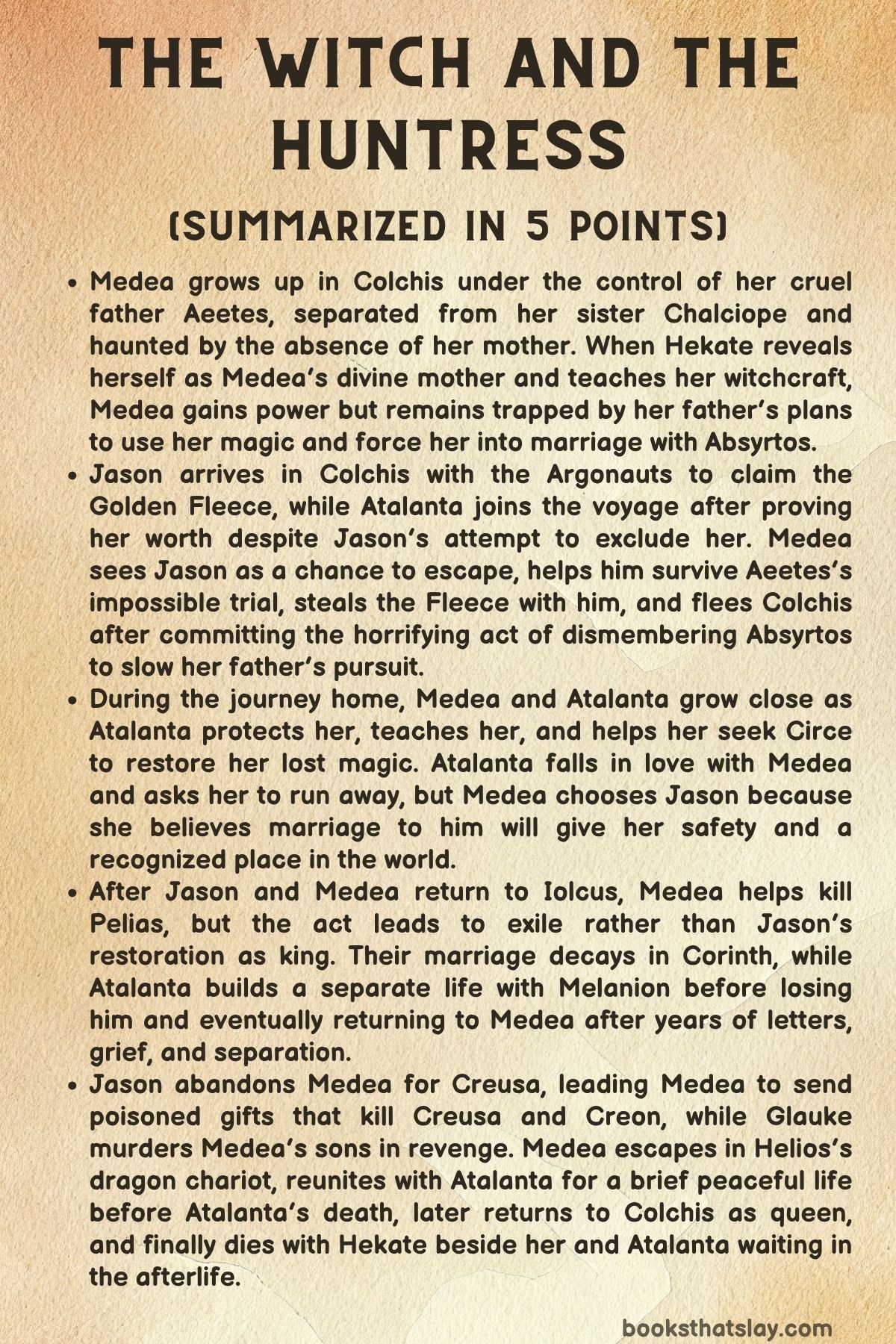
Summary
Atalanta arrives in Corinth after twenty years away and knocks on Medea’s door. Medea is older now, living with Jason and their sons, but the sight of Atalanta brings back a past full of longing, danger, bloodshed, and unfinished feeling.
Their reunion opens the story of Medea’s earlier life in Qulha, the land the Greeks call Colchis, where she grows up as the daughter of King Aeetes. Her palace life is not warm or secure.
Her sister Chalciope, the one person who once gave her comfort, is married off to Phrixus in exchange for the Golden Fleece. Medea’s mother, Hekate, is believed dead, and Medea is left with a brutal father, a cruel brother named Absyrtos, and the heavy loneliness of a royal household that treats her as a possession.
As a girl, Medea prays at a shrine of Hekate and receives an answer through a dream. Hekate reveals that she is not dead but has become a goddess, and that she is Medea’s true mother.
She gives Medea knowledge of witchcraft and promises that if Medea lives a life worthy of remembrance, she will return at Medea’s death and raise her beyond mortality. Medea dedicates herself to Hekate, builds a temple, and grows into a gifted priestess.
She learns charms, illusions, divinations, transformations, and other forms of magic, but her power does not protect her from Aeetes. Her father sees her gifts as tools for his own purposes.
When Medea learns that he intends to marry her to Absyrtos to keep her bound to the royal family, she is horrified.
Chalciope eventually returns in grief and tells Medea that Aeetes murdered her husband Phrixus and sent her sons away in a boat to die. The sisters begin plotting against their father, hoping to kill the man who has destroyed both of their lives.
At the same time, far from Colchis, Jason of Iolcus is forced into a dangerous quest by his uncle Pelias, who has stolen his throne. Pelias tells Jason he can reclaim his place only if he retrieves the Golden Fleece.
After Jason unknowingly helps Hera in disguise, she gives him the Argo, and he gathers a crew of heroes. Atalanta joins this expedition after defeating Jason in a spear-throwing contest, proving herself when he tries to exclude her because she is a woman.
She also carries her own private wound: she is searching for Procris, a huntress she once loved and lost after Procris returned to her husband, Cephalus.
The Argo’s journey is troubled almost from the beginning. Jason accidentally kills King Cyzicus during a confused nighttime battle, and Queen Cleite dies from grief.
Soon after, Atalanta loses her friend Meleager when his mother burns the enchanted log tied to his life, reducing him to ash. These events reveal the cost of heroic quests and the damage left behind by fame-seeking men.
Jason later discovers Chalciope’s sons alive on an island, and their presence becomes useful because they can help him gain access to Aeetes’s court. When the Argonauts reach Colchis, Jason demands the Golden Fleece, but Aeetes refuses to surrender it freely.
Instead, he sets Jason an impossible test involving fire-breathing bronze bulls.
Medea sees Jason as a possible escape from her father and the marriage planned with Absyrtos. She secretly helps Jason by giving him magical ointments that allow him to survive the bulls.
Jason promises to take her away and marry her. Medea chooses to trust him, not only because she is drawn to him but because he appears to offer the lawful home and public protection she has never had.
With her help, Jason survives the trial, steals the Golden Fleece, and flees Colchis. Atalanta also plays a role during the escape, but the flight becomes horrifying when Absyrtos is struck by an arrow and dies aboard the Argo.
Desperate to slow Aeetes’s pursuing fleet, Medea cuts her brother’s body apart and throws the pieces into the sea, forcing Aeetes to stop and gather his son’s remains. The act shocks Jason and the crew.
Afterward, Medea’s magic disappears, leaving her frightened and stripped of the power that had defined her.
During the return journey, Medea and Atalanta become close. Atalanta protects her, helps her seek out Circe in the hope of restoring her magic, and teaches her the hunt.
Atalanta’s feelings slowly shift from her lost love for Procris toward Medea, while Medea also feels drawn to Atalanta. Yet Medea continues to cling to Jason because she believes marriage to him is the only way to secure a place in the world.
The Argonauts continue to face danger. On Lemnos, Queen Hypsipyle tries to trap the men of the Argo after murdering the island’s men, but Medea and Atalanta uncover the truth and help save the crew.
Circe purifies Medea for Absyrtos’s murder but also tries to manipulate her. Later, the crew encounters Phineus and the Harpies, then reaches Crete, where Medea defeats the bronze giant Talos after Atalanta is injured.
Atalanta finally confesses her love and asks Medea to run away with her. Medea hesitates, caught between desire and her fear of losing the public security Jason represents.
On Phaeacia, Medea’s situation becomes urgent when the people threaten to return her to Colchis unless she is married. Jason publicly claims her as his wife, and the marriage is made real that night.
Atalanta is heartbroken, knowing Medea has chosen Jason even though their bond is weaker than what exists between the two women.
After more hardship, including the crossing of Libya, the Argo returns to Iolcus. Jason expects Pelias to surrender the throne, but Pelias refuses, saying Jason can rule only after his death.
Jason turns to Medea for help. Medea tricks Pelias’s daughters into believing they can restore their father’s youth by cutting him apart and boiling him, using a magical demonstration to convince them.
Pelias dies, but Jason and Medea are not rewarded. Instead, they are exiled.
Jason is horrified by Medea’s violence and demands that she swear never to use magic again unless he commands it. Pregnant and terrified of abandonment, Medea agrees.
They go to Corinth, where their marriage hardens into resentment and emotional distance.
Atalanta returns to Arcadia, where her father Schoenus claims authority over her life and forces her into a marriage contest. Any suitor who wishes to marry her must beat her in a race or die by her hand.
Many men try and fail. Melanion eventually wins, not by seeking to own her but by offering her real choice.
He uses golden apples from Aphrodite to slow the race and promises a marriage built on respect. Atalanta marries him and has a son, Parthenopaios.
She later writes to Medea, and Medea treasures her letters as one of the few living links to the person she once was. Years later, Atalanta and Melanion anger Aphrodite and are transformed into lions.
Artemis restores Atalanta too late to save Melanion, who dies. Grieving, Atalanta eventually comes to Corinth and reunites with Medea.
For a brief time, Medea and Atalanta recover the closeness they once shared. But Jason has grown tired of Medea and sees a new opportunity when King Creon offers him his daughter Creusa as a bride and a route to Corinth’s throne.
Jason decides to abandon Medea. Medea is devastated, especially when Jason plans to keep their sons.
In revenge, she sends poisoned gifts to Creusa and Creon and burns the palace. Her sons, Mermerus and Pheres, are sent to Hera’s temple for safety, but Glauke, Creon’s wife, murders them to avenge her husband and daughter.
Medea does not kill Glauke. Instead, she forces her to honor the dead boys every year.
When Jason accuses Medea of murdering their children, Helios gives her a golden dragon chariot, and she escapes. Before leaving, she prophesies that Jason will die beneath a rotten beam of the Argo.
Medea flies to Atalanta’s camp on Mount Geraneia, where Atalanta welcomes her. Together they create a quieter life away from Jason, Corinth, and the wreckage of the past.
Medea is pregnant with Jason’s child, while Atalanta is dying from a spreading illness. Atalanta urges Medea to keep living after her death, and she dies peacefully in Medea’s arms.
Medea later returns to Colchis, defeats Perses with the help of dragons descended from Xanthippus, frees Chalciope, and becomes queen. Decades later, as Medea lies on her deathbed, Hekate comes for her.
Medea chooses the end of mortal life and crosses toward the afterlife, where Atalanta waits for her on the shore.
Characters
Medea
In The Witch and the Huntress, Medea is presented as far more than the infamous woman of myth. She begins as a lonely child trapped in her father’s palace, deprived of maternal care, separated from her sister, and surrounded by people who either fear her or wish to control her.
Her bond with Hekate gives her power, but it also gives her a burden: she is told her life must become worthy of immortal memory. Medea’s witchcraft becomes a source of identity, resistance, and survival, yet it never fully frees her from male authority.
Aeetes wants to use her magic, Jason wants to restrict it, and Corinth fears it. Much of her tragedy comes from confusing escape with safety.
She believes Jason can give her a legitimate home, but his love proves conditional, especially once her power and violence no longer serve his ambitions. Medea is capable of tenderness, loyalty, desire, and maternal love, but she is also capable of terrifying revenge when betrayed.
The book reshapes her darkest acts by surrounding them with loss, coercion, exile, and misjudgment, making her a woman whose choices are extreme but never simple.
Atalanta
Atalanta stands as Medea’s emotional counterpart and, in many ways, her truest witness. Within The Witch and the Huntress, she is a warrior and hunter who repeatedly proves that the limits placed on women are artificial.
Jason first tries to exclude her from the Argo, but she earns her place through skill. Her history with Procris reveals her capacity for deep attachment, while her later love for Medea shows her willingness to risk social rejection for emotional truth.
Atalanta is not untouched by grief; she loses Meleager, Procris, Melanion, and eventually her own health. Yet she remains more grounded than many around her.
She offers Medea not status or security but recognition. Her love is patient, protective, and honest, even when Medea chooses Jason over her.
Her marriage to Melanion also shows that she values choice above conquest. By the end of the story, Atalanta becomes the person who gives Medea a glimpse of peace beyond revenge and survival.
Her final role is not only as lover but as the promise of reunion beyond death.
Jason
Jason is ambitious, charismatic enough to gather heroes, and weak enough to rely on others while claiming the rewards for himself. He begins as a displaced prince seeking his stolen throne, and his quest for the Golden Fleece is framed as a path to justice.
Yet his conduct reveals a deep dependence on women and divine favor. Hera gives him the Argo, Atalanta strengthens the crew, Medea secures his success in Colchis, and later Medea removes Pelias when Jason cannot.
Despite this, Jason repeatedly treats Medea’s power as acceptable only when it benefits him. He promises marriage when he needs her help, recoils from her violence when it threatens his image, and later abandons her for Creusa when a better political future appears.
His tragedy lies in his inability to understand the cost of what others sacrifice for him. He wants kingship without moral responsibility and family without loyalty.
By the time he accuses Medea of murdering their children, he has become a man more concerned with preserving his own innocence than facing the wreckage caused by his choices.
Hekate
Hekate is both divine mother and distant judge in Medea’s life. Her revelation gives Medea power, belonging, and a sacred lineage, but it also creates a sense of destiny that shapes Medea’s choices.
Hekate does not rescue her daughter from Aeetes, Absyrtos, Jason, or Corinth. Instead, she offers knowledge and the promise of apotheosis if Medea lives a life worthy of remembrance.
This makes her love feel both real and demanding. She equips Medea to resist, but she leaves her to bear the consequences of that resistance alone.
Hekate’s role in the book raises questions about divine motherhood: whether a god’s gift is protection, burden, or test. At the end, when she returns to Medea’s deathbed, she fulfills her promise, but Medea’s final choice carries the weight of everything she has endured.
Hekate is not a comforting mother in the human sense. She represents power, inheritance, magic, and the cold grandeur of immortality.
Aeetes
Aeetes is the first major force of oppression in Medea’s life. As king of Colchis, he treats daughters, sons, marriages, and sacred objects as instruments of rule.
His cruelty toward Chalciope and Phrixus shows that he values power above kinship, and his plan to marry Medea to Absyrtos reveals the full horror of his desire to control her body and future. He does not see Medea’s magic as a sign of personhood or divine connection.
To him, it is another royal asset to possess. His murder of Phrixus and attempted destruction of Chalciope’s sons make him a tyrant within both family and kingdom.
Aeetes also creates the conditions that lead to Medea’s later violence. By trapping her, isolating her, and making escape feel impossible, he teaches her that survival may require shocking acts.
He is not merely a villain from her past; he is the origin of many wounds that follow her into adulthood.
Absyrtos
Absyrtos is Medea’s brother and one of the darkest presences in her childhood. His cruelty reinforces the danger of the palace and the absence of safe family bonds.
The possibility that Medea may be forced to marry him turns him from a threatening sibling into a symbol of total entrapment. His death aboard the Argo becomes one of the defining moments of Medea’s life.
Whether he is loved, hated, feared, or rejected, his body becomes the object through which Medea commits an act that horrifies the Argonauts and scars her own sense of self. By cutting up Absyrtos and casting the pieces into the sea, Medea severs herself from Colchis in the most violent possible way.
His role in the story is brief compared with others, but his presence is powerful because he represents both the abuse Medea flees and the moral line she crosses during that escape.
Chalciope
Chalciope is Medea’s sister and one of the few figures connected to her early emotional life. Her marriage to Phrixus removes her from Medea’s childhood, deepening Medea’s isolation, but her return to the palace brings truth and urgency.
Chalciope’s grief over Phrixus and her sons reveals the brutality of Aeetes’s rule. She becomes Medea’s ally in the desire to kill their father, and her suffering helps Medea understand that Aeetes’s cruelty is not limited to her alone.
Chalciope also represents the family Medea might have had if the royal household had not been ruled by fear. Later, when Medea returns to Colchis and frees her, Chalciope’s survival offers one form of restoration.
She is not simply a background relative; she is a reminder that Medea’s rebellion begins not from ambition but from a shared history of family betrayal.
Phrixus
Phrixus is important less for his direct presence than for the consequences of his marriage, death, and connection to the Golden Fleece. His marriage to Chalciope initially appears to be part of a political exchange, but his later murder by Aeetes reveals how disposable even royal alliances are under a tyrant’s rule.
His death devastates Chalciope and helps drive the sisters’ plot against their father. The Golden Fleece, tied to Phrixus’s story, becomes the object that draws Jason to Colchis and sets Medea’s escape in motion.
Phrixus therefore stands at the crossroads of family tragedy and heroic myth. His fate exposes the greed behind the legends men tell about glory, kingship, and sacred prizes.
Procris
Procris is Atalanta’s lost love and a figure who shapes Atalanta’s emotional life before Medea. Her return to Cephalus leaves Atalanta wounded, searching, and uncertain about whether love between women can survive the claims of marriage and social order.
Procris does not dominate the plot, but her absence matters. She represents a love that was real but unfinished, and her memory influences how Atalanta first approaches Medea.
Atalanta’s affection for Medea grows partly out of the space left by Procris, but it becomes its own deeper bond. Procris also helps establish the book’s larger concern with women whose desires are redirected, hidden, or sacrificed because the world around them recognizes only certain forms of union.
Meleager
Meleager is Atalanta’s friend and one of the early losses that marks the Argo’s journey. His death is sudden and unnatural, caused by his mother burning the enchanted log tied to his life.
This event shows how fragile even celebrated heroes are when their lives are bound to forces beyond their control. For Atalanta, Meleager’s death is another reminder that companionship on heroic quests can vanish without warning.
His loss adds emotional weight to her journey and deepens her understanding of mortality. He also reflects the book’s treatment of mythic fame as unstable and costly.
Heroism does not protect him from grief, magic, or family vengeance.
Circe
Circe appears as a powerful witch whose encounter with Medea is both necessary and dangerous. Medea seeks her after losing her magic, hoping for restoration and purification after the murder of Absyrtos.
Circe performs a sacred function by purifying her, but she is not purely benevolent. She tries to manipulate Medea, suggesting that female power can be complicated by rivalry, control, and self-interest.
Circe reflects a possible version of Medea: isolated, magically gifted, and deeply aware of how power can separate a woman from ordinary life. Her role helps Medea confront the spiritual consequences of her violence, but it also reminds readers that magical women in the story are not automatically safe allies.
They may understand each other, but they may still test, wound, or use one another.
Pelias
Pelias is the political manipulator who sends Jason after the Golden Fleece and later refuses to honor the promise that began the quest. He represents the corrupt older generation of kings who create impossible tasks, exploit younger claimants, and hide behind technicalities when their victims succeed.
His refusal to surrender the throne pushes Jason back toward Medea’s magic and leads to his own death through the deception of his daughters. Pelias’s fate is gruesome, but it is also rooted in his own dishonesty.
He sets the heroic plot in motion and then becomes one of its victims. His presence shows that kingship in the story is rarely noble; it is usually maintained through fear, delay, bargains, and betrayal.
Hera
Hera acts as a divine supporter of Jason, granting him the Argo after he helps her in disguise. Her role is significant because Jason’s heroic identity depends partly on divine intervention, even before Medea assists him.
Hera’s favor helps make the quest possible, but it also exposes how much of Jason’s success comes from outside himself. She is not portrayed as a constant guide or protector in the same intimate way Hekate is connected to Medea.
Instead, Hera functions as a goddess whose aid helps launch a chain of events that will affect many lives. Her influence reminds readers that the gods often begin human stories without staying to repair the damage.
Melanion
Melanion is the man who wins Atalanta’s race by offering something different from conquest. Many suitors enter the contest seeking possession and die because they underestimate her.
Melanion wins through Aphrodite’s golden apples, but more importantly, he gives Atalanta a choice and promises a marriage based on respect. This makes him one of the few men in the book who approaches a woman’s strength without trying to destroy it.
His marriage to Atalanta is not presented as the deepest love of her life, but it is meaningful because it allows her dignity and companionship. His later transformation into a lion and death add sorrow to Atalanta’s life, but he remains a rare example of masculine tenderness and restraint.
Parthenopaios
Parthenopaios, the son of Atalanta and Melanion, represents the life Atalanta builds after the Argo. His presence shows that Atalanta’s story does not stop with the voyage or with Medea.
She becomes a wife and mother, but never loses the part of herself that longs for freedom, movement, and deep emotional truth. Parthenopaios also complicates Atalanta’s identity, reminding readers that motherhood does not erase desire, grief, or personal history.
Although he does not have a large direct role, he is important as evidence of the years that pass while Medea and Atalanta live separate lives.
Creon
Creon is the Corinthian king whose offer of Creusa to Jason ignites the final collapse of Medea’s marriage. He represents political opportunity disguised as respectability.
By offering Jason a royal bride and a path to the throne, he gives Jason a way to abandon Medea while claiming advancement rather than betrayal. Creon’s decision treats Medea as disposable once she is no longer useful to Jason’s ambitions.
His death by Medea’s poisoned gifts places him among the rulers destroyed by underestimating her. Like Aeetes and Pelias, Creon belongs to a world where kings make arrangements over women’s lives and expect obedience.
Medea’s revenge is horrific, but it arises from a system that has already decided she can be cast aside.
Creusa
Creusa is Jason’s intended new bride and the daughter of Creon. She is not the architect of Medea’s suffering in the same way Jason is, but she becomes the symbol of Medea’s replacement.
Her role is tragic because she is drawn into a political marriage that promises Jason legitimacy and Creon advantage. To Medea, Creusa represents humiliation, exile, and the threatened loss of her sons.
The poisoned gifts that kill her reveal how objects associated with bridal beauty and royal celebration can become instruments of revenge. Creusa’s death is one of the clearest examples of how women in the book are made to pay for bargains arranged by men.
Glauke
Glauke, Creon’s wife, becomes the agent of one of the story’s most devastating reversals. Medea sends her sons to Hera’s temple for safety, but Glauke murders Mermerus and Pheres in revenge for the deaths of Creon and Creusa.
Her act shifts the familiar mythic accusation away from Medea and places the children’s deaths within a cycle of retaliatory violence. Glauke is grieving and enraged, but her choice destroys innocent lives.
Medea’s decision to spare her while forcing her to honor the boys every year is significant. It shows that Medea’s punishment can be more complex than death.
Glauke must live with memory, ritual, and guilt, becoming a permanent witness to the children she killed.
Mermerus and Pheres
Mermerus and Pheres are Medea and Jason’s sons, and their deaths form the emotional breaking point of the Corinthian tragedy. They are caught between parents, politics, and revenge, though they are responsible for none of it.
Jason wants to keep them when he abandons Medea, making them part of the struggle over legitimacy and inheritance. Medea tries to protect them by sending them to Hera’s temple, but even sacred space cannot save them from Glauke’s retaliation.
Their deaths are crucial because the book refuses to make Medea their killer. Instead, it shows how a society built on betrayal, dynastic marriage, and vengeance consumes children as well as adults.
Mermerus and Pheres embody the innocent cost of heroic ambition and royal conflict.
Helios
Helios appears near Medea’s moment of escape, giving her the golden dragon chariot that carries her away from Corinth. His intervention marks Medea as more than an abandoned mortal woman.
It connects her to divine power and allows her to leave Jason’s accusation behind without submitting to punishment from the city that has already failed her. The chariot is both rescue and recognition.
It does not erase Medea’s grief, but it prevents her enemies from defining the end of her story. Helios’s role is brief, yet it gives Medea the means to survive the destruction of her family and move toward the later stages of her life.
Artemis
Artemis is closely connected to Atalanta’s identity as a huntress and later restores her from lion form after Aphrodite’s punishment. Yet Artemis’s aid arrives too late to save Melanion, making divine help feel partial and imperfect.
She represents wildness, chastity, female independence, and the world beyond marriage, all of which are central to Atalanta’s character. Her presence also contrasts with Aphrodite’s power over desire and punishment.
Artemis may restore Atalanta’s human form, but she cannot remove grief. This makes her a meaningful but limited divine figure in the story: a goddess aligned with Atalanta’s nature, yet unable to shield her from every consequence of love and divine anger.
Themes
Female Power Under Male Control
Medea’s magic, Atalanta’s skill, and Chalciope’s grief all exist inside systems that try to reduce women to marriage, inheritance, obedience, or utility. Medea is powerful enough to command illusions, charms, and dragons, yet Aeetes still plans to use her body for dynastic control.
Jason depends on her power to win the Fleece and defeat Pelias, but once her magic threatens his comfort, he orders her to swear it away unless he commands it. Atalanta earns her place through physical excellence, but Jason initially refuses her because she is a woman, and later her father tries to contain her through a marriage race.
The book repeatedly shows that female strength is not enough by itself when society is organized to fear, exploit, or redirect it. The Witch and the Huntress gives its women extraordinary abilities, but the deeper conflict lies in whether they can own those abilities without being punished.
Power becomes both gift and danger, especially when men accept it only as long as it serves their ambitions.
Love, Choice, and the Need for Recognition
The central emotional tension of the story comes from the difference between being chosen publicly and being truly recognized. Medea chooses Jason because he offers marriage, escape, and a lawful place in Greek society, but he never fully sees her.
He values what she can do for him, then recoils from the very force that saved him. Atalanta, by contrast, sees Medea’s fear, hunger for freedom, violence, tenderness, and longing without asking her to become smaller.
Their bond grows slowly because Medea is torn between social safety and emotional truth. Atalanta’s marriage to Melanion also explores choice in a different form.
He wins the race not simply by strategy but by offering respect rather than ownership. Across the story, love is not treated as pure rescue.
It can be selfish, frightened, delayed, or politically useful. The most meaningful love is the kind that allows a person to remain fully themselves, even when that truth is difficult to accept.
Exile, Home, and Belonging
Medea spends much of her life searching for a home that will not turn into a prison. Colchis is her birthplace, but under Aeetes it becomes a place of fear.
The Argo offers escape, but also judgment. Iolcus promises Jason a throne, but gives Medea exile.
Corinth gives her marriage and children, yet slowly becomes another place where she is unwanted and replaceable. Her repeated displacement shows that home is not simply land, marriage, or status.
It must include safety, recognition, and the freedom to exist without constant bargaining. Atalanta’s journey also circles around belonging.
She moves from the wild to the Argo, from Arcadia to marriage, from transformation to wandering, and finally to Medea. Their late life together on Mount Geraneia becomes powerful because it is quiet and chosen.
It is not a palace, throne, or reward. It is a space where both women can live outside the demands that shaped their suffering.
Myth, Memory, and Rewriting Blame
The story challenges the way legends preserve some names while flattening the people behind them. Medea is remembered most often through the worst accusations against her, especially the deaths of her children, but the novel reshapes that memory by showing the pressures, betrayals, and false claims surrounding her life.
Jason’s heroism is also questioned. The famous quest depends on help from goddesses, witches, sailors, and women whose sacrifices are often ignored.
Atalanta’s presence further corrects the heroic record, showing that women were not merely prizes, victims, or side figures in mythic journeys. The book’s treatment of Mermerus and Pheres is especially important because it shifts blame away from the simplified version of Medea as monstrous mother and places their deaths inside a wider pattern of vengeance and political violence.
Memory becomes a battlefield. Whoever controls the story controls guilt, honor, and legacy.
By retelling these myths through Medea and Atalanta, the novel asks readers to question which versions of the past were preserved, which were silenced, and who benefited from the silence.