The Write-Off Summary, Characters and Themes
The Write-Off by Kara McDowell is a second-chance romance about fame, creative ownership, old heartbreak, and the strange way fiction can preserve feelings that people are too afraid to say aloud. Margot “Mars” Darling is a once-beloved fantasy romance author trying to recover from the disaster that followed the end of her famous Torched trilogy.
West Emerson is the former love, former muse, and fellow writer she believes caused that collapse. When they are forced together at the Tucson Festival of Books, years of anger, regret, attraction, and misunderstanding rise back to the surface, pushing them to confront what really happened between them.
Summary
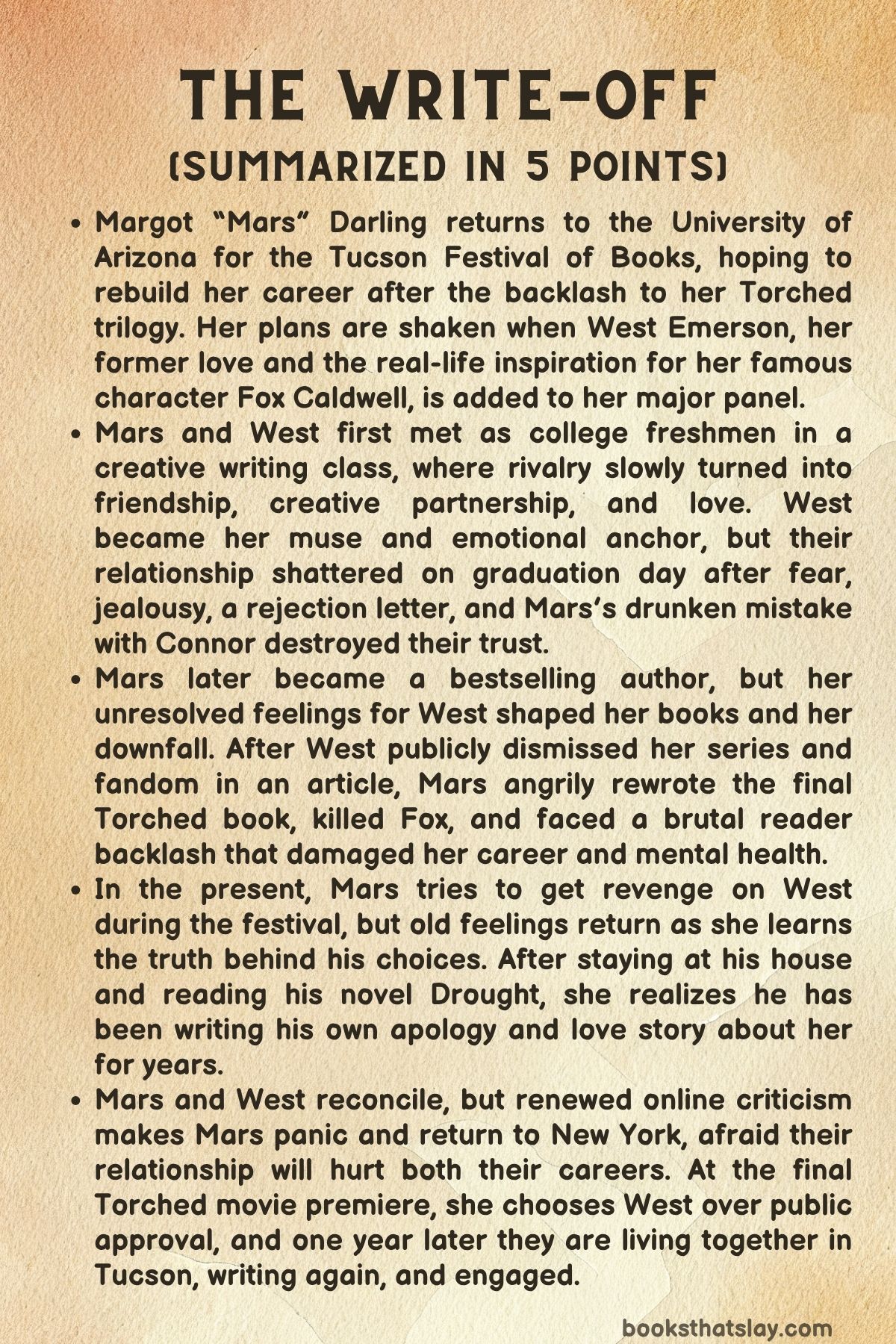
Margot “Mars” Darling returns to the University of Arizona for the Tucson Festival of Books with a mix of hope, dread, and resentment. Years earlier, she was one of the biggest names in fantasy romance because of her bestselling Torched trilogy, but her reputation was badly damaged after the final book enraged fans.
Readers had expected a romantic ending for Fox Caldwell, the fae king they adored, but Mars killed him instead and denied the series the conclusion its fandom wanted. Since then, she has carried the anger of readers, the shame of public backlash, and the fear that she might never fully recover as a writer.
Her new novel, Shattered, is supposed to mark her professional comeback, but the festival also brings her back to the campus where her entire history with West Emerson began.
Mars is already nervous when her publicist tells her that West has been added to her major Sunday panel because another author had to drop out. West is not just another writer.
He is the man who inspired Fox Caldwell, the man Mars once loved, and the man she blames for the humiliation that destroyed her confidence and nearly ended her career. She tries to have him removed from the panel, but the attempt fails.
Instead, she is forced to keep crossing paths with him on the same campus where they once fell in love, and every familiar location pulls her back into the past.
Thirteen years earlier, Mars and West met as freshmen in a creative writing class. Mars arrived with firm ambition and a fierce belief that writing was the one thing she could truly do well.
She wanted to become a published fantasy romance author and took her dreams seriously from the beginning. West, by contrast, seemed casual and unserious at first.
Mars underestimated him until he won their professor Dr. Bachmann’s writing competition, a prize Mars had badly wanted. Losing to West wounded her pride, but it also made him impossible to dismiss.
Their rivalry slowly shifted into friendship as they studied together, joked about class, and began to rely on each other.
West became important to Mars in ways she did not expect. He helped her with math, listened to her ideas, challenged her writing, and noticed details in her work that made her feel seen.
A rare snowfall in Tucson became one of the defining moments of their early bond. West held her in the street, and Mars ran back to her room with new creative energy.
Soon after, they kissed in the library stacks, and Mars understood that West had become more than a crush. He was becoming her muse, her safest reader, and the person whose opinion mattered most.
Through college, Mars kept writing while West became her emotional and creative partner. He gave feedback on her scenes, pushed her to improve, and believed in her talent even when she doubted herself.
Their friendship finally became a romantic relationship in senior year. During that time, Mars wrote the faerie novel that would become Torched, shaping Fox Caldwell with West’s eyes, looks, and mannerisms.
West was all through the character, even if Mars was the one building the fantasy world around him.
On graduation day, Mars’s dreams came true. She signed with an agent, sold Torched at auction, and planned to move to New York with West.
But that same day, West received a harsh rejection letter and spiraled into shame. He was already insecure about his future and felt the pressure of helping his struggling family.
Instead of telling Mars the truth, he told her he could not go to New York. Mars believed he was abandoning her because he was jealous of her success or afraid of her future.
Crushed and angry, she went to a party, got drunk, and slept with Connor.
When Mars returned home, West was waiting in her bed. He had come back ready to apologize and try a long-distance relationship.
Mars confessed what had happened, but West shut down. Her explanation reminded him painfully of his father’s cheating, and he could not move past it in that moment.
He walked out, and Mars left Tucson soon after. Their love ended in misunderstanding, pride, fear, and a betrayal neither of them knew how to repair.
Mars went on to become wildly successful. Torched became a phenomenon, Fox Caldwell became a beloved character, and the books were adapted into films.
Yet success did not free her from West. She remained lonely, creatively blocked, and emotionally tied to the person she had lost.
At Amber’s wedding, she tried to reconnect with him, but West pushed her away and claimed he had moved on. That rejection hurt her deeply, but it also pushed her to finish the sequel.
Later, Mars and West crossed paths again at a writing retreat on Martha’s Vineyard. This time, they softened toward each other.
They reconnected, admitted that old feelings still existed, and nearly found their way back. West promised to call when they returned to New York, but before he could, a New York Times article exposed the real-life connection between West and Fox Caldwell.
Embarrassed by the attention and insecure around literary people he wanted to impress, West dismissed Torched as a teenage love story and called the fandom pathetic. Mars felt humiliated and betrayed.
She blocked him and, in anger, rewrote the final Torched book. Fox died, the romance ended badly, and readers turned on her with brutal force.
The backlash was severe. Mars received vicious reviews and death threats.
Her tour was canceled, and she sank into depression. She believed West had ruined her by making her feel foolish and publicly exposed.
In the present, seeing him again at the festival reawakens all that anger. Mars decides she wants revenge.
She sends him to the wrong location for a signing, arranges for an audience member to ask irritating questions during a panel, and reads from his work in a way meant to provoke him. At first, these schemes give her a sense of control, but the more time she spends near West, the harder it becomes to hold on to her version of events.
West begins revealing truths Mars never fully knew. He admits that he dropped out of college and hid his rejection from her because he felt unworthy of her success.
After a hotel fire forces Mars to stay at his house, she sees the life he has built in Tucson. He is close to his half sister Gabbi, works as a high school English teacher, takes writing seriously, and still keeps reminders of their old relationship.
Mars also reads his new novel, Drought, and realizes that it is about her. West has written his own version of their love story, with a heroine clearly based on Mars and a dedication that acts as an apology.
Their shared memories have been transformed into fiction, just as she once turned him into Fox Caldwell.
A storm and car accident finally force them to be honest with each other. Stranded in the rain, West explains that the article came from insecurity, panic, and fear, not hatred or contempt.
He had felt exposed by the fandom’s attention and was afraid that any relationship with Mars would be consumed by public scrutiny. Drought, he tells her, was his apology written in the only language that made sense to both of them.
Mars starts to understand that West has loved her all along, even when he failed her. They reconcile, complete their festival panel together, spend more time in Tucson, sleep together, go on dates, and begin imagining what a future might look like.
Their happiness is soon tested. Photos of Mars and West together revive the old scandal online.
Readers criticize Mars for being with the man connected to the controversy around Fox. Her publisher worries about Shattered and considers postponing it.
West loses his agent. Mars panics, afraid that their relationship will damage both their careers beyond repair.
West asks her to choose them instead of fear, but Mars returns to New York, convincing herself that she is protecting them both.
In New York, Mars posts a careful public statement and continues her tour. Her events go well, and Shattered begins finding readers, but she feels hollow.
In Los Angeles, before the premiere of the final Torched film, she reads an old letter West wrote years before and hid inside a copy of his first novel. In the letter, he admits he misses her, thinks about her constantly, and imagines finding her again beneath the palm trees in Tucson.
Mars realizes that West has been writing love letters to her for years, in public and private, through novels, dedications, and hidden messages. She calls him.
At the premiere, West appears beside her with Red Vines, keeping an old promise from college. When the audience recognizes him, he tries to publicly apologize for the article, but Mars stops him.
She realizes she no longer wants to live according to the fandom’s anger or the internet’s judgment. West kisses her, and they leave together.
Mars finally tells him she loves him and has loved him for years.
One year later, Mars has moved to Tucson. She and West live together, write side by side, and even work on a playful book together for fun.
Shattered succeeds well enough to earn a sequel, and West finds a new agent. More importantly, Mars learns to separate her worth from her career and from public approval.
At the next Tucson Festival of Books, West brings her back to the bench where they first met and proposes. Mars says yes, choosing the love they lost, rebuilt, and finally allowed themselves to keep.
Characters
Margot “Mars” Darling
Mars is the emotional center of The Write-Off, a writer whose greatest professional success is tied directly to her deepest personal wound. She is ambitious, talented, sharp, and intensely attached to the idea of being seen through her work.
As a college student, writing is not just a dream for her; it is the one place where she feels certain of herself. West’s belief in her gives her creative confidence, but that also makes his later rejection feel unbearable.
When her career takes off, she appears to have everything she wanted, yet the book shows that fame does not cure loneliness, insecurity, or unfinished grief. Mars turns West into Fox Caldwell because he has become part of her imagination, but she also later punishes both West and herself through fiction when she kills Fox in anger.
Her journey is about learning that public approval cannot replace emotional honesty. For years, she lets reader backlash, career pressure, and online judgment control her choices.
Her reconciliation with West requires her to admit that she contributed to their pain too, not only through one mistake in college but through years of defensiveness. By the end, Mars becomes stronger not because the world approves of her again, but because she stops letting strangers define her worth.
West Emerson
West is a complicated romantic lead because he is both Mars’s muse and one of the main causes of her pain. He is charming, intelligent, creative, and more serious than he first appears, but he is also deeply insecure.
In college, he supports Mars with real tenderness, helping her with classes, reading her work, and pushing her to trust her talent. Yet his own fear of failure makes him withdraw at the moment when she most expects him to stand beside her.
His rejection letter, family responsibilities, and sense of inadequacy make him believe he cannot belong in her future. Instead of being honest, he hides, and that silence causes damage that lasts for years.
West’s later mistake in the article shows the same weakness in another form. He wants to protect himself from embarrassment, so he says careless things that humiliate Mars and wound her career.
Still, the book does not reduce him to a villain. His novel Drought reveals that he has been carrying regret and love for years, trying to apologize through the medium that matters most to both of them.
West’s growth lies in finally choosing openness over self-protection. By the end of The Write-Off, he becomes someone willing to apologize publicly, love honestly, and build a life with Mars without hiding from scrutiny.
Gabbi
Gabbi, West’s half sister, gives readers a clearer view of the life West has built after losing Mars. She shows a side of him that Mars does not fully know at first: responsible, loyal, present, and rooted in Tucson.
Through Gabbi, West is not only a former lover or literary rival; he is a brother, a teacher, and a person with family ties that shape his choices. Her presence also helps soften the distance between Mars and West because she reveals the domestic, ordinary, and caring parts of his life.
Gabbi matters because she represents the world West stayed to protect and support, the world Mars once interpreted only as rejection. She gives emotional context to West’s decisions without excusing the harm he caused.
In the story, she also helps Mars see that West did not simply freeze in the past. He has changed, grown, and become accountable to other people.
Gabbi’s role is not as large as Mars’s or West’s, but she is important because she grounds West’s character in family, loyalty, and responsibility.
Amber
Amber functions as part of Mars and West’s shared past, especially through the wedding where Mars tries to reconnect with him. Her wedding becomes a painful turning point because Mars approaches West with hope, only to be rejected again.
Amber’s role is less about her own development and more about marking the passage of time in the lives of the central characters. She represents the world around Mars and West continuing forward while they remain emotionally trapped in what happened between them.
Her wedding setting is important because weddings naturally suggest commitment, reunion, and romantic possibility, but for Mars, the event becomes another reminder of loss. Through Amber, the book shows how old wounds can follow people even into joyful social spaces.
Mars may be surrounded by celebration, but her private focus remains fixed on West and the unfinished feelings between them. Amber helps frame one of the moments when Mars’s longing turns into renewed hurt, which then feeds back into her writing and her emotional choices.
Connor
Connor is significant because he is tied to the mistake that destroys Mars and West’s relationship at the end of college. He is not presented as the true emotional rival to West, but his role is devastating because sleeping with him becomes the act Mars cannot undo.
Mars is drunk, heartbroken, and convinced that West has abandoned her, but the consequences are still severe. Connor’s presence in the story shows how one impulsive decision, made in pain, can reshape years of life.
For West, Mars’s explanation reminds him of his father’s cheating, so Connor becomes connected to an older wound that Mars does not fully understand at the time. In that sense, Connor is less a developed romantic option and more a catalyst for collapse.
He exposes how fragile Mars and West’s relationship already is when honesty fails. The damage does not come only from Mars’s act, but from the timing, the secrecy, and the emotional history West brings into the moment.
Dr. Bachmann
Dr. Bachmann is important as the professor who first places Mars and West in creative competition. His writing contest becomes the spark that shifts Mars’s view of West.
Before West wins, Mars can dismiss him as unserious; after the loss, she must recognize that he has talent and that he can challenge her. Dr. Bachmann therefore helps establish the creative tension that defines Mars and West’s relationship from the beginning.
In a story about writers, mentors and teachers matter because they create spaces where ambition, jealousy, admiration, and vulnerability can surface. His class gives Mars and West a setting where their bond can begin through writing rather than simple attraction.
He also indirectly shapes the future of their romance by making West’s talent visible to Mars. The contest loss hurts her pride, but it also opens the door to friendship, partnership, and love.
Mars’s Publicist
Mars’s publicist represents the business side of authorship and the pressure Mars faces as she tries to rebuild her career. The publicist’s decision to inform Mars that West has been added to the Sunday panel sets much of the present-day conflict in motion.
This character’s role shows that Mars’s life is not only shaped by emotion and creativity but also by scheduling, reputation management, publisher expectations, and public perception. The publicist is part of the machinery around Mars’s comeback, a reminder that writers who become famous often lose full control over their own public lives.
Mars wants to avoid West, but the professional world pushes them together for practical reasons. Through the publicist, the book highlights how difficult it is for Mars to separate her private wounds from her public identity.
Every panel, event, and tour stop becomes emotionally loaded because her career and her heartbreak are so closely connected.
West’s Literary Friends
West’s literary friends are important because they influence the insecurity behind his disastrous comments in the New York Times article. Around them, West feels pressure to appear serious, detached, and above the popular fantasy romance world that made Mars famous.
His desire to impress or protect himself in that environment leads him to dismiss Torched and insult its fandom. These characters do not need to be central individuals to affect the story; they represent a kind of literary snobbery that makes West ashamed of being connected to Mars’s public success.
Through them, the book criticizes the divide between supposedly serious literature and popular genre fiction. West’s failure is not just that he says the wrong thing, but that he allows insecurity and social pressure to override loyalty.
His friends help reveal one of his weaknesses: when he feels small, he sometimes tries to survive by distancing himself from what he actually loves.
The Torched Fandom
The Torched fandom acts almost like a collective character because its love and anger shape Mars’s life so powerfully. At first, the fandom helps make her career.
Readers adore Fox Caldwell, support the series, and turn Torched into a cultural phenomenon. But that same intensity becomes frightening when Mars kills Fox and denies the happy ending readers wanted.
Their backlash includes cruel reviews, public criticism, and death threats, pushing Mars into depression and fear. The fandom shows the double edge of reader devotion.
Love for a story can create community, excitement, and success, but it can also turn possessive when readers feel ownership over characters and endings. Mars’s struggle with the fandom is really a struggle over who gets to control a story once it belongs to the public imagination.
By the end, she does not reject readers entirely, but she stops letting their approval decide whether she is allowed to love West or trust herself.
Fox Caldwell
Fox Caldwell is fictional within the book’s world, yet he is one of the most important figures in the story because he carries the emotional trace of West. Mars builds Fox from West’s appearance, mannerisms, and romantic force, turning private love into a beloved fantasy character.
For readers, Fox is a fae king and romantic hero. For Mars, he is also a record of desire, memory, and heartbreak.
Killing Fox becomes one of Mars’s most destructive acts because it is both a narrative decision and an emotional retaliation. She uses fiction to punish the image of West that once gave her inspiration, but in doing so, she also wounds herself and her readers.
Fox represents the danger of putting real people into art without fully understanding what that transformation will cost. He also shows how fiction can outlive the relationship that created it, becoming public property even when its roots are painfully private.
Themes
Fiction as Love, Revenge, and Apology
Writing in this story is never separate from emotion. Mars turns West into Fox Caldwell because love gives her creative energy, and West later writes Drought as a long apology to Mars because ordinary speech has failed him.
Their books become coded letters, emotional records, and battlegrounds where unresolved feelings are reshaped into characters and plots. This gives the novel much of its power because it treats fiction as something both beautiful and dangerous.
Mars’s imagination helps her build a career, but it also gives her a way to act out rage when she cannot face West directly. Killing Fox is not only a choice about a fictional character; it is Mars trying to hurt the version of West that lives inside her work.
West’s Drought reverses that damage by using fiction to take responsibility. In The Write-Off, stories preserve love long after people stop speaking, but they can also distort pain when writers use them to punish instead of understand.
Public Approval and Private Worth
Mars’s career shows how unstable public love can be. At the height of Torched, readers celebrate her, adore her characters, and help turn her work into a phenomenon.
After the final book, that admiration changes into anger, and Mars’s sense of self collapses with it. Her depression after the backlash reveals how deeply she has tied her worth to reader approval and career success.
The same pattern appears again when photos of her with West cause renewed criticism. Instead of trusting her own feelings, she fears the internet, her publisher, and the possible damage to Shattered.
Her instinct is to manage the public story even if it means sacrificing private happiness. The theme becomes especially clear at the movie premiere, when West tries to apologize publicly and Mars stops him.
She finally understands that no statement, explanation, or performance will satisfy everyone. Her growth comes from accepting that her life cannot be built around pleasing readers, protecting a brand, or avoiding criticism.
She has to decide who she is when applause disappears.
Miscommunication and the Cost of Fear
Mars and West lose years not because they stop loving each other, but because fear keeps replacing honesty. West hides his rejection letter and college struggles because he feels ashamed.
Mars assumes his refusal to go to New York means jealousy or abandonment. After she sleeps with Connor, West cannot explain the full force of his reaction because it is tied to his father’s betrayal.
Later, the New York Times article repeats the same pattern on a public scale. West feels insecure and exposed, so he performs indifference instead of admitting vulnerability.
Mars responds by blocking him and rewriting her book in anger rather than confronting him. Their relationship is repeatedly damaged by what they do not say in time.
The story shows that silence can be as destructive as betrayal when people use it to protect their pride. Their reconciliation requires painful honesty: West must admit his fear and shame, while Mars must admit how much she let hurt guide her choices.
Love survives between them, but only truth allows it to become livable.
Second Chances and Choosing Love Without Certainty
The romance between Mars and West is built on the idea that a second chance is not a return to the past. They cannot become the college students they once were, and they cannot erase the article, the final Torched book, Connor, the years of loneliness, or the public scandal.
What they can do is face the truth with more maturity than they had before. Their reunion at the Tucson Festival of Books forces them to revisit the places where they first met, studied, kissed, and dreamed, but nostalgia alone is not enough to repair them.
They need accountability, forgiveness, and the courage to choose each other while knowing that public criticism may continue. Mars’s decision at the premiere matters because she stops waiting for perfect conditions.
West’s proposal one year later works because their relationship has moved beyond longing into daily partnership. They live together, write together, and build a future that includes both creativity and ordinary commitment.
The theme suggests that happiness is not found by avoiding risk, but by choosing love even when certainty is impossible.