The Wild Card Summary, Characters and Themes
The Wild Card by Piper Rayne is a sports romance centered on Callie Carlisle and Foster Davis, whose secret one-night connection becomes much more complicated when Callie discovers she is pregnant. Foster is a Chicago Colts pitcher, her brother’s teammate, and a man with a reputation that makes trusting him difficult.
The book follows their shift from secrecy and suspicion into co-parenting, attraction, emotional honesty, and family healing. Beneath the pregnancy plot, the story explores fear of abandonment, public pressure, messy family history, and the difficult work of choosing love when past wounds keep getting in the way. It’s the 2nd book of the Dugout series.
Summary
Callie Carlisle begins the story already pregnant, though the baby’s father, Foster Davis, has no idea. The situation is delicate because Foster is not a stranger.
He is a pitcher for the Chicago Colts, a close friend and teammate of Callie’s older brother Hayes, and a man widely known for his playboy image. Callie tells only her best friend Leighton, who is engaged to Hayes, but she refuses to reveal the father’s name until she has told Foster herself.
At a Colts game, Callie watches Foster enter as “The Reaper,” the powerful, intimidating pitcher fans expect him to be. But nearby are Stephie and Millie, two flashy women with tickets Foster arranged, and Callie cannot stop herself from noticing.
She tells herself she is not jealous, but seeing Foster linked with other women hurts more than she wants to admit.
After the game, Foster is angry with himself because, although the Colts won, his own performance disappointed him. Stephie throws herself at him, reinforcing the image Callie already has of him as a man who treats women casually.
The group later goes to Saffire, where Decker, Foster’s estranged twin brother, dances with Callie. Foster reacts with jealousy, revealing that his interest in Callie did not end with their one-night stand.
Callie, however, sees him with Stephie and assumes he views women as replaceable. By the end of the night, she decides she must tell him about the pregnancy and accept the possibility that she may raise the baby alone.
Foster is also facing pressure in his professional life. His agent, Jagger, tells him that his baseball career may be nearing its final stretch and that he needs endorsement opportunities to secure his future.
Callie, meanwhile, is focused on her podcast, If I’m Honest. During an interview with Amelia, a mother who initially gives safe, polished answers, Callie manages to create space for real honesty.
Amelia admits that she reinvented herself after a painful childhood, and the interview reminds Callie why her work matters. Soon after, Callie’s agent Jarrah tells her that a major streaming platform is interested in the podcast, but the platform wants her to interview five celebrities first.
Callie worries about relying on Hayes or using his connections.
Callie plans to tell Foster about the baby by leaving a onesie, baby booties, pregnancy tests, and confetti on his bed at The Dugout, the condo building where several Colts players live. The plan collapses when Foster comes home early with Stephie.
Callie scrambles to hide the evidence, but Foster discovers everything. He is stunned, then hurt when he realizes Callie assumed he would reject the baby.
Instead, he tells her clearly that he wants to be involved and that the child will come first. They order food, talk through the situation, and agree to start again as future co-parents.
At the first doctor’s appointment, Foster is nervous, protective, and overwhelmed. The ultrasound confirms that the pregnancy is healthy, and seeing the baby’s heartbeat changes something in him.
The reality of fatherhood hits him with force. Afterward, he takes Callie home, only for them to discover her landlord Jerry inside her apartment wearing her lingerie.
Foster nearly loses control, but Callie keeps him from going too far. He insists she cannot stay there anymore and asks her to move into his condo.
Callie resists, not wanting to depend on him, so Foster offers to help her secure celebrity guests for her podcast. They set rules for living together: no other sexual partners in the condo, no excessive protectiveness, and clear boundaries between them.
Once Callie moves in, their relationship begins to shift. Foster cooks, helps around the apartment, and follows through on arranging podcast guests, including Maren Hale and later tattoo celebrities Jax and Frankie.
Callie begins to see a side of Foster that does not match his public reputation. He is loyal, thoughtful, awkward in his care, and deeply affected by old pain.
Foster sees Callie as brave, honest, and committed to building a meaningful career on her own terms. Through a truth-telling game called “one for one,” they learn more about each other.
Foster reveals that when he and Decker were children, their parents split them up. Foster lived with his father, who pushed baseball above all else, while Decker stayed with their mother.
Foster believes his mother abandoned him, and that belief shaped his anger, guardedness, and fear of being unwanted.
The pregnancy becomes public before Callie and Foster are ready. A photo of them at the OBGYN leaks online, and during a press conference, a reporter asks Hayes if Callie is pregnant with Foster’s baby.
Hayes storms out, furious that he found out in such a humiliating public way. Foster and Callie later tell her parents, who react with warmth and welcome Foster as part of the family.
At Peeper’s, Easton, Decker, and Leighton support them, while Hayes struggles mostly with the fact that they kept the truth from him. Foster speaks to Hayes privately, apologizes, and admits he was afraid of losing one of his closest friends.
Hayes forgives him but warns him not to hurt Callie.
With the secret out, Foster and Callie’s attraction becomes harder to resist. Their physical relationship resumes under the excuse of “lessons,” but the emotional connection behind it quickly becomes clear.
They grow closer through daily life: doctor visits, podcast work, grocery shopping, baby shopping, and quiet moments at home. Foster’s pitching improves as his life becomes steadier, and Callie becomes the anchor he did not know he needed.
When they learn the baby is a girl, Foster is scared but happy. Callie reassures him that he will be a good father.
At the same time, Foster begins repairing other relationships. He grows closer to Decker and slowly opens himself to the idea of speaking with his mother, Angela.
Their progress breaks when Callie tells Foster she loves him after a tender night together. Foster panics.
Rather than accept the love she offers, he shuts down and leaves, convinced that he cannot give her what she deserves. Hurt and unwilling to remain in that emotional uncertainty, Callie moves out and stays with Hayes and Leighton.
Foster’s life starts to unravel. He is suspended after an emotional outburst and loses an endorsement opportunity.
Hayes and Leighton confront him, telling him that he has to stop destroying his own happiness. Foster finally speaks with Angela, who admits she failed him, chose the easier path, and did not fight hard enough to stay in his life.
Her honesty helps him understand how much his old pain has controlled his choices.
Foster apologizes to Callie during a podcast setup arranged by Lex as a surprise. He speaks openly about his childhood, his father’s emotional abuse, and his fear of love.
He tells Callie he loves her. Then he reveals an even larger secret: his father, Jason, had been betting on games, bookies had threatened Foster, and Foster had paid debts to keep the scandal from destroying his career.
Callie accepts the truth and stays with him. Later, the scandal becomes public during a Seattle game, with headlines falsely suggesting Foster bet against himself.
Foster denies the accusations, the Colts and players’ association begin reviewing the matter, and his team, friends, Callie, Decker, and Angela stand beside him.
Outside the Seattle stadium, Jason confronts Foster, insults Callie, and tries to manipulate him for more money. Foster finally cuts him off.
When Jason suggests the baby might not be Foster’s, Decker punches him, showing how far the brothers have come in rebuilding their bond. Foster sees Angela beside him and allows himself to believe some healing may still be possible.
In the epilogue, the Colts lose game seven, but Callie goes into labor at the stadium. Everyone rushes to the hospital and waits through the long delivery.
Foster finally announces that Ellis Riley Davis has been born. Callie and Foster welcome their daughter surrounded by family, friends, and the team they have created around themselves.
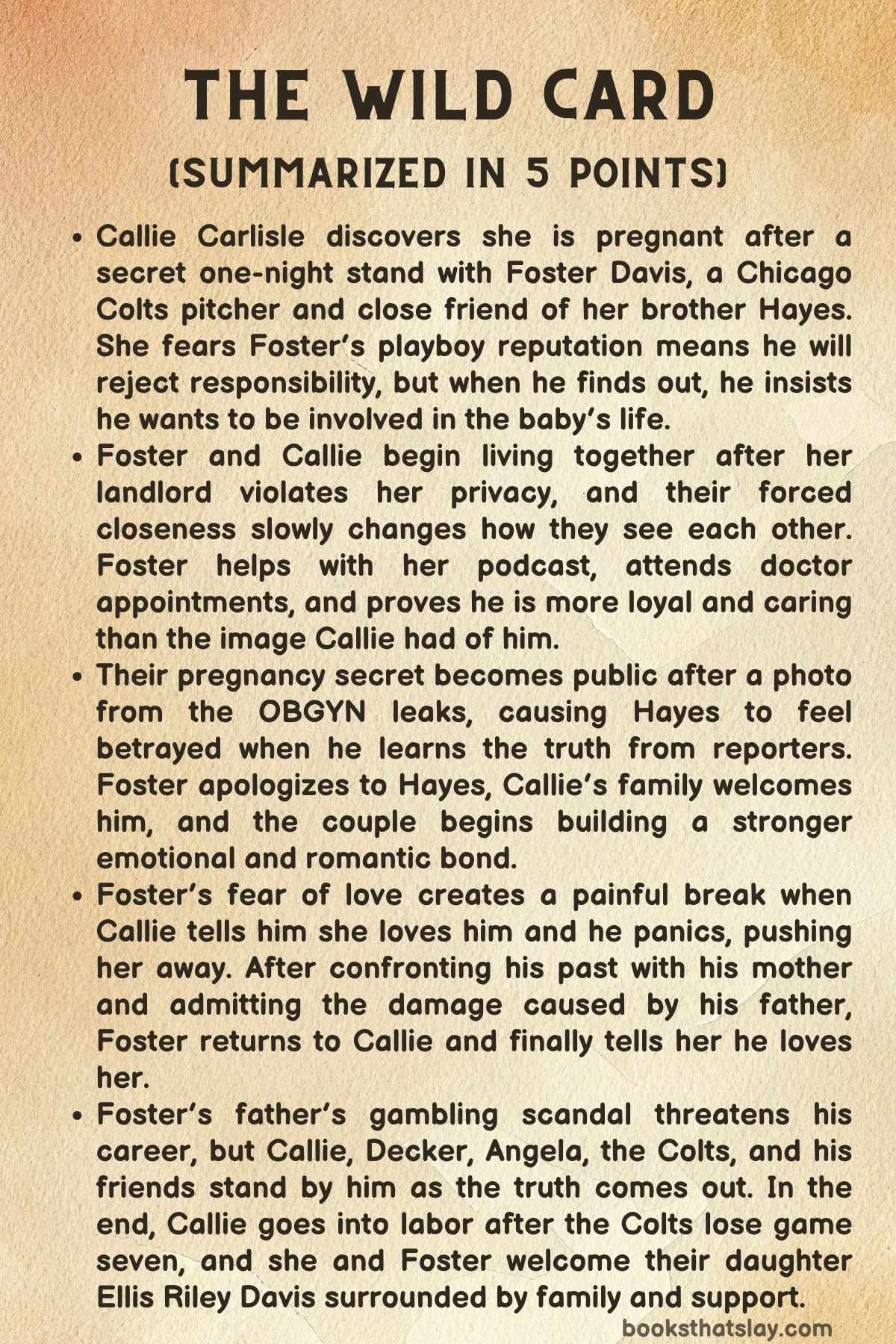
Characters
Callie Carlisle
Callie Carlisle is the emotional center of the book, and her pregnancy forces her to confront trust, independence, and vulnerability all at once. She begins as someone determined to protect herself and her baby, partly because Foster’s reputation makes her believe he may not be reliable.
Her hesitation to tell him about the pregnancy is not simple dishonesty; it comes from fear, pride, and a need to prepare herself for rejection before it can hurt her. Callie is also ambitious and committed to her podcast, If I’m Honest, which reflects her desire to create meaningful conversations rather than shallow content.
As the story moves forward, she learns that protecting herself does not mean shutting Foster out. Her strength lies not only in her independence but also in her ability to soften when someone proves worthy of trust.
Foster Davis
Foster Davis is one of the most emotionally guarded characters in The Wild Card, shaped by a childhood that taught him love could be withdrawn without warning. His image as a charming, careless athlete hides a man who feels abandoned by his mother, controlled by his father, and uncertain of his own worth outside baseball.
When he learns Callie is pregnant, his reaction immediately challenges her assumptions: he wants to be present, involved, and responsible. Foster’s journey is built around learning that fatherhood, love, and family do not have to repeat the damage of his past.
His fear causes him to hurt Callie when she confesses her love, but his eventual honesty shows real growth. By facing his father, reconciling with his mother, and choosing Callie openly, he becomes more than the reputation surrounding him.
Hayes Carlisle
Hayes Carlisle plays an important role as Callie’s protective older brother and Foster’s close friend. His anger after the pregnancy becomes public is understandable because he feels blindsided by two people he loves and trusts.
Hayes is not simply angry because Foster got Callie pregnant; he is hurt because the secrecy makes him feel excluded from a major truth in his sister’s life. His protectiveness can be intense, but it comes from loyalty rather than control.
Once Foster speaks honestly to him, Hayes shows maturity by forgiving him while still warning him to treat Callie carefully. He represents the kind of family bond that can be strained by secrets but strengthened by direct honesty.
Leighton
Leighton is Callie’s best friend and Hayes’s fiancée, making her a bridge between Callie’s private fear and the larger family circle. She is one of the first people Callie trusts with the pregnancy, and her presence gives Callie emotional support before Foster knows the truth.
Leighton does not pressure Callie to reveal more than she is ready to reveal, which shows her sensitivity and loyalty. Later, she also helps confront Foster when he pushes Callie away, proving that her support is not passive.
She cares about Callie enough to defend her, but she also understands that Foster must face his own emotional damage if he wants a future with her.
Decker Davis
Decker Davis begins as Foster’s estranged twin brother, but his role grows as the story reveals the painful family split that shaped both men. While Foster lived with their father, Decker stayed with their mother, creating years of resentment and misunderstanding between them.
Decker’s early interaction with Callie at Saffire also triggers Foster’s jealousy, but the deeper importance of his character lies in the family history he carries. As the brothers reconnect, Decker becomes proof that old fractures do not have to remain permanent.
His punch after Jason questions the baby’s paternity is more than a dramatic reaction; it shows that he has chosen Foster, Callie, and the baby as family worth defending.
Angela Davis
Angela Davis is Foster and Decker’s mother, and her presence in the book forces Foster to reconsider the story he has told himself since childhood. For much of his life, Foster believes Angela abandoned him, and that belief becomes one of the roots of his fear of love.
When Angela admits she failed him and did not fight hard enough to stay connected, she does not excuse herself. Her honesty matters because it gives Foster a truth he can finally work with instead of a wound built only on assumptions.
Angela’s character adds complexity to the family conflict because she is neither fully innocent nor cruel. She is flawed, regretful, and important to Foster’s healing.
Jason Davis
Jason Davis is the destructive force behind much of Foster’s pain. As Foster’s father, he pushed baseball above everything and treated his son’s career as something to control rather than support.
His gambling scandal adds a serious threat to Foster’s professional life, but his emotional damage is even more lasting. Jason manipulates, insults, and demands, showing little concern for Foster as a son or future father.
His confrontation outside the Seattle stadium exposes the full ugliness of his character, especially when he insults Callie and questions the baby’s paternity. In The Wild Card, Jason represents the kind of parent Foster is determined not to become.
Callie’s Parents
Callie’s parents bring warmth and stability into the story at a moment when Callie and Foster expect judgment. Their reaction to the pregnancy is surprisingly happy and welcoming, which helps Foster see what healthy family acceptance can look like.
They do not treat the situation as a scandal or a mistake that defines Callie. Instead, they welcome Foster and focus on the baby as a new part of the family.
Their response contrasts strongly with Jason’s manipulation and Angela’s past absence. Through them, the novel shows how family can create safety rather than fear.
Jagger
Jagger, Foster’s agent, represents the professional pressure surrounding Foster’s baseball career. His warning that Foster’s career may be nearing its final stretch adds urgency to Foster’s need for endorsements and stability.
Jagger’s role is practical, but it also highlights how much Foster has to lose when the gambling scandal comes to light. For Foster, baseball has never been only a job; it has been tied to his father’s control, his identity, and his public value.
Jagger’s presence keeps that pressure visible and reminds readers that Foster’s personal choices are unfolding under public and professional scrutiny.
Jarrah
Jarrah, Callie’s agent, helps move Callie’s career forward by bringing news of interest from a major streaming platform. Her requirement that Callie secure celebrity interviews creates both opportunity and anxiety.
Callie wants success, but she does not want to feel as if she earned it only through Hayes’s fame or Foster’s connections. Jarrah’s role brings out Callie’s professional pride and her desire to be respected for her own work.
Through Jarrah, the story gives Callie a life beyond pregnancy and romance, showing that her ambitions remain central to who she is.
Stephie and Millie
Stephie and Millie function as reminders of Foster’s public reputation and Callie’s fears about him. Stephie, especially, reinforces Callie’s belief that Foster treats women casually and may not be emotionally reliable.
Their presence near Callie at the game and later around Foster at Saffire stings because Callie is carrying a private truth that makes Foster’s behavior feel more personal. Although they are not deeply developed characters, they serve an important purpose in the story.
They embody the image Foster must move beyond if he wants Callie to believe he can be a committed partner and father.
Jerry
Jerry, Callie’s landlord, is a disturbing minor character whose actions create a turning point in Callie and Foster’s living arrangement. When Foster and Callie find him inside her apartment wearing her lingerie, the violation confirms that Callie is not safe in her home.
Jerry’s behavior is invasive and unsettling, and it gives Foster a chance to show protectiveness that is not empty posturing. Callie still insists on maintaining control and boundaries, but Jerry’s actions make it clear that moving into Foster’s condo is not only convenient but necessary.
His role pushes Callie and Foster into closer daily contact, which becomes essential to their growing bond.
Ellis Riley Davis
Ellis Riley Davis is born at the end of the story, but her presence shapes nearly every major choice before she arrives. Even before her birth, she forces Foster and Callie to confront who they are, what they fear, and what kind of family they want to build.
For Callie, Ellis represents responsibility, love, and the courage to ask for support. For Foster, she represents a chance to break the cycle created by his own father.
Her birth after the Colts’ game seven loss shifts the ending away from sports victory and toward family. Ellis becomes the clearest sign that Foster and Callie’s real win is the life they choose together.
Themes
Choosing Responsibility Over Reputation
Foster’s public image makes it easy for Callie to assume he will avoid responsibility, and the early conflict depends on that gap between reputation and reality. He is known as a talented pitcher with a playboy lifestyle, surrounded by women and professional pressure, so Callie prepares herself for disappointment before giving him a chance.
Yet his response to the pregnancy immediately complicates that image. Foster does not run from the baby.
He wants appointments, involvement, safety, and a real place in the child’s life. This theme develops through daily action rather than grand declarations.
He cooks, helps Callie move, supports her podcast, attends appointments, and begins imagining himself as a father. Callie also has to move beyond the version of Foster she thinks she knows.
Responsibility in The Wild Card is not treated as one dramatic promise but as repeated choices made under stress, fear, and public attention. Foster becomes trustworthy because he keeps showing up, even when he is scared.
Love Shaped by Fear of Abandonment
Foster’s fear of love comes from a childhood defined by separation and emotional neglect. Being split from Decker and raised by a father who valued baseball above emotional care left him with the belief that love is unstable and conditional.
His mother’s absence becomes the wound he uses to explain his own guardedness, even before he understands the full complexity of what happened. This is why Callie’s confession of love frightens him so deeply.
The moment should bring them closer, but it activates his fear that he will fail her or be left behind. His reaction hurts Callie because he turns away just when she becomes most vulnerable.
The story treats this fear as understandable but not excusable. Foster has to face Angela, hear her regrets, and recognize how much his past has controlled his present.
Love becomes possible only when he stops using old pain as protection and starts speaking honestly about what he needs, fears, and wants.
Family as Both Wound and Shelter
Family in the story has two opposing faces: it can damage a person deeply, but it can also become the place where healing begins. Foster’s family history is marked by separation, resentment, and manipulation.
Jason uses his son’s career for his own gain, while Angela’s earlier failure to fight for Foster leaves him feeling unwanted. Decker’s estrangement adds another layer of loss, because Foster is not only separated from a parent but also from the twin who should have shared his life most closely.
Against that damaged family structure stands Callie’s family, which is protective, warm, and capable of forgiveness. Hayes is angry when he learns the truth publicly, but his anger comes from love and hurt rather than selfishness.
Callie’s parents welcome Foster instead of shaming him. The contrast shows that family is not defined only by blood or history.
It is built through accountability, protection, apology, and the willingness to stay present when things become difficult.
Honesty as the Basis of Intimacy
Callie’s podcast, If I’m Honest, reflects one of the story’s central ideas: real connection requires truth that is often uncomfortable to say aloud. Callie’s work depends on helping people move past polished answers, and that same need for honesty shapes her relationship with Foster.
Their “one for one” game allows them to reveal pieces of themselves gradually, turning attraction into emotional intimacy. But the story also shows what happens when truth is delayed.
The pregnancy secret hurts Hayes when it becomes public, and Foster’s hidden connection to his father’s gambling debts threatens his career and relationship. Silence may seem protective in the moment, but it creates larger damage later.
The most important turning points happen when characters finally speak plainly: Foster apologizes to Hayes, Angela admits her failures, and Foster tells Callie about his childhood and the scandal. Honesty does not erase consequences, but it gives the characters a real chance to choose each other with full knowledge of the truth.