The Wicked Sea Summary, Characters and Themes
The Wicked Sea by Jordan Stephanie Gray is a dark fantasy romance built around sirens, merrow history, death magic, old gods, betrayal, and a dangerous quest beneath the sea. The story follows Zephyra, a merrow thief marked by grief, guilt, and captivity, after she becomes bound to Arion Stone, a dying warlock who needs the lost Heart of Mortem to survive.
Their uneasy alliance grows into trust and desire while enemies from the human world, the sea, and the realm of death close in around them. The book mixes revenge, divine reincarnation, doomed bargains, and underwater myth into a story of survival and sacrifice.
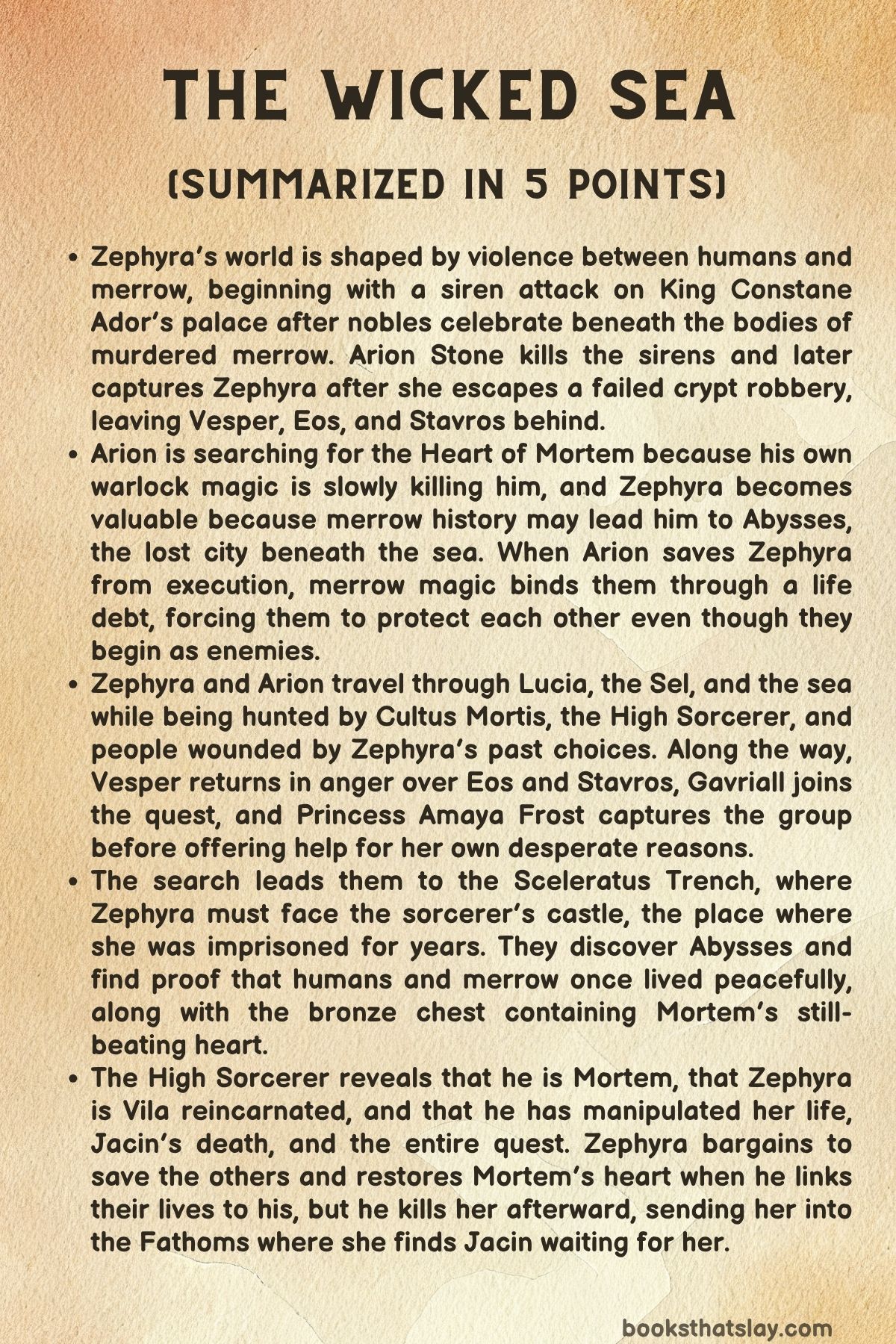
Summary
The story begins in King Constane Ador’s palace garden after a brutal celebration in Mortia. Human nobles have gathered beneath the displayed bodies of slaughtered merrow, turning death into spectacle.
Aurelia of the Sel enters the palace grounds with her sisters, Argonia and Phylla, seeking revenge for the crimes committed against their people. The sirens attack with lethal force, killing guards and storming the masquerade where the nobility is gathered.
Their voices become weapons, compelling humans to bleed, injure themselves, and die. Aurelia comes close to making King Constane stab himself, but the massacre is stopped by Warlock Arion Stone, who is immune to siren song.
Arion kills Phylla, Argonia, and Aurelia, and Constane orders their corpses to be displayed with the others.
Days later, Zephyra joins Vesper, Eos, and Stavros in a dangerous robbery beneath the Temple of Mortem. They plan to steal valuables from recently buried noble corpses, but the job begins poorly when Zephyra admits she failed to get the key she claimed to have.
Eos squeezes through a narrow vent and opens a hidden stairway, allowing the group to descend into the crypt. Inside, they find the new tomb, but they are not alone.
A masked, wraith-like creature is feeding on the dead. Stavros uses gunpowder to damage the chamber and force the creature away, but the explosion injures Vesper and alerts the guards above.
As the guards come down, panic takes over. Vesper tries to fight despite her injuries, but Zephyra shoves her aside, worsening her condition, then runs ahead.
She attacks the guards and escapes alone with stolen jewels, leaving the others behind. Her betrayal will follow her long after she reaches the surface.
Zephyra flees into Crestfall and tries to bargain with Magnus, leader of the Leones gang, for a carriage and a way out of Mortia. She intimidates him by pretending to be one of the sirens responsible for the palace massacre, but her plan is interrupted when Arion finds her.
Zephyra tries to manipulate Arion into facing her without magic. For a moment, she succeeds and pins him with a dagger at his throat, but Arion overpowers her with magical cords and takes her to Tower Arcana.
While she is imprisoned, Arion studies old texts about the Heart of Mortem. His own warlock magic is destroying him, causing fatal decay, and he believes the Heart may be the only thing that can save him.
With help from the historian Gavriall, Arion finds evidence that Mortem’s heart may be hidden in Abysses, a lost utopia beneath the sea. Zephyra confirms that merrow know Abysses was real, making her valuable to Arion.
King Constane and Elder Branche prepare Zephyra’s public execution. Stavros, who has also been captured, is forced to testify against her, then killed for helping a merrow.
Arion realizes that if Zephyra dies, his chance of finding Abysses may die with her. At the execution, he cuts her noose, blasts the crowd aside, and carries her away.
Zephyra does not trust him and tries to escape by diving into the sea, nearly drowning him. But because Arion saved her life, merrow magic creates a life debt between them.
A silver cord connects their hearts, and when Arion is hurt, Zephyra bleeds too. Until she repays the debt, she cannot allow him to die.
Their bond becomes even more dangerous when the High Sorcerer of the Four Seas senses Zephyra’s magic. Attacks from the sea force Arion to protect her, and he flies them to a ruined shore-palace.
Zephyra admits she does not know Abysses’ location, but she suggests that the Illuminated Library in Lucia may contain records. She also tells Arion the merrow version of history: Abysses was created by Vila, goddess of life, love, and the sea, and Mortem destroyed it after Vila rejected him and opposed his power.
Zephyra and Arion travel to Lucia and disguise themselves with help from shopkeepers Gerald and Harold. They break into the library, a place tied to Zephyra’s memories of Jacin, the boy she once loved.
The mission turns deadly when dryads attack, followed by Cultus Mortis, a death cult serving Mortem. The Death Lord reveals that the cult knows Arion is searching for the Heart.
Zephyra and Arion escape into the sea, and Gavriall, who has followed Arion, joins them after Zephyra gives him gills so he can survive underwater.
In the Sel, Arion tells Zephyra the full truth: his magic is killing him, and because of their life debt, she will die if he dies before the debt is settled. Zephyra begins to trust him, but Vesper finds her and attacks.
Vesper is furious because Eos and Stavros died after Zephyra abandoned them in the crypt. During their fight, a giant squid seizes both Zephyra and Vesper.
Arion helps save them, but the group is then captured by a Tempest skyship and taken aboard Princess Amaya Frost’s vessel. Amaya, a treasure-hunting daughter of Tempestas, offers to help find the Heart because she wants treasure and a way to save Tempest.
Vesper and Zephyra agree to cooperate temporarily, though Vesper still intends to hand Zephyra over to the sorcerer in exchange for Eos. Amaya reveals that an explorer named Vasiliev may have found signs of Abysses in the Sceleratus Trench.
This terrifies Zephyra because the trench is where the High Sorcerer’s castle stands. She was imprisoned there for eight years, and returning means facing the worst part of her past.
To stop the sorcerer from tracking her, Vesper tells Zephyra to bleed into all four seas. Arion supports Zephyra through the ordeal, and their bond becomes romantic.
They sleep together and briefly imagine a future, even though both know the journey may end in death.
The group reaches the Sceleratus Trench and enters the sorcerer’s castle. The corridors shift, traps divide them, and several of Amaya’s crew are killed.
Zephyra’s blood opens a hidden door, but a flood carries them out of the castle and into the lost city of Abysses. The city is still beautiful and intact.
Inside a temple, they find murals proving that humans and merrow once lived together in peace. Beneath a statue lies a bronze chest containing Mortem’s beating heart.
Before Arion can take it, Cultus Mortis arrives after killing Amaya’s crew. Amaya’s secret is exposed: she made a deal with the cult to save Tempest.
But when the cult betrays her and murders her people, she turns against them. Zephyra destroys the Death Lord with seawater, and the remaining cultists flee.
The victory does not last. The High Sorcerer appears and reveals that he is Mortem himself, cursed to the sea after Vila cut out his heart.
Mortem explains that he has been manipulating everyone, including Amaya, Gavriall, Vesper, and Zephyra. He also reveals the truth about Jacin.
Years earlier, Jacin saved Zephyra and died, and Mortem offered to bring him back if Zephyra belonged to him. Jacin became Mortem’s prisoner as well.
Later, Mortem forced Zephyra to cut out Jacin’s heart in exchange for a chance to escape. Mortem then reveals the deepest truth: Zephyra is Vila reincarnated, reborn again and again through time, always found and tormented by him.
Mortem demands that Zephyra open the chest and return his heart. Zephyra bargains for the people around her.
She asks for Eos’s life, Vesper’s safety, help for Amaya’s people, Gavriall’s freedom, and Arion’s restored life. Mortem grants these terms, and Eos is brought back.
Zephyra opens the chest, confirming that she truly is Vila reborn. She tries to destroy Mortem’s heart, but he has linked the others’ lives to his own, so they begin dying with him.
To save them, Zephyra places the heart back in Mortem’s chest.
Mortem becomes whole again. Arion is healed and made stronger, and the others are freed.
Then Mortem claims the price of the bargain. He snaps Zephyra’s neck and kills her.
In the Fathoms, Zephyra awakens with broken memories and is forced into a dark castle. There, she finds Jacin waiting on a throne.
He welcomes her home, and Zephyra realizes in horror that he is still alive in death.
Characters
Zephyra
Zephyra is the central force of the book, a merrow thief whose sharp instincts are shaped by trauma, guilt, and a long history of being hunted. She begins as someone willing to betray others to survive, most clearly when she abandons Vesper, Eos, and Stavros after the failed crypt robbery.
Yet her selfishness is not simple cruelty; it comes from years of captivity under the High Sorcerer and from the unbearable loss of Jacin. Her choices often carry the weight of fear, and she is constantly trying to stay ahead of people who want to use, punish, or possess her.
In The Wicked Sea, her journey moves from desperate self-preservation toward painful responsibility. The life debt with Arion forces her into closeness with someone she mistrusts, but it also gives her a chance to choose connection again.
Her identity as Vila reborn deepens her tragedy because her suffering is revealed to be part of a cycle older than her current life. Zephyra’s final bargain shows her growth most clearly: instead of saving herself, she fights for Eos, Vesper, Amaya’s people, Gavriall, and Arion, even though Mortem still takes her life.
Arion Stone
Arion Stone is a warlock whose power makes him feared, useful, and doomed. At the beginning, he appears as an agent of Mortia’s authority, immune to siren song and capable of killing Aurelia and her sisters when they attack the palace.
His status as King Constane’s weapon makes him seem cold and dangerous, but his private motive is more desperate than loyal. His magic is killing him, and his search for the Heart of Mortem comes from the need to survive his own decay.
Arion’s relationship with Zephyra changes him because she is not simply a tool he can use; she becomes tied to his life, his guilt, and eventually his hope. He protects her repeatedly, sometimes because the debt demands it, but increasingly because he cares for her.
His attraction to Zephyra grows alongside his respect for her resilience. By the time Mortem restores and strengthens him, Arion has already become far more than a dying warlock chasing salvation.
He is a man who has allowed himself to want a future, only to watch that future destroyed when Zephyra is taken from him.
Vesper
Vesper is one of the most emotionally charged figures in the novel because her anger toward Zephyra is completely tied to grief. She is injured during the crypt robbery and then abandoned when Zephyra chooses escape over loyalty.
The deaths of Eos and Stavros turn that betrayal into something unforgivable in her eyes. When she later finds Zephyra, her attack is not only revenge; it is an expression of loss, rage, and the need to make someone pay for what happened.
Vesper is not presented as a simple enemy, because her pain has clear roots. She loved the people Zephyra left behind, and her willingness to hand Zephyra over to the sorcerer in exchange for Eos shows how far grief has pushed her.
Yet Vesper is also practical and capable. She helps Zephyra avoid the sorcerer’s tracking by telling her to bleed into all four seas, and she works with her when survival demands it.
Her arc depends on tension between vengeance and loyalty, showing how betrayal can harden a person without completely erasing their ability to act with courage.
Eos
Eos has a smaller but important role because her fate becomes one of the emotional stakes that drives the later bargain with Mortem. During the robbery beneath the Temple of Mortem, she proves her usefulness and courage by squeezing through the narrow vent to open the secret stairway when Zephyra fails to obtain the key.
Her action allows the group to enter the crypt, but the mission turns disastrous, and she becomes one of the people lost because of Zephyra’s abandonment. Eos’s death deepens Vesper’s hatred and becomes a constant reminder of the cost of Zephyra’s survival instincts.
When Mortem later uses Eos as part of the bargain, her return shows how easily death can become a tool in the hands of a god. Eos is not simply restored as an act of mercy; her life is used to pressure Zephyra into returning Mortem’s heart.
Through Eos, the story shows how innocent or loyal companions can become bargaining pieces in conflicts driven by divine cruelty and old revenge.
Stavros
Stavros represents the human cost of being connected to Zephyra and the merrow world. In the crypt, he is capable and bold, using gunpowder to drive away the corpse-feeding creature and save the group from immediate death.
His action gives the others a chance to live, but it also draws the guards and makes escape almost impossible. After his capture, he is forced to testify against Zephyra in public, turning him into part of the spectacle of her punishment.
His execution for aiding a merrow shows the brutality of Mortia’s regime and the hatred built into its laws. Stavros’s death also exposes the hypocrisy of power: he is useful as a witness until the crown decides he must be punished too.
Though he does not remain in the story for long, his fate leaves a mark on Zephyra’s journey. He is one of the people sacrificed by the violence surrounding her, and his death helps make Vesper’s anger understandable.
Arion’s Historian Gavriall
Gavriall is important because he connects research, history, and moral vulnerability. He helps Arion search old texts for the Heart of Mortem, guiding him toward the possibility that Abysses was real and that Mortem’s heart may lie beneath the sea.
At first, he seems to belong to the world of books and records rather than danger, but his decision to follow Arion pulls him into the quest directly. Zephyra gives him gills, allowing him to survive underwater, and he becomes part of the group traveling through increasingly dangerous territory.
Gavriall’s presence matters because the truth of the world is hidden in damaged history, competing myths, and stories shaped by human and merrow conflict. He is drawn into Mortem’s manipulation like the others, proving that knowledge alone is not enough protection against divine schemes.
His bargain for freedom at the end shows that Zephyra values him not only as a scholar, but as a person who has also been trapped by forces larger than himself.
Princess Amaya Frost
Princess Amaya Frost is ambitious, secretive, and driven by a fierce need to save Tempest. As a treasure-hunting daughter of Tempestas, she first appears as someone motivated by gain and adventure, capturing Zephyra, Arion, Vesper, and Gavriall aboard her skyship.
Her offer to help find the Heart is not purely generous; she wants treasure and a solution for her endangered home. Amaya’s flaws become sharper when it is revealed that she made a deal with Cultus Mortis.
That betrayal places her in a morally compromised position, but the book does not reduce her to a villain. When the cult kills her people and reveals the emptiness of its promises, Amaya turns against them.
Her shift is driven by loyalty to her crew and horror at the cost of her choices. In The Wicked Sea, Amaya’s role shows how desperation can make people bargain with evil, especially when they believe they are acting for their own nation or people.
Her grief over her crew gives her ambition a painful human edge.
Mortem / The High Sorcerer
Mortem is the main source of cruelty behind the novel’s larger conflict. For much of the story, he is known as the High Sorcerer of the Four Seas, the figure who once imprisoned Zephyra for eight years and continues to sense her through her magic.
His final revelation reframes the entire story. He is not merely a sorcerer but Mortem himself, cursed to the sea after Vila cut out his heart.
His obsession with Vila has lasted across lifetimes, and his treatment of Zephyra reveals a possessive love twisted into punishment, control, and endless torment. He manipulates Amaya, Gavriall, Vesper, and Zephyra, using each person’s desire or grief to move them toward his goal.
His cruelty toward Jacin and Zephyra is especially personal. By forcing Zephyra to cut out Jacin’s heart and later using Jacin’s existence in death against her, Mortem turns love into imprisonment.
His restored heart does not make him whole in a moral sense; it only returns his power and allows him to claim Zephyra again.
Jacin
Jacin is the lost love at the center of Zephyra’s deepest wound. Before the full truth is revealed, he exists largely through memory: the boy Zephyra loved, the person tied to her past visits to Lucia, and the death that changed her life.
His story becomes far darker when Mortem reveals that Jacin saved Zephyra, died, and was brought back as part of a bargain that trapped them both. Jacin’s resurrection is not a gift but another form of captivity.
Mortem uses him to bind Zephyra emotionally, and the revelation that Zephyra was forced to cut out Jacin’s heart adds horror to her trauma. At the end, Jacin’s presence in the Fathoms turns the ending into a nightmare rather than a reunion.
He waits on a throne and welcomes Zephyra home, showing that death has not released either of them. His survival in that realm suggests that love, memory, and captivity remain tangled in Zephyra’s fate, even after her mortal life ends.
King Constane Ador
King Constane Ador represents the violence and arrogance of Mortia’s human rule. His palace celebration beneath slaughtered merrow bodies shows a regime that has turned domination into public entertainment.
When Aurelia and her sisters attack, they are responding to a world that has already treated their people as trophies. Constane’s survival depends on Arion, and his response to the sirens’ deaths is not reflection or mercy but further display, ordering their bodies to be strung up with the rest.
Later, he helps prepare Zephyra’s public execution, using punishment as political theatre. Constane’s power is built on fear, spectacle, and the dehumanization of merrow.
He does not need extensive private development to be significant; his actions define the human system Zephyra is trying to escape. Through him, the story shows how rulers use cruelty to maintain control and how public violence can become normalized when a society treats certain lives as lesser.
Aurelia, Argonia, and Phylla
Aurelia, Argonia, and Phylla appear briefly, but their opening attack shapes the entire atmosphere of the story. As sirens of the Sel, they enter King Constane’s palace not as random killers but as avengers responding to the slaughter and display of merrow bodies.
Their song is terrifying, forcing humans to harm themselves and die, yet their violence mirrors the brutality already committed against their own people. Aurelia nearly succeeds in making Constane kill himself, which would have turned the palace massacre into an act of direct retribution against the king.
Their deaths at Arion’s hands establish his power and his early alignment with Mortia’s ruling order. The decision to hang their bodies with the other merrow adds another layer of insult and horror.
These sisters embody the rage of an oppressed people, but they also show how revenge can become indiscriminate once grief and hatred take command.
Elder Branche
Elder Branche serves as part of the political and religious structure that condemns Zephyra. His involvement in preparing her execution places him beside King Constane as one of the figures who helps turn punishment into public ceremony.
He represents institutional cruelty rather than personal rage. Through him, the story suggests that Zephyra’s danger does not come only from kings, gangs, cults, or gods, but also from officials who preserve violent systems through procedure and authority.
Elder Branche’s role is important because executions, testimonies, and public judgments need administrators as much as rulers. He helps create the conditions in which Stavros can be used and killed, and Zephyra can be displayed as a warning.
His presence reinforces the idea that Mortia’s hatred of merrow is organized, lawful, and socially accepted.
Magnus
Magnus, the leader of the Leones gang, belongs to the criminal world of Crestfall and shows the kind of danger Zephyra navigates outside royal authority. After escaping the crypt with stolen jewels, Zephyra turns to him for passage out of Mortia, hoping to buy a carriage and disappear.
Her attempt to frighten him by pretending to be one of the palace sirens reveals both her boldness and her desperation. Magnus is not as powerful as Arion, Constane, or Mortem, but he represents the transactional world Zephyra knows well: everything has a price, and survival depends on bluffing better than the person across from you.
His scene also shows how quickly Zephyra’s plans collapse when larger forces find her. Before she can finish bargaining with a gang leader, Arion arrives and takes control of her fate.
Gerald and Harold
Gerald and Harold offer a rare moment of ordinary kindness and comic relief in a story filled with pursuit, violence, and betrayal. As shopkeepers in Lucia, they help Zephyra and Arion disguise themselves before the library break-in.
Their role may be small, but it matters because their assistance allows the pair to move through the city and continue their search for information about Abysses. They also briefly soften the tone of the journey, showing that not everyone Zephyra meets is trying to imprison, exploit, or kill her.
In a novel dominated by rulers, gods, cultists, and monsters, Gerald and Harold represent the smaller human connections that make survival possible. Their help is practical, but it also gives Zephyra and Arion a moment of temporary cover before the danger of the library returns the story to violence.
Themes
Survival, Guilt, and the Cost of Betrayal
Zephyra’s survival is never clean. She lives because she runs, lies, steals, bargains, and sometimes abandons others before they can abandon or destroy her.
Her escape from the crypt is the clearest example: she leaves Vesper, Eos, and Stavros behind, and that choice saves her in the moment but stains everything that follows. The book treats survival as something both necessary and morally costly.
Zephyra’s guilt does not erase what she did, and Vesper’s rage keeps the consequences alive. This is why their later alliance remains tense even when cooperation becomes unavoidable.
Zephyra is not allowed to move forward simply because she suffered too. Her own wounds explain her actions, but they do not excuse the harm she causes.
The return of Eos through Mortem’s bargain sharpens this theme because Zephyra’s past failure becomes part of a new moral test. She must decide whether survival still means protecting herself first, or whether she can accept responsibility for lives beyond her own.
Power, Possession, and Divine Cruelty
Mortem’s love for Vila is not love in any freeing sense; it is possession disguised as destiny. His pursuit of Zephyra across lifetimes turns romance, memory, and divinity into instruments of control.
He does not only want his heart returned. He wants Zephyra to recognize that every path has been shaped by him, every loss arranged or exploited, and every bargain designed to reduce her choices.
His treatment of Jacin shows the ugliest form of power in the story: he uses resurrection as imprisonment and turns love into leverage. The Wicked Sea presents divine power as dangerous not simply because gods can kill, but because they can redefine reality around their desires.
Mortem links lives to his own heart so that Zephyra cannot destroy him without killing the people she is trying to save. This makes his cruelty strategic as well as emotional.
He understands compassion well enough to weaponize it. By the end, his restored heart does not represent healing.
It represents the return of a tyrant who can now enforce his obsession more completely.
History, Myth, and the Truth Beneath the Sea
Abysses begins as a lost place, half memory and half legend, but it becomes the key to understanding the world’s buried truth. Human and merrow histories do not match, and the search for the city exposes how power controls what people believe.
Zephyra knows the merrow version: Vila created Abysses, and Mortem destroyed it after she rejected him. Arion approaches the same mystery through texts, scholarship, and Gavriall’s research, but written records are incomplete and shaped by those who survived.
When the group finally reaches Abysses, the murals reveal that humans and merrow once lived together peacefully. That discovery challenges the violence of Mortia, where merrow bodies are displayed as trophies and hatred has become normal.
The lost city proves that the current order is not inevitable. There was once another way to live.
The sea, then, is not just a dangerous setting; it is an archive of suppressed memory. Beneath fear, myth, and propaganda lies proof that the divisions between peoples were made, not born.
Love as Debt, Bargain, and Sacrifice
Love in the story is rarely safe. Zephyra’s bond with Arion begins as a life debt, not trust, and the silver cord between them makes emotional closeness inseparable from danger.
If he is injured, she suffers; if he dies before the debt is repaid, she dies too. Their romance grows inside that pressure, making tenderness feel both chosen and trapped.
Zephyra’s past with Jacin is even more painful because love becomes the reason Mortem can control her. Jacin’s death, resurrection, and imprisonment show how devotion can be twisted into a chain when someone powerful controls the terms.
The final bargain brings all forms of love together: Zephyra asks for Eos, Vesper, Amaya’s people, Gavriall, and Arion to be spared or restored. She tries to destroy Mortem but cannot bear the cost when others begin dying with him.
Her sacrifice saves them, but it also delivers her into death and back toward Jacin. Love saves lives in this story, but it also creates the openings through which cruelty enters.