The Wedding Vow Summary, Characters and Themes
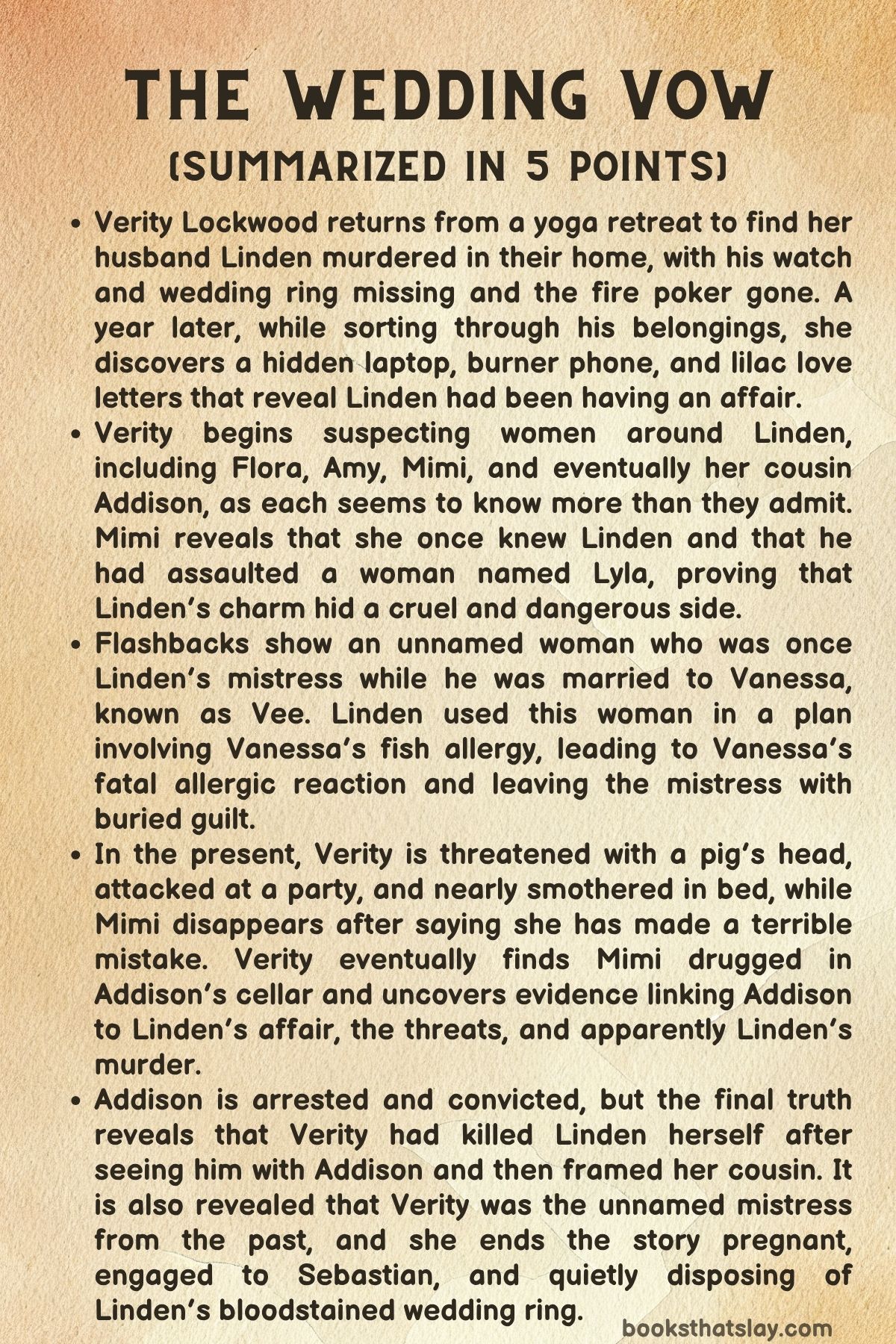
The Wedding Vow by Dandy Smith is a domestic psychological thriller about marriage, betrayal, hidden histories, and the lies people preserve to protect the lives they have built. The story begins with Verity Lockwood discovering her husband Linden murdered in their home, but the apparent crime soon grows into something far more personal.
A year later, secrets from Linden’s past and present begin to surface, forcing Verity to question friends, family, and even her own memories of their marriage. The novel uses shifting revelations to show how love can turn into possession, revenge, and self-preservation when truth becomes too dangerous to face.
Summary
Verity Lockwood returns from the Oakleaf Yoga Retreat feeling anxious because her husband Linden has not answered her calls or messages. He is meant to pick her up from the station, but he is nowhere to be seen.
The silence feels wrong, and her worry deepens as she travels home with her assistant Flora. Before arriving, Verity calls her neighbour and closest friend Mimi, asking her to check on Linden at Windermere, the home Verity shares with him.
When Verity reaches the house, Mimi comes running outside in a panic, screaming for someone to call the police. Verity enters the house and finds Linden dead in the lounge.
He has been violently beaten, apparently with the fire poker that is now missing from the hearth. His wedding ring and watch are gone, so the police initially consider the possibility that a burglary turned fatal.
A year passes, but Verity remains trapped in the aftermath of Linden’s death. She still lives at Windermere, though she has moved into another bedroom because the old spaces carry too much pain.
With help from her cousin Addison, she begins sorting through Linden’s belongings. During the process, Addison finds a loose floorboard in Linden’s wardrobe.
Hidden beneath it are a laptop, a burner phone, and lilac love letters. The discovery shatters Verity’s belief in her marriage.
Linden had been unfaithful, and the secret nature of the items suggests the affair was serious and carefully concealed. Verity takes everything to the police, convinced that Linden’s mistress may have had a motive to kill him.
Addison warns that the police could turn suspicion back on Verity if they think she knew about the affair before Linden died, but Verity insists she was ignorant of it and has nothing to hide.
Once Verity knows Linden had a mistress, nearly every woman in his life begins to seem suspicious. Flora reacts oddly when Verity mentions discovering secrets among Linden’s possessions.
Amy, who had once worked as Linden’s accountant and now manages Verity’s finances, becomes evasive when asked about her connection to him. Mimi’s behaviour also troubles Verity.
After Linden’s funeral, Mimi had suddenly disappeared from Verity’s life, cutting off contact without proper explanation. When she returns to the house next door, she refuses to speak openly.
Addison points out that Mimi knew Linden before Verity did and had hidden that fact, making it possible that Mimi was his lover.
Verity later finds a photograph proving that Mimi and Linden were together at a New Year’s Eve party years before Mimi supposedly first met him through Verity. When confronted, Mimi admits that she once knew Linden well.
She explains that Linden had assaulted a woman named Lyla, who worked as an editorial assistant, and that Mimi had kept quiet because Linden threatened to expose her lies and destroy her friendship with Verity. This revelation changes Verity’s understanding of Linden.
He was not merely unfaithful; he was manipulative, dangerous, and skilled at silencing people.
Alongside Verity’s present-day investigation, the story shows the past through the eyes of an unnamed woman who had an affair with Linden while he was married to a woman called Vee. This woman is obsessed with Linden and accepts the secret life he offers her.
When she loses her place to live, he moves her into Paddledown, a hidden house where their affair can continue away from his wife. At first, she sees this as proof of his devotion, but the relationship soon becomes controlling and unsettling.
She receives anonymous notes warning her that Linden is married and that his wife deserves the truth. She suspects several people, including a young woman named Millie, before learning that her own mother, Penelope, sent the notes after seeing her with Linden.
The affair grows darker when Linden begins speaking about his wife’s fish allergy in a disturbing way. Later, he involves the other woman in collecting a lunch order for Vee’s office and makes sure Vee’s salad is placed on top.
Vee suffers a severe allergic reaction, and her EpiPen is missing. The other woman realizes Linden may have used her to help kill his wife while allowing her to believe she was only helping with a harmless errand.
This past crime casts Linden as a man capable of careful, indirect violence, and it also shows that the woman involved with him has her own buried guilt.
In the present, Verity’s life becomes increasingly threatening. A severed pig’s head is left outside her house with a knife and a note.
The butcher says it was collected by a tall blond man using Linden’s name, which makes the act feel both staged and personal. At the Verity Rose winter party, Verity is lured into a cellar and attacked by a man who resembles Linden.
Soon after, someone breaks into Windermere and tries to smother her while she sleeps. Verity begins to believe Linden’s killer is not finished with her.
Flora becomes another focus of suspicion when Amy reveals that Linden kissed her shortly before his death. Flora admits Linden tried to help her career and kissed her, but she says she rejected him.
She feared that her ex-boyfriend Adam, who was angry and unstable, might have killed Linden. Flora also reveals that her married lover Benjamin resembles Linden, which makes Verity wonder whether Benjamin could be the man who attacked her at the party.
Each explanation creates new possibilities but no certainty, and Verity grows more isolated.
Mimi then contacts Verity and asks to meet privately, saying she has made a terrible mistake. Before they can talk, Mimi disappears.
Verity and Addison are questioned, and Verity becomes convinced that Mimi’s disappearance is linked to Linden’s murder. During Christmas, Verity stays with Addison and Addison’s husband Harry because she is afraid to remain alone at Windermere.
Max, a man close to Mimi, later reaches out to Verity and says Mimi may have known who killed Linden. He also tells Verity something important: the photograph of Mimi and Linden was not Mimi’s, as Addison had claimed, but Linden’s.
Verity realizes Addison has lied to her.
During a blackout at Addison’s house, Verity hears noises from the cellar. She goes down and finds a scrap of lilac paper matching the love letters hidden in Linden’s wardrobe.
The truth starts to form: Addison wrote the letters. In the cellar, Verity discovers Mimi drugged and locked inside an ottoman bed.
Addison returns and panics when Verity finds her secret. She admits she had been Linden’s mistress for almost a year.
Their affair began after Addison learned that Harry was sterile and went to Windermere for comfort, only to find Linden alone. Addison says she loved Linden and believed he wanted a future and children with her.
Verity then reveals that Linden had secretly had a vasectomy, meaning he had never truly planned the life Addison imagined.
Addison also confesses to several of the attacks and threats. She sent the pig’s head, arranged the basement attack by blackmailing Benjamin, broke into Windermere, tried to terrify Verity, and attacked Mimi to stop her from revealing the affair.
Verity then finds the missing fire poker and Linden’s watch in Addison’s cellar. Addison insists she did not murder Linden, but the evidence appears damning.
Verity runs, and Addison attacks her, nearly strangling her. Max arrives in time to save Verity.
Addison is arrested and later convicted of Linden’s murder.
Mimi recovers in hospital and explains why she stayed away from Verity. On the night Linden died, Mimi saw Addison leaving Windermere.
Later, she saw someone she believed was Verity also leaving the house. Thinking Verity may have killed Linden after discovering the affair, Mimi remained silent to protect her friend.
With Mimi’s testimony, Addison’s affair, the fake break-up letter on Linden’s burner phone, and the evidence found in Addison’s cellar, the police conclude Addison killed Linden.
Two years later, Verity visits Addison in prison. Addison insists that Verity murdered Linden and framed her.
The final truth confirms that Addison is right. Before going to the retreat, Verity had already found the lilac letters.
While at Oakleaf, she got Heidi drunk, took Heidi’s car, and secretly drove back to Windermere. There, she saw Addison with Linden.
The sight of her husband betraying her with her cousin broke something in her. Verity entered the house and killed Linden with the fire poker.
Afterward, she manipulated the investigation and planted evidence to make Addison appear guilty.
The final revelation goes even deeper. The unnamed other woman from the past was Verity herself.
Before becoming Linden’s wife, she had been his mistress while he was married to Vanessa, known as Vee. Verity had helped deliver the contaminated lunch that led to Vanessa’s death, though Linden had used her in the crime.
Years later, Verity became the wife betrayed by Linden in the same way Vanessa had been. By the end, Verity has rebuilt her life with a new fiancé, Sebastian, and is pregnant.
She returns to Paddledown, takes Linden’s bloodstained wedding ring, and throws it into the canal, releasing the last physical symbol of their marriage while keeping the darkest truth of her own actions hidden.
Characters
Verity Lockwood
Verity Lockwood is the central figure of the novel and one of its most deceptive characters. At first, she appears to be a grieving widow who has been blindsided by her husband’s murder and later devastated by the discovery of his affair.
Her fear, suspicion, and emotional collapse make her seem like a victim surrounded by people who have lied to her. Yet The Wedding Vow gradually reveals that Verity is not simply uncovering the truth but also controlling how truth is seen.
Her ability to present herself as wounded and innocent allows her to guide suspicion toward others while hiding her own guilt. The final reveal transforms her completely: she murdered Linden after discovering his betrayal with Addison and then framed Addison with chilling patience.
Verity’s past as Linden’s mistress during his marriage to Vanessa also shows that she has long been connected to secrecy, betrayal, and moral compromise. She is not a straightforward villain, because Linden manipulated and damaged her too, but she is willing to let another person lose everything for a crime she committed.
Her survival depends on performance, and by the end of the book, she has mastered the art of appearing innocent while carrying enormous guilt.
Linden Lockwood
Linden Lockwood dominates the story even after death because almost every secret leads back to him. He is charming enough to attract devotion from women around him, but beneath that charm is a pattern of manipulation, coercion, and emotional cruelty.
His affair with Verity while married to Vanessa reveals his ability to turn desire into control, and the allergy incident suggests a capacity for calculated harm. He uses people as tools, allowing others to become implicated in his schemes while he remains protected.
In his marriage to Verity, he continues the same pattern by betraying her with Addison and letting Addison believe in a future that he knows cannot exist. His secret vasectomy exposes how deeply he lies even to women who believe they know him.
Linden’s assault of Lyla and his threats against Mimi further show that his power over others is not only romantic but also social and psychological. In the book, Linden is less a lost husband than the source of a long chain of damage.
His death does not end his influence, because the fear, guilt, jealousy, and resentment he created keep shaping the lives of everyone left behind.
Addison
Addison is Verity’s cousin and one of the most tragic figures in the story because her betrayal is real, but her final punishment is based on a crime she did not commit. She begins as a supportive relative, helping Verity sort through Linden’s belongings and appearing to stand beside her during a painful period.
Beneath that role, however, Addison is hiding her affair with Linden. Her vulnerability begins with the pain of learning Harry is sterile, which leaves her desperate for comfort, validation, and the possibility of motherhood.
Linden exploits that longing, making her believe she could have a future and children with him. Addison’s actions after the affair is exposed show how unstable and dangerous she becomes when threatened.
She sends the pig’s head, arranges an attack, breaks into Verity’s home, and imprisons Mimi to protect herself. These acts make her morally responsible for serious harm, even if she did not kill Linden.
Her tragedy lies in the way guilt makes her easy to frame. In The Wedding Vow, Addison becomes the perfect scapegoat because she has done enough wrong that the larger lie becomes believable.
Mimi
Mimi is Verity’s neighbour and best friend, but her silence makes her both protective and deeply flawed. Her initial reaction to Linden’s body shows genuine horror, yet her disappearance after the funeral creates suspicion.
Mimi’s hidden connection to Linden reveals that she has been carrying secrets for years. She knew him before Verity did, knew about his assault of Lyla, and understood that he was dangerous.
Her failure to tell Verity is rooted in fear: Linden threatened to expose her lies and destroy her friendship. Later, Mimi’s silence after seeing Addison and then someone she believed was Verity leaving Windermere comes from a different kind of loyalty.
She thinks Verity may have killed Linden and chooses to protect her rather than tell the police. Mimi is not innocent in a simple sense, because her secrecy allows lies to spread and enables others to control the story.
Yet she is also one of the few characters whose silence comes from attachment rather than self-interest alone. Her recovery after being drugged and trapped by Addison gives her a second chance to speak, but by then Verity has already shaped the case to her advantage.
Flora
Flora functions as one of the early suspects because her connection to Linden is ambiguous and her reactions make Verity uneasy. As Verity’s assistant, she is close enough to the family to know private details, but not close enough to be fully trusted.
Her strange response when Verity mentions secrets among Linden’s belongings suggests she may know more than she admits. The later revelation that Linden kissed her adds another layer to her role.
Flora’s situation shows how Linden’s behaviour reached beyond his marriage and affair with Addison. He tried to involve himself in her career, blurred boundaries, and forced her into a position where rejecting him could still leave her exposed.
Her fear that Adam may have killed Linden reflects the chaos Linden created around the women he targeted or pursued. Flora’s married lover Benjamin also becomes part of the mystery because he resembles Linden and could have been used in the staged attack.
Flora is not the central betrayer, but her storyline reinforces how Linden’s charm and entitlement created suspicion, shame, and danger around everyone who crossed his path.
Amy
Amy is a smaller but useful character in the mystery because her evasiveness helps widen Verity’s suspicion. As Linden’s former accountant and later Verity’s accountant, she occupies a space between past and present.
Verity senses that Amy knows more than she says, and her guarded behaviour makes her appear potentially connected to Linden’s hidden life. Amy’s importance comes mainly through the information she provides about Linden kissing Flora.
That detail shifts Verity’s attention and briefly opens another possible motive for murder. Amy also reflects how many people around Linden had partial knowledge rather than full understanding.
She knows enough to disturb Verity but not enough to solve the crime. Her role shows how secrets in the novel are scattered among different people, with each person holding one piece of a larger picture.
Amy’s evasiveness is not proof of guilt, but it adds to the atmosphere of mistrust in which Verity can direct suspicion from one person to another.
Vanessa / Vee
Vanessa, also called Vee, is Linden’s first wife and one of the story’s most important absent characters. She is dead before the main events, but the truth about her death reshapes the entire novel.
In the past storyline, she is presented through the eyes of Linden’s mistress, who sees her as an obstacle rather than a fully understood person. That limited view is important because it shows how affairs can reduce a spouse to an inconvenience in someone else’s fantasy.
Vanessa’s fish allergy becomes the method through which Linden appears to arrange her death, using the other woman to help deliver the contaminated meal. Her missing EpiPen makes the incident seem even more deliberate.
Vanessa’s fate mirrors Verity’s later position as a betrayed wife, creating a cruel cycle in which Verity once helped harm another woman and later suffers a similar betrayal herself. Vanessa represents the cost of Linden’s selfishness and the danger of believing that love justifies secrecy.
Though she has little direct presence, her death is the hidden foundation of Verity’s guilt.
Harry
Harry is Addison’s husband, and his role is important because his infertility becomes the emotional opening through which Linden enters Addison’s life. Harry is not presented as a villain; instead, he is part of the domestic disappointment Addison is trying to escape.
When Addison learns that he is sterile, the news damages her hopes for the future and leaves her vulnerable to Linden’s attention. Harry’s presence also makes Addison’s affair a betrayal on multiple levels.
She does not only betray Verity as a cousin; she betrays her own marriage while chasing the fantasy Linden offers. Harry’s innocence makes Addison’s choices look more selfish and desperate.
He also becomes part of the setting in which Verity later uncovers the truth, since Addison’s home and cellar conceal evidence, Mimi, and the signs of Addison’s crimes. Harry stands at the edge of the main conflict, but his marriage to Addison helps explain why her longing for a different life becomes so intense.
Max
Max is connected to Mimi and becomes crucial near the end because he refuses to let her disappearance remain unexplained. He contacts Verity with information that challenges Addison’s version of events, especially the truth about the photograph of Mimi and Linden.
By revealing that the photo belonged to Linden rather than Mimi, Max helps Verity identify Addison’s lie. His concern for Mimi gives him a clearer moral position than many other characters, because he acts out of care rather than self-protection.
Max also saves Verity when Addison attacks her, preventing the confrontation from becoming fatal. His intervention helps secure Addison’s arrest, though the reader later understands that this rescue also preserves Verity’s false version of events.
Max is useful to justice in one sense, because he helps expose Addison’s crimes against Mimi, but he is also unknowingly used by Verity’s larger deception. His role shows how even well-intentioned characters can become part of a false conclusion when the evidence has been carefully arranged.
Benjamin
Benjamin is Flora’s married lover and becomes important because Addison uses him in her campaign to frighten Verity. His resemblance to Linden makes him especially useful as a weapon of fear.
When Verity is attacked at the winter party by a man who looks like Linden, the moment feels almost supernatural to her, as though her dead husband has returned. The truth is more practical and more cruel: Addison blackmails Benjamin into helping stage the attack.
Benjamin’s role exposes the extent of Addison’s planning and willingness to manipulate others. He is not central to the emotional core of the novel, but he shows how secrets create leverage.
Because he has his own hidden affair with Flora, Addison can control him. Like many characters in the story, Benjamin is compromised before he is used, and that compromise allows another person to pull him into a larger scheme.
Penelope
Penelope is Verity’s mother and appears most strongly in the past storyline, where she tries to stop her daughter’s affair with Linden. She sends anonymous notes warning that Linden is married and that his wife deserves the truth.
At first, these notes seem threatening, but once their source is revealed, they become an act of desperate protection. Penelope sees the danger in Linden more clearly than her daughter does.
She understands that the affair is not romantic freedom but a destructive situation that will hurt multiple people. Her attempt to intervene fails, and Verity continues down the path that eventually connects her to Vanessa’s death and later Linden’s murder.
Penelope’s role is small but meaningful because she represents the voice of warning that Verity refuses to hear. She also shows that Verity’s moral collapse was not inevitable in a simple way; someone tried to stop her before the damage became permanent.
Lyla
Lyla is an editorial assistant who was assaulted by Linden, and although she does not occupy much space in the active plot, her story is essential to understanding his true nature. Through Mimi’s confession, Lyla becomes evidence that Linden’s cruelty was not limited to affairs or emotional manipulation.
He was capable of direct harm and then of using threats to silence those who knew. Lyla’s experience also explains part of Mimi’s fear and guilt.
Mimi did not tell Verity what she knew because Linden had power over her, and Lyla’s suffering became one of the truths buried to preserve appearances. In the story, Lyla represents the women whose pain is pushed aside because a charming man knows how to protect his reputation.
Her presence widens the novel’s moral scope, showing that Linden’s violence affected more people than Verity initially realizes.
Sebastian
Sebastian appears at the end as Verity’s new fiancé and the father of her unborn child. His role is not deeply explored, but his presence is important because it shows how successfully Verity has rebuilt her life after framing Addison.
To the outside world, Sebastian likely represents a fresh start, stability, and the promise of a new family. To the reader, however, his presence is unsettling because Verity has not truly escaped her past; she has buried it.
Her pregnancy and engagement suggest renewal, but they sit beside the knowledge that she committed murder and allowed Addison to be punished for it. Sebastian therefore becomes part of the final irony.
He is the symbol of Verity’s future, but that future rests on secrets as dark as the ones Linden once kept.
Themes
Betrayal as a Cycle Rather Than a Single Act
Betrayal moves through the story in repeating patterns, with each act creating the conditions for another. Verity is first introduced as the betrayed wife, shattered by the discovery that Linden had a hidden lover.
Yet the ending reveals that she had once stood in the same position as Addison, becoming Linden’s mistress while he was married to Vanessa. This reversal changes the meaning of the entire novel.
Betrayal is not shown as something that happens once and ends; it travels through relationships, reshaping victims into perpetrators and lovers into rivals. Linden betrays Vanessa with Verity, then betrays Verity with Addison, while Addison betrays both Verity and Harry.
Even Mimi’s silence becomes a form of betrayal, though it is driven by fear and loyalty rather than malice. The Wedding Vow uses these repeated betrayals to show how people justify their actions when desire, shame, and self-preservation are involved.
No one sees themselves as the villain at first. Each person believes there is a reason for secrecy, but those secrets build toward violence, false justice, and permanent damage.
The Performance of Innocence
Verity’s greatest strength is not simply that she hides the truth, but that she understands how innocence should look. Her grief, fear, and confusion seem convincing because they are partly real.
Linden did betray her, and she did suffer because of him. This mixture of genuine pain and deliberate deception makes her performance harder to question.
She gives the police evidence, expresses shock at each discovery, and allows suspicion to move naturally toward women who had reasons to hate or fear Linden. Addison becomes the perfect target because she is guilty of enough surrounding crimes to make murder believable.
The story examines how easily people trust visible suffering, especially when it fits the expected image of a wronged wife. Verity weaponizes that expectation.
She does not need to invent every suspicion herself; she only needs to guide others toward the conclusion they are already prepared to accept. The theme becomes especially unsettling because the final truth does not erase Verity’s victimhood.
Instead, it shows that a person can be wounded and still be calculating, sympathetic in one moment and dangerous in the next.
Marriage, Possession, and Control
Marriage in the novel is less a safe bond than a structure where control, ownership, and secrecy can hide behind respectability. Linden’s marriages are built on lies.
With Vanessa, he pursues Verity while maintaining the appearance of a settled life. With Verity, he creates another hidden relationship with Addison while preserving the public image of a successful husband.
He treats marriage not as commitment but as a position from which he can manage women’s access to truth. His wedding ring, stolen after his death and later thrown into the canal, becomes a powerful object because it represents both promise and corruption.
Addison wants the future she believes Linden can give her, including children and a shared life, but that dream is based on falsehood because Linden has had a vasectomy. Verity’s attachment to the marriage is also complicated by pride, betrayal, and rage.
She does not only mourn love; she reacts to humiliation and replacement. The novel presents marriage as something that can become dangerous when appearances matter more than honesty and when a partner treats devotion as something to exploit.
Secrets, Evidence, and Manufactured Truth
Truth in the story is not discovered in a clean line; it is built, hidden, moved, and staged. Objects such as the laptop, burner phone, lilac letters, photograph, fire poker, watch, and wedding ring all seem to carry clear meaning, but their meaning changes depending on who placed them and why.
The police believe evidence points to Addison because Verity makes sure it does. Addison’s real crimes help support the false story, creating a manufactured truth that is convincing because it contains pieces of reality.
Mimi’s testimony also becomes complicated because what she saw was true, but what she believed about it was wrong. This theme shows how evidence can be powerful without being honest.
A hidden letter can reveal an affair, but it can also be used to redirect suspicion. A missing object can suggest robbery, then murder, then framing.
The novel is especially concerned with how people choose the version of events that makes emotional sense to them. Once Addison appears guilty, every piece of information begins to support that conclusion.
The final reveal exposes the danger of confusing a believable story with the real one.