The Verdant Cage Summary, Characters and Themes
The Verdant Cage by Jess Lourey is a dystopian mystery about a young apothecary raised inside a settlement built on obedience, sacrifice, and fear. Rose Allgood has spent her life believing Noah’s Valley is protected by sacred rules, but her world begins to break apart when her twin brother is condemned and her mother is murdered.
What first looks like one family’s tragedy soon opens into a larger history of lies, poison, hidden technology, and institutional control. The book follows Rose as she moves from dutiful citizen to reluctant rebel, uncovering the violent truth behind the Wall and the sacrifices that have sustained her home.
Summary
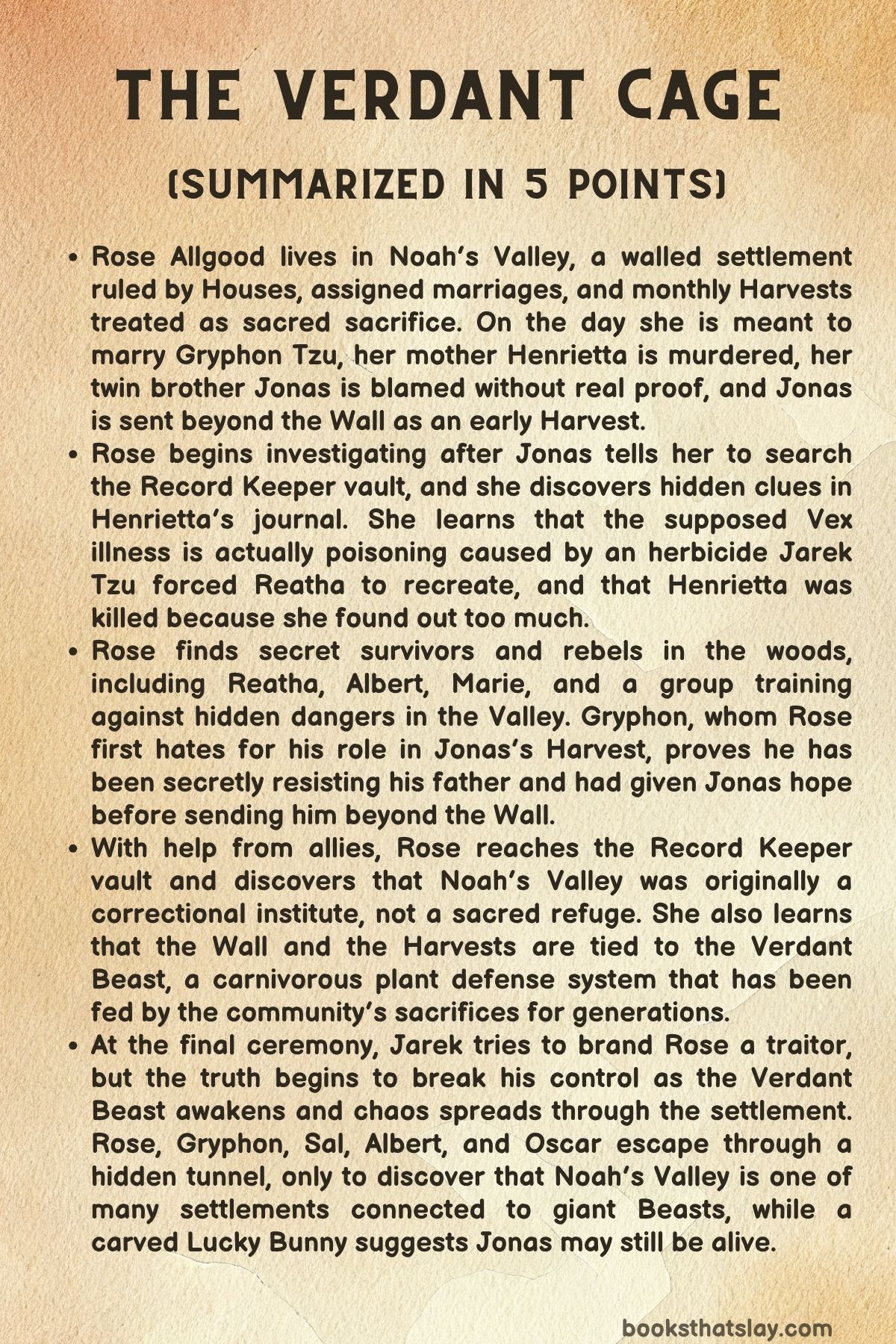
Rose Allgood lives in Noah’s Valley, a sealed community surrounded by a great Wall and governed by strict traditions. Every citizen belongs to a House, every role is assigned, and marriage is treated as a duty to preserve the settlement.
The people believe the monthly Harvests are sacred sacrifices necessary for the survival of the whole, and they accept the authority of the Council without question. Rose belongs to the Apothecary House and has spent her life working with medicine, caring for the sick, and trying to follow the rules even when those rules feel cruel.
Her closest bond is with her twin brother, Jonas, and the thought of leaving him behind frightens her more than her arranged marriage.
Rose is supposed to marry Gryphon Tzu, a member of the powerful Guardian House and the son of Jarek Tzu, the Council’s dominant leader. The marriage would force Rose into the Tzu home and separate her from the people and work she loves.
Before the ceremony, Jonas tells her that he has secretly entered the Record Keeper vault and discovered something terrible about the people inside the Wall. He says they are not what Rose believes they are, but he is interrupted before he can fully explain.
Rose is already unsettled because she has broken the law by leaving medicine for Horace, an elderly man who is not supposed to receive treatment because citizens over seventy are considered beyond medical care.
At the wedding square, Rose notices the Harvest basket has already been lowered, which is strange because it should not be needed for a wedding. The ceremony is shattered when Rose’s mother, Henrietta, is found stabbed to death near Jonas.
Jonas is holding a clean medical blade, and Jarek immediately declares him guilty. Rose insists her brother was trying to help, not kill, but the crowd silently accepts Jarek’s judgment.
When she argues that Apothecaries are exempt from Harvest because of the unresolved Vex illness, Jarek claims the law has changed. Jonas briefly escapes the guards, embraces Rose, and tells her to go to the Record Keeper vault.
Then Gryphon is forced to lead him into the basket. Jonas is raised up Eden’s Gate and carried beyond the Wall.
Rose is taken to the Tzu house, where Misia Tzu begins stripping away her old identity and imposing the expectations of the Guardian House. Although the wedding has not truly been completed, Misia expects Rose to sleep in Gryphon’s room.
Rose hates Gryphon for his role in Jonas’s condemnation, yet he shows more softness than she expects. He gives her his shirt and sleeps on the floor, suggesting that he may not be as cruel as his family’s public image.
Rose remains suspicious, grieving, and furious, but she cannot fully ignore the signs that Gryphon is hiding his own doubts.
The next day, Rose returns to the Apothecary cottage and speaks with Aunt Florence and Uncle Richard. They tell her that Marina Seingalt, a girl from the Record Keeper House, had lured Henrietta and Jonas away before the murder by claiming someone had symptoms of the Vex.
In her mother’s lab, Rose finds Henrietta’s hidden journal. At first it seems like a plant record, but Rose realizes certain entries contain deliberate falsehoods and marked letters.
Henrietta appears to have hidden a coded message inside the journal, and Rose begins to suspect her mother discovered something dangerous before she died.
Rose visits Marina and tries to learn whether Jonas truly entered the vault. Marina denies it, but her behavior suggests she knows more than she admits.
She also hints that people may survive beyond the Wall, a possibility Rose has never seriously believed. Driven by hope, Rose runs to Eden’s Gate and thinks she hears Jonas calling.
She nearly touches the Wall before Gryphon stops her. He admits that survival outside the Wall is possible, though very difficult without training, luck, and skill.
This changes Rose’s understanding of the Harvests. If people can survive beyond the Wall, then the sacrifices may not be holy deaths at all.
Soon after, Rose is brought to the body of Peter Martinez by Leonidas. Peter is said to have been killed by an animal, but Rose notices three puncture wounds similar to those on her mother’s body.
She declares that a murderer is loose in Noah’s Valley. Jarek slaps her and orders her to call the death an animal attack.
His violent reaction confirms that he is trying to suppress the truth. Rose follows a strange moving shadow into the woods and discovers another hidden secret: Reatha, Albert, and Marie of the Chemist House are alive.
Everyone believed they had self-Harvested, but they have been hiding in a cave.
In the cave, Rose learns that Reatha fled because Jarek demanded something dangerous from her. Albert has modified his wheelchair using stolen technology, proving that advanced knowledge and old-world devices still exist inside the Valley.
Rose also discovers that Gryphon, Eero, Meryl, Sal, and Oscar have been secretly training in the woods. They distrust her at first because she has always been known as obedient and rule-bound, but she proves that she wants the truth.
She joins their circle and learns that they have been preparing for threats the rest of the village refuses to see.
As Rose decodes more of Henrietta’s journal, she learns that the Vex is not a mysterious illness. It is poisoning.
Reatha confirms that Jarek found an old herbicide in the Record Keeper vault and forced her to recreate it. Henrietta uncovered the connection between the poison and the Vex, which made her a danger to Jarek.
Rose also learns about killer vines near the quarantined industrial district, further proving that the Valley contains old secrets and unnatural dangers. Older villagers such as Augustus reveal that they knew parts of the truth but remained silent for too long.
Rose realizes that Jarek’s ambitions go beyond controlling the village. He wants to use weapons and explosives from a hidden Founders’ cache to blow open the Wall.
Rose’s feelings toward Gryphon grow more complicated as she learns that his public obedience has partly been an act. He admits he whispered hope to Jonas before the basket rose, telling him to survive.
He had also released Jonas briefly on the wedding day so Rose could say goodbye. Rose still carries anger and mistrust, but Gryphon’s choices show that he is not fully aligned with Jarek.
Their bond strengthens as they work toward the same goal, even though Rose’s main purpose remains finding Jonas and exposing the truth.
Jarek tightens his control by punishing Rose’s friends publicly. He brands them criminals and has them whipped, using fear to warn the village against rebellion.
Uncle Richard tells Rose that she and the others must escape before Jarek destroys them. The group decides to destroy the weapons and the tablet connected to Jarek’s plans.
During the mission, however, Jarek captures Rose. He intends to marry her to Gryphon in shackles and frame her as a traitor, using the ceremony as a public display of his power.
With help from Sojourner, Rose finally reaches the Record Keeper vault. There she discovers the true origin of Noah’s Valley.
It was never the noble refuge described by tradition. It was once Noah’s Valley Correctional Institute, an experimental prison settlement created for violent offenders and their descendants.
The first Record Keeper was not a sacred founder but Warden Helen Hayes. The Wall was meant to open automatically after five generations, but the truth was hidden from the population.
Rose also learns about the Verdant Beast, a carnivorous plant defense system connected to the settlement. The monthly Harvests were not sacred offerings to preserve community balance.
They were feedings.
David Seingalt reveals that he has known the truth and helped Jarek maintain control. He also admits that he manipulated Albert into killing Henrietta by promising him technology and Marina’s hand.
The murder that destroyed Rose’s family was part of a larger scheme built on fear, secrecy, and personal greed. At the final ceremony, Jarek tries to turn the village against Rose by calling her and Henrietta traitors.
Rose fights back with the truth, and enough people begin to doubt him for his power to crack.
The Verdant Beast awakens near Eden’s Gate and begins feeding on bodies. The ceremony collapses into chaos as villagers, rebels, Guardians, Gryphon, Misia, and Rose’s allies fight for survival.
Vines lash through the crowd, and the hidden violence beneath Noah’s Valley becomes impossible to deny. Jarek is eventually seized by the Beast and crushed, ending his rule but not saving the settlement.
The surviving rebels flee into the Record Keeper basement while hostile Guardians pursue them. Augustus sacrifices himself to hold attackers back, giving Rose and the others a chance to escape.
Rose finds a hidden exit, and she, Gryphon, Sal, Albert, and Oscar escape through a tunnel. Others are left behind when the passage collapses, sealing the survivors outside Noah’s Valley.
Once beyond the Wall, they discover a truth even larger than the one Rose uncovered inside the vault. Noah’s Valley is only one of many walled settlements attached to enormous Verdant Beasts, suggesting that the entire system functions like a farm built to feed the creatures.
Then Rose finds a tiny carved Lucky Bunny arranged as part of an arrow pointing toward a white light. The sign suggests Jonas may still be alive and has left her a trail to follow.
Characters
Rose Allgood
Rose Allgood is the central figure of The Verdant Cage, and her journey is shaped by the collapse of nearly everything she has been taught to trust. At the beginning, she is dutiful, frightened, and deeply tied to the Apothecary House, where healing gives her purpose and structure.
Her loyalty to law is never simple obedience, because she quietly breaks rules when compassion demands it, as shown through her decision to bring medicine to Horace despite the Valley’s cruel age restrictions. Rose’s strength grows out of grief and love rather than ambition.
The murder of her mother and the Harvest of Jonas force her into action, but she does not become reckless without thought. She investigates, decodes, questions, and gradually learns to act against the system that raised her.
Her courage is also emotional, because she must accept that many adults she trusted either lied, stayed silent, or enabled the Valley’s violence. By the end of the book, Rose has transformed from a protected apothecary into a survivor who understands that truth can destroy a world before it can free anyone.
Jonas Allgood
Jonas Allgood functions as both Rose’s closest emotional anchor and the first major victim of Noah’s Valley’s machinery of control. His bond with Rose is immediate and intense because they are twins, and his absence shapes almost every choice she makes after he is taken.
Jonas is curious enough to break into the Record Keeper vault, which proves that he has already begun questioning the official history before Rose fully understands its falsehoods. His warning to Rose shows courage, but it also shows how dangerous knowledge is inside the Valley.
Once he is accused of Henrietta’s murder, the speed of his condemnation exposes how little justice exists under Jarek’s rule. Jonas is not given a real defense because his usefulness to the system ends the moment he becomes inconvenient.
His final instruction to Rose sends her toward the truth, making him essential even when he is physically absent from much of the story. The carved Lucky Bunny at the end keeps his presence alive and turns Rose’s grief into hope.
Henrietta Allgood
Henrietta Allgood is most powerful in the story through what she leaves behind. As Rose’s mother and an apothecary, she represents knowledge, care, and resistance hidden beneath ordinary duty.
Her journal reveals that she understood the natural world with enough precision to hide a code inside false plant entries, making her both scientifically skilled and careful under pressure. Henrietta’s discovery that the Vex was poisoning places her in direct conflict with Jarek, because the truth would expose his manipulation of the community and his willingness to harm his own people.
Her murder is not random; it is the removal of someone who has become too dangerous to the ruling order. Henrietta’s importance lies in the way she prepares Rose without openly endangering her too soon.
She leaves the tools Rose needs to continue the investigation, and her death becomes the event that forces Rose to confront the difference between sacred law and engineered obedience.
Gryphon Tzu
Gryphon Tzu is one of the most conflicted figures in the book because he belongs to the Guardian House and is the son of Jarek, yet he repeatedly acts against the brutality that defines his family’s power. At first, Rose sees him as the person who led Jonas to the Harvest basket, and her hatred is understandable.
Gryphon’s position makes him appear complicit, especially because he has been trained to perform obedience in public. His private actions gradually reveal a different person.
He comforts Rose without demanding closeness, tells Jonas to survive, allows Rose a brief goodbye, and trains with the rebels in secret. Gryphon is not free of weakness, because he has survived by hiding his resistance rather than openly challenging Jarek from the start.
Still, his choices show that he has been trying to work within a dangerous structure while waiting for a chance to break it. His relationship with Rose grows because both of them learn that trust is not created by words alone but by repeated risk.
Jarek Tzu
Jarek Tzu is the main human face of Noah’s Valley’s corruption. He uses law, ritual, fear, and public punishment to make his own decisions appear sacred and unavoidable.
His authority depends on controlling not only actions but also language: Jonas is called guilty without proof, Peter’s murder is called an animal attack, and the Harvests are treated as holy sacrifices rather than feedings. Jarek understands that power is strongest when people are trained to participate in their own submission, which is why the villagers kneel and turn away instead of challenging him.
His cruelty is personal as well as political. He strikes Rose, manipulates the Council, punishes rebels, and tries to force her into marriage as a spectacle of control.
His plan to use weapons and explosives reveals that he is not protecting Noah’s Valley; he is prepared to destroy its fragile order if doing so expands his power. His death at the hands of the Beast is fitting because he is consumed by the very hidden system he exploited.
Misia Tzu
Misia Tzu represents the domestic face of Guardian control. She does not need to rule the Council to enforce the system’s cruelty, because she works through identity, appearance, marriage, and household discipline.
When Rose is brought into the Tzu home, Misia immediately begins separating her from the Apothecary life she knows. Her treatment of Rose shows how oppression operates inside private spaces as well as public ceremonies.
She expects Rose to accept the role assigned to her, sleep where she is told, and become part of the Tzu household whether she is grieving or not. Misia is not as openly central as Jarek, but she reinforces the same worldview: individual pain matters less than structure, reputation, and obedience.
Her presence also helps explain Gryphon’s emotional restraint, because he has grown up in a home where control is treated as normal.
David Seingalt
David Seingalt is one of the story’s most disturbing figures because his betrayal is rooted in knowledge. As part of the Record Keeper world, he has access to the truth that most citizens are denied, but instead of using that truth to free the Valley, he helps preserve the lie.
His role proves that information alone does not create morality. David understands the origin of Noah’s Valley, the nature of the Harvests, and the function of the Verdant Beast, yet he uses secrecy as currency.
His manipulation of Albert into killing Henrietta is especially cruel because he exploits Albert’s desires and vulnerabilities for political ends. David’s betrayal also darkens Marina’s position, showing that the Record Keeper House is not simply a neutral guardian of history but a place where truth has been hoarded, edited, and weaponized.
In The Verdant Cage, David shows how dangerous a keeper of records can become when preservation matters more than justice.
Marina Seingalt
Marina Seingalt is a complicated character because she moves between fear, secrecy, and partial truth. She draws Henrietta and Jonas away before the murder by claiming there are Vex symptoms, placing her close to the event that destroys Rose’s family.
When Rose questions her, Marina denies that Jonas entered the vault, but her evasiveness suggests that she is protecting something or someone. Her hints that people can survive beyond the Wall are important because they help crack one of the Valley’s central beliefs.
Marina’s position in the Record Keeper House gives her access to hidden knowledge, but she seems trapped by that knowledge rather than fully empowered by it. She is not presented as simply innocent or villainous.
Instead, she reflects the moral confusion of those raised inside families that maintain dangerous secrets. Her connection to Albert also becomes part of the manipulation that leads to Henrietta’s death, making her indirectly tied to one of the book’s most painful betrayals.
Reatha
Reatha is a key figure in revealing the truth behind the Vex. Her survival in hiding shows that the official stories about self-Harvests are not trustworthy, and her flight from the Chemist House proves that citizens who refuse Jarek’s orders can be erased from public life without truly dying.
Reatha’s knowledge of the herbicide connects the personal tragedy of Henrietta’s murder to a wider act of poisoning. She confirms that Jarek forced her to recreate a dangerous substance found in the vault, making her both a victim of coercion and a witness against him.
Her hidden life in the cave suggests the cost of resistance in Noah’s Valley: survival requires disappearance, secrecy, and separation from community. Reatha also helps Rose understand that the Valley’s sickness is manufactured, not mysterious.
Through her, the book shows how scientific knowledge can be turned into a weapon when controlled by people who value authority over life.
Albert
Albert is one of the most morally troubling characters because he is both exploited and guilty. His modified wheelchair and use of stolen technology show intelligence, determination, and frustration with the limits imposed on him.
Those qualities make him vulnerable to David Seingalt’s manipulation. David promises him technology and Marina’s hand, using Albert’s desires to push him into killing Henrietta.
Albert’s actions cannot be excused, because Henrietta’s murder causes enormous suffering and helps Jarek’s cover-up continue. At the same time, his role exposes how corrupt systems recruit damaged or desperate people into doing their violence for them.
Albert is not a simple monster. He is a person whose longing for power, love, and recognition is twisted into betrayal.
His escape with Rose and the others leaves him in a tense position, because survival does not erase what he has done.
Aunt Florence and Uncle Richard
Aunt Florence and Uncle Richard provide Rose with family support after Henrietta’s death and Jonas’s Harvest. They help connect the details surrounding the murder by revealing Marina’s role in drawing Henrietta and Jonas away.
Their presence gives Rose a link to the Apothecary House and to a life built around care rather than domination. Uncle Richard becomes especially important when he warns Rose that she and the others must escape.
He recognizes that Jarek’s control has reached a point where ordinary caution will no longer protect them. Florence and Richard are not at the center of the rebellion, but they show that Rose is not completely alone among the adults of the Valley.
Their support gives her enough grounding to keep questioning, even when the official world turns against her.
Sal
Sal is part of the secret training group that prepares for dangers most of Noah’s Valley refuses to acknowledge. Sal’s importance comes from loyalty, readiness, and the willingness to act before the truth is publicly accepted.
At first, Sal and the others distrust Rose because she has been known as a rule-follower, which makes sense in a community where obedience can make someone dangerous. Over time, Sal becomes one of the people who accepts Rose into the rebel circle.
Sal’s survival beyond the tunnel places this character among the small group forced to face the larger world outside the Valley. In that sense, Sal represents the younger generation that has inherited lies but may still have the courage to build something beyond them.
Oscar
Oscar belongs to the group of young rebels training in secret, and his role helps show that resistance in Noah’s Valley is not the work of one person alone. Like Sal, Eero, and Meryl, he understands that the Valley’s public calm hides real threats.
His willingness to train outside the official structures of the settlement makes him part of an underground network of doubt and preparation. Oscar’s survival outside the Wall gives him a place in the uncertain future that follows the collapse of the tunnel.
He is not as central as Rose or Gryphon, but his presence matters because rebellion requires ordinary people who are willing to risk punishment before victory seems possible.
Eero
Eero is another member of the hidden training group, and his presence broadens the sense that many young people in Noah’s Valley are quietly preparing for conflict. He helps challenge Rose’s belief that she understands how the Valley works.
The discovery of Eero and the others training in the woods reveals that there is already organized resistance beneath the surface. Eero’s distrust of Rose at first is practical rather than cruel, because the group cannot afford to welcome someone who might still believe in the rules.
His role shows how secrecy shapes relationships under authoritarian control. Even potential allies must test one another before trust can form.
Meryl
Meryl contributes to the rebel circle that Rose discovers in the woods. As part of the group, Meryl helps establish that Rose’s awakening is not isolated.
Others have seen enough danger to prepare themselves physically and strategically. Meryl’s role also reflects the risk faced by young citizens who challenge the Valley’s official order.
Training in secret is not a harmless act; it is a crime in a society where Jarek punishes dissent publicly and violently. Meryl helps create the social bridge Rose needs after losing her mother, Jonas, and her faith in the Valley’s institutions.
Through characters like Meryl, the story shows that resistance often begins before the main confrontation, in hidden choices made by people who refuse to remain helpless.
Augustus
Augustus represents the older generation’s burden of silence. He and other elders know parts of the truth, but they have delayed action for too long.
This makes him morally complicated, because his knowledge could have helped prevent suffering, yet fear and habit kept him quiet. However, Augustus is not portrayed only as a coward.
When the final escape becomes possible, he sacrifices himself to hold off attackers and give Rose and the others a chance to survive. His death does not erase the cost of his silence, but it gives him a final act of courage.
Augustus shows that people who fail to resist early may still choose bravery later, though the delay often means the price is much higher.
Sojourner
Sojourner plays a crucial role by helping Rose reach the Record Keeper vault. This act matters because the vault contains the truth that can break the Valley’s official history.
Sojourner’s assistance shows that the rebellion depends not only on fighters but also on people who can move others toward knowledge at the right moment. The character’s importance lies in enabling Rose to reach the evidence she needs, making Sojourner part of the chain that exposes the prison origins of Noah’s Valley and the function of the Verdant Beast.
In a society built on controlled access to information, helping someone reach the truth is itself a major act of resistance.
Peter Martinez
Peter Martinez is a victim whose death helps Rose recognize that Henrietta’s murder is not an isolated act. His body is officially described as the result of an animal attack, but Rose notices wounds that match the pattern on her mother.
This discovery gives her stronger evidence that a murderer is operating inside Noah’s Valley and that Jarek is suppressing the facts. Peter’s role is brief but important because his death widens the mystery.
It shows that the violence surrounding Rose’s family belongs to a larger pattern of concealment. Through Peter, Rose learns that official explanations must be examined rather than accepted.
Horace
Horace’s role is small but meaningful because Rose’s decision to bring him medicine reveals her moral character before the larger rebellion begins. The law says elderly citizens should not receive medical intervention after a certain age, but Rose quietly rejects that cruelty.
Her care for Horace shows that she values individual life over rigid doctrine, even when she still considers herself a rule-follower. This early act prepares the reader to understand why Rose later challenges the entire structure of Noah’s Valley.
She does not become compassionate after rebellion; compassion is the reason she is capable of rebellion in the first place.
Themes
Obedience as a Tool of Control
Noah’s Valley survives because its people are trained to treat obedience as virtue. The Houses, arranged marriages, age restrictions, and Harvests all appear as sacred customs, but they function as systems that keep citizens from making independent moral choices.
Jarek’s power depends on the villagers accepting decisions before evidence is considered. Jonas is condemned almost instantly, and the crowd’s silent kneeling shows how deeply public submission has been normalized.
This kind of control is effective because it makes cruelty look like duty. People do not need to be forced every moment if they have been taught that resistance is selfish, dangerous, or unholy.
Rose’s growth begins when she separates law from goodness. She realizes that rules can be used to protect lies, reward violence, and punish compassion.
Her secret care for Horace is an early rejection of this system, while her later rebellion becomes a larger refusal to let authority define truth. The book presents obedience as most dangerous when it is linked to ritual, because ritual gives oppression the appearance of meaning.
Truth Hidden Inside Records, Bodies, and Land
Truth in The Verdant Cage is never absent; it is buried, coded, mislabeled, or guarded. Henrietta hides information inside a plant journal, the Record Keeper vault preserves the real history of Noah’s Valley, and the bodies of Henrietta and Peter carry physical evidence that contradicts official explanations.
Even the land itself tells the truth through killer vines, the industrial district, the Wall, and the Verdant Beast. The problem is not that the truth cannot be found.
The problem is that power controls who can name it. Jarek calls murder an animal attack, David preserves records while hiding their meaning, and the Valley’s origin is rewritten as sacred founding rather than imprisonment.
Rose’s investigation matters because she learns to read beyond approved language. She studies wounds, patterns, coded letters, and contradictions.
The theme shows that history can be manipulated, but it cannot be fully erased. Evidence remains in unexpected places, waiting for someone brave enough to connect it.
Once Rose understands this, she becomes dangerous to the people who depend on silence.
Sacrifice, Exploitation, and the Myth of the Greater Good
The monthly Harvests are presented as sacred sacrifices for the survival of the community, but the truth reveals a horrifying system of exploitation. Citizens are taught to believe that giving up selected lives preserves balance, yet the Harvests actually feed the Verdant Beast.
This changes the moral meaning of the entire settlement. What the people call devotion is really consumption, and what they call tradition is a feeding schedule maintained through fear and ignorance.
The phrase “for the good of the whole” becomes one of the most dangerous ideas in the story because it allows leaders to erase individual suffering. Jonas’s early Harvest shows how easily the system can be adjusted to remove someone inconvenient.
The elderly are denied care, rebels are punished publicly, and the condemned are stripped of personhood through ritual. The theme asks what happens when sacrifice is demanded by those who never intend to offer themselves.
True sacrifice appears later through characters like Augustus, who gives his life so others can escape. The contrast makes clear that chosen sacrifice can be noble, but forced sacrifice is violence disguised as duty.
Family, Loyalty, and the Cost of Breaking Inherited Lies
Rose’s rebellion begins with family love: her need to save Jonas, understand Henrietta’s death, and honor the truth her mother died protecting. Yet the story also shows that family can bind people to dangerous systems.
Gryphon is trapped by his connection to Jarek and Misia, Marina is shaped by the secrecy of the Seingalt family, and Albert is manipulated through promises tied to belonging and marriage. Family loyalty becomes complicated when the people closest to a character are connected to harm.
Rose must learn that loving her home is not the same as preserving its lies. Gryphon must decide whether blood loyalty requires obedience to his father or resistance to him.
The older villagers must face the damage caused by protecting peace over truth. This theme gives the story much of its emotional weight because escaping Noah’s Valley is not only a physical act.
It means leaving behind inherited stories, assigned identities, and the comfort of belonging to a known order. Rose’s final step outside the Wall is therefore both a loss and a beginning.