Blood Promise Summary, Characters and Themes
Blood Promise by Richelle Mead is a young adult paranormal romance and fantasy novel, the fourth book in the Vampire Academy series. It follows Rose Hathaway after a devastating loss changes the course of her life.
Instead of staying at St. Vladimir’s Academy and completing her guardian training, Rose travels to Russia to face the man she loves, Dimitri Belikov, who has been turned into a Strigoi. The novel focuses on grief, loyalty, obsession, identity, and the painful difference between love and duty. It also expands the series beyond the academy, showing new parts of the Moroi, dhampir, Alchemist, and Strigoi worlds.
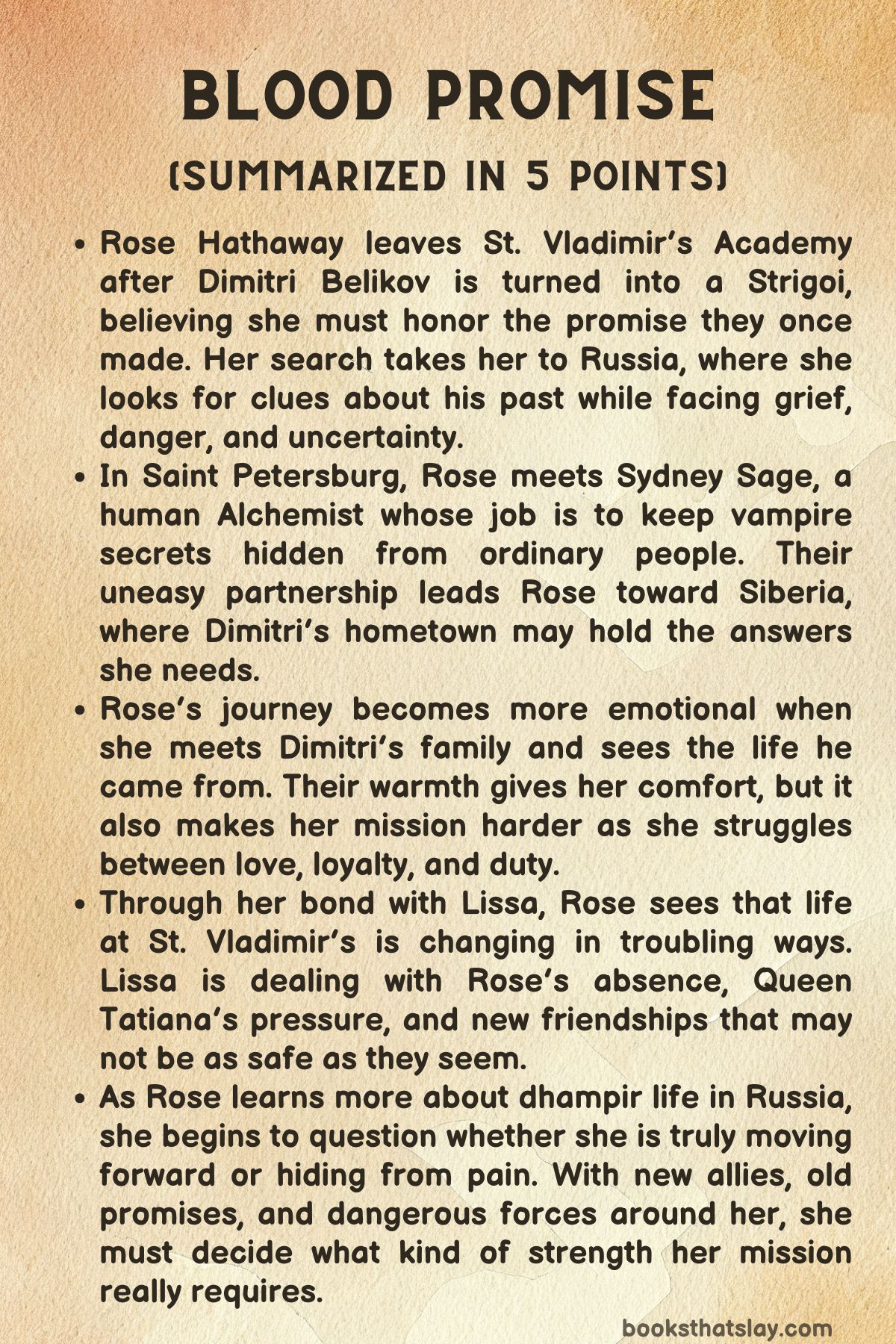
Summary
After Dimitri Belikov is turned into a Strigoi, Rose Hathaway leaves St. Vladimir’s Academy and abandons the future that had once seemed certain. She had trained to become a guardian, and her duty was supposed to be protecting her best friend, Lissa Dragomir.
But Dimitri’s transformation changes everything. To Rose, the man she loved is gone, and what remains is an undead creature wearing his face.
She believes Dimitri would rather be dead than live as a Strigoi, and because of that belief, she goes to Russia to find him and kill him.
Rose begins her search in Saint Petersburg, hoping to locate Moroi or dhampirs who can lead her to Dimitri’s Siberian hometown. She watches an elite Moroi club called the Nightingale, where Moroi gather with dhampirs who have chosen lives outside the guardian system.
Rose questions a dhampir woman and a guardian, but neither gives her the answers she needs. Her search is lonely and uncertain, and she is forced to rely on instinct, memory, and the small pieces of information Dimitri once shared about his past.
After leaving the club, Rose realizes she is being followed. She expects danger, but her pursuer turns out to be Sydney Sage, a human Alchemist.
Sydney knows about Moroi, dhampirs, and Strigoi, though she views their world with discomfort and suspicion. Her role is to help hide supernatural activity from ordinary humans.
When a Strigoi attacks them, Rose kills it, and Sydney uses an Alchemist chemical to dissolve the body and erase the evidence. The encounter shows Rose that Sydney’s organization is powerful, secretive, and deeply involved in keeping vampire society hidden.
Rose asks Sydney for help finding a dhampir village near Omsk, which may be connected to Dimitri’s family. Sydney does not simply hand over the location.
Instead, her superiors order her to escort Rose there herself. The two travel by train through Moscow and toward Siberia.
Their relationship is tense at first. Sydney dislikes vampires and dhampirs, and Rose has little patience for anyone standing between her and Dimitri.
Yet their journey slowly reveals how both women are bound by systems larger than themselves.
During the trip, Rose continues to check on Lissa through their psychic bond. Although Rose has left her behind, the bond still pulls Rose back into Lissa’s life.
At St. Vladimir’s, Lissa is suffering from Rose’s absence and trying to manage the pressure of being the last Dragomir. Queen Tatiana places new demands on her, and the school changes when Eugene Lazar replaces Kirova as headmaster.
He arrives with his daughter Avery, his son Reed, and Avery’s guardian Simon. Lissa first distrusts Avery, assuming she is meant to spy on her, but after seeing Avery argue with her father, Lissa begins to view her as lonely and misunderstood.
Rose and Sydney eventually reach Omsk, buy a car, and continue toward the village. They stop for the night at a remote house, where Rose senses Strigoi nearby.
When she goes outside, two Strigoi attack her. The fight is brutal, and Rose’s shadow-kissed abilities bring ghosts into the battle.
The ghosts distract the Strigoi long enough for Rose to kill them, but the effort drains her completely. She passes out and later wakes in Baia, Dimitri’s hometown, under the care of Olena Belikova, Dimitri’s mother.
Being in Baia shakes Rose in ways she did not expect. She meets Dimitri’s family: his mother Olena, his sisters Karolina, Sonya, and Viktoria, his grandmother Yeva, and the children in the household.
The Belikov home is filled with reminders of the man Dimitri used to be. Rose sees where he came from, hears family stories, and feels the warmth of people who loved him before she ever knew him.
Their kindness comforts her, but it also deepens her grief and guilt.
Rose eventually tells the family the truth: Dimitri was not killed in the ordinary way, but turned into a Strigoi. The news devastates them.
They choose to treat him as dead, because to them, the real Dimitri would never willingly exist as a Strigoi. The family holds a memorial service for him, and Rose feels the weight of what she has brought into their home.
She knows honesty was necessary, but watching Dimitri’s family mourn makes her mission even harder.
While Rose stays in Baia, a mysterious Moroi named Abe Mazur begins taking an interest in her. He is powerful, wealthy, and surrounded by guardians.
Known as “Zmey,” he carries influence that makes others uneasy. Abe pressures Rose to leave Baia, but she refuses.
She is not ready to move on, and part of her is drawn to the life Dimitri left behind. The Belikov family gives her a temporary sense of belonging, even though she knows she came to Russia for a darker purpose.
Rose also meets Oksana and Mark, a Moroi and dhampir pair bonded in a way that resembles Rose and Lissa’s connection. Through them, Rose learns more about spirit and the burden carried by shadow-kissed guardians.
Mark explains that the darkness Rose absorbs from Lissa may be something Lissa can heal, because once the darkness is inside Rose, it becomes like an illness. This gives Rose a new way to think about the mental strain she has been carrying, though it does not solve her immediate problems.
Meanwhile, Lissa’s situation grows worse. Through the bond, Rose sees her becoming closer to Avery.
Lissa starts drinking more, partying, ignoring responsibilities, and distancing herself from Christian and Adrian. Her behavior becomes more reckless, and Rose senses that something is wrong, even if she cannot fully understand it from so far away.
Adrian continues reaching Rose in dreams, worried about Lissa and frustrated by Rose’s refusal to come home. He challenges Rose, but she remains focused on Dimitri.
In Baia, Rose learns more about the lives of dhampirs outside the formal guardian world. She meets Denis and other young dhampirs who hunt Strigoi recklessly for revenge and excitement.
Their anger is understandable, but their methods are dangerous and careless. Rose sees how easily grief can turn into self-destruction.
She rejects their invitation to join them, recognizing that their path is not the same as hers, even though she too is driven by loss.
Rose also grows close to Viktoria, Dimitri’s younger sister. But when she discovers Viktoria is involved with Rolan, an abusive Moroi blood-drinker, Rose becomes alarmed.
Rolan has used women in the Belikov family before and now seems to be taking advantage of Viktoria. Rose wants to protect her, but she has limited power in the village.
She turns to Abe for help, and he agrees to use his influence against Rolan on one condition: Rose must leave Baia.
Rose accepts Abe’s demand because Viktoria’s safety matters. Abe forces Rolan away, but Viktoria reacts with anger and hurt when she learns Rose interfered.
She tells Rose she does not belong in the family. The words cut deeply because part of Rose had begun pretending she could stay there, surrounded by Dimitri’s memories, instead of facing the reason she came to Russia.
That confrontation forces Rose to see the truth. She has been hiding in Dimitri’s past because it is easier than hunting the Strigoi he has become.
Baia gave her comfort, family, and a place to grieve, but it also delayed her mission. Rose realizes she cannot keep living among Dimitri’s loved ones while avoiding the promise that brought her there.
With pain and uncertainty, she leaves the Belikov home.
Before moving forward, Rose reaches through the bond to Lissa again, still worried by what she has seen. Her own life is filled with danger and unresolved grief, but Lissa’s behavior shows that trouble is growing back at St. Vladimir’s as well.
Rose is caught between two loyalties: the friend she abandoned and the man she came to kill. Blood Promise follows her as she tries to honor love without losing herself to it, and as she learns that keeping a promise can demand more strength than making one.
Characters
In Blood Promise, the characters are shaped by grief, loyalty, power, temptation, and the painful difference between love and duty. Each major character reflects a different part of Rose’s emotional and moral journey, especially as she tries to understand what it means to honor Dimitri, protect Lissa, and survive the consequences of being shadow-kissed.
Rose Hathaway
Rose Hathaway is the emotional center of the book and one of its most conflicted characters. She begins the story driven by grief and love after Dimitri Belikov is turned into a Strigoi.
Her decision to leave St. Vladimir’s Academy and travel to Russia shows her fierce loyalty, but it also reveals how deeply pain can narrow her sense of purpose. Rose believes she is honoring Dimitri by hunting him, because she knows the real Dimitri would never want to exist as a Strigoi.
This makes her mission both an act of love and an act of violence, and that contradiction gives her character much of its emotional depth.
Rose is also struggling with identity. She has always seen herself as Lissa’s protector, yet in this part of the story she abandons that role to follow a personal mission.
This does not mean she stops caring about Lissa; in fact, her bond with Lissa continues to pull her emotionally back to the life she left behind. However, Rose is no longer able to live only as someone else’s guardian.
Her time in Russia forces her to confront her own grief, desires, guilt, and exhaustion. She is brave and skilled, but she is also impulsive, wounded, and vulnerable to emotional escape.
Her stay with Dimitri’s family reveals a softer side of her. Rose is usually direct, sharp, and defensive, but around the Belikovs she becomes almost desperate for belonging.
Their home gives her a glimpse of the life Dimitri had before he became a guardian and before tragedy changed him. At the same time, Rose’s comfort there becomes dangerous because it tempts her to stop moving forward.
Viktoria’s anger toward her is painful, but it also forces Rose to recognize that she has been hiding inside Dimitri’s past instead of facing her mission.
Rose’s shadow-kissed abilities add another layer to her character. The ghosts she summons during the Strigoi attack show that her connection to death is becoming stronger and more unstable.
She is not simply a warrior dealing with ordinary trauma; she is absorbing darkness through her bond with Lissa, and that darkness affects her mentally and spiritually. Rose’s strength in the book comes not from being fearless, but from continuing to act even when fear, grief, and uncertainty are overwhelming her.
Dimitri Belikov
Dimitri Belikov is physically absent for much of the story, yet his presence dominates Rose’s thoughts and choices. He exists in the book as both a memory and a mission.
To Rose, Dimitri represents love, discipline, honor, and the kind of strength she has always admired. His transformation into a Strigoi is devastating because it corrupts everything he stood for.
Rose’s belief that he would rather be dead than undead shows how deeply she understands his values, but it also places an unbearable responsibility on her.
Dimitri’s character is explored through the people who knew him before Rose did. His mother, sisters, grandmother, and village all reveal parts of him that Rose had never fully seen.
Through them, Dimitri becomes more than Rose’s mentor and lover; he becomes a son, brother, uncle, and member of a close-knit community. This makes his loss feel larger and more human.
The reader sees that Dimitri’s tragedy affects not only Rose but an entire family whose love for him remains strong even after he has become something monstrous.
The idea of Dimitri also challenges Rose’s morality. Killing Strigoi is something she has trained for, but killing Dimitri is different because love makes the act emotionally impossible and morally complicated.
Dimitri’s role in Blood Promise is therefore not only as a lost beloved figure, but also as the standard by which Rose measures duty, honor, and sacrifice. Even when he is not directly present, he shapes the emotional direction of the story.
Sydney Sage
Sydney Sage is an important contrast to Rose because she belongs to the hidden human world that manages vampire secrecy from the outside. As an Alchemist, Sydney is practical, controlled, and uneasy around vampires and dhampirs.
Her job is to hide supernatural evidence, not to become emotionally involved in vampire society. This makes her first interactions with Rose tense, because Sydney views Rose through suspicion and professional discomfort rather than friendship.
Sydney’s character is defined by duty, but it is a different kind of duty from Rose’s. Rose acts from emotion and loyalty, while Sydney acts from training, rules, and obedience to her superiors.
Her decision to escort Rose instead of simply giving her directions shows that Sydney is bound by a system larger than herself. She may not like Rose’s world, but she understands enough about it to survive within its borders.
Despite her guarded attitude, Sydney is not cold. Her actions after the Strigoi attack show courage and competence, even though she is not a fighter like Rose.
She handles the dead Strigoi with disturbing efficiency, proving that her role in the supernatural world is grim and necessary. Sydney helps expand the story beyond Moroi and dhampir society, showing that humans are also entangled in the consequences of vampire existence.
Lissa Dragomir
Lissa Dragomir’s role in the story is marked by loneliness, vulnerability, and emotional instability. Rose’s absence leaves a deep wound in her life because their bond has always been more than friendship.
Lissa is not simply missing someone she loves; she is missing the person who has protected, understood, and emotionally anchored her. Without Rose, Lissa becomes more exposed to manipulation, pressure, and her own darker impulses.
Her struggles at St. Vladimir’s show how fragile her position is. As a royal Moroi and spirit user, Lissa carries expectations that other students do not.
Queen Tatiana’s interest in her future and the political world surrounding her create pressure that she is not fully prepared to handle. Lissa’s growing closeness with Avery seems at first like a possible source of comfort, but it also leads her toward reckless behavior, partying, drinking, and emotional distance from Christian and Adrian.
Lissa’s connection to Rose remains one of the most important elements of her character. Through the bond, Rose sees that something is wrong, but distance prevents her from fully helping.
This creates a painful reversal: Rose has always protected Lissa physically, but now Lissa’s emotional danger is happening where Rose cannot reach her. Lissa’s arc in the book shows how easily grief and loneliness can make a person vulnerable to influence, even when that person is kind, powerful, and intelligent.
Queen Tatiana
Queen Tatiana represents authority, royal pressure, and political control. Her involvement in Lissa’s life shows how the Moroi ruling class often treats young royals as pieces in a larger social and political game.
Tatiana is not presented as warm or nurturing; she is strategic and demanding. Her interest in Lissa’s future guardians suggests that she sees Lissa less as a grieving young woman and more as a royal asset whose life must be managed.
Tatiana’s presence also reveals how difficult it is for Lissa to have personal freedom. While Rose is physically traveling through Russia, Lissa is trapped in a different kind of world: the world of royal expectations, court politics, and social manipulation.
Tatiana increases the sense that Lissa’s life is being watched and shaped by powerful adults who may not care about her emotional needs.
Eugene Lazar
Eugene Lazar’s arrival as the new headmaster changes the atmosphere at St. Vladimir’s. He represents institutional control and the influence of royal politics within the school.
His appointment is not just an administrative change; it signals that the academy is being drawn more tightly into the priorities of the Moroi elite. Through Eugene, the story shows how adult power can reshape the lives of students who are already dealing with grief and danger.
His relationship with Avery is especially revealing. Lissa sees Avery fighting bitterly with him, which complicates her first impression of Avery as merely a spy.
Eugene appears to be a controlling and difficult father, and this helps explain Avery’s loneliness. His presence therefore affects the plot not only through his authority but also through the emotional damage visible in his family.
Avery Lazar
Avery Lazar is introduced in a way that makes her seem suspicious, especially from Lissa’s point of view. Because she arrives with her powerful father, Lissa initially assumes Avery may be there to observe or manipulate her.
However, Avery soon appears lonely, unhappy, and emotionally wounded by her relationship with Eugene. This makes her seem sympathetic and gives Lissa a reason to lower her guard.
Avery’s importance lies in the way she enters Lissa’s life when Lissa is emotionally vulnerable. She offers companionship at a time when Lissa feels abandoned by Rose and pressured by the royal world.
However, the changes in Lissa’s behavior after growing closer to Avery create unease. Lissa becomes more reckless and more distant from the people who truly care about her.
Avery therefore functions as both a companion and a warning sign, because her influence appears tied to Lissa’s emotional decline.
Reed Lazar
Reed Lazar is part of Avery’s family circle and contributes to the uneasy atmosphere surrounding the Lazars. Though he is less developed than Avery, his presence reinforces the sense that this family has its own tensions and secrets.
He is connected to the new power structure at St. Vladimir’s through his father, and his arrival helps make Lissa’s school environment feel unfamiliar and unstable.
Reed’s role is important because he is part of the world that begins closing in around Lissa while Rose is gone. Even when he is not central to the action, he adds to the impression that Lissa is surrounded by people whose motives are not entirely clear.
Simon
Simon, Avery’s guardian, represents watchfulness and controlled strength. His presence emphasizes Avery’s status and the seriousness of the Lazar family’s arrival at St. Vladimir’s.
Guardians are usually symbols of protection, but Simon’s role also creates suspicion because he is tied to a family that Lissa does not fully trust.
As a character, Simon adds tension rather than emotional openness. He is part of the protective structure around Avery, but that protection also makes Avery’s world feel guarded and secretive.
His presence helps underline the difference between true emotional safety and the appearance of safety.
Olena Belikova
Olena Belikova, Dimitri’s mother, is one of the most emotionally significant characters in Rose’s time in Baia. She represents maternal warmth, family strength, and the pain of losing a son.
When Rose wakes in her care, Olena becomes a source of comfort during one of Rose’s most fragile moments. Her kindness makes the Belikov household feel safe, which is especially powerful because Rose has spent so much of the story surrounded by danger.
Olena’s grief after learning what happened to Dimitri is quiet but devastating. She treats his transformation into a Strigoi as a kind of death, which shows how deeply Moroi and dhampir culture view becoming Strigoi as the loss of the true self.
Her response gives Rose permission to mourn, but it also increases Rose’s guilt because Rose has brought this terrible truth into the family’s home.
Olena also helps Rose see Dimitri as part of a family history. Through her, Dimitri becomes less like an idealized warrior and more like a beloved son.
This deepens Rose’s grief because she is forced to understand the full human cost of what happened to him.
Karolina Belikova
Karolina Belikova, one of Dimitri’s sisters, helps show the ordinary family life Dimitri came from. Her presence in the household gives Rose a sense of continuity, domestic warmth, and shared grief.
Karolina is part of the family structure that welcomes Rose, making Rose feel connected to Dimitri in a way that is both healing and painful.
Karolina’s role also reflects the realities of dhampir village life. Through her and the other women in Baia, Rose sees a world where dhampir women often live apart from the guardian path Rose has chosen.
This challenges Rose’s understanding of what dhampir life can become and forces her to compare her own choices with the lives of women connected to Moroi men, children, and family obligations.
Sonya Belikova
Sonya Belikova adds another layer to the story’s portrayal of dhampir women and their vulnerabilities. Her connection to Rolan, especially the fact that he got her pregnant, shows the exploitative relationships that can exist between Moroi men and dhampir women.
Sonya’s situation reveals how power, desire, and dependence can create lasting consequences.
Through Sonya, the book shows that danger does not only come from Strigoi. Emotional exploitation, social inequality, and irresponsible Moroi behavior can also damage dhampir lives.
Sonya’s role helps Rose understand the darker side of the society Dimitri came from and the limited choices faced by many dhampir women.
Viktoria Belikova
Viktoria Belikova is one of the most important members of Dimitri’s family for Rose’s emotional development. Young, passionate, and vulnerable, Viktoria reminds Rose of the dangers that can come from wanting love and attention in a society where dhampir women are often undervalued.
Her relationship with Rolan alarms Rose because Rose recognizes that Viktoria is being used.
Rose’s attempt to protect Viktoria comes from genuine concern, but it also exposes Rose’s habit of taking control without fully considering how others will feel. Viktoria’s anger after Rose interferes is painful because it attacks Rose’s sense of belonging in the Belikov family.
When Viktoria tells Rose she does not truly belong there, the words hurt because they are partly true. Rose has found comfort in Dimitri’s family, but she cannot replace Dimitri, and she cannot remain there forever.
Viktoria’s role is therefore crucial because she forces Rose to wake up emotionally. Through Viktoria, Rose realizes that staying in Baia has become a way of avoiding her promise.
Viktoria may be young and mistaken about Rolan, but her anger cuts through Rose’s denial and pushes Rose back toward action.
Yeva Belikova
Yeva Belikova, Dimitri’s grandmother, brings mystery, tradition, and sharp perception into the Belikov household. She has an unsettling presence because she seems to understand more than she directly explains.
Her age and authority make her feel connected to older customs and deeper knowledge within the dhampir community.
Yeva’s role is important because she adds spiritual and cultural weight to Rose’s time in Baia. While Olena offers warmth, Yeva offers insight that can feel uncomfortable.
She reminds Rose that family and grief are not simple comforts; they also carry truth, duty, and consequences. Yeva helps make the Belikov home feel rooted in history, not just emotion.
Abe Mazur
Abe Mazur is mysterious, powerful, and intimidating. His nickname, “Zmey,” gives him an almost legendary quality, suggesting danger and influence.
When he approaches Rose with guardians and pressures her to leave Baia, he immediately becomes a figure of suspicion. He is not physically threatening in the same direct way as Strigoi, but his power comes from connections, information, and the ability to control situations from behind the scenes.
Abe’s interest in Rose makes him difficult to read. He appears dangerous, but he is also useful.
When Rose needs help protecting Viktoria from Rolan, Abe is able to act with speed and authority. This shows that his power is real and that he knows how to move through hidden networks of influence.
Abe complicates Rose’s world because he is neither clearly enemy nor friend.
His character also mirrors one of the book’s larger ideas: power does not always look like combat. Rose understands physical danger easily, but Abe represents social and political power, which can be harder for her to fight.
He unsettles her because he can pressure her without needing to defeat her in battle.
Mark
Mark is a dhampir bonded to Oksana, and his role is especially important because he gives Rose a new understanding of the shadow-kissed bond. Like Rose, he carries the effects of being connected to a spirit user.
However, unlike Rose, he has lived with that bond long enough to understand it more deeply. This makes him a guide for Rose at a moment when she badly needs answers.
Mark’s explanation that spirit users may be able to heal the darkness absorbed by their bonded guardians gives Rose hope. Until this point, Rose has seen the darkness as something she simply has to endure.
Mark suggests that it might be treatable, which changes how Rose understands her connection to Lissa. His calmness and experience contrast with Rose’s confusion and emotional exhaustion.
Mark also represents a possible future for Rose: a bonded guardian who survives not only through strength, but through communication, trust, and healing. His relationship with Oksana shows that the bond does not have to be only a burden; it can also become part of a balanced partnership.
Oksana
Oksana is a Moroi spirit user whose presence helps expand the story’s understanding of spirit magic. She is important because she shows that Lissa is not alone in her abilities and that spirit can be understood outside the limited knowledge available at St. Vladimir’s.
Through Oksana, Rose learns that spirit is not only dangerous and mysterious; it can also heal.
Oksana’s relationship with Mark gives Rose a model of emotional and magical balance. Unlike Lissa and Rose, who are separated and struggling, Oksana and Mark appear to have learned how to manage the effects of their bond together.
This makes Oksana a quiet but meaningful figure in the story. She represents knowledge, healing, and the possibility that the darkness Rose carries may not have to consume her.
Adrian Ivashkov
Adrian Ivashkov remains emotionally connected to Rose even while she is in Russia. Through dreams, he reaches out to her, argues with her, worries about her, and tries to pull her attention back to the people she left behind.
Adrian’s role is complicated because he cares for Rose, but he also cannot force her to return or heal from her grief. His frustration comes from helplessness as much as affection.
Adrian is also important because of his concern for Lissa. As another spirit user, he understands some of the emotional instability and danger surrounding her.
His worry suggests that Lissa’s behavior is not ordinary teenage rebellion but something more serious. Adrian’s dream visits serve as reminders that Rose’s life is still connected to St. Vladimir’s, even when she tries to separate herself from it.
His character brings emotional honesty to the story. Adrian often hides behind sarcasm and charm, but his concern for Rose and Lissa shows sincerity.
He is flawed, but he is observant, loyal in his own way, and more emotionally perceptive than many characters give him credit for.
Christian Ozera
Christian Ozera’s importance is seen mostly through Lissa’s growing distance from him. He represents one of Lissa’s healthiest emotional connections, so when she begins pulling away from him, it signals that something is wrong.
Christian is sharp, skeptical, and emotionally guarded, but his relationship with Lissa is based on real care rather than social advantage.
His role in this part of the story is quieter, but still significant. Christian’s distance from Lissa shows how Avery’s influence and Lissa’s grief are disrupting her closest relationships.
He functions as a measure of Lissa’s emotional state: the more she withdraws from him, the clearer it becomes that she is slipping into dangerous behavior.
Christian also contrasts with the royal world around Lissa. Unlike Tatiana or the Lazars, he is not trying to use Lissa for status or control.
His importance lies in the fact that he cares about who Lissa is, not just what she represents.
Denis
Denis represents a dangerous path that Rose could have taken. He and the other young dhampirs who hunt Strigoi recklessly are driven by revenge, excitement, and anger.
Their behavior resembles courage on the surface, but it lacks discipline and purpose. Through Denis, the story shows the difference between true guardian training and reckless violence.
Rose’s rejection of Denis and his group reveals her maturity. Although she is also hunting Strigoi, she understands that their approach is careless and self-destructive.
Denis helps reflect Rose’s own danger back at her. She can see in him the same grief and rage that partly drive her, but without the moral focus that gives her mission meaning.
Denis is important because he shows how trauma can turn into a hunger for violence. His character warns that fighting monsters can become its own kind of addiction if it is not guided by duty, love, or self-control.
Rolan
Rolan is one of the clearest examples of exploitation in the book. As a Moroi who drinks from and uses dhampir women, he represents the imbalance of power between Moroi men and vulnerable dhampir women in the village.
His involvement with Viktoria is disturbing not only because he is abusive, but also because he has already hurt Sonya by getting her pregnant.
Rolan’s character shows that not all threats are supernatural. He is not Strigoi, but his behavior is predatory and harmful.
He takes advantage of affection, status, and social inequality. Through him, Rose sees a form of danger that cannot be solved by staking a monster in battle.
It requires influence, intervention, and social power, which is why she turns to Abe.
Rolan’s role also helps expose the limits of Rose’s control. She can recognize that he is bad for Viktoria, and she can arrange for him to be removed, but she cannot make Viktoria understand or accept the truth immediately.
His presence creates one of the emotional conflicts that finally pushes Rose to leave Baia and continue facing the promise she made to Dimitri.
Themes
Grief and the Burden of Love
Rose’s journey is shaped by grief that refuses to stay quiet. Her love for Dimitri does not end when he becomes Strigoi; instead, it becomes heavier because she believes killing him is the last loyal act she can offer him.
In Blood Promise, love is not shown as simple comfort but as something that demands painful choices. Rose’s arrival in Baia makes her grief more personal because Dimitri is no longer only a lost lover or a fallen guardian; he becomes a son, brother, uncle, and part of a family that still loves him.
Seeing his home and relatives forces Rose to understand the full human cost of what happened to him. Her promise to Dimitri becomes harder because she is surrounded by people who mourn him as dead, while she knows his body still exists as something dangerous.
The theme shows that love can survive loss, but survival does not always bring peace.
Duty Versus Emotional Escape
Rose repeatedly struggles between doing what she came to Russia to do and surrendering to the comfort of delay. Baia gives her a temporary refuge from the harshness of her mission.
Dimitri’s family welcomes her, and for a while she allows herself to belong to a life that might have been hers. This emotional pause is understandable, but it also becomes a form of avoidance.
Her promise to Dimitri requires action, yet her grief makes inaction tempting. The contrast between her guardian training and her private pain shows how duty is not only about physical bravery; it also requires emotional honesty.
Rose can fight Strigoi, protect others, and face danger, but the harder task is admitting that staying with Dimitri’s family is keeping her from her purpose. Her eventual decision to leave shows growth because she stops hiding inside memory and accepts that love cannot excuse abandoning responsibility.
Identity, Belonging, and Displacement
Rose spends much of the story caught between places, roles, and versions of herself. She is no longer at St. Vladimir’s, no longer acting as Lissa’s protector in person, and not fully part of Dimitri’s world despite being welcomed by his family.
Russia becomes a place where she searches for Dimitri but also confronts who she is without the familiar structure of school, training, and friendship. Her connection to the Belikov family offers warmth, yet Viktoria’s anger reminds her that grief does not automatically make her family.
Sydney also reflects this theme because she belongs to a hidden human order that knows about vampires but remains separate from them. Lissa’s experiences create a parallel sense of displacement: without Rose, she becomes vulnerable to influence and loses her emotional balance.
Blood Promise uses these separations to show that belonging is fragile when identity depends too much on another person.
Control, Influence, and Emotional Vulnerability
Many characters are shaped by forces that push them away from clear judgment. Rose is pulled by grief, guilt, love, and the bond with Lissa, while Lissa becomes increasingly affected by loneliness, pressure, and Avery’s presence.
The psychic bond gives Rose insight, but it also exposes her helplessness because she can witness Lissa’s decline without being able to step in directly. This creates a painful kind of knowledge: Rose can see danger forming but cannot control it.
Avery’s influence over Lissa shows how emotional vulnerability can be exploited when someone feels abandoned or misunderstood. Abe’s pressure on Rose adds another form of control, using power and connections rather than emotional manipulation.
Even Viktoria’s relationship with Rolan shows how affection and attention can become tools of harm. Through these situations, the story suggests that control is often most dangerous when it appears as comfort, protection, or intimacy.