Dead and Gone Summary, Characters and Themes
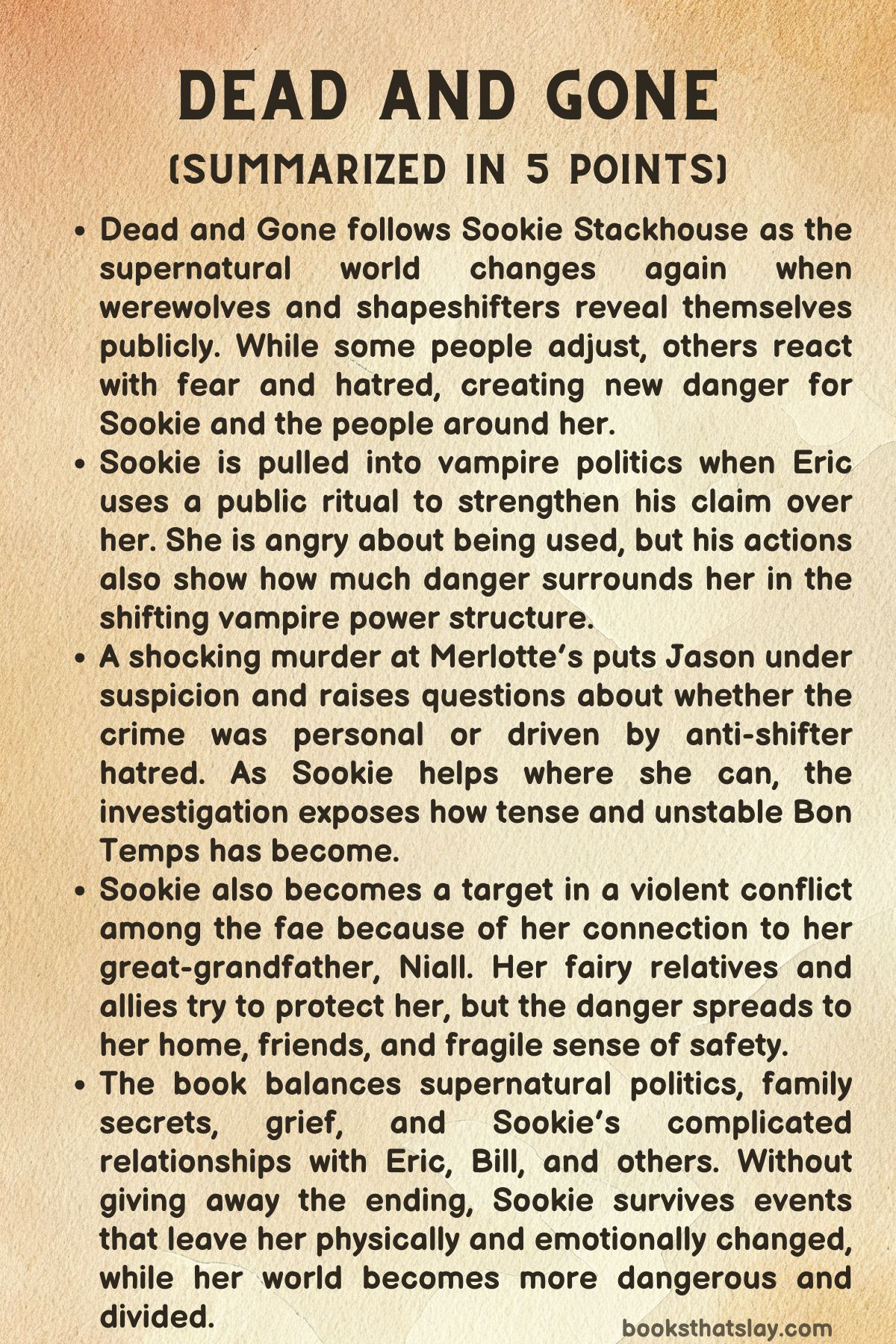
Dead and Gone by Charlaine Harris is the ninth novel in The Southern Vampire Mysteries, an urban fantasy series centered on Sookie Stackhouse, a telepathic waitress in Bon Temps, Louisiana. In this book, the hidden supernatural world becomes even more exposed when weres and shapeshifters reveal themselves to humans.
The announcement brings fear, curiosity, violence, and political tension. At the same time, Sookie is drawn into vampire power struggles and a deadly fairy conflict connected to her own bloodline. The story follows her as she faces betrayal, murder, family secrets, and the painful cost of survival.
Summary
Dead and Gone begins in Bon Temps, Louisiana, where Sookie Stackhouse works at Merlotte’s Bar and Grill. Vampires are already known to the public, but another hidden supernatural group is preparing to reveal itself.
Werewolves and shapeshifters decide that the time has come for humans to know they exist. Sam Merlotte, Sookie’s boss and close friend, takes part in this public announcement by changing into his collie form in front of the customers at Merlotte’s.
Tray Dawson also reveals that he is a Were, and other transformations are shown elsewhere.
The reaction is mixed. Some people are frightened, some are curious, and others accept the news better than expected.
For a short time, Merlotte’s loses some business, but things begin to return to normal. Not everyone is willing to accept the two-natured, however.
Arlene Fowler, Sookie’s coworker and former friend, reacts with anger and disgust. She has become involved with the Fellowship of the Sun, an extremist anti-supernatural group, and the reveal strengthens her hatred.
She quits her job and cuts herself further away from Sookie and Sam.
Soon after the announcement, Sam receives terrible news from Texas. His mother, who is also a shapeshifter, has been shot by his stepfather after revealing her true nature.
Sam leaves Bon Temps to be with his family and asks Sookie to help manage the bar while he is gone. Sookie agrees, although her own life is already under pressure from several directions.
At the same time, vampire politics grow more dangerous. Felipe de Castro, the King of Nevada, has taken control of Louisiana after the fall of Queen Sophie-Anne.
Eric Northman, the vampire sheriff of Area Five, is in a difficult position because he is one of the few surviving leaders from the old Louisiana rule. Victor Madden, Felipe’s representative, watches Eric closely and seems eager to weaken him.
Eric worries that Felipe may try to claim Sookie for her telepathic ability. Her gift is valuable to vampires, especially in business and political dealings.
To protect his own claim over her, Eric tricks Sookie into taking part in a vampire marriage ritual. Sookie does not understand the meaning of the ceremony until it is too late.
Among vampires, she is now considered tied to Eric. She is furious because he made the decision without her full knowledge or consent.
Eric argues that he acted to protect her, but Sookie sees the act as another example of supernatural beings using her for their own purposes.
Sookie also receives attention from the FBI. Agents Sara Weiss and Tom Lattesta come to question her about the disaster at the Pyramid of Gizeh hotel, where she helped find survivors after a bombing.
They suspect that Sookie has an unusual ability, and their interest makes her nervous. She knows that if the government fully understands her telepathy, she could lose control over her own life.
Before that threat can fully develop, a murder shakes Bon Temps. Crystal Norris Stackhouse, Jason’s pregnant wife, is found brutally killed and displayed behind Merlotte’s.
Crystal was a werepanther from Hotshot, and her death appears to be a public act of hatred against the newly revealed two-natured. Because Crystal and Jason had a troubled marriage, Jason becomes a possible suspect.
Sookie does not believe he killed her, and Jason has an alibi, but the murder increases fear throughout the community.
The crime seems connected to the anger stirred up by the shapeshifter reveal. Sookie begins to wonder whether the Fellowship of the Sun or other anti-supernatural humans are responsible.
Her suspicions deepen when Arlene contacts her and tries to draw her into a trap. Arlene, now fully influenced by the Fellowship, helps arrange for Sookie to be attacked and possibly killed in the same manner as Crystal.
Sookie realizes what is happening in time and calls for help. A confrontation follows, leading to arrests and violence.
Although Arlene and her associates are guilty of plotting against Sookie, Sookie later understands that they did not murder Crystal. They were planning a copycat crime.
The real danger comes from another part of Sookie’s life: her fairy heritage. Sookie has learned that her great-grandfather is Niall Brigant, a powerful fairy prince.
This connection brings her into a violent conflict within the fairy world. Niall’s enemies believe that fairies have weakened themselves by mixing with humans.
They want to destroy humans with fairy blood, including Sookie and Jason. Two especially cruel fairies, Lochlan and Neave, are central to this campaign of violence.
Sookie discovers that the fairy conflict is tied to old wounds in her own family. Lochlan and Neave were involved in the deaths of her parents, and they also killed Crystal, not because of a human hate movement but for their own cruel amusement.
This truth makes the situation even more horrifying. Crystal’s death was not only a murder but also part of a larger pattern of fairy violence touching Sookie’s family and community.
As the fairy war grows more dangerous, Sookie’s friends and protectors try to keep her safe. Claudine, her fairy godmother, remains one of her most important allies.
Tray Dawson also helps protect her, while Amelia Broadway, Sookie’s witch roommate, is emotionally connected to Tray. Bill Compton, Sookie’s former vampire lover, continues to watch over her from a distance.
Although their romantic relationship has ended, Bill remains loyal and ready to risk himself for her.
Eric also stays close to Sookie, even while their relationship remains complicated. She is still angry about the vampire marriage ritual, but she cannot deny that Eric is deeply involved in her safety.
Their bond grows stronger through danger, blood, and shared secrets. Eric reveals more of his past to her, including memories of his human life and the vampire who made him.
These moments show Sookie a more personal side of him, though he remains powerful, possessive, and difficult to trust completely.
The fairy conflict reaches its most brutal point when Lochlan and Neave capture Sookie. They torture her severely, using her pain as a weapon against Niall.
Sookie suffers terrible injuries and trauma. Bill finds her and rescues her, but he is injured by silver in the process.
His actions prove that his loyalty to Sookie remains strong despite everything that has happened between them.
The final confrontation brings heavy losses. Claudine is killed, which devastates Sookie.
Claudine had been a protector, guide, and link to the fairy world, and her death makes the conflict deeply personal. Tray Dawson also dies, leaving Amelia heartbroken.
Eric and Bill help defeat Sookie’s enemies, and Niall faces the consequences of the war among his people.
After the battle, Niall decides that the fairy world must be sealed away from the human world. He believes that continued contact will only bring more death and suffering.
He says goodbye to Sookie and Jason before leaving. For Sookie, this farewell is painful because Niall is one of the few living links to her fairy family, but his departure also closes one dangerous chapter of her life.
By the end of Dead and Gone, Sookie survives, but she is physically wounded and emotionally changed. The shapeshifters have revealed themselves, and the human world is no longer able to ignore them.
Hatred against supernatural beings has turned violent. Vampire politics have tightened around Sookie through Eric’s claim.
The fairy world has taken loved ones from her and then closed itself away. Sookie remains alive, but her life is more dangerous, more exposed, and more lonely than before.
Characters
Sookie Stackhouse
Sookie Stackhouse is the emotional and moral center of Dead and Gone. In the book, she is shown as someone who is constantly pulled into supernatural conflicts even when she is simply trying to live an ordinary life and work at Merlotte’s.
Her telepathy makes her useful to vampires, federal agents, and supernatural communities, but it also makes her vulnerable because many people see her less as a person and more as a tool. Sookie’s strength lies in her endurance: she keeps managing the bar, helping others, protecting herself, and trying to understand the truth behind Crystal’s murder even while danger surrounds her from every side.
Her anger at Eric’s manipulation shows that she values her independence deeply, even when she is surrounded by powerful beings who try to make decisions for her. By the end of the story, Sookie is physically and emotionally wounded, but she survives with a clearer understanding of how dangerous her world has become.
Her character represents resilience, compassion, and the painful cost of being connected to many different supernatural worlds.
Eric Northman
Eric Northman is powerful, calculating, protective, and emotionally more complex than he first appears. His decision to bind Sookie to him through the ceremonial knife shows his manipulative side because he acts without her full understanding or consent.
At the same time, Eric believes that his claim over her is a form of protection in a dangerous vampire political climate. This makes him morally complicated: he cares for Sookie, but he often expresses that care through control.
His conversations about his human life, including his wife, children, and transformation into a vampire, reveal a more vulnerable side beneath his authority and confidence. Eric’s character in Dead and Gone becomes important because he stands at the intersection of love, power, protection, and possession.
His bond with Sookie grows stronger, but it remains uneasy because trust between them is damaged by his willingness to use vampire customs to secure what he wants.
Bill Compton
Bill Compton remains a loyal and significant figure in Sookie’s life despite the painful history between them. He is no longer simply her former lover; he becomes someone whose devotion is shown through action rather than persuasion.
His most important role comes when he finds and rescues Sookie after she is tortured by Lochlan and Neave. The fact that he suffers severe silver poisoning while saving her shows that his concern for her is genuine and self-sacrificing.
Bill’s character is marked by regret, loyalty, and quiet persistence. He does not dominate Sookie’s life in the same way Eric tries to, but he remains close enough to protect her when she is in terrible danger.
His presence reminds the reader that old emotional bonds do not disappear easily, even when romance has been broken.
Sam Merlotte
Sam Merlotte is one of the most sympathetic and burdened characters in the story. As a shapeshifter, he becomes directly affected by the public revelation of the two-natured, and his shift in front of Merlotte’s customers is both a personal risk and a political act.
Sam’s situation becomes even more painful when his mother reveals her own nature and is shot by his stepfather. This forces Sam to leave Bon Temps for Texas, showing how the Great Reveal does not simply create public controversy but also tears apart families.
Sam is practical, loyal, and trusting enough to leave Sookie in charge of the bar, but he is also vulnerable because his identity places him in danger from ordinary human prejudice. His character shows the cost of visibility for supernatural beings who want acceptance but must face hatred instead.
Arlene Fowler
Arlene Fowler becomes one of the clearest examples of human hatred and fear in the book. At first, she is connected to Sookie through work and ordinary small-town life, but her reaction to the shapeshifter revelation reveals the depth of her prejudice.
Her disgust toward Sam and the other “supes” shows how quickly familiar relationships can collapse when bigotry takes over. Arlene’s involvement with the Fellowship of the Sun makes her more dangerous because her hatred becomes organized and violent.
Her attempt to lure Sookie into a trap and have her crucified shows a complete moral fall. Arlene is frightening because she is not a distant monster; she is someone from Sookie’s everyday life who becomes capable of extreme cruelty.
Her character represents the danger of ordinary prejudice turning into fanatical violence.
Jason Stackhouse
Jason Stackhouse is placed in a painful and suspicious position after Crystal’s murder. Because Crystal was his estranged wife and had betrayed him, he becomes an obvious suspect, but his alibi clears him.
Jason is often flawed, impulsive, and emotionally immature, but in this part of the story he is also shown as someone caught in the consequences of relationships he cannot fully control. His connection to Crystal and the Hotshot community places him in the middle of grief, suspicion, and supernatural politics.
Jason’s role also matters because he shares Sookie’s fairy heritage, even if he does not understand that world as deeply as she does. When Niall says goodbye to both Sookie and Jason, Jason’s importance as part of the family line becomes clearer.
He is not as central to the supernatural conflicts as Sookie, but he is still tied to them by blood, marriage, and history.
Crystal Norris Stackhouse
Crystal Norris Stackhouse is a tragic character whose death drives much of the human and shifter conflict in the story. As Jason’s pregnant estranged wife and a werepanther, she is connected to both the Stackhouse family and the Hotshot panther community.
Her murder is brutal and symbolic, especially because she is crucified behind Merlotte’s, turning her death into an act of terror. Crystal was not portrayed as innocent in her personal relationships, particularly because of her betrayal of Jason, but her flaws do not lessen the horror of what happens to her.
Her death exposes the violence directed at the two-natured after their public revelation and also creates confusion over whether the motive is personal revenge, anti-shifter hatred, or both. Crystal’s character matters because even in death she reveals how vulnerable supernatural beings are when human prejudice and private resentment overlap.
Calvin Norris
Calvin Norris is the leaderly and grieving representative of the Hotshot werepanthers. His reaction to Crystal’s murder shows both personal sorrow and communal responsibility.
He and the other panthers try to understand what happened through scent and instinct, which emphasizes how their community operates by different rules from ordinary human law enforcement. Calvin is controlled, serious, and deeply tied to family and clan loyalty.
His grief is not only for Crystal as an individual but also for the violation committed against the Hotshot community. He represents an older, more traditional supernatural order that values blood ties, territory, and internal justice.
Through Calvin, the story shows that the two-natured are not just isolated individuals but members of close communities with their own ways of mourning and seeking justice.
Tray Dawson
Tray Dawson is loyal, brave, and ultimately tragic. His public shift alongside Sam helps mark the beginning of a new era for shapeshifters and werewolves, but it also places him among those exposed to human judgment.
Tray is closely connected to Amelia, and his death becomes one of the emotional casualties of the fairy war. He is not simply a fighter; he is someone whose presence gives Amelia stability and whose loss deeply affects her.
Tray’s character shows how people around Sookie often pay a terrible price for being near supernatural conflict. His death strengthens the sense that the fairy war is not distant or abstract but immediate, personal, and devastating.
Amelia Broadway
Amelia Broadway is important because she represents friendship, magic, and emotional vulnerability. As someone close to Sookie and romantically connected to Tray, she becomes another person harmed by the violence surrounding Sookie’s world.
Tray’s death devastates her, showing a softer and more wounded side of her character. Amelia is capable and magical, but her abilities do not protect her from grief.
Her role in the story reminds the reader that supernatural power does not prevent emotional suffering. She also shows how Sookie’s circle of friends is increasingly drawn into conflicts that began outside ordinary human life but now invade homes, relationships, and personal safety.
Niall Brigant
Niall Brigant is majestic, powerful, distant, and sorrowful. As Sookie’s great-grandfather, he connects her to the fairy world and reveals the importance of her bloodline.
He cares for Sookie, but his love is complicated by the violence and politics of the fae. Niall’s conflict with Breandan places Sookie in danger, showing that family heritage can be both a source of identity and a source of threat.
His farewell to Sookie and Jason is deeply significant because it closes a door between worlds. Niall is not a warm, ordinary grandfather figure; he belongs to an ancient and dangerous realm.
Yet his affection for Sookie is real, and his departure leaves her with both loss and protection, since closing the portals also cuts off some of the danger.
Claudine
Claudine is one of Sookie’s most protective fairy allies, and her death is one of the most painful losses in the story. She often serves as a guardian figure, standing between Sookie and the dangers of the fae world.
Her loyalty is not casual; she repeatedly acts to protect Sookie because of both duty and affection. Claudine’s death shows the seriousness of the fairy war and the heavy cost paid by those who try to defend Sookie.
Her character combines beauty, strength, warmth, and sacrifice. Losing her changes the emotional shape of Sookie’s world because it removes one of the few fairy presences that seemed genuinely caring and protective.
Claude
Claude is connected to Sookie through fairy blood and family ties, but he is more guarded and less openly nurturing than Claudine. His presence helps expand Sookie’s understanding of the fae world and its complicated loyalties.
Claude is beautiful, supernatural, and somewhat emotionally distant, which makes him feel less comforting than Claudine even when he is on Sookie’s side. He represents the mysterious and unsettling nature of fairy relatives: they may be family, but they do not always behave according to human expectations of warmth or openness.
His role is important because he helps show that Sookie’s fairy heritage is not simple or purely comforting; it is filled with danger, secrecy, and divided loyalties.
Breandan
Breandan is one of the major hostile forces in the fairy conflict. As an enemy of Niall, he directs violence toward those connected to Niall, which makes Sookie a target.
His hatred is political, personal, and hereditary, turning Sookie’s bloodline into a reason for attack. Breandan’s character represents the cruel divisions within the fae world.
He is dangerous not only because he has power but because he belongs to a conflict that has lasted beyond ordinary human understanding. Through him, the story shows that the fairy world is not gentle or whimsical; it is brutal, proud, and capable of devastating violence.
Lochlan
Lochlan is one of the most terrifying figures in the book because his cruelty is intimate and physical. Along with Neave, he captures and tortures Sookie, making him a direct embodiment of the fairy war’s brutality.
Lochlan does not merely threaten Sookie from a distance; he participates in her suffering in a deliberate and sadistic way. His character shows the darkest side of the fae, stripping away any romantic idea of fairies as harmless or beautiful beings.
He is important because his violence changes Sookie permanently, leaving her with trauma that cannot be easily dismissed after the conflict ends.
Neave
Neave is as cruel and frightening as Lochlan, and together they form one of the most brutal threats Sookie faces. Her participation in Sookie’s torture makes her a symbol of merciless fae violence.
Neave’s danger comes from her lack of pity and from the fact that she treats suffering as something to be inflicted with purpose. Like Lochlan, she helps reveal the savage reality beneath the beauty and mystery of the fairy world.
Her character matters because she forces Sookie into one of her most helpless and painful experiences, making survival itself an act of strength.
Victor Madden
Victor Madden represents the danger of vampire politics after Felipe de Castro’s rise to power. As Felipe’s representative, he is watchful, calculating, and politically significant.
His presence at Fangtasia during Eric’s knife ceremony makes the situation more dangerous because Eric’s actions are partly shaped by the need to protect Sookie in front of vampire authority. Victor is not emotionally close to Sookie, but his role matters because he represents outside power pressing into her life.
Through him, the story shows that vampire politics are formal, strategic, and threatening, even when violence is not immediate.
Felipe de Castro
Felipe de Castro does not need to appear constantly to influence the story. As the new vampire king, his power shapes the behavior of Eric and the political atmosphere around Sookie.
His rule creates pressure, uncertainty, and danger for those connected to the vampire world. Felipe represents authority at a distance: even when he is not directly present, his control affects the choices of others.
His importance lies in the way his rise changes the balance of power and makes Eric more determined to secure Sookie under his protection.
Quinn
Quinn’s role is smaller but emotionally meaningful because his blocked attempt to see Sookie shows how Eric’s claim interferes with Sookie’s personal freedom. Quinn represents a connection from Sookie’s past that is pushed aside by vampire politics.
The fact that Eric’s maneuver prevents Quinn from reaching her reinforces Sookie’s anger and highlights how supernatural claims can control relationships. Quinn’s character in this part of the story is less about direct action and more about what his exclusion reveals: Sookie’s life is increasingly being shaped by decisions made by powerful men around her.
Sara Weiss
Sara Weiss is one of the FBI agents who approaches Sookie because of her involvement in the Rhodes bombing aftermath. Her role introduces federal attention into Sookie’s life, showing that Sookie’s telepathy has not gone unnoticed by human authorities.
Sara is important because she represents official human curiosity about supernatural abilities. Unlike the Fellowship, she does not approach Sookie through open hatred, but her questions still create pressure.
Her presence reminds the reader that Sookie is vulnerable not only to vampires, shifters, and fairies, but also to government scrutiny.
Tom Lattesta
Tom Lattesta works alongside Sara Weiss in questioning Sookie about the events at Rhodes. Like Sara, he represents the human government’s growing awareness that people with unusual abilities exist.
His role is significant because it adds another layer of danger to Sookie’s life. Even when he is not attacking her, his interest threatens her privacy and safety.
Tom’s character helps show that the supernatural world is no longer hidden from powerful human institutions, and Sookie’s usefulness as a telepath may make her a person of interest far beyond Bon Temps.
Barry Bellboy
Barry Bellboy is important because he shares Sookie’s telepathic ability and is connected to the Rhodes bombing investigation. Although he is not central to the main action here, his existence matters because he proves Sookie is not entirely alone in her gift.
The FBI’s interest in both of them suggests that telepathy can become a public and political issue, not just a private burden. Barry’s character functions as a mirror to Sookie: he has a similar ability, but his life and choices are separate from hers.
His presence broadens the world of the story by showing that rare human gifts can attract dangerous attention.
Appius Livius Ocella
Appius Livius Ocella is significant because of his connection to Eric’s past. As the vampire who turned Eric, he represents the violent break between Eric’s human life and immortal existence.
Eric’s mention of him helps reveal that Eric was once a husband and father before being forced into a completely different kind of life. Appius does not need to dominate the present action to matter; his importance lies in how he shaped Eric’s identity.
Through him, the reader sees that Eric’s power came from trauma, loss, and transformation rather than simple ambition.
Themes
Fear of Difference and Social Prejudice
Public acceptance becomes fragile the moment werewolves and shapeshifters reveal themselves. The reaction at Merlotte’s shows that prejudice often hides beneath ordinary politeness until people are forced to confront what they fear.
Some customers manage the shock with curiosity or uneasy tolerance, but Arlene’s hatred exposes the darker side of human response. Her rejection of Sam is not just personal; it reflects a wider fear of beings who look human but are suddenly seen as “other.” In Dead and Gone, the Great Reveal does not create prejudice so much as expose what was already present.
Crystal’s murder and Sookie’s near-crucifixion show how quickly fear can become organized cruelty when groups like the Fellowship give people language, purpose, and justification for violence. The theme is powerful because it connects supernatural identity with real social patterns: once a community labels someone as dangerous or unnatural, sympathy disappears, and brutality begins to look acceptable to those who are afraid.
Power, Manipulation, and Loss of Choice
Sookie’s world is full of powerful beings who claim to protect her while also limiting her freedom. Eric’s use of the ceremonial knife is one of the clearest examples.
He frames the act as necessary protection, but Sookie experiences it as manipulation because she is made part of a vampire pledge without full understanding or consent. This theme shows how power often operates through rules that ordinary people do not know until it is too late.
Vampire politics, fairy bloodlines, FBI attention, and supernatural customs all place Sookie inside systems she did not choose. Even when others care about her, their protection can become another form of control.
Eric, Niall, and the vampires each act from their own priorities, and Sookie must keep fighting to remain more than a useful asset. The emotional tension comes from the fact that danger is real, but so is her right to decide what happens to her own life.
Family, Bloodlines, and Inherited Conflict
Family in the novel is not limited to comfort, loyalty, or belonging; it also brings danger, obligation, and pain. Sookie’s connection to Niall gives her access to a hidden part of her identity, but it also makes her a target in a conflict she did not begin.
Her fairy blood becomes both an inheritance and a threat. The same pattern appears in other families as well.
Sam’s mother suffers because of her shapeshifter identity, Jason is pulled into suspicion because of his broken marriage to Crystal, and the Hotshot community grieves Crystal through its own rules of kinship and justice. Blood ties carry history, but they do not always bring safety.
In Dead and Gone, family can explain who someone is, but it can also trap them inside old rivalries and expectations. Sookie’s farewell to Niall is especially painful because it gives her a deeper sense of origin while also leaving her more alone in the human world.
Survival, Trauma, and Emotional Endurance
Sookie’s survival is not presented as simple bravery. It is physical, emotional, and moral endurance under extreme pressure.
She keeps working, investigating, helping others, and managing crises even while danger moves closer to her home. The torture she suffers at the hands of Lochlan and Neave marks one of the darkest points in her journey, because survival here means living through pain that changes her permanently.
The deaths of Claudine and Tray also show that survival is never clean; Sookie lives, but not without loss. Bill’s rescue of her, despite the harm he suffers from silver, adds another layer to the theme by showing that loyalty can still matter in a world shaped by violence and political calculation.
By the end, Sookie is not untouched or fully healed. She is wounded, grieving, and more aware of how dangerous her world has become.
Her strength lies in continuing after trauma, not in escaping it without scars.