First Lord’s Fury Summary, Characters and Themes
First Lord’s Fury by Jim Butcher is the sixth and final book in the Codex Alera series. It brings the long conflict between Alera and the vord to its decisive end, placing Gaius Octavian, once known as Tavi, at the center of the Realm’s last stand.
The novel follows armies, refugees, old enemies, and uneasy allies as they fight for survival against a relentless enemy that has already destroyed nations. It is a story about leadership, loyalty, sacrifice, and the cost of becoming the ruler Alera needs.
Summary
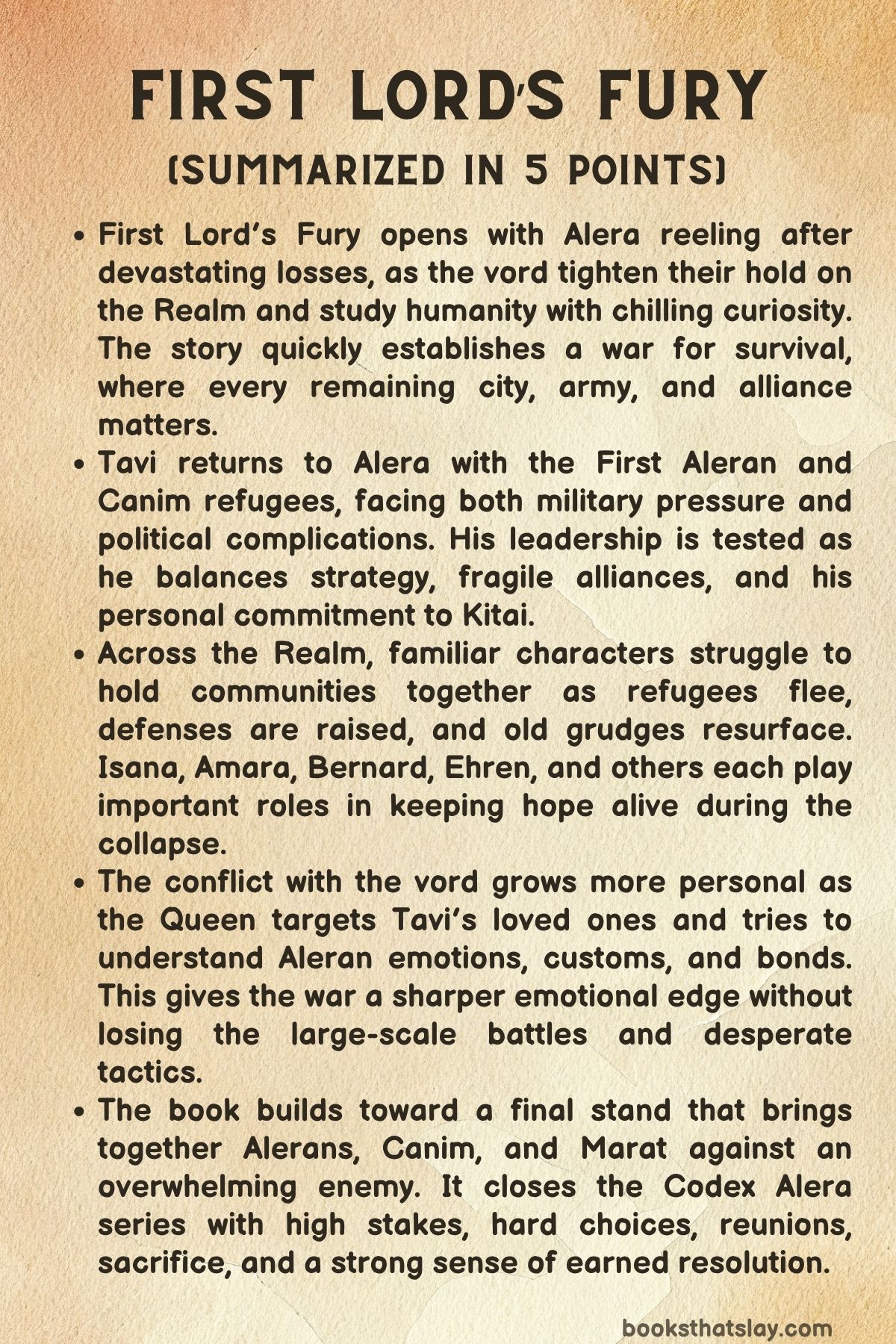
After the fall of Alera Imperia and the death of Gaius Sextus, the Realm is close to ruin. The vord now control much of central Alera, spreading their croach across cities, farms, and roads.
Their young Queen studies Alerans with cold curiosity, trying to understand the emotions and customs of the people she intends to conquer. Invidia Aquitaine, kept alive by a vord parasite, is forced to serve her and watch as the Queen treats captive Alerans like specimens.
The Queen observes meals, families, and love, but her lack of human feeling makes her experiments terrifying. She nearly kills a child simply to understand the mother’s suffering, then decides that she and Invidia should dine together, as if imitation could teach her what life among Alerans means.
Far from Alera, Varg leads the surviving Canim away from their ruined homeland of Canea. Their people travel with Aleran aid aboard enormous ice ships, but not all Canim accept this dependence.
Khral, a ritualist, stirs resentment against the Alerans, arguing that the Canim should not rely on their former enemies. Varg understands the danger but also knows the truth: without Aleran ships, furycraft, and food, the Canim refugees will die.
Tavi, now returning home with the First Aleran and the Canim, trains secretly with the ancient fury Alera. He is becoming more powerful, but the effort taxes him.
At the same time, he struggles with Kitai, who reminds him that if he means to marry her, he must honor her properly and not treat the matter as only a political fact.
At Riva, Aquitaine commands the surviving Aleran Legions. Ehren brings grim news: Parcia has fallen, and the vord have been growing in hidden caverns beneath the land.
To slow them, he proposes destroying the resources they need. Crops must be burned, wells poisoned, and a dead corridor created before Riva.
Aquitaine approves the harsh plan, hoping it will force the Queen to appear. Isana works with Veradis to care for refugees and control disease, then travels toward Calderon, convinced that Tavi is alive and returning.
In Calderon, Bernard and Amara protect refugees and strengthen defenses. They also face political trouble when Senator Valerius tries to challenge Tavi’s legitimacy by questioning Septimus’s marriage.
Tavi lands near Antillus and reveals the full disaster in Alera to his officers and to Varg. He intends to march across the continent and trap the vord between his army and Aquitaine’s forces.
The plan is dangerous, especially with Canim civilians and warriors moving alongside Alerans, but there is no safer option. Max warns him that his plan to marry Kitai will create political problems unless he publicly honors her.
Tavi begins to court her with more care, recognizing that love, duty, and rule cannot be separated as neatly as he once hoped.
The vord Queen answers Tavi’s return by confronting him through watercrafting. Tavi responds with a message of his own, sending his voice across Alera and revealing himself as Gaius Octavian.
He calls the Realm to resist. The Queen, angered by his defiance, chooses to hurt him personally.
She infiltrates Riva and abducts Isana and Araris. Isana realizes that the Queen calls her “grandmother” because of her connection to Tavi.
While Araris is tortured, Isana tries to endure captivity and learn what she can.
Riva falls into chaos as the vord attack. Amara, Ehren, Bernard, and others struggle to organize rescue efforts and protect civilians.
Amara recruits Aldrick and Odiana for a mission to save Isana and Araris, but the battle collapses so badly that she must abandon the attempt. The survival of the Realm comes first.
Fires spread, the defenses break, and civilians and soldiers retreat under crushing pressure.
Tavi drives his army south with desperate speed, using ice ships over a furycrafted road of ice to reach Phrygia and then Calderon. During the march, Magnus exposes Valiar Marcus as Fidelias, the former Cursor and traitor who has been hiding for years.
Tavi first condemns him to crucifixion, but later spares him, demanding that he spend his remaining life serving the Realm usefully. Near Phrygia, Tavi prepares to move through the Shieldwall toward Calderon, believing that his home valley will become the place where the war is decided.
Elsewhere, Ehren escorts refugees and supplies when vord attack. Just as defeat seems certain, Doroga and Marat reinforcements arrive, destroying the attackers and giving the fleeing Alerans new hope.
Isana remains captive as the Queen moves from hive to hive. Araris is sealed in croach, and Isana is forced to watch the Queen’s strange attempts to understand Aleran life.
The Queen allows her to clean dishes properly for dinner, treating ordinary customs as lessons. Invidia appears, badly burned after being cast off by Aquitaine, and Isana confronts her.
During their exchange, Invidia reveals that she helped turn Rhodus and Kalarus against Septimus, contributing to his death. Isana formally denounces her and vows to kill her before escaping.
As Tavi marches through rain with Aleran and Canim forces, a conflict arises over two Canim ritualists he killed in self-defense. To settle the matter, he agrees to pay a blood price.
Master Marok accepts the arrangement, kills a dissenting ritualist, and confirms that Tavi’s blood will answer the debt. Alera then warns Tavi that his massive weathercrafting has weakened them both.
The vord Queen grows stronger as the croach spreads, and Tavi will eventually have to face her alone.
At Calderon, Amara brings Doroga before Aquitaine’s council, even knocking out a hostile knight who tries to stop her. Doroga confronts Aquitaine about his role in the old Marat invasion, and Aquitaine admits his guilt.
With the vord closing in, Amara explains the valley’s layered defenses. Calderon has been prepared as the Realm’s final trap.
Tavi retakes Riva in a powerful assault. He uses water, wood, ice, fire, and windcrafting to break the gates and tear open a section of the wall.
The vord answer with mantis forms, vordknights, wax spiders, and arrow-wasp nests, but Tavi, Kitai, Crassus, the Legions, and the Canim defeat them. Tavi orders the vord larders and croach burned.
The Queen watches through watercrafting and realizes that Tavi has become far more dangerous than before. She tells Isana that she wants to live, partly because other vord queens in Canea may one day come to destroy her.
The final battle begins at Calderon. The first vord assault crashes into the prepared defenses and suffers heavy losses, but the enemy continues to advance.
Invidia secretly approaches Amara and Aquitaine, offering information and claiming she wants to betray the Queen. Aquitaine warns that Invidia will betray them as well, but they use what she provides.
Tavi arrives with his army and prepares a plan meant to force the Queen into the open.
Inside the hive, Invidia turns against the Queen but is defeated. The Queen sends her out with Phrygia’s sword and orders her to kill everyone.
A rescue and assassination force reaches the hive and frees Isana and Araris, though the Queen escapes upward to face Tavi. Within the hive, Isana, Araris, and the others continue fighting vord.
Tavi draws the Queen away from the battlefield toward Garados. Their duel moves through wind, ice, fire, stone, and storm.
The Queen is stronger and faster, but Tavi uses the mountain, Alera’s guidance, and his own skill to wear her down. He forces the fight toward the volcanic power beneath Garados and finally breaks her weapon.
With one clean strike, he kills her, ending the Vord War.
After the Queen’s death, the remaining vord lose direction. The survivors mourn, heal, and begin the long work of rebuilding.
Aquitaine dies from his wounds, leaving Tavi to become First Lord. Fidelias is pardoned and given a chance at a new life.
Isana, Araris, Amara, Bernard, Kitai, and their allies survive. First Lord’s Fury closes with Tavi and Kitai publicly joining their lives in an Aleran ceremony, while Kitai remains amused by the strangeness of Aleran customs.
Characters
In First Lord’s Fury, Jim Butcher brings together rulers, soldiers, spies, healers, enemies, and entire peoples in a final struggle where nearly every character is tested by war, loyalty, identity, and sacrifice. The character work in the book is strongly shaped by the collapse of old political structures and the need to build a future out of survival rather than tradition.
Tavi / Gaius Octavian
Tavi is the central heroic figure of the book, and his journey reaches its fullest expression as he openly accepts the identity of Gaius Octavian. Earlier in his life, he was defined by what he lacked, especially his unusual absence of furycrafting, but here he becomes a leader capable of commanding legions, negotiating with enemies, uniting different peoples, and facing a threat that is almost beyond human scale.
His strength does not come only from power, though by this point his furycrafting has become extraordinary. It comes from judgment, endurance, adaptability, and his ability to inspire trust across deep divisions.
Tavi’s leadership is especially important because he does not think like a traditional Aleran noble. He is willing to work with the Canim, respect the Marat, listen to Cursors, use unconventional tactics, and question inherited assumptions.
This makes him politically dangerous to some but essential to the Realm’s survival. His decision to reveal himself publicly as Gaius Octavian is not just a claim to power; it is an act of hope meant to rally a broken people.
By the end of the story, Tavi becomes First Lord not because he simply inherits the role, but because he proves that he can imagine a larger and more inclusive future for Alera.
Kitai
Kitai is Tavi’s partner, equal, and emotional counterweight. She is fierce, perceptive, proud, and deeply loyal, but she is never reduced to being merely a romantic companion.
Her Marat background gives her a different understanding of honor, identity, and partnership, which repeatedly challenges Aleran customs. Her insistence that Tavi court her properly is both humorous and meaningful, because it forces him to recognize that love cannot be treated as a political afterthought or private assumption.
Kitai’s importance lies in the way she balances intimacy with independence. She loves Tavi, but she does not dissolve into his role or ambitions.
She remains amused by Aleran traditions, skeptical of needless ceremony, and confident in her own way of seeing the world. In battle, she is courageous and capable, fighting beside Tavi rather than behind him.
Her final public union with him suggests not only a personal victory but also a symbolic joining of cultures, showing that the future of Alera will not be built only on old bloodlines and old customs.
Isana
Isana is one of the emotional centers of the book. Her role is rooted in compassion, endurance, and moral clarity.
She begins as a healer and mother figure, but her strength becomes especially visible during her captivity with the vord Queen. In that situation, she has little physical power compared with the forces around her, yet she resists through patience, intelligence, empathy, and refusal to surrender her humanity.
Her conversations with the Queen are important because they place human love, grief, family, and conscience directly against the vord’s cold hunger to understand and consume.
Isana’s connection to Tavi gives her special significance, but she is not important only because she is his mother. She represents the values that Tavi ultimately fights to preserve: mercy, loyalty, tenderness, and the belief that life is more than survival.
Her confrontation with Invidia also reveals her moral courage. When she learns more about Invidia’s role in Septimus’s death, Isana’s grief becomes judgment.
She is compassionate, but not weak; forgiving by nature, but not blind to evil. Her survival reaffirms that the gentler virtues in the story are not lesser than martial strength.
Araris Valerian
Araris is a figure of loyalty, discipline, and quiet nobility. As a swordsman and protector, he embodies the older heroic ideal of personal honor, but his role in the book is not merely physical.
His endurance under torture and captivity demonstrates a strength that is deeply internal. He suffers because of his loyalty to Isana, Tavi, and the memory of Septimus, and he refuses to become a weapon for the enemy despite the pain inflicted on him.
Araris also represents the long shadow of the past. His life has been shaped by Septimus’s death, hidden identities, lost opportunities, and years of service carried in silence.
In this final story, his survival matters because it allows the older generation’s loyalty and sacrifices to be carried into the new world Tavi creates. He is not a loud or politically ambitious character, but his steadiness gives emotional weight to the book’s idea that honor is often proven through endurance rather than display.
The Vord Queen
The vord Queen is the main antagonist of the book and one of its most unsettling figures. She is terrifying not only because of her power, armies, and intelligence, but because she is learning.
Her attempts to understand dinner, family, love, grief, and human attachment make her more disturbing than a simple monster. She studies people as specimens, and even when she imitates intimacy or social behavior, the result feels unnatural because she lacks the moral foundation that gives those acts meaning.
At the same time, the Queen is not mindless. She wants to live, fears other queens, adapts to her enemies, and grows more dangerous as the croach spreads.
Her connection to Tavi and Isana creates a strange imitation of family, but it is a corrupted version of kinship based on possession and control. Her final duel with Tavi is therefore more than a physical contest.
It is a clash between domination and chosen loyalty, between consumption and community, between a being that absorbs everything and a leader who unites different peoples without erasing them.
Invidia Aquitaine
Invidia is one of the most tragic and morally corrupted figures in the book. Kept alive by a vord parasite, she exists in a state between victimhood and guilt.
She has been physically violated by the enemy and forced into service, yet she is not innocent. Her past schemes, ambition, betrayals, and role in the events leading to Septimus’s death make her responsible for immense suffering.
This makes her character morally complex, because the reader can recognize her horror and degradation without excusing what she has done.
Her conversations with Isana expose the ugliness beneath her aristocratic pride. Invidia’s suffering does not purify her, but it does bring her to a point where she tries to betray the Queen.
Even that betrayal is uncertain, dangerous, and self-interested, because Aquitaine correctly understands that Invidia is likely to betray anyone. She is a character shaped by ambition, resentment, and survival instinct, and her final actions show that even damaged and morally compromised people can still influence the fate of the world around them.
Attis Aquitaine
Attis Aquitaine is a complicated political and military figure. He has spent much of the larger story as an ambitious rival for power, and in this book he commands what remains of the Aleran defense with ruthlessness and strategic clarity.
His willingness to destroy crops, poison wells, and create a dead corridor before Riva shows that he understands the vord war as a struggle where ordinary moral limits are collapsing. He is not sentimental, and his decisions often carry a cold brutality.
Yet Aquitaine is not portrayed as uselessly cruel or foolish. He is intelligent, disciplined, and capable of facing the reality of extinction.
His admission to Doroga about his role in the old Marat invasion shows that the past still matters and that political sins do not disappear simply because a greater enemy has arrived. His death leaves the path open for Tavi, but it also marks the end of an older style of Aleran power: proud, aristocratic, ruthless, and brilliant, yet ultimately unable to create the kind of unity the Realm now needs.
Varg
Varg is one of the strongest examples of honor outside Aleran culture. As a Canim leader, he is fierce, practical, and deeply responsible for his people.
After the destruction of Canea, he carries the burden of survival, guiding refugees who have lost their homeland and must now depend on former enemies. His acceptance of Aleran help is not weakness; it is wisdom.
He understands that pride without survival is empty.
Varg’s relationship with Tavi is built on respect rather than easy friendship. He recognizes strength, honesty, and competence, and he responds to Tavi because Tavi treats the Canim as people rather than tools or monsters.
Varg’s presence expands the moral and political scope of the book. Through him, the conflict becomes not merely about saving Alera, but about whether different species and cultures can overcome generations of hatred in order to survive together.
Khral
Khral represents resistance within the Canim to dependence on Alerans. As a ritualist, he agitates against cooperation and clings to older hostilities and pride.
His position is understandable in the context of Canim suffering, because his people have lost their home and are being forced into reliance on former enemies. However, his inability to accept necessity makes him dangerous.
Khral’s role shows how internal division can threaten survival as much as an external enemy. He is not the central antagonist, but he embodies the bitterness and mistrust that could destroy the fragile alliance Tavi and Varg are trying to preserve.
His conflict with Varg highlights Varg’s greater wisdom: a true leader must sometimes endure humiliation, compromise, and anger from his own people in order to keep them alive.
Max
Max is Tavi’s friend, ally, and one of the more grounded military figures around him. He provides loyalty, blunt advice, and emotional familiarity in the middle of enormous political and supernatural events.
His warning to Tavi about Kitai shows that Max understands both public perception and personal honor. He recognizes that Tavi’s private relationship cannot be separated from his public role, especially when Tavi’s marriage choices may affect the stability of the Realm.
Max’s value lies partly in his honesty. He is close enough to Tavi to speak plainly, and that gives him an important place in Tavi’s circle.
While many characters see Tavi as a prince, commander, or symbol, Max can still address him as a friend who needs correction. That personal bond helps keep Tavi human at the very moment he is becoming a legendary ruler.
Crassus
Crassus is a capable soldier and important part of the Aleran military effort. He stands with Tavi during the retaking of Riva and participates in the desperate struggle against the vord’s many forms.
His presence reinforces the importance of disciplined military courage in a war where even powerful furycrafting is not enough by itself.
Crassus also represents the younger generation of Aleran nobility and military leadership that must adapt to Tavi’s new world. The old order is collapsing, and survival depends on people who can fight under unconventional command, cooperate with former enemies, and accept Tavi’s legitimacy.
Crassus’s loyalty in battle helps show that Tavi’s leadership is becoming real not merely through bloodline, but through the trust of those who fight beside him.
Ehren
Ehren is one of the book’s sharpest strategic minds. His importance comes not from battlefield strength but from intelligence, observation, and the courage to recommend terrible necessities.
His report about Parcia and the vord’s underground growth reveals the scale of the danger, while his proposal to burn crops, poison wells, and create a lifeless corridor shows his willingness to think beyond conventional warfare. He understands that the vord cannot be fought as an ordinary army.
Ehren also plays a vital role in preserving hope. His later movement with refugees and supply wagons places him in a vulnerable but essential position, and the arrival of Doroga and the Marat during that crisis reinforces the value of his work.
He is a character who proves that survival depends on logistics, intelligence, communication, and moral courage as much as swordplay. In a story filled with dramatic warriors, Ehren shows the heroism of thinking clearly under pressure.
Bernard
Bernard is a steady, protective, and practical leader. In Calderon, he shelters refugees, raises defenses, and helps prepare the valley for the final confrontation.
His strength is rooted in responsibility rather than ambition. He is the kind of character who responds to crisis by building, organizing, defending, and caring for those under his protection.
Bernard’s connection to Calderon is especially meaningful because the valley is not just a battlefield; it is home. His leadership gives emotional weight to the defense of the place where Tavi’s story began.
He represents local loyalty, family loyalty, and the quiet courage of those who hold the line while greater political powers move around them. His survival helps preserve continuity between the humble origins of the story and its imperial conclusion.
Amara
Amara is brave, disciplined, and morally serious. As a Cursor and fighter, she has long been defined by duty, but in this book her role expands through rescue efforts, military coordination, and diplomacy.
She moves through chaos at Riva, helps organize survival under pressure, and later brings Doroga to Aquitaine’s council despite resistance. Her willingness to knock down a hostile knight if necessary shows her practical courage and refusal to be intimidated by rank or arrogance.
Amara’s character is important because she combines compassion with action. She wants to save Isana and Araris, but when the battle collapses, she is forced to accept that the Realm’s survival must come first.
That decision is painful, but it shows maturity rather than coldness. Amara understands duty as something larger than personal desire, and her continued presence beside Bernard and the other defenders reinforces the book’s emphasis on partnership, trust, and shared sacrifice.
Senator Valerius
Senator Valerius represents political opportunism at a moment when unity is desperately needed. His attempt to undermine Tavi’s legitimacy by challenging Septimus’s marriage shows how old political habits persist even during near-apocalypse.
While the vord threaten the existence of Alera, Valerius remains focused on succession, legality, status, and advantage.
His role is important because it reminds the reader that the Realm is not only endangered by monsters from outside. It is also weakened by internal ambition, factionalism, and obsession with noble legitimacy.
Valerius does not command the same narrative weight as the Queen or Aquitaine, but he represents the kind of narrow political thinking that Tavi must overcome if he is to become more than another ruler in the old pattern.
Magnus
Magnus is a figure of wisdom, loyalty, and hidden perception. His exposure of Valiar Marcus as Fidelias is one of the key moments of revelation in the book.
By uncovering the truth, he forces Tavi to confront betrayal not as an abstract political problem but as a personal and military reality within his own command structure.
Magnus’s importance lies in his ability to see what others miss and to serve the Realm through knowledge rather than force. He belongs to the group of older, experienced figures who help Tavi survive the burdens of leadership.
His presence gives the story a sense of continuity, because the new First Lord does not rise alone; he is supported, challenged, and protected by people who understand the dangers of power and deception.
Fidelias / Valiar Marcus
Fidelias, living under the identity of Valiar Marcus, is one of the most morally complex characters in the book. He is a traitor, but not a simple villain.
His years under a false identity have placed him close to Tavi and the First Aleran, allowing him to serve the very cause he once betrayed. When his identity is exposed, Tavi’s first sentence of crucifixion reflects the seriousness of his crimes, yet Tavi’s later decision to spare him shows a deeper understanding of justice and utility.
Fidelias represents guilt, survival, and the possibility of partial redemption. He cannot erase what he has done, and the book does not pretend that service automatically cleanses betrayal.
However, his continued usefulness to the Realm gives him a path forward. His pardon at the end suggests that Tavi’s rule will not be based only on punishment, but on the difficult judgment of whether broken people can still serve a better future.
Alera
Alera, the ancient fury, is both a supernatural presence and a symbolic embodiment of the land itself. Her relationship with Tavi gives him access to immense power, but it also teaches him that power has limits and consequences.
When she explains that his vast weathercrafting has weakened both of them, she becomes a voice of warning against the reckless use of strength, even in a righteous cause.
Alera’s role is also deeply thematic. She connects Tavi’s personal identity to the fate of the Realm, making his final battle not only political or military but elemental.
Her guidance during the confrontation with the Queen shows that Tavi’s victory depends on harmony with the land, not domination over it. In First Lord’s Fury, Alera’s presence helps transform the final conflict into a struggle for the soul and future of the entire Realm.
Veradis
Veradis is a healer and relief worker whose importance lies in the civilian cost of war. Her work with Isana on refugee relief and disease control shows that survival requires more than defeating enemies in battle.
Armies can win territory, but people still need food, medicine, shelter, sanitation, and care. Veradis helps bring that quieter but essential struggle into focus.
Her character also highlights Isana’s strengths by giving her a practical partner in mercy. Together, they show that compassion must be organized if it is to save lives on a large scale.
Veradis may not dominate the central conflict, but she represents the countless acts of service that keep a society from collapsing completely during catastrophe.
Doroga
Doroga is a powerful Marat leader whose arrival brings hope at a moment of extreme danger. His intervention against the vord saves refugees and supply wagons, showing the importance of the Marat alliance.
He is physically formidable, but his deeper significance is political and moral. His presence proves that old enemies can become indispensable allies.
Doroga’s confrontation with Aquitaine about the old Marat invasion gives him additional weight. He carries historical memory, and he does not allow Aleran leaders to escape responsibility for past violence.
Yet he still chooses to stand against the vord because the present crisis demands cooperation. Doroga represents strength joined with memory: he can fight beside Alerans without forgetting what Alerans have done.
Master Marok
Master Marok plays an important role in managing Canim honor and ritual law. When Tavi kills two Canim ritualists in self-defense, Marok accepts the arrangement of a blood price and confirms that Tavi’s blood will repay the debt.
This moment is significant because it prevents a dangerous internal conflict from weakening the alliance.
Marok’s character shows that Canim society has its own structures of justice, authority, and religious seriousness. He is not merely an obstacle or exotic figure; he is a leader operating according to a different but coherent moral code.
His willingness to settle the matter allows Tavi to maintain unity without dismissing Canim customs. Through Marok, the book emphasizes that true alliance requires respect for another culture’s laws, not just military convenience.
Aldrick
Aldrick is a dangerous and skilled figure whose involvement in the attempted rescue mission shows how desperate circumstances can force unlikely cooperation. His past and personality make him morally ambiguous, but his abilities are useful when conventional rescue becomes nearly impossible.
Amara’s decision to recruit him reflects the severity of the crisis and her willingness to use whatever tools are available.
Aldrick’s role in the book is not centered on redemption in a grand emotional sense, but on usefulness under pressure. He belongs to the group of characters whose loyalty may be uncertain or complicated, yet whose actions matter in the struggle against extinction.
His presence adds a sharper edge to the rescue effort, reminding the reader that war often requires cooperation with people who would be uncomfortable allies in ordinary times.
Odiana
Odiana is unsettling, powerful, and emotionally unstable, but she is also more than a source of danger. Her recruitment for the rescue mission alongside Aldrick shows that her abilities remain valuable even when her nature makes her difficult to trust.
She brings unpredictability into scenes already filled with danger, and that unpredictability makes her both useful and frightening.
Her character reflects the book’s broader interest in damaged people. Odiana is not presented as conventionally heroic, yet she exists within the moral chaos of a war where survival sometimes depends on imperfect allies.
Her presence complicates any simple division between noble defenders and wicked outsiders. Like several other characters, she occupies the uncomfortable space between threat and asset.
Gaius Sextus
Gaius Sextus is dead before the main action described here, but his influence remains powerful. His death creates the political and emotional vacuum that Tavi must fill.
As the former First Lord, he represents the old imperial order, with all its strength, secrecy, authority, and burden. The fall of Alera Imperia after his death shows how much depended on his power and leadership.
His legacy also shapes Tavi’s public identity. When Tavi reveals himself as Gaius Octavian, he is not only claiming descent; he is stepping into the space left by Sextus while also transforming what that role means.
Gaius Sextus belongs to the past, but his absence drives the urgency of the present. The Realm cannot simply restore what was lost; it must become something new under Tavi.
Septimus
Septimus is another absent character whose memory strongly affects the story. His marriage, death, and lost future are central to the question of Tavi’s legitimacy.
The challenge raised by Valerius and the revelations about Invidia’s role in setting enemies against Septimus show that the past still has political and emotional consequences.
For Isana and Araris, Septimus is not merely a historical figure but a personal wound. His death shaped their lives, their secrecy, and their grief.
For Tavi, Septimus represents the father and inheritance he was denied. The book uses Septimus’s memory to show that hidden truths eventually return, especially when power, family, and succession are involved.
Phrygia
Phrygia appears less as a fully developed present character and more as a figure associated with legacy, power, and symbolic weaponry. The Queen’s use of Phrygia’s sword through Invidia gives the character’s name a lingering significance.
The sword becomes part of the Queen’s attempt to turn Aleran strength and history against Alera itself.
Phrygia’s importance therefore lies in association rather than direct action. The reference to the sword suggests that the war is being fought not only with living soldiers but also with the remnants and symbols of older powers.
In the hands of the Queen’s servant, such a weapon becomes a sign of corruption: something once tied to Aleran identity is repurposed by an enemy that seeks to consume all identity.
Rhodus
Rhodus is important primarily as part of the political history surrounding Septimus’s death. Invidia’s revelation that she helped set Rhodus and Kalarus against Septimus gives Rhodus a role in the larger pattern of intrigue that damaged the Realm long before the vord became the central threat.
His significance lies in how old rivalries and ambitions helped weaken Alera from within.
Although Rhodus is not a major active presence in the events described, his connection to Septimus’s downfall helps deepen the sense that the present catastrophe did not emerge from nowhere. The Realm’s vulnerability is partly the result of past betrayals, noble conflicts, and political schemes.
Rhodus belongs to that older world of factional violence whose consequences Tavi must inherit.
Kalarus
Kalarus, like Rhodus, is tied to the political forces that contributed to Septimus’s death. His involvement in that older conflict marks him as part of the destructive ambition that has haunted the Realm for years.
The mention of his role through Invidia’s confession strengthens the book’s theme that personal ambition among the powerful can have consequences lasting across generations.
Kalarus’s importance is therefore historical and thematic. He represents the noble rivalries and violent schemes that damaged the imperial line and helped create the conditions of uncertainty around Tavi’s birthright.
Even though the final enemy is the vord, figures like Kalarus remind the reader that Alera’s internal corruption and division made the Realm easier to break.
Themes
Leadership Under Ruin
Power in First Lord’s Fury is tested most clearly when the old political order collapses and survival depends on hard choices rather than titles. Gaius Sextus is dead, Alera Imperia has fallen, and much of the Realm is already occupied, so leadership can no longer rely on ceremony, tradition, or inherited authority alone.
Tavi’s rise shows a different model of rule: he leads by trust, speed, sacrifice, and the ability to unite groups that have every reason to hate one another. His command of Alerans, Canim, Marat allies, and former enemies proves that leadership is not simply control over people, but the ability to make them believe that a shared future is possible.
Aquitaine also represents leadership, but his version is colder and more political, shaped by necessity and guilt. He authorizes brutal defensive measures because he understands that sentiment cannot stop the vord.
Together, these leaders show that in wartime, moral clarity is often pressured by practical need. The novel treats true leadership as the burden of choosing what must be done, even when every option carries pain.
Humanity, Love, and the Meaning of Family
The vord Queen’s attempts to understand Aleran customs make human emotion one of the story’s central concerns. Her study of captives is frightening because she observes love, family, grief, and loyalty without truly understanding their value.
To her, a mother’s pain can become an experiment, dinner can become a ritual to copy, and family can become a structure to imitate without compassion. This makes her dangerous not only because she commands armies, but because she lacks the moral imagination that gives human relationships meaning.
Isana’s captivity becomes important for this reason: she is not merely a prisoner, but a living example of maternal strength, grief, dignity, and defiance. The Queen calls her “grandmother,” but the word is empty because it has no love behind it.
In contrast, Tavi and Kitai’s relationship shows love as choice, respect, and public commitment. Their courtship is not treated as a distraction from war; it becomes part of what they are fighting to preserve.
The story argues that civilization survives through bonds that cannot be reduced to biology, power, or strategy.
Unity Across Old Enmities
Survival depends on alliances that would once have seemed impossible. The Canim and Alerans have a long history of violence, mistrust, and cultural difference, yet the destruction of Canea forces both peoples into cooperation.
Varg understands this more clearly than the more rigid Canim voices around him: pride cannot feed refugees, carry armies across frozen seas, or defeat the vord. Tavi’s strength lies in his willingness to respect the Canim as a people rather than treating them only as former enemies or useful soldiers.
The same pattern appears with the Marat, whose arrival at a desperate moment reminds the Alerans that old wars do not have to define present loyalties. Even characters with compromised pasts, such as Fidelias and Invidia, complicate the idea of enemy and ally.
Some betrayals cannot simply be erased, but usefulness, repentance, and shared danger can reshape a person’s role. First Lord’s Fury presents unity as difficult, imperfect, and often politically costly, but also as the only answer to an enemy that consumes all difference.
Division makes the Realm vulnerable; cooperation gives it a chance to endure.
Identity, Legitimacy, and the Burden of the Past
Tavi’s public identity as Gaius Octavian changes the political meaning of his actions, but the story makes clear that legitimacy is not created by blood alone. His ancestry matters because Alera needs a symbol around which to gather, yet his right to lead is proven through courage, judgment, and service.
Senator Valerius’s challenge to Septimus’s marriage shows how fragile political legitimacy can be when people use law and reputation as weapons. Against that, Tavi’s conduct offers a stronger claim: he protects the Realm, honors Kitai, negotiates with the Canim, confronts the Queen, and accepts personal risk rather than hiding behind rank.
The past also weighs heavily on other characters. Aquitaine must face the consequences of earlier ambitions.
Invidia’s crimes against Septimus return through Isana’s judgment. Fidelias’s hidden identity forces Tavi to decide whether justice means punishment alone or whether a guilty man can still serve a final purpose.
The novel suggests that the past cannot be ignored, but neither does it have to completely imprison the future. Identity becomes meaningful only when it is tested by action.