Halt’s Peril Summary, Characters and Themes
Halt’s Peril by John Flanagan is an adventure novel and the 9th book from the Ranger’s Apprentice series. It follows Will, Halt, and Horace as they pursue Tennyson, a dangerous fraud who uses religion, fear, and violence to control his followers.
The story moves from rough coastal taverns to dangerous seas, harsh mountain country, lonely farms, forests, and underground caves. At its center is the bond between mentor and apprentice, tested when Halt is struck by a deadly poison. The book combines pursuit, strategy, loyalty, humor, and moral courage as its heroes fight both armed enemies and deception.
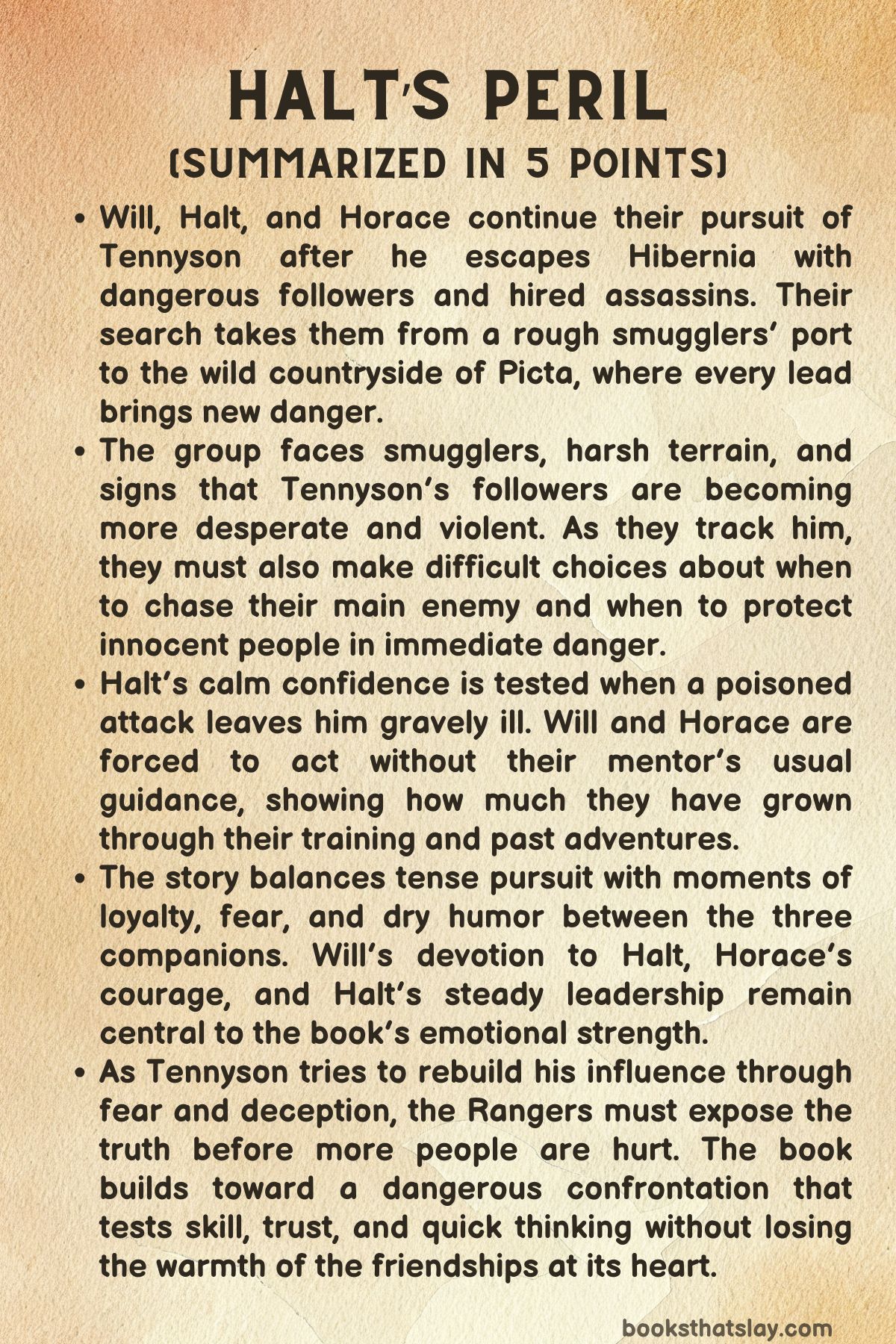
Summary
Will reaches Port Cael, a wet and lawless harbor known for smuggling, while searching for Tennyson, the false prophet who escaped Hibernia with his surviving followers and two Genovesan assassins. After leaving Tug in a stableyard, Will enters the Heron, a grim tavern near the docks, where he pressures the filthy tavern keeper into making coffee and paying attention to his questions.
He wants to find Black O’Malley, the smuggler believed to have carried Tennyson out of the country. With half a gold coin as payment, the tavern keeper points O’Malley out when he arrives with two heavyset guards, Dennis and Nialls.
Will confronts O’Malley and asks where Tennyson was taken. O’Malley admits enough to prove he transported Tennyson but refuses to name the destination.
He mocks Will by claiming he has answered the question and demands payment anyway. Will leaves angry, but O’Malley sends his men after him to rob him.
Outside, Will uses the darkness to his advantage and stops them with carefully aimed arrows, wounding Nialls’s ear and scaring both men away.
The next day Halt and Horace arrive, and Will reports that Tennyson has left Hibernia, though the destination remains unknown. Halt decides to handle O’Malley himself.
That night, the three wait until O’Malley enters the Heron, then follow him inside. Halt sits calmly opposite the smuggler, Horace stands ready, and Will covers the door with his bow.
When O’Malley orders his men to throw Halt out, Horace knocks them both unconscious almost instantly. Halt then holds a knife to O’Malley’s throat and demands the truth.
O’Malley tries to bargain, but Halt makes it clear that others in the tavern may know the answer if O’Malley dies. Frightened, O’Malley reveals that he took Tennyson to the Craiskill River in Picta, near the Mull of Linkeith.
Halt also recovers Will’s gold coin.
To avoid being watched by O’Malley, Halt hires a ship from Fingle Bay instead of Port Cael. The Sparrow carries them toward the Craiskill River, though Halt suffers badly from seasickness.
During the voyage, O’Malley’s ship, the Claw, appears in pursuit. It is faster and armed, and its captain tries to force the Sparrow into danger near Palisade Reef.
Halt and Will use their bows to disable the Claw’s steering, wounding O’Malley and stopping another crewman from taking control. The Claw crashes onto the reef and breaks apart.
Halt orders barrels thrown into the sea so the surviving smugglers have some chance of staying afloat, even though he knows they would not have shown the same mercy. The Sparrow reaches land safely, and Halt gives Captain Keelty a recommendation to King Sean for a reward.
In Picta, the three follow Tennyson’s trail inland. Tennyson’s own group is miserable, hungry, and angry because O’Malley cheated them with bad supplies.
When Bacari, one of the Genovesans, finds a small farm nearby, Tennyson leads his followers there. He pretends to offer payment for food, but when the farmer resists, Tennyson orders him killed.
Bacari and Marisi shoot the farmer, and Bacari also kills the farmer’s wife as she runs. The Outsiders steal food, slaughter a cow, and burn the cottage and barn.
Halt, Will, and Horace later find the ruined farm. Will discovers Genovesan crossbow bolts in the farmer’s body, proving Tennyson’s party was responsible.
Horace is horrified by the murder of helpless people and insists they bury the dead before continuing. The three then enter One Raven Pass, where Halt explains the grim history of an old Araluan attack on Scotti warriors.
Beyond the pass, they discover a second set of tracks made by a Scotti raiding party. Although Tennyson is still their main target, Halt decides they must stop the raiders before they attack an Araluan farm.
Will scouts ahead and finds the Scotti resting. Halt forms a plan to use the farm’s cattle against them.
After some trouble getting the herd moving, Horace provokes the bull, and Kicker helps drive it into a panic. The stampeding cattle crash into the Scotti, while Halt and Will stop escape attempts with arrows.
Many raiders are trampled, and the survivors retreat. The rescued farm family complains about their scattered cattle, angering Halt, who forces them to give thanks before the group moves on.
Halt, Will, and Horace regain Tennyson’s trail and realize he is less than two days ahead. They also see signs that Tennyson has acquired horses.
Horace suggests calling for reinforcements, but Halt prefers surprise. Soon Will spots a rider watching them from a ridge and sees a flash of purple, suggesting one of the Genovesans has discovered them.
The pursuit turns deadly when Halt is struck by a poisoned Genovesan crossbow bolt. He wakes at first, and Will is relieved, but Halt explains that the poison often tricks people by seeming to fade before returning stronger.
Will is shaken by the thought of losing him, but Halt orders him to stay steady. By morning, Halt has worsened.
His fever has returned, and he cannot be properly woken. Will realizes the poison has entered his whole body.
Will decides their only hope is Malcolm, the skilled healer in Grimsdell Wood near Macindaw. He rides through exhaustion, switching between Tug and Abelard while leading Kicker so he can keep moving.
Along the way, he passes eerie burial mounds and imagines a threatening presence, but he forces himself onward. Horace stays behind, caring for Halt, cooling his fever, and listening as Halt drifts through memories and mistakes Horace for Crowley.
Halt speaks as if he may die and asks that Will, Horace, and Pauline be looked after.
Will reaches Grimsdell Wood, becomes lost, and finally follows the sound of frogs to the mere. There, Malcolm’s dog Shadow finds him and leads him to the healer.
Meanwhile, Bacari watches Halt’s camp and reports to Tennyson that Halt is dying and Will has gone for help. Horace senses the watcher and confirms his suspicion by pretending to fetch water while secretly studying the ridge.
Will returns with Malcolm, who identifies the poison as aracoina. The problem is that it comes in two forms, blue and white, each needing a different antidote.
The wrong antidote will kill Halt. To learn which poison was used, Will creates a false death scene.
They hide Halt, bury a wrapped log, and pretend to leave. Bacari believes the deception and rides away.
Will follows, catches him, and defeats him after a dangerous chase. With Bacari captured, Malcolm can determine the correct antidote and save Halt.
After Halt recovers enough to act, the group follows Tennyson into a cave system where the Outsiders are holding a gathering. Horace struggles with the dark tunnels, but Malcolm gives him glowing moss and fungus to help him control his fear.
They reach the main cavern, where Tennyson is preaching to his followers and pretending to call on Alseiass for signs. Will discovers a hidden assistant using a lantern and mirror to create false flashes of light.
He climbs through the rocks and knocks the man unconscious, causing Tennyson’s miracle to fail.
Halt then appears through smoke, wearing a rough crown and pretending to be the ghost of King Ferris, whom Tennyson murdered. Tennyson’s terrified reaction exposes his guilt.
When one of his men attacks, Will shoots him from hiding. Halt drops the disguise, reveals himself as a King’s Ranger, and tells the crowd the truth: Tennyson is a fraud, the bandits are his allies, and the donated gold and jewels are being stolen.
The ordinary followers begin to leave, turning against their leader.
Once the crowd is gone, Tennyson orders his armed men to attack. Halt and Horace fight them while Will shoots from above and Malcolm throws explosive mudballs that fill the cavern with noise and smoke.
The blasts loosen the unstable roof. Tennyson tries to escape through a hidden tunnel, but Will throws the remaining mudballs to stop him.
The explosion shakes the cave, falling rock startles Tennyson, and he falls to his death.
The cave begins collapsing. Will leads Malcolm, Horace, and Halt through the dust and darkness, helping Horace fight his terror of the narrow tunnels.
They escape just before the cave system falls in behind them. Afterward, Halt and Horace plan to deal with the remaining bandits, while Will escorts Malcolm home.
At Healer’s Clearing, Will is welcomed warmly and receives a puppy named Ebony from Shadow’s litter.
Will later rejoins Halt and Horace. Horace rides toward Castle Araluen, clearly pleased at the thought of seeing Evanlyn.
Halt and Will return to Castle Redmont, where Baron Arald, Lady Pauline, Alyss, and the people welcome them with joy. Halt reunites with Pauline, Will reunites with Alyss, and a feast honors their return.
Pauline thanks Will for saving Halt, though Will still feels guilty for not seeing the poisoned wound sooner. The journey ends with Tennyson defeated, Halt alive, and the bond between the Rangers stronger than ever.
Characters
Will
Will is one of the most emotionally driven and capable characters in Halt’s Peril. He begins the story acting independently in Port Cael, showing the confidence and skill of a trained Ranger, but also revealing that he is still young enough to be angered by humiliation.
His encounter with Black O’Malley shows both his courage and his inexperience: he is brave enough to confront a dangerous smuggler alone, yet he allows O’Malley to twist the situation and leave him without useful information. However, his later ambush of Dennis and Nialls proves his quick thinking, stealth, and ability to control a dangerous situation without unnecessary killing.
Will’s deepest qualities appear when Halt is poisoned. His relationship with Halt is not just professional; it is almost familial.
When Halt explains the danger of the poison, Will’s fear becomes overwhelming because the thought of losing Halt shakes him completely. Even so, he forces himself into action.
His ride to fetch Malcolm shows extraordinary endurance, loyalty, and determination. He pushes himself through exhaustion, fear, darkness, and uncertainty because Halt’s life depends on him.
This part of the story reveals Will as someone whose love for others makes him stronger rather than weaker.
Will is also highly intelligent and creative under pressure. His plan to fake Halt’s death shows not only tactical skill but emotional discipline, because he must act convincingly while knowing Halt is truly close to dying.
His pursuit and capture of Bacari demonstrate maturity: he does not simply react with anger, but uses strategy, speed, and precision to get the information Malcolm needs. In the cave, Will again becomes essential.
He stops the hidden assistant, supports Halt and Horace with his bow, notices the danger of the unstable cavern, and ultimately helps lead the others out. By the end of the book, Will is no longer just Halt’s apprentice in spirit; he has proved himself as someone capable of saving his mentor, protecting his friends, and making difficult decisions in moments of crisis.
Halt
Halt is the calm, disciplined, and intimidating center of the story. He is experienced enough to understand people quickly and ruthless enough, when necessary, to frighten the truth out of them.
His confrontation with Black O’Malley shows his mastery of psychological pressure. Unlike Will, Halt does not allow O’Malley to control the conversation.
He understands the smuggler’s fear, pride, and dependence on reputation, then uses those weaknesses to force him into revealing Tennyson’s destination. Halt’s authority is quiet but overwhelming, and he often wins before a real fight begins.
At the same time, Halt is not merely a hard man. His decision to have barrels thrown into the sea for O’Malley’s surviving crew shows that he still follows a moral code, even toward enemies who would not have shown him mercy.
He is practical, sometimes grim, but not cruel for cruelty’s sake. His leadership also appears in the way he reads tracks, makes strategic choices, and prioritizes protecting innocent people.
When he abandons Tennyson’s trail to stop the Scotti raiders, he shows that duty is not only about pursuing a personal enemy; it is about preventing harm wherever he can.
Halt’s poisoning reveals a more vulnerable side of him. Usually controlled and dryly humorous, he becomes physically helpless and mentally disoriented.
His fevered words about Will, Horace, Crowley, and Pauline show the emotional bonds he normally keeps hidden. Even near death, his concern is for others rather than himself.
Later, in the cave, Halt returns to his familiar role as strategist and performer. His impersonation of King Ferris’s ghost is bold, theatrical, and psychologically devastating to Tennyson.
He understands that exposing a fraud sometimes requires using the fraud’s own methods against him. Halt’s strength lies not only in combat, but in insight, timing, courage, and an unshakable sense of duty.
Horace
Horace is the loyal warrior whose courage is both physical and moral. He is often straightforward, but that simplicity should not be mistaken for lack of depth.
When the group discovers the murdered crofters, Horace is the one who insists that they stop and bury the dead. Halt is focused on the urgency of the chase, but Horace reminds the group that innocent lives deserve respect even when time is short.
This moment shows his compassion, decency, and strong sense of honor.
In action, Horace is brave and dependable. At the Heron tavern, he knocks O’Malley’s henchmen unconscious with immediate efficiency, proving why Halt trusts him in close combat.
During the cattle stampede plan, Horace risks himself directly by provoking the bull, and although the moment becomes chaotic, his willingness to put himself in danger helps make the plan work. Against armed enemies, he is steady and powerful, serving as the group’s main defense when fighting becomes unavoidable.
Horace’s fear of dark, tight spaces gives him an important vulnerability. His struggle in the cave does not make him weak; instead, it makes his courage more meaningful.
He is terrified, but he keeps going because his friends need him. Malcolm’s glowing moss helps him control the panic, yet Horace still has to master himself enough to continue.
His care for Halt while Will is gone also shows his gentler side. He cools Halt’s fever, feeds him broth, and listens helplessly as Halt speaks in confusion.
Horace is not just a fighter; he is a deeply loyal friend who endures fear, grief, and uncertainty without abandoning his responsibilities.
Tennyson
Tennyson is the main villain of the story and one of its clearest examples of manipulation disguised as faith. He presents himself as a prophet of Alseiass, but his religion is a tool for power, wealth, and control.
He understands how to use fear, hope, ritual, and spectacle to influence ordinary people. His staged miracles, sermons, white-robed followers, and hidden tricks all show a man who has carefully built an image of holiness while concealing greed and violence beneath it.
His cruelty becomes unmistakable at the Scotti croft. Though he speaks peacefully and pretends he will pay, he has already decided to take what he wants.
His order to murder the farmer and his wife shows that he views ordinary people as obstacles rather than human beings. Burning the house and barn, even with animals trapped inside, reinforces his moral emptiness.
Tennyson’s leadership depends on deception, but when deception fails, he relies on brutality.
Tennyson is also cowardly beneath his grand image. When Halt appears as the supposed ghost of King Ferris, Tennyson panics because he knows his own guilt.
His reaction exposes him more effectively than any accusation could. Once the crowd begins to turn, his authority collapses quickly, proving that his power was always based on illusion.
His attempt to escape through the hidden tunnel shows his selfishness: he is willing to abandon followers who believed in him. His death by falling from the ledge is fitting because it comes while he is trying to flee the consequences of his own lies.
Bacari
Bacari is a dangerous Genovesan assassin whose cold professionalism makes him one of the most threatening figures in the book. He is patient, observant, and skilled with the crossbow, and his use of poison makes him especially deadly.
Unlike ordinary fighters, Bacari does not need open battle to change the course of events. One hidden shot is enough to bring Halt close to death, which shows how dangerous he is as a silent enemy.
Bacari’s personality is marked by arrogance and emotional distance. He kills the Scotti farmer and later the farmer’s wife with chilling efficiency, treating murder as a task rather than a moral act.
His confidence in the poison also shows his pride in Genovesan methods. He believes that no ordinary healer can save Halt, and in a practical sense he is almost right.
His danger lies not only in skill but in the belief that his skill makes him untouchable.
However, Bacari is not as controlled as he appears. His growing hostility toward Tennyson suggests that he does not truly respect the false prophet; he works with him because it suits his purpose.
He is observant enough to watch Halt’s camp and understand Will’s movements, but he is also vulnerable to deception. Will’s fake funeral plan succeeds because Bacari trusts what he thinks he has seen.
His defeat at Will’s hands is significant because it shows that Ranger intelligence and determination can overcome even a trained assassin’s confidence.
Marisi
Marisi is another Genovesan assassin, and though he receives less focus than Bacari, he contributes strongly to the atmosphere of danger surrounding Tennyson. He is part of the hidden violence that supports Tennyson’s public fraud.
While Tennyson manipulates people with words and staged miracles, Marisi represents the silent force that makes resistance deadly. His role in killing the farmer shows his willingness to murder without hesitation.
Marisi’s presence also confirms that Tennyson is not merely a wandering preacher with deluded followers. He has hired or allied himself with professional killers, which makes his movement far more dangerous.
Marisi helps reveal the true structure of Tennyson’s power: deception for the crowd, armed followers for intimidation, and assassins for eliminating threats. Even when he is not central to every scene, his involvement deepens the threat faced by Halt, Will, and Horace.
Black O’Malley
Black O’Malley is a smuggler defined by greed, secrecy, and arrogance. He operates in Port Cael, a place suited to his character because it is rough, corrupt, and shaped by hidden dealings.
O’Malley’s first exchange with Will shows that he takes pride in twisting words and exploiting technicalities. He admits enough to confirm he transported Tennyson, but refuses to give the useful answer Will needs.
His behavior is not simply cautious business practice; it is a deliberate humiliation.
O’Malley is also cowardly when confronted by someone stronger. With Will, he feels safe because he has henchmen and local influence.
With Halt, Horace, and Will working together, his confidence quickly disappears. Halt exposes the weakness beneath his bluster by making it clear that O’Malley’s life is less secure than he thinks.
O’Malley reveals Tennyson’s destination not because he becomes honest, but because fear overwhelms his pride.
His pursuit of the Sparrow later shows vindictiveness and poor judgment. Rather than accept defeat, he chases Halt’s group with the Claw, intending to use his faster and armed ship to destroy or capture them.
This decision leads to his own ruin on Palisade Reef. O’Malley’s downfall comes from the same traits that define him throughout the story: greed, spite, overconfidence, and the belief that intimidation will always succeed.
Dennis
Dennis is one of O’Malley’s henchmen and represents the crude physical power that supports the smuggler’s authority. He is not shown as clever or independent; his main function is to intimidate, threaten, and obey orders.
When O’Malley sends him after Will, Dennis acts as a typical dockside bully, expecting an easy victim rather than a trained Ranger.
His encounter with Will reveals the limits of brute force. In the darkness outside the tavern, Dennis is helpless against stealth and archery.
Later, when Horace knocks him unconscious in the Heron, Dennis again proves that muscle alone is not enough against trained skill. He helps show the difference between ordinary violence and disciplined combat.
Nialls
Nialls, like Dennis, serves as one of O’Malley’s enforcers. He helps create the sense that Port Cael is a place where criminal authority depends on hired strength.
His attempt to rob Will after the tavern meeting shows that he is accustomed to preying on people who seem isolated or vulnerable.
Nialls’s wounded ear is an important humiliation because Will does not need to kill him to dominate the encounter. The near miss is controlled and deliberate, proving that Will has power over the situation.
Nialls functions as a reminder that lesser villains often depend on numbers and intimidation, but they collapse quickly when faced with superior discipline and nerve.
The Heron Tavern Keeper
The tavern keeper is a minor but memorable character who reflects the filth, fear, and corruption of Port Cael. He is dirty, unpleasant, and reluctant to serve Will properly until intimidated.
His behavior suggests that he is used to a rough clientele and probably survives by cooperating with dangerous men like O’Malley.
At the same time, he is practical rather than loyal. Once Will pays him, he identifies O’Malley.
He does not act from courage or morality, but from self-interest. His role helps establish the atmosphere of the port: information can be bought, people look away from wrongdoing, and survival depends on knowing when to obey stronger forces.
Captain Keelty
Captain Keelty is the captain of the Sparrow and represents professional seamanship and practical courage. He understands the dangers of the sea, especially Palisade Reef, and his explanations show that he is experienced rather than reckless.
He is worried when the Claw pursues them because he knows the reality of the danger, not because he lacks courage.
Keelty’s role also allows Halt and Will’s skills to shine in an unfamiliar environment. On land, Rangers control the terrain; at sea, they must rely on Keelty’s knowledge.
His successful navigation near the reef is essential to their survival. Halt’s recommendation to King Sean suggests that Keelty has earned respect and reward through competence under pressure.
King Sean
King Sean does not take an active role in the events described, but his importance is felt through Halt’s connection to him. Halt’s written recommendation to the king reveals that Halt has influence and royal standing beyond what strangers might expect from a weathered Ranger.
King Sean also represents legitimate authority in contrast to Tennyson’s false spiritual authority and O’Malley’s criminal power.
His presence in the background helps widen the world of the story. The struggle against Tennyson is not just a private chase; it exists within a larger network of kingdoms, rulers, loyalties, and political consequences.
Through Sean, the book reminds the reader that Halt’s actions carry weight beyond the immediate journey.
The Scotti Farmer
The Scotti farmer is a brief but important figure because his murder exposes Tennyson’s true nature. He is an ordinary man trying to protect his home, his animals, and his family.
His resistance is not heroic in a grand military sense, but it is deeply human. He tries to hold on to what belongs to him when armed strangers arrive under false pretenses.
His death marks a moral turning point in the pursuit. Tennyson can no longer be seen merely as a fraud who deceives followers; he is directly responsible for the murder of innocent people.
The farmer’s fate also strengthens Horace’s emotional response and reinforces the need to stop Tennyson before more ordinary families suffer.
The Scotti Farmer’s Wife
The farmer’s wife is another innocent victim of Tennyson’s cruelty. Her attempt to run after her husband is killed shows terror and helplessness rather than resistance, making her murder especially brutal.
Bacari’s killing of her demonstrates the complete absence of mercy among Tennyson’s hired killers.
Though she appears briefly, she has strong emotional weight in the story. Her death helps reveal the human cost of Tennyson’s ambition.
She is not a warrior, conspirator, or follower; she is simply someone caught in the path of violent men. The burial that follows gives her dignity and shows the moral difference between the heroes and the villains.
The Scotti Raiders
The Scotti raiders are not connected to Tennyson’s group, but they create an important test of Halt’s priorities. They are a heavily built, all-male war party moving toward Araluan land, likely intending to attack a farm.
Their presence forces Halt, Will, and Horace to choose between continuing their urgent pursuit and protecting innocent people nearby.
As characters, the raiders function more as a collective threat than as individuals. They represent sudden, practical danger rather than deception or ideology.
The cattle stampede that defeats them shows Halt’s preference for strategy over direct confrontation. Their retreat after being trampled and losing their leader proves that even a dangerous war party can be broken by surprise, terrain, and clever planning.
The Scotti Raider Leader
The Scotti raider leader is significant because his death causes the remaining raiders to lose direction and withdraw. He likely holds the group together through authority and strength, and once he is gone, their attack collapses.
Though not deeply developed, he represents the kind of martial leadership that depends on momentum and confidence.
His defeat also contrasts with Tennyson’s leadership. The raider leader commands warriors openly, while Tennyson commands through lies and religious performance.
Both are dangerous, but in different ways. The leader’s death ends an immediate physical threat, while Tennyson’s influence requires exposure before it can truly be destroyed.
The Araluan Farmer
The Araluan farmer whose land is saved from the Scotti raiders is an ungrateful and comic contrast to the danger Halt’s group has just faced. Instead of immediately thanking the people who saved his family and probably his life, he complains about scattered cattle.
His reaction angers Halt because it shows a narrow concern for inconvenience after a major rescue.
This farmer is not villainous, but he is petty and limited in perspective. His behavior makes the scene more realistic because not every innocent person is noble or gracious.
He also gives Halt a moment of sharp moral irritation, reminding the reader that doing the right thing does not always earn appreciation.
The Araluan Farm Family
The farm family represents the civilians Halt, Will, and Horace are sworn to protect. Their decision to flee into the woods shows sensible fear rather than cowardice.
They are ordinary people facing a threat they cannot defeat by themselves. Their presence justifies Halt’s decision to leave Tennyson’s trail temporarily.
As a group, they help show the broader purpose of the Rangers and warriors. The heroes are not chasing Tennyson merely for revenge or duty to a crown; they repeatedly act to protect people who may never fully understand how close danger came to them.
The family’s survival is one of the quieter victories in the story.
Dirkin
Dirkin is one of Tennyson’s followers or associates, sent ahead to contact Barrett. His role is small, but it shows that Tennyson’s organization extends beyond the group immediately traveling with him.
Tennyson depends on messengers, local contacts, and scattered Outsider groups, which makes his movement more organized than it first appears.
Dirkin’s presence also helps build anticipation for the final confrontation. By sending him ahead, Tennyson is trying to reconnect with support and strengthen his position.
Even minor characters like Dirkin help show that Tennyson’s fraud has spread through networks of people willing to assist him.
Barrett
Barrett is mentioned as the leader of another Outsider group near Willey’s Flat. Although he does not play a major active role in the events described, he is important because he suggests that Tennyson’s influence is not isolated.
There are other groups connected to his false religious movement, and Barrett appears to be one of the local leaders who could help him regain strength.
Barrett’s significance lies in what he represents: the spread of fanaticism and fraud beyond a single traveling party. His existence makes Tennyson’s movement feel larger and more dangerous.
Even when Tennyson is weakened, there are still people and groups who may support him unless his lies are publicly exposed.
Malcolm
Malcolm is the healer whose knowledge, calmness, and unusual methods save Halt’s life. He is not a warrior like Horace or a Ranger like Halt and Will, but his expertise is just as vital.
When he identifies the poison as aracoina and explains the danger of choosing the wrong antidote, he shows the seriousness of specialized knowledge. Without him, courage and loyalty would not be enough to save Halt.
Malcolm is also practical and inventive. His glowing moss helps Horace manage his fear in the caves, while his explosive mudballs become a major weapon during the final confrontation.
He blends healing, science, illusion, and strategy in a way that makes him unique. His past association with frightening illusions is echoed in Will’s unnerving experience near the burial mounds, reinforcing Malcolm’s connection to mystery and psychological effect.
Most importantly, Malcolm is compassionate. He responds to Will’s desperate need and comes to help Halt without hesitation.
His presence gives the story a different kind of heroism: the heroism of knowledge, patience, and care. By saving Halt, he becomes essential not only to the plot but to the emotional resolution of the book.
Shadow
Shadow, Malcolm’s dog, is a small but meaningful presence. When Will is lost and exhausted in Grimsdell Wood, Shadow becomes the guide who leads him toward Malcolm.
In that moment, the dog represents hope and rescue after Will has pushed himself almost beyond endurance.
Shadow also connects Will to Healer’s Clearing and to the gentler world that exists outside pursuit, violence, and danger. Her later puppies create a sense of renewal after the fear surrounding Halt’s poisoning and the collapse of Tennyson’s cult.
Shadow’s role is brief but warm, and she helps shift the story toward healing and homecoming.
Trobar
Trobar is part of the welcoming community at Healer’s Clearing. His warmth toward Will shows the affection and trust that exist among Malcolm’s people.
He also helps bring emotional softness after the intense danger of the earlier scenes.
His gift of Ebony, the puppy, is especially important because it gives Will something living, loyal, and hopeful to carry forward. Trobar’s role is not dramatic in the same way as the fighters or villains, but he contributes to the book’s sense of kindness and recovery after violence.
Ebony
Ebony, the black-and-white puppy given to Will, symbolizes renewal, loyalty, and emotional healing. After Will nearly loses Halt and endures the strain of the chase, Ebony enters the story as a promise of life continuing beyond danger.
The puppy is not a major actor in the conflict, but its presence matters emotionally.
Ebony also strengthens Will’s connection to Malcolm, Shadow, and Healer’s Clearing. The gift suggests trust and affection, and it gives Will a personal reward that is gentle rather than martial.
In a story filled with pursuit, poison, and deception, Ebony represents innocence and future companionship.
King Ferris
King Ferris is important even though he is dead before the final confrontation. His murder is one of Tennyson’s great crimes, and Halt uses his image to expose Tennyson’s guilt.
Ferris represents rightful rule and the consequences of Tennyson’s ambition. The fact that Tennyson reacts with terror when Halt appears as Ferris’s ghost shows that Ferris still has power over him through guilt.
Ferris’s role is also symbolic. He becomes the face of truth returning to confront lies.
Halt’s impersonation works because Tennyson knows exactly what he has done. In that sense, Ferris is not merely a murdered king in the background; he is the moral accusation that Tennyson cannot escape.
The Hidden Assistant
The hidden assistant in the cave is one of the practical workers behind Tennyson’s false miracles. By using a lantern and mirror to create flashes of light, he helps manufacture the illusion that Alseiass is answering Tennyson’s prayers.
His role shows that Tennyson’s religion is not based on misunderstanding or sincere belief; it is built through deliberate stagecraft.
When Will knocks him unconscious, the miracle fails, and the crowd begins to doubt. This makes the assistant more important than his brief appearance might suggest.
He is a small part of the machinery of deception, and removing him causes that machinery to break down.
The Armed White-Robed Followers
The armed white-robed followers are the hard core of Tennyson’s movement. Unlike the ordinary villagers, they do not simply believe; they enforce.
Once Halt exposes the fraud and the ordinary people begin leaving, these followers remain ready to fight. Their loyalty is therefore more dangerous, because it survives the first collapse of illusion.
They represent fanaticism mixed with criminal loyalty. Some may believe in Tennyson, while others may simply benefit from his power, but together they form the violent center of the cult.
Their defeat in the cave shows that Tennyson’s movement cannot survive once its fear, mystery, and armed support are broken.
The Ordinary Outsider Followers
The ordinary Outsider followers are important because they are victims as well as participants. They have given gold, jewels, trust, and obedience to Tennyson, believing in his claims about Alseiass.
Their faith has made them vulnerable to exploitation. When Halt reveals the truth, their confusion and anger show how deeply they have been deceived.
However, they are not treated the same as Tennyson’s armed men. Halt gives them a chance to leave, recognizing that many of them are misguided rather than evil.
Their departure marks the collapse of Tennyson’s authority. Once the ordinary followers stop believing, the false prophet is reduced to a criminal leader with a shrinking band of fighters.
Alseiass
Alseiass is not a real active character in the events, but the name is central to Tennyson’s deception. Tennyson uses Alseiass as a false divine authority to control people, demand loyalty, and justify his power.
The supposed signs from Alseiass are manufactured through hidden tricks, proving that the godlike presence Tennyson invokes is part of a fraud.
As an idea within the story, Alseiass represents the danger of belief manipulated by selfish leaders. The ordinary followers are not foolish because they want hope; they are vulnerable because Tennyson turns that hope into a weapon.
When the staged miracle fails, the false sacred image begins to collapse.
Crowley
Crowley appears through Halt’s fevered confusion, which makes him important to understanding Halt’s inner life. When Halt mistakes Horace for Crowley, it suggests that Crowley is someone deeply connected to Halt’s past and trusted enough to receive his final concerns.
Halt’s words show that, when his defenses are down, he thinks of the people who matter most to him.
Crowley’s presence in Halt’s delirium also helps reveal the seriousness of Halt’s condition. Halt is not merely sleeping or weakened; his mind is drifting through memory, fear, and unfinished responsibility.
Through Crowley, the reader sees Halt as a man with long friendships and emotional history, not only as a legendary Ranger.
Lady Pauline
Lady Pauline represents Halt’s emotional home. Though she appears most strongly near the end and in Halt’s fevered words, her importance is clear.
When Halt asks that Pauline be remembered, it reveals the love and attachment beneath his usually guarded exterior. She is one of the people who gives Halt’s life personal meaning beyond duty.
Her reunion with Halt at Castle Redmont brings emotional closure. The embrace between them shows relief after the possibility of death has hung over the story.
Pauline’s later thanks to Will also reveals her understanding of what Will has done. She recognizes the depth of Will’s loyalty and the fact that Halt’s survival depended on him.
Alyss
Alyss appears at the end as part of Will’s return to safety, affection, and normal life. Her reunion with Will balances the hardship he has endured throughout the story.
After fear, exhaustion, and danger, Alyss represents emotional warmth and the personal life waiting for him beyond his duties as a Ranger.
Her presence also reminds the reader that Will is not defined only by missions and danger. He has relationships, hopes, and attachments that make survival meaningful.
The welcome at Castle Redmont would feel incomplete without her because she is part of the home Will returns to.
Baron Arald
Baron Arald represents stability, authority, and welcome at Castle Redmont. His presence at the end helps mark the transition from danger back to community.
He is part of the world that Halt and Will have protected through their actions, even though much of the conflict has taken place far from Redmont.
His role is not central to the chase or the final battle, but he contributes to the feeling of resolution. The feast held in honor of the returning heroes shows public recognition of private sacrifice.
Through Arald, the story acknowledges that the efforts of Halt, Will, Horace, and Malcolm deserve honor.
Evanlyn
Evanlyn is mentioned through Horace’s feelings rather than direct action. Her importance lies in what she reveals about Horace.
His hint that she is one reason he is happy to return to Castle Araluen shows a softer, more personal side of him. After the dangers he has faced, his thoughts turn not only to duty but to affection.
She also represents the life awaiting Horace beyond battle. Like Alyss for Will and Pauline for Halt, Evanlyn helps show that the heroes are not isolated adventurers.
They are connected to people who matter to them, and those connections give emotional weight to their survival.
Kicker
Kicker, Horace’s horse, becomes unexpectedly important during the cattle stampede. When the bull throws Horace, Kicker attacks it fiercely, biting and kicking until the bull panics.
This action helps turn the herd and makes the plan succeed. Kicker’s behavior shows loyalty and courage in animal form.
Kicker is also part of the practical rhythm of the journey. Along with Tug and Abelard, he helps Will reach Malcolm by allowing the horses to be rotated during the desperate ride.
His role reminds the reader that in this world, horses are not background objects; they are trusted companions whose endurance and instincts can decide life or death.
Tug
Tug is Will’s horse and one of his closest companions. He is essential during Will’s desperate ride to find Malcolm and again during the pursuit of Bacari.
Will trusts Tug’s speed, balance, and responsiveness completely, and that trust allows him to act with confidence in dangerous moments.
Tug’s importance is especially clear when Will crashes him into Bacari’s horse. This is not a simple riding maneuver; it requires deep partnership between horse and rider.
Tug represents the Ranger bond with a horse as something more than transportation. He is part of Will’s strength, mobility, and identity.
Abelard
Abelard, Halt’s horse, plays a quieter but still important role. During Will’s ride to Grimsdell Wood, Abelard helps make the impossible journey possible because Will can rotate horses and preserve their strength.
Abelard’s endurance contributes directly to Halt’s chance of survival.
As Halt’s horse, Abelard also reflects the long partnership and discipline associated with the Rangers. Though not as prominently featured as Tug in the action, Abelard is part of the dependable support system that allows the characters to survive harsh travel and urgent missions.
Themes
Loyalty and the Burden of Friendship
Loyalty in Halt’s Peril is shown not as a simple feeling, but as a demanding responsibility that forces characters to act under pressure, exhaustion, and fear. Will’s response to Halt’s poisoning reveals how deep his bond with his mentor has become.
He does not merely feel sorrow or panic; he turns that fear into action, riding through the night, refusing rest, and risking himself to bring Malcolm back in time. Horace’s loyalty appears in a quieter but equally important form.
He remains beside Halt, feeding him, cooling his fever, and protecting the camp while Will is gone. Halt’s own loyalty is seen earlier when he chooses to protect innocent Araluan farmers even though it means leaving Tennyson’s trail.
This shows that loyalty is not limited to personal bonds; it extends to duty, justice, and the protection of strangers. The theme gains emotional strength because loyalty costs the characters something.
They must sacrifice speed, safety, comfort, and certainty. Through these choices, friendship becomes a moral commitment rather than just affection.
Courage in the Face of Fear
Courage is presented as the ability to continue acting even when fear is intense and reasonable. Horace’s fear of enclosed spaces makes the cave scenes especially meaningful because his bravery is not effortless.
He is not fearless; he is deeply shaken by the darkness, narrow tunnels, and collapsing stone. Yet he keeps moving because the mission and his friends need him.
Will’s courage also develops through emotional fear rather than only physical danger. He faces the possibility of losing Halt, rides alone through harsh country, and confronts Bacari despite knowing the assassin’s poison could kill again.
Halt shows courage through calmness and control, whether threatening O’Malley, facing Tennyson’s followers, or enduring illness without allowing Will to collapse emotionally. The story suggests that courage is not loud confidence.
It is often practical, strained, and uncomfortable. Characters are brave because they keep choosing the necessary action while afraid, tired, grieving, or uncertain.
This makes courage feel human rather than heroic in a distant way.
Deception, False Power, and Truth
Tennyson’s power depends on performance, fear, and manipulation rather than genuine belief or moral authority. He uses religious language, staged miracles, hidden assistants, stolen wealth, and armed followers to control vulnerable people.
His deception is dangerous because it does not remain harmless trickery; it leads to murder, theft, cruelty, and the destruction of innocent lives. The false flashing light in the cavern shows how easily appearances can be used to create obedience.
Halt defeats Tennyson by using deception against him, but with a different purpose. His ghostly disguise is not meant to exploit the innocent permanently; it is a temporary strategy used to expose a lie.
Once Tennyson’s fraud is weakened, Halt reveals his identity and explains the truth clearly. This contrast is central to Halt’s Peril: deception used for selfish control corrupts, while deception used to reveal truth can become a tool of justice.
The crowd’s change of heart shows that false power collapses when people are given evidence and courage to question it.
Justice, Mercy, and Moral Choice
Justice in the story is not presented as simple revenge. The characters repeatedly face choices where they could act harshly but instead measure their actions against a moral standard.
Halt forces O’Malley to reveal the truth, yet the purpose is to continue the pursuit of a murderer, not to punish for anger alone. When O’Malley’s ship is wrecked, Halt orders barrels thrown into the sea to give the smugglers a chance of survival, even though he knows they would not have shown the same mercy.
This moment matters because justice does not make the heroes cruel. Horace’s insistence on burying the murdered crofters also shows that justice includes respect for the innocent dead, not only the defeat of villains.
Against this, Tennyson represents a complete lack of moral restraint. He kills, steals, burns, and manipulates whenever it benefits him.
The contrast makes the theme clear: real justice requires strength, but also discipline, compassion, and the refusal to become like the people being opposed.