Gone Tomorrow Summary, Characters and Themes
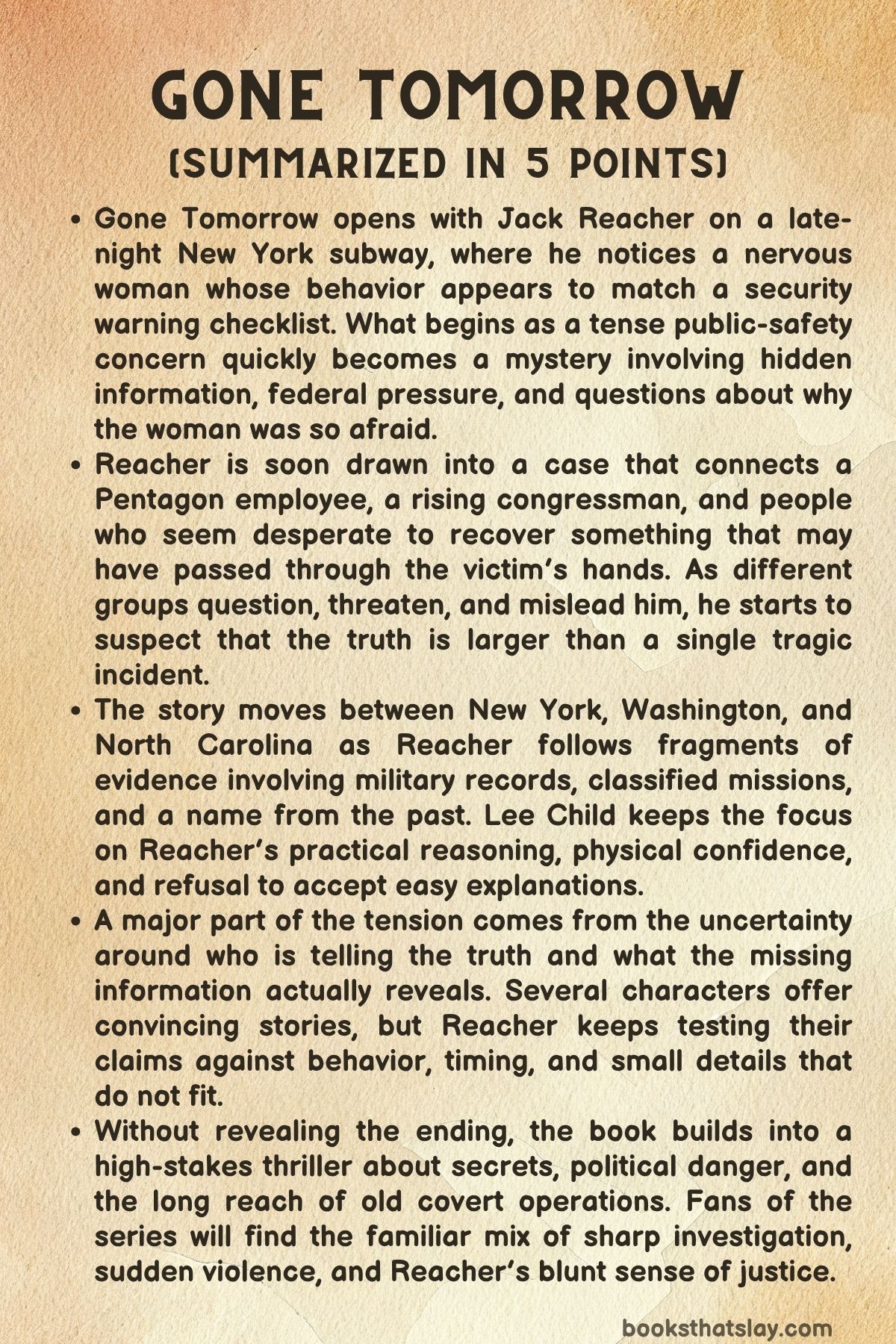
Gone Tomorrow by Lee Child is a fast, tense Jack Reacher thriller (13th in the series) set mainly in New York and Washington, D.C. The story begins with Reacher making a split-second judgment on a late-night subway, where a woman’s strange behavior suggests she may be a suicide bomber. Instead, her death opens a far larger mystery involving secret military records, political ambition, federal cover-ups, and a ruthless pair of women hunting for a hidden file.
In my view, this is a book about instinct, consequence, and the cost of buried history. Reacher follows the truth with his usual blunt logic, physical courage, and refusal to back away.
Summary
Jack Reacher is riding a nearly empty late-night subway train in New York when he notices a woman whose behavior sets off every warning sign he knows from an Israeli security checklist. She is overdressed, sweating, breathing hard, muttering, clutching a bag, and keeping her hands hidden.
Reacher doubts that she is a suicide bomber because the train is almost empty and the hour makes no sense for an attack, but the signs are too strong to ignore. He approaches her carefully and asks to see her hands.
The woman is terrified. Reacher tries to calm her and says he wants to be wrong.
When he asks what is in her bag, she pulls out a revolver instead of a bomb trigger. Before he can stop her, she puts the gun under her chin and kills herself.
The subway is locked down at Grand Central, and Reacher is questioned by Detective Theresa Lee. The woman is identified as Susan Mark.
Her brother, Jacob Mark, a police officer from New Jersey, arrives and insists that Susan would never have killed herself without a powerful reason.
Federal agents soon question Reacher. They ask whether Susan gave him anything, whether he knows a woman named Lila Hoth, and whether Susan said anything about Congressman John Sansom.
Reacher says no. After he leaves, private security men ask almost the same questions, which convinces him that Susan’s death is tied to something important.
He learns that Susan worked as a civilian clerk at the Pentagon in Army Human Resources Command, where military personnel records are stored.
Reacher and Jacob reason that Susan may have been forced to retrieve or copy classified information. A note found in her car, written as “600-82219-D,” appears at first to be a phone number, but Reacher later recognizes it as connected to Army regulations on medal records.
Susan had driven from Virginia to New York with her father’s gun and was delayed by a traffic accident. Reacher believes she may have been going to a meeting, missed a deadline, and panicked when he approached her on the train claiming to be a police officer.
The trail leads to Congressman John Sansom, a rising political figure with a decorated military past. Reacher travels to Washington, D.C., and sends Sansom a message claiming that Susan died with his name on her lips.
Sansom’s wife, Elspeth, arranges a meeting but sets him up instead. At the Watergate, the same federal agents confront Reacher and warn him to stop investigating.
Reacher realizes that Sansom’s classified military past is dangerous to someone.
He follows Sansom to Greensboro, North Carolina, and forces a conversation with him at a hotel. Sansom denies knowing Susan Mark or Lila Hoth.
He admits only that his Delta Force missions are secret. Reacher senses that Sansom is both honest and guarded.
Back in New York, Reacher learns from Detective Lee that Susan had been expected at the Four Seasons Hotel by Lila Hoth, a woman claiming to be Ukrainian.
Reacher and Lee meet Lila and her mother, Svetlana. Lila says Susan had been helping Svetlana find an American soldier named John, who had once shown her kindness.
Lila claims the search began innocently through military records and that Susan became a friend. Reacher does not trust the story.
Susan had been armed, terrified, and desperate, not behaving like someone coming to dinner. Lila asks for the memory stick she believes Susan gave Reacher, but he refuses because he does not have it and does not believe her.
Lila then gives a fuller story. She says Svetlana’s husband and brother were Soviet snipers in Afghanistan and that an American Delta team stole a secret rifle before handing the men over to Afghan fighters, who tortured them to death.
Svetlana believes the American officer was a Delta captain named John who received a Distinguished Service Medal in the same period. Lila thinks Sansom may be that officer and claims she only wants answers.
Reacher warns her that chasing a classified secret can have severe consequences.
Reacher returns to Washington and notices something crucial in Sansom’s office. Sansom’s chief of staff, Springfield, is the same man Reacher saw on the subway with Susan Mark the night she died.
Before he can fully act on that realization, unidentified federal agents capture him. They believe Susan gave him a real memory stick and that the empty pink USB drive found on him is a decoy.
They also suspect he is working with Lila.
Reacher wakes in a basement cell inside a closed firehouse in Greenwich Village. Theresa Lee and Jacob Mark are held nearby.
Lee believes the men work for the Secretary of Defense and are trying to contain a leak. Reacher attacks during interrogation, overpowers the agents, steals a tranquilizer dart gun, leaves to get tools, returns, and breaks Lee and Jacob out through the floors of their cells.
The three escape just as federal pressure around the site increases.
New information changes everything. The men killed under the FDR Drive are identified as Lila’s hired crew, and Lila and Svetlana’s background as Ukrainians proves false.
They entered the country on Turkmen passports with men linked to Tajikistan and Afghanistan. Reacher concludes that the story Lila told was reversed.
Svetlana was likely not a victim of Soviet violence but connected to the fighters who committed it.
Jacob and Lee turn themselves in to warn the police and deal with the threat to Susan’s son, Peter Molina. Reacher continues alone.
Lila confirms she has Peter. Later, at the Four Seasons, Springfield tells Reacher that Susan copied a classified file from Pentagon archives onto a memory stick and deleted the original.
Lila then sends Reacher a DVD. The video shows Lila and Svetlana torturing a Kabul taxi driver who had helped an American journalist.
It also shows Peter tied up and terrified. Reacher understands that Peter has been used to force Susan’s cooperation and may already be dead.
Sansom finally explains the secret. The missing file is not a report but a photograph showing Sansom and Springfield standing with Osama bin Laden during a covert mission ordered under President Reagan.
Sansom fears it will ruin his political career. Reacher reasons that Al Qaeda may want the image suppressed because it could damage bin Laden’s reputation more than Sansom’s.
If so, the photograph is more dangerous to the terrorists than to the congressman.
Reacher prepares to attack Lila’s group. With help from Theresa and Springfield, he obtains immigration records, a suppressed MP5, ammunition, a knife, and tactical gear.
He first draws several of Lila’s men to Union Square, where NYPD counterterrorism officers arrest them. Federal agents also appear, but Reacher escapes by clinging to the outside of a moving subway train and slipping away through the tunnel.
He then tracks Lila and Svetlana to abandoned buildings near the Four Seasons. He kills guards at the rear entrance, enters through the restaurant area, and finds evidence that Peter was murdered there.
Moving through the building, he fights his way upward, killing more armed men. He reaches the apartment where Lila and Svetlana are waiting.
A final hidden gunman appears, and Reacher kills him with his last bullet, but Lila grabs the man’s pistol and forces Reacher to disarm.
Lila and Svetlana plan to kill him with knives, but Reacher has hidden a knife taped to his back. He cuts Svetlana, fights both women while badly wounded, kills Svetlana, and finally overpowers and strangles Lila.
Bleeding heavily, he tapes his wound shut and collapses.
Reacher wakes in Bellevue Hospital. Theresa and Springfield found him by tracing his phone.
The government will publicly control the aftermath and claim credit for the dead attackers. Reacher explains that Susan threw the memory stick from her car on I-95 after seeing proof that Peter was being tortured.
The final effort turns toward finding it by reconstructing her route and timing. The truth will probably be buried, but Reacher has stopped Lila, exposed the real stakes, and avenged Susan and Peter in the only way left to him.
Characters
Jack Reacher
Jack Reacher is the central figure of Gone Tomorrow, and his character is built around instinct, discipline, suspicion, and a deeply personal sense of justice. He begins as a passenger on a late-night subway, but his military training immediately makes him read the scene differently from ordinary people.
His use of the Israeli counterintelligence checklist shows that he is observant, analytical, and conditioned to notice danger before anyone else does. However, the tragedy of Susan Mark’s suicide also exposes the limits of even Reacher’s skill.
He is not careless, but he misreads the nature of the threat, and that mistake becomes the moral wound that drives much of his investigation. Reacher is not simply curious; he feels responsible because his intervention may have pushed Susan into believing she had no way out.
As the story develops, Reacher becomes a classic lone investigator, but his intelligence is as important as his physical strength. He does not accept official explanations, especially when powerful people try to intimidate him.
He studies patterns, motives, military procedures, travel routes, timing, and human reactions. His mind works practically rather than emotionally, but the case gradually becomes personal because Susan was vulnerable, Peter was used as leverage, and the Hoths’ cruelty crosses a line that Reacher cannot ignore.
His strength lies in his ability to move outside systems: he has no office, no fixed position, and no political loyalty, so he can pursue the truth without institutional fear.
Reacher is also morally complex because he is capable of extreme violence, yet the book presents that violence as purposeful rather than random. When he fights the federal agents, Lila’s men, and finally Lila and Svetlana, he acts with cold efficiency because he understands that hesitation could get innocent people killed.
Still, Springfield’s later criticism that Reacher fought emotionally is important because it shows that Reacher is not purely mechanical. Beneath his calm exterior, he is angry about Susan, Peter, and the brutality he has witnessed.
His final injuries and collapse show that he is not invincible; he survives because of endurance, improvisation, and willpower, not because danger never touches him.
Susan Mark
Susan Mark is one of the most tragic characters in the book. She appears only briefly in person, yet her death shapes the entire story.
At first, she seems like a possible suicide bomber because of her appearance and behavior, but the truth is much sadder: she is a terrified woman carrying the weight of coercion, guilt, and panic. Her bulky clothing, sweating, muttering, and rigid posture suggest not fanaticism but emotional collapse.
She is a civilian clerk with access to sensitive military records, and that access makes her valuable to people far more ruthless than she is.
Susan’s tragedy comes from her vulnerability. She is lonely, her relationship with her son Peter is strained, and she seems to have been manipulated through her emotional attachment to him.
Her decision to copy the classified file and delete the original shows that she was placed in an impossible situation. She is not portrayed as greedy or malicious; instead, she is someone trapped between fear for her son and fear of the authorities.
When Reacher approaches her on the train and claims to be a cop, she likely believes the entire situation has closed around her. Her suicide is therefore not an act of simple despair but the result of pressure, confusion, and terror.
Even after her death, Susan remains morally significant because the investigation gradually restores her humanity. The authorities treat her as a security problem, the Hoths treat her as a tool, and the political world treats her as a leak.
Reacher, however, comes to see her as a frightened mother who was forced into betraying secrets to save her child. Her hidden action of throwing the memory stick out of the car window shows courage and resistance.
At the very end, it becomes clear that she was not merely a victim; she tried, in the only way left to her, to keep the secret from the people who had destroyed her life.
Jacob Mark
Jacob Mark is Susan’s brother and a small-town police officer from New Jersey. His role in the story is important because he gives Susan a family identity beyond the frightening image Reacher first sees on the train.
Jacob refuses to believe that Susan would kill herself without a reason, and this conviction helps push Reacher deeper into the case. He is not as physically dominant or strategically experienced as Reacher, but he has emotional knowledge that matters.
He knows enough about Susan’s past, loneliness, and family situation to make her death feel personal rather than procedural.
Jacob represents ordinary decency in a world controlled by intelligence agents, political operatives, and killers. He is a local cop, not a federal operator, and that makes him more grounded.
His grief is restrained, but it is real. He wants answers not because of ambition but because Susan was his sister.
He also becomes a useful partner to Reacher and Theresa Lee because he can confirm family details, check on Peter, and provide a moral reminder that the case began with a human death, not just a national-security problem.
His imprisonment alongside Reacher and Lee shows his vulnerability, but it also proves that he has been pulled into a much larger conflict. Jacob is not built for that world, yet he does not collapse.
His decision to turn himself in later, partly because of concern for Peter and partly because he believes the police must be alerted, shows that he still trusts lawful procedure more than Reacher does. That difference makes him an effective contrast to Reacher.
Jacob believes in institutions even after they fail him; Reacher believes in outcomes when institutions become compromised.
Detective Theresa Lee
Detective Theresa Lee is one of the most important allies in the novel. She begins as the police officer questioning Reacher after Susan’s suicide, but she gradually becomes much more than an official investigator.
Lee is sharp, practical, and willing to think beyond the obvious. She listens to Reacher’s explanation of the suicide-bomber checklist, considers the strange details surrounding Susan’s death, and recognizes that the case does not fit a simple explanation.
Her intelligence is shown through her ability to treat Reacher neither as a fool nor as a hero, but as a useful and dangerous source of insight.
Lee’s character is especially interesting because she stands between official law enforcement and Reacher’s unofficial methods. As an NYPD detective, she has procedures, obligations, and limits.
Yet as the case becomes more dangerous, she realizes that normal channels are being manipulated by federal forces and powerful interests. Her captivity in the firehouse proves that even legitimate police authority offers little protection when secret agencies decide to erase a problem.
After that, Lee becomes more personally involved, but she still retains her professional instincts.
Her relationship with Reacher is based on trust earned under pressure. She does not blindly follow him, but she understands that he sees things others miss.
She helps coordinate information, receives updates, warns him about the missing twentieth man, and later helps rescue him. Lee is competent without being idealized.
She is brave, but not reckless in the same way Reacher can be. Her presence adds emotional and procedural balance to the story, showing how a good police officer tries to act honestly inside a system that is being bent by secrecy.
Lila Hoth
Lila Hoth is one of the most deceptive and dangerous figures in the book. She first presents herself as a Ukrainian woman searching for answers about her mother’s past, and that performance is carefully designed to create sympathy.
Her beauty, wealth, elegance, and apparent vulnerability allow her to manipulate people into underestimating her. She frames the story as a personal search for justice, claiming that her family suffered because of an American covert mission.
This false narrative is effective because it contains enough emotional truth to sound plausible, but it hides her real identity and purpose.
Lila’s true nature is revealed gradually through contradictions. Susan was terrified, armed, and heading toward a meeting, which does not match Lila’s claim of innocent friendship.
Leonid and the hired men suggest surveillance and coercion, not harmless assistance. Once Peter’s kidnapping and the torture DVD are revealed, Lila’s mask falls away completely.
She is not a grieving daughter seeking answers; she is a ruthless manipulator who uses fear, pain, and psychological control as weapons. Her treatment of Peter shows that she understands cruelty not only as violence but as communication.
She wants Reacher to see suffering, to understand the “sequence,” and to know that she controls the game.
Lila is frightening because she combines charm with fanaticism. She is intelligent, patient, and tactically organized.
She uses hotels, false identities, hired men, emotional stories, and threats with confidence. She is also arrogant, which ultimately contributes to her defeat.
She believes she can control Reacher through humiliation and fear, forcing him to strip and preparing to kill him with knives. But she misjudges his ability to improvise and his willingness to endure pain.
Her death is the result of that miscalculation. As a villain, she represents the danger of a false victim narrative weaponized by someone who is actually predatory.
Svetlana Hoth
Svetlana Hoth is initially presented as an older woman haunted by past suffering, but she is later revealed as something far darker. Through Lila’s story, Svetlana seems to be a widow seeking the truth about Soviet relatives killed after an American covert operation.
This version of her invites pity and gives Lila’s mission an emotional foundation. However, once the truth begins to emerge, Svetlana becomes a chilling example of how stories can be inverted to hide guilt.
She is not simply a bereaved survivor; she appears to have been connected to violence herself.
Her role in the torture DVD is crucial to understanding her character. Svetlana’s brutality toward the Kabul taxi driver shows that she is not merely supportive of Lila’s cruelty; she actively participates in it.
The violence is intimate, deliberate, and ideological. She is capable of causing suffering slowly and personally, which makes her more terrifying than a distant commander.
Her age does not soften her character. Instead, it makes her cruelty feel more deeply rooted, as though it has been shaped by decades of hatred and conflict.
Svetlana also functions as the emotional source of Lila’s mission. Whether mother and daughter are driven by loyalty, revenge, ideology, or self-preservation, Svetlana’s presence gives the operation a generational quality.
She carries the past into the present, while Lila turns it into strategy. In the final confrontation, Svetlana is physically dangerous despite appearing less dominant than Lila.
Her fight with Reacher confirms that she is not a passive figure. She is one of the story’s clearest examples of hidden menace: someone who first appears wounded, then is revealed to be merciless.
John Sansom
John Sansom is a rising politician whose public image depends on honor, military service, and controlled disclosure. He is a congressman from North Carolina with a decorated military past, but his record is incomplete because of classified Delta Force missions.
At first, he seems like the obvious source of the mystery: his name is connected to Susan Mark, Lila Hoth, and a secret military file. Yet his character is more complicated than a corrupt politician trying to bury a scandal.
He is evasive, but not necessarily dishonest in the simple sense. He hides information because secrecy has shaped his entire public and military life.
Sansom’s main conflict is between political survival and national-security reality. The missing photograph of him and Springfield standing with Osama bin Laden during a covert mission could destroy his career if misunderstood.
His fear is believable because politics often punishes images more harshly than context. Yet Reacher forces him to think beyond his own reputation.
If the photograph could damage bin Laden or Al Qaeda more than it damages Sansom, then suppressing it becomes morally questionable. This is where Sansom’s character is tested: he must decide whether he is merely protecting himself or serving a larger truth.
Sansom is not portrayed as weak, but he is cautious and insulated. He has staff, security, political handlers, and a wife who can set traps on his behalf.
He is used to managing threats indirectly. Reacher’s directness unsettles him because Reacher cannot be handled through normal political methods.
By the end, Sansom becomes less of a suspect and more of a man trapped by the consequences of old covert decisions. His character shows how secrets from the past can become political explosives decades later.
Elspeth Sansom
Elspeth Sansom is John Sansom’s wife, and her role is defined by intelligence, loyalty, and political calculation. When Reacher sends a message claiming that a woman died with Sansom’s name on her lips, Elspeth responds instead of her husband.
This immediately shows that she is not merely decorative or passive. She is part of Sansom’s protective circle and understands that threats must be managed quickly.
Her meeting with Reacher appears cooperative at first, but it turns into a setup, revealing her willingness to deceive in order to protect her husband.
Elspeth’s character reflects the political world surrounding Sansom. She is polished, controlled, and strategic.
She does not need to threaten Reacher physically because she has access to people who can pressure him more effectively. Her deception at the Watergate shows that she understands power as arrangement: place the right person in the right room with the right people waiting, and the problem may be contained.
She is therefore dangerous in a social and political sense rather than a physical one.
At the same time, Elspeth’s actions can be read as loyalty rather than villainy. She believes Reacher may be a threat to her husband’s career, reputation, or safety.
From her perspective, diverting him to federal agents may seem like responsible damage control. Her character adds another layer to the story’s theme of secrecy: even people who are not directly evil can become manipulative when they are protecting powerful interests.
Springfield
Springfield is Sansom’s man and one of the key figures connecting the present mystery to the classified past. His significance grows when Reacher recognizes him as the man who had been on the subway with Susan Mark the night she died.
That discovery changes the direction of the case because it proves that Susan’s death was not isolated from Sansom’s circle. Springfield is controlled, experienced, and deeply familiar with the hidden world that Reacher is trying to uncover.
He is not simply a political aide. His connection to Sansom’s military past and the photograph with bin Laden gives him a deeper role.
He understands the danger of the missing file, the consequences of exposure, and the importance of keeping certain operations buried. Unlike some of the federal agents, Springfield is not shown as a brute.
He is more measured and pragmatic. He supplies information and later helps equip Reacher indirectly, suggesting that he recognizes Reacher as the best available weapon against the Hoths.
Springfield’s criticism of Reacher near the end is revealing. He says Reacher wasted ammunition and fought emotionally, which shows that Springfield evaluates violence like a professional.
He respects efficiency and control. This criticism also separates him from Reacher morally and psychologically.
Springfield may be competent, but he is colder and more institutional. Reacher is tactical, but he is also driven by outrage.
Springfield’s character therefore serves as a mirror: he resembles Reacher in training and seriousness, but lacks Reacher’s independent moral fire.
Peter Molina
Peter Molina, Susan Mark’s grown son, is central to the emotional machinery of the plot even though he spends much of the story offstage. He is a USC football player, and his disappearance initially seems ambiguous because he has reportedly gone away with a woman and may be considering quitting football.
This uncertainty makes him an effective piece of leverage. Because Peter is young, physically strong, and distant from his mother, the danger surrounding him is not immediately obvious.
That delay allows the people manipulating Susan to remain hidden.
Peter’s importance lies in what he means to Susan. Even if their relationship is strained, he is still the pressure point through which she can be controlled.
The Hoths understand that a mother’s fear can force obedience more effectively than direct threats against herself. Peter’s kidnapping and torture reveal the full cruelty of Lila’s operation.
He is not only a hostage but also a message, a way to break Susan and later threaten Reacher. His suffering turns the case from a mystery about classified files into a personal horror.
Peter is also tragic because his death shows how innocent people are consumed by secret wars they do not understand. He has no meaningful connection to Sansom’s old mission, the military photograph, or international terrorism.
He is targeted only because of his relationship to Susan. In that sense, Peter represents collateral damage in its most intimate form.
His fate gives Reacher’s final assault emotional urgency and helps explain why Reacher becomes less detached as the story moves toward its violent conclusion.
Leonid
Leonid is one of Lila Hoth’s men and serves as an early sign that her story cannot be trusted. Reacher first notices him as a watcher carrying a phone with Reacher’s photograph on it.
That detail immediately turns Lila’s supposed innocence into something more suspicious. Leonid is not merely a messenger; he is part of a surveillance network.
His presence at Penn Station suggests planning, coordination, and a willingness to track anyone connected to Susan Mark.
As a character, Leonid functions less through personality and more through action. He is a physical extension of Lila’s operation.
He watches, follows, carries information, and later fights Reacher. His phone becomes a clue that leads Reacher toward the Four Seasons, meaning Leonid accidentally helps expose the structure of Lila’s network.
In a thriller, characters like Leonid often reveal the hidden machinery behind a polished front. Lila may speak elegantly in hotel rooms, but Leonid shows the violence and monitoring that support her lies.
Leonid also helps demonstrate Reacher’s superiority in close combat and field awareness. Reacher spots him, disables him, and uses what he carries.
This pattern repeats throughout the story: enemies try to track Reacher, but he turns their tools against them. Leonid is therefore important not because he is emotionally complex, but because he is one of the first visible cracks in Lila’s carefully staged performance.
The Unidentified Federal Agents
The unidentified federal agents represent the frightening side of state power when secrecy overrides law. They question Reacher after Susan’s death, confront him again in Washington, and eventually kidnap him, Theresa Lee, and Jacob Mark.
Their lack of clear identity is important because it makes them feel less accountable. They operate in the shadows, apparently connected to high levels of defense authority, and their purpose is not justice but containment.
They want the memory stick, the leak controlled, and inconvenient witnesses silenced or intimidated.
Their interrogation style reveals arrogance and fear. They assume Reacher is hiding something because they cannot accept that a civilian encounter on a subway may have disrupted a major classified crisis.
Their belief that he has the real memory stick leads them to escalate from questioning to illegal detention and drugging. The dart gun becomes a symbol of their method: they do not argue openly or arrest properly; they disable, remove, and control.
As antagonists, they differ from Lila’s group. Lila’s people are openly murderous once revealed, while the federal agents hide behind national-security logic.
Yet both groups dehumanize others in pursuit of their goals. Reacher’s escape from the firehouse is significant because it is not just a physical victory; it is a rejection of secret authority abusing power.
The agents show how institutions can become dangerous when they treat truth as a threat.
The Lead Interrogator
The lead interrogator among the federal agents stands out as the face of the secret operation against Reacher. He is aggressive, suspicious, and convinced that Reacher is withholding the key evidence.
His questioning is built on pressure rather than discovery. He does not seem interested in understanding Susan Mark as a person or in protecting innocent lives; he wants control of the missing file and the people connected to it.
His character is defined by overconfidence. He believes the controlled environment of the firehouse gives him power over Reacher.
The locked rooms, drugging, stripped prisoners, and armed support create the illusion that Reacher has been neutralized. But he misjudges Reacher’s timing and willingness to attack first.
When Reacher shoves the table, takes the dart gun, and turns the interrogation against him, the lead interrogator’s authority collapses instantly.
He represents a broader theme in the story: powerful men often fail because they assume systems make them safe. The lead interrogator has procedures, weapons, and a hidden facility, but he lacks Reacher’s adaptability.
His defeat shows that secret power is not the same as competence.
Browning
Browning is introduced as Elspeth Sansom’s security man, and his role is to reinforce the controlled, guarded world surrounding the congressman. He is not deeply developed, but he matters because he helps frame Sansom’s circle as professional, cautious, and difficult to penetrate.
His presence during Elspeth’s interaction with Reacher suggests that every contact with Sansom is filtered through protection and strategy.
Browning functions as a barrier rather than an independent force. He is part of the machinery that keeps Reacher away from direct access to Sansom.
In this way, he reflects the political culture of the story: important people do not meet danger directly if staff, security, and intermediaries can absorb it first. His character also helps contrast Sansom’s world with Reacher’s.
Browning belongs to structure and hierarchy; Reacher moves through gaps in that structure.
Although Browning does not dominate the plot, he contributes to the atmosphere of suspicion. The reader understands that anyone around Sansom may be withholding information or redirecting Reacher.
Browning’s importance is therefore functional: he helps create the sense that Reacher is entering a protected political zone where truth is managed rather than freely spoken.
Docherty
Docherty is a supporting figure connected to Theresa Lee and the flow of police information. His role becomes important when Lee and Reacher need updates about the dead men under the FDR Drive and the true background of the Hoths.
Through Docherty, the investigation begins to shift from Lila’s false Ukrainian story to the more alarming possibility of Afghan, Tajik, and terrorist-linked identities. He helps widen the case beyond a personal revenge narrative.
Docherty also represents the ordinary law-enforcement network that still functions despite federal interference. While Reacher works outside the system and the federal agents abuse hidden authority, Docherty belongs to the practical world of police communication, identification, and alerts.
The possibility that he has been arrested shows how dangerous the case has become for anyone trying to help. Even secondary contacts are vulnerable once the secret operation expands.
His character is not explored emotionally, but he matters as a link in the chain of truth. The information associated with him helps dismantle the Hoths’ lies.
In that sense, Docherty is part of the story’s investigative backbone: not a heroic central figure, but a necessary source of reality in a plot full of deception.
The Medical Technician
The medical technician in the firehouse is a minor but revealing character. He supports the federal agents by handling the tranquilizer equipment, which makes him part of the illegal detention operation even if he is not one of the main interrogators.
His presence shows that the operation is organized, not improvised. The agents have medical support, drugs, cells, and procedures, suggesting a practiced ability to hold people outside normal law.
The technician is important because Reacher uses him to understand how to reload and operate the dart gun. This is a typical Reacher moment: an enemy resource becomes an advantage once he gains control of it.
The technician’s capture also shows the weakness of specialized roles under pressure. He may be useful inside a controlled system, but once Reacher breaks that system, he becomes another vulnerable participant.
Although the technician is not given much personal depth, he contributes to the moral atmosphere of the firehouse scenes. His involvement suggests complicity.
He may not be the one asking questions or making decisions, but he enables the abuse. The book uses him to show that unlawful power depends not only on leaders but also on technicians, assistants, and quiet professionals who keep the machinery running.
The Private Security Men
The private security men who confront Reacher after he leaves the precinct are early indicators that Susan Mark’s death has attracted more than police interest. They ask the same kinds of questions as the federal agents, especially about Lila Hoth and John Sansom, which tells Reacher that multiple groups are searching for the same missing information.
Their appearance expands the mystery from a subway suicide into a struggle involving private, political, and federal forces.
These men represent intimidation without transparency. They imply that they work for someone powerful, but they do not fully identify their employer or purpose.
Their method is to pressure Reacher into cooperation while revealing as little as possible. In doing so, they help establish one of the story’s central tensions: everyone wants to know what Susan gave Reacher, but no one wants to tell him why it matters.
As characters, they are not individually complex, but their function is important. They show that Reacher has stepped into a conflict before he understands its shape.
Their failure to intimidate him also establishes a pattern that continues throughout the novel. Reacher cannot be pushed away by authority, wealth, or implied violence; attempts to scare him usually make him more interested.
Susan Mark’s Father
Susan Mark’s father is not an active character in the main action, but his gun becomes important because Susan carries it to New York. The Ruger .357 Magnum links her present terror to her family past.
It also reveals that she did not arrive on the subway as an ordinary commuter. She came armed, frightened, and prepared for a confrontation or an escape that went terribly wrong.
His importance is symbolic rather than personal. The father’s gun suggests inheritance, memory, and desperation.
Susan uses something from her family home at the moment when her own family is under threat through Peter. This detail deepens the tragedy because the weapon is not the sign of a professional criminal; it is the sign of an ordinary woman reaching for the only protection she can imagine.
By connecting Susan to her father, the story also reminds the reader that she had a life before the conspiracy swallowed her. She was not just a Pentagon employee or a security breach.
She belonged to a family, had a brother, had a son, and carried pieces of that family history with her even in her final moments.
The Night Porter
The night porter at the shabby hotel is a minor character, but he plays a useful role in showing how Lila’s network protects itself. When Reacher searches for the Hoths, the porter denies that they are there, and Lila’s later call confirms that he warned her.
This makes him part of the outer layer of her operation. He may not be a fighter, but he serves as an informant and shield.
His character reflects the way criminal groups use ordinary urban spaces and ordinary people. Hotels, front desks, phones, and casual lies become part of a survival system.
The porter’s cooperation may come from fear, money, loyalty, or self-interest, but the result is the same: he helps dangerous people stay hidden. Reacher’s later pressure on him reveals that this protection is fragile when confronted directly.
The night porter is not morally central, but he contributes to the realism of the hunt. Lila and Svetlana do not survive only because of armed men; they survive because people at the edges of the operation give warnings, deny facts, and delay discovery.
The Kabul Taxi Driver
The Kabul taxi driver is a victim whose suffering reveals the true nature of Lila and Svetlana. He had helped an American journalist, and for that he is tortured on the DVD shown to Reacher.
His role is brief but devastating because he proves that the Hoths’ violence is not theoretical, defensive, or exaggerated. It is real, intimate, and merciless.
He matters because his torture changes the emotional temperature of the story. Until that point, Lila’s claims may still seem partly ambiguous, even if suspicious.
The video removes that ambiguity. The taxi driver’s helplessness exposes the Hoths as perpetrators of cruelty, not seekers of justice.
His death also foreshadows Peter Molina’s fate, making the threat against Peter horrifyingly credible.
As a character, the taxi driver represents innocent people caught between larger powers, ideologies, and revenge missions. Like Peter, he is punished not because he controls events but because he is useful as an example.
His suffering gives moral clarity to Reacher’s later actions against Lila and Svetlana.
The Hoths’ Armed Men
The armed men working for Lila and Svetlana form the physical force behind the deception. They include watchers, guards, sentries, and attackers, and their number becomes important when Reacher learns that there may be twenty rather than nineteen.
They are not deeply individualized, but collectively they create the sense that Lila’s operation is large, organized, and dangerous. She is not acting alone; she commands a disciplined network capable of surveillance, kidnapping, torture, and armed defense.
These men also serve as a measure of Reacher’s tactical ability. He studies faces, counts enemies, uses movement and misdirection, draws some into police capture, and kills others during the final assault.
The fact that one missing man nearly changes the outcome shows how seriously Reacher depends on accurate information. Numbers matter, ammunition matters, and one overlooked enemy can become fatal.
Collectively, the armed men represent the hidden army beneath Lila’s polished surface. Her elegance at the Four Seasons is only the visible front.
Behind it are men with guns, safe houses, phones, and orders. Their defeat strips away her power layer by layer until she and Svetlana must face Reacher directly.
Osama bin Laden
Osama bin Laden is not an active present-day character in the main action, but his image in the old photograph becomes one of the most important hidden forces in Gone Tomorrow. The photograph of him standing with Sansom and Springfield during a covert mission is the secret that drives the panic around Susan’s copied file.
Its significance lies not simply in the embarrassment it could cause Sansom, but in the possibility that the image could damage bin Laden’s own mythology or expose something Al Qaeda would rather suppress.
His role is therefore symbolic and political. He represents the long shadow of covert history, where past alliances, operations, and photographs can become dangerous decades later.
The fear surrounding the image shows that public meaning can be more explosive than classified truth. A single photograph, without context, can ruin careers, alter narratives, or threaten ideological reputations.
Even though he does not act directly in the story, bin Laden’s presence raises the stakes from personal blackmail to international consequence. He is the absent figure around whom many powerful people move, lie, kill, and conceal.
Themes
Paranoia, Surveillance, and the Fear of Hidden Power
Gone Tomorrow presents a world where almost every public space feels watched, controlled, or quietly manipulated by people who do not need to explain themselves. The late-night subway scene begins with Reacher observing Susan Mark through a checklist, turning ordinary human distress into possible evidence of terrorism.
This sets the tone for a story where suspicion becomes both necessary and dangerous. Reacher is watched by federal agents, followed by private security, tracked through phones, and repeatedly questioned by people who hide behind authority.
The fear in the narrative does not come only from violence, but from uncertainty about who is acting, who they serve, and what they are allowed to do. Government power appears secretive, impatient, and willing to erase inconvenient details.
At the same time, the villains use false identities, fake histories, and staged emotional appeals to control what others believe. The result is a tense atmosphere where truth is buried under surveillance, intimidation, and misdirection.
Truth, Secrecy, and the Cost of Classified History
The plot is driven by the danger of a hidden past becoming visible. Sansom’s military record is not suspicious because it is too grand, but because it is incomplete, suggesting actions that were never meant to be public.
Susan Mark’s work with personnel records becomes deadly because official history has gaps, and those gaps contain political, military, and personal consequences. The secret photograph matters because it challenges the clean public version of events and threatens powerful reputations.
Yet the story complicates the idea of exposure: the same evidence that could damage Sansom might also damage the enemies trying to recover it. This makes truth morally unstable.
Releasing it may serve justice, but it may also serve strategy, revenge, or propaganda. Reacher’s role is not simply to uncover information; he must understand why different groups want it hidden or revealed.
The theme shows that secrecy protects nations and careers, but it also leaves ordinary people vulnerable when hidden actions return with force.
Manipulation, False Victimhood, and Moral Deception
Lila and Svetlana survive by controlling the story others hear about them. Their first account presents them as grieving victims searching for answers about Soviet brutality and American betrayal.
This version is emotionally persuasive because it gives Susan, Reacher, and others a reason to see them as wounded rather than dangerous. Their power comes from turning sympathy into a weapon.
Once the truth emerges, the story’s moral shape reverses: they are not helpless seekers of justice, but ruthless people using a false past to gain access to classified information. This theme is especially important because it warns that suffering, when narrated convincingly, can be used to disable judgment.
Reacher does not reject compassion, but he learns that compassion without testing facts can become a trap. Susan’s loneliness and concern for her son make her especially vulnerable to emotional pressure.
Through this deception, the novel shows how lies become most effective when they are built around pain, family, and the promise of justice.
Guilt, Responsibility, and Reacher’s Personal Code
Reacher’s involvement begins with a mistake that he cannot fully dismiss. He approaches Susan because he believes she may be a threat, but his intervention contributes to her panic and suicide.
From that moment, his investigation is driven not by duty alone, but by responsibility. He knows he did not create the conspiracy, yet he also knows his actions became part of Susan’s final moments.
This gives his search a moral urgency that goes beyond curiosity. In Gone Tomorrow, Reacher’s code depends on direct action: when institutions hide, delay, or protect themselves, he moves forward alone.
His sense of justice is practical, physical, and personal. He wants the truth, but he also wants to punish those who use innocent people as leverage.
Peter Molina’s torture and murder sharpen that purpose, turning the case into a reckoning. Reacher’s final violence is not presented as clean heroism; it is costly, emotional, and nearly fatal, showing that responsibility can demand a brutal price.