Her Fearful Symmetry Summary, Characters and Themes
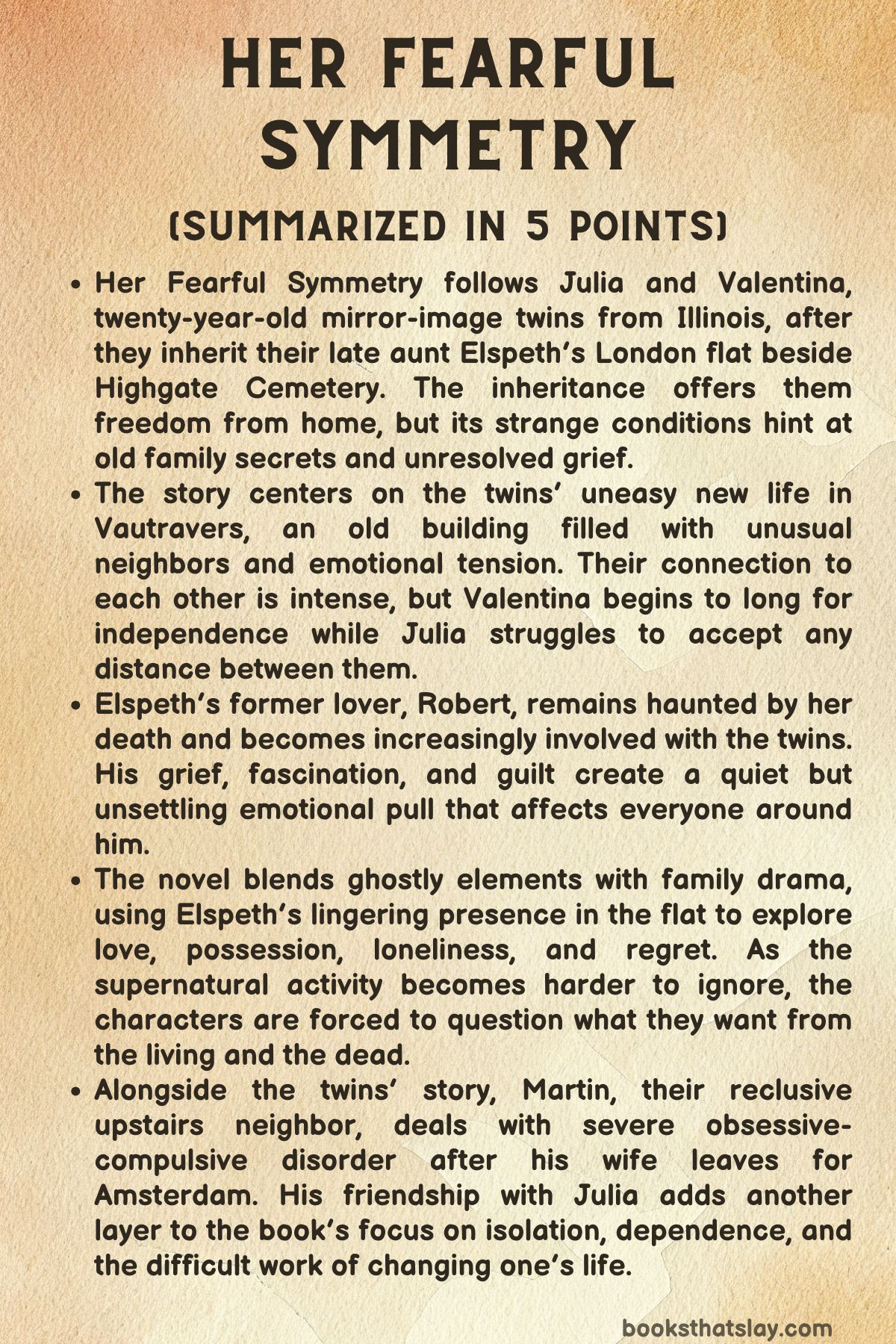
Her Fearful Symmetry is a gothic novel by Audrey Niffenegger about twins, grief, identity, and the strange pull of the dead on the living. Set mainly in and around Highgate Cemetery in London, the book follows Julia and Valentina Poole, young mirror-image twins who inherit a flat from their unknown aunt, Elspeth Noblin.
What begins as a chance for independence becomes a story of hauntings, secrets, illness, obsession, and dangerous longing. The novel uses ghostly events not just for mystery, but to ask what happens when love becomes possession and when one life is lived too closely inside another.
Summary
Elspeth Noblin dies in a London hospital while Robert Fanshaw, her lover, is away buying tea. At the moment of death, she sees herself from outside her body and watches Robert return, climb into the bed, and hold her.
Her death leaves him broken. Elspeth is buried in the Noblin family mausoleum in Highgate Cemetery, where Robert works as a guide and is writing a thesis.
He lives in Vautravers, an old building beside the cemetery, in the flat below Elspeth’s.
Across the Atlantic, Elspeth’s estranged twin sister, Edie Poole, receives Elspeth’s final letter. Edie has been secretly collecting and burning Elspeth’s letters, while her husband Jack has grown suspicious enough to hire a detective.
The final letter reveals that Elspeth has left her estate not to Edie, but to Edie’s twin daughters, Julia and Valentina. The will comes with unusual rules: the young women must live in Elspeth’s London flat for a year before they can sell it, and their parents may never enter or benefit from it.
Julia and Valentina are twenty-year-old mirror-image twins living in Lake Forest, Illinois. They have dropped out of several colleges, do not work, and live in a closed world of their own.
Julia is dominant, bold, and eager for adventure. Valentina is quieter, more anxious, physically fragile, and increasingly desperate for a life separate from her sister.
When the inheritance arrives, Julia sees London as freedom. Valentina is frightened, but she follows Julia, as she always has.
The twins arrive in London and move into Elspeth’s flat. The place is filled with mirrors, old furniture, books, papers, and signs of Elspeth’s former life as a dealer in rare and used books.
Unknown to them, Elspeth’s ghost is trapped inside the flat. She cannot leave or speak, but she can watch them.
She feels tenderness toward them, especially Valentina, whose abnormal heartbeat she notices. Slowly, Elspeth learns the limits of her new condition.
She can change her appearance to herself, create cold spots, move small objects, affect electricity, and eventually write in dust.
The building also contains Martin Wells, an upstairs neighbour with severe obsessive-compulsive disorder. His wife, Marijke, has left him for Amsterdam because she can no longer live under the rules and rituals that control his life.
Martin rarely leaves the flat, orders supplies online, and remains trapped by fear and compulsions. Julia becomes fascinated by him after a leak from his flat brings them together.
She begins visiting him, opening boxes from his past, and trying to help him reconnect with the world. Her interest grows into something like attraction, but Martin still loves Marijke.
Robert avoids the twins at first. He is grieving Elspeth and feels uneasy about their arrival.
Instead of introducing himself, he follows them around London as they visit shops, landmarks, and museums. Eventually they meet properly when he leads them on a tour of Highgate Cemetery.
Valentina realizes he is Elspeth’s Robert, and she is moved by his grief. Her sympathy soon becomes love, though Robert is troubled by his own feelings because Valentina resembles Elspeth.
Valentina and Robert begin spending time together. He tells her how he met Elspeth and how his life became centered on her.
Their bond grows into romance. Julia reacts badly, angry that Valentina is acting independently and staying out late.
Valentina, who wants privacy, her own body, and her own future, begins sleeping apart from Julia. She also starts sewing again and thinks about applying to fashion school.
Julia sees these choices as betrayal, because the twins have always made decisions together.
Elspeth’s ghost makes herself known by writing in dust on the piano. Robert and the twins create a Ouija board and communicate with her.
Elspeth says she is lonely, trapped, and growing stronger. She does not want Edie told.
Robert begins visiting Elspeth while the twins are out, and through automatic writing they speak with painful intimacy. He still loves Elspeth, but he also wants Valentina.
Elspeth becomes jealous and hurt, though she pretends to accept his new attachment.
Valentina also begins speaking with Elspeth. Elspeth tells stories about her and Edie’s childhood, but refuses to reveal the central secret that caused their estrangement.
That secret later comes into sharper focus: years earlier, Elspeth and Edie switched identities. Jack has long known or suspected the truth, but the switch damaged their family and left deep confusion over love, marriage, motherhood, and betrayal.
A strange event changes everything. Elspeth accidentally pulls the soul from the body of the kitten Valentina has adopted, briefly killing it, then manages to put the soul back.
Valentina sees this and realizes Elspeth can separate soul from body. For Valentina, who feels imprisoned by Julia’s control and her own weak health, the discovery becomes a dangerous possibility.
She forms a plan with Robert and Elspeth: Elspeth will remove Valentina’s soul from her body, Valentina will be declared dead, and after the funeral her soul will return to her body. She believes this staged death will free her from Julia.
The plan is carried out. Valentina dies, at least outwardly, and her funeral is arranged.
Julia is devastated, unable to understand life without her twin. Edie and Jack come to London.
Jack speaks with Robert and learns from Elspeth’s diaries that he truly was Julia and Valentina’s father, despite years of uncertainty caused by the twin switch. Robert is consumed by guilt but continues with the plan.
After the funeral, Robert secretly opens Valentina’s coffin in the cemetery and carries her body back to Vautravers. He waits for the moment when Elspeth will return Valentina’s soul to the body.
But the plan fails in the most terrible way. Elspeth takes Valentina’s body for herself, claiming Valentina was too weak to return and dispersed.
Robert realizes that the woman before him is not Valentina but Elspeth, alive again in her niece’s body.
Martin, meanwhile, makes his own escape. With Julia’s help and renewed hope of seeing Marijke, he finally leaves his flat and travels to Amsterdam.
Terrified but determined, he reaches Marijke, and they are reunited. His journey contrasts with Valentina’s failed attempt at freedom: Martin moves toward life by facing fear, while Valentina’s escape through death leaves her trapped.
Julia senses that something is wrong. She searches Robert’s flat and finds evidence linking him to Valentina’s body.
Robert and Elspeth flee London. Jessica, a cemetery volunteer, is horrified when Robert confesses the truth.
Edie and Jack return to Chicago, and during the flight Jack finally calls Edie by her true name, Elspeth, making clear that he has known about the identity switch for years. Edie breaks down and apologizes.
Julia remains at Vautravers and slowly begins to live alone. Valentina, however, has not vanished.
She is a ghost in the flat, hiding with the ghostly kitten. Eventually Julia helps her leave by carrying her and the kitten into Highgate Cemetery.
Released from the flat, Valentina discovers a world of cemetery ghosts and finds happiness among them, riding above London with other spirits. Julia returns home alone, changed but at peace.
Elspeth lives in Sussex with Robert and their baby, but her stolen life does not bring lasting happiness. Robert finishes his thesis and disappears, leaving her behind.
Her Fearful Symmetry ends with the living and the dead scattered by the consequences of love, control, secrecy, and the desire to become someone else.
Characters
Elspeth Noblin
Elspeth Noblin is one of the most haunting, morally complicated figures in Her Fearful Symmetry. Even before her death, she is defined by secrecy, possession, and emotional intensity.
Her decision to leave her flat and fortune to Julia and Valentina appears generous at first, but it is also controlling: the inheritance comes with conditions that pull the twins away from their parents and into the physical and emotional space Elspeth once occupied. As a ghost, Elspeth initially seems lonely and pitiable, trapped in her old flat and desperate to communicate.
However, her loneliness gradually becomes something more dangerous. She wants contact, influence, and eventually embodiment.
Her love for Robert is sincere, but it is also possessive, and her affection for Valentina becomes entangled with envy and opportunity. By taking Valentina’s body, Elspeth crosses the line from tragic victim to active violator.
She is a character shaped by longing, but the book shows that longing can become destructive when it refuses to accept limits.
Edie Poole
Edie Poole is Elspeth’s estranged identical twin and one of the central figures behind the story’s buried family mystery. She lives in America with her husband Jack and her daughters, Julia and Valentina, but her ordinary domestic life is built on silence and concealed guilt.
Her habit of secretly collecting and burning Elspeth’s letters reveals both fear and emotional dependence: she wants to know what Elspeth says, but she also wants to erase the evidence of contact. Edie’s reaction to the inheritance shows how deeply the past still controls her.
She is protective of her daughters, yet she is also trapped by the consequences of choices made long before the main events of the story. Her pain becomes clearer near the end, when Jack calls her by her true name and the old identity switch is exposed emotionally, not just factually.
Edie is not simply a guilty character; she is someone who has spent years living inside a lie and trying to make that lie feel like a life.
Julia Poole
Julia Poole is the more dominant of the mirror-image twins, and her personality is built around control, confidence, and dependence disguised as leadership. She is adventurous and excited by the move to London, but her excitement is not purely independent; she expects Valentina to share her desires automatically.
Julia loves her sister deeply, yet her love often becomes possessive. She resists Valentina’s wish for privacy, education, romance, and a separate identity because Valentina’s independence threatens the twin bond Julia has treated as permanent.
Her relationship with Martin reveals another side of her: she is curious, bold, and capable of tenderness, but she also crosses boundaries, especially when she secretly gives him medication. After Valentina’s apparent death, Julia’s grief forces her into a new emotional reality.
She must confront life without the sister she has always defined herself against and alongside. By the end, Julia’s act of helping Valentina’s ghost leave the flat shows growth.
She finally loves Valentina in a way that releases rather than confines her.
Valentina Poole
Valentina Poole is one of the most tragic characters in the book because her central desire is simple but nearly impossible within her circumstances: she wants to be herself. She is physically fragile, anxious, and often overshadowed by Julia, yet she possesses a quiet inner strength that grows throughout the story.
London awakens her desire for separation, creativity, love, and self-definition. Her interest in fashion school and her relationship with Robert both represent attempts to imagine a life beyond twinhood.
Valentina’s bond with Elspeth begins as fascination and sympathy, but it becomes dangerous because Elspeth understands and exploits her desperation. Valentina’s plan to escape her life by temporarily dying is both heartbreaking and revealing; she feels so trapped that death seems like the only doorway to freedom.
After Elspeth takes her body, Valentina becomes a ghost, ashamed and hidden. Her final release into the cemetery’s ghost world gives her a strange but meaningful freedom.
She loses her human life, but she finally escapes the roles imposed on her.
Robert Fanshaw
Robert Fanshaw is a grieving lover, a scholar of Highgate Cemetery, and a man whose emotional weakness leads to devastating consequences. At the beginning, he is defined by his love for Elspeth and by his inability to accept her death.
His grief is sincere, but it keeps him emotionally suspended between the living and the dead. When Julia and Valentina arrive, Robert becomes fascinated by them partly because they are connected to Elspeth and partly because Valentina awakens new desire in him.
His feelings for Valentina are genuine, yet they are shadowed by his unresolved attachment to Elspeth. Robert’s greatest flaw is passivity mixed with obsession.
He often knows something is wrong but continues because he wants comfort, love, or reunion. His role in Valentina’s death-and-revival plan shows how grief can weaken moral judgment.
By the end, his disappearance from Elspeth and their baby suggests that he cannot live peacefully with the consequences of what he helped create. Robert is not evil, but he is dangerously unable to choose clearly between memory, desire, and responsibility.
Martin Wells
Martin Wells is one of the most sympathetic characters in Her Fearful Symmetry, despite the severity of his obsessive-compulsive disorder and the pain it causes those around him. His illness confines him physically and emotionally, turning his flat into both refuge and prison.
Martin’s rituals are exhausting, but the story does not reduce him to them. He is intelligent, witty, sensitive, and deeply loving.
His marriage to Marijke shows the cost of illness on both partners: he loves her, but his compulsions make ordinary shared life nearly impossible. Julia’s arrival unsettles him, but it also helps him begin moving outward again.
His progress is slow and frightening, especially when he attempts to face sunlight, thresholds, and eventually travel. Martin’s journey to Amsterdam is one of the clearest acts of courage in the story.
Unlike several other characters, he grows by confronting fear rather than manipulating others. His reunion with Marijke offers one of the novel’s most hopeful emotional resolutions.
Marijke Wells
Marijke Wells is Martin’s wife, and her character represents love pushed to the edge of endurance. Her decision to leave Martin is painful, but it is not cruel.
She still loves him, as shown by the careful way she writes and places her letter, taking his compulsions into account even as she escapes them. Marijke’s departure is an act of self-preservation.
She has lived under the restrictions of Martin’s illness for so long that leaving becomes necessary for her own survival. At the same time, she does not completely abandon hope; she tells Martin he may come to Amsterdam if he can leave the flat.
This condition is both a boundary and an invitation. Marijke’s importance lies in her refusal to let love mean total self-erasure.
Her reunion with Martin is moving because it happens only after he makes a genuine effort to come toward her. She is compassionate, but she also insists that compassion cannot require the destruction of her own life.
Jack Poole
Jack Poole is Edie’s husband and the father of Julia and Valentina, though his place in the family is complicated by the twins’ old identity deception. He is suspicious enough to hire a detective to follow Edie, which shows that he senses the marriage is built around something hidden.
Yet he is also patient and deeply wounded rather than simply controlling. Jack’s long awareness of the identity switch makes him one of the quieter but most emotionally burdened characters.
He has lived with uncertainty about love, fatherhood, and truth, and his conversation with Robert confirms the damage caused by Elspeth and Edie’s deception. When he finally calls Edie by her true name on the plane, the moment is not just an accusation; it is a release of years of silence.
Jack represents the people harmed by secrets they did not create but were forced to live inside.
Martin and Julia
Martin and Julia form one of the story’s strangest but most revealing relationships. Julia is drawn to Martin because he is brilliant, damaged, and enclosed in a world very different from her own.
Martin is drawn to Julia’s energy and boldness, but he remains emotionally loyal to Marijke. Their connection helps both characters in different ways.
Julia gains a space away from Valentina where she can act independently, while Martin receives encouragement to confront the boundaries of his illness. Yet Julia’s behavior toward him is not always healthy; secretly giving him medication shows her tendency to interfere and control, even when she believes she is helping.
Their relationship is meaningful because it exposes Julia’s need to manage others while also allowing Martin to begin reclaiming his life.
Jessica Bates
Jessica Bates is a cemetery volunteer and a practical observer within the story. She is connected to Robert through Highgate Cemetery and becomes one of the people who notices the emotional and moral disturbance around him.
Her skepticism about Robert’s ghostly claims gives her a grounded quality, especially in a story filled with hauntings and blurred identities. Later, when Robert brings Elspeth to her after the body exchange, Jessica’s horror is important because it gives the reader an outside moral response.
Where Robert is emotionally compromised, Jessica sees the situation more clearly. She represents ordinary ethical perception in the face of extraordinary events.
James Bates
James Bates is a smaller character, but his childhood memory of seeing the ghost of a tree gives Robert a way to imagine that Elspeth might still exist. His role is therefore subtle but important.
He helps open the story’s supernatural possibility before Elspeth’s presence is fully confirmed. James’s anecdote makes the ghostly world feel less like a sudden invention and more like part of a wider, mysterious reality.
He also contrasts with characters who are trapped by obsession; his experience with the supernatural is strange, but not possessive or destructive.
Mr Roche
Mr Roche, Elspeth’s solicitor, functions as the formal messenger of Elspeth’s will. He explains the inheritance and its conditions to Julia and Valentina, but he does not reveal the emotional truth behind them.
His role is important because he represents law, property, and procedure in a story driven by secrets and desires. Through him, Elspeth’s control continues after death in a socially legitimate form.
He does not appear to be malicious, but his professional distance helps create the conditions that draw the twins into Elspeth’s world. He is a reminder that legal arrangements can carry emotional manipulation inside them.
Sebastian
Sebastian is an undertaker with dental training who appears during Martin’s toothache crisis. Though his role is brief, he adds to the story’s unusual blending of death, bodily discomfort, and dark comedy.
His extraction of Martin’s tooth inside the flat is grotesque but also practical, showing how the people around Martin adapt to the limitations created by his illness. Sebastian’s presence reinforces the novel’s atmosphere, where ordinary problems often unfold in strange, death-adjacent ways.
Theo Wells
Theo Wells, Martin and Marijke’s son, appears near the end and represents continuity beyond the central tragedies. His meeting with Julia suggests the possibility of ordinary human connection after grief.
He is not as developed as the major characters, but his presence matters because he belongs to a family that has begun to heal. Through Theo, Julia’s future seems less completely defined by Valentina’s absence.
He stands for the world continuing after loss.
Themes
Identity and the Burden of Doubling
In Her Fearful Symmetry, identity is unstable, especially because twinship turns the self into something shared, reflected, and sometimes stolen. Julia and Valentina are treated almost as one person, but this closeness becomes a trap for Valentina, whose private desires are repeatedly absorbed by Julia’s stronger will.
She wants fashion school, privacy, romantic love, and a life that belongs only to her, yet every attempt at separation feels like betrayal. The older generation shows an even darker version of this problem through Elspeth and Edie, whose past identity switch damages marriages, parenthood, and trust for decades.
The novel suggests that being seen as someone’s double can erase personal freedom. Mirror-image twinship becomes more than a physical condition; it becomes a psychological prison.
The tragedy grows from the failure to respect individual boundaries. When one sister’s life is treated as available to another, love turns into possession, and identity becomes something that can be claimed, hidden, or violently replaced.
Grief, Attachment, and the Refusal to Let Go
Grief in the novel is not gentle or healing; it often becomes a force that keeps the dead and living trapped together. Robert cannot accept Elspeth’s death, so his mourning turns into obsession.
He continues speaking to her, visiting her grave, sleeping in her bed, and later communicating with her ghost as though death has only changed the form of their relationship. Elspeth’s ghost also refuses release.
Her loneliness and fear make her cling to the flat, Robert, and eventually life itself. This refusal to let go harms everyone around her, especially Valentina.
The same pattern appears in Martin’s life: Marijke leaves because love alone cannot survive when it becomes confinement. The novel shows that attachment can be tender, but when it denies change, it becomes destructive.
Love for the absent person must eventually make room for life, choice, and separation. Without that, grief becomes a haunting, not only of places but also of people.
Freedom, Control, and the Desire for Selfhood
The desire for freedom runs through the younger and older characters, but freedom is rarely simple. Valentina wants to escape Julia’s control and become a separate person, yet she is timid, physically fragile, and emotionally conditioned to obey her twin.
Julia also wants freedom from her parents and from an ordinary future, but once in London she tries to control Valentina in the same way she once felt controlled by family expectations. Martin’s struggle is more literal: his obsessive-compulsive disorder confines him inside his flat, making the outside world feel dangerous.
Marijke’s departure is painful because it is an act of self-preservation; she must leave in order to have a life not ruled by Martin’s rituals. The novel presents freedom as frightening because it requires loss, risk, and guilt.
No one becomes free without hurting someone or leaving something behind. Yet the ending suggests that selfhood depends on this difficult separation, even when it arrives through sorrow.
Death, Haunting, and the Unfinished Past
Death does not bring silence in Her Fearful Symmetry; instead, it exposes unfinished desires, secrets, and betrayals. Elspeth’s ghost remains in the flat because her emotional life is unresolved.
Her presence turns the home into a place where the past keeps pressing against the present. Highgate Cemetery reinforces this atmosphere, but the real haunting comes from family history: the old identity switch, the hidden truth about parentage, and the long estrangement between the sisters.
The living characters are haunted even before they meet actual ghosts, because secrets shape their choices without being fully understood. Valentina’s fate shows the danger of treating death as reversible or controllable.
The plan to escape life by briefly entering death becomes an opening for Elspeth’s selfish return. Yet the ending gives haunting a gentler meaning through Valentina’s ghost, who finally leaves the flat and enters a wider world.
Death remains mysterious, but release becomes possible when possession gives way to acceptance.