Pirate Latitudes Summary, Characters and Themes
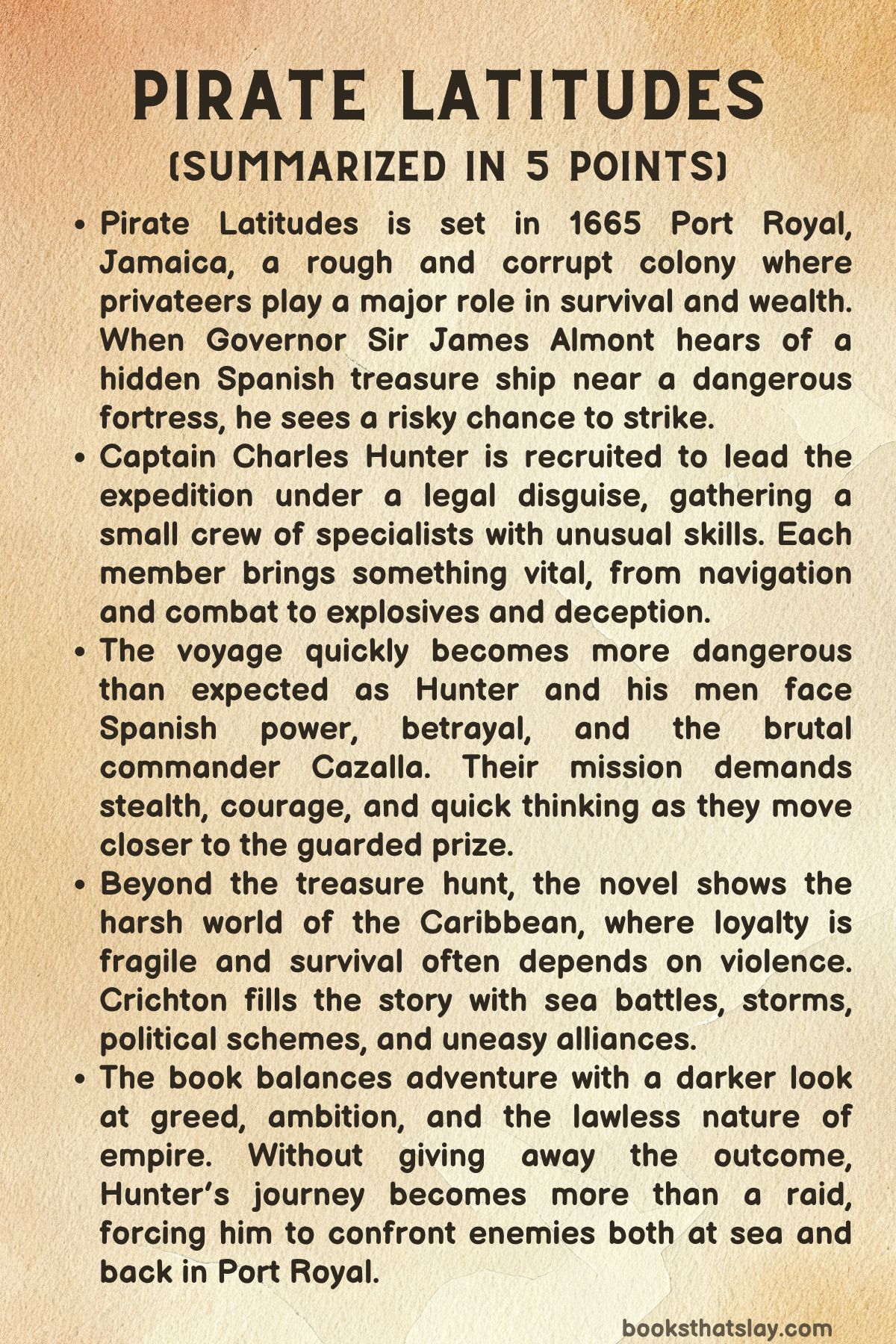
Pirate Latitudes is an adventure novel by Michael Crichton set in the violent, profit-hungry world of seventeenth-century Jamaica. The story follows privateer Charles Hunter as he leads a dangerous raid against a Spanish treasure ship hidden near the fortress island of Matanceros.
Built around betrayal, colonial politics, sea battles, storms, and treasure, the book presents Port Royal as a place where law, greed, loyalty, and survival are always in conflict. Crichton writes the Caribbean not as a romantic paradise, but as a harsh world shaped by disease, slavery, piracy, ambition, and sudden death.
Summary
In 1665, Port Royal, Jamaica, is a rough English colony where power depends as much on violence and privateering as on law. Governor Sir James Almont governs a place filled with merchants, sailors, thieves, soldiers, prostitutes, and adventurers.
Though Port Royal is officially part of the English empire, much of its wealth comes from attacks on Spanish shipping. Privateers operate under legal papers, but the line between sanctioned raiding and piracy is often thin.
A ship called the Godspeed arrives from England carrying several important passengers. Among them are Robert Hacklett, the new secretary to Governor Almont, Hacklett’s wife Emily, and a group of convict women sent from England.
One of these women is Anne Sharpe, a young thief from plague-stricken London. Almont takes Anne into his household, and she soon becomes part of the strange world of Port Royal.
Anne tells Almont that during the voyage the Godspeed passed a Spanish warship anchored near a fortified island. Strangely, the Spanish ship did not attack.
Almont understands the significance at once. A true Spanish warship would have attacked an English vessel.
He suspects that the ship Anne saw was not ready for battle but was a damaged treasure galleon hiding near Matanceros, a Spanish stronghold commanded by the feared Cazalla. If Almont is right, the ship could be carrying a fortune.
Almont calls in Captain Charles Hunter, one of Port Royal’s most capable privateers. Hunter is clever, brave, and experienced in dangerous raids.
Almont proposes an expedition to capture the Spanish treasure ship. The mission is dangerous because Matanceros is heavily defended, and Cazalla is known for cruelty.
Still, the potential reward is enormous.
Hunter begins choosing a small group of specialists. Enders is a surgeon and excellent helmsman.
Lazue is a sharp-eyed Frenchwoman who dresses and lives as a man. Bassa is a huge mute fighter with great strength.
Don Diego is a Jewish expert in explosives. Sanson is a skilled and deadly Frenchman.
Together, they form a compact group suited for a mission that will require stealth, violence, and technical skill.
Don Diego prepares special fuses, grenades, and explosive devices. Hunter outfits his sloop, the Cassandra, while disguising the voyage as a legal expedition to cut logwood.
This cover gives the mission a lawful appearance, though the true goal is to seize Spanish treasure.
Meanwhile, Robert Hacklett grows disgusted by Port Royal. He sees corruption everywhere and becomes suspicious of Almont’s methods.
Hacklett is rigid, ambitious, and eager to impose stricter English authority. He begins to work against Almont, believing the governor is allowing Port Royal to become little more than a nest of criminals.
Hunter sails with about sixty men aboard the Cassandra. The journey soon becomes dangerous.
Before reaching Matanceros, the sloop is overtaken by a powerful Spanish ship commanded by Cazalla himself. Hunter and his crew are captured.
Cazalla tortures prisoners to find out where they are going and what they know. The situation seems hopeless, but Sanson has hidden aboard the Cassandra.
He helps retake the sloop from the Spanish prize crew and frees Hunter’s men.
Rather than turn back, Hunter continues toward Matanceros. His plan is bold.
Instead of attacking the fortress directly by sea, he sends the Cassandra away and leads a small party across the island by land. Hunter, Sanson, Lazue, Bassa, and Don Diego move through jungle, avoid Spanish patrols, and face the harsh terrain.
They climb the dangerous Leres ridge, a route so difficult that the Spanish do not expect attackers to use it.
At dawn, the raiders reach the fortress and put their plan into action. Don Diego and Hunter sabotage the fortress guns and the magazine so the Spanish cannot respond effectively.
Sanson, Lazue, and Bassa help seize the treasure ship, the El Trinidad. Inside the fortress, Hunter discovers Lady Sarah Almont, the governor’s niece, being held captive in Cazalla’s quarters.
Her presence adds urgency and personal danger to the raid.
Cazalla attacks Hunter, and the two men fight. Hunter kills him.
With the Spanish defenses disrupted, the raiders escape with Lady Sarah and take control of the El Trinidad, towing the Cassandra behind them. The raid succeeds, but the escape is only the beginning of their troubles.
The captured galleon carries pearls, gold, silver, trade goods, and other valuables. Some of the silver, however, turns out to be impure and less valuable than expected.
Even so, the treasure remains immense. As Hunter and his crew flee Spanish waters, they face repeated danger.
A sea monster attacks, adding terror and confusion to the voyage. A Spanish warship pursues them.
Fireboats are sent against them. Each threat forces Hunter to improvise and use every bit of seamanship and courage he has.
Then a devastating hurricane strikes. Hunter divides the treasure between the El Trinidad and the Cassandra to reduce the risk of losing everything.
During the storm, the ships are separated. Hunter’s galleon survives, though badly tested by the weather.
Later, he rescues Lady Sarah from island natives after she is separated from the group. After all these dangers, Hunter finally brings the El Trinidad back to Port Royal.
Instead of receiving honor, Hunter is arrested. During his absence, Hacklett has gained control by claiming that Almont is dying.
Commander Scott supports Hacklett, giving him military backing. Hacklett uses his new authority to put Hunter on trial for piracy.
The charge is serious because if Hunter’s voyage is ruled illegal, he can be executed and his enemies can claim power and profit from the affair.
The trial is unfair. Sanson betrays Hunter by falsely claiming that Hunter forced the crew into an unlawful raid.
Lady Sarah also lies against Hunter, frightened and pressured into giving false testimony. Hunter is convicted and imprisoned.
His enemies seem to have won.
In prison, Hunter learns that Almont is still alive but being held under guard. This changes everything.
Hunter escapes and begins taking revenge on those who helped betray him. He kills several men involved in the plot, confronts Hacklett, and helps restore Almont’s authority.
Hacklett is mortally wounded, Commander Scott is condemned for treason, and Hunter’s conviction is overturned.
Yet the matter of Sanson remains unresolved. Hunter learns the full extent of Sanson’s betrayal.
After the hurricane separated the ships, Sanson took command of the Cassandra. He wrecked it, buried its share of the treasure, murdered the surviving crewmen, and returned alone.
He carries a coded coin that supposedly marks the location of the hidden hoard.
Sanson then makes one last dangerous move. He seizes the El Trinidad in Port Royal harbor and threatens to sink it unless he is pardoned.
Hunter refuses to let him escape justice. He sends a distracting woman aboard the ship while he secretly climbs onto it.
Once aboard, Hunter arms himself and confronts Sanson. The fight ends when Hunter kills him with a crossbow.
Afterward, Hunter searches for Sanson’s buried treasure, but he never finds it. The fortune remains lost.
Almont eventually returns to England with Lady Sarah. Anne Sharpe later becomes an actress.
Hunter also ends his life in England, but not in triumph. After years of illness and disappointment, he dies far from the violent Caribbean world where he made his name.
Pirate Latitudes closes not with a clean victory, but with the sense that greed, betrayal, and chance shaped the lives of everyone who chased treasure in Port Royal.
Characters
Captain Charles Hunter
Captain Charles Hunter is the central adventurous force in Pirate Latitudes. He is intelligent, daring, practical, and deeply shaped by the violent world of Port Royal.
Hunter is not presented as a simple heroic figure; he is a privateer whose courage is mixed with ambition, ruthlessness, and a strong instinct for survival. His decision to lead the expedition against the Spanish treasure galleon shows both his hunger for wealth and his confidence in his own skill.
He understands ships, men, weapons, timing, and danger, which makes him the kind of leader others follow even when the mission seems almost impossible.
Hunter’s greatest strength is his ability to remain calm under pressure. Whether he is captured by Cazalla, crossing hostile terrain, infiltrating Matanceros, surviving a hurricane, or escaping imprisonment, he thinks quickly and acts decisively.
He is a man of action, but not a reckless fool. His success depends on preparation, discipline, and his ability to judge people.
At the same time, the book shows that Hunter’s world rewards violence, and he is capable of killing without hesitation when he believes it is necessary.
Hunter also represents the unstable line between privateering and piracy. He begins with legal authority from Governor Almont, but once politics in Port Royal turns against him, the same actions are redefined as crimes.
This makes him a character caught between law and lawlessness. He is loyal to those who prove loyal to him, but his trust is punished by Sanson’s betrayal and Lady Sarah’s false testimony.
By the end of the story, Hunter survives many physical dangers but is left marked by disappointment, loss, and the realization that courage does not always lead to lasting reward.
Governor Sir James Almont
Governor Sir James Almont is a politically skilled and morally flexible ruler of Port Royal. He understands that the colony’s prosperity depends on privateers, even though their work exists in a dangerous space between legitimate warfare and piracy.
Almont is not innocent, but he is not foolish either. He recognizes the value of the Spanish treasure galleon immediately and knows that men like Hunter are essential to Port Royal’s wealth and defense.
Almont’s character reflects the corruption and practicality of colonial power. He uses official authority to support an expedition that is risky, violent, and personally profitable.
However, he is also more capable and more reasonable than Hacklett. Unlike Hacklett, Almont understands the actual conditions of Jamaica.
He does not pretend that Port Royal can be governed by English ideals alone. His power depends on compromise, secrecy, and calculated risk.
His relationship with Hunter is based on mutual usefulness rather than pure friendship, but there is still a degree of respect between them. Almont’s temporary removal from power exposes how fragile political authority is in the colony.
When Hacklett seizes control, Almont becomes a prisoner within his own system. His restoration at the end suggests that he is the only ruler practical enough to manage Port Royal, even if his morality remains deeply questionable.
Robert Hacklett
Robert Hacklett is one of the clearest antagonistic figures in the book. He arrives from England with a rigid moral view of Port Royal and is immediately disgusted by its violence, corruption, and dependence on privateers.
On the surface, Hacklett appears to represent order, law, and civilization, but his actions reveal hypocrisy, ambition, cowardice, and cruelty. He condemns the lawlessness around him while using political manipulation and false charges to gain control.
Hacklett’s weakness is that he does not understand the world he is trying to govern. He sees Port Royal through the eyes of an outsider and believes that English authority alone can control it.
His hatred of Hunter is partly moral, but it is also personal and political. Hunter represents everything Hacklett despises: freedom, violence, masculine confidence, colonial practicality, and the privateering system that makes Port Royal powerful.
As the story progresses, Hacklett becomes more dangerous because he gains temporary power without gaining wisdom. His trial of Hunter is not true justice; it is a performance designed to destroy a rival and reshape the colony according to his own interests.
His downfall is fitting because he is defeated by the very kind of violent, unpredictable world he failed to understand. Hacklett’s character shows how self-righteousness can become just as corrupt as open criminality.
Emily Hacklett
Emily Hacklett is a quieter but important character because she helps show the social and emotional tensions within Port Royal. As Hacklett’s wife, she enters the colony from England and is connected to the world of manners, respectability, and domestic order.
However, the setting around her is anything but orderly. Her presence highlights the contrast between English expectations and the brutal realities of colonial life.
Emily’s role also reflects the limited position of women in the society of the book. She is tied to her husband’s status and choices, and her identity is shaped by the men around her.
Even so, her presence is meaningful because she helps establish Hacklett’s connection to conventional English respectability. Through Emily, the story suggests that Port Royal is not merely a place of adventure but also a place where imported social rules become unstable and vulnerable.
Although she does not dominate the plot, Emily contributes to the atmosphere of moral discomfort surrounding Hacklett. She belongs to the world he claims to defend, but that world cannot fully survive in Port Royal.
Her character reminds the reader that the colony is not only dangerous for pirates and soldiers but also for those who arrive expecting structure, safety, and familiar values.
Anne Sharpe
Anne Sharpe is a young woman shaped by poverty, crime, and survival. Coming from plague-ridden London as one of the convict women, she enters the story from a position of extreme vulnerability.
Yet Anne is not merely helpless. She is observant, sharp, and capable of adapting to new circumstances.
Her mention of the Spanish ship becomes crucial because it sets the main expedition in motion, showing that even a socially powerless character can influence major events.
Anne’s character represents survival at the margins of society. She has already lived through hardship before reaching Port Royal, and her criminal background suggests a life formed by necessity rather than simple wickedness.
In a world ruled by men, money, and violence, Anne survives by noticing things and by adjusting quickly. Almont taking her into his household changes her position, but it does not erase the uncertainty surrounding her future.
Her later life as an actress is significant because it suggests reinvention. Anne begins as a convict transported from England, but she does not remain fixed in that identity.
Her path shows that identity in the story is fluid, especially for those clever enough to use opportunity when it appears. Anne is one of the characters through whom the book explores social mobility, performance, and survival.
Lazue
Lazue is one of the most distinctive members of Hunter’s crew. A Frenchwoman who lives as a man, Lazue challenges the gender expectations of the world around her.
She is valued not for social position or conventional femininity but for skill, courage, and sharp eyesight. Her ability to function within the violent male world of privateering makes her both unusual and essential.
Lazue’s disguise and identity give her character a strong sense of independence. She survives by refusing the role society would normally assign to her.
In Hunter’s expedition, she earns her place through competence. She crosses dangerous terrain, joins the assault on Matanceros, and helps seize the treasure ship.
Her presence shows that the privateering world, while brutal, sometimes allows room for people who cannot fit into respectable society.
She also adds complexity to the story’s treatment of loyalty. Lazue remains useful and committed during the mission, unlike Sanson, whose skill hides treachery.
Her character proves that trust in the book is not determined by background, gender, or appearance, but by action. Lazue is secretive by necessity, yet she is far more dependable than characters who appear more conventional.
Bassa
Bassa is a huge mute fighter whose physical strength makes him one of the most formidable members of Hunter’s party. His silence gives him a mysterious presence, and much of his character is expressed through action rather than speech.
In a violent expedition where survival often depends on force, Bassa becomes a symbol of raw power, discipline, and loyalty.
Although he does not speak, Bassa is not an empty figure. His muteness makes his actions more important.
He follows Hunter into extreme danger, helps during the assault on Matanceros, and functions as a reliable part of the team. His loyalty contrasts strongly with Sanson’s betrayal.
Bassa may be physically intimidating, but he is not morally unstable in the same way Sanson is.
Bassa’s role also reflects the harsh practicality of Hunter’s world. Each member of the expedition is chosen for a specific skill, and Bassa’s value lies in strength, endurance, and combat.
He is not given the same psychological depth as Hunter or Hacklett, but he contributes to the book’s atmosphere of danger and specialized survival. He is a reminder that in this world, silence can be as powerful as speech.
Don Diego
Don Diego is the expedition’s explosives expert and one of Hunter’s most important specialists. As a Jewish expert in fuses, grenades, and sabotage, he brings technical intelligence to a mission that cannot succeed through courage alone.
His knowledge allows the raiders to attack a stronger enemy by disabling defenses and creating chaos at the right moment.
Don Diego’s character shows the importance of expertise in the story. The assault on Matanceros depends not only on fighting ability but on planning, timing, and specialized knowledge.
He represents science and craft within a world that might otherwise seem ruled only by swords, guns, and greed. His preparations help turn an impossible raid into a possible one.
He also adds to the diversity of Hunter’s crew. The group is made up of outsiders, specialists, and people who exist beyond ordinary respectability.
Don Diego’s background marks him as someone who may not fully belong in the dominant Christian colonial order, but within Hunter’s crew, his value is practical and undeniable. The book repeatedly shows that survival depends less on social status than on usefulness, courage, and reliability.
Enders
Enders is both a surgeon and a master helmsman, making him valuable in two very different ways. He represents skill, steadiness, and professional usefulness.
In a voyage filled with wounds, storms, battles, and dangerous navigation, Enders is the kind of man who helps keep others alive. His abilities make him essential to the success of the expedition, even if he is not always at the center of the action.
As a surgeon, Enders belongs to the practical medical world of sailors and privateers, where injury is common and treatment is often urgent. As a helmsman, he is connected to the discipline of seamanship.
This combination makes him a character of control and competence. He is not defined by ambition like Hunter, hypocrisy like Hacklett, or betrayal like Sanson.
Instead, he is defined by usefulness.
Enders also helps build the sense that Hunter’s expedition is not a random pirate raid but a carefully assembled operation. Every major member has a purpose, and Enders’ purpose is stability.
In a story filled with chaos, his skills represent the quiet forms of knowledge that make adventure possible.
Sanson
Sanson is one of the most dangerous and morally corrupt characters in the book. At first, he appears to be a valuable member of Hunter’s party.
He is deadly, resourceful, and brave enough to hide aboard the Cassandra and help retake it after the Spanish capture. His early actions make him seem loyal and useful, which makes his later betrayal more powerful.
Sanson’s character is built around hidden ambition and treachery. Unlike Hacklett, who cloaks his corruption in moral language, Sanson is a predator who understands violence and uses loyalty only when it serves him.
His betrayal during Hunter’s trial, his false testimony, his murder of surviving crewmen, and his theft of treasure reveal that he has no true allegiance except to himself. He is not simply greedy; he is coldly opportunistic.
His final confrontation with Hunter is important because it brings the story’s personal betrayal into direct conflict. Hunter can survive storms, Spaniards, prisons, and politics, but Sanson represents the danger that comes from within one’s own circle.
His death by Hunter’s hand restores a measure of justice, but it does not undo the damage he caused. Sanson is a reminder that in a world built on plunder, the greatest threat may not be the enemy nation but the trusted companion who wants the treasure for himself.
Cazalla
Cazalla is the brutal Spanish commander of Matanceros and one of the main external enemies in the story. He represents imperial violence, cruelty, and military power.
His command of the fortress and his control over the treasure galleon make him a direct obstacle to Hunter’s expedition. He is dangerous not only because he has soldiers and weapons, but because he is willing to torture and terrorize prisoners.
Cazalla’s cruelty establishes the stakes of the mission. When Hunter and his crew are captured, Cazalla’s methods show that failure will not lead to ordinary imprisonment but to suffering and death.
He is a figure of fear, and his presence makes the Spanish threat personal rather than abstract. He is not merely a representative of Spain; he is a sadistic individual whose violence defines the fortress he commands.
His death at Hunter’s hands is both a practical victory and a symbolic one. Hunter defeats not only a military opponent but a man who embodies domination and cruelty.
Cazalla’s role in the book is relatively direct: he is the tyrannical enemy who must be outwitted and killed. Even so, he is effective because his brutality gives urgency to the adventure and sharpens the contrast between Hunter’s calculated violence and Cazalla’s sadism.
Lady Sarah Almont
Lady Sarah Almont is a significant character because she links the adventure plot to the personal and political world of Governor Almont. As the governor’s niece, her captivity in Cazalla’s quarters gives Hunter’s raid an unexpected human dimension.
What begins as a treasure expedition also becomes a rescue, and Lady Sarah’s presence complicates the meaning of Hunter’s success.
Lady Sarah is vulnerable in several ways. She is first a captive of Cazalla, then a survivor of the escape, and later someone pressured into lying against Hunter.
Her false testimony is morally troubling, but the book presents it as an act shaped by fear and coercion rather than pure malice. She is not as openly villainous as Hacklett or Sanson, but her weakness has serious consequences for Hunter.
Her character reflects the limited agency of women within the political and legal structures of the story. Lady Sarah’s social rank gives her importance, but it does not give her complete freedom.
She is used by powerful men, threatened by enemies, and pressured in court. Her eventual departure to England with Almont suggests a retreat from the violent world of Port Royal, but it also leaves behind the damage caused by her fear.
Commander Scott
Commander Scott is a supporting antagonist whose importance lies in his willingness to support Hacklett’s seizure of power. He represents military authority used in service of political corruption.
Unlike Cazalla, he is not an enemy from outside the colony, and unlike Sanson, he is not a private criminal acting alone. Scott is dangerous because he gives official force to Hacklett’s ambitions.
His support helps make Hunter’s arrest and trial possible. Without men like Scott, Hacklett’s moral outrage would have less practical power.
Scott shows how institutions can become corrupt when authority is placed behind falsehood. His betrayal is not as personal as Sanson’s, but it is still serious because it turns the colony’s legal and military systems against a man who had acted under the governor’s authority.
Scott’s condemnation for treason is appropriate because his crime is fundamentally political. He helps undermine the legitimate governor and participates in a false version of justice.
Through Scott, the story shows that corruption is not limited to pirates and thieves. It can also exist in uniforms, courts, and official commands.
Themes
Greed and the Hunger for Wealth
The search for treasure drives almost every major decision in Pirate Latitudes. Port Royal survives on stolen Spanish wealth, and its leaders treat privateering as both business and defense.
Hunter’s voyage begins with the promise of pearls, gold, silver, and trade goods, but the expedition quickly shows that greed is never simple profit. Treasure attracts danger from every direction: Spanish soldiers, violent storms, rival ships, betrayal within the crew, and political enemies at home.
The disappointing discovery of impure silver also undercuts the fantasy of easy riches. Wealth seems glorious from a distance, but once seized, it becomes a burden that must be hidden, guarded, divided, and defended.
Sanson represents greed in its most corrupt form because he is not satisfied with a share; he murders his own companions and tries to control the entire prize. Through the treasure hunt, Michael Crichton shows that greed creates ambition, courage, and daring, but it also destroys loyalty and turns victory into suspicion.
Law, Power, and Corruption
Port Royal appears to have laws, courts, offices, and official authority, but beneath that surface, power depends on force, influence, and convenience. Governor Almont uses legal language to support privateering, yet the colony’s wealth comes from violence that is only acceptable because it benefits England.
This makes the boundary between privateer and pirate unstable. Hunter is praised when his actions serve powerful men, but he is condemned as soon as Hacklett controls the narrative.
The trial shows that justice can be shaped by fear, false testimony, and political ambition. Hacklett presents himself as moral and orderly, yet he becomes more dangerous than the men he condemns because he uses law as a weapon.
Commander Scott’s support of Hacklett further shows how institutions can protect betrayal instead of truth. The colony’s legal system does not seek justice; it protects whoever currently has power.
The theme suggests that corruption is not only found among criminals but also within official systems that claim to oppose them.
Loyalty, Betrayal, and Trust
The expedition depends on trust among people who are dangerous, secretive, and morally uncertain. Hunter’s crew survives because each specialist contributes something essential: Don Diego’s explosives, Lazue’s sharp perception, Bassa’s strength, Enders’s skill, and Sanson’s early usefulness.
Their success at Matanceros proves that loyalty can exist even among outlaws when shared risk creates mutual dependence. Yet the same world also makes betrayal likely.
Sanson’s treachery is especially painful because he first helps save the crew, which makes his later crimes feel calculated rather than impulsive. Lady Sarah’s false testimony shows another kind of betrayal, one shaped by fear and pressure rather than greed.
Even trust in public honor fails when Hunter returns to Port Royal and is imprisoned instead of rewarded. The theme becomes darker because loyalty is not guaranteed by friendship, rank, nationality, or law.
Trust must be earned through action, and even then it remains fragile in a world where survival, treasure, and power can change people’s choices.
Survival in a Violent World
Survival in Pirate Latitudes depends on intelligence as much as bravery. Hunter’s journey is filled with threats that cannot be defeated by strength alone: enemy ships, torture, jungle terrain, fortress defenses, sea creatures, fireboats, hurricanes, courtrooms, prison, and betrayal.
Each danger demands a different kind of response. At Matanceros, survival requires stealth and planning.
At sea, it requires seamanship and quick judgment. In Port Royal, it requires political awareness and the ability to escape traps set by men who control the law.
The repeated dangers create a world where safety is temporary and victory is never complete. Even after Hunter captures the treasure ship and kills Cazalla, he faces storms, false accusations, and Sanson’s final betrayal.
His later life, marked by illness and disappointment, suggests that survival does not always lead to peace or happiness. The theme presents adventure as exciting but harsh: those who live through danger may gain fame or wealth, but they also carry loss, mistrust, and exhaustion.