Paradise Rot Summary, Characters and Themes
Paradise Rot by Jenny Hval is a strange, intimate novel about foreignness, desire, illness, and the unstable borders between bodies and places. It follows Johanna, a young Norwegian biology student who moves to the fictional English town of Aybourne and becomes the lodger of Carral, an older woman living in a decaying converted brewery.
The book has the mood of a fever dream: rooms sweat, fruit rots, walls leak, and identity begins to soften. Written with a sharp, sensory voice, Paradise Rot turns everyday discomfort into a study of loneliness, sexuality, dependence, and transformation.
Summary
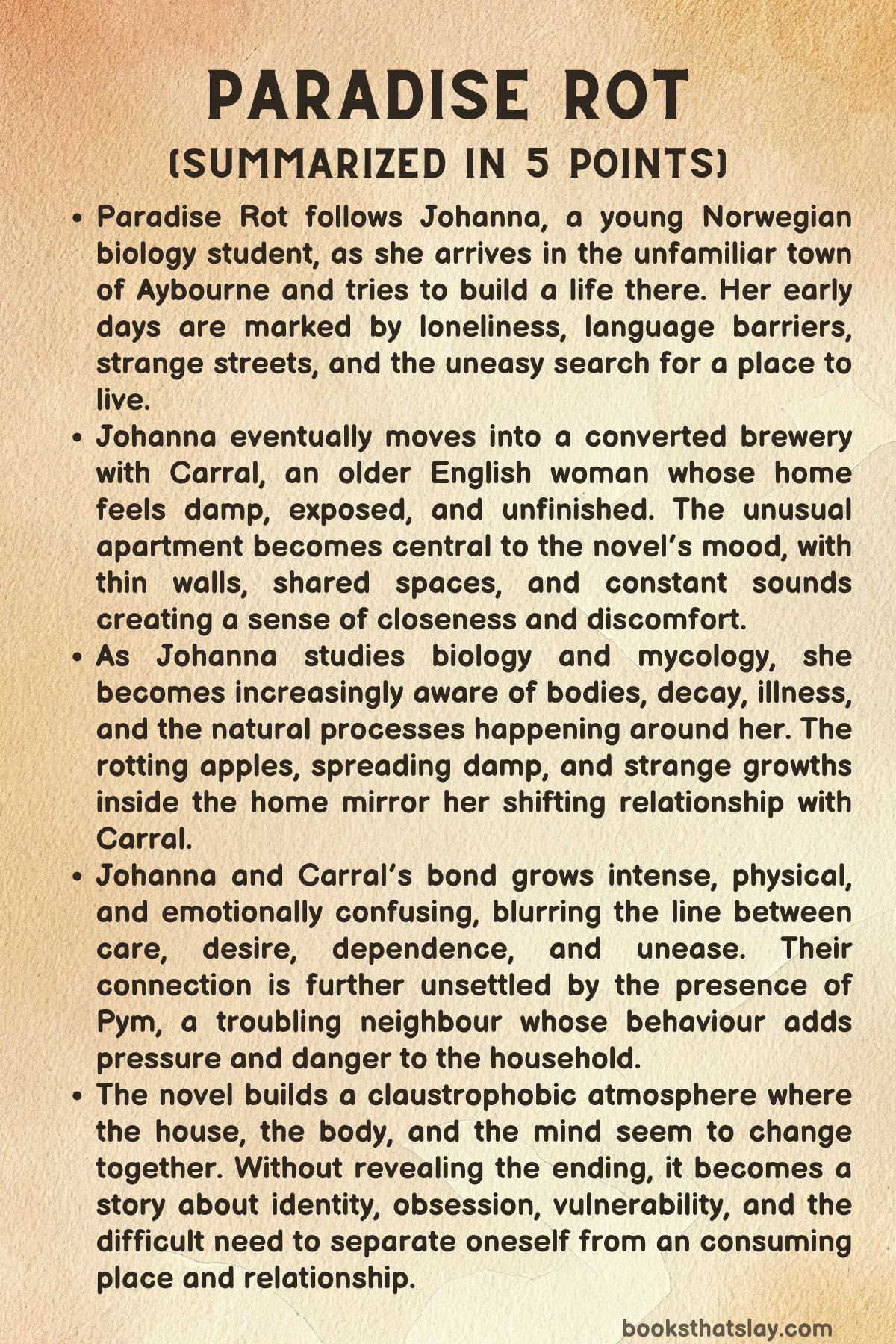
Johanna arrives in Aybourne from Norway to begin her studies in biology, but the town immediately feels difficult to understand. She is alone, uncertain, and unable to move through the place with ease.
Even the train journey and the first search for somewhere to stay become confusing. She ends up in a shabby hostel, walks through foggy streets, and eats food that feels unfamiliar and heavy.
The town itself seems to resist her. Motorways, the sea, hills, and winding streets make Aybourne feel closed in, as if she has entered a place that cannot be mapped in any simple way.
At university, Johanna is surrounded by students, but she still feels separate from them. English is not her first language, and studying in English makes her aware of every sentence she speaks and hears.
She meets other foreign students, including May, two Canadian girls, and Franziska, a German student in her programme. These connections offer some practical help but do not remove her loneliness.
Her search for a room is awkward and uncomfortable. Interviews with potential landlords or housemates feel strained, and some encounters with men leave her uneasy.
She wants a stable place to live, yet every option seems to expose her to some new form of discomfort.
Franziska eventually shows Johanna a notice for a room in a large warehouse. The room is described as quiet, and Johanna goes to see it.
There she meets Carral Johnston, an older English woman who lives in a converted brewery in the Hawthorn district. Carral’s apartment is unlike any home Johanna knows.
It has high ceilings, makeshift walls, mezzanine sleeping areas, and an unfinished quality that makes privacy almost impossible. Sounds travel easily through the plasterboard.
The bathroom offers little separation. The whole place feels damp, open, and vulnerable.
Still, Johanna accepts the room almost at once.
After moving in, Johanna becomes increasingly absorbed by the brewery and by Carral. The building is not simply a background to her life; it begins to feel alive.
It creaks, leaks, carries smells, and lets every sound pass through it. Johanna notices how different it is from the sealed, orderly homes she associates with Norway.
Carral also becomes an object of fascination. Johanna watches her movements, her tiredness, her body, and her habits.
Carral brings home discarded apples, and the two women eat them and talk together. Soon the remaining apples begin to rot and are put into a compost bin, where they become part of the apartment’s growing atmosphere of decay.
Johanna’s studies in biology and mycology start to echo her life at home. She learns about fungi, growth, dampness, and decomposition, while the apartment itself seems to become a living experiment.
Carral has strange patterns of sleep. She falls asleep suddenly, sometimes in odd places.
She becomes ill and weak, and Johanna grows more aware of her body and its sounds. At night, Carral begins coming into Johanna’s bed.
Their closeness becomes physical and emotional, but it is never easy to define. Johanna is drawn to Carral, yet also unsettled by the loss of distance between them.
Johanna finds a pulp romance novel belonging to Carral called Moon Lips. The sexual passages disturb and attract her at the same time.
Reading them makes her aware of her own desire, embarrassment, and inexperience. Carral later takes Johanna to a work gathering, but the evening becomes humiliating.
Carral calls Johanna young and innocent in front of others, making her feel exposed. Carral’s manager then asks invasive questions about Johanna’s sexual life and whether she has been with a man.
The conversation leaves Johanna ashamed and angry. That night, Carral comes to Johanna’s bed again.
Later, Carral apologises for her behaviour. When she learns that Johanna is a virgin, she jokes that they will find someone for her, a comment that is both playful and troubling.
Pym, Carral’s neighbour, soon becomes part of their lives. He is older, large, red-haired, and physically overpowering.
He says he is writing a novel in verse and carries a notebook. During a drunken evening with Johanna and Carral, he writes lines that seem inspired by Johanna’s identity as a biology student.
Carral drinks heavily and falls asleep. Johanna then has a fragmented sexual encounter with Pym, but the memory is unclear.
The next day, she cannot tell whether they actually had sex. The uncertainty itself becomes disturbing, because she cannot trust her own body or memory.
Pym returns with his notebook, but Johanna resists him. Later, at a student bar, he forcibly kisses her.
This confirms the threat she has already sensed in him. That same night, Johanna goes back to the brewery and hears, or believes she hears, Carral and Pym having sex on Carral’s mezzanine.
The sound cuts into her sense of what exists between her and Carral. It is unclear how much is real and how much comes from Johanna’s fear, jealousy, and imagination, but the effect is powerful.
Pym becomes not only a man who has crossed her boundaries, but also a presence inside the fragile world she shares with Carral.
After this, the apartment begins to break down more quickly. Storms hit Aybourne, and damp spreads through the building.
Mould appears. Grass, spiders, insects, and mushrooms seem to enter the living space.
The composted apples smell worse. The brewery becomes increasingly hard to separate from the bodies inside it.
Carral’s health also declines. She grows weaker, loses control of her bladder, loses her hair, and becomes dependent on Johanna.
Johanna cuts Carral’s hair and confronts her about Pym. Carral says she does not remember clearly and admits she was afraid Johanna would leave.
Johanna promises not to go, but this promise draws her deeper into Carral’s illness and the apartment’s decay. Their memories and bodies begin to blur.
Carral remembers a story from Johanna’s childhood as if it belonged to her. Johanna imagines Pym being absorbed into Carral and then into herself.
The boundaries between self and other, desire and disgust, care and control, become harder to maintain. Johanna’s biological studies give language to what seems to be happening around her: growth, rot, invasion, reproduction, and transformation.
Yet knowledge does not protect her. Instead, it makes her more aware of the processes consuming the house and her life inside it.
Johanna later finds Pym’s notebook rotting in the compost. When she reads it, she discovers that he has written a fantasy involving a biologist, another girl, and a man.
In his version, the women exist to satisfy and merge into him. Carral has changed the ending, turning the fantasy against him so that the women consume him and become a four-breasted creature.
This altered ending gives Johanna a disturbing image of female union, revenge, and bodily transformation. It also shows how Pym’s presence has been taken into the strange private mythology of the brewery.
Johanna and Carral’s intimacy becomes more intense and more frightening. Carral’s body seems to demand care, but that care threatens to erase Johanna.
Their closeness no longer feels like comfort. It becomes a form of absorption.
Johanna senses that if she stays, she may lose the version of herself that can still leave. She decides she must escape, even though leaving Carral feels like betrayal.
On her final day in the brewery, Johanna runs a bath for Carral. She tells her that she has to go.
In a symbolic act, she imagines drawing Pym, herself, and their shared nights out of Carral, as if trying to separate the tangled remains of what has happened between them. Then she walks away and goes to Franziska’s flat.
This departure is not triumphant. It is necessary, painful, and incomplete.
In the epilogue, Johanna looks back on Carral as someone who fades behind her. She never finds her again.
Yet she does not feel that she has fully escaped. She imagines that only one version of herself left Aybourne, while another version remains in the brewery with Carral and the ghosts of the place.
That other Johanna is still submerged in the damp, the sea, the beer, the mould, and the memories that shaped her there. Paradise Rot ends with escape shadowed by haunting: Johanna survives by leaving, but part of her remains inside the house that changed her.
Characters
In Paradise Rot, Jenny Hval builds her characters less through conventional plot development and more through atmosphere, bodily unease, emotional dependency, and the gradual collapse of boundaries between people and places. The characters often seem half-real and half-symbolic, shaped by damp rooms, strange smells, illness, desire, shame, and memory.
Johanna
Johanna is the central consciousness of the book, and her character is defined by dislocation, vulnerability, curiosity, and gradual bodily awakening. As a young Norwegian student arriving alone in Aybourne, she begins the story as someone removed from everything familiar: language, food, weather, housing, social codes, and even the structure of the town itself.
Her early confusion shows how deeply she is affected by environment. Aybourne feels less like a place she can enter confidently and more like a maze that presses against her from every side.
This makes Johanna appear observant but passive at first, as though she is absorbing the world before she knows how to act within it.
Her biology studies are important because they shape the way she experiences the world. Johanna does not simply notice people emotionally; she notices bodies, fluids, rot, mould, fungi, skin, smell, and decay.
Her scientific interest merges with her private sensations, making her both analytical and intensely sensual. She is drawn to processes of transformation, especially the way living things break down and become something else.
This makes her fascination with Carral and the brewery feel natural: Johanna is attracted to spaces and people that seem unstable, porous, and in the process of changing.
Johanna is also a character caught between innocence and desire. She is inexperienced, especially sexually, but she is not simple or unaware.
Her reading of Carral’s romance novel, her shame, her arousal, and her confused encounters with Carral and Pym reveal a young woman trying to understand her own body without clear guidance or safety. The book does not present her sexual awakening as romantic or liberating in a straightforward way.
Instead, it is mixed with fear, embarrassment, curiosity, coercion, and uncertainty. Johanna’s inability to tell what happened with Pym shows how easily her sense of self and bodily control can become blurred.
Her relationship with Carral becomes the emotional and symbolic centre of her character arc. Johanna wants closeness, but the closeness she finds is consuming rather than comforting.
She becomes caretaker, witness, lover, child, double, and almost extension of Carral. As Carral weakens, Johanna is pulled further into the brewery’s world of dampness and decay.
Her final decision to leave is therefore crucial. It is not a simple escape from a bad living situation; it is an attempt to recover the borders of her own self.
Yet the ending suggests that Johanna’s escape is incomplete. One version of her leaves, but another remains trapped in the brewery, which shows how deeply trauma, intimacy, and place have entered her identity.
Carral Johnston
Carral is one of the most mysterious and unsettling figures in the book. She is older than Johanna, English, independent in appearance, and already deeply connected to the strange brewery space before Johanna arrives.
At first, she seems eccentric rather than threatening. She brings home discarded apples, lives in an unfinished converted building, sleeps in unusual places, and behaves with a kind of careless openness.
Her life appears loose, improvised, and free from ordinary domestic rules. For Johanna, this makes Carral fascinating because she represents a way of living that is completely unlike the ordered privacy of home.
Carral’s character is strongly tied to the apartment. The thin walls, exposed bathroom, shared sounds, high ceilings, damp air, and mezzanine beds all reflect her lack of boundaries.
She lives in a place where privacy barely exists, and her personality has the same quality. She enters Johanna’s space, speaks too openly, sleeps unpredictably, and gradually crosses emotional and physical limits.
Carral’s intimacy can seem tender, but it is also invasive. She needs Johanna, draws her in, and then becomes increasingly dependent on her.
Her illness and physical decline turn her into a figure of decay. Carral’s weakening body mirrors the rotting apples, spreading mould, insects, mushrooms, and dampness of the brewery.
She becomes less stable as a separate person and more like part of the building’s ecosystem. Her loss of hair, loss of bladder control, and exhaustion strip away the social surface she once had.
Yet this does not make her merely helpless. Carral remains emotionally powerful because Johanna cannot easily separate pity, desire, responsibility, and fascination.
Carral is also morally ambiguous. She embarrasses Johanna at the work gathering, fails to protect her from invasive questioning, and becomes entangled with Pym in ways that wound and confuse Johanna.
At the same time, Carral herself seems frightened, lonely, and possibly unable to understand or control everything happening around her. Her claim that she was afraid Johanna would leave reveals her dependency and insecurity.
Carral wants to keep Johanna close, but the form that closeness takes becomes destructive. She is both victim and force of consumption, a woman who is decaying and absorbing others at the same time.
Pym
Pym is the most openly predatory and intrusive character in the story. He enters Johanna and Carral’s world from next door, already carrying a sense of physical excess and threat.
His size, red hair, age, drunkenness, and literary pretensions make him feel both ridiculous and dangerous. He says he is writing a novel in verse, but his writing does not make him seem sensitive or artistic.
Instead, it becomes another way for him to possess and reshape the women around him.
Pym’s treatment of Johanna exposes his entitlement. During the drunken evening, he turns her identity as a biology student into material for his own fantasy.
The uncertain sexual encounter that follows is disturbing because Johanna cannot clearly determine what occurred. This uncertainty is central to his role in the book.
Pym operates in blurred spaces: drunkenness, half-memory, coercion, unwanted intimacy, and the confusion between desire and violation. His later forced kiss at the student bar confirms that his interest in Johanna is not respectful or mutual.
He imposes himself on her body and her story.
His notebook reveals the full ugliness of his imagination. The fantasy he writes reduces the women into figures who exist to satisfy and merge into him.
He wants to transform Johanna’s biological knowledge, Carral’s body, and female intimacy into material that centres male desire. In that sense, Pym is not just a character but also a symbol of invasive authorship.
He tries to write the women into his own sexual mythology. Carral’s altered ending, where the women consume him instead, reverses this power and turns his fantasy against him.
Pym’s eventual symbolic absorption into Carral and Johanna is one of the book’s most disturbing transformations. He does not simply disappear as a person; he becomes a contaminating presence inside their shared bodily and mental world.
Johanna’s attempt to draw Pym out of Carral near the end shows her desire to remove his influence from their intimacy. Pym represents masculine intrusion, coercive imagination, and the violence of being turned into someone else’s material.
Franziska
Franziska is a quieter but important character because she offers Johanna one of the few practical connections to ordinary student life. As a German student in Johanna’s programme, she occupies a similar position as a foreigner, but she seems more grounded and functional.
She helps Johanna find the housing notice that leads her to Carral, making her indirectly responsible for Johanna’s entrance into the brewery. Unlike Carral and Pym, Franziska is not associated with decay, bodily invasion, or unstable desire.
She belongs more to the world of university, schedules, rooms, and practical survival.
Her importance increases at the end because Johanna goes to Franziska’s flat after leaving Carral. This makes Franziska a figure of possible refuge.
She represents the life Johanna might have had if she had remained connected to ordinary friendships and student routines instead of being absorbed into the brewery. However, Franziska is not developed as a saviour.
Her role is limited, and that limitation matters. She can offer a place to go, but she cannot fully understand or undo what Johanna has experienced.
Franziska also helps show Johanna’s isolation. Even when Johanna has access to another student and potential friend, she is drawn away from that world and into Carral’s.
Franziska’s relative normality makes the brewery seem even stranger by contrast. She stands at the edge of the story as a reminder that another form of life exists, but Johanna’s emotional and bodily entanglement with Carral prevents her from fully belonging to it.
May
May is one of the foreign students Johanna meets early in Aybourne, and her role is mostly atmospheric and social. She belongs to the early part of Johanna’s arrival, when Johanna is still trying to understand the town and place herself among other outsiders.
May helps create the sense that Johanna is not the only foreigner struggling to adapt, but she does not become a deep companion or emotional anchor.
As a character, May reflects the possibility of ordinary student connection that never fully develops for Johanna. She appears in a world of introductions, hostels, unfamiliar streets, and early attempts at social belonging.
Because Johanna soon becomes absorbed by Carral and the brewery, May fades into the background. This fading is significant because it shows how Johanna’s life narrows.
The ordinary network of peers that might have supported her is replaced by the intense, enclosed world of Carral, Pym, and the decaying apartment.
May’s minor role also contributes to the book’s sense of alienation. Johanna meets people, but these meetings do not necessarily become relationships.
Social contact exists, but it remains thin and temporary. May therefore helps mark Johanna’s early loneliness and the failure of ordinary companionship to protect her from the more consuming intimacy that follows.
Themes
Alienation and Displacement
Johanna’s arrival in Aybourne is marked by confusion, discomfort, and a constant sense of being out of place. The town never feels welcoming to her; its fog, roads, sea, hills, and strange layout make it feel more like a trap than a new beginning.
Her foreignness is not only geographical but also emotional and linguistic. Studying in English makes her self-conscious, and even ordinary social situations become strained because she cannot fully trust her own voice or reactions.
In Paradise Rot, this displacement shapes the way Johanna begins to depend on Carral and the brewery. Since the outside world feels cold, unclear, and difficult to enter, the strange home becomes both shelter and prison.
Her isolation makes her vulnerable to people who disturb her boundaries, especially Carral and Pym. The theme shows how loneliness can weaken a person’s sense of judgment, making unsettling spaces and relationships seem necessary simply because they offer attention, contact, and a place to stay.
The Breakdown of Boundaries
The brewery constantly challenges the idea of privacy, separation, and personal space. Its thin walls, open bathroom, mezzanine beds, damp air, and carrying sounds make it almost impossible for Johanna and Carral to remain separate individuals.
Their bodies, routines, and memories begin to press against each other until intimacy becomes disturbing rather than comforting. This breakdown is not only physical; it is psychological as well.
Carral begins to remember Johanna’s childhood story as if it belongs to her, while Johanna imagines other bodies and experiences entering her own. The home reflects this loss of boundaries through its dampness, mould, insects, rot, and spreading organic life.
Nothing stays contained. Food decays, walls fail, sound travels, and identities blur.
The theme suggests that closeness without limits can become dangerous. What begins as fascination and companionship slowly turns into absorption, where care, desire, sickness, and dependence become difficult to separate.
Decay, Rot, and Transformation
Rot is not only a sign of destruction in Paradise Rot; it is also a force of change. The discarded apples, compost, mould, mushrooms, damp walls, and Carral’s weakening body all create a world where living things are constantly breaking down and becoming something else.
Johanna’s biology studies make her especially alert to these processes, so decay becomes both scientific and emotional. The brewery seems alive because it changes, smells, leaks, grows, and produces new forms from waste.
Carral’s decline mirrors the house’s deterioration, making the body and the building feel connected. This theme shows that decay can be frightening because it removes control.
Things lose their original shape, and people lose certainty about what has happened to them. At the same time, rot also produces transformation: the composted notebook, Carral’s altered ending, and Johanna’s imagined escape all suggest that corruption can create new meanings, even when those meanings are disturbing.
Female Desire, Power, and Escape
Johanna’s desire is shown as uncertain, shifting, and often shaped by shame, fear, curiosity, and pressure. Her attraction to Carral grows through observation, bodily closeness, and shared domestic life, but it never becomes simple or safe.
Pym’s presence introduces a more threatening form of sexuality, one connected to force, fantasy, and male control. His notebook reduces the women to figures in his own imagination, but Carral’s altered ending changes that fantasy by making the women consume him instead.
This reversal is important because it turns female desire from something passive into something powerful and frightening. Still, power does not fully free Johanna.
Her bond with Carral becomes so intense that escape feels necessary for survival. Leaving the brewery is not a clean victory; Johanna senses that part of herself remains behind.
The theme presents desire as both awakening and danger, especially when it is tied to dependency, possession, and the struggle to reclaim the self.