The Atlas Complex Summary, Characters and Themes
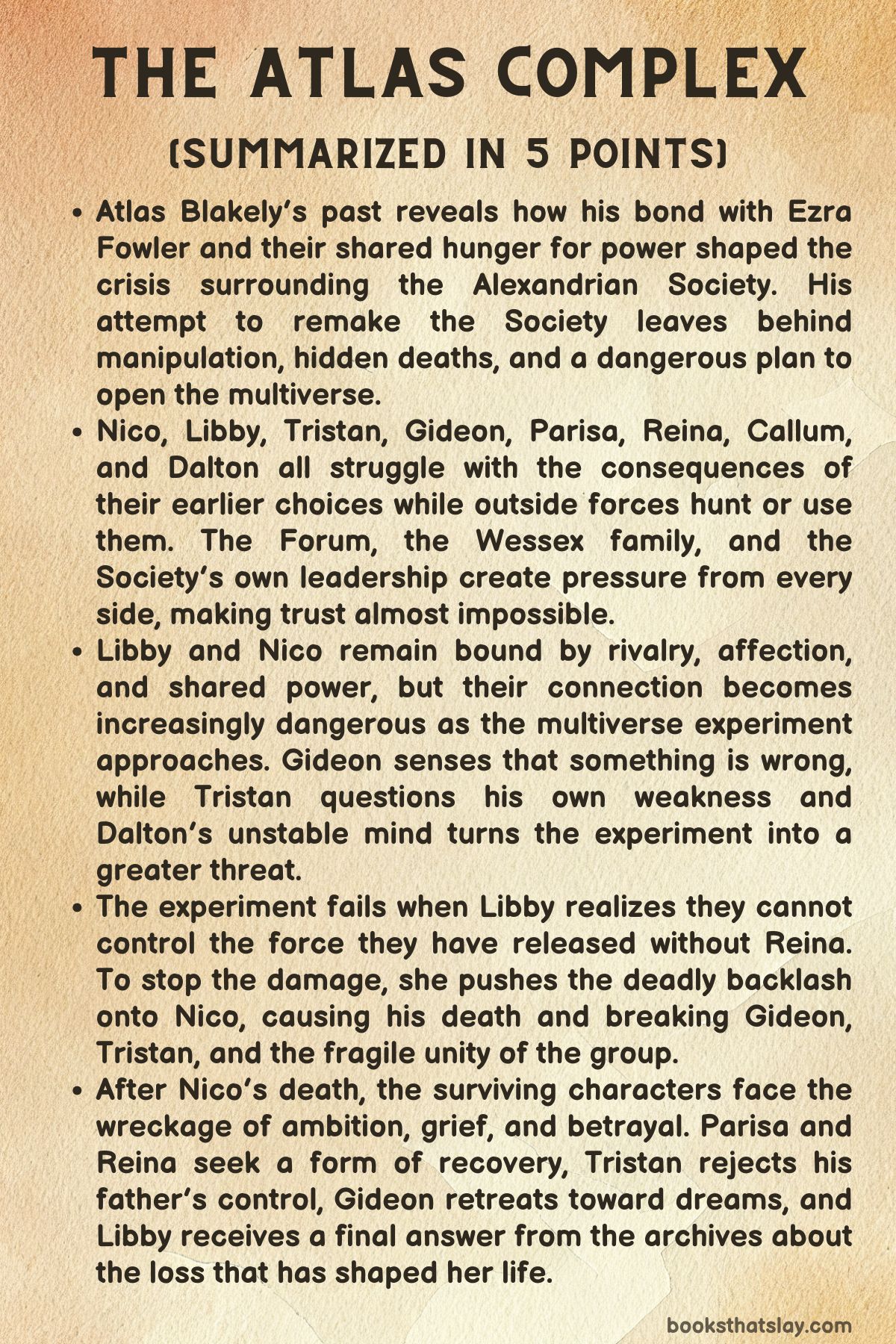
The Atlas Complex by Olivie Blake is the conclusion to the Atlas trilogy, following the gripping tales of The Atlas Six and The Atlas Paradox. The story follows the remaining members of the Alexandrian Society as they face the consequences of earlier betrayals, failed loyalties, and dangerous magical ambition.
Its world is filled with telepaths, physicists, illusionists, dream-walkers, and political manipulators, but its central concern is deeply human: whether people can be trusted with extraordinary power when they are still driven by grief, pride, fear, love, and self-interest.
Summary
The story begins by returning to Atlas Blakely, the enigmatic Caretaker of the Alexandrian Society. Long before he recruited the latest six initiates, Atlas had been a gifted but dissatisfied young man who found his own invitation to the Society almost by accident.
He joined less out of reverence than boredom, and in his cohort he met Ezra Fowler, whose ability to manipulate time made him both fascinating and dangerous. Atlas and Ezra developed a bond built on intellectual hunger, alienation, and a shared belief that the Society needed to be remade.
Their friendship became one of the origins of the damage that now threatens everyone around them.
The novel then moves among the scattered initiates and their allies. Eilif, a mermaid bound by a debt to the mysterious Accountant, tries to capture Nico Ferrer de Varona but finds Callum Nova instead.
Callum, emotionally ruthless and almost impossible to control, resists her magic and defeats both her and the military forces with her. Eilif dies cursing the Accountant, noticing a sign that hints at his true identity as James Wessex.
Her death marks the reach of outside powers that want access to the Alexandrian Society and its initiates.
Nico is summoned by the Society’s administration to answer for destruction, deaths, and his decision to bring Gideon Drake into Society affairs. Gideon is not a member, and the Society wants his memory erased, but Nico argues for him.
Gideon is allowed a limited administrative placement, though under suspicion. Nico’s mind is still torn between his feelings for Gideon, his bond with Libby Rhodes, and his obsession with fixing the crisis that Atlas left behind.
Libby has returned from the past after killing Ezra, and she warns that Atlas intended to open the multiverse through a dangerous experiment. She believes the archives may kill the initiates unless one of them dies, but Nico resists any solution that leaves Gideon behind.
At the manor house, Tristan Caine has taken Dalton Ellery’s place as researcher. He is unsettled by his own moral weakness and by his connection with Libby.
Libby, haunted by the damage caused by her return to the present, looks to Tristan for understanding, and their relationship becomes both intimate and unstable. Nico’s arrival interrupts their closeness, showing how unresolved the bond between Nico and Libby remains.
Parisa Kamali has left the manor but remains tied to everyone’s fate. In New York, assassins come after her, and she kills them with calm precision.
Dalton, whose mind she once helped repair, offers her a future in which she could replace Atlas and help shape a new world. Parisa is tempted by power but remains cautious.
When her husband Nasser fails to arrive for a meeting, she later learns he has been killed because of a hit connected to the Forum, a rival organization led by Nothazai. His death sharpens Parisa’s grief and removes one of the last pieces of ordinary life she had left.
Meanwhile, Reina Mori and Callum work outside the manor, trying to influence politics. Reina believes she can use power to create meaningful change, even if the methods are brutal.
Callum questions whether change is ever permanent, but he still helps her use fear and manipulation as tools. Their partnership is strategic, but it is also uneasy.
Reina wants control over history; Callum wants distance from feeling, though his fascination with Tristan keeps betraying him.
Inside the manor, Libby and Nico argue about the multiverse experiment. Nico believes in action, even dangerous action, while Libby fears becoming the sort of person who sacrifices others for ambition.
Their connection remains intense, more than friendship and not quite romance. Gideon senses something wrong with Libby, something that reminds him of his mother and the dangers of unstable consciousness.
He also worries that Nico is ignoring practical and moral warning signs. The manor is running out of supplies, Atlas is absent, Dalton is unreliable, and the Accountant is searching for Gideon.
The story widens to reveal Ezra’s hidden group, the Ezra Six, made up of powerful figures placed against the Society and its initiates. Julian Rivera Pémy, a technomancer with CIA ties, works with Nothazai to track Callum and Reina.
Li, another member, notices what others miss: Callum is using Reina to strengthen his powers, and Libby may be the true threat to the Society. Eden Wessex, James Wessex’s daughter, is frustrated by being underestimated and begins acting on her own.
Sef Hassan doubts Nothazai’s motives, while James Wessex is gradually revealed as the Accountant whose reach has shaped several characters’ debts and dangers.
Atlas’s past is revealed in fragments. His original cohort learned that one of them had to die for the Society’s initiation, and Atlas and Ezra tried to evade that price through time manipulation.
The result was not salvation but a long chain of deaths, guilt, and rationalization. Atlas became increasingly isolated, convinced that he could fix the world if he gained enough control.
He damaged minds, manipulated Dalton, and took the Caretaker’s position through morally corrupt means. His stated goal of replacing the Society becomes harder to separate from his desire to dominate it.
The central group slowly moves toward the experiment. Dalton, fragmented and dangerous, returns to the manor pretending Parisa will come too.
In truth, Parisa has realized he is far more unstable than she understood. Dalton can create living copies, and his need to know the source of his power has become nearly uncontrollable.
He believes the experiment is the reason he exists. Parisa, horrified by what he demonstrates, flees, but by then he has inserted himself into the plan.
Libby and Nico finally confront what they are to each other. Nico suggests that across the multiverse they either end up together or destroy each other, but that this universe belongs to his love for Gideon.
Libby recognizes that Nico cannot heal the wound left by Ezra’s betrayal or by her own ambition. This realization leads her to choose the experiment, not because she is certain it is right, but because she cannot stop wanting the answer.
The experiment begins with Nico, Libby, Tristan, Dalton, and Gideon present. They combine their magic and open themselves to a force larger than any of them can manage.
Tristan experiences cosmic smallness and a strange freedom from his father’s expectations. Dalton’s buried memories reveal guilt over his brother’s death and the possibility that his powers were tied to that loss.
Gideon senses danger but misjudges its source. Libby realizes that something is wrong with Dalton, with the Society, and with herself.
She understands that someone must make a choice before the experiment destroys them.
Libby stops the experiment, recognizing too late that excluding Reina was a fatal mistake. Reina could have absorbed the excess energy, but without her, either Libby or Nico must take it.
Libby chooses herself as the one who understands what must happen and forces the backlash onto Nico. Nico dies.
His final reflections return to Gideon and to Libby, acknowledging both the strange inevitability of his bond with her and the meaningful love he has found with Gideon in this single universe.
The aftermath is devastating. Gideon refuses to let Dalton use Nico’s body as a tool for another attempt.
He rejects Libby’s explanation and tells her she must live with what she has done. Tristan also pulls away from Libby, questioning why she believes she alone gets to decide who lives and dies.
He tries to leave but is captured by agents connected to his father, Adrian Caine.
Parisa and Callum manipulate the Society’s board into appointing Nothazai as the new Caretaker. Parisa intends to take real control while using Nothazai’s ambition as a tool.
She returns to the manor with Callum, prepared to kill Libby, but finds a new crisis in Dalton’s damaged mind. Gideon and Parisa enter the mental ruins of Dalton’s consciousness, where Wessex forces attack.
Gideon realizes James Wessex is the Accountant and that Dalton’s mind has become a battlefield. Though stopping Dalton may require abandoning Parisa, Gideon chooses to save her.
Libby, changed by Nico’s death, begins to see that killing Ezra, Atlas, and Nico has solved nothing. She considers killing Callum but stops because another death will not repair the damage.
Callum later shoots Dalton and rushes to rescue Tristan when he learns the Caines have him. At the pub, Tristan realizes Callum never truly meant to kill him.
Adrian shoots Callum, and reality fractures through possible versions of Tristan’s choices. In the final version, Tristan rejects his father’s control and shoots Adrian.
Reina survives an assassination-related attack and later returns to the manor broken by the news of Nico’s and Atlas’s deaths. She nearly gives herself back to the earth, but Parisa stops her and offers companionship.
Gideon retreats into the dream world, where he finds a version of Nico and chooses the comfort of that moment, whether real or not. Libby visits Belen, returns to her old school, and finally goes home, where she reads her dead sister Katherine’s journal.
Nothazai becomes Caretaker, but when he asks the archives for answers, he is denied. Libby, however, is given a book that may contain the truth about whether she could have saved her sister.
The ending returns to the question that has haunted the entire story: knowledge may offer answers, but it cannot free anyone from the moral cost of wanting them.
Characters
Atlas Blakely
In The Atlas Complex, Atlas Blakely is the figure whose absence controls as much of the story as his presence. He begins as a brilliant young man who joins the Alexandrian Society without reverence, then grows into someone who believes he can correct the failures of the institution and the world itself.
His tragedy lies in the way his ideals become indistinguishable from control. Atlas sees corruption clearly, but he responds by becoming manipulative, secretive, and willing to damage other people’s lives for a future only he can define.
His relationship with Ezra shapes much of this decline because it teaches him that time, death, and consequence might be things to outwit rather than accept. Atlas is not simply a villain; he is a warning about intellect without humility.
By the end, his plans survive him as damage, proving that the desire to fix everything can become another form of destruction.
Libby Rhodes
Libby Rhodes is one of the most morally difficult figures in The Atlas Complex because her intelligence and guilt are always competing with her ambition. She wants to believe she acts for necessity rather than power, but the story repeatedly tests that self-image.
Her return from the past has left collateral damage behind her, and her killing of Ezra has not freed her from fear or uncertainty. Libby’s connection with Nico remains central to her identity, yet she also resents how deeply that connection defines her.
With Tristan, she finds someone who sees her darkness more plainly, but even that intimacy cannot absolve her. Her decision to push the experiment’s backlash onto Nico exposes the coldest part of her character: when forced to choose, she decides that her understanding matters more than his life.
Libby is not without feeling, but she becomes dangerous because she can turn feeling into justification.
Nico Ferrer de Varona
Nico Ferrer de Varona is brilliant, impulsive, loyal, selfish, and more emotionally vulnerable than he wants to admit. His magic and confidence make him seem reckless, but beneath that restlessness is a fear of losing the people who define him.
His relationship with Gideon gives him a gentler emotional center, while his bond with Libby represents a more volatile kind of attachment, one built from rivalry, recognition, and shared power. Nico often treats danger like a puzzle that can be solved through daring, which blinds him to the emotional cost of his choices.
Yet he is also capable of apology, tenderness, and real self-knowledge. His death is devastating because it comes after he has begun to understand that not every bond needs to become possession.
In the book, Nico’s final thoughts make clear that he values Gideon not as an escape from destiny, but as the meaningful exception to it.
Gideon Drake
Gideon Drake is the emotional conscience of the story, though he is not powerless or passive. As a dream-walker, he occupies a space between reality and the subconscious, which makes him unusually sensitive to hidden damage in others.
He understands Nico more quietly than anyone else does, and his love is patient, observant, and often painful. Gideon’s unease around Libby and Dalton shows that he sees danger before others are willing to name it.
At the same time, his loyalty can place him in terrible positions, especially when he refuses to abandon Parisa inside Dalton’s mind. Nico’s death pushes Gideon into grief so intense that reality becomes less bearable than dreams.
His final movement toward the dream world is not simple defeat; it is a retreat into the only place where love, memory, and possibility can still coexist.
Tristan Caine
Tristan Caine is shaped by perception, inheritance, and the fear that he is weaker than the people around him. His ability to see through illusions gives him insight, but it does not automatically grant courage.
Much of his arc is about the painful gap between knowing what is true and acting on that knowledge. His relationship with Libby is built on recognition and guilt, while his bond with Callum carries anger, fascination, and unspoken tenderness.
Tristan fears becoming like Atlas because he recognizes the same temptation in himself: the urge to stand aside until someone else makes the terrible choice. His confrontation with Adrian, his father, forces him to reject being used as a weapon by family, Society, or lover.
By killing Adrian, Tristan makes a brutal choice, but it is also a refusal to remain trapped in someone else’s design.
Parisa Kamali
Parisa Kamali is a strategist, survivor, and telepath whose control often masks grief. She understands desire better than most characters because she can see what people hide, but that insight does not protect her from being hurt.
Nasser’s death removes a personal anchor and leaves her with very little outside the world of power and manipulation. Parisa’s relationship with Dalton is especially complex because she is drawn to his brokenness and possibility, yet she fails to fully grasp how dangerous he has become.
Her attempt to position Nothazai as Caretaker shows her political intelligence and her willingness to use systems rather than merely oppose them. She is not idealistic, but she is not empty either.
Her later care for Reina shows that beneath her sharpness remains a capacity for connection. Parisa survives by adapting, but the book asks whether survival without trust is enough.
Callum Nova
Callum Nova presents himself as detached, cruel, and amused by everyone else’s moral seriousness. His emotional manipulation makes him one of the most frightening characters because he can turn a person’s feelings into a weapon.
Yet the story slowly reveals that his indifference is not as complete as he claims. His fixation on Tristan begins as strategy, but it becomes the clearest evidence that he is still capable of wanting someone beyond utility.
Callum understands corruption in families, politics, and institutions because he comes from the Nova world of corporate power and public performance. He often behaves as if nothing matters because caring would make him vulnerable.
His final rush to save Tristan proves that feeling has broken through his defenses. Callum’s tragedy is that by the time his care becomes undeniable, the world he has mocked and manipulated gives him little mercy.
Reina Mori
Within The Atlas Complex, Reina Mori is driven by the belief that power should be used to change the world, even if the process requires force, fear, or manipulation. She is often distant from the others because her concerns are broader than personal survival.
Politics, climate, systems of power, and social collapse matter to her more than the emotional conflicts inside the manor. Yet this large-scale thinking also isolates her and makes her vulnerable to despair when her efforts seem meaningless.
Her magic connects her to the natural world, and the pomegranate grove that protects her after the attack suggests that life responds to her even when human systems betray her. Reina’s near-suicidal surrender to the earth shows how deeply failure wounds her.
Parisa’s intervention gives her a chance to stop measuring her worth only by whether she can save everyone.
Dalton Ellery
Dalton Ellery is one of the most unsettling characters because he is both victim and threat. His mind has been altered, broken, copied, and repaired until even his own sense of self becomes unstable.
He wants to understand where his power comes from, and that desire becomes more important to him than the lives affected by his experiments. His childhood memory of saving a tree while his brother died nearby reveals how guilt and denial shaped his identity.
Dalton chooses a version of memory that protects him from the possibility that his gift may be tied to loss. His ability to create living copies makes him nearly godlike, but emotionally he remains fractured and needy.
He is dangerous not because he lacks feeling, but because his need for meaning overwhelms his judgment. His death ends one immediate threat, but not the questions his existence raises.
Ezra Fowler
Ezra Fowler is the ghost of earlier betrayal and failed ambition. His time-manipulating ability made him central to Atlas’s original plans, and his bond with Atlas helped create the pattern of evasion that damages later generations.
Ezra’s influence continues even after his death because he helped build a mindset in which sacrifice could be postponed, redirected, or forced onto someone else. To Libby, he represents betrayal on an intimate scale.
To Atlas, he represents a shared dream that curdled into ruin. Ezra’s power over time makes him symbolically important: he is tied to the refusal to accept consequence.
The story treats him less as a present actor than as a force that shaped everyone’s current disaster. His end does not close the wound because the logic he helped create remains alive in the Society.
Nothazai, Edwin Sanjrani
Nothazai, born Edwin Sanjrani, is a reformer who becomes another version of the thing he opposes. His biomancy gives him the ability to see flaws in bodies, and that vision expands into a larger disillusionment with humanity.
He begins with the desire to help, but his awareness of imperfection hardens into contempt. As the leader of the Forum, he positions himself against the Alexandrian Society’s abuses, yet he is also hungry for authority and recognition.
Parisa understands this weakness and uses it to help place him in the Caretaker role. His appointment suggests that institutions often replace one compromised leader with another.
When he asks the archives for answers and is denied, his limitations become clear. He may have gained the title, but not the deeper legitimacy or insight he craves.
James Wessex
James Wessex, revealed as the Accountant, is a figure of debt, control, and hidden weakness. He operates through contracts, threats, and corporate power, making him dangerous even when he remains physically distant.
His pursuit of Gideon and his connection to the attacks on the initiates show how private systems of wealth can rival magical institutions in cruelty. Yet James is not as invincible as he appears.
Eilif’s curse anticipates his collapse, and Tristan’s later confrontation exposes the hollowness beneath his authority. James has spent his life maintaining power through fear and concealment, including the truth about Eden’s lack of magical ability.
When Tristan forces him to withdraw the bounty, James is left diminished. His failure is not dramatic nobility but exposure: the empire he built cannot protect him from the consequences of underestimating others.
Eden Wessex
Eden Wessex is defined by frustration, invisibility, and the burden of living under James Wessex’s shadow. She wants to be useful and feared, but others repeatedly treat her as a messenger rather than a true player.
Her lack of magical ability, hidden by her father, intensifies her insecurity and makes her more desperate to prove herself. When she confronts Parisa, her violence is partly strategic and partly emotional, an attempt to seize control in a world that has denied her importance.
Parisa’s easy domination of her exposes the gap between Eden’s desired self-image and her actual power. Still, Eden is not insignificant.
She reveals how families built around control damage even their privileged children. Her resentment becomes another symptom of the Wessex world, where love is secondary to usefulness.
Sharon
Sharon appears at first as a rigid administrative figure, but the story gradually gives her emotional depth. She represents the Society’s bureaucracy: rule-bound, cautious, and trained to reduce human crises to protocols.
Her treatment of Nico and Gideon shows how the institution protects itself first, even when people are afraid or grieving. Yet Sharon’s conversation with Parisa reveals private pain, especially through her daughter’s illness.
That vulnerability changes how she reads Parisa and eventually makes her willing to bend the rules. Sharon is important because she shows that not every person inside a corrupt system is equally corrupt.
Some are tired, frightened, and compromised by personal need. Her choice to help Parisa access tracking information is not pure heroism, but it is a human decision made in a world that often treats humanity as an inconvenience.
Eilif
Eilif’s role is brief but meaningful. As a mermaid bound by debt, she belongs to the wider network of bargains and punishments that surrounds the Society.
Her attempt to capture someone from the Alexandrian circle is not simply villainous; it is the act of someone trapped by obligation. Her confrontation with Callum reveals his terrifying resistance to control and his ability to dominate even trained forces.
In death, Eilif becomes important because she sees the clue that points toward James Wessex as the Accountant. Her curse gives her final moments power, turning her defeat into a prophecy of his downfall.
Eilif shows how many lives outside the central group have been caught in the ambitions of greater powers.
Max Wolfe
Max Wolfe provides an important contrast to the magical and institutional chaos around Nico and Gideon. His relationship with Nico is practical, comedic, and transactional on the surface, especially through their annual performance for Max’s family.
Yet Max sees Gideon’s feelings clearly and tells Nico not to ruin what Gideon has carried for years. That moment matters because Max speaks from outside the Society’s grand intellectual drama.
He cuts through Nico’s self-absorption with plain emotional truth. Max is not central to the magical conflict, but he helps reveal Nico’s personal stakes.
In a story crowded with people who hide behind theory, power, and destiny, Max’s bluntness feels grounding.
Belen, Dr. J Araña
Belen is tied to Libby’s past and to the ethical wreckage caused by magical and political conflict. Under the identity of Dr. J Araña, she becomes connected to public violence, investigation, and the consequences of manipulation.
Her dementia, caused by Nothazai’s interference with her brain, turns her into another example of a person damaged by someone else’s mission. Libby’s visit to her is heavy with guilt, gratitude, and the possibility of forgiveness that neither woman can fully state.
Belen does not offer Libby easy absolution, and that matters. Her decline reminds the reader that magical harm is not abstract.
It leaves bodies, minds, reputations, and futures permanently altered.
Katherine Rhodes
Katherine Rhodes, Libby’s dead sister, is absent but emotionally central to Libby’s deepest wound. Libby’s return to her childhood home and discovery of Katherine’s journal bring the story back from cosmic experiments to an older, more intimate grief.
Katherine represents the question Libby cannot stop asking: whether knowledge or power could have saved the person she lost. This unresolved grief helps explain Libby’s hunger for answers, but it does not excuse the people she sacrifices along the way.
Katherine matters because she is not just a tragic memory. She is the measure against which Libby tests the value of everything she has become.
The archive’s final answer to Libby suggests that the personal loss beneath her ambition has never stopped guiding her.
Nasser
Nasser, Parisa’s husband, represents one of the few remaining links Parisa has to a life beyond strategy and survival. His death is not given as much space as the central magical conflicts, but its emotional impact is severe.
For Parisa, losing him confirms that no private refuge is safe from the wars surrounding the Society and the Forum. His murder also sharpens her break from hesitation.
After Nasser is gone, Parisa has less reason to preserve any illusion of ordinary stability. He matters because his death strips away the boundary between personal and political violence.
Parisa’s grief becomes quieter than rage, but it changes the force of every choice she makes afterward.
Aiya Sato
Aiya Sato is a board member whose polished control reflects the Society’s upper-level power structure. Her conversation with Selene Nova reveals a mind skilled at influence, reputation management, and mutually beneficial calculation.
She understands that philanthropy can function as strategy, not merely generosity, and she guides Selene toward choices that serve both public image and private interest. Aiya’s attraction to Selene is secondary to her commitment to power, which makes her emotionally restrained and politically effective.
Her later conversation with Reina also shows her clear-eyed skepticism toward savior fantasies. Aiya believes in control over idealism.
She is not warm, but she is perceptive, and her presence shows how institutional survival often depends on people who never need to raise their voices.
Selene Nova
Selene Nova inherits the Nova Corporation’s leadership and must manage the fallout of public investigation and political pressure. She is poised, image-conscious, and far more capable than her polished exterior might suggest.
During her trial and later corporate maneuvering, she benefits from the same performance of innocence that protects powerful families. Her conversation with Aiya shows that she is learning how to convert scandal into opportunity.
Selene’s role also helps explain Callum’s emotional detachment. The Nova family operates through presentation, leverage, and survival, leaving little room for sincerity.
Selene is not merely a background corporate figure; she represents the continuation of elite power under a cleaner face.
Alys Caine
Alys Caine is caught between Tristan and the Caine family’s controlling world. Her conversations with Callum show concern for Tristan, but also the limits of what she can do inside a family ruled by Adrian’s expectations.
Callum uses her partly to provoke Tristan, yet Alys is not just a pawn. She understands enough of her family’s dysfunction to fear where it may lead.
Her presence makes Tristan’s conflict with his father feel more personal because it shows that the Caine damage extends beyond one son. Alys also becomes part of Callum’s path toward admitting feeling, since his interactions with her are tied to his fixation on Tristan and the danger surrounding him.
Adrian Caine
Adrian Caine is the embodiment of parental control turned into violence. He views Tristan less as a son than as an asset, a weapon to be claimed and directed.
His willingness to bargain, threaten, and shoot Callum shows that love has little place in his understanding of family. Adrian’s power depends on making Tristan believe there is no escape from inheritance.
The confrontation between them is therefore not only physical but psychological. When Tristan rejects him, he refuses the entire structure of obedience Adrian represents.
Adrian’s death is brutal, but it also marks Tristan’s break from being shaped by his father’s hunger for control.
Julian Rivera Pémy
Julian Rivera Pémy is one of Ezra’s chosen allies and a figure shaped by secrecy, intelligence work, and technomancy. His rise from a difficult Bronx upbringing to the top of CIA magical operations makes him disciplined and formidable.
He is accustomed to knowing more than others and hiding more than he reveals. Yet his work with Nothazai also shows the limits of expertise.
He can analyze footage and systems, but he does not always see the deeper emotional and magical dynamics at play, such as Callum drawing strength from Reina. Julian represents institutional intelligence: powerful, informed, and still vulnerable to blind spots created by arrogance and compartmentalization.
Li
Li is one of the most perceptive members of Ezra’s group. Their importance lies in recognizing what others overlook.
While the group focuses on Callum, Reina, and corporate pressure, Li understands that Libby may be the more significant threat. This makes Li dangerous because they are not distracted by the obvious.
Their skepticism toward Ezra’s information also shows independent judgment. Li does not accept the given narrative simply because a powerful figure supplied it.
Their later silent encounter with Reina works as a warning rather than a direct attack, which suggests patience and strategic restraint. Li’s role is quiet, but their clarity makes them one of the sharper observers in the wider conflict.
Sef Hassan
Sef Hassan stands apart within Ezra’s circle because he values his own integrity, or at least believes he does. He is skeptical of Nothazai’s claims and recognizes that the archives will not simply yield to ambition.
Sef’s self-image as more honest than his colleagues may be partly justified, but it also reveals pride. He wants to see himself as cleaner than the power games around him, even while participating in them.
His role highlights a recurring issue in the book: people often condemn corruption while benefiting from proximity to it. Sef may be more principled than some, but he is not outside the machinery of manipulation.
Alexis Lai
Alexis Lai is one of the clearest figures of mortality in Atlas’s past. Her necromancy and her attempt to resurrect Neel expose the fear and desperation that haunted Atlas’s original cohort.
Over time, her illness and dependence on Atlas turn her into a living reminder of consequence. She urges him not to waste his life, but he misreads this plea through the lens of his own need for purpose.
Instead of accepting life’s limits, he decides he must fix everything. Alexis is important because her decline becomes one of the emotional roots of Atlas’s distorted mission.
Her death shows that even powerful people cannot make mortality obey them.
Neel
Neel’s role is largely tied to death, resurrection, and accusation. As a member of Atlas’s original cohort, his fate reflects the cost of the Society’s initiation and the failed attempts to evade sacrifice.
His resurrection through Alexis’s necromancy does not restore order; it reveals how deeply wrong things have gone. Neel’s blame toward Atlas matters because it challenges Atlas’s preferred version of himself.
Atlas wants to see himself as a reformer or savior, but Neel’s presence marks him as someone already implicated in harm. Even as a smaller figure, Neel helps expose the rot beneath Atlas’s grand explanations.
Ivy
Ivy belongs to Atlas and Ezra’s original cohort and is significant because she recognizes the fatal structure of their initiation. Her realization that one of them must die helps trigger the chain of fear, calculation, and avoidance that follows.
Ivy’s role is not defined by long action but by clarity. She sees the price before others are willing to accept it.
In doing so, she helps frame the central moral pattern that later repeats with Libby, Nico, and the others. Power in the Society demands payment, and every attempt to escape that payment only moves the cost onto someone else.
Themes
Power Without Moral Clarity
Power in The Atlas Complex rarely arrives with wisdom attached to it. The characters are extraordinary, but their gifts do not make them more ethical, stable, or prepared for consequence.
Libby can alter matter and make impossible choices, but her ability does not tell her whether she has the right to choose who dies. Nico can imagine solutions others cannot, yet his confidence often becomes avoidance.
Parisa can read desire and fear with devastating accuracy, but even she misjudges Dalton’s danger. Atlas has enough intelligence to diagnose institutional rot, but he turns that intelligence into manipulation and control.
The book treats power as an amplifier rather than a cure. It enlarges grief, pride, insecurity, ambition, and love.
This is why the Society is so dangerous: it gathers exceptional people and then teaches them that exceptional ability might justify exceptional harm. The result is not enlightenment but escalation.
Characters who believe they are acting from necessity repeatedly discover that necessity is often just ambition with better language.
The Cost of Trying to Control the Future
The desire to control the future drives Atlas, Ezra, Libby, Reina, Dalton, and Nothazai in different ways. Atlas and Ezra try to escape the cost of initiation through time and planning, but their evasion only creates more death.
Libby wants the answer that will make her losses meaningful, especially the loss of her sister, but that hunger leads her toward choices she cannot undo. Reina wants to redirect politics and social systems toward survival, yet she learns that large-scale change resists even immense power.
Dalton wants to understand the source of his existence, and his need for certainty makes him monstrous. The future in this story is not a clean destination waiting to be engineered.
It is unstable, crowded with other people’s choices, and resistant to ownership. Every character who tries to dominate it ends up sacrificing the present.
The novel does not argue that action is pointless; rather, it questions the arrogance of believing that one person’s vision can justify everyone else’s suffering.
Love, Attachment, and Possession
The book repeatedly asks where love ends and possession begins. Nico and Gideon offer one of the clearest emotional bonds, but even there, Nico must learn not to treat people as extensions of his own need.
Nico and Libby’s connection is deeper than ordinary friendship, yet it is also dangerous because each sees in the other a version of destiny. Libby’s mistake is partly believing that this connection gives her a special authority over what Nico means in the larger design of things.
Tristan and Callum’s relationship is built from antagonism, attraction, recognition, and fear, and Callum’s final attempt to save Tristan reveals a feeling he has spent the entire story denying. Parisa and Reina, by contrast, move toward a quieter form of care after great loss.
Their bond suggests that love does not always need to solve history or become grand. Sometimes it is simply the act of stopping someone from disappearing into despair.
The story values love most when it releases control rather than demanding ownership.
Mortality, Grief, and the Search for Answers
Death shapes nearly every major decision in the story. Atlas is formed by the deaths of his cohort and by his refusal to accept human limits.
Libby is driven by Katherine’s death and by the hope that somewhere there may be an answer to whether her sister could have been saved. Parisa is changed by Nasser’s murder.
Gideon is broken by Nico’s death and turns toward dreams because reality no longer offers him comfort. Even the archives, which appear to promise endless knowledge, cannot remove the pain of loss.
The novel’s treatment of grief is severe because it does not allow knowledge to function as easy healing. Answers may exist, but they do not restore the dead or erase responsibility.
Mortality gives urgency to the characters’ choices, yet their attempts to overpower death often create new suffering. The final movement toward Libby receiving a book about Katherine suggests that the search for answers matters, but it also leaves a harder truth intact: understanding loss is not the same as undoing it.