The Art of Fielding Summary, Characters and Themes
The Art of Fielding by Chad Harbach is a campus novel about baseball, ambition, failure, desire, and the fragile selves people build around achievement. Set at Westish College, it follows Henry Skrimshander, a gifted shortstop whose perfect fielding seems to promise greatness, until one bad throw changes his life and the lives around him.
Harbach uses baseball not just as a sport, but as a way to examine pressure, loyalty, mentorship, love, shame, and self-discovery. The story becomes less about winning games than about how people survive when the identity they trusted begins to collapse.
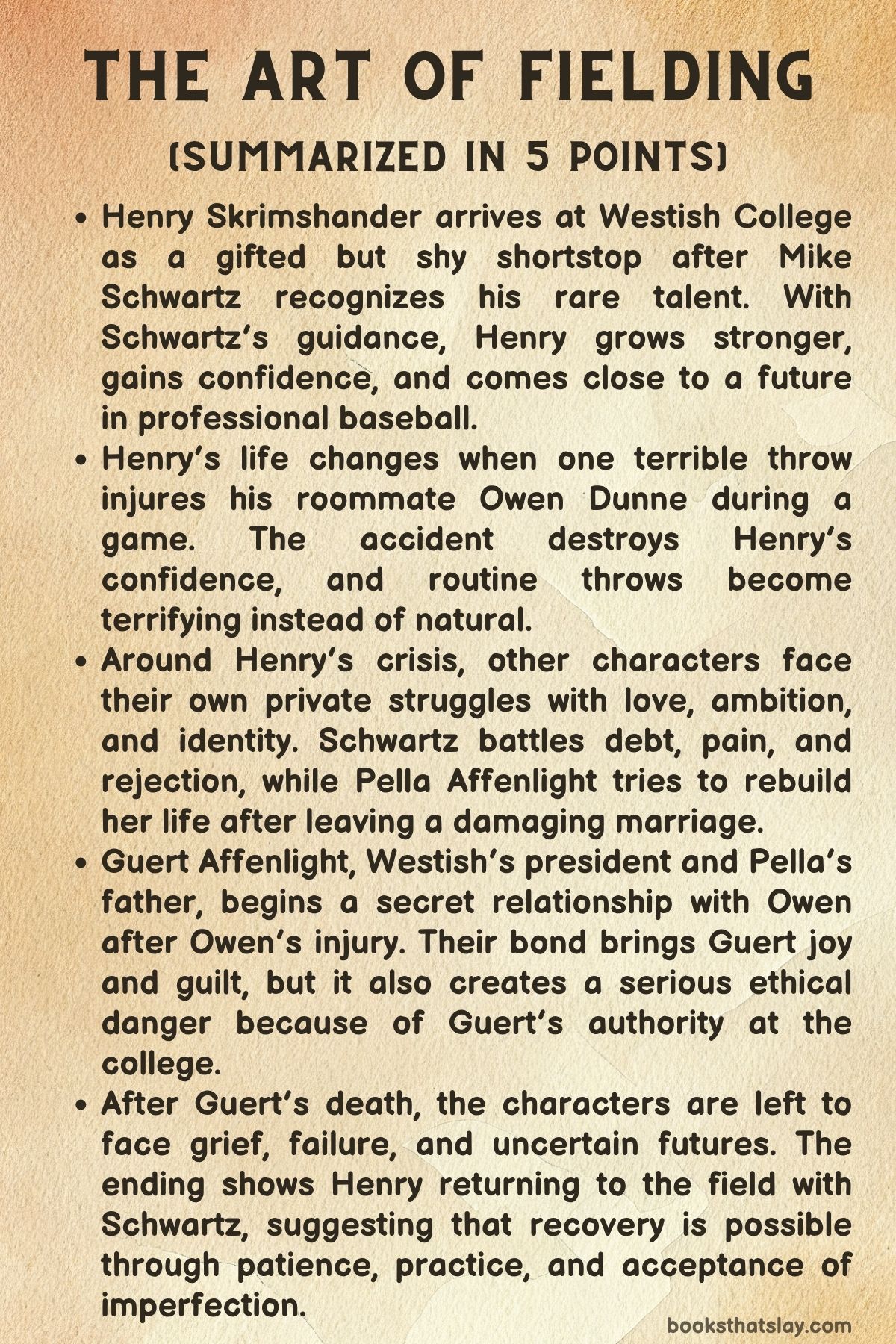
Summary
Henry Skrimshander arrives at Westish College because Mike Schwartz sees something extraordinary in him. During a summer baseball tournament, Henry’s shortstop skills catch Schwartz’s attention.
Henry is small, quiet, and unsure of himself, but on the field he seems almost impossibly precise. Schwartz, the Westish catcher and team captain, believes he has found the rare talent he has been searching for, and he decides to bring Henry into Westish baseball.
Henry comes from Langton, South Dakota, where his family life is modest and his future in baseball had never seemed guaranteed. His father works as a foreman, his mother as an X-ray technician, and his younger sister Sophie is still in high school.
Henry has shaped his life around the teachings of Aparicio Rodriguez, a legendary shortstop whose guide to fielding has become Henry’s private manual for discipline and perfection. Henry treats the sport with almost religious seriousness.
His glove, Zero, is sacred to him, and shortstop is not simply a position but the place where he understands himself best.
At Westish, Henry rooms with Owen Dunne, another baseball player. Owen is intelligent, calm, openly gay, and often detached from the intense athletic world around him.
He reads in the dugout and carries himself with a kind of ease that Henry does not yet possess. Their friendship becomes important to Henry as he struggles to adjust to college life.
Meanwhile, Schwartz becomes Henry’s mentor, trainer, protector, and almost older brother. He teaches Henry how to lift weights, eat, practice, and carry himself like a serious athlete.
Under Schwartz’s guidance, Henry gains muscle, confidence, and attention from scouts. By his junior year, he is close to tying Aparicio’s record for consecutive errorless games, and professional baseball seems within reach.
Westish College is led by President Guert Affenlight, a respected scholar of Herman Melville. Guert’s life has been shaped by literature, ambition, and loss.
After the death of his partner Sarah, he raised their daughter Pella mostly on his own. Their relationship grew distant after Pella left school to marry David, an older architect, and disappeared into an unhappy adult life before she was ready for one.
Years later, Pella returns to Westish, having left David and San Francisco behind. She is depressed, uncertain, and searching for a way to rebuild herself.
Guert welcomes her, though their relationship is tense and full of things neither of them says clearly.
Everything changes during a Westish baseball game when Henry makes a terrible throw. The ball flies into the dugout and hits Owen in the face.
Owen survives, but he suffers a concussion and a fractured cheekbone. Henry is horrified.
He cannot explain the mistake, and the accident damages the confidence that has always guided his body. What had once been automatic suddenly becomes frightening.
Routine throws begin to feel impossible. The closer he comes to professional success, the more his mind turns against him.
Owen’s injury also brings Guert closer to him. When Guert visits Owen in the hospital, he becomes increasingly aware of his attraction to the younger man.
At first, he is confused and embarrassed by his feelings, especially because Owen is a student and decades younger than he is. Yet the attraction grows, and Owen responds to it.
Their relationship becomes physical and secretive. Guert begins hiding parts of his life from Pella and from the college, even as he knows that the affair is professionally dangerous and morally complicated.
Pella, meanwhile, begins to find structure in small acts of work. She gets a job washing dishes under Chef Spirodocus and discovers that labor, routine, and cooking give her a sense of purpose.
Her marriage to David has made her feel controlled and diminished, and his arrival at Westish shows her how badly she needs to separate from him. David tries to draw her back into the old pattern of manipulation, but Pella resists.
Her life at Westish is messy, yet it gives her the first real chance to decide what she wants.
Schwartz’s own life begins to fracture. Beneath his confidence and leadership, he is dealing with debt, chronic pain, law school rejections, and growing dependence on painkillers.
He had imagined a future in law and politics, but every rejection letter weakens the story he has told himself about who he will become. He also begins a relationship with Pella, and though he cares for her, his anxiety over Henry, baseball, and his own failure keeps him from being fully present.
Schwartz has invested so much of himself in Henry’s success that Henry’s breakdown feels like his own defeat.
Henry’s decline worsens. He makes more errors, loses his ease, and becomes the focus of scouts, reporters, teammates, and opponents who all watch for signs that he is finished.
The phrase “Steve Blass disease” enters the discussion, naming the terrifying loss of basic athletic ability caused by mental pressure. Henry’s body still knows what to do, but his mind blocks him.
During a major game attended by his family, scouts, and Aparicio himself, Henry reaches a breaking point. He fields a routine ball but cannot throw it.
Instead, he walks it to the pitcher and leaves the field.
After this collapse, Henry disappears emotionally and physically. He isolates himself, stops eating, and drifts into a serious mental and physical decline.
He briefly stays with Pella, and the two have sex, which deeply hurts Schwartz when he finds out. Pella also discovers the truth about Guert and Owen’s affair, and she confronts both Owen and her father.
She worries that Guert will be ruined if the relationship is exposed. Her fears prove justified when college administrators confront Guert and ask him to resign after learning of the affair.
Guert, already troubled by guilt and chest pain, goes to Henry’s dorm and finds him in terrible condition. He comforts Henry, gets him to eat a little, and arranges for him to fly to South Carolina, where the Harpooners are playing in a national championship game.
After leaving Henry, Guert’s chest pain worsens. He writes to Pella, thinks about what to tell Owen, and lies down in his office.
He dies before morning.
At the championship game, the Westish players are exhausted and emotionally strained. Henry arrives late, not in uniform at first, but he eventually joins the dugout.
News of Guert’s death reaches Schwartz, who must tell Owen. The team is shaken.
When Owen is too devastated to bat, Henry is sent in as a pinch hitter. Still weak and malnourished, Henry steps into a fast pitch that strikes him in the helmet.
Though concussed, he manages to reach base and later scores the winning run. Westish wins, but Henry ends up in the hospital, where doctors recognize the severity of his physical and psychological condition.
Henry later learns that the St. Louis Cardinals have drafted him, though far later than expected. He is offered a signing bonus, but the decision is no longer simple.
His talent remains, but the dream that once seemed pure has been damaged by fear, dependency, and loss. Pella, Schwartz, Owen, and Henry continue dealing with Guert’s death in different ways.
Pella enrolls at Westish and begins shaping a life that belongs to her. Schwartz accepts a coaching position, finally recognizing that his gift may lie not in personal glory but in teaching and guiding others.
Owen prepares to leave for Tokyo, carrying his grief and his memories of Guert.
In the final movement of the story, Pella decides that Guert should not remain buried in the cemetery. She believes he would have wanted to rest in Lake Michigan, connected to the Melvillean world he loved.
With Schwartz, Henry, Owen, and the dog Contango, she digs up Guert’s body and takes it out onto the lake. They say goodbye in their own strange, loving way, honoring him outside official rules and public expectations.
Afterward, Henry and Schwartz return to the baseball field. Henry is still fragile, and his throws are erratic at first.
Schwartz hits grounders to him again and again. The scene recalls the discipline that first built Henry’s greatness, but now it carries a different meaning.
Henry is no longer chasing untouched perfection. He is trying to begin again after failure.
At last, after many bad throws, he makes one perfect throw, suggesting that recovery is possible, though it will not erase what has happened.
Characters
Henry Skrimshander
Henry Skrimshander is the gifted shortstop at the center of The Art of Fielding, and his journey shows how dangerous it can be when a person’s entire identity depends on flawless performance. At the beginning of the book, Henry is shy, disciplined, and almost innocent in his devotion to baseball.
He does not seek attention in a loud way; instead, he lets his talent speak for him. His skill at shortstop is so natural that others treat it as a sign of destiny.
Yet Henry’s greatness is built on an intense private faith in control. He believes that if he follows the rules, respects the game, trains hard, and keeps his mind pure, he can avoid failure.
When his throw injures Owen, that belief collapses. The accident creates a split between his body and mind, turning ordinary throws into sources of panic.
Henry’s later depression, disordered eating, and withdrawal reveal how little of himself he has developed beyond baseball. He is not weak; he is young, frightened, and unequipped to survive the loss of the one thing that made him feel certain.
By the end of the book, his return to fielding does not mean he has been magically healed. It means he has taken one small step toward living with imperfection.
Mike Schwartz
Mike Schwartz is one of the most forceful and vulnerable figures in the book. He is a captain, catcher, mentor, strategist, and emotional engine of the Westish team.
His ability to recognize Henry’s talent changes Henry’s life, but Schwartz’s investment in Henry also exposes his own hunger for greatness. Schwartz does not possess Henry’s natural athletic gift, so he builds his identity around effort, leadership, and sacrifice.
He trains harder than his body can bear, studies for law school, manages the team’s emotional life, and tries to bend the future into the shape he wants. His childhood loss and early independence have made him tough, but they have also taught him to hide need behind command.
When law schools reject him, his body breaks down, and Henry begins to fail, Schwartz feels as if every structure holding him together has cracked. His relationship with Pella offers comfort, but he often cannot separate love from pressure, responsibility, and pride.
In The Art of Fielding, Schwartz becomes a study of someone who is built for devotion but nearly destroyed by the belief that devotion must always produce victory. His later move toward coaching feels right because it allows his gifts to survive without pretending he was meant to be the star.
Owen Dunne
Owen Dunne is calm, intelligent, observant, and quietly resistant to the masculine pressure surrounding Westish baseball. Unlike many of his teammates, he does not treat the sport as the whole measure of existence.
He reads in the dugout, speaks with dry wit, and maintains a composed distance from the rituals of panic and aggression around him. His openness about being gay also places him apart from the assumptions of some people in Henry’s world, especially Henry’s parents.
Owen’s friendship with Henry is gentle and stabilizing, which makes Henry’s accidental injury of him especially devastating. Owen’s relationship with Guert is one of the book’s most complicated emotional threads.
He is not presented simply as a victim or seducer; he is curious, desiring, intelligent, and capable of choosing, yet the power imbalance between student and college president cannot be ignored. Owen seems to want recognition, intimacy, and perhaps a future larger than the one Westish can offer him.
His fellowship to Tokyo suggests independence, but Guert’s death leaves him carrying grief that cannot be neatly resolved. Owen’s character brings grace and irony to the story while also forcing the book to confront secrecy, desire, and institutional risk.
Guert Affenlight
Guert Affenlight is a scholar-president whose life has been shaped by literature, memory, and longing. He is charming, intelligent, and deeply tied to the intellectual culture of Westish.
His discovery of Melville’s connection to the college gives him a personal mythology, and his presidency allows him to turn that mythology into institutional identity. As a father, however, Guert is loving but flawed.
He adores Pella, yet he often understands her through reflection rather than direct emotional presence. His relationship with Owen awakens a part of himself he had not fully understood before, and this late discovery gives him joy, confusion, and fear.
Guert’s tragedy lies partly in his habit of interpreting life as if it were literature. He can analyze desire, youth, masculinity, and beauty, but analysis does not protect him from consequence.
His affair with Owen is tender at times, but it is also reckless because of his authority over the college and Owen’s position as a student. In The Art of Fielding, Guert represents the danger of mistaking self-discovery for exemption from responsibility.
His death leaves others to sort through love, anger, guilt, and unfinished meanings.
Pella Affenlight
Pella Affenlight returns to Westish after leaving a damaging marriage and an earlier version of herself behind. She is intelligent, wounded, impulsive, and searching for a form of adulthood that is not defined by David, Guert, or any man who claims to know what is best for her.
Her decision to marry David as a teenager cost her education, independence, and self-trust. When she comes back to her father, she is not simply running away; she is trying to recover the part of herself that once had choices.
Pella’s work in the kitchen becomes one of the most important signs of her renewal. Dishwashing and cooking give her rhythm, discipline, and pride without demanding that she perform brilliance for others.
Her relationships with Schwartz and Henry show her desire for closeness, but also her confusion and vulnerability. She can be careless with other people’s feelings, yet she is also unusually perceptive, especially about Guert and Owen.
Her plan to move Guert’s body to the lake is strange, illegal, and deeply personal, but it expresses her need to honor him in a way that feels true rather than official. Pella’s growth comes from choosing a life piece by piece.
Aparicio Rodriguez
Aparicio Rodriguez is less present as an active character than as an ideal that shapes Henry’s mind. As the legendary shortstop whose philosophy guides Henry, Aparicio represents the dream of perfect discipline.
Henry treats his writing as a sacred manual, using it to order his habits, his glove care, his movements, and his understanding of baseball. Because of this, Aparicio’s presence is powerful even when he is absent.
He becomes a standard Henry tries to reach and a symbol of the purity Henry associates with the game. When Aparicio attends the game where Henry collapses, the pressure becomes unbearable.
Henry is no longer failing in private; he is failing in front of the figure who represents everything he has tried to become. Aparicio’s discussion of players who lost their ability to throw also widens the meaning of Henry’s crisis.
He shows that Henry’s problem is not unique, but part of a larger pattern in sports, where excellence can be broken by thought itself. Aparicio’s role is therefore both inspiring and oppressive, because the ideal he represents gives Henry purpose before it becomes part of what crushes him.
David
David is Pella’s estranged husband and an important figure in understanding what she has survived. He is older, confident, polished, and controlling.
His relationship with Pella began when she was still very young, and he benefited from her admiration, uncertainty, and desire to escape ordinary expectations. By the time she leaves him, their marriage has become emotionally suffocating.
David’s behavior at Westish reveals his methods clearly. He presents himself as reasonable and supportive, but his support comes with pressure.
He tries to reframe events, unsettle Pella’s memory, and pull her back into dependence. The earrings he gives her are not simply a gift; they are a symbol of control disguised as affection.
Pella’s act of dropping them into her wine and swallowing them shows both her desperation and her refusal to return to the role he wants her to play. David is not drawn as a cartoon villain.
His danger lies in how ordinary and socially acceptable his control can appear. Through him, the book shows how manipulation can hide beneath charm, taste, and adult confidence.
Coach Cox
Coach Cox is the practical authority figure of the baseball team, but his role is quieter than Schwartz’s. He understands the team, the pressures on Henry, and the emotional limits of young athletes, even when he cannot fully solve their problems.
Unlike Schwartz, who often turns every problem into a personal mission, Coach Cox has a more seasoned awareness of what can and cannot be controlled. When Henry tries to quit, Coach Cox refuses to accept that resignation too easily, showing that he recognizes Henry’s crisis as something deeper than poor performance.
He also knows when to rely on Schwartz’s leadership, even though Schwartz himself is struggling. Coach Cox represents institutional sports at its better end: imperfect, sometimes blunt, but not without care.
His presence reminds readers that baseball is structured by coaches, lineups, and decisions, yet the deepest crises often happen beyond the reach of strategy. He cannot restore Henry’s confidence by command, but he can keep a place open for him long enough for the possibility of return.
Adam Starblind
Adam Starblind is talented, competitive, and often careless in a way that contrasts with Henry’s discipline and Schwartz’s responsibility. As a pitcher, he has real ability, and at times his performance draws attention away from Henry.
His rivalry with Henry in workouts shows the aggressive energy within the team, where friendship and competition are constantly mixed. Starblind’s behavior with Sophie, however, reveals his immaturity and selfishness.
His willingness to drink with Henry’s younger sister during a chaotic moment adds to Schwartz’s anger and shows how the team’s culture can become reckless when not held together by responsibility. Starblind is not central in the same emotional way as Henry, Schwartz, Owen, Pella, or Guert, but he helps define the atmosphere around them.
He represents the ordinary ego and appetite of college athletics, the part of the world that keeps moving even while others are in crisis. His draft by the Cubs also reminds readers that professional opportunity does not always arrive according to moral deserving or emotional readiness.
Sophie Skrimshander
Sophie Skrimshander, Henry’s younger sister, appears most strongly during the period when Henry is collapsing. Her arrival at Westish brings his family world into contact with his college life, and her presence exposes how far Henry has drifted from the stable identity his family associates with him.
Sophie is excited, curious, and vulnerable in an unfamiliar environment. When she ends up drinking with Starblind, the situation shows how poorly the adults and near-adults around her are managing responsibility.
She is not simply a plot device; she represents the innocent witness to Henry’s unraveling. Through Sophie, the book briefly shows Henry not as a prospect, teammate, or symbol of athletic promise, but as a brother.
Her concern for him makes his disappearance and decline feel more personal. She also brings out Schwartz’s protective anger, even as that anger is mixed with his own frustration and need for control.
Sophie’s role is small but important because she reminds the story of the family Henry came from before Westish remade him.
Chef Spirodocus
Chef Spirodocus becomes important through Pella’s attempt to rebuild her life. He is demanding, proud of his kitchen, and unwilling to treat food as casual or secondary.
When Pella asks for work, he gives her a chance, and his praise matters to her because it is tied to effort rather than beauty, family name, or romantic attachment. His kitchen offers Pella a place where she can measure progress through practical action.
Washing dishes, learning food preparation, and earning a paycheck help her recover dignity after years of emotional dependence. Chef Spirodocus also represents a kind of mentorship different from Schwartz’s.
He does not try to take over Pella’s destiny; he simply gives her work, standards, and room to improve. Through him, labor becomes a path toward self-respect.
He helps show that healing in the book does not always come through dramatic declarations. Sometimes it comes through showing up, doing a task well, and discovering that being useful can become the beginning of wanting a future.
Themes
Perfection and the Fear of Failure
In The Art of Fielding, athletic perfection is both beautiful and dangerous. Henry’s fielding initially appears pure because it seems effortless, but the book gradually shows the cost of building a self around never making mistakes.
Baseball is an especially harsh stage for this idea because the sport records failure with brutal clarity. An error is visible, countable, and remembered.
Henry’s record of errorless games gives him value in the eyes of scouts and teammates, but it also traps him inside the expectation that he must remain untouched by ordinary human weakness. Once he makes the throw that injures Owen, failure is no longer theoretical.
It has harmed someone he loves. From that moment, the routine act of throwing becomes charged with fear.
The body that once moved freely becomes subject to overthinking. This theme also applies to Schwartz, who believes effort should let him overcome every limitation.
His law school rejections and physical pain reveal that discipline cannot guarantee reward. The book treats perfection as seductive because it promises safety, but false because no person can live there for long.
Mentorship, Control, and Dependency
The bond between Henry and Schwartz begins as one of the book’s most generous relationships, but it grows increasingly complicated because mentorship can easily become possession. Schwartz sees Henry’s gift before anyone else at Westish does, and his belief gives Henry access to a larger life.
He trains him, protects him, and teaches him how to become stronger. Yet Schwartz also pours his own frustrated ambition into Henry’s future.
Henry becomes the proof that Schwartz’s eye, discipline, and sacrifice matter. This makes Henry’s crisis devastating not only because Schwartz loves him, but because Schwartz has tied his own worth to Henry’s success.
The relationship raises difficult questions about where guidance ends and control begins. Henry needs Schwartz, but he also becomes dependent on him in ways that limit his independence.
Schwartz needs Henry too, because mentoring him is the closest Schwartz comes to the greatness he wants for himself. Their final return to the field suggests that mentorship can survive only if it changes.
Schwartz must stop treating Henry as his achievement, and Henry must learn to stand apart from the person who built him.
Desire, Secrecy, and Moral Risk
Desire in the story often arrives at the wrong time, in the wrong place, or under conditions that make honesty difficult. Guert’s attraction to Owen is not treated as false or shallow.
It awakens real joy in him and opens a part of his identity that he had not fully faced. Yet the relationship is also marked by secrecy and an undeniable imbalance of power.
Guert is not just an older man falling in love; he is the president of the college, while Owen is a student whose scholarship and housing can be viewed through the lens of institutional authority. The emotional truth of the relationship does not erase its ethical danger.
Pella and Schwartz’s relationship also carries strain because both are wounded and seeking stability while still tied to other unresolved loyalties. Pella and Henry’s brief sexual encounter comes from loneliness and confusion, but it damages trust.
Across these relationships, the book refuses to present desire as purely liberating or purely destructive. It shows desire as a force that can reveal hidden selves while also exposing people to guilt, harm, and consequence.
Recovery, Grief, and Beginning Again
The later parts of the story are shaped by the question of how people continue after collapse. Henry loses the athletic certainty that once defined him.
Pella loses her father just as she is beginning to rebuild her life near him. Owen loses Guert and must carry a love that cannot be publicly mourned in a simple way.
Schwartz loses his imagined future in law and politics, then has to reconsider what kind of life his talents actually fit. None of these losses is repaired neatly.
The book is more honest than that. Recovery appears through awkward, physical, incomplete acts: Pella washing dishes, Schwartz accepting coaching, Henry eating again, Owen helping with Guert’s strange final farewell, and the group rowing Guert’s body into the lake.
The illegal burial ritual is not merely shocking; it is an attempt to create meaning where official ceremonies feel inadequate. Henry’s final perfect throw matters because it follows many bad ones.
It does not restore innocence, erase illness, or guarantee success. It simply shows that a broken motion can be practiced again, and that beginning again is sometimes enough.