The Art of Gathering Summary and Analysis
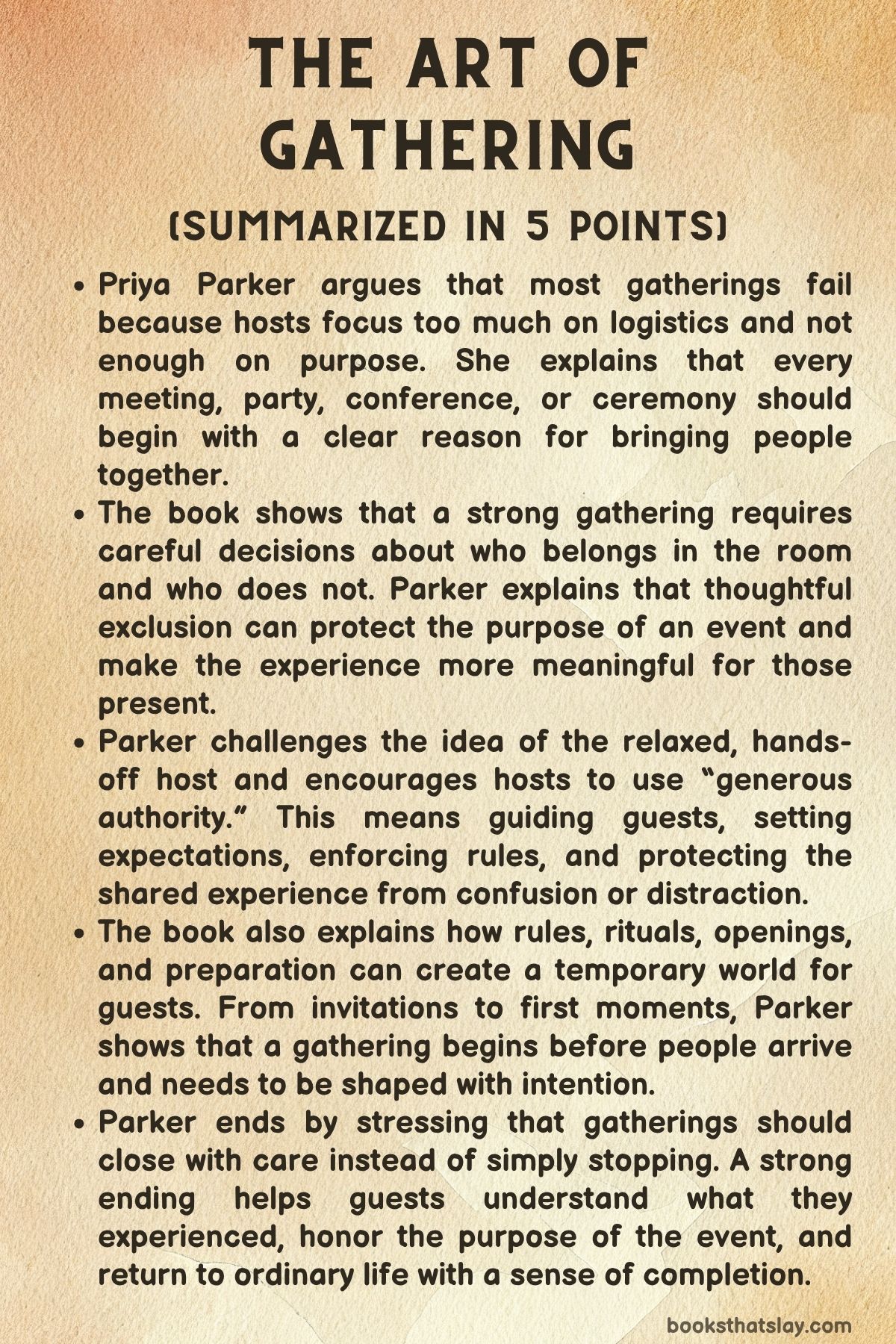
The Art of Gathering: How We Meet and Why It Matters by Priya Parker is a practical work of nonfiction about how people come together, why many gatherings fail, and what hosts can do to make shared time more meaningful. Parker argues that meetings, parties, conferences, dinners, ceremonies, and even casual get-togethers often disappoint because people focus too much on logistics and not enough on purpose.
Instead of treating a gathering as a default social habit, she asks readers to design it with intention, courage, boundaries, and care. The book is both a guide and a critique of ordinary social routines.
Summary
The Art of Gathering begins with Priya Parker’s central argument that most gatherings are weaker than they need to be because people misunderstand what makes them work. Hosts often give their attention to things like food, seating, technology, decoration, timing, and venue, while ignoring the deeper question of why people are being brought together at all.
Parker believes that a gathering succeeds or fails because of its purpose and the way that purpose is carried through every decision. A meeting, birthday party, conference, courtroom, wedding, or dinner is not meaningful simply because people are in the same place.
It becomes meaningful when the host shapes the event so that the people present understand why they are there and are guided toward a shared experience.
Parker first insists that every gathering needs a clear, specific purpose. A broad label such as “birthday party,” “networking event,” or “staff meeting” is not enough because it describes a category, not a reason.
The real purpose must answer why this particular group is meeting at this particular moment. A birthday party might be about honoring a year of change, reconnecting with friends, marking a turning point, or simply creating joy after a difficult period.
A business meeting might be about making a hard decision, rebuilding trust, challenging assumptions, or creating a plan. When the purpose is too vague, the event becomes passive and forgettable.
When the purpose is sharp, it can guide the guest list, location, rules, opening, activities, and ending.
The book uses examples from public institutions, professional events, and personal life to show how purpose changes everything. One important example is a community justice center that rethinks the courtroom.
Rather than treating legal proceedings as cold, adversarial rituals, the center creates a space where judges, social workers, defendants, and others work together with a more human focus. The physical setting and the behavior inside it support the purpose of treating defendants as whole people who need support, not only punishment.
This example shows Parker’s belief that gatherings are never neutral. A room, a seating arrangement, a tone, and a process all communicate what matters.
After defining purpose, Parker turns to the question of who should be included. She argues that hosts often confuse generosity with unlimited inclusion.
In her view, including everyone can weaken a gathering if some people do not serve the purpose or if their presence changes the mood in an unhelpful way. Exclusion may feel impolite, but it can also protect the experience of those who are meant to be there.
A guest list is not just a social formality; it is a design choice. Parker encourages hosts to think honestly about who belongs in the room and why.
The right boundary can create focus, trust, and freedom.
This idea also applies to place. A location is not only a container for a gathering; it influences behavior.
People act differently in a boardroom, a home, a palace, a theater, a park, or a courtroom. Parker shows that when a venue contradicts the purpose, it can damage the event.
The failed merger conversation between Alcatel and Lucent becomes an example of how place can send unintended signals. What was meant to be a business negotiation became charged with status, national pride, and resentment because the chosen setting made one side feel overpowered.
Parker’s point is that hosts must choose a space not only for convenience, price, or capacity, but for the kind of conduct and feeling it invites.
A major part of the book challenges the idea of the relaxed, hands-off host. Parker argues that being “chill” often means refusing responsibility.
A host who does not guide the gathering leaves guests to navigate uncertainty, awkwardness, dominant personalities, distractions, and unclear expectations on their own. Instead, Parker promotes what she calls generous authority.
This means the host takes charge not for ego or control, but to protect the group and serve the purpose. A good host explains expectations, enforces boundaries, equalizes participation, and guards the shared experience from behaviors that could harm it.
Parker’s examples show how authority can be playful, firm, and protective. A conference founder who bans ties makes a symbolic rule to create informality.
A movie theater that removes people for using phones protects the attention of the audience. Events that remove job titles from name tags can reduce status anxiety and help people meet as people rather than as résumés.
Parker believes these interventions matter because gatherings naturally reproduce social habits unless the host interrupts them. People may cluster with familiar friends, compete for status, hide behind professional identities, or check their phones.
The host’s work is to create conditions that help people behave differently for a limited time.
The book then develops the idea that a gathering can create a temporary alternative world. This temporary world is shaped through rules that apply only inside the gathering.
Parker contrasts these rules with traditional etiquette. Etiquette often comes from fixed social hierarchies and old expectations about proper behavior.
Temporary rules, by contrast, can be democratic, creative, and suited to the needs of a specific group. They can help strangers cooperate, encourage people to speak differently, or invite participants to set aside their usual roles.
A networking event where people cannot reveal their job titles or last names becomes a different kind of meeting because it removes the normal scripts of professional status.
Parker also pays close attention to beginnings. She argues that a gathering starts before people arrive.
The invitation, the wording, the request made of guests, and the sense of anticipation all prepare people for what is coming. This preparation is not about perfect decorations or food; it is about preparing human beings.
When a host asks guests to bring a story, a memory, an object, a question, or a reflection, the gathering has already begun in their minds. Parker’s examples range from elaborate preparation for a bachelor party to a simple request for photographs before a holiday party.
In both cases, guests are not merely attending; they are entering a designed experience.
Once people arrive, Parker believes they need a real transition into the gathering. A weak beginning filled with logistics, sponsor remarks, or long thank-yous can drain energy before the event has truly started.
A strong beginning marks a shift from ordinary life into the shared space. This can be done through silence, a toast, a question, a ritual, a welcome, or an action that reminds everyone why they are there.
The beginning should not be treated as filler. It is one of the host’s best chances to establish meaning.
The middle of a gathering requires continued guidance. Parker criticizes events where people present polished versions of themselves and hide behind expertise, status, or rehearsed speeches.
She favors formats that invite real stories and equal participation. Her method of inviting toasts around a shared theme shows how people can move beyond predictable introductions and offer something more personal.
These moments work because they make guests attentive to one another and reduce the dominance of the loudest or highest-status person in the room. Parker does not argue that every event must become intensely emotional, but she does believe that gatherings improve when people are invited to be more honest than usual.
The book also argues that conflict has a place in good gatherings. Parker rejects the habit of avoiding difficult topics simply to preserve politeness.
Some gatherings become dull because everyone knows the real issue but no one names it. In the right setting, guided disagreement can make an event more truthful and productive.
Parker does not recommend conflict for its own sake. She stresses that controversy must be connected to the purpose, bounded by rules, and held by a capable host.
When done well, disagreement can reveal what matters and help people move beyond shallow consensus.
Finally, Parker explains that endings deserve as much care as beginnings. Many gatherings simply stop, fade out, or end with announcements and logistics.
Parker sees this as a missed opportunity. A strong ending helps people recognize what has happened and return to the outside world with a sense of completion.
The host should close at the right moment, after the purpose has been served but before the energy disappears. A good ending may include reflection, a gesture, a toast, a final question, a ritual, or a clear line of exit.
It should honor the people who gathered and connect the specific experience to something larger.
By the end, The Art of Gathering becomes a guide to intentional human connection. Parker shows that gatherings are not minor social events to be arranged through habit.
They are chances to shape attention, build trust, create meaning, challenge people, and mark change. Her message is that anyone who brings people together has more power and responsibility than they may realize.
A host is not merely someone who provides a room and refreshments. A host is a temporary leader of human experience.
Key Figures
Priya Parker
Priya Parker is the central voice and guiding intelligence of The Art of Gathering. She appears not as a fictional protagonist, but as the thinker, host, observer, and teacher who holds the book together.
Her background in a multiracial and multicultural home gives her a strong awareness of difference, belonging, identity, and social tension. Her training in conflict resolution also shapes the way she sees gatherings: not as simple social occasions, but as structured encounters where power, emotion, purpose, and human behavior all matter.
Parker’s personality in the book is practical, direct, and willing to challenge polite assumptions. She does not accept that meetings must be boring, parties must be predictable, or ceremonies must follow tradition without question.
Her role is to wake readers up to the hidden choices behind every gathering. She is also honest about her own failures, especially when she describes an event she ended poorly.
This makes her more credible because she is not presenting herself as flawless. She is a host who has learned through practice, mistake, observation, and revision.
Nora Abousteit
Nora Abousteit is an important figure because her examples show how purpose can be protected through boundaries and rules. In The Art of Gathering, she represents the kind of organizer who understands that a gathering’s structure must defend its reason for existing.
Her father’s students-only bar is especially revealing because it shows how exclusion can preserve identity rather than weaken generosity. Turning away an important public figure may seem rude in ordinary social terms, but within the logic of that gathering, it protects the space for students.
Nora’s own CraftJam event also shows her ability to design rules that push people away from dull professional scripts. By requiring punctuality, encouraging people to meet new participants, and replacing standard business introductions with more unusual personal prompts, she creates a setting where people can connect with more curiosity and less posturing.
Her presence in the book strengthens Parker’s argument that good gatherings are rarely accidental. They are built by people who are brave enough to make choices.
Nora Abousteit’s Father
Nora Abousteit’s father appears briefly, but he plays a meaningful role as an example of disciplined hosting. His students-only bar is not just a business or social location; it is a gathering place with a clearly defended identity.
His refusal to admit the vice mayor shows that he understands the difference between status and purpose. Many hosts might bend their own rules to please an influential person, but he does not.
This firmness gives the bar its character and helps explain why it lasts. He represents the quiet courage required to say no when a no protects the people for whom the space was created.
In the book, his example challenges the common belief that more access always means more generosity. Sometimes a gathering remains meaningful because someone is willing to close the door.
The Red Hook Community Justice Center Team
The Red Hook Community Justice Center team functions as a collective character that shows how institutions can gather people differently. The judges, social workers, defendants, and support staff form a model of purpose-driven design.
Their work changes the meaning of a courtroom by changing the relationships inside it. Instead of making the defendant feel like an isolated object of judgment, the center treats each person as someone with a broader life and a need for practical support.
The team’s importance lies in its ability to turn a formal legal process into a more collaborative human encounter. In the book, this group shows that gathering is not only about parties or conferences.
It also affects justice, dignity, and public life. Their example proves that when the purpose changes, the room, roles, tone, and outcomes can change too.
Richard Saul Wurman
Richard Saul Wurman appears as a vivid example of the host who uses authority symbolically. As the founder of TED, he understands that even a small rule can send a strong message about the world a gathering is trying to create.
His rule against ties is not mainly about clothing; it is about lowering formality and reducing the stiff signals of hierarchy. The story of him cutting off a speaker’s tie may seem theatrical, but it shows Parker’s point that hosts must sometimes enforce the world they have promised to create.
Wurman’s character in the book is bold, performative, and highly conscious of atmosphere. He shows that a host’s authority is not limited to scheduling speakers.
It includes protecting the emotional and cultural tone of the room.
The Alamo Drafthouse Staff
The Alamo Drafthouse staff serves as a collective example of protective authority. Their strict no-phones policy matters because it is enforced, not merely announced.
Many places ask audiences to silence their devices, but few are willing to remove people who violate the rule. The staff’s role is important because they take on the burden that ordinary guests should not have to carry.
Instead of forcing moviegoers to confront rude behavior themselves, the institution protects the shared experience. In the book, they represent the host’s duty to guard attention.
They show that rules without enforcement are often empty, while rules backed by action can create trust. Guests relax because they know someone is actively defending the purpose of the gathering.
Felix Barrett
Felix Barrett appears as the recipient of an unusually elaborate bachelor party, and his role reveals the power of anticipation. As a theater director known for creativity, he is given a gathering that matches his imagination.
The strange key, suitcase, coordinates, photographs, secret society invitation, and eventual arrival at the event all prepare him emotionally before the party itself begins. Barrett is important because he shows that a guest can be drawn into a gathering long before entering the room.
His friends understand him well enough to create a beginning that is mysterious, playful, and personal. His example also shows that priming is not decoration.
It is a way of shaping attention and expectation. Through him, the book demonstrates that preparation can become part of the experience rather than merely a task behind the scenes.
Randa Slim
Randa Slim represents the serious and patient side of preparation. Her work before a major summit shows that some gatherings require long, careful relationship-building before people can sit together productively.
She does not treat the event as a single moment on a calendar. She understands that trust, context, and readiness must be built in advance.
Her role in the book is especially important because it expands the idea of hosting beyond domestic or social settings. In political and diplomatic contexts, preparation can determine whether people are capable of hearing one another at all.
Slim’s character stands for patience, respect, and strategic listening. She shows that some gatherings cannot be rushed because the real work begins long before anyone officially meets.
Michel Laprise
Michel Laprise demonstrates how a host can create meaning with a simple request. Asked to plan a Christmas party with little time, he does not rely on expensive decoration or complex planning.
Instead, he asks guests to send photographs of happy moments from the year, then uses those images to create a celebration centered on the people in the room. His example is powerful because it shows that intimacy does not always require grandeur.
A gathering can become personal when guests are asked to contribute something connected to memory and feeling. Laprise’s character is resourceful, sensitive, and focused on human connection.
In the book, he shows that a host can transform an ordinary party by asking people to do something meaningful rather than simply bring something material.
Marina Abramović
Marina Abramović appears as an example of transition and attention. By asking audiences to wear noise-cancelling headphones and sit in silence before a performance, she creates a clear break from ordinary life.
Her role in the book shows that a gathering does not fully begin just because people have arrived. They may still be mentally elsewhere, distracted by noise, devices, travel, conversation, or personal concerns.
Abramović’s method slows people down and prepares their senses. Her character represents discipline, presence, and artistic seriousness.
She shows that silence can be an active tool, not an absence. Through her, Parker demonstrates that a strong beginning often requires helping people cross a threshold.
Baratunde Thurston
Baratunde Thurston is presented as someone who understands how to guide a room without harshness. Faced with a distracted and rowdy crowd, he does not simply demand attention from the stage.
Instead, he begins with smaller groups and gradually draws the larger room into focus. His approach is socially intelligent because it works with the energy of the crowd rather than fighting it directly.
Thurston’s role in the book shows that hosting requires adaptation. A good host reads the room and chooses a method that fits the moment.
He represents warmth, humor, patience, and skillful control. His example makes clear that authority does not always have to look strict.
Sometimes it works best when it feels natural.
Stefanie Zoe Warncke
Stefanie Zoe Warncke brings a darker and more psychologically complex dimension to the book. As a former lawyer who becomes a dominatrix, she is used to seeing people reveal hidden parts of themselves.
Her presence supports Parker’s argument that gatherings cannot always be built only around cheerful, polished, socially acceptable feelings. People bring fear, shame, desire, grief, anger, and secrecy with them even when a host pretends otherwise.
Warncke’s role is not to make every gathering extreme, but to show that darkness exists within human beings and can sometimes be acknowledged safely. In the book, she represents the importance of making space for truth without forcing exposure.
Her example adds depth to Parker’s view of authenticity because it reminds readers that real openness is not always comfortable.
Ida Benedetto
Ida Benedetto appears as a figure who thinks carefully about risk. Her approach to transgressive events is guided by two questions: what gift the experience offers and what danger it carries.
This makes her an important counterbalance in The Art of Gathering. She is not reckless, even though her events may push boundaries.
Instead, she treats risk as something that must be understood, justified, and managed. Her character helps clarify Parker’s position on controversy and discomfort.
The goal is not to shock people or create conflict for entertainment. The goal is to decide whether a difficult experience can offer something valuable enough to be worth the risk.
Benedetto represents judgment, courage, and responsibility.
Michael J. Smith
Michael J. Smith is a professor whose small ritual with students becomes a memorable example of closing well. When students complete a demanding long-term academic project, he marks the moment with tequila shots.
The gesture is surprising, informal, and celebratory, but its meaning is serious. It acknowledges effort, completion, and transition.
Smith’s role in the book shows that endings do not need to be elaborate to matter. They need to make people feel that something has been completed and recognized.
He represents the teacher as host, someone who understands that intellectual work also has emotional milestones. His example shows how a simple closing act can give shape to an ending that might otherwise pass unnoticed.
The Seeds of Peace Campers
The Seeds of Peace campers appear as a collective character shaped by conflict, youth, and the possibility of changed perception. These teenagers come from contexts marked by political and social division, yet the camp allows them to experience ordinary summer activities, friendship, teamwork, and competition in a different setting.
The Color Games near the end of camp become important because they help the campers look outward after forming relationships inside the camp world. Their role in the book shows how a gathering can temporarily change the terms by which people understand conflict.
They are not presented as symbols alone; they represent young people whose lived realities are difficult, but whose experiences inside the gathering may create new empathy. Their example gives emotional weight to Parker’s belief that gatherings can prepare people to return to the world differently.
The Alcatel and Lucent Negotiators
The Alcatel and Lucent negotiators function as a cautionary collective character. Their failed merger talks show how a gathering can be damaged by signals that the hosts may not fully understand.
The shift from a neutral location to a luxurious French palace changes the mood of the meeting and creates feelings of imbalance, pride, and insult. The negotiators matter because they reveal how easily a gathering can become about power rather than purpose.
Their example is especially useful because no one needs to behave openly badly for the gathering to fail. The setting itself communicates hierarchy.
In the book, they show that hosts must think beyond practical convenience and ask what a venue says to the people entering it.
The House of Genius Participants
The House of Genius participants represent people who are invited to leave behind the usual habits of networking. By hiding last names, job titles, employers, and other professional markers, they enter a space where the normal signals of status are suspended.
Their role in the book is to show how rules can produce different kinds of interaction. Instead of sorting one another by prestige or usefulness, participants are pushed toward fuller attention and collaboration.
They also appear in examples where entrepreneurs present problems rather than polished pitches. This matters because it shifts the gathering from self-promotion to shared problem-solving.
As a group, they demonstrate Parker’s belief that people often become more open and useful to one another when the host removes the scripts they usually rely on.
Themes
Purpose as the Foundation of Meaning
In The Art of Gathering, purpose is treated as the central force that gives shape to every successful human meeting. Parker argues that people often confuse a gathering’s category with its reason for existing.
A wedding, birthday, meeting, conference, or dinner may tell us what kind of event is happening, but it does not tell us what the event is supposed to do for the people present. Purpose must be specific, timely, and strong enough to guide decisions.
Once the host knows the real reason for gathering, every other choice becomes clearer: who should be invited, where the event should happen, what rules should apply, how it should begin, what kind of conversation should be encouraged, and how it should end. This theme challenges casual social habits because it asks hosts to take responsibility for meaning.
A gathering without purpose easily becomes a repetition of inherited forms. A gathering with purpose can create focus, belonging, honesty, celebration, repair, or transformation.
Parker’s treatment of purpose is practical rather than abstract. She wants readers to make sharper choices, even when those choices unsettle expectations.
The Responsibility of the Host
Hosting is presented as an active moral and social responsibility, not a decorative role. Parker rejects the idea that the best host is the one who stays relaxed, avoids interference, and lets people do whatever they want.
In her view, that kind of passivity often abandons guests to confusion, awkwardness, domination by stronger personalities, and unclear expectations. A host must protect the purpose of the gathering and the people who came for it.
This may involve excluding certain guests, enforcing rules, interrupting bad behavior, guiding conversation, or asking participants to take emotional or social risks. The host’s authority should not be selfish or controlling.
It should be generous, meaning that it exists to serve the group’s experience. This theme is important because it redefines power in a gathering.
Power is not something a host should pretend not to have. It is something the host should use carefully and openly.
Parker’s examples show that when authority is absent, the loudest, most distracted, or most status-conscious people often shape the event by default. Good hosting prevents that from happening.
Boundaries, Rules, and Temporary Worlds
Boundaries and rules appear throughout the book as tools that make freedom possible. Parker argues that a gathering becomes more meaningful when it creates a temporary world with its own expectations.
These expectations may concern who is allowed in, how people introduce themselves, whether phones are used, what topics are welcomed, or how disagreement is handled. Such limits may seem restrictive at first, but Parker shows that they can actually create safety, equality, and originality.
When people cannot rely on job titles, familiar friends, social rank, or ordinary etiquette, they may encounter one another more directly. This theme also challenges the assumption that inclusion is always the highest good.
A clear boundary can protect the people who belong in the room and allow the gathering to serve its purpose more fully. Parker’s view of rules is flexible and creative.
She does not support rigid manners for their own sake. Instead, she favors temporary rules designed for a particular moment.
These rules help people step outside everyday behavior and briefly inhabit a different social order.
Beginnings and Endings as Acts of Design
The book treats beginnings and endings as essential parts of a gathering’s meaning rather than as formalities. Parker argues that a gathering begins before the official start, at the moment guests first learn about it.
The invitation, the request made of participants, and the mood created in advance all shape how people arrive. A strong beginning then helps guests cross from ordinary life into the shared experience.
It may use silence, ritual, a question, a welcome, or a symbolic action, but it should direct attention toward the gathering’s purpose rather than drain energy through logistics. Endings require the same care.
Parker criticizes gatherings that simply stop, fade away, or close with practical announcements. A real ending helps people understand what has happened and prepares them to return to the outside world.
This theme matters because it shows that time has emotional structure. People need thresholds.
They need to be brought in and released with intention. When hosts design beginnings and endings well, the gathering feels complete rather than accidental.