The Fake Divination Offense Summary, Characters and Themes
The Fake Divination Offense (Magic and Romance #2) by Sara Raasch is a fantasy sports romance centered on professional rawball player Orok Monroe and cheerleader Alexo Warden, whose staged relationship gradually becomes genuine.
Beneath the magical games, public performances, and supernatural danger, the novel examines trauma, religious pressure, consent, emotional dependence, and the meaning of strength. Orok is trying to separate himself from a god whose followers helped define his childhood suffering, while Alexo hides an identity that could make him the target of a violent cult. Their relationship gives both men the courage to question the systems that have controlled their lives and build a safer form of belonging.
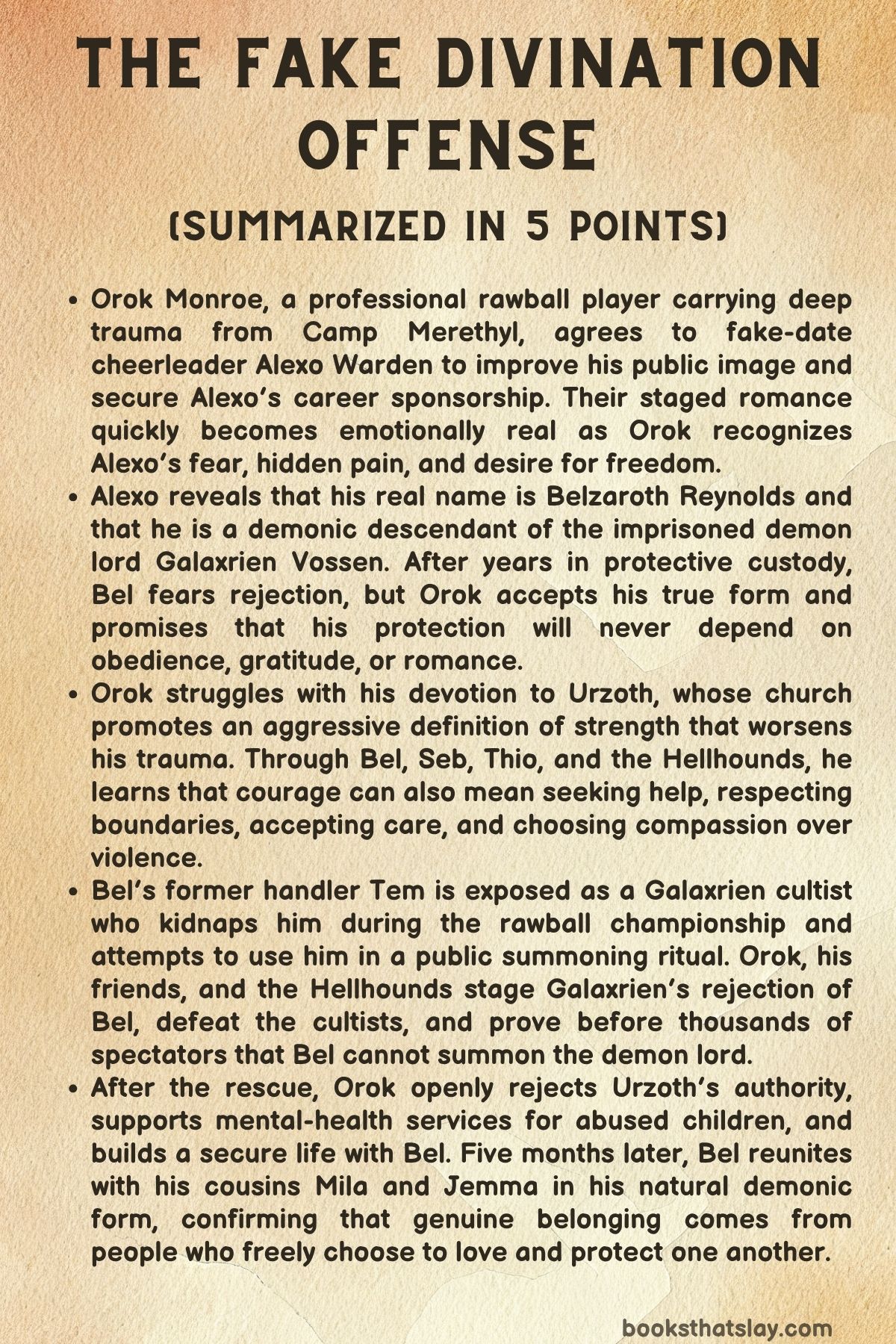
Summary
Professional rawball player Orok Monroe meets his closest friends, Seb and Thio, at the Silver Hound to celebrate their engagement and the successful lawsuit against Camp Merethyl. Orok and Seb were abused at the camp as children, but the legal victory has not ended the public judgment surrounding their decision to seek justice through the courts.
Followers of Urzoth Shieldsworn, the god of strength, argue that Orok should have responded with violence rather than legal action. Their criticism worsens Orok’s trauma and strengthens his fear that his new teammates on the Philadelphia Hellhounds secretly consider him weak.
During karaoke, Orok becomes fascinated by a dazzling performer who calls himself Alexo the Magnificent. Alexo’s confidence, beauty, and visible desire for freedom immediately attract him, but the evening turns tense when an aggressive man grabs Alexo’s arm.
Orok intervenes and lifts Alexo away from the confrontation, but he pauses to confirm that Alexo actually wants his help. Alexo thanks him, refuses further protection, kisses his cheek, and leaves, while Orok secretly watches until he safely boards a bus.
The next morning, Orok awakens from a nightmare in which he believes he is still trapped at Camp Merethyl. Seb and Thio help him return to the present, and Orok admits that he intends to renounce Urzoth because the god’s church and its definitions of strength have become inseparable from his childhood suffering.
At Hellhounds headquarters, Orok plans to announce his decision to manager Roesia Sombercrown. Instead, he finds Reverend Maddock Drach waiting with her and postpones the renunciation because he is not prepared for a direct confrontation with the leader of Urzoth’s Philadelphia church.
Roesia explains that Orok’s compassionate behavior at the Silver Hound has improved both his public image and the church’s reputation. Alexo then enters the office, revealing that he is an intern in the Hellhounds’ cheerleading department.
Roesia and Drach propose that Orok and Alexo pretend to date for the rawball season. The romance would make Orok appear more approachable, provide favorable publicity for the church, and allow Alexo to receive church sponsorship as a full cheerleader.
Alexo initially refuses but accepts after realizing that the sponsorship would give him financial security and a genuine opportunity to perform professionally. Orok also agrees because he cannot bring himself to deny Alexo his dream, even though the arrangement forces him to remain publicly connected to Urzoth.
Their first staged date begins awkwardly but becomes more sincere as Orok apologizes for grabbing Alexo during their first meeting. Alexo reveals that performing is the central ambition of his life, but their conversation is interrupted when the aggressive man from the bar appears outside.
Alexo identifies the man only as someone complicated and leaves with him. Orok becomes increasingly worried, although he recognizes that his concern is developing into an emotional fixation that may repeat old patterns of obsession and dependency.
As the rawball season begins, Orok tries to avoid both Alexo and Seb. He concentrates on training and continues wearing Urzoth’s symbol even though it reminds him of praying for rescue at Camp Merethyl and receiving no answer.
The Hellhounds’ first game takes place on a water-filled field created by the visiting Gorgons. Orok initially struggles when his swimming enchantments are removed, but rookie Marlow Keel and the rest of the team repeatedly defend and heal him.
Their support shows Orok that the Hellhounds are different from his former team, the Vegas Chimeras. The Hellhounds win, and Orok is nearly overwhelmed when he sees Alexo performing in his new cheerleading uniform.
During their scheduled postgame appearance, Alexo kisses him. The act is supposed to generate publicity, but it awakens genuine desire and powerful possessive feelings in Orok.
A reporter then asks whether the victory has made Urzoth proud. Because Alexo’s sponsorship depends on the church, Orok is forced to praise a god he privately wants to abandon.
When Orok discovers that the hostile man lives with Alexo, he frightens publicist Treva while demanding information. Ashamed of using his size and anger as weapons, he apologizes and withdraws, terrified that he is becoming the kind of man Urzoth’s harshest followers admire.
Orok continues attending staged dates while emotionally distancing himself from Alexo. His coldness hurts Alexo, especially when Seb and Thio warmly welcome him into their found family without realizing that the relationship is fake.
Orok eventually confesses the arrangement to them and admits that he believes Alexo may be in danger. Seb argues that Orok’s ability to love deeply is not automatically destructive and urges him to let Alexo decide whether he wants something genuine.
Orok follows Alexo home and is confronted for stalking him. He apologizes, offers to end the fake relationship without damaging Alexo’s career, and admits that he wants a real connection.
Alexo reveals that the hostile man, Tem, abandoned him in an unsafe neighborhood after an argument. Orok takes Alexo to a magical smash room, where they destroy enchanted statues of various gods.
When Orok faces a statue of Urzoth, he acknowledges how completely his religion has become associated with fear, Camp Merethyl, and his mother’s expectations. Destroying the statue beside Alexo gives him a sense of release he has never found through worship.
They kiss privately in Orok’s car, but Alexo panics when Orok touches him in a particular way and resists removing some of his clothing. Orok immediately stops, promises that Alexo will control every boundary, and assures him that their relationship does not depend on physical access.
Their connection develops through brief messages containing personal facts rather than demanding explanations. Alexo shares details about dance, childhood ballet lessons, and cousins he has not seen for years.
At a charity gala, a reporter challenges Orok’s plan to use his legal settlement to fund crisis hotlines and mental-health services for children. Alexo takes control of the interview and argues that asking for help can require greater strength than hiding pain.
Alexo ends the interview by telling viewers to keep dancing, secretly addressing the cousins from whom he has been separated. Orok is moved by both his defense and his concealed grief, and their private intimacy afterward becomes an act of growing trust.
Later that evening, reports announce that Galaxrien cultists have attempted human sacrifice. Alexo reacts with unusual terror, while Orok finally explains the full truth about Camp Merethyl.
The camp tried to turn Orok and Seb into a perfectly dependent magical combat unit. During the final test, they were trapped in a flooding chamber, and Orok cut open his shoulder so Seb could use the iron in his blood to destroy the ward.
Orok explains that Seb, not Urzoth, saved him. Alexo responds that Orok also saved Seb and tells him that survival, compassion, and sacrifice make him stronger than the violence praised by the church.
The following morning, Tem arrives with adventurers Ilbryen and Gulus and exposes Alexo’s secret. Alexo Warden is an assumed identity, and his real name is Belzaroth Reynolds.
Bel is a demonic descendant of Galaxrien Vossen, an imprisoned demon lord whose followers believe Bel’s blood or body can summon him. Illusion magic hides Bel’s horns, tail, unusual eyes, rose-gold skin, scent, and other demonic features.
Bel has spent eight years in protective custody, largely controlled by Tem. He expects Orok, as a public follower of Galaxrien’s ancient enemy, to reject or surrender him, but Orok kisses him and declares that his ancestry changes nothing.
Orok challenges Tem’s abusive behavior, and Ilbryen agrees to remove him as Bel’s handler. When the adventurers want to return Bel to confinement, Orok argues that protection without freedom is merely another form of imprisonment.
Orok asks Bel what he wants instead of deciding for him. Bel chooses to remain with Orok, who promises that his safety will never depend on romance, sex, obedience, gratitude, or continued affection.
Bel allows his illusion to disappear and reveals his natural form. Orok responds with admiration and tells him that he does not need to hide himself inside their home.
As their relationship becomes fully intimate, Orok remains attentive to Bel’s boundaries and uncertainty. Holding Bel afterward gives Orok the peace and certainty that he once sought through religious devotion.
Orok becomes determined to protect Bel without replacing Tem’s captivity with a new one. He improves the security of his apartment, while the Hellhounds continue using the couple’s connection to Urzoth as a public shield against some cultists.
Bel moves into Orok’s home and reveals how little stability Tem provided. He shows Orok a photograph of his cousins Mila and Jemma, who were taken from his life when he entered protective custody at fifteen.
Seb and Thio accept Bel’s identity without hesitation and begin constructing wards and protective charms. Their practical support helps Bel understand that he can be known fully without being treated as dangerous or shameful.
Seb also helps Orok question his belief that intense love must always become unhealthy. He reminds Orok that their own relationship once contained dependency but also allowed them to survive, heal, and eventually develop healthier boundaries.
During a game against the Vegas Chimeras, Orok is deliberately targeted by his former teammates. Minotaur player Naell calls him weak and injures his shoulder, but the Hellhounds immediately defend him and treat his pain as something deserving care rather than shame.
When Orok’s mother, Ghorza, sees the injury, she interprets it as a failure of faith. At lunch, she praises aggression, criticizes Seb, and dismisses the lasting effects of Camp Merethyl.
Bel finally defends Orok, arguing that restraint, survival, compassion, and the willingness to seek justice reveal more strength than domination. His words force Ghorza to begin reconsidering the beliefs through which she has judged her son.
Orok then tells Bel that he intended to renounce Urzoth on the day their fake relationship began. He has remained connected to the church only because its sponsorship and public protection benefit Bel.
During Urzoth’s birthday service, Orok is expected to deliver a prepared speech crediting the god for his success. He refuses to repeat ideas he no longer believes and instead declares that his strength comes from relationships, especially his bond with Alexo.
At a later celebration with the Hellhounds, Orok realizes that his teammates never deliberately rejected him as he feared. Surrounded by people who have chosen him, he develops a plan to free Bel from the cult’s attention.
Orok, Seb, and Thio decide to stage an elaborate false summoning ritual. By combining every contradictory cult belief and showing Galaxrien rejecting Bel, they hope to convince followers that Bel is useless to their cause.
Before the plan can be carried out, Bel disappears during the rawball championship. Orok’s magical alarm reveals that Bel has activated his emergency signal, and Roesia joins the search instead of demanding that Orok remain focused on the game.
Beneath the stadium, they find Ilbryen unconscious and Bel chained in his natural form. Tem reveals that he is a Galaxrien cultist who infiltrated Bel’s protective detail, became his handler, and controlled his life while preparing him for sacrifice.
Tem raises the ritual chamber into the stadium so thousands of spectators can witness Galaxrien’s return. While Seb and Thio attack the magical barrier, Orok distracts Tem, Marlow secretly moves toward Bel, and the Hellhounds surround the cultists.
Orok improvises their planned deception. Seb and Thio create smoke, lightning, a demonic voice, and the appearance of Galaxrien rejecting the ritual and declaring Bel useless.
The cultists believe the performance. When the barrier falls, Orok and his allies free Bel, defeat Tem, and expose the entire ritual before the championship audience.
The Hellhounds return to the game and win the championship. Orok removes Urzoth’s emblem from his jersey, Bel is accepted by the team in his natural form, and Orok’s mental-health initiative receives public support.
Five months later, the failed ritual has greatly reduced cult interest in Bel. The Urzoth church ends his sponsorship, but he now has a secure position with the Hellhounds and no longer needs the church to support his career.
Ilbryen permits Bel to take carefully managed risks, including reconnecting with Mila and Jemma. Orok drives him to their home, but Bel repeatedly asks him to circle the block because he fears that they may have forgotten or resented him.
Orok reminds Bel that love always requires risk and that avoiding connection allows fear to steal happiness before rejection ever occurs. Bel approaches the house in his natural form, and Mila and Jemma immediately run to embrace him.
The reunion restores the family bond that captivity interrupted. As Bel introduces Orok to his cousins, both men understand that belonging does not need to come from divine approval, public performance, or forced dependence.
Characters
Orok Monroe
Orok Monroe is the emotional center of The Fake Divination Offense, and his development is shaped by the conflict between the version of strength imposed upon him and the gentler strength he gradually claims for himself. His physical power, professional status, and intimidating appearance encourage others to assume that he is fearless, yet he lives with nightmares, shame, hypervigilance, and a deep fear of being considered weak.
His abuse at Camp Merethyl affects nearly every decision he makes. Because the camp tried to turn him and Seb into a dependent combat unit, Orok associates intense attachment with danger and repeatedly worries that loving Bel will become another destructive obsession.
Orok’s protectiveness is both one of his greatest virtues and one of his central weaknesses. He notices danger quickly and willingly places himself between vulnerable people and violence, but his fear can also lead him to follow Bel, intimidate Treva, make plans without consultation, and treat control as if it were the same as safety.
What distinguishes him from the abusive people around him is his willingness to examine his conduct. When he realizes that he has frightened someone or limited Bel’s choices, he does not excuse himself through good intentions; he apologizes, changes his behavior, and returns decision-making power to the person affected.
His relationship with Urzoth represents his deepest spiritual conflict. Orok once believed that devotion would give meaning to his suffering, but the god’s silence and the church’s admiration of aggression leave him feeling abandoned.
His eventual rejection of Urzoth is therefore not a rejection of courage but a redefinition of it. He learns that seeking help, trusting teammates, accepting comfort, respecting boundaries, surviving abuse, and remaining compassionate are stronger acts than domination.
Orok’s love for Bel becomes healthier as he stops treating every intense emotion as proof that he is dangerous. By the conclusion, he understands that love can be powerful without being controlling and that belonging can be chosen rather than earned through pain.
Belzaroth Reynolds and Alexo Warden
Within The Fake Divination Offense, Belzaroth Reynolds initially appears as Alexo Warden, a brilliant performer whose glamour conceals years of fear, isolation, and surveillance. His public identity allows him to approach the career he wants, but it also reflects how thoroughly he has been taught that his natural self must remain hidden.
Bel’s love of dance represents freedom, continuity, and personal identity. Even after protective custody separates him from Mila and Jemma, performing allows him to preserve a connection with the boy he was before fear and cult violence took control of his life.
His confidence as Alexo often hides the uncertainty created by years under Tem’s authority. Bel has been given so few meaningful choices that he sometimes struggles to distinguish love from obligation, safety from ownership, and gratitude from consent.
This history explains his desire to belong completely to Orok. His language about being kept may sound romantic, but it also reveals how deeply captivity has shaped his understanding of security.
Bel nevertheless possesses considerable courage and emotional intelligence. He defends Orok against reporters, Ghorza, and religious judgment, often recognizing Orok’s strength more clearly than Orok can recognize it himself.
His boundaries around physical intimacy are important expressions of reclaimed control. Each time Orok respects those limits, Bel receives evidence that closeness does not require surrendering his body or identity.
Bel’s transformation is not simply a movement from danger to safety. It is a movement from concealment to self-possession, as he begins living in his natural form, participates in decisions about his protection, challenges Orok’s controlling instincts, and reconnects with his family.
By approaching Mila and Jemma without an illusion, he stops presenting a safer version of himself for acceptance. Their immediate embrace confirms that the person he feared was unacceptable has always been worthy of love.
Seb
Seb is Orok’s oldest and most important emotional connection. Their shared survival at Camp Merethyl gives him an understanding of Orok’s trauma that no other character can fully possess.
The camp intentionally created dependency between them, but the book refuses to reduce their relationship to something unhealthy. Seb helped Orok survive physically and emotionally, and their later efforts to establish boundaries show that a damaged relationship pattern can be repaired without denying the love beneath it.
Seb functions as Orok’s most direct source of emotional honesty. He challenges Orok’s habit of withdrawing from others, reminds him that needing reassurance is not failure, and refuses to accept Orok’s belief that intense love is automatically dangerous.
His acceptance of Bel is immediate but not naïve. Seb considers the possibility that either Orok or Bel could betray the other, yet he evaluates their actions rather than allowing fear or ancestry to determine his judgment.
Seb also represents a model of strength that directly opposes Urzoth’s harsher followers. His magic, loyalty, intelligence, and willingness to support others demonstrate that strength can be cooperative rather than competitive.
His engagement to Thio reveals how far he has progressed beyond the forced dependency of Camp Merethyl. He is able to build a chosen partnership based on trust while remaining an essential friend to Orok.
Thio
Thio brings steadiness, humor, and practical care to Orok’s found family. Although he did not share Orok and Seb’s childhood imprisonment, he understands the lasting effects of their trauma and supports them without treating either man as broken.
His relationship with Seb demonstrates a secure form of intimacy. Thio does not compete with Orok for Seb’s loyalty and instead welcomes Orok as part of the family they are building together.
Thio is especially important during moments of crisis because he converts concern into action. He helps ground Orok after nightmares, constructs magical protections for Bel, participates in the false ritual plan, and works with Seb to break Tem’s barrier.
His acceptance of Bel also helps transform Orok’s apartment into a genuine home. Thio treats Bel’s demonic identity as information to understand rather than a reason for suspicion.
Through his calm presence, Thio shows that support does not always require dramatic declarations. Consistent care, practical assistance, humor, and emotional availability can provide the stability that traumatized people have long been denied.
Tem
Tem is the clearest example of protection becoming abuse. He presents himself as Bel’s handler and guardian, but his true purpose is to isolate, control, and eventually sacrifice him.
His success depends on appearing necessary. By keeping Bel in poor living conditions, restricting his relationships, discouraging independence, and repeatedly reminding him of outside danger, Tem ensures that Bel associates obedience with survival.
Tem’s role as a cultist also reveals the danger of systems that give authority figures unchecked control over vulnerable people. The understaffed adventure party allows him to enter Bel’s life with insufficient oversight, and he exploits that trust for years.
His treatment of Bel is possessive rather than protective. He believes that Bel’s body, blood, identity, and future belong to a religious cause, making him an extreme reflection of the ownership language that Orok must learn to resist.
Tem is also incapable of accepting evidence that contradicts his beliefs. Orok realizes that logical argument will never defeat him because fanaticism allows Tem to reinterpret every failure as a reason to continue.
The false summoning defeats him by using his certainty against him. Tem believes the staged rejection because he is more committed to religious spectacle than to Bel’s humanity.
Roesia Sombercrown
Roesia Sombercrown is a capable manager whose actions occupy a morally complicated position between care and commercial calculation. She supports Orok’s lawsuit and respects his decision to expose Camp Merethyl, yet she also uses his private life to manage publicity.
The fake relationship begins partly because Roesia sees emotional connection as a marketable solution to a public-relations crisis. This choice places Orok and Bel under additional pressure and allows the Urzoth church to influence their lives.
However, Roesia is not indifferent to their welfare. She accepts Bel’s demonic ancestry, keeps his secret, and immediately joins the search when he is kidnapped before the championship.
Her response during the crisis proves that she values her players and performers beyond profit. Rather than insisting that Orok prioritize the game, she uses her abilities and authority to help rescue Bel.
Roesia represents an institution capable of change because the people within it are willing to place human safety above reputation. Her leadership becomes most admirable when she stops managing appearances and begins protecting the individuals behind them.
Ghorza Monroe
Ghorza is Orok’s mother and one of the strongest personal sources of his religious shame. Her devotion to Urzoth has taught her to interpret injury, vulnerability, hesitation, and emotional pain as failures of character.
She believes aggression is the proper response to humiliation and assumes that Orok’s physical strength should protect him from every form of suffering. As a result, she repeatedly dismisses the psychological damage caused by Camp Merethyl.
Her criticism of Seb is particularly damaging because Seb saved Orok when the god she worships did not. By refusing to recognize that truth, Ghorza protects her religious worldview at the expense of her son’s lived experience.
Bel’s defense of Orok creates the first significant challenge to her assumptions. Because Bel speaks with both passion and knowledge of Urzoth’s teachings, she cannot easily dismiss him as ignorant or hostile.
Ghorza does not undergo a complete transformation, but she begins trying to understand Orok’s trauma. This limited progress is realistic because deeply rooted beliefs rarely disappear after a single confrontation.
Her character demonstrates that parental love can coexist with harmful expectations. Orok’s healing requires him to stop waiting for her full approval before defining strength for himself.
Ilbryen
Ilbryen represents the uneasy boundary between institutional protection and institutional confinement. She knows that Bel faces a serious threat, but the system she serves has responded by limiting his freedom for most of his life.
Her willingness to allow Bel’s public role with the Hellhounds shows that she recognizes the harm caused by isolation. Even so, she initially accepts Tem’s authority and does not detect the abuse occurring under the language of security.
Once Tem’s behavior is exposed, Ilbryen removes him and listens to Orok’s argument that Bel deserves a life rather than permanent imprisonment. She also allows Bel to decide whether he wants to remain with Orok.
Ilbryen remains cautious because the danger is real, but she gradually becomes more flexible. After the cult’s influence weakens, she permits Bel to take measured risks and reconnect with Mila and Jemma.
Her development suggests that responsible protection should adapt to the wishes and growth of the protected person. Safety measures become unjust when they continue automatically without considering the cost to freedom, dignity, and human connection.
Marlow Keel
Marlow Keel is a talented half-mermaid rookie whose presence helps Orok recognize that the Hellhounds are a genuine team. Her abilities dominate the water-filled game against the Gorgons, but her greater importance lies in her loyalty.
When Orok is targeted by the Chimeras, Marlow becomes angry on his behalf rather than treating his injury as evidence of weakness. Her reaction directly contrasts with the cruelty and competitiveness he experienced on his former team.
Marlow also participates in Bel’s rescue by secretly climbing toward the structure where he is imprisoned. Her actions show courage guided by teamwork rather than the desire for individual glory.
Through Marlow and the other Hellhounds, Orok receives repeated proof that he does not have to earn protection by remaining invulnerable. The team’s willingness to defend him helps replace his expectation of rejection with trust.
Reverend Maddock Drach
Reverend Maddock Drach embodies the institutional interests of Urzoth’s church. He participates in the fake relationship because Orok’s popularity can repair the church’s damaged reputation.
His support for Alexo’s cheerleading career is therefore conditional. The church provides money and opportunity only while the relationship serves its public image and reinforces its preferred narrative about Orok.
Drach’s influence prevents Orok from renouncing Urzoth when he initially intends to do so. By connecting Bel’s career and safety to Orok’s religious performance, the church turns faith into a commercial and political obligation.
The prepared birthday speech reveals the institution’s desire to control Orok’s interpretation of his own success. Orok’s refusal to repeat it becomes a quiet but powerful rejection of Drach’s authority.
When the church later withdraws Bel’s sponsorship, its loyalty is exposed as transactional. Bel’s relief shows that freedom from conditional support can be more valuable than continued institutional approval.
Treva
Treva is a publicist caught between the demands of the Hellhounds’ image strategy and the emotional reality of the people involved. She becomes the target of Orok’s anger when he seeks information about Alexo and Tem.
Her fear forces Orok to confront how threatening his behavior can become even when he believes he is acting protectively. She therefore plays an important role in his moral development despite having limited influence over the central conflict.
Treva also reflects the dangers of treating personal relationships primarily as publicity material. Her work requires her to shape photographs, interviews, injuries, and romance into controlled narratives.
When publicists attempt to keep Bel away from the injured Orok because comfort might make him appear weak, Orok rejects that system. The moment establishes that emotional truth matters more to him than the image Treva’s department is expected to preserve.
Naell
Naell, the minotaur player from the Vegas Chimeras, represents the aggressive culture Orok has escaped. He calls Orok weak and deliberately targets his injured body, treating harm as proof of dominance.
His behavior reflects the same narrow definition of strength promoted by the most rigid followers of Urzoth. Power is measured through intimidation, punishment, and the ability to withstand suffering without support.
Naell’s attack becomes important because of the Hellhounds’ response. Instead of blaming Orok for being injured, they defend him, provide aid, and express anger at the person who caused the harm.
The contrast helps Orok understand that the Chimeras were not simply a difficult team. Their culture reinforced his trauma by rewarding cruelty and treating vulnerability as failure.
Mila and Jemma
Mila and Jemma are Bel’s cousins and the strongest remaining connection to his childhood. Their shared love of dance symbolizes the ordinary family life taken from him when he entered protective custody.
Bel’s repeated message to keep dancing is directed toward them, allowing him to maintain hope that they might still remember him. The phrase carries grief because he cannot know whether they have heard it or understood its meaning.
His fear before approaching their home reveals how thoroughly captivity has damaged his expectations of love. He imagines rejection, resentment, and abandonment because those possibilities feel safer to anticipate than hope.
Their immediate embrace rejects every fear he has carried. They recognize and accept him in his natural form, proving that the separation did not erase their bond.
Mila and Jemma complete Bel’s movement from survival toward restoration. Their reunion gives him back a part of his identity that romance alone could not replace.
Themes
Strength, Vulnerability, and Survival
Strength in The Fake Divination Offense is repeatedly separated from physical dominance. Orok is one of the most powerful players in professional rawball, yet the people around him often use that power to deny the reality of his fear, pain, and trauma.
Urzoth’s church, the Chimeras, and Ghorza all promote a version of strength based on aggression, retaliation, and emotional silence. Under that standard, seeking justice through the courts appears weaker than violence, accepting medical care becomes shameful, and asking for help is treated as failure.
Orok’s experiences gradually expose the cruelty of this definition. He survived Camp Merethyl not because a god rewarded his toughness but because he and Seb trusted one another enough to cooperate, sacrifice, and ask for support.
Bel also helps redefine strength when he defends Orok publicly and argues that reaching for help can require courage. His words challenge the idea that vulnerability is passive, showing instead that admitting fear and allowing others to respond demands trust.
The Hellhounds reinforce this lesson whenever they protect an injured teammate without humiliating him. Their loyalty allows Orok to see that receiving care does not make him less capable.
By removing Urzoth’s emblem, Orok does not abandon strength. He claims a form of it based on survival, compassion, accountability, restraint, and the courage to remain emotionally open after abuse.
Freedom, Consent, and the Difference Between Protection and Control
Bel’s life demonstrates how easily protection can become captivity when the protected person is denied meaningful choice. His years in protective custody may have reduced the cult’s access to him, but they also separated him from his family, restricted his movement, and gave Tem enormous authority over his daily existence.
Tem uses danger to justify control. Because the cult threat is genuine, he can present isolation, intimidation, neglect, and surveillance as necessary security measures.
Orok initially risks repeating part of this pattern. His intense fear for Bel leads him to follow him home, demand information, build extensive protections, and use possessive language when making decisions.
The difference between Orok and Tem lies in Orok’s willingness to recognize the problem. He repeatedly asks Bel what he wants, apologizes when he crosses a boundary, and promises that safety will never depend on obedience, romance, physical intimacy, or gratitude.
Consent is treated as a continuing process rather than a single agreement. Orok checks before intervening, stops immediately when Bel panics, respects clothing boundaries, and makes room for Bel to change his mind.
Bel’s freedom grows as he begins challenging Orok instead of simply accepting protection. Their relationship becomes secure only when care moves in both directions and both men accept that love does not grant ownership over another person’s body, choices, or future.
Faith, Religious Authority, and Personal Truth
Orok’s conflict with Urzoth examines the difference between personal belief and an institution that demands obedience. The church claims to represent strength, but its public messaging repeatedly ignores Orok’s trauma and turns his suffering into a reputation problem.
Orok once prayed to Urzoth during Camp Merethyl, believing divine power might rescue him. The silence he experienced becomes impossible to reconcile with a church that later insists the god deserves credit for his survival and professional success.
Religious authority also becomes financially coercive. The church sponsors Bel’s career, allowing it to influence Orok’s public statements and delay his renunciation.
This arrangement shows how institutions can transform devotion into obligation. Orok is not remaining publicly faithful because his belief has returned; he is protecting someone he loves from losing money, opportunity, and security.
Bel’s demonic ancestry adds another layer to this conflict. Ancient religious opposition encourages others to see him as a symbol of Galaxrien rather than as an individual with his own desires and moral choices.
The false summoning ultimately defeats fanaticism by exposing how strongly cultists prefer spectacle to truth. Orok’s final spiritual understanding comes not from divine approval but from the peace he finds in chosen relationships.
His renunciation therefore becomes an act of honesty. He stops allowing an institution to name his strength, interpret his survival, or claim ownership over the meaning of his life.
Chosen Family, Belonging, and Emotional Healing
Both Orok and Bel begin the story fearing that belonging can be withdrawn. Orok worries that the Hellhounds see him as weak, while Bel believes that revealing his natural identity will cause rejection or confinement.
Their fears are rooted in earlier experiences. Camp Merethyl taught Orok that relationships could be manipulated into weapons, and protective custody taught Bel that care could require secrecy, obedience, and separation.
Seb and Thio offer a different model of family. They know Orok’s flaws, understand his trauma, accept Bel’s demonic identity, and respond to danger with practical support rather than judgment.
The Hellhounds provide a wider community in which vulnerability does not cancel respect. Their defense of Orok during games and their participation in Bel’s rescue prove that teammates can become family through repeated acts of loyalty.
Bel’s relationship with Orok is central to his healing, but the novel does not present romance as a replacement for every lost connection. His reunion with Mila and Jemma restores a family bond that existed before Tem, the cult, and protective custody controlled his life.
The final embrace matters because Bel approaches them in his natural form. He is not accepted as Alexo, as a public symbol, or as someone hidden behind illusion magic.
Belonging becomes something created by people who see one another clearly and continue choosing connection. Healing does not erase trauma, but it gives Orok and Bel relationships in which fear no longer has the final authority.