The Lowe Job Summary, Characters and Themes
The Lowe Job by Grace Alexander is a sharp contemporary novel about celebrity, politics, family loyalty, ambition, and the price of controlling your own story.
At its center is Lili Lowe, a politically ambitious young woman whose affair with married MP Teddy Landen becomes a national scandal and unexpectedly turns her entire family into celebrities. What begins as public humiliation grows into a complicated examination of who controls women’s reputations, how private experiences become entertainment, and whether fame can become a form of power. Alongside Lili’s story, the novel follows her mother and sisters as each confronts love, identity, ambition, loss, and the consequences of living under constant public attention.
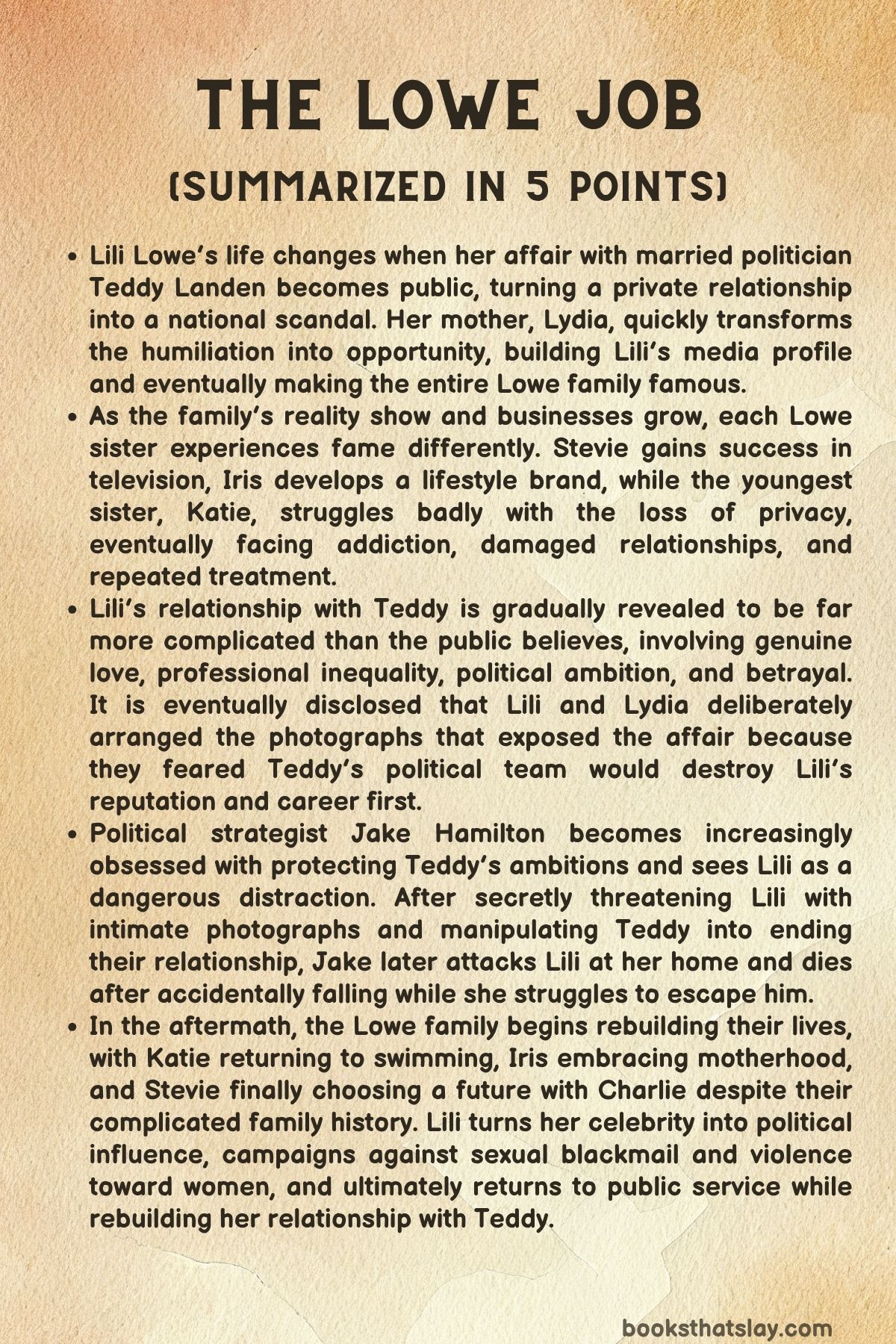
Summary
Lili Lowe’s life changes when explicit photographs reveal her sexual relationship with Teddy Landen, the married politician for whom she works. Instead of allowing the press to define Lili as an anonymous mistress, her mother Lydia immediately recognizes that the family can seize control of the scandal by making Lili highly visible.
Lydia arranges a television interview in which Lili refuses to behave like either a helpless victim or an apologetic seductress. Her confidence makes her fascinating to the public, and Lydia rapidly begins constructing a media career around her daughter while a reality television project about the Lowe family takes shape.
Behind the public spectacle is a complicated relationship that began long before the photographs appeared. Lili was politically ambitious and genuinely admired Teddy’s ideas, but professional admiration became attraction, and the imbalance between employer and employee grew increasingly difficult to separate from their emotional connection.
Their relationship develops through political trips, private meetings, gifts, professional collaboration, and repeated attempts to convince themselves that their circumstances can somehow be resolved. Teddy remains married to Anna and responsible for his children, while Lili becomes increasingly emotionally invested in a man who possesses considerably more professional and personal power than she does.
As Lili becomes famous, the rest of the Lowe family is drawn into Lydia’s expanding media operation. Stevie, who has spent years struggling at the bottom of the television industry, suddenly receives major presenting opportunities, while Iris becomes the focus of lifestyle projects built around her beauty, spirituality, yoga, and unusual worldview.
Katie, the youngest sister, reacts very differently. A talented swimmer who dreams of earning a university scholarship, she values privacy and ordinary teenage life, making her family’s growing celebrity particularly frightening.
Lydia treats attention as a resource. Having once lost her own acting career and later been marginalized in the talent industry after becoming a mother, she believes that money, visibility, and influence are essential protections against institutions and individuals powerful enough to control other people’s lives.
Her strategy works financially. Lili becomes enormously successful through commercial partnerships, the family reality program becomes popular, Stevie’s television career advances, and Iris gradually develops a profitable lifestyle business.
Yet the cost becomes increasingly visible through Katie. Photographers invade her swimming environment, classmates gossip about her family, and Lydia’s attempts to help by arranging opportunities only increase the pressure Katie feels.
Katie begins dating Rory, hoping that the relationship can remain something private and normal. After a huge teenage party at the Lowe home becomes public, however, details about their sexual relationship circulate at school and online, and Rory withdraws because he cannot cope with the attention.
Katie loses confidence in swimming, performs badly academically, falls out with her closest friend Divya, and increasingly turns toward alcohol and drugs. What began as discomfort with fame becomes a severe collapse in her sense of identity, forcing the family eventually to recognize that Lydia’s carefully constructed celebrity machine has damaged the daughter least equipped to survive it.
Meanwhile Stevie’s seemingly platonic relationship with her roommate Charlie grows increasingly complicated. They have loved each other for years without properly acknowledging it, largely because a drunken kiss and an ambiguous conversation left each believing the other preferred friendship.
Stevie tries dating the kind and impressive Kwame while Charlie begins secretly seeing someone else. The situation becomes disastrous when Stevie discovers that Charlie’s mysterious girlfriend is Iris, who had no idea that her sister was in love with him.
Charlie and Stevie finally admit their feelings, but the situation becomes permanent when Iris reveals that she is pregnant with Charlie’s child. Stevie refuses to demand that Iris sacrifice the motherhood she has long wanted, while Iris explains that she never intentionally betrayed her sister.
At the same time, Lili discovers that she has never emotionally escaped Teddy. Her glamorous relationship with Hollywood actor Dyllan Derouen eventually ends because she knows that continuing with him while loving somebody else is unfair.
The truth about Lili and Teddy’s original scandal gradually emerges as well. Before the photographs appeared, political strategist Jake Hamilton had become increasingly concerned that Lili’s affair with Teddy threatened Teddy’s leadership ambitions, particularly because Lili possessed an influence over him that Jake could not control.
Jake convinces Teddy that the affair must end, partly by suggesting that journalists already possess evidence. Teddy breaks Lili’s heart and attempts to end their relationship in order to protect his political future, while Jake falsely tells Lili that Teddy has also blocked her promotion.
Feeling that both her relationship and political career have been taken from her, Lili turns to Lydia. Together they arrange the very scandal that appeared to have destroyed Lili: Lili meets Teddy privately, Lydia alerts photographers, and the resulting sexual photograph places Lili in control of the story before Teddy or his advisers can define her first.
The revelation changes the meaning of the entire public scandal. Lili was neither simply exposed nor merely exploited by the press; she deliberately used exposure as a defensive weapon after concluding that her professional future was already in the hands of people more powerful than she was.
Years later, another threat appears when somebody sends Lili intimate photographs that she had shared only with Teddy. Assuming Teddy may be responsible, she contacts him for the first time in eighteen months and discovers that many things she believed about their breakup were false.
Teddy explains that he had supported her promotion and denies sending the photographs. Their reunion makes it clear that neither has stopped loving the other despite betrayal, anger, political consequences, and the public destruction of their relationship.
Rather than surrendering to the new blackmail attempt, Lili decides to destroy its power. She publicly releases the threatening photograph herself and uses it as the centerpiece of a campaign about sexual double standards, bodily autonomy, victim-blaming, workplace inequality, and the way women’s bodies are repeatedly used against them.
The media initially treats the campaign as another publicity stunt, frustrating Lili because even her political arguments are reduced to judgments about her sexuality. Lydia advises her to think gradually: changing the conversation will require repeated intervention rather than one dramatic act.
The true source of the blackmail eventually appears when Jake arrives intoxicated at Lili’s home. He admits sending the photographs and reveals that his previous claims about evidence of Lili and Teddy’s affair were manipulations intended to frighten Teddy into ending the relationship.
Jake’s professional obsession has consumed him to such an extent that he sees Lili as the person who destroyed the political future around which he built his entire identity. His confrontation with her becomes violent, and after he attacks and strangles her, Lili escapes onto the roof terrace.
Teddy arrives as Jake attacks again. While Lili struggles to free herself, Jake loses his balance and falls down the exterior stairs, dying from the fall.
Police conclude that Jake’s death was accidental, but Lili is deeply traumatized. Teddy subsequently resigns from politics, while Lili begins therapy and gradually attempts to rebuild a life in which political purpose, personal relationships, and celebrity no longer have to exist as opposing forces.
Other members of the Lowe family also begin rebuilding. Iris gives birth to Charlie’s son and discovers that motherhood provides the sense of purpose she had long been seeking, while Stevie eventually accepts that loving Charlie does not require rejecting her sister or nephew.
Katie returns repeatedly to treatment but gradually regains stability and eventually returns to swimming on her own terms. She abandons the UCLA dream that had become associated with pressure and begins imagining a future based on what she now wants rather than what her family history once suggested she should want.
Lili ultimately transforms the fame she once regarded as the destruction of her political ambitions into a means of pursuing them differently. Returning to the television interviewer who first introduced the scandal to a national audience, she announces that she will work as a government adviser supporting women and families affected by male violence.
The family reality series continues, their businesses expand, and Teddy remains involved in Lili’s life, but Lili no longer treats fame and serious political work as mutually exclusive. The Lowe Job therefore ends by returning to the scandal that started everything and showing how a moment designed to shame Lili eventually becomes the unlikely foundation from which she regains control of her public voice and original purpose.
Characters
Lili Lowe
Lili is the central force of The Lowe Job, defined by a combination of intelligence, sexual confidence, political ambition, competitiveness, and an unusually strong instinct for self-preservation. She enters the book wanting conventional political influence, believing that expertise, hard work, and proximity to government will eventually allow her to change institutions.
Her affair with Teddy complicates this ambition because personal desire becomes connected to professional advancement and political access. Lili understands that Teddy holds more formal power than she does, but she is never written as a completely passive participant; she wants him, challenges him, influences his decisions, and repeatedly insists upon her own agency.
What makes her especially complex is her willingness to behave selfishly while still possessing genuine political convictions. She hurts Anna, deceives Dyllan emotionally, helps engineer her own public scandal, and sometimes uses media manipulation without hesitation, yet her commitment to gender equality and resistance to misogyny is not merely a celebrity performance.
Her deepest development involves redefining power. At first she wants institutional authority, then discovers the enormous influence of celebrity, and finally learns to use visibility in service of the political causes that mattered to her before fame arrived.
Her campaign against sexual blackmail represents the strongest expression of that transformation. Instead of allowing another person to determine when and how her body will be exposed, she chooses the terms of exposure herself and converts attempted humiliation into political speech.
Lydia Lowe
Within The Lowe Job, Lydia functions simultaneously as mother, manager, strategist, protector, opportunist, and architect of the family’s celebrity empire. Nearly everything she does comes from her conviction that people without power are vulnerable to people who possess it.
Her worldview is shaped by personal humiliation. Losing her acting career taught her how quickly attention disappears, while being pushed aside at a talent agency after becoming a mother taught her that competence alone cannot protect a woman from institutions prepared to replace or silence her.
The death of Eric intensifies this determination because Lydia becomes solely responsible for four daughters whose futures she refuses to leave vulnerable to other people’s decisions. She therefore converts love into strategy, often believing that creating opportunities for her daughters is equivalent to protecting them.
This makes her both impressive and dangerous. She creates wealth, careers, businesses, media platforms, and negotiating power for her children, but she also repeatedly assumes that she understands what they need better than they understand themselves.
Katie exposes the limit of Lydia’s philosophy. Lydia believes visibility produces freedom, whereas Katie experiences visibility as imprisonment, forcing Lydia to confront the possibility that her method of protecting her daughters has seriously harmed one of them.
Her complexity lies in the fact that her controlling behavior is rarely motivated by simple greed. Money and fame matter to her because she associates them with independence, yet her inability to distinguish empowerment from control repeatedly creates the very power imbalance she claims to oppose.
Katie Lowe
Katie is the Lowe sister least suited to public life and therefore the character through whom the psychological cost of family celebrity becomes most visible. Unlike her older sisters, she is still forming her identity when the scandal transforms the family into entertainment.
Swimming initially provides a protected space in which she knows exactly who she is. Her talent belongs to her rather than to the Lowe brand, and her dream of earning a scholarship allows her to imagine a future connected to her father but achieved through her own work.
Public attention gradually contaminates that refuge. Paparazzi enter swimming spaces, Lydia arranges a scout without permission, classmates discuss Katie’s sexuality, and her private relationship with Rory becomes public information.
Her resulting collapse is gradual rather than sudden. She stops competing successfully, withdraws from school, loses Divya, drinks increasingly heavily, experiments with drugs, and attempts to become someone else because being Katie Lowe has become unbearable.
Her recovery is equally complicated. Treatment does not immediately solve everything, and the book acknowledges relapse, repeated rehabilitation, damaged confidence, and the need to reconstruct identity slowly.
Returning to swimming eventually matters because Katie chooses it again for herself. By rejecting UCLA and considering a different future, she separates her genuine love of swimming from the expectations surrounding her father, her family, and the identity she believed she had to maintain.
Stevie Lowe
Stevie uses humor as both her greatest social strength and her most effective emotional defense. Growing up beside sisters who were more conventionally beautiful, she learns to become the funny one, developing a personality capable of controlling a room through wit before anybody can make her feel inadequate.
Her professional development rewards this ability. Years of low-level television work finally lead to presenting opportunities, and although Lydia’s influence helps accelerate her rise, Stevie has genuine talent that allows her to keep the opportunities once they appear.
Her relationship with Charlie exposes the limitations of humor as protection. Stevie can say almost anything except the one thing that matters most: that she loves him.
Because sincerity makes her vulnerable, she repeatedly converts emotional moments into jokes, dates Kwame despite loving somebody else, and allows a misunderstanding with Charlie to continue for years. The result demonstrates how avoidance can create consequences just as serious as deliberate decisions.
Her response to Iris’s pregnancy shows her strongest quality. Although devastated, Stevie refuses to treat her sister or the unborn child as enemies, choosing family loyalty even when doing so appears to cost her the person she loves.
Her eventual relationship with Charlie therefore represents more than romantic resolution. Stevie finally accepts that honesty does not automatically destroy the bonds she is trying to protect and that love can survive a family situation that remains permanently complicated.
Iris Lowe
Iris appears dreamy, spiritual, beautiful, and sometimes detached from ordinary practical concerns, but much of that identity has been shaped by guilt and emotional avoidance. Her failed marriage to Billy and the sexual photographs connected to her infidelity remain important psychological wounds.
Astrology, yoga, crystals, spirituality, and later her lifestyle business give Iris a language for meaning and self-understanding. Lydia initially treats those interests primarily as commercial material, but Iris gradually proves that her unusual sincerity connects with people precisely because she does not approach everything strategically.
Her relationship with Charlie creates the greatest conflict between her private desires and family loyalty. She genuinely does not understand Stevie’s feelings and believes her meeting with Charlie may represent the kind of romantic fate she has always wanted to find.
Pregnancy changes her priorities completely. Iris recognizes that Charlie is not her lifelong romantic partner, yet she is certain that motherhood is something she deeply wants.
Her reconciliation with Stevie reveals her fundamental gentleness. She does not become defensive once she understands her sister’s pain, and Stevie’s acceptance of the baby allows both women to preserve their bond without pretending that nothing difficult has happened.
Motherhood ultimately gives Iris the sense of purpose she had spent years searching for through spiritual systems and lifestyle identities.
Teddy Landen
Teddy is charismatic, politically ambitious, emotionally conflicted, and morally compromised. His relationship with Lili contains genuine affection and intellectual respect, yet it also begins within a workplace structure in which he is older, married, professionally senior, and capable of influencing her career.
He repeatedly wants incompatible things. Teddy wants his marriage and children protected, wants political leadership, wants Lili, wants to regard himself as principled, and wants to believe that nobody must be sacrificed for these desires.
His greatest weakness is therefore not an absence of feeling but an inability to accept the cost of his choices. When political danger becomes serious, he ends the relationship and cruelly minimizes its importance despite loving Lili because he believes emotional brutality will make separation possible.
Later revelations soften but do not erase his responsibility. He did support Lili’s promotion, was manipulated by Jake, regrets publicly calling her a mistake, and eventually accepts that allowing ambition to dictate his personal decisions caused enormous damage.
His resignation from politics indicates a final rejection of the structure around which Jake built his life. Teddy ultimately chooses work outside Parliament and attempts to rebuild his relationship with Lili on terms no longer defined by employer authority or leadership campaigns.
Jake Hamilton
Jake represents ambition stripped of emotional balance. He is extraordinarily disciplined, strategically intelligent, and committed to making Teddy a national leader, but his career gradually becomes the sole source of meaning in his life.
His failed marriage offers an early warning about this obsession. Jake acknowledges that politics cost him his relationship and nevertheless admits that he would make the same choice again, revealing how completely achievement has replaced ordinary emotional priorities.
Lili threatens him because she resembles him. Both are ambitious, politically intelligent, competitive, and interested in influence, but Lili possesses personal access to Teddy that Jake cannot reproduce through formal strategy.
Rather than accepting her as an ally, Jake increasingly interprets her influence as interference. His decision to frighten Teddy with claims about evidence of the affair becomes an attempt to remove what he considers a dangerous distraction from the campaign.
The blackmail photographs expose how completely his judgment deteriorates. Jake convinces himself that threatening Lili is justified because her political criticism might destabilize Teddy’s leadership, placing the success of a political project above another person’s safety and autonomy.
His final violence is the extreme result of that collapse. After Teddy fires him, Jake loses the identity around which he organized his life and directs his rage toward the woman he has long blamed for threatening it.
Charlie Branson
Charlie combines warmth, humor, loyalty, and emotional caution. His friendship with Stevie operates like a romantic partnership long before either is willing to define it that way.
The misunderstanding following their early kiss becomes central to his development. Charlie interprets Stevie’s description of them as best friends as rejection, so he suppresses his feelings rather than risk destroying the relationship they already have.
His involvement with Iris is therefore not an intentional betrayal. From his perspective Stevie has repeatedly presented herself as romantically unavailable to him, and he is entitled to pursue another relationship.
Iris’s pregnancy forces Charlie to confront responsibility without confusing parenthood with romantic obligation. He promises to support Iris and their child while remaining clear that the person he loves romantically is Stevie.
His patience with Stevie ultimately distinguishes him. Rather than demanding that she choose him immediately, he accepts the complicated family circumstances and continues insisting that their relationship can exist alongside his responsibilities as a father.
Eric Lowe
Eric remains one of the most influential figures in the book despite being dead before the main events. His memory shapes Lydia’s determination, Katie’s swimming ambitions, Lili’s political ideals, and the sisters’ understanding of emotional security.
He is remembered as calm, encouraging, intellectually supportive, and capable of balancing Lydia’s intense personality. His advice to young Lili about using her intelligence and voice to improve the world becomes one of the clearest foundations for her later political ambitions.
His death leaves an emotional absence that every family member handles differently. Lydia responds by becoming more controlling and determined, while Katie initially tries to continue his swimming legacy.
Naming Iris’s son Eric brings his influence into a new generation. The choice suggests that the family is no longer simply grieving him but incorporating his memory into a future that continues beyond the loss.
Divya
Divya provides Katie with one of the few relationships initially untouched by celebrity. Their friendship is built around swimming, teasing, shared adolescence, and a level of familiarity that allows Divya to speak to Katie more directly than most members of her family can.
Her confrontation with the paparazzi demonstrates her fierce loyalty, while her later argument with Katie reflects frustration rather than abandonment. Divya recognizes that Katie is surrendering the activities and relationships that once gave her an independent identity.
Their friendship breaks when Katie is least capable of accepting difficult truths. Yet Divya returns after treatment without forcing Katie to perform an elaborate apology, allowing their familiar humor to create a path back toward trust.
Her success at nationals also demonstrates that life continued while Katie was unwell. Katie’s ability to celebrate that success becomes a quiet sign that recovery is allowing her to reconnect with people without measuring herself against them.
Rory Lomond
Rory initially represents the ordinary teenage life Katie desperately wants. He is gentle, funny, relatively unaffected by the Lowe family, and careful during their early physical relationship, particularly when he suggests slowing down rather than taking advantage of Katie’s uncertainty.
The publicity surrounding their relationship overwhelms him. Instead of explaining his fear maturely, he withdraws and leaves Katie dealing simultaneously with rejection and public humiliation.
Later information complicates Katie’s interpretation of his behavior. Rory denies making the crude comments attributed to him and explains that he simply panicked when their private relationship became public.
He therefore functions less as a villain than as another young person unequipped to handle celebrity attention. His inability to cope still hurts Katie badly, but the later clarification allows her to release some of the shame she had attached to their relationship.
Dyllan Derouen
Dyllan enters Lili’s life as part publicity creation and part genuine romantic possibility. Lydia initially manufactures speculation about them, but Lili and Dyllan discover real attraction and transform an invented celebrity rumor into an actual relationship.
For Lili, he represents the possibility of replacing the emotionally destructive secrecy of Teddy with something glamorous, open, and apparently uncomplicated. Yet the very perfection of the alternative reveals that her unresolved feelings cannot simply be replaced by a more suitable partner.
Dyllan’s disappointment when the relationship ends is important because he has genuinely invested in Lili. His belief that she might have used him reminds Lili that being manipulated in the past does not prevent her from hurting another person.
Breaking up with him becomes an act of painful honesty. Lili finally accepts that emotional truth matters even when continuing the relationship would be easier professionally and publicly.
Anna Landen
Anna is largely kept outside the main narrative perspective, which mirrors the uncomfortable position she occupies within Lili and Teddy’s affair. She is the person whose marriage is being violated while other characters repeatedly focus on desire, political careers, media strategy, and scandal management.
Her handwritten letter to Lili forces the consequences of the affair into personal rather than abstract terms. Anna’s fear that Lili may have pursued Teddy for advantage reminds both Lili and the reader that the relationship has injured someone who never consented to participate in its risks.
Lili later admits regret about hurting her, even while refusing to pretend that she felt sufficient concern during the affair to stop. Anna therefore prevents the moral questions surrounding Lili and Teddy from becoming entirely about workplace power or media sexism.
Valentino “Val” Gaspari
Val initially appears as the stylist hired to rebuild Lili’s public appearance, but his role gradually becomes more personal. He understands image-making as a language of power and helps the family develop the polished visual identity that supports their transition from scandal to celebrity.
Unlike Lydia, however, Val sometimes places Lili’s welfare above publicity strategy. His insistence that she report the threatening photographs to the police demonstrates a practical concern for her safety.
His continuing presence at family events also shows how people originally hired for the media enterprise gradually become incorporated into the Lowes’ extended world. He is part technician, adviser, and trusted ally.
Kwame
Kwame is deliberately presented as an excellent romantic prospect for Stevie. He is attractive, successful, intelligent, considerate, and genuinely interested in her beyond the celebrity surrounding her family.
His most revealing moment comes when Stevie drunkenly propositions him and he refuses because she is too intoxicated to consent meaningfully. The decision establishes his decency while making Stevie’s inability to love him more significant.
There is nothing obviously wrong with Kwame that allows Stevie to explain away the relationship. She eventually has to admit the far more uncomfortable truth that compatibility cannot substitute for loving somebody else.
His character therefore helps Stevie recognize that choosing Charlie is not a rejection of better judgment. It is an acknowledgment of an emotional reality she has avoided for years.
Shane
Shane is Katie’s swimming coach and one of the few adults who consistently sees her as an individual athlete rather than a member of a famous family. His demanding training gives structure to Katie’s life before public attention begins damaging her relationship with the sport.
During her panic attack, he rescues her from the pool, and later he immediately recognizes the seriousness of her physical and emotional deterioration. Importantly, he does not attempt to force her back into competition.
Instead, Shane tells Katie that the swimming community will support her when she is ready. This makes him a contrast to Lydia, whose instinct is usually to respond to difficulty by pushing harder or creating another opportunity.
Billy Bobb
Billy is Iris’s teenage husband and the person most directly harmed by her early infidelity. Although his role in the present story is limited, his reaction becomes psychologically permanent for Iris.
His question after discovering what she had done remains in her mind for years. The memory helps explain why Iris constructs much of her adult identity around spirituality, forgiveness, fate, and the search for a larger meaning capable of containing past mistakes.
Billy therefore functions less through present action than through remembered emotional consequence. His pain becomes part of the guilt Iris must eventually learn to live beyond.
Rehan
Rehan briefly offers Katie something she believes she has lost completely: interaction with someone who does not know who she is. By introducing herself as Melanie, Katie experiences the temporary freedom of inventing an ordinary identity unrelated to her family.
Their genuine connection makes the discovery of her lie especially painful. Rehan is not primarily angry that she is famous; he is disturbed because she deceived him about something as fundamental as her identity.
The encounter exposes how deeply Katie’s crisis has developed. She no longer merely wants privacy but wants to stop being herself, and Rehan unintentionally forces her to see that anonymity created through self-erasure cannot provide genuine intimacy.
Simon Steen
Simon Steen represents the media environment that repeatedly attempts to reduce Lili to scandal. His interviews frame her through sex, Teddy, embarrassment, and public judgment even when she tries to discuss larger political questions.
His importance becomes especially clear when Lili returns to his studio years later. The same interview structure that once threatened to define her becomes a stage on which she demonstrates how thoroughly she has learned to control the conversation.
Simon does not fundamentally change; Lili does. His continuing attempts to return to the original scandal therefore provide a useful measure of her growing refusal to accept somebody else’s framing of her identity.
Themes
Power, Ambition, and the Right to Control Your Own Life
Power in The Lowe Job is rarely presented as a simple possession held by politicians, wealthy people, or celebrities. Instead, the novel repeatedly asks what allows one person to control the choices available to another and what happens when somebody recognizes that dependence too late.
Lydia’s entire philosophy emerges from experiences of professional powerlessness. Losing control of her acting career and later being marginalized after maternity leave convince her that talent means very little without money, leverage, access, and the ability to survive somebody else’s refusal.
Lili initially believes political office represents the clearest route to influence. Her affair with Teddy exposes the weakness of that assumption because proximity to political authority does not protect her when Teddy can simultaneously determine her professional opportunities and decide whether their private relationship continues.
Jake provides the darkest version of ambition. He sacrifices his marriage, sobriety, emotional balance, and eventually his moral boundaries because Teddy’s political success becomes more important to him than any life outside the campaign.
Katie presents the opposite argument. She does not want greater visibility or influence; she wants the right to refuse them, showing that genuine power also includes the ability to remain private and determine which opportunities are actually desirable.
The novel ultimately distinguishes power from domination. Real autonomy develops when characters gain enough control to make choices without forcing those same choices upon somebody else.
Public Identity and Private Self
The Lowe family repeatedly discovers that publicity does more than reveal private experiences; it creates alternative versions of people that can become more influential than reality. Lili becomes the seductress, Stevie becomes the funny sister, Iris becomes the mystical beauty, and Katie becomes another participant in a celebrity family before she has consciously chosen any identity at all.
Reality television makes the conflict especially visible because supposedly spontaneous family life is constantly edited, staged, exaggerated, or strategically arranged. Lili and Lydia manufacture a pregnancy scare, paparazzi are tipped off, relationships become promotional material, and even genuine emotional disasters can immediately be evaluated according to their usefulness as television.
The danger becomes greatest when characters begin measuring themselves against these public versions. Katie changes how she dresses and behaves partly because constant attention makes her uncertain about who she is without the Lowe identity surrounding her.
Lili develops differently because she gradually learns that performance does not necessarily eliminate authenticity. She can participate knowingly in celebrity culture while still caring sincerely about political ideas.
The distinction therefore becomes less about whether a public persona is artificial and more about who controls it. A constructed identity becomes destructive when other people impose it, but performance can become a form of agency when the individual understands and chooses the role being performed.
Sexuality, Gender, and Unequal Judgment
Sexual behavior repeatedly becomes a test through which female characters are judged more harshly than the men around them. Lili participates willingly in an affair with a married politician, yet the public narrative surrounding the scandal concentrates overwhelmingly on her body, motives, clothing, ambition, and morality.
The novel does not solve this inequality by declaring Lili innocent. She knowingly hurts Anna and later admits that desire mattered more to her during the affair than concern about Teddy’s marriage, allowing personal accountability and sexist public judgment to exist simultaneously.
This distinction becomes essential to the book’s argument. A woman can make ethically questionable decisions without deserving sexual humiliation, career destruction, blackmail, or the assumption that her sexuality invalidates everything else she thinks or accomplishes.
Katie experiences the same culture from a different position. Because her sister is publicly sexualized, classmates project sexual assumptions onto Katie, and her first relationship becomes material for gossip before she has developed the emotional resources to manage such exposure.
The threatening photographs sent to Lili transform this social judgment into direct coercion. By publishing the photograph herself, she refuses the idea that nudity becomes powerful merely because somebody else possesses it.
Her campaign therefore expands the question beyond personal embarrassment. Control over sexual images becomes connected to workplace equality, violence, consent, reputation, and the larger expectation that women remain responsible for managing both male behavior and society’s reaction to their own bodies.
Family Love, Protection, and Control
The Lowes are bound together by intense loyalty, but the novel repeatedly questions when protection stops being care and becomes control. Lydia provides the clearest example because nearly every intrusive decision she makes can be traced to a sincere determination that her daughters will never experience the helplessness she once experienced.
She arranges opportunities, negotiates contracts, builds companies, manages scandals, manipulates publicity, and attempts to create financial independence for each daughter. To Lydia, these actions are expressions of love because she believes security requires having enough influence to prevent other people from dictating your future.
Katie reveals why that philosophy cannot be universally applied. Every opportunity Lydia creates adds another layer of expectation to a daughter who wants less attention rather than more, proving that protection offered without listening can become another form of pressure.
The sisters repeatedly face similar tensions among themselves. Stevie chooses Iris over immediate happiness with Charlie, Iris refuses to treat Stevie’s pain defensively, Lili ultimately protects Katie’s right not to film, and the family rallies around Katie when her substance use becomes dangerous.
Their strongest relationships survive because they eventually allow conflicting needs to coexist. Iris can keep her baby without demanding Charlie’s romantic commitment, Stevie can love Charlie without rejecting her nephew, and Katie can remain part of the family without becoming an enthusiastic participant in its public identity.
Family love therefore becomes healthiest when it stops insisting on a single definition of success or safety. The Lowes remain unusually involved in one another’s lives, but their gradual progress depends on recognizing that loving someone also means allowing that person to choose a life different from the one you would choose for them.