The Missed Connection Summary, Characters and Themes
The Missed Connection by Tia Williams is a contemporary romantic novel about recovery, chance, fear, and the difficult difference between imagining love and recognizing it when it is already present. At its center is Sasha Cruz, a gifted New York casting director rebuilding her life after trauma, and Wesley Dane, the former private investigator whose own past is closely connected to hers.
What begins as Sasha’s search for a mysterious stranger she meets on a flight gradually becomes a story about trust, emotional courage, self-knowledge, and two people who must stop treating their deepest feelings as problems to solve.
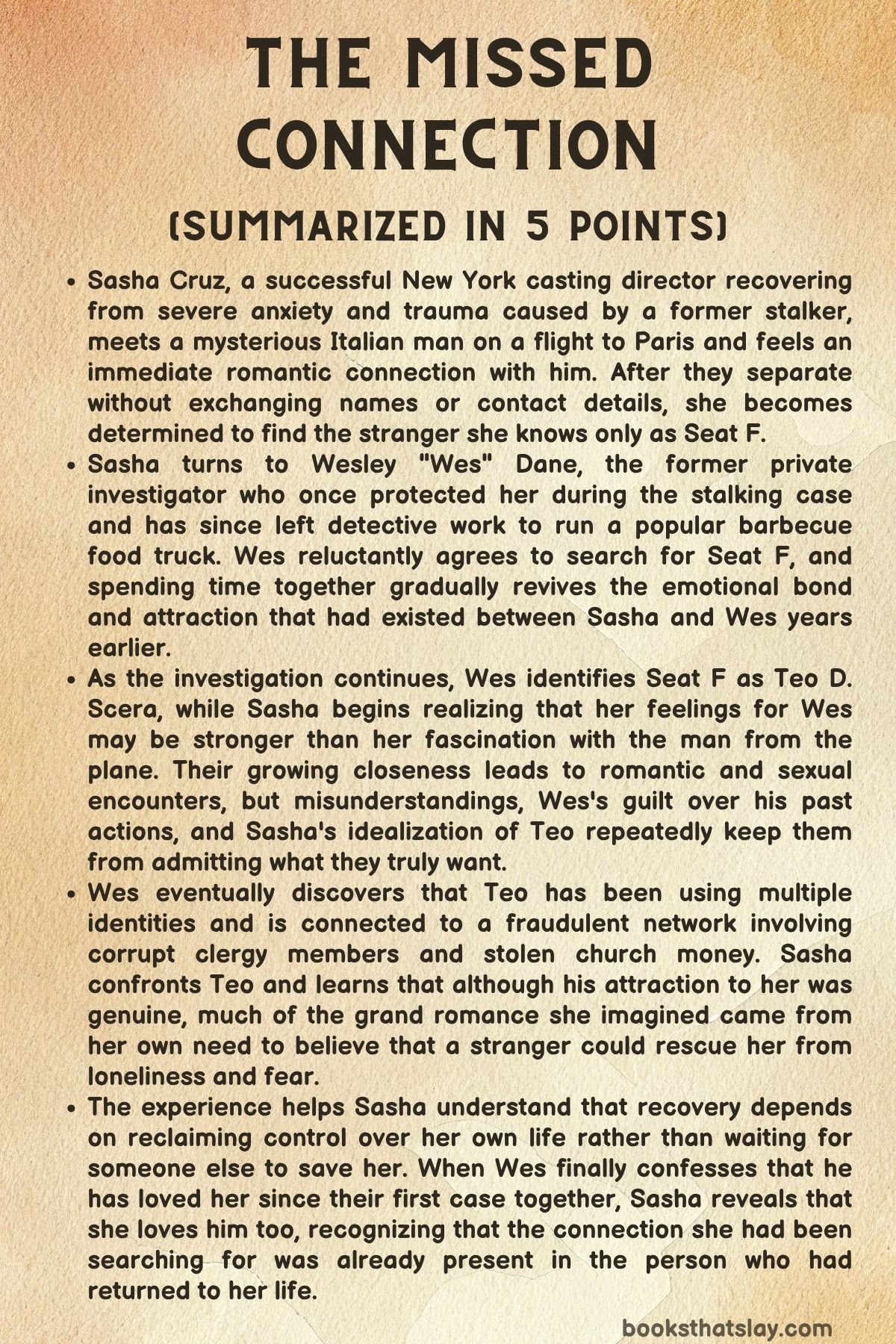
Summary
Thirty-two-year-old Sasha Cruz is a successful New York casting director who has only recently returned to work after spending a year away because of severe depression, anxiety, and the psychological consequences of a terrifying stalking incident. Her isolation had become so complete that a medical emergency finally forced her to recognize how far she had withdrawn from ordinary life, and a new beauty campaign for Seraphina offers her an opportunity to rebuild both her career and her confidence.
At an airport spa before flying to Paris, Sasha meets a manicurist named Maxi who reads her palm and predicts that a chance encounter with a man will begin a chain of events leading toward happiness. Sasha dismisses the prediction as entertainment, yet Maxi’s insistence that the right connection can cross time and distance stays with her, especially because Sasha has only recently begun wondering whether she is capable of intimacy again.
On the flight to Paris, Sasha is seated beside a striking Italian man with pale green eyes. He notices her nervousness and initially pretends to be gay so she will not worry that he intends to spend the flight flirting with her, then admits that he only wanted to make her feel comfortable.
Their conversation soon becomes unusually personal. They discuss their complicated families, absent parents, cultural identities, loneliness, work, and the emotional consequences of growing up with important pieces of their families missing, and Sasha feels an immediate familiarity with a man whose name she never learns.
The stranger tells Sasha that he comes from Gallipoli, spends part of the year in SoHo, works as a luxury hotel inspector, and visits Film Forum on Fridays when he is in New York. He writes the Italian expression “in bocca al lupo” on a napkin for her, asks her on a date, and holds her hand during the flight, leaving Sasha convinced that something extraordinary has occurred between them.
Their connection is broken by confusion after landing. They are sent into separate taxis before exchanging names or phone numbers, and a drunken Sasha later emails a Seraphina contact asking for help locating the mysterious passenger she calls Seat F, accidentally sending the message to the company’s global staff.
The mistake becomes an international office spectacle. Employees trade theories, volunteer to investigate, joke about the romance, and turn Sasha’s embarrassment into a company-wide search, while her friend Destiny Morgan, a professional matchmaker, warns her against transforming one appealing stranger into a perfect romantic destiny before she actually knows him.
Sasha nevertheless believes searching for Seat F means more than finding a boyfriend. For someone who has spent years protecting herself through withdrawal, pursuing a person she genuinely wants represents an active decision to participate in life again, and she remembers the one man capable of finding someone with almost no identifying information: Wesley “Wes” Dane.
Wes was once a gifted private investigator, but he has abandoned detective work and now owns Natural Born Griller, a thriving Brooklyn barbecue truck. Cooking gives him the sense of community, simplicity, and satisfaction that investigation never could, and he has built a peaceful existence after years of carrying other people’s violence, fear, and tragedy into his own emotional life.
Sasha unexpectedly appears at his truck and asks him to locate Seat F. Wes is visibly shaken by seeing her because Sasha was never simply another former client, although he initially refuses the request and insists that he left investigative work precisely because he could no longer survive its emotional cost.
Their shared history began during the stalking incident that changed Sasha’s life. A man wearing a Wolverine mask terrorized her around her apartment, sent threatening communications, demonstrated that he could observe her movements, and frightened her so badly that she injured her wrist while escaping through a window and down a fire escape.
With police protection proving inadequate, Sasha contacted Wes’s detective agency. Wes recognized patterns in the stalker’s behavior, gave Sasha a place to stay when she felt unsafe anywhere else, and became the person beside whom she could temporarily stop expecting danger from every direction.
As they investigated, they suspected an actor named Jones Wright, whose repeated professional rejection by Sasha had turned into resentment. Wes eventually caught him and arranged his arrest, but the investigation also brought Wes and Sasha dangerously close emotionally and physically, crossing boundaries that Wes believed a detective should never cross with a client.
Back in the present, Wes eventually agrees to search for Seat F. He tells himself that finding the man who might make Sasha happy could provide closure to the case that once changed both of their lives, but spending time with Sasha quickly revives the attraction, protectiveness, and emotional attachment he has tried to suppress.
The investigation also becomes part of Sasha’s recovery. She joins Wes for a stakeout at Film Forum, begins leaving her apartment more often, talks openly about the habits created by hypervigilance, and even removes the gold cuff she uses to conceal the scar on her wrist after Wes describes it as evidence of survival rather than something she should hide.
Sasha and Wes increasingly become part of each other’s daily lives. Late-night telephone conversations turn them into close friends, their teasing familiarity returns, and Wes eventually discovers that Seat F has been visiting Seraphina stores looking for the woman he met on the plane, proving that Sasha did not imagine the importance of their encounter.
At the same time, Sasha begins recognizing her attraction to Wes. He understands her fear without treating her as fragile, notices when she starts isolating herself, helps her manage nightmares, and becomes the person whose presence allows her to attempt experiences that once felt impossible.
Their closeness becomes even more apparent when Sasha accompanies Wes to a ceremony honoring his late father, Wesley Dane Sr. The community remembers the elder Dane as an admired detective and generous neighborhood figure, but Sasha sees the painful side of that legacy when Wes’s family describes him as a disappointment and belittles the barbecue business he has worked hard to build.
Sasha fiercely defends Wes, exposing how strongly she already cares about him. Their attraction soon becomes impossible to deny, and after Wes finally identifies Seat F as Teo D. Scera, he and Sasha kiss and sleep together, only for Wes to retreat emotionally because he believes he has violated the boundaries he tried so hard to maintain.
Sasha is hurt by his withdrawal because finding Teo no longer feels as important as it once did. Wes dominates her thoughts, yet jealousy, misunderstanding, his history with investigative journalist Imani McIntyre, and their inability to speak plainly about their feelings repeatedly lead them to deny what their behavior has already revealed.
Wes continues investigating Teo and discovers reasons for concern. Teo’s supposed career cannot be verified, his former fiancée possesses suspicious postcards that were handed to her rather than mailed, and several unusual aliases appear in financial information connected to him and a charity called Two Tunics.
Meanwhile, Sasha and Wes sleep together again, followed by a painful confrontation in which Wes admits that the arrangement is destroying him. He cannot continue acting as Sasha’s protector, lover, friend, and investigator while helping deliver her to another man, because he believes Sasha ultimately sees him as useful rather than as someone she could truly choose.
At a Two Tunics gala, Sasha makes substantial progress in confronting her fear. She circulates among strangers, befriends a woman named Patricia Moreno, willingly shares her phone number, reconnects with her Dominican identity, and finally admits aloud that she is in love with Wes.
Wes overhears part of the confession through their surveillance equipment but misunderstands it, assuming Sasha means Teo. Believing he has finally lost her, he tells Sasha that once the case ends he cannot remain her friend because pretending not to love her has become unbearable.
Sasha then encounters Teo. He remembers her immediately and confirms that he has been searching for her, apparently validating the romantic possibility she has carried since the flight, and Sasha impulsively agrees to leave with him after the gala.
A jealous and intoxicated Wes confronts Teo before secretly arranging to listen to Sasha and Teo’s conversation from the front of Teo’s chauffeured car. During the ride, Teo talks about enormous wealth, aliases, religion, constant travel, and an isolated villa in Gallipoli where Sasha could escape from the world entirely.
To Sasha, the villa initially sounds like perfect safety. To Wes, it sounds dangerous because Teo is encouraging exactly the instinct Sasha has been struggling to overcome: disappearing from the world whenever life becomes frightening.
Teo then casually reveals several aliases. Wes recognizes them from his investigation and realizes that they are word games connected with Catholic terminology, while even Teo’s own name can be rearranged into an Italian word meaning priest.
Wes concludes that Teo is part of a fraudulent international network of clergy members who steal church money, assume different identities, and finance extravagant secret lives. Sasha initially thinks Wes is inventing accusations because he cannot tolerate losing her, forcing Wes to reveal the truth he has concealed about her old stalking case.
Wes admits that he manipulated evidence against Jones Wright and assaulted him to make certain Sasha’s stalker would be arrested. His father discovered the misconduct and fired him, explaining both Wes’s disappearance from Sasha’s life and his obsession with maintaining professional boundaries when she returned.
The confession reveals the painful contradiction at the center of Wes’s character. He knows that his choices violated his professional ethics and destroyed his career, yet he also admits that, faced with the same threat to Sasha, he cannot promise that he would choose differently.
Imani later confirms that Wes’s conclusions about Teo are accurate. Sasha confronts Teo directly, and he calmly acknowledges his identity as a priest, his deliberate use of aliases, and his enjoyment of leaving linguistic clues behind, although he insists that his affection for Sasha and his effort to find her were genuine.
Teo also tells Sasha an uncomfortable truth: he did not create the grand romance she imagined after their flight. Sasha herself turned their brief encounter into a promise of salvation because she wanted a stranger to prove that loneliness, anxiety, and trauma could disappear if the right person arrived.
Recognizing this changes Sasha’s understanding of both Teo and herself. She blocks him, accepts that hoping was not foolish, and realizes that recovery cannot depend on being rescued by a mysterious romantic figure because she is increasingly capable of protecting, challenging, and rebuilding herself.
That realization carries into her professional life. During a live casting session for Seraphina, Sasha encourages performers to stop hiding the contradictions, shame, fear, and personal history that make them human, while privately recognizing that she can understand her own past in the same way.
She no longer sees herself only as the helpless target of a stalker. She recognizes the courage, resourcefulness, and determination that helped her survive, and although anxiety remains part of her life, it no longer has complete authority over her decisions.
Sasha then learns that the accidental worldwide search for Seat F created unexpected romantic connections among other Seraphina employees. Maxi’s prediction was therefore correct in an unexpected way: Sasha’s chance meeting helped produce happiness, even if the stranger on the plane was never meant to be her own destination.
One final performer arrives for Sasha’s casting under the name Dean W. Seely. She soon realizes that the name is an anagram of Wesley Dane, and Wes appears before her ready to stop hiding behind investigation, professional rules, shame, and fear of rejection.
Wes confesses that he has loved Sasha since she first appeared in his office during the stalking case. He still believes she loves Teo because he misunderstood her conversation at the gala, but Sasha finally explains that the man she was talking about was Wes himself.
Their final misunderstanding disappears as both acknowledge what has been present between them for years. The stranger on the airplane was indeed a meaningful missed connection, but his greater purpose was bringing Sasha back to the man whose connection with her had never truly ended.
Characters
Sasha Cruz
Sasha Cruz is the emotional center of The Missed Connection, and much of her development concerns the difference between surviving trauma and learning how to live after it. She begins the book professionally accomplished and outwardly controlled, yet her polished appearance conceals a life organized around anxiety, isolation, vigilance, and the fear that safety can disappear without warning.
Her response to the stalking incident is not reduced to a temporary period of fear. Sasha develops habits designed to anticipate danger, studies exits, monitors strangers, struggles with nightmares, avoids leaving home, and chooses environments according to how easily she can protect herself, showing how traumatic experience can continue shaping ordinary decisions long after the immediate threat has ended.
What makes Sasha’s development important is that recovery never requires her anxiety to vanish. Instead, she gradually stops allowing fear to make every decision for her, and seemingly ordinary acts such as attending events, visiting Wes alone, sharing her phone number with Patricia, exposing her scar, and inviting someone into her apartment become evidence of regained agency.
Her obsession with Seat F is therefore more complicated than romantic infatuation. Teo becomes a symbol of possibility because meeting him occurs at the exact moment Sasha wants proof that she can still trust another person, experience desire, act impulsively, and imagine a future that is not structured entirely around self-protection.
This explains why she idealizes him so quickly. Because she barely knows Teo, he can represent everything she wants without yet possessing the flaws, contradictions, or demands of a real relationship, making the fantasy emotionally safer than admitting how much she cares about Wes.
Sasha’s relationship with Wes ultimately challenges that fantasy because he knows the parts of her she would prefer to leave behind. She initially associates him with the darkest period of her life, but gradually understands that being known through painful history does not make a relationship unhealthy when both people are capable of seeing each other as more than their worst experiences.
Her professional identity also supports her larger arc. Sasha prides herself on recognizing human potential through casting, so discovering Teo’s deception damages not only her romantic confidence but also her belief that she can accurately read people.
By the end, she develops a more mature understanding of perception. Reading people does not mean never being deceived, and courage does not mean never feeling frightened; both involve accepting uncertainty without abandoning judgment, curiosity, or participation in life.
Wesley “Wes” Dane
Wesley Dane is Sasha’s romantic counterpart and one of the most psychologically conflicted figures in The Missed Connection. He is intelligent, observant, funny, protective, emotionally intuitive, and deeply capable, yet much of his adult identity has been shaped by the belief that his strongest instincts are also the qualities most likely to cause damage.
His career as a private investigator demonstrates this conflict clearly. Wes is exceptionally talented at noticing details and understanding motives, but he cannot maintain the emotional distance his profession demands because other people’s suffering becomes personally meaningful to him.
The stalking case exposes the limits of that compassion. Wes’s desire to protect Sasha becomes so powerful that he manufactures evidence and physically attacks her stalker, actions that secure the result he wants while violating the ethical standards his father taught him to respect.
Losing his career therefore produces more than professional disappointment. Wes comes to believe that loving Sasha made him dangerous to his own judgment, which explains why he repeatedly retreats behind rules when she returns and why every renewed moment of intimacy makes him fear that he is repeating an old failure.
Natural Born Griller is central to understanding him. Cooking allows Wes to care for people without investigating their secrets, entering their crises, or deciding how far justice should permit him to go, and the food truck gives him a version of usefulness that feels creative rather than destructive.
His confidence in that life remains vulnerable because of his family. Years of criticism from his parents, especially his father’s demanding standards and his mother’s willingness to weaponize his childhood weaknesses, have taught Wes to measure himself against an ideal he can rarely satisfy.
That insecurity shapes his romantic behavior as much as his professional history does. He sees Sasha as glamorous, accomplished, sophisticated, and socially successful, while imagining himself as an ordinary food-truck owner who cannot compete with the wealthy and mysterious Teo.
His mistake is not a lack of feeling but a refusal to believe he can be chosen without first proving his usefulness. Wes can investigate for Sasha, protect Sasha, comfort Sasha, feed Sasha, and locate Teo for Sasha, but accepting that Sasha might simply love him requires a form of vulnerability he finds far more frightening.
By appearing at her casting under the anagram Dean W. Seely, Wes finally turns one of his intellectual habits into an act of emotional openness. Instead of solving Sasha’s life for her, he arrives prepared to state what he wants and accept whatever answer she chooses to give.
Teo D. Scera
Teo initially functions as an ideal precisely because Sasha knows so little about him. His courtesy, physical attractiveness, international lifestyle, emotional openness, and apparent sensitivity create a compelling first impression, and the circumstances of the flight allow both Sasha and the reader to understand why she believes the encounter might signal a new direction in her life.
His significance becomes more complex once his deceptions are uncovered. Teo is a priest participating in financial fraud, living through multiple identities and treating secrecy almost as a private intellectual game, yet his feelings toward Sasha are not presented as entirely fabricated.
That distinction matters because Teo is not simply exposed as a man who lied about every aspect of their connection. He genuinely remembers Sasha, searches for her, enjoys their conversations, and appears attracted to her, making the eventual disappointment more difficult than discovering that the entire relationship was an invention.
Teo’s greatest danger to Sasha is psychological rather than physical. When he offers her an isolated villa where she could disappear from unwanted people and responsibilities, he validates the fantasy of withdrawal that Sasha has been trying to resist.
He also delivers one of the most uncomfortable truths Sasha needs to hear. By telling her that she created much of the epic romance herself, Teo forces her to recognize how strongly she invested an unfinished encounter with expectations that no real person could reasonably carry.
His role is therefore less that of a conventional rival and more that of a catalyst. The search for Teo returns Wes to Sasha’s life, motivates Sasha to take risks, exposes the difference between fantasy and intimacy, and eventually helps her understand that a meaningful encounter does not have to become a permanent relationship to change someone’s life.
Destiny Morgan
Destiny Morgan provides Sasha with friendship that is affectionate without being unquestioningly supportive. As a professional matchmaker, she approaches romance strategically and distrusts Sasha’s decision to interpret an unnamed stranger as destiny after a single airplane conversation.
Her skepticism offers an important counterbalance to Sasha’s romantic imagination. Destiny repeatedly encourages her to distinguish attraction from knowledge, possibility from compatibility, and excitement from evidence.
At the same time, Destiny never treats Sasha’s desire for love as foolish. She understands that Sasha’s renewed curiosity about relationships is part of her movement away from isolation, so her role is to encourage that movement while trying to keep her friend grounded.
Destiny is especially perceptive about Wes. Long before Sasha openly accepts her feelings, Destiny notices how frequently she talks about him and recognizes that Sasha’s attempt to divide Wes into “the traumatic past” and Teo into “the hopeful future” is too simple.
Her loyalty also includes concern for Sasha’s safety. By making Sasha promise not to meet Teo alone, Destiny shows that friendship in the novel involves giving someone freedom while still acknowledging the vulnerabilities that freedom cannot erase.
Imani McIntyre
Imani McIntyre initially appears threatening from Sasha’s perspective because she represents everything Sasha fears about Wes’s romantic past. She is glamorous, intelligent, professionally successful, physically confident, and close enough to Wes that they still share location information after having once been lovers.
Yet Imani refuses to become a stereotypical romantic rival. She quickly recognizes the attraction between Sasha and Wes, assists the investigation, and ultimately encourages Wes to accept that he is in love rather than using insecurity as an excuse to remain silent.
Her career as an investigative journalist also makes her a useful counterpart to Wes. Both work through information, hidden motives, and difficult truths, but Imani appears more comfortable separating professional investigation from personal identity than Wes ever was.
She becomes particularly important when she confirms the reality of Teo’s fraudulent network. Her verification prevents Wes’s jealousy from being mistaken for evidence and gives the revelation independent credibility.
Imani’s presence therefore strengthens rather than obstructs the central relationship. She reveals Sasha’s jealousy, exposes Wes’s self-doubt, assists in discovering Teo’s secret life, and refuses to participate in the mistaken belief that Wes is somehow unworthy of the woman he loves.
Maxi
Maxi appears briefly but influences the entire structure of the story. Her palm reading gives Sasha a framework through which she interprets her meeting with Seat F, and the prediction becomes especially powerful because it arrives when Sasha is newly willing to imagine that chance might lead somewhere other than danger.
The prediction is misunderstood rather than false. Sasha assumes the promised happiness must belong directly to her and the man she meets, while Maxi later realizes that the chance encounter creates connections and romantic outcomes for other people as well.
Maxi consequently represents the ambiguity of fate. Her role suggests that events can matter deeply without meaning what a person originally assumes they mean.
She also touches Sasha’s most vulnerable emotional territory when she tries to remove the cuff hiding the scar on her wrist. Even before the central search begins, Maxi indirectly connects Sasha’s desire for future love with the unresolved evidence of her past.
Brooke Dane
Brooke Dane, Wes’s twin sister, helps reveal the family environment that shaped his insecurity. Her abrasive manner and pressure surrounding their father’s memorial ceremony show that the Dane family carries unresolved resentment, grief, loyalty, and judgment that have not been comfortably separated from one another.
Through Brooke, Sasha sees that Wes’s discomfort with his family is not simple avoidance. The ceremony exposes relationships in which old disappointments can still be used against him, even while the family publicly honors the man whose standards contributed to Wes’s shame.
Brooke’s importance therefore comes largely through context. She belongs to the network of family expectations that helps explain why Wes is so sensitive to failure and so convinced that his mistakes reveal something fundamentally inadequate about him.
Wesley Dane Sr.
Wesley Dane Sr. remains influential even after his death. Publicly, he is remembered as a respected detective, neighborhood benefactor, and man of principle, creating an impressive legacy that makes his son’s professional misconduct appear even more serious.
Privately, however, his relationship with Wes was far more demanding. Wes grew up measuring himself against a father whose expectations made achievement feel closely tied to approval and failure feel closely tied to personal worth.
His decision to fire Wes after discovering the manipulated evidence is professionally understandable. Wes had violated serious ethical boundaries, and the elder Dane’s response establishes that love or good intentions cannot automatically excuse misconduct.
Yet the emotional consequences of the firing become part of Wes’s deeper conflict. Because his father dies before their relationship can fully recover, Wes is left with unresolved shame and no opportunity to discover whether disappointment was truly his father’s final judgment of him as a person.
Wes’s Mother
Wes’s mother exposes the damaging side of family memory during the memorial ceremony. Her comments move beyond grief into deliberate humiliation as she criticizes Wes’s career, revisits his childhood vulnerabilities, and tells him that his father died disappointed in him.
Her behavior helps explain why Wes has internalized such a harsh view of himself. When the people closest to someone repeatedly frame impulsiveness, mistakes, or difference as evidence of inadequacy, success in adulthood may not automatically erase the expectation of being judged.
She also gives Sasha an opportunity to see Wes in an environment where he is not confident or socially effortless. Sasha’s immediate defense of him demonstrates that her feelings are rooted not only in attraction but also in respect for what he has created despite the criticism surrounding him.
Sweet Willy Watson
Sweet Willy Watson, Wes’s eccentric stepfather, belongs to the unusual and emotionally complicated family circle Sasha encounters at the bench dedication. Although he occupies less narrative space than Wes’s mother or Brooke, his presence contributes to the sense that Wes’s family cannot be understood through the idealized public image of Wesley Dane Sr. alone.
He helps fill out a family environment shaped by remarriage, loss, old loyalties, and contrasting personalities. His role is mainly contextual, helping Sasha see that the private life surrounding Wes is far stranger and less orderly than the respected Dane family reputation suggests.
April MacGruder
April MacGruder acts as an important professional stabilizer for Sasha after the disastrous Seraphina email. Instead of reacting with immediate punishment, she recognizes that the accidental message has unexpectedly amused and united employees across the company.
Her response reduces Sasha’s fear that one embarrassing mistake will destroy her career. Although April disables Sasha’s corporate email to control the situation, she does so pragmatically rather than vindictively.
Later, April brings Sasha the accumulated messages that reveal the unexpected consequences of the worldwide search. Through her, Sasha learns that an error she experienced as humiliation became the starting point for connections and relationships among strangers.
April therefore contributes to a recurring idea in the story: events cannot always be evaluated accurately from the moment in which they occur. Something that initially feels disastrous can acquire a completely different meaning with time.
Roslyn
Roslyn is the former flight attendant who helps Wes obtain the passenger manifest that finally gives Seat F a name. Her cooperation emerges through an exchange in which Wes first listens seriously to her experience of discrimination at the airline and offers to connect her with Imani.
The interaction demonstrates both Wes’s investigative skill and his tendency to become personally involved in other people’s problems. He does not simply manipulate Roslyn for information; he recognizes that she has been treated unfairly and tries to offer something meaningful in return.
Roslyn also marks the point at which Wes begins moving beyond the ethical limits he initially established for the new investigation. His willingness to obtain restricted passenger information shows how quickly the Sasha case awakens the boundary-crossing instincts he fears in himself.
Patricia Moreno
Patricia Moreno appears at a crucial stage in Sasha’s recovery. Meeting another Dominican woman at the gala allows Sasha to form a spontaneous connection in a setting that would once have triggered intense anxiety and withdrawal.
Sasha’s willingness to give Patricia her phone number is especially meaningful because she spent so long limiting access to herself. The act demonstrates that her growing openness is no longer confined to romance or to people who have already proven they can protect her.
Patricia also becomes the first person to hear Sasha plainly declare that she loves Wes. Because Patricia is nearly a stranger, the confession suggests that Sasha has reached a point where the truth feels harder to suppress than to admit.
Her invitation to a Dominican book club gives the encounter another dimension. Sasha’s progress involves not only romantic connection but also community, cultural identity, friendship, and the possibility of building a fuller social life.
Jones Wright
Jones Wright is the actor whose resentment after repeated professional rejection develops into stalking and terror. His actions permanently alter Sasha’s sense of safety and demonstrate how professional power can become the excuse through which an entitled person justifies retaliation.
He is frightening partly because Sasha initially experiences him as nearly omnipresent. His surveillance and threatening behavior cause her to imagine that danger can appear anywhere, and that psychological effect lasts much longer than his actual ability to harm her.
Jones also changes Wes’s life. Catching him should have been the successful conclusion of an investigation, but Wes’s decision to manipulate evidence and assault him turns the case into the event that ends Wes’s detective career.
His role consequently extends beyond villainy. The consequences of his actions remain active in both protagonists for years, shaping Sasha’s relationship with fear and Wes’s relationship with guilt, professional ethics, and emotional attachment.
Kim
Kim, Teo’s former fiancée, provides evidence that his romantic charm is not unique to Sasha. Her memories of Teo as loving and appealing make him more believable as someone capable of creating powerful emotional connections while simultaneously maintaining a deceptive life.
The postcards she possesses become a crucial clue because Teo handed them to her rather than actually mailing them. What once seemed romantic becomes evidence that he may have been carefully controlling what she knew about his movements.
Kim therefore shows how deception can coexist with genuine tenderness. Her relationship with Teo helps establish that his ability to make women feel valued is real, even when the circumstances surrounding those feelings are dishonest.
Great-Uncle Rudy
Great-Uncle Rudy has a smaller role, but his influence on Wes’s second career is meaningful. He teaches Wes barbecue techniques that eventually help him construct Natural Born Griller and build a life separate from the Dane family’s detective tradition.
His influence represents an alternative inheritance. Wes does not have to define himself only through his father’s profession or standards because another family connection gives him knowledge that leads toward work better suited to his temperament.
Through Rudy’s legacy, cooking becomes more than a career change. It becomes proof that family can provide models of identity that support rather than judge, allowing Wes to discover a form of work in which caring for people does not require sacrificing himself.
Themes
Recovery as the Return of Choice
Trauma changes Sasha’s life by narrowing the range of choices she feels capable of making, and The Missed Connection treats recovery as the gradual restoration of those choices rather than a sudden disappearance of fear. Her anxiety remains real throughout the story, but the balance of power begins changing when she chooses to leave her apartment, attend public events, trust people, expose her scar, visit Wes at night, and allow strangers into her social world.
This approach makes seemingly small actions carry unusual weight. Giving Patricia her phone number matters because isolation once represented safety, while attending the gala matters because crowded unfamiliar environments once demanded constant vigilance rather than curiosity.
The same change appears in Sasha’s understanding of her scar. Initially she hides it beneath a cuff because it connects her body to the night she was terrorized, but Wes’s description of it as a war wound allows her to consider that the mark can represent survival rather than helplessness.
Her final professional breakthrough completes this shift. Sasha does not claim that anxiety has disappeared; instead, she understands that having anxiety is different from allowing anxiety to possess complete control over her life.
That distinction prevents recovery from becoming an unrealistic transformation into fearlessness. Sasha grows because she begins acting while fear is still present, allowing courage to become an exercise of agency rather than proof that vulnerability has vanished.
Fantasy, Projection, and Real Intimacy
Sasha’s fascination with Teo demonstrates how easily possibility can become projection when very little information is available. Because their first meeting is brief, intense, and unfinished, Teo can remain almost perfectly aligned with whatever Sasha needs him to represent.
The fantasy is especially attractive because it contains no shared history. Teo does not know Sasha as the frightened woman hiding in a detective office, does not carry memories of her stalking case, and appears to offer a future untouched by humiliation, anxiety, or trauma.
Wes represents the opposite kind of connection. He knows Sasha at her most vulnerable, has seen her panic and exhaustion, remembers the circumstances surrounding her scar, and understands the habits she developed after the attack, making intimacy with him far less controllable.
This difference helps explain why Sasha can chase Teo while resisting Wes. Fantasy allows her to decide what the connection means, whereas loving Wes requires accepting that another person already knows parts of her she cannot edit out.
Teo’s eventual statement that Sasha largely led herself on becomes essential to her growth. He does not deny that their attraction was real, but he forces her to recognize that genuine chemistry does not automatically justify all the meaning she attached to it.
The book ultimately separates intensity from intimacy. A dramatic meeting can matter, but lasting love requires knowledge, disappointment, honesty, disagreement, forgiveness, and the willingness to be seen without relying on mystery to make the relationship feel extraordinary.
Protection, Control, and the Ethics of Love
Wes’s instinct to protect Sasha is simultaneously one of his most appealing qualities and one of his greatest weaknesses. He notices danger quickly, takes her fear seriously, offers security when she has nowhere to sleep, helps manage her nightmares, and later recognizes risks surrounding Teo that Sasha cannot initially see.
Yet the stalking case shows what happens when protection becomes justification for control. Wes manipulates evidence and assaults Jones Wright because he wants absolute certainty that Sasha’s stalker will be punished, placing his personal conviction above the ethical boundaries of his profession.
The act raises a difficult moral question because his motive is sympathetic while his methods are not. Wes knows he violated professional standards, and the consequences include losing his career, damaging his relationship with his father, and carrying years of shame.
His later behavior around Teo repeats smaller versions of the same problem. Jealousy and legitimate suspicion become difficult to separate, and his decision to secretly monitor Sasha’s conversation shows that love does not automatically grant him the right to override her privacy.
Sasha must also learn that protection cannot become dependence. Her attraction to rescuers, first through her history with Wes and later through the imagined salvation represented by Teo, risks placing responsibility for her safety and emotional future in someone else’s hands.
Their eventual relationship becomes possible only after both move closer to recognizing this boundary. Wes can care for Sasha without controlling her choices, while Sasha can accept support without treating another person as the source of her ability to survive.
Chance, Misunderstanding, and the Meaning We Give Events
Chance repeatedly creates opportunities in the story, but the characters determine what those opportunities become. Sasha’s airplane encounter, the accidental corporate email, Maxi’s prediction, the return of Wes, the connections formed among Seraphina employees, and even Patricia’s unexpected friendship all begin through events nobody carefully plans.
Sasha initially believes chance should reveal a fixed destiny. If Maxi predicts an important connection and Teo appears immediately afterward, then she assumes the most obvious interpretation must also be the correct one.
The story gradually challenges that reasoning. Maxi’s prediction proves meaningful, but its effect is wider and stranger than Sasha expects, while Teo matters enormously without becoming the man with whom she is meant to build a future.
Misunderstanding operates in a similar way between Sasha and Wes. Both repeatedly possess enough information to recognize their feelings, yet fear changes how they interpret what they see and hear.
Wes assumes Sasha’s gala confession concerns Teo because he already believes he cannot compete with him. Sasha assumes Wes’s withdrawal after sex proves indifference because she already believes he is emotionally unavailable, showing how insecurity can turn incomplete information into apparently convincing evidence.
The final revelation does not argue that fate mechanically arranged every event. Instead, chance creates openings, people assign meaning to them, and maturity requires accepting that an event can be significant even when its real purpose looks nothing like the future originally imagined.