The Wicked and the Damned Summary, Characters and Themes
The Wicked and the Damned by Rebecca Robinson is a dark fantasy novel about power, captivity, revenge, and the cost of survival. The story follows Vaasa, the last Kozár heir, as she is forced back into Asteryan politics after weeks of torture meant to expose and control her magic.
Around her, rulers, priests, soldiers, pirates, witches, and old lovers all seek to use her claim to the throne. At its center, the book is about a woman trying to reclaim herself while everyone else treats her body, bloodline, and magic as weapons. It mixes court intrigue, war, romance, and divine conflict with a sharp sense of danger. It’s the 2nd book of the Dark Inheritance Trilogy.
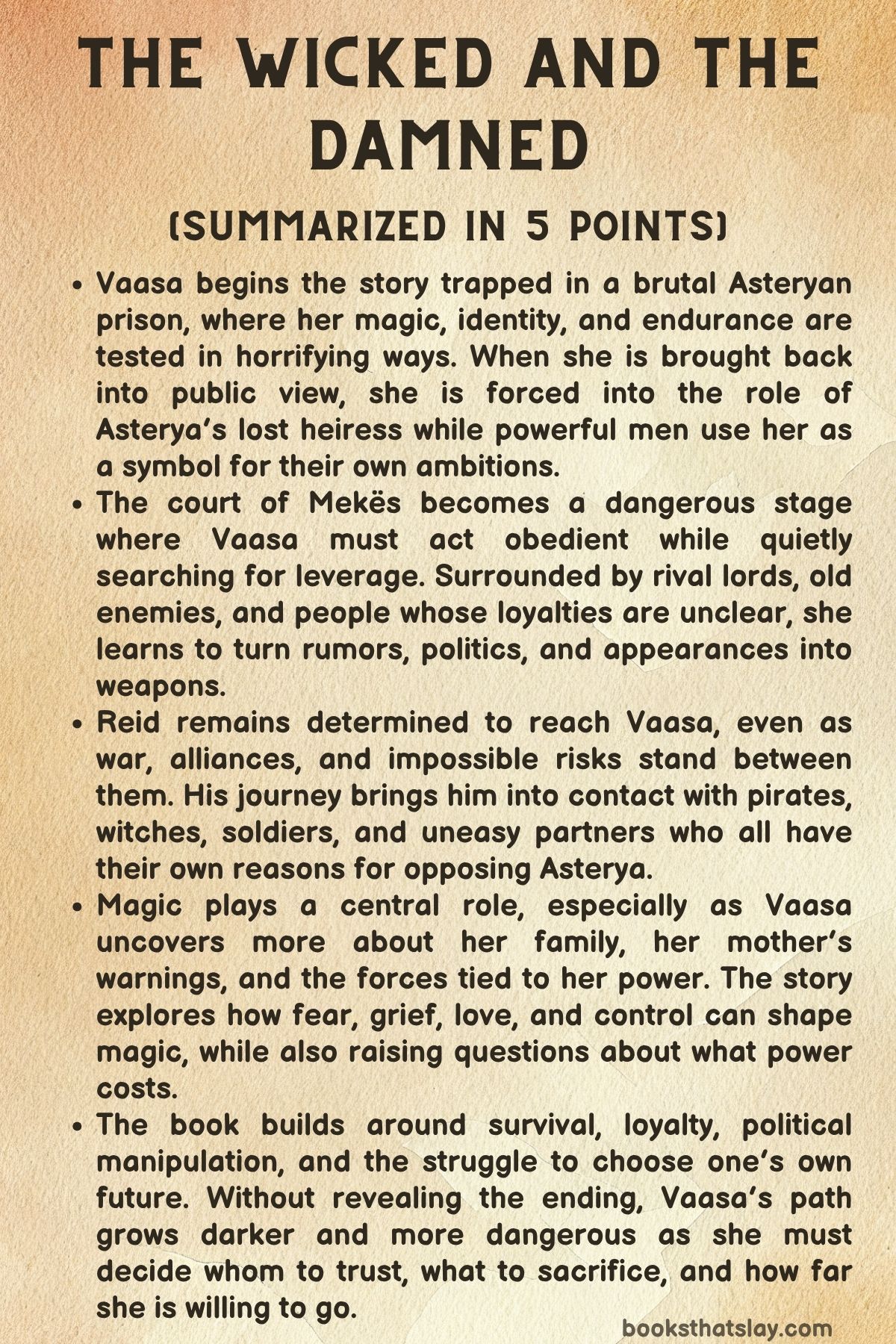
Summary
Vaasa has spent six weeks imprisoned in Mekës, locked in darkness and cold while Lord Vlacik and the Asteryan clergy torture her in the name of studying Veragi magic. They cut her, restrain her with iron, and test her body to learn where witch magic comes from and how it might be used as a weapon.
She survives by imagining Reid coming for her, but the fantasy always breaks when she wakes to pain and chains. Ozik, who now controls the bargain-linked connection to her power, lets the torture continue only until the agreed time ends.
Then he stops Vlacik and has Vaasa removed from the prison.
Ozik takes Vaasa from the island prison toward Mekës and treats her in public as Asterya’s future empress. In private, he rules her through threats.
When she steals his knife and cuts his cheek, he reveals that Amalie is also his prisoner. Amalie is brought out in chains, injured and weak.
Ozik threatens to kill her if Vaasa disobeys. Vaasa notices something strange in Amalie’s eyes before she is dragged away.
Ozik explains that Vaasa is alive because, as the last Kozár, she is Asterya’s legal heir. He intends to use her as a symbol while he holds the real power.
He also says her marriage to Reid has been dissolved and that she must choose a new husband from the gathered lords.
In Mekës, Ozik parades Vaasa before the city, clergy, and archbishop. Her injured body is used as false proof that Icruria abused her.
The archbishop cuts her palm, shows the crowd her red blood, and declares that she is not a witch and that her curse has been cleansed. The city accepts the lie that Ozik rescued her from Reid.
Vaasa is then placed in her dead parents’ rooms inside the Iron Fortress, where memories of her mother’s death haunt her.
Meanwhile, Reid leads Icrurian forces through northern Asterya. He attacks Innisjour to destroy the dam that caused famine in eastern Icruria and to gain support for a campaign against Mekës.
After the city surrenders, Lord Rezek gives Reid papers claiming his marriage to Vaasa is dissolved. Reid rejects them, learns that Vaasa is alive and supposedly seeking a husband, orders the dam destroyed, and kills Rezek.
At court, Vaasa is forced to play the obedient heir while Ozik manages the politics around her. He punishes her through their magical bond and warns her not to investigate their connection too deeply.
In her father Dominik’s study, Vaasa finds hidden records of experiments on witches, references to the Miro’dag called Zetyr, and a letter from her mother. The letter says Vaasa was left something to protect her from “him,” but warns her not to unite the pieces because the price is too high.
The object appears to be her mother’s necklace, made of iron links and a black stone like Ozik’s ring, but the necklace is missing.
Reid, Koen, and Melisina travel secretly toward Mekës, but pirates attack their vessel. The pirate captain, Sachia, is an Imros witch who controls metal.
She recognizes Reid and agrees to help him reach Iron Bay in exchange for an Icrurian pardon, asylum for her imprisoned brother, access to salt trade, and magical training from Melisina. Sachia later captures an Asteryan ship carrying black powder and learns it is linked to Vlacik and the pirate king Sutherland, whose betrayal led to her brother’s imprisonment.
Vaasa receives the lords who have come to compete for her hand. She studies the divide between Old Asteryans, represented by Vlacik, and New Asteryans, represented by Lord Karev.
She sees that the marriage contest can be used to turn them against each other. Karev is polished, ambitious, and useful.
Vlacik, who helped torture her, offers to protect her secret if she marries him, but she refuses. When he insults her publicly, she plays the injured victim and turns the room’s sympathy against him.
In the hallway, Vaasa sees Roman, the soldier she once loved and believed dead. Later, in her grandfather’s old wing, they speak privately.
Roman says he survived capture, escaped Icruria, returned after Dominik’s death, and was made her lead sentinel by Ozik. Vaasa suspects Ozik arranged his return to control her through memory and emotion.
Roman fears magic, and both of them hide the full truth from each other.
Ozik begins training Vaasa in Veragi magic. He says her power is fueled by emotion and has been feeding on her own fear.
He urges her to feed on the emotions of others instead. Vaasa briefly manifests a wolf and senses Ozik’s fear, but she rejects his method.
Ozik cuts her off from her power again and promises visits with Amalie only if she cooperates. Later, Vaasa feels Ozik using her magic elsewhere and glimpses a strange underground place with a red, living pool tied to death.
Vlacik is killed at The Lady Fortune after Reid reaches the city. Ozik is not troubled by the death because Vlacik knew too much.
Karev later blackmails Vaasa, saying he knows she was at the brothel and connected to Icrurians there. Vaasa lies that she was acting under Ozik’s orders to contact salt lords.
Karev uses the scandal and her rumored affair with Roman to force a marriage agreement, offering his army and an alibi in return.
Vaasa meets Reid, Koen, Sachia, and Karev in Sachia’s basement shop. Karev believes Koen is an Icrurian salt lord and Reid is his guard.
They negotiate a smuggling plan involving salt, pirates, soldiers, and land. Vaasa suggests that her engagement celebration could pull guards away from the prison, creating a chance to free Amalie and Sachia’s brother.
Karev agrees, and he and Vaasa announce their engagement. Vaasa and Reid later meet in secret, where he admits he killed Vlacik.
Their bond remains strong, though danger forces them apart again.
Sachia brings Melisina to Vaasa disguised as a seamstress. Vaasa tells Melisina about Ozik’s bargain, her father’s notes, her mother’s warning, and the missing necklace.
Melisina suggests Vaasa may be drawing on Ozik’s magic just as he draws on hers. They search Vaasa’s mother’s rooms but find nothing.
Vaasa plans to use Roman’s promise to take her to Amalie as a way to map the prison route for the rescue.
During the public execution of the supposed Wolf of Mireh, Vaasa rides beside Karev through cheering crowds. At the Sanctum, Ozik presents them as Asterya’s future rulers.
From the Emperor’s Suite, Vaasa sees that the prisoner below is Koen, not Reid. When Karev boasts that he saved her from herself, she reveals that he has misjudged everything.
Explosions tear through the Sanctum. Vaasa releases her magic, summons a black wolf, and kills Karev.
She then tricks Roman, steals his keys, locks him in a tunnel, and escapes.
In the square, Reid, disguised as the executioner, reaches Koen while Sachia breaks his chains. Vaasa is seized by a guard and, overwhelmed by rage and fear, unleashes destructive magic across the crowd and soldiers.
Reid reaches her inside the storm and asks her to let it go. She pulls the magic back and flees with him and Sachia.
They enter the prison and find Sachia’s brother Micha dead, likely murdered by Karev. Sachia is devastated and kills the guards who arrive.
Vaasa and Reid free Amalie, but Amalie’s body is possessed by the goddess Veragi. The group escapes toward the bridge, where Zetyr appears in Ozik’s body with Roman kneeling before him.
The Miro’dag traps them from behind.
Veragi fights Zetyr, and Vaasa understands that Ozik’s ring is one of the anchors linked to him. When the Miro’dag threatens Reid, Vaasa chooses Reid over the ring and throws him her mother’s necklace for protection.
Her magic fully returns and joins with Ozik’s power. She summons a huge wolf of magic that drives the Miro’dag away.
Reid and Vaasa jump into the freezing sea and are rescued by Sachia’s crew. As Asteryan ships pursue them, Vaasa, Melisina, and Sachia combine their magic to bring down an iron tower and block the Loursevain Gap.
Aboard the Red Corsair, Vaasa rests with Reid but still senses Ozik through their bond. She realizes she left the ring behind on purpose, unwilling to pay the unknown price of reuniting the anchors.
In the end, Ozik is trapped inside his own mind while Zetyr controls his body. Zetyr orders Roman and Sutherland to recover the necklace and ring.
Ozik manages to warn Roman to remember their bargain: Roman must keep Vaasa alive, or die himself.
Characters
Vaasa Kozár
Vaasa is the emotional and political center of The Wicked and the Damned, and her character is built around survival, control, trauma, and the dangerous return of power. At the beginning, she is physically broken by imprisonment, torture, iron restraints, and magical experimentation, yet she does not become passive.
Her mind keeps reaching for Reid as a symbol of hope, but the story repeatedly forces her to face the fact that rescue alone cannot save her. What makes Vaasa compelling is that she learns to survive in places where direct resistance would get her or someone she loves killed.
In Mekës, she is forced to become a public symbol for Asterya while privately remaining a prisoner, and she quickly understands that performance can be a weapon. She smiles, dances, lies, lowers her eyes when needed, and allows others to underestimate her, not because she is weak, but because she understands how power works in rooms full of ambitious men.
Vaasa’s inner conflict comes from the fear that Asterya, Ozik, and her own family history may have shaped her into something monstrous. Her Veragi magic responds to emotion, especially fear, rage, grief, and love, which means her power is inseparable from her wounds.
Ozik tries to teach her to feed on others’ emotions, turning pain into domination, but Vaasa resists becoming his reflection. Still, she is not morally simple.
She manipulates Roman’s feelings, uses Karev’s ambition, and eventually kills with terrifying force. Her violence in the square shows how much rage has been buried inside her, and the book does not present that rage as clean or heroic.
Instead, it reveals the cost of being hunted, experimented on, and treated as a throne rather than a person. Vaasa’s greatest strength is that even when she is tempted by destruction, she continues to choose love and loyalty at crucial moments, especially when she chooses Reid over the ring and refuses to pay an unknown price for power she does not fully understand.
Reid
Reid is defined by loyalty, grief, and relentless devotion to Vaasa. His role in the book is not simply that of a rescuer, because his rescue mission is tied to military strategy, political rebellion, and personal desperation.
In Icruria and Asterya alike, he carries the reputation of the Wolf of Mireh, and the title reflects both his danger and his protectiveness. His attack on Innisjour shows that he is capable of ruthless action when he believes it serves a larger cause, especially when destroying the dam becomes a way to answer Asterya’s cruelty toward Icruria.
He is not a gentle figure placed in a violent world; he is a violent figure trying to direct that violence toward justice and toward the woman he refuses to abandon.
Reid’s love for Vaasa is one of his defining qualities, but it is complicated by possessiveness, rage, and the political consequences of their relationship. When he learns their marriage has been dissolved, he rejects the decree emotionally and morally, treating it as meaningless because his bond with Vaasa is not something Asterya can erase.
His killing of Vlacik reveals how personally he takes Vaasa’s suffering and how quickly justice can become vengeance in him. Yet Reid’s most important moments are not only violent.
When Vaasa loses control in the square, he reaches her not by overpowering her but by asking her to let go and come back to herself. That moment shows that Reid understands her not as a weapon or a curse, but as a person in pain.
His strength lies in the fact that he fights for Vaasa’s freedom while also serving as one of the few people who can call her back from becoming consumed by her own magic.
Ozik
Ozik is one of the most complex figures in the story because he is both captor and protector, villain and victim, manipulator and man bound by an older promise. For much of the book, he appears to be the main force controlling Vaasa’s life.
He uses Amalie as leverage, parades Vaasa before the city, forces her into court politics, controls her access to magic, and physically punishes her through their bond. His treatment of Vaasa is cruel, calculated, and deeply invasive.
He understands that power is most effective when it controls not only the body but also the choices a person believes are available to them. By threatening Amalie and shaping public opinion, Ozik traps Vaasa in a role where every act of defiance risks someone else’s life.
At the same time, Ozik is not driven only by ordinary ambition. His bond with Zetyr and his past promise to Vena Kozár complicate his motives.
He keeps Vaasa alive not because he is merciful, but because he is bound by a bargain and by history. The epilogue reveals that he is also imprisoned, trapped inside his own mind while Zetyr uses his body.
This does not erase the harm he causes, but it gives his character tragic depth. Ozik’s cruelty often feels like the behavior of someone who has learned to survive through control, bargains, and manipulation.
His warning to Roman shows that some part of him still fights against Zetyr, even when nearly defeated. In the book, Ozik becomes a frightening example of what happens when protection becomes possession and when survival requires serving something far darker than oneself.
Zetyr
Zetyr is the deeper supernatural threat behind much of the political and magical conflict. While Ozik controls Vaasa for much of the story, Zetyr represents an older and more terrifying form of domination.
He is connected to the black stone anchors, the ring, the necklace, the Miro’dag, and the living darkness that surrounds the story’s magic. Unlike the human characters, who are shaped by trauma, ambition, love, and fear, Zetyr feels more absolute in his hunger for control.
His presence turns the struggle for Asterya from a political conflict into a spiritual and magical war.
Zetyr’s possession of Ozik’s body makes him especially unsettling because he does not need to stand openly in power to influence events. He works through bonds, bargains, objects, and bodies, reducing people to vessels or tools.
His appearance at the bridge, with Roman kneeling before him and the Miro’dag closing in, makes clear that the escape from Asterya is not the end of the conflict but the opening of something larger. Zetyr is dangerous because he understands the value of patience and possession.
He does not merely want a throne; he wants the anchors, the magic, and the people tied to them. His control over Ozik also suggests that anyone who bargains with ancient power may eventually lose the right to own their own mind.
Roman
Roman is a painful and morally uncertain character because he returns to Vaasa as both comfort and threat. He represents her past, the life she might have had, and the emotional vulnerability Ozik can exploit.
When Vaasa sees him again, the shock is powerful because he was someone she loved and believed dead. Their reunion carries tenderness, memory, and longing, but it is immediately shadowed by suspicion.
Roman has been placed near her by Ozik, and even when he claims to care for her, his presence serves Asterya’s control over her. This makes every interaction between them emotionally unstable.
Roman’s fear of magic is central to his character. He cares for Vaasa, but he does not fully understand or accept what she has become.
His jealousy of Reid and his desire to reclaim a place in Vaasa’s life make him vulnerable to manipulation, both by Vaasa and by more powerful forces. Vaasa uses his feelings to reach Amalie and gather information, while Ozik and Zetyr use his loyalty and bargain to bind him to their plans.
Roman is not purely villainous, but he is weak in ways that make him dangerous. He wants to protect Vaasa, yet often tries to direct her choices.
His final position beside Zetyr shows that his love has become entangled with obedience, fear, and bargain-bound survival. Roman’s tragedy is that he remembers loving Vaasa, but he no longer knows how to love her without trying to possess or control the situation around her.
Amalie
Amalie is one of the emotional anchors of the book and one of Vaasa’s strongest reasons to keep obeying when resistance seems impossible. Her imprisonment gives Ozik leverage, but Amalie herself is never merely a hostage.
Even weakened, chained, and bruised, she remains spiritually and emotionally resilient. Her bond with Vaasa is built on trust, honesty, and the kind of loyalty that survives fear.
When Vaasa is finally able to tell Amalie the truth about Reid, Koen, Melisina, Roman, Ozik, and the darkness inside herself, the confession steadies her. Amalie becomes the person before whom Vaasa does not have to perform.
Amalie’s connection to Veragi also makes her important beyond her emotional role. Her body becomes the vessel through which Veragi appears, turning her from captive into a terrifying supernatural force during the prison escape.
This possession complicates her vulnerability because it shows that even those who seem powerless may be tied to immense divine power. Yet Amalie’s importance remains deeply personal.
She represents the human cost of Ozik’s control and the reason Vaasa cannot simply burn everything down without consequence. Through Amalie, the story keeps returning to the question of what people will endure for those they love.
Lord Karev
Lord Karev is ambitious, polished, opportunistic, and politically intelligent. He enters the story as a representative of the New Asteryans, which immediately positions him against older powers like Vlacik.
Unlike Vlacik, who is openly cruel and threatening, Karev is charming enough to seem useful. He flatters Vaasa, offers information, presents himself as modern and practical, and recognizes that marriage to her could make him emperor.
His danger lies in the fact that he understands politics as negotiation, blackmail, and image-making. He does not need to torture Vaasa to threaten her; he can trap her with scandal, alibis, military support, and public expectation.
Karev’s flaw is the same one Vaasa identifies before she kills him: confidence. He believes he has read Vaasa correctly.
He thinks she is trapped by circumstance, reputation, and the need for allies. He assumes he can save her from herself while using her for power, which makes him resemble Dominik in his arrogance.
His death is brutal and symbolic. Vaasa’s wolf manifestation tearing out his throat is not only an act of revenge but also a rejection of yet another man who believes he can define her future.
Karev is important because he shows that even a seemingly progressive political faction can still be built on control, entitlement, and hunger for power.
Lord Vlacik
Lord Vlacik is one of the most openly repulsive figures in the story. He is tied to the Asteryan clergy, Dominik’s magical studies, and the torture of witches, including Vaasa.
His presence carries the horror of institutional cruelty. He does not merely harm people out of personal hatred; he participates in systems that turn bodies into research, faith into justification, and magic into something to be extracted.
His connection to The Lady Fortune, pirate dealings, and secret schemes shows that his public authority is supported by corruption and hidden violence.
Vlacik’s interactions with Vaasa reveal his cruelty and arrogance. He threatens her through Amalie, implies he could help hide her magic if she married him, and publicly insults her as ruined by Icruria.
He underestimates Vaasa’s ability to turn humiliation into strategy. When she appears wounded and meek, she uses the room’s sympathy against him, showing that he understands fear but not performance.
His death at Reid’s hands feels like personal vengeance, but Sachia’s involvement in disposing of his body also ties him to wider networks of betrayal and exploitation. Vlacik represents old Asterya at its worst: brutal, hypocritical, superstitious, and corrupt beneath its noble and religious language.
Dominik Kozár
Dominik is dead during the events described, but his influence remains everywhere. As Vaasa’s brother and former ruler, he represents the family legacy she is trying to understand and escape.
His hidden journal, coded files, magical experiments, and dealings with smugglers reveal that he was deeply involved in dangerous attempts to study, contain, and manifest witch magic. He was not simply a political ruler; he was a man willing to turn suffering into knowledge and knowledge into power.
His work with the Vlaciks and clergy shows that the cruelty inflicted on Vaasa has roots in her own family’s rule.
Dominik’s importance lies in how much he haunts Vaasa’s understanding of herself. When she discovers his research, she is forced to confront the possibility that her family was not merely victimized by history but helped build the horrors now surrounding her.
Karev’s similarity to Dominik is also significant. Both men are confident, strategic, and certain that they can control forces larger than themselves.
Dominik’s legacy is one of ambition without moral restraint. He becomes a warning about what Vaasa could become if she allows pain, power, and fear to justify every choice.
Vena Kozár
Vena Kozár, Vaasa’s mother, is a haunting presence in the book. Though she is not physically active in the main events, her memory shapes Vaasa’s terror, grief, and search for answers.
Her room is so emotionally charged that Vaasa cannot enter it at first, which shows how deeply her death and legacy still wound her daughter. Vena’s letter reveals tenderness and fear.
She left Vaasa something meant to protect her, but also warned her not to unite the other pieces because the price would be too great. This makes Vena both a mother trying to save her child and a woman who knew more about the magical danger than Vaasa initially understands.
Vena’s necklace becomes one of the story’s most important objects because it connects maternal protection, ancient power, and the anchors binding Zetyr. Her relationship with Ozik also complicates the past, especially because Ozik promised to keep Vaasa alive.
That promise suggests Vena acted in desperation, perhaps bargaining with dangerous forces to protect her daughter. Vena’s character is defined by absence, but that absence is powerful.
She left behind warnings, protection, trauma, and unanswered questions, all of which continue to shape Vaasa’s choices.
Koen
Koen is a loyal ally whose presence helps connect Reid’s rescue mission with the larger political and military strategy against Asterya. He travels with Reid and Melisina toward Mekës, takes part in the dangerous alliance with Sachia, and later plays the role of the supposed Icrurian salt lord during negotiations with Karev.
His ability to participate in deception shows that he is not merely a soldier or companion; he understands the importance of disguise, timing, and political theater.
Koen’s most dramatic role comes when he is used in the execution scene as the supposed Wolf of Mireh. His body becomes part of the plan’s misdirection, placing him in extreme danger so Reid can move through the square disguised as the executioner.
Koen’s willingness to endure that risk reveals courage and trust. He may not dominate the emotional landscape the way Vaasa, Reid, or Roman do, but he is essential to the rescue effort.
His character represents the kind of loyalty that works quietly inside dangerous plans, accepting pain and risk so others can act.
Melisina
Melisina is a figure of magical knowledge, emotional loyalty, and practical support. She travels with Reid and Koen, uses Veragi magic with deadly force when needed, and later reaches Vaasa disguised as a seamstress.
Her reunion with Vaasa is emotionally important because she is one of the few people Vaasa can speak to openly about the bargain, the notebook, the necklace, and the possibility that Ozik’s magic can be drawn through their connection. Melisina helps Vaasa think through the magical logic of her situation rather than simply reacting to fear.
Melisina’s strength is calm intelligence. She does not only fight; she interprets.
She understands that magic has rules, costs, and loopholes, and she helps Vaasa consider possibilities Ozik has hidden from her. During the escape, Melisina also joins Vaasa and Sachia in using magic to bring down the iron tower and block pursuit.
That moment places her inside a powerful trio of women whose different forms of magic work together against Asterya’s military force. Melisina’s role in the story is to remind Vaasa that magic does not have to be only a curse or a weapon of domination.
It can also be knowledge, solidarity, and survival.
Sachia
Sachia is one of the most vivid supporting characters in the book. As captain of The Red Corsair, an Imros witch, and a pirate with the ability to control metal, she brings danger, independence, and sharp bargaining power into the story.
She is not intimidated by Reid’s reputation as the Wolf of Mireh, and she immediately forces him to negotiate rather than command. Her demands are practical and personal: a pardon, asylum for her brother, access to salt trade, magical training, and help freeing Micha.
Sachia’s character is built around hard-earned mistrust. She helps Reid and Vaasa not because she is sentimental, but because their goals can serve her own.
At the same time, Sachia is not cold. Her love for Micha gives her character emotional depth, and his death in the prison devastates her.
Her grief turns instantly into lethal action when she kills guards with metal torn from the bars, showing how closely her magic is tied to rage and loss. Sachia also reveals that she pushed Vlacik’s body from the window after Reid killed him, which shows her willingness to act decisively and dirty her hands.
By the end, she is one of the key forces enabling the escape, and her magic helps bring down the iron tower. Sachia represents freedom outside the laws of empires, but that freedom has been shaped by betrayal, loss, and survival at sea.
Micha
Micha appears mainly through Sachia’s love and the rescue mission built around him, but his role is still important. As Sachia’s imprisoned brother, he gives her a personal reason to enter the dangerous alliance with Reid and Vaasa.
His captivity in Mekës shows the reach of Asteryan punishment and the way political and criminal networks overlap through figures like Vlacik and Sutherland. Micha is not simply a missing family member; he is evidence of the betrayals that have shaped Sachia’s life.
His death in the prison is devastating because it turns hope into grief at the exact moment the rescue seems possible. The discovery that he is already dead, likely murdered by Karev, exposes the cruelty and cowardice of Asteryan power.
Micha’s death also changes Sachia’s emotional state during the escape, turning her from a controlled negotiator into someone acting through shock and rage. Though he has limited direct presence, Micha’s character matters because his absence creates consequences.
He is the lost person whose death proves that not every rescue comes in time.
Veragi
Veragi functions as both divine force and magical source, connected especially to Vaasa, Amalie, and Melisina. Veragi’s magic is emotional, intimate, and dangerous, shaped by sentiment rather than cold calculation.
This makes it powerful but unstable, especially in Vaasa, whose trauma gives the magic so much pain to feed from. Through Ozik’s explanations and Vaasa’s experiences, Veragi magic becomes one of the central ways the story explores emotion as power.
Fear, love, rage, grief, and desire are not abstract feelings here; they can become wolves, storms, death, and survival.
When Veragi possesses Amalie, the goddess becomes physically present in the conflict. This moment transforms the prison escape from a human rescue into a clash between divine powers.
Veragi battles Zetyr and restrains him, making clear that the gods and ancient forces are not distant mythology but active players in the story’s violence. Veragi is not soft or purely benevolent.
Her power kills, possesses, and overwhelms. Yet she also stands against Zetyr, and her connection to Amalie suggests patience, timing, and hidden protection.
In the book, Veragi represents the terrifying possibility that salvation and destruction may come from the same source.
The Miro’dag
The Miro’dag is a monstrous supernatural presence tied to Zetyr and the darker magical mythology of the story. It is less a human character than a manifestation of ancient threat, but it still functions as an active force in the plot.
Its appearance on the bridge turns the escape into a trap, placing Vaasa, Reid, and the others between the creature and Zetyr. The Miro’dag’s danger lies in how it combines physical terror with symbolic meaning.
It represents the cost of powers and bargains that the human characters only partially understand.
Vaasa’s confrontation with the Miro’dag is one of the clearest demonstrations of her full magical strength. When the creature threatens Reid, she chooses him over the ring and throws him her mother’s necklace to protect him.
Her power then returns fully and joins with Ozik’s, allowing her wolf manifestation to force the Miro’dag away. This moment is crucial because the monster draws out Vaasa’s deepest priorities.
She does not choose victory through the anchors; she chooses the person she loves. The Miro’dag therefore reveals both the scale of the supernatural conflict and the emotional truth at the center of Vaasa’s choices.
Lord Rezek
Lord Rezek is a smaller but significant representative of Asteryan authority. His role in Innisjour connects political paperwork, military defeat, and Reid’s personal fury.
When he gives Reid the documents declaring the dissolution of his marriage to Vaasa, he becomes the messenger of Asterya’s attempt to erase Reid’s bond with her. The papers themselves are politically meaningful, but Reid treats them as morally meaningless.
Rezek’s death shows how little patience Reid has for Asteryan legitimacy when it is used to justify cruelty or control.
Rezek also matters because his city and dam connect Asterya’s internal infrastructure to Icruria’s suffering. The destruction of the dam is not only a military move but an answer to famine and drought caused by Asteryan policy.
Rezek therefore stands at the intersection of administrative violence and battlefield consequence. He is not explored with great emotional depth, but his presence allows the story to show that oppression is not maintained only by villains like Ozik or Vlacik.
It is also maintained by lords, papers, cities, and systems that make suffering appear lawful.
Captain Sutherland
Captain Sutherland is a shadowy but important figure tied to piracy, betrayal, and Zetyr’s future plans. He is connected to the betrayal that led to Micha’s imprisonment, which makes him personally significant to Sachia’s storyline.
His association with Vlacik’s dealings also shows how Asteryan power extends through criminals, smugglers, mercenaries, and pirates. Sutherland helps reveal that the empire’s corruption is not limited to court politics; it reaches into maritime violence and underground trade.
By the epilogue, Sutherland’s importance increases because Zetyr orders him and Roman to retrieve the necklace and ring. This places him within the next stage of the supernatural conflict.
He is not merely a pirate king from Sachia’s past but a potential agent in Zetyr’s attempt to regain the anchors. His character represents betrayal made useful by darker powers.
Where Sachia uses piracy as independence, Sutherland seems tied to treachery, opportunism, and service to whoever can give him advantage.
Themes
Survival Under Control
Vaasa’s struggle is not only about staying alive; it is about preserving the part of herself that torture, captivity, and political manipulation are meant to erase. Her imprisonment turns her body into a site of study and punishment, while Ozik turns her identity into a tool for power.
The cruelty she faces is systematic: iron restraints, public lies, forced obedience, and the constant threat to Amalie. Yet survival here is not shown as clean or heroic.
Vaasa survives by calculating, lying, performing weakness, and using the desires of others against them. Her strength lies in adapting without surrendering completely.
Even when she is forced into the role of future empress, she keeps searching for information, allies, and openings. In The Wicked and the Damned, survival becomes an act of resistance because Vaasa refuses to let those who control her define the meaning of her pain, her magic, or her future.
Power, Fear, and Manipulation
Power in the story often depends less on rightful authority and more on fear, spectacle, and control over information. Ozik controls Vaasa through the magical bargain, but he also controls public belief by turning her suffering into propaganda.
The crowd is made to see her as rescued, cleansed, and legitimate, even though the truth is the opposite. Karev, Vlacik, Roman, and the clergy all try to use her position for their own advantage, showing that political power is built through pressure as much as loyalty.
Vaasa learns to survive inside this world by becoming a manipulator herself. She encourages rivalry between factions, pretends to be harmless, uses scandal when it protects her, and turns men’s confidence into weakness.
The theme becomes morally complex because manipulation is both the weapon used against her and one of the few tools she can use in return. Power is shown as dangerous not only when it is violent, but when it convinces people to accept lies as truth.
Love as Weakness and Strength
Love repeatedly places Vaasa in danger, yet it is also what keeps her human. Ozik understands this clearly, which is why Amalie becomes his strongest weapon against her.
Roman’s return complicates love further because affection is mixed with suspicion, jealousy, and political usefulness. Vaasa cannot fully trust him, but she also cannot dismiss the emotional history between them.
Reid represents a different kind of love: one rooted in loyalty, recognition, and shared defiance. His refusal to accept the dissolved marriage shows that their bond cannot be undone by legal or religious performance.
Still, Vaasa’s love for Reid is not simple safety. She risks strategy for him, chooses him over the ring, and lets emotion guide decisions that may have lasting consequences.
The story treats love as both vulnerability and power. It can be exploited, but it also gives Vaasa something stronger than fear: a reason to resist becoming the ruthless figure her enemies expect her to become.
Identity, Magic, and Inheritance
Vaasa’s identity is shaped by forces she did not choose: her Kozár bloodline, her mother’s curse, her father’s experiments, Asterya’s need for an heir, and the gods’ struggle for control. Her magic is not just an ability; it carries family history, trauma, and political consequence.
Dominik’s research reveals how violently Asterya has tried to understand and own witch power, turning magic into a resource to be contained, copied, or weaponized. Vaasa’s search for her mother’s necklace becomes a search for protection, but also for truth about what was left to her and what price that inheritance demands.
In The Wicked and the Damned, magic is closely tied to emotion, especially fear, grief, rage, and love. Vaasa’s challenge is not simply to use her power, but to decide what kind of person she will become while using it.
Her final choice to delay reuniting the anchors shows her refusal to accept an inherited destiny without understanding its cost.