The Museum Of Lost Dreams Summary, Characters and Themes
The Museum Of Lost Dreams by Christine Nolfi is a multigenerational family novel about inherited pain, hidden relationships, guilt, and the possibility of rebuilding a damaged family. The story centers on Bess Rollins, who returns to her childhood home after the sudden deaths of her parents and becomes responsible for her younger siblings.
Her return forces her to reconsider the people she once loved, blamed, or idealized. Moving between Bess’s present and Valerie Van Horn’s past, the novel gradually uncovers the secret relationship that shaped several generations while showing how understanding the past can change what a family chooses to create in the future.
Summary
In 1962, Davi “Dove” Appelbaum discovers private writings and photographs after the death of her sister-in-law, Chava. The material confirms what she has long known about her beloved brother Julius: before his marriage, he had been deeply in love with mathematician and computer scientist Valerie Van Horn, and his feelings for Valerie never fully disappeared.
Dove learns that the cottage where she and Julius spend time near Seneca Lake was purchased partly because Valerie lived nearby in the enormous Tudor estate that local residents call the museum. Curious about the family Julius was forced to leave behind, Dove secretly visits the property and notices a small girl named Bess being neglected by the adults around her.
More than two decades later, twenty-seven-year-old Bess Rollins is working in the Philippines for the Green Seed Foundation. She has built a life devoted to helping impoverished communities, far from Seneca Lake and the painful family history she left behind.
Her independence ends abruptly when Raisa Grün, the longtime housekeeper who helped raise her, informs her that her parents, Shayla and Whit, have died in Brazil after their vehicle was caught in a mudslide. Their deaths make Bess the legal guardian of her fourteen-year-old siblings, twins Casey and Caleb.
Returning home means confronting much more than bereavement. Bess must face Casey’s anger, Caleb’s traumatic brain injury, her complicated feelings toward her parents, and Luke, the man she once loved but abandoned when she fled overseas.
The roots of Bess’s guilt lie three years earlier. At twenty-four, she had already taken on much of the responsibility for raising the twins because Shayla and Whit were unreliable parents whose drug use and chaotic lifestyle regularly placed their children in difficult situations.
Caleb was exceptionally intelligent but increasingly rebellious. During a violent storm, after Bess postponed a promised boating trip, he defiantly took the family powerboat onto Seneca Lake, forcing Bess to climb aboard in an attempt to stop him.
The boat crashed near the shore. Bess survived with injuries, but Caleb suffered a severe head injury that permanently affected his memory and cognitive functioning.
Unable to bear what happened, Bess eventually left the country. She believed distance would allow her to survive the guilt, but her departure created new wounds within the family, particularly for Casey.
When Bess returns after her parents’ deaths, the home she inherited feels both familiar and hostile. The Tudor mansion is filled with the awards and accomplishments of her late grandmother, Valerie Van Horn, whose achievements turned the house into what people called the museum.
Casey makes it clear that she resents Bess’s return. She has changed dramatically during Bess’s absence, withdrawing from healthier friendships, experimenting with marijuana, skipping school, overeating, and expressing much of her grief through anger.
Caleb has changed even more profoundly. His brain injury has left him with serious difficulty retaining new memories, and he sometimes cannot remember who Bess is even after she tells him that she is his older sister.
Luke has remained close to Caleb throughout Bess’s absence. He arranged work for him at a garage, supports his education, understands his neurological limitations, and has become one of the people Caleb trusts most deeply.
Seeing Luke again forces Bess to face the relationship she abandoned. Their love is still present, but Luke is angry that she left without properly facing what had happened, while Bess remains defensive about many of the beliefs she carries concerning her family.
The greatest disagreement between them concerns Valerie. Bess remembers her grandmother as the person who loved and protected her when Shayla and Whit made her feel unwanted, but Luke suggests that Valerie’s favoritism may have contributed to the conflict between Bess and her mother.
Valerie’s own history reveals why the family became divided. Born to working-class parents, she displayed extraordinary mathematical ability from childhood, receiving encouragement from her mother, Agata, even when her father initially failed to appreciate the value of his daughter’s intelligence.
Valerie became determined to build a career at a time when women faced severe limitations in academia and science. She viewed marriage as a possible threat to her independence and believed professional achievement required sacrifices that men were rarely asked to make.
Her mother’s death deepened Valerie’s emotional isolation. Agata had spent years working for the wealthy Johnstone family, where she endured the arrogance of Selvia Johnstone and lived under the threat created by Selvia’s predatory husband, Edmund.
Valerie eventually became an important figure in mathematics and the developing computer industry. Yet professional success could not protect her from a devastating romantic experience.
In the 1930s, while temporarily working in Manhattan, Valerie met Julius Appelbaum after he saved her from stepping in front of a taxi during a snowstorm. Julius was younger than Valerie, wealthy, interested in architecture, and burdened by family expectations of his own.
Their relationship developed quickly because each understood the other’s desire for independence. Julius and Valerie fell deeply in love, purchased the Seneca Lake estate together, and imagined filling their “museum of dreams” with Valerie’s professional accomplishments and the family they expected to build there.
Julius, however, belonged to a family determined to arrange his marriage to Chava, the daughter of his father’s business partner. Chava’s emotional instability and a suicide attempt increased the pressure on Julius, while his father threatened to destroy Valerie’s career if Julius refused the marriage.
Believing he could protect Valerie only by allowing her to think he had betrayed her, Julius left without explaining the truth. Valerie was pregnant when their relationship ended and interpreted his disappearance as proof that she had trusted the wrong man.
Their daughter, Shayla, was born into secrecy. Because an unmarried pregnancy could have destroyed Valerie’s career, Valerie publicly claimed that she had adopted the child.
As Shayla grew older, Valerie became emotionally distant. Shayla resembled Julius strongly, and her appearance continually reminded Valerie of the man she believed had abandoned her.
Raisa increasingly took responsibility for raising Shayla while Valerie devoted herself to work. When twelve-year-old Shayla confronted her mother after being mocked about her parentage, Valerie finally admitted that Shayla was her biological daughter but refused to identify Julius.
The revelation did not repair their relationship. Shayla concluded that her mother could not love her because she looked like the father Valerie hated, and the resentment remained with her into adulthood.
When Bess was born, Valerie behaved very differently. Bess physically resembled Valerie and displayed intellectual qualities that Valerie recognized and admired, causing grandmother and granddaughter to form an exceptionally close bond.
Valerie eventually arranged for Bess to inherit almost her entire fortune while leaving Shayla a controlled allowance. Raisa warned Valerie that this decision would intensify Shayla’s resentment and place Bess in the middle of a conflict she had not created, but Valerie refused to change the arrangement.
Back in 1986, Bess slowly begins questioning the simple story she has always told herself about her childhood. She had considered Valerie loving and Shayla cruel, but she gradually recognizes that both women were carrying injuries created long before she understood them.
Bess also begins rebuilding her relationships with the twins. She notices Casey’s remarkable tenderness toward Caleb, including the memory cards she prepares for him and the small surprises she hides for him to find.
A confrontation near the lake helps Bess understand that Casey does not simply blame her for Caleb’s accident. Casey has her own memories of their brother’s recklessness and resents Bess for assuming every emotion in the family must somehow be connected to Bess’s guilt.
Raisa later reveals that Casey ran away on the night Bess left for Africa and remained missing for four days. The combination of Caleb’s accident, Bess’s departure, parental instability, and years of emotional neglect contributed to Casey’s withdrawal and unhealthy relationship with food.
Bess begins recognizing that guilt has controlled her life for years. Rather than helping the people she loves, her constant self-blame has often prevented her from seeing their experiences clearly.
Her relationship with Luke also begins to recover. After several difficult conversations, both acknowledge that they never stopped loving one another, but Bess wants to establish a stable home and professional direction before fully rebuilding their romance.
Inspired partly by Caleb’s experiences, Bess develops the idea of using Valerie’s vast inheritance to establish a summer camp and charitable organization for children with disabilities. She imagines a place where disabled and nondisabled children can spend time together while receiving appropriate educational, medical, and social support.
Casey becomes involved in the project, allowing the sisters to begin building a different kind of relationship. Bess no longer tries to replace their mother, while Casey gradually allows Bess to become her sister again.
The family’s hidden history takes a major turn when Bess and Casey clear Valerie’s old office and discover a concealed compartment inside a wall safe. It contains photographs of Valerie with a young man and a letter signed only with the initial “J.”
The photographs reveal that the mysterious man looked remarkably like Shayla. Research identifies him as Julius Appelbaum, while the letter shows that he loved Valerie and their unborn child rather than simply abandoning them.
Bess begins to understand the pattern that damaged the family. Valerie looked at Shayla and saw Julius, while Shayla later looked at Bess and saw Valerie; in both cases, unresolved pain was transferred onto a younger generation.
At the same time, Bess becomes increasingly determined to make the summer camp a reality. After failing to receive a response from philanthropist Ellen Powers-Murray, she drives to Manhattan and boldly enters Ellen’s office to present the proposal in person.
Ellen remembers Bess from her earlier charitable work and becomes impressed by both the project and Bess’s willingness to donate hundreds of acres of valuable land. Her foundation ultimately commits major financial support, transforming the camp from an ambitious plan into a realistic long-term institution.
The mystery surrounding Julius is resolved unexpectedly through Raisa. When she hears Bess and Luke discussing him, Raisa recognizes the surname because she knows Davi Appelbaum.
Bess and Luke visit Davi, who explains the circumstances that separated Julius and Valerie. Julius had wanted to marry Valerie, had helped purchase the estate, and had expected to raise their child there, but family pressure and threats against Valerie’s career forced him into marriage with Chava.
After Chava’s death, Davi discovered the truth about Shayla and Bess. Julius considered approaching the family several times but remained at a distance because circumstances were always unstable and because Valerie had explicitly ordered him to stay away.
Most importantly, Julius is still alive. Davi takes Bess to his cottage, where she discovers that he has quietly followed the family’s lives for years and kept photographs that allowed him to remain connected from afar.
Bess chooses not to judge him solely by the decisions of the past. Instead, she allows Julius and Davi to enter the family, giving Casey and Caleb the chance to know relatives whose existence had been hidden from them.
Julius and Davi immediately demonstrate their commitment through action. They research Caleb’s brain injury, create memory aids for him, and prepare carefully for the possibility that building a relationship with him will require patience.
Their arrival also strengthens the new charity. Julius can use his architectural experience in designing the camp, while Davi brings years of research and practical knowledge concerning brain injuries.
By the following spring, the family has changed dramatically. The camp is nearly ready to open, with cabins, activity spaces, a cafeteria, an infirmary, and other facilities designed to create a supportive community.
Casey has developed close relationships with Julius and Davi, Caleb continues forming a bond with his grandfather, Raisa plans to teach cooking, and Luke has become an important part of the organization. The estate that once preserved Valerie’s accomplishments is now being used to improve the lives of children and families.
Bess has also rebuilt her personal future. Luke proposes, she accepts, and the two begin preparing for marriage while planning to work together at the charity.
The final revelation that Bess is pregnant completes the novel’s movement from inherited loss toward renewal. The museum once represented ambitions destroyed by secrecy and family pressure, but Bess transforms its meaning by building a place where love, inclusion, responsibility, and new possibilities can replace the damage inherited from previous generations.
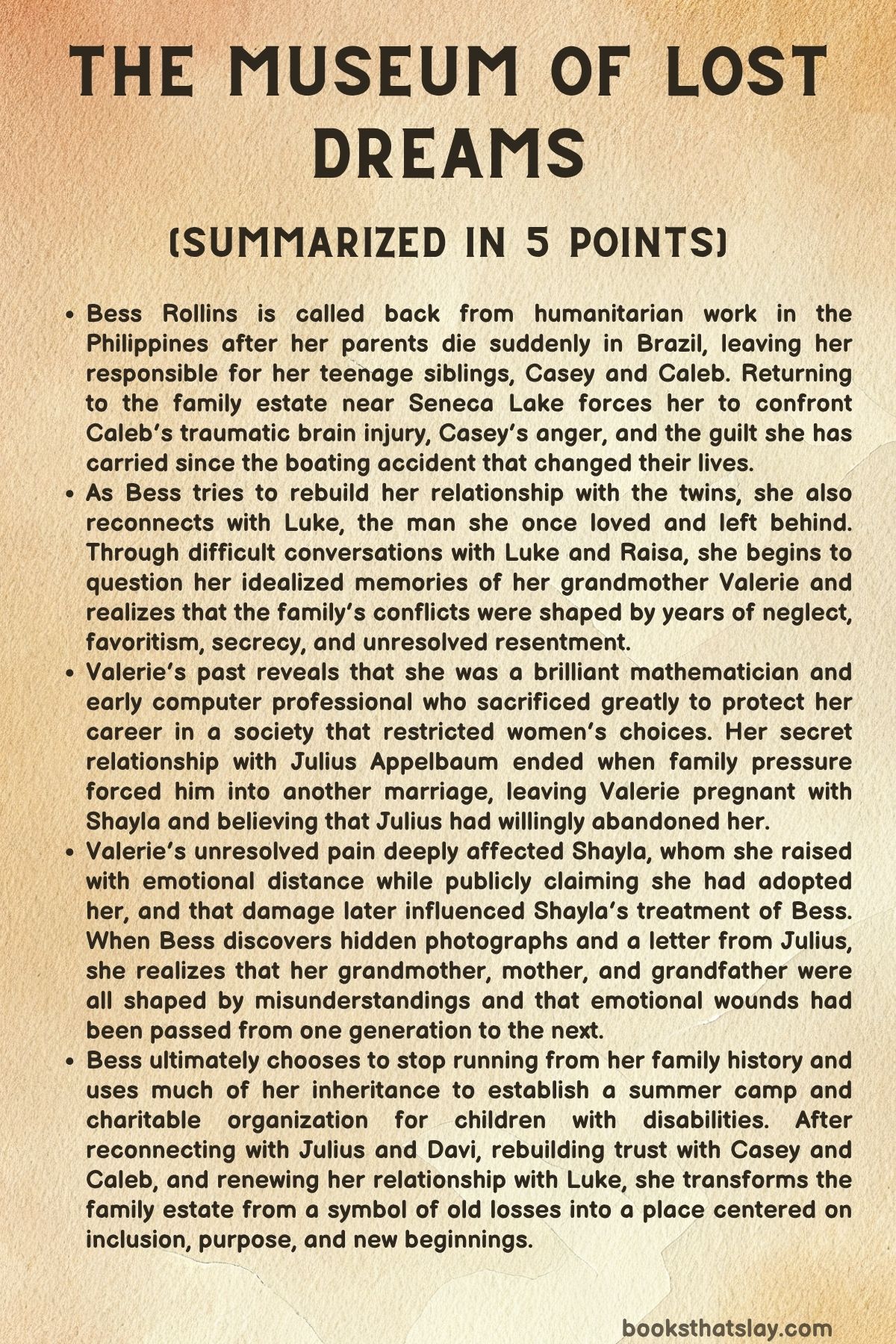
Characters
Bess Rollins
Bess Rollins is the emotional center of The Museum Of Lost Dreams, and much of her development comes from learning that responsibility and guilt are not the same thing. At the beginning of her adult story, she has built an impressive life of humanitarian service abroad, yet her willingness to help strangers also functions partly as an escape from the family disaster she cannot forgive herself for causing.
Caleb’s boating accident dominates the way Bess understands herself. Because she was present when he was injured, she turns one terrible event into a permanent judgment of her own character, treating almost every later family problem as evidence that she failed the twins.
Her return to Seneca Lake forces her to recognize how limiting this perspective has become. Casey’s anger, for example, cannot be reduced to Caleb’s accident; it also comes from abandonment, parental instability, grief, emotional neglect, and the burden of helping care for her brother.
Bess’s greatest internal challenge concerns Valerie. She has spent years treating her grandmother as the one unquestionably good figure in an otherwise painful childhood because Valerie gave her the affection and validation she rarely received from Shayla and Whit.
Learning about Valerie’s treatment of Shayla therefore threatens Bess’s understanding of her own childhood. Her growth becomes visible when she accepts that Valerie could genuinely love her while also making choices that harmed Shayla and intensified the conflict between mother and daughter.
Bess also matures in the way she handles Luke. Instead of returning impulsively to an old romance, she tries to understand why she left, acknowledges the damage she caused, and rebuilds the relationship with greater honesty.
Her decision to create the summer camp represents the fullest expression of her development. Rather than using wealth to preserve Valerie’s status or using charitable work as an excuse to remain distant from home, Bess converts inheritance into a project rooted directly in the people and responsibilities she once feared facing.
By the end, she is no longer defining herself through escape. She has become a guardian, sister, partner, future mother, philanthropist, and builder of community without surrendering the independent sense of purpose she developed abroad.
Valerie Van Horn
Valerie Van Horn is one of the most complicated figures in The Museum Of Lost Dreams because extraordinary professional courage exists beside profound emotional failure. She overcomes class limitations, gender expectations, family hardship, and professional prejudice to become an accomplished mathematician and an important participant in early computing.
Her ambition is not presented as selfish in itself. Valerie understands that the society around her expects women to sacrifice intellectual achievement for marriage, domesticity, and social respectability, so her determination to protect her career comes from a realistic understanding of the limitations placed upon her.
Her relationship with Agata also explains much of her drive. Valerie recognizes the sacrifices her mother made to support her education and seems to experience achievement partly as a way of honoring those sacrifices.
Julius changes the emotional structure of her life. For perhaps the first time, Valerie believes she can combine love, family, and professional accomplishment, which makes his unexplained departure especially destructive.
The tragedy is that Valerie never learns the true reason Julius left. Believing that he consciously betrayed her, she allows resentment toward him to affect her relationship with their daughter.
Shayla becomes associated with the man Valerie believes abandoned her. Instead of separating her daughter’s identity from her own romantic suffering, Valerie withdraws emotionally and lets Raisa provide much of the warmth and daily parenting Shayla needs.
Her treatment of Bess exposes another weakness. Valerie loves her granddaughter sincerely, but she also favors Bess because Bess resembles her physically and intellectually, turning the child into a source of affirmation.
The inheritance arrangement makes this favoritism permanent. Valerie believes she is protecting family wealth from Shayla’s irresponsibility, but she refuses to recognize how giving almost everything to Bess will deepen an already destructive mother-daughter rivalry.
Valerie is therefore neither a simple victim nor a simple cause of the family’s suffering. She breaks barriers for women and achieves remarkable things, yet she cannot apply the same courage and discipline to confronting emotional injury, and her avoidance leaves consequences that survive her death.
Shayla Rollins
Shayla is initially visible largely through Bess’s memories, which makes her appear cruel, unstable, resentful, and irresponsible. As more of her childhood becomes known, however, her adult behavior gains a painful context without being excused.
Her earliest wound is uncertainty about her identity. Valerie tells the world that Shayla is adopted, leaving her vulnerable to questions about her parentage and preventing her from understanding why she resembles neither the story nor family structure surrounding her.
When Valerie finally admits the truth, Shayla discovers that her mother concealed her birth to protect a career and still refuses to identify her father. To a child already convinced that she is unloved, this secrecy becomes confirmation that her existence represents something shameful.
Valerie’s emotional distance also affects Shayla’s self-worth. Raisa provides much of the practical affection she needs, while Valerie’s professional commitments and unresolved feelings about Julius leave Shayla convinced that she is less important than her mother’s career and memories.
Bess’s birth intensifies this injury. Valerie immediately recognizes herself in Bess and gives her the affection, admiration, money, and attention that Shayla spent years wanting.
As an adult, Shayla repeats some of the emotional damage she suffered. She directs resentment toward Bess because Bess resembles Valerie and represents Valerie’s favoritism, creating the same pattern through which Valerie once associated Shayla with Julius.
Her drug use, neglectful parenting, and emotional cruelty remain serious failures. The novel does not erase the suffering she causes simply because she was once neglected herself.
Yet understanding her past changes the moral picture. Shayla becomes an example of how a wounded child can grow into an adult who harms others when grief, rejection, and anger are never properly confronted.
Luke
Luke represents stability, patience, and practical loyalty, but he is more than a conventional romantic partner. His importance comes from his willingness to remain present when Bess chooses distance.
During Bess’s absence, Luke continues helping Caleb. He arranges employment, understands the limitations created by the brain injury, participates in difficult conversations, and provides a dependable male presence within a family marked by unreliable adults.
His relationship with Bess contains genuine hurt. Luke still loves her, but he does not pretend that her abrupt departure caused no damage, and his willingness to challenge her distinguishes him from someone who simply tells her what she wants to hear.
One of his most important functions is questioning Bess’s idealization of Valerie. He encourages her to distinguish love from protection and to recognize that a person can care deeply while still making harmful decisions.
Luke also learns from his own past. He eventually worries that he may once have pushed Bess too quickly toward the life he wanted with her, showing that his maturity includes examining his own behavior rather than placing all responsibility on Bess.
Their reconciliation succeeds because neither treats love as sufficient by itself. They rebuild trust through conversation, patience, shared work, and respect for the responsibilities Bess now carries.
By the end, Luke becomes part of the charitable project as well as Bess’s future family. His role reflects the novel’s broader argument that dependable love is demonstrated less through dramatic declarations than through consistent participation in another person’s life.
Caleb Rollins
Caleb undergoes one of the most dramatic changes in the story. Before the boating accident, he is extraordinarily intelligent, restless, fearless, and increasingly rebellious, partly because ordinary expectations fail to challenge him and partly because his home life lacks reliable boundaries.
The accident radically alters his cognitive abilities. His traumatic brain injury affects both older memories and his ability to retain new information, meaning that people around him must repeatedly introduce facts that others would remember automatically.
His condition creates some of the book’s most emotionally difficult situations. Learning that his parents have died is especially painful because the information can disappear from his memory, causing him to experience the grief again when the reality is explained.
Yet Caleb is never reduced to his disability. He works at a garage, develops routines, enjoys familiar television programs and activities, and forms relationships according to the abilities he still possesses.
His trust in Luke demonstrates how consistency creates security. His gradual recognition of Bess similarly becomes an important measure of their repaired sibling relationship.
Caleb also influences Bess’s professional future. Her observations of his needs help inspire the camp, turning one of the most painful experiences in the family into motivation for creating opportunities for other people.
The care others take in preparing memory cards and adapting communication around him also changes the way belonging is represented. Caleb does not have to become the person he was before the accident in order to deserve a meaningful future.
Casey Rollins
Casey initially appears angry, rebellious, and openly hostile toward Bess. Beneath that behavior, however, she is a young person who has spent several years absorbing responsibilities and losses that the adults around her failed to manage.
Caleb’s accident deeply affects her, but Bess’s departure creates an additional crisis. Casey runs away immediately after Bess leaves and later experiences withdrawal, disordered eating patterns, academic problems, and increasing emotional isolation.
Her overeating is particularly important because it expresses distress that she does not yet know how to articulate. The eventual diagnosis of prediabetes forces the family to confront the behavior as something connected to emotional health rather than laziness or simple defiance.
Casey’s relationship with Caleb reveals another side of her personality. She prepares memory tools for him, calms him when he becomes overstimulated, remembers the lullaby Bess once sang, and creates small routines that bring him security.
Her anger toward Bess is therefore connected partly to love. She remembers the sister who once cared for them and experiences Bess’s departure not merely as absence but as the loss of someone she believed would protect them.
Casey gradually becomes more open when Bess stops behaving as though she must become a replacement mother. Her request that Bess simply be her sister establishes a healthier basis for their relationship.
Her involvement in the camp and her growing bond with Davi also create room for creativity and responsibility. Instead of being defined by rebellion, Casey begins developing interests, relationships, and a place within the family’s new future.
Raisa Grün
Raisa functions as the most consistent caretaker across several generations of family instability. She serves Valerie, helps raise Shayla, later helps care for Bess and the twins, and remains at the estate when biological relatives repeatedly fail one another.
Her loyalty is not passive obedience. She challenges Valerie’s decision to leave most of the estate to Bess and accurately predicts that the arrangement will deepen Shayla’s resentment.
Raisa also refuses to support Bess’s idealized version of Valerie. She understands that affection for someone does not require denying their mistakes, and she repeatedly encourages Bess to examine the family with greater balance.
Her treatment of the twins is similarly practical. She recognizes Casey’s emotional problems, understands Caleb’s needs, and keeps the household functioning through crises that would overwhelm many people.
At times, Raisa withholds information, particularly concerning Casey’s disappearance after Bess left. These choices show that even a deeply loving caretaker can make questionable decisions when trying to protect someone from additional guilt.
Her influence ultimately pushes Bess toward maturity. Raisa encourages her to stop running, create meaningful work, accept love, and understand that caring for family does not require sacrificing every part of her personal identity.
Julius Appelbaum
Julius is initially presented as the mysterious man whose disappearance shaped Valerie’s life. Later revelations transform him from a presumed betrayer into another person whose choices were constrained by family power, social expectations, and fear.
His love for Valerie appears genuine. He helps purchase the Seneca Lake estate, imagines raising their children there, and supports Valerie’s professional ambitions rather than asking her to surrender them.
His decision to marry Chava is nevertheless morally complicated. Julius believes that leaving Valerie without explanation is the best way to protect her career from his father’s threats, but the secrecy leaves Valerie believing that she was casually abandoned.
That misunderstanding influences Shayla’s entire childhood. Julius therefore becomes an example of how a decision made with protective intentions can produce damage when the person being protected is denied the truth.
After Valerie orders him to stay away, Julius respects her demand even though it separates him from his daughter and granddaughter. His later life is marked by distance, observation, and regret rather than direct participation.
When Bess finally meets him, he does not demand immediate forgiveness or authority. He enters the family cautiously and begins contributing through patience, preparation, and practical assistance.
His architectural experience eventually allows him to help design the camp. In this way, the estate he once imagined as a home with Valerie finally becomes connected to his original hopes for family and shared purpose, although in a form neither of them could have predicted.
Davi “Dove” Appelbaum
Davi is one of the major keepers of the family’s hidden history. As a young woman, she is deeply devoted to Julius, partly because he gives her unconditional affection despite the social isolation caused by her facial disfigurement.
She understands his love for Valerie and recognizes the injustice of the marriage being forced upon him. Her loyalty creates a lifelong desire to protect her brother and preserve the truth about the life he was prevented from having.
After Chava’s death, Davi discovers writings that reveal more about Valerie, Shayla, and Bess. Her visit to the estate makes her a distant witness to Bess’s troubled childhood long before Bess knows she exists.
Davi’s later role is considerably more active. When Bess finally reaches her, she explains the past without trying to manipulate Bess into a particular judgment.
Her personality also brings warmth and creativity into the reconstructed family. She quickly connects with Casey and encourages artistic interests that might otherwise have remained neglected.
Davi demonstrates that family relationships can exist before formal recognition and can grow rapidly when people approach one another with care. Her long loyalty to Julius eventually helps reconnect people separated by decisions made half a century earlier.
Chava
Chava is an important secondary figure because her actions contribute directly to the separation of Julius and Valerie. She is emotionally unstable and desperate to secure Julius’s commitment, even cutting her wrists in an attempt that increases pressure on him to marry her.
Her behavior causes serious harm, but she is also trapped within a social structure that treats marriage as a family and economic arrangement rather than simply a personal choice. Her father’s business relationship with Julius’s father gives their proposed marriage significance beyond the wishes of either young person.
Julius eventually becomes more caretaker than husband within the marriage. Chava therefore represents both coercion and suffering: she helps force Julius into a life he does not want, yet her own instability suggests that she is hardly living freely either.
After her death, her private writings help expose the truth. Ironically, information preserved by the woman whose marriage separated Julius from Valerie eventually contributes to reconnecting the descendants affected by that separation.
Whit Rollins
Whit is Bess, Casey, and Caleb’s father and shares responsibility with Shayla for the chaotic environment in which the children grow up. Drug use, poor judgment, emotional unreliability, and weak parenting leave Bess carrying responsibilities that should have belonged to the adults.
His failure is especially significant because Bess becomes a substitute parent while still young herself. The absence of reliable parental structure contributes both to Caleb’s rebelliousness and to Bess’s belief that she must control everything in order to keep the family safe.
Whit’s death complicates Bess’s grief because she cannot mourn him as an uncomplicated loving father. She must acknowledge resentment, anger, and even relief alongside loss.
This emotional contradiction helps the novel reject simplistic ideas about bereavement. A person can grieve someone while also recognizing the damage that person caused.
Agata Van Horn
Agata is the foundation beneath Valerie’s remarkable career. Although she lacks Valerie’s educational opportunities, she recognizes her daughter’s intelligence and works relentlessly to ensure that talent is not wasted.
Her employment in the Johnstone household exposes the class inequalities Valerie later becomes determined to escape. Agata tolerates exhausting work and humiliating conditions partly because financial security and Valerie’s education remain more important to her than personal comfort.
She is also protective of Valerie in ways Valerie does not always recognize. Her warning concerning Edmund Johnstone shows that she understands dangers created by gender and class that her highly educated daughter is still somewhat naive about.
Agata’s death becomes a defining emotional loss for Valerie. Valerie’s later ambition, financial independence, and attachment to the painting associated with Agata’s Polish background all suggest that her mother remains an important psychological presence long after her death.
Berend Van Horn
Berend, Valerie’s Dutch father, represents some of the gender expectations Valerie must overcome early in life. He initially wants a son and does not immediately value having an intellectually exceptional daughter.
His attitude helps establish why Valerie becomes so fiercely determined to prove herself. From childhood, she learns that ability alone may not earn recognition if society has already decided what women are supposed to become.
Although Berend occupies a relatively small portion of the story, his presence contributes to Valerie’s lifelong resistance to dependency. Her determination to control her career, finances, and personal decisions grows partly from experiencing a world in which female potential can be casually dismissed.
Selvia Johnstone
Selvia Johnstone represents privilege without empathy. She maintains a rigid social hierarchy inside her household and expects servants to meet demanding standards regardless of their exhaustion, inexperience, or health.
Her treatment of Agata particularly enrages Valerie. Even when Agata is visibly unwell, Selvia prioritizes an elaborate holiday meal over the health of the woman who has served her family faithfully.
Selvia also knows about Edmund’s behavior toward women and responds not by confronting him but by controlling which women are employed in the household. This response protects appearances while leaving the underlying danger untouched.
Valerie’s later purchase of the Johnstone estate therefore carries symbolic importance. The daughter of a servant eventually owns the mansion where her mother was treated as socially inferior, reversing a hierarchy that once seemed permanent.
Edmund Johnstone
Edmund is a predatory figure whose behavior exposes the vulnerability of women working within wealthy households. He corners Valerie, makes sexual comments, and proposes a secret encounter despite knowing she is the daughter of an employee.
His actions reveal how class and gender can combine to create power without accountability. Agata’s warning indicates that Valerie is not his first target and that his behavior is familiar enough to shape hiring decisions inside the household.
Edmund’s role is limited but thematically important. Valerie’s later insistence on professional and financial independence becomes easier to understand when placed against a social environment where economically dependent women can be exposed to men who expect their status to protect them from consequences.
Ellen Powers-Murray
Ellen enters relatively late but becomes essential to Bess’s transformation from someone with an idea into someone capable of creating a sustainable organization. As a philanthropist, she possesses the resources to accelerate the camp’s development, but she does not support Bess merely because the project sounds compassionate.
She evaluates budgets, staffing, construction, insurance, and long-term planning. Her scrutiny forces Bess’s idealism to operate within practical structures.
Ellen also recognizes Bess’s previous charitable work and understands that the proposed camp comes from years of experience rather than a sudden emotional impulse. Her decision to commit substantial long-term funding validates both the project and Bess’s ability to lead it.
Her mentorship provides Bess with something especially valuable: support from an accomplished woman who does not demand that Bess choose between ambition and family. In that sense, Ellen offers a healthier model of female achievement than the one Valerie believed was available to her.
Uri Appelbaum
Uri is Julius’s older brother and represents the family pressure surrounding Julius’s decisions. His physical attack on Julius demonstrates that the conflict over marriage is not a mild disagreement but a struggle backed by intimidation and coercion.
Although Uri remains peripheral, his presence helps explain the environment Julius faces. The Appelbaum family treats individual romantic choice as secondary to business relationships, family reputation, and expected obedience.
Uri therefore contributes to the forces that separate Julius and Valerie. His role reinforces the idea that private tragedies can emerge from wider systems of family power rather than from the choices of only two lovers.
Themes
Inherited Pain and the Repetition of Family Wounds
Pain moves across generations because people repeatedly direct unresolved emotions toward those who remind them of earlier injuries. Valerie believes Julius betrayed her, and because Shayla strongly resembles him, Valerie struggles to separate her daughter from the man associated with her greatest romantic loss.
Shayla later repeats the same behavior with Bess. Because Bess resembles Valerie and receives Valerie’s affection, Shayla looks at her daughter and sees the mother whose rejection shaped her childhood.
The damaging pattern is therefore not simply passed through genetics or family history; it survives through perception. Each generation assigns an old emotional meaning to a younger person who did not create the original wound.
The Museum Of Lost Dreams shows that breaking such a pattern requires more than discovering hidden facts. Bess must learn to see Valerie, Shayla, Julius, Casey, and herself as separate individuals rather than symbols in a family argument.
Her greatest achievement is refusing to continue the pattern. She does not punish Casey for Shayla’s mistakes, does not reject Julius because Valerie rejected him, and does not allow her own guilt over Caleb to define her relationship with him forever.
Understanding the past matters because it creates the possibility of responding differently. The family begins healing only when inherited explanations stop controlling present relationships.
Guilt, Responsibility, and Self-Forgiveness
Bess’s guilt over Caleb’s accident becomes almost an identity. She knows she was on the boat when he was injured and had postponed the outing he wanted, so she interprets the accident as proof that she failed in the role she had assumed as protector of the twins.
The problem is not that Bess feels remorse. The problem is that she turns remorse into a permanent obligation to punish herself.
Leaving home becomes one form of punishment, while her later tendency to assume responsibility for Casey’s anger, Caleb’s disability, and the collapse of the family becomes another. She repeatedly places herself at the center of tragedies that involve parental neglect, Caleb’s own recklessness, family addiction, emotional abandonment, and circumstances beyond her control.
Raisa helps challenge this thinking by insisting that terrible outcomes do not always require one person to carry lifelong blame. Casey also disrupts Bess’s assumptions when she explains that she never understood Caleb’s accident in the simple way Bess imagined.
Bess eventually learns that responsibility should produce constructive action rather than endless self-condemnation. She studies Caleb’s condition, repairs her relationship with Casey, builds the camp, faces Luke, and remains present.
The distinction changes her life. Self-forgiveness does not mean pretending that mistakes never occurred; it means refusing to make suffering the only acceptable response to them.
Love, Protection, and the Damage Caused by Secrecy
Several characters believe they are protecting someone when they conceal the truth. Julius hides the threats against Valerie because he thinks allowing her to hate him will save her career, while Valerie hides Shayla’s parentage because public knowledge of an unmarried pregnancy could destroy her professional future.
Both decisions have understandable motives, yet the consequences are devastating. Valerie spends decades believing she was abandoned, Shayla grows up confused about her identity, and Julius remains separated from a daughter he wanted to know.
Valerie later makes another supposedly protective decision when she gives Bess control of most of the family fortune. She believes she is preventing Shayla from wasting the estate, but the arrangement confirms Shayla’s conviction that Valerie considers Bess more worthy of love and trust.
Luke introduces an important distinction when he challenges Bess’s belief that Valerie protected her simply because she loved her. Love can be genuine while the actions performed in its name are misguided.
The story repeatedly suggests that secrecy protects people only temporarily. Once the hidden truth begins affecting identity, relationships, inheritance, and memory, concealment creates problems greater than the danger it was intended to prevent.
Healing begins when people finally share information, explain motives, and allow others to decide what the truth means for themselves.
Rebuilding Family Through Choice and Purpose
Family in the novel is ultimately defined less by biological connection than by sustained participation. Raisa is not the biological parent of the children she helps raise, yet she provides more consistency than several of their relatives.
Luke behaves similarly toward Caleb. He continues supporting him during Bess’s absence, establishes routines, helps him work, and remains present during moments of confusion and grief.
Julius and Davi demonstrate the same principle once they are given an opportunity to join the family. Instead of assuming that blood automatically entitles them to closeness, they research Caleb’s condition, prepare memory cards, learn how to communicate with him, and look for practical ways to contribute.
Bess eventually builds her own understanding of family around this idea. She stops trying to repair the past by controlling everyone and instead creates conditions in which people can contribute according to their abilities.
The summer camp becomes the clearest expression of this new model. Land and money associated with secrecy, favoritism, and broken relationships are redirected toward inclusion, education, employment, and shared community.
The transformation of the estate therefore reflects the transformation of the family itself. What was once primarily a monument to one woman’s accomplishments becomes a place where many people can belong, participate, and build futures that are not limited by the failures of the generations before them.