Hunting Ground Summary, Characters and Themes
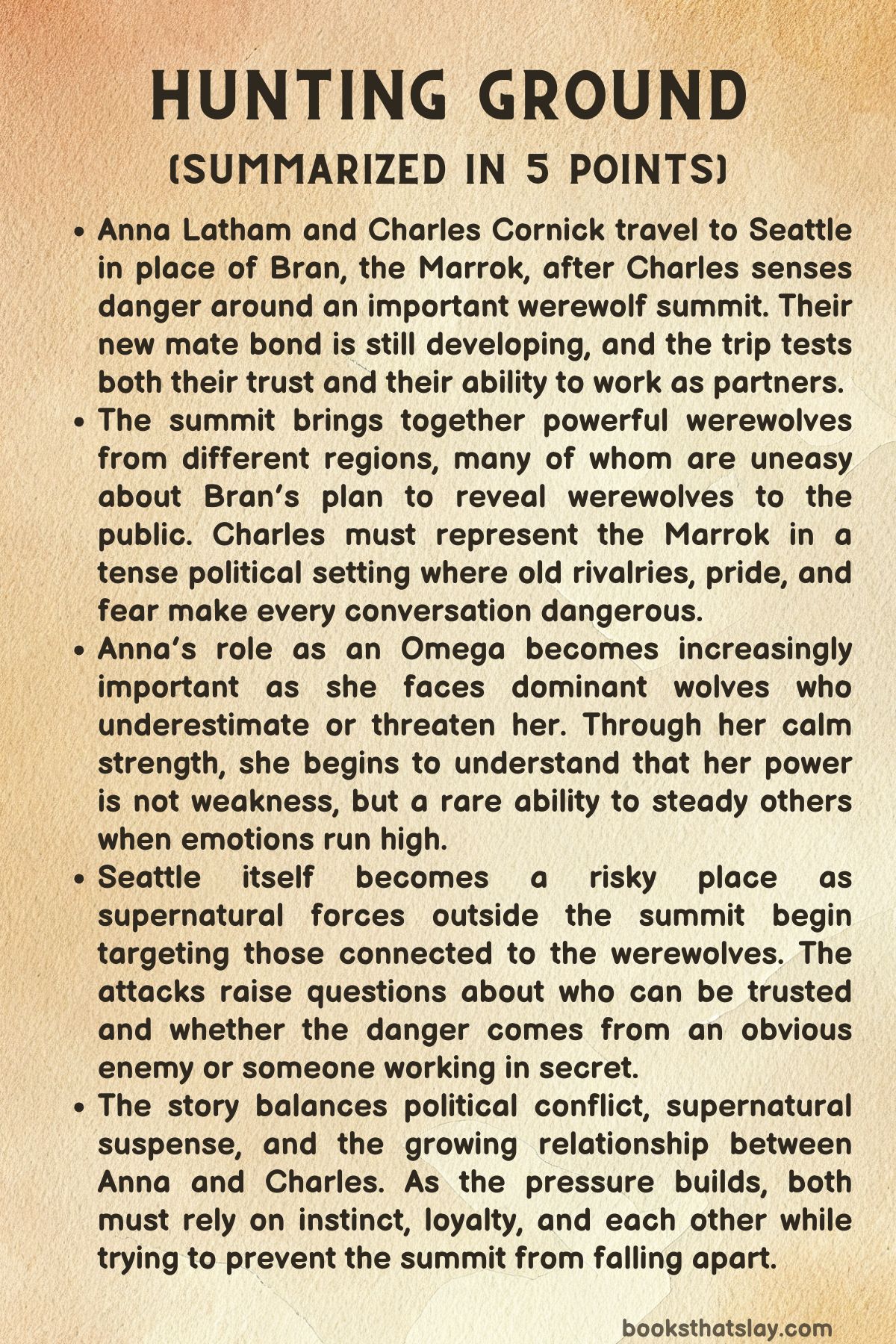
Hunting Ground by Patricia Briggs is an urban fantasy novel centered on werewolf politics, danger, loyalty, and the fragile trust between newly bonded mates. The story follows Anna Latham, an Omega werewolf still learning the reach of her unusual power, and Charles Cornick, the Marrok’s feared enforcer, as they travel to Seattle in Bran’s place.
What begins as a diplomatic summit about revealing werewolves to the human world soon turns into a deadly conflict involving old enemies, hidden magic, hired vampires, and personal attacks. The book balances political tension with the growing strength of Anna and Charles’s partnership. It’s the 2nd book of the Alpha & Omega series.
Summary
Anna Latham is still adjusting to life as the mate of Charles Cornick, son of Bran Cornick, the Marrok and ruler of the North American werewolves. Charles is not only Bran’s son but also his executioner, a role that has made him dangerous, controlled, and deeply feared.
When Anna finds him furious after arguing with Bran, she realizes his anger is close to becoming something he cannot manage. Rather than confront him with words, she changes into wolf form and attacks him while he is shoveling snow.
Her goal is not to wound him but to break through his rage. The fight becomes playful, and Bran joins them in wolf form, helping ease the tension.
The argument concerns a major werewolf summit in Seattle. Bran plans to meet with European werewolf leaders to discuss his decision to reveal werewolves to the public.
Charles believes Bran should not attend because he has a strong instinct that the meeting is dangerous, especially with Jean Chastel, the Beast of Gévaudan, expected to be there. Chastel is cruel, powerful, and known for violence.
Anna admits she called Bran because she feared Charles’s anger and because she understands that Charles’s warning should not be ignored. Bran accepts Charles’s judgment and chooses to stay behind, sending Charles and Anna to represent him instead.
While Charles and Anna travel to Seattle, danger is already present in the city. A vampire named Ivan and his companion Krissy murder a young musician named Jody for entertainment and dispose of his body in the water.
Their casual cruelty signals that the threat waiting in Seattle is not limited to werewolf politics.
Charles and Anna arrive in Emerald City Pack territory and are greeted by Ian Garner, who explains that the European delegations are gathering. Charles suspects Chastel may already be in Seattle and hiding somewhere private.
Before the summit begins, Charles and Anna visit Dana Shea, a powerful fae Gray Lord who has agreed to moderate the meeting. On the way, they encounter a real troll near Seattle’s famous troll statue.
The troll warns them not to trust the fae, a warning that later proves important.
At Dana’s houseboat, Anna learns that Dana and Charles once had a romantic relationship. Dana tests Anna with glamour, but Anna resists and claims Charles as hers.
Charles gives Dana a painting from Bran, showing the homeland Dana lost long ago. The gift affects Dana strongly, but she also warns that European wolves will see Anna as a weakness and that Charles may struggle to command them because he is not an Alpha.
At their hotel, Anna and Charles continue learning how to live with their mate bond and with Brother Wolf, the wolf side of Charles’s nature. Their quiet moment ends when Charles learns that Chastel, the Spanish wolves, and Arthur Madden, the British Alpha, are about to clash at a barbecue restaurant.
Charles and Anna rush there, and Charles stops Chastel from attacking Sergio, a Spanish wolf. Anna tries to calm the room with her Omega power, but Charles growls at her because he needs his aggression sharp enough to face Chastel.
Hurt and unsettled, Anna leaves the private room but stays in the restaurant, where she plays piano for the human diners and helps restore peace.
At the summit, Charles presents Bran’s argument for revealing werewolves to humans. He explains that secrecy is already weakened by government knowledge and hostile groups, so it is better for werewolves to control the reveal rather than be exposed by enemies.
Anna’s presence unsettles the dominant wolves, so Charles sends her shopping with Tom Franklin, the Emerald City Pack’s second, and Moira, Tom’s blind witch mate.
On the way back to the hotel, Anna, Tom, and Moira are attacked by six vampires hidden by a spell that smells like wolf magic. The vampires try to kidnap Anna.
Tom is badly injured, but Anna kills one attacker, Tom kills another, and Moira casts a spell that mimics sunlight, forcing the remaining vampires to retreat. Anna carries Tom back while Moira hides them from notice.
Charles follows the trail and confirms there were six attackers. Because the vampires used concealment that seemed connected to werewolf magic and fought with unusual coordination, Anna suspects someone linked to the summit arranged the attack.
Angus, the Emerald City Alpha, helps manage the aftermath, and Alan Choo, the pack healer, is called to tend Tom. Charles and Angus consider possible suspects.
Chastel is an obvious possibility, but Angus doubts he would hire others to do violence for him. Charles and Anna later attend dinner at Arthur Madden’s condo, where Arthur’s human wife, Sunny, welcomes them.
Arthur shows Charles and Anna his collection of historical artifacts, especially objects tied to King Arthur. He believes he is the reincarnated King Arthur and treasures a sword he believes is Excalibur.
After the dinner, Michel, one of Chastel’s wolves, warns Charles that Chastel has become fixated on Anna and wants to kill her. Arthur offers Michel protection, knowing Chastel may punish him for the warning.
The next day, Anna waits in Angus’s office during the conference and meets Ric, an Omega from the Italian delegation. Ric has been treated like a submissive wolf, but Anna explains that Omegas are outside normal pack hierarchy.
They are not weak; they calm others and protect packs from their own violence. Ric is inspired and decides to join the night’s hunt, even though submissive wolves are usually excluded.
He encourages Anna to join too, believing it may help her face her fear of dominant wolves.
Meanwhile, Chastel disrupts the negotiations by rejecting the Marrok’s help and insisting Europe is beyond Bran’s authority. Dana smoothly redirects the meeting toward the planned hunt, but Chastel’s resistance damages the talks.
Later, Chastel appears in Angus’s office and threatens Anna. She refuses to submit, telling him Charles will kill him if he touches her.
Charles arrives and forces Chastel to leave. Anna realizes Chastel did not know about the vampire attack, which suggests he was not behind it.
That evening, Sunny goes to dinner with friends while Arthur attends werewolf business. In a parking garage, she is approached by a well-dressed vampire who flatters her before attacking.
Other vampires join him, and they torture and feed on her. They want to test whether she is truly Arthur’s mate.
At the hunt, Anna decides to participate. Charles is worried, but he respects her choice.
The hunt takes place in the Emerald City Pack’s warehouse grounds. Anna changes quickly and hunts with Ric and Isaac.
During the event, Arthur collapses because Sunny is dying. Charles tracks her phone and finds her body outside the compound.
She has been murdered by the same vampires who attacked Anna.
Anna senses Charles’s distress through their bond and leaves the hunt with Ric and Isaac. She sees one of the vampires watching before he escapes in a minivan.
When she returns, she learns Sunny is dead. Arthur is broken by the loss, and Angus arranges for pack members and Tom to take Arthur and Sunny’s body home.
After the hunt ends, Chastel enters with one of the prize bags and drops it near Anna. He lunges at her throat without actually biting.
Charles, in wolf form, attacks him savagely and nearly kills him. Dana claims Charles broke the hunt’s no-blood rule and orders the wolves to capture him, but Anna uses her Omega power to stop them.
Angus points out that the hunt had already ended, so the rule no longer applies. Chastel survives, and Charles runs.
Anna follows Charles to the waterfront and finds him in wolf form. She comforts him, and together they consider what happened.
Anna believes Dana used fae magic to manipulate both Charles and Chastel, pushing Charles toward violence so Dana could justify punishing or killing him. Angus arrives and confirms he sensed fae magic.
They call Bran, who tells them the vampires may be hired assassins and orders Charles to find and destroy them. With Sunny dead and the talks damaged, the summit can be ended early, but Chastel has already weakened the negotiations.
The danger around Anna and Charles is far from over, and the true force behind the attacks still needs to be exposed.
Characters
Anna Latham
Anna Latham is the emotional center of Hunting Ground, and her role in the book is defined by a powerful contrast between vulnerability and quiet strength. She begins as someone still adjusting to her bond with Charles, but she is not passive within that relationship.
When she sees Charles dangerously close to losing control, she does not retreat from him or wait for someone else to manage the situation; instead, she confronts him in wolf form and deliberately breaks through his anger. This shows that Anna understands Charles in a way others do not.
Her courage is not loud or aggressive, but it is steady, instinctive, and deeply compassionate.
As an Omega, Anna’s power is especially important because it challenges the usual werewolf hierarchy. Dominant wolves expect power to look like force, rank, violence, and intimidation, but Anna’s strength works through calm, emotional balance, and resistance to fear.
She unsettles the dominant wolves because she does not fit the rules they rely on. Her interactions with Ric reveal her growing confidence in understanding what an Omega truly is.
She does not define Omegas as weak or submissive; instead, she explains that they stand outside the normal structure and protect the pack from destroying itself through dominance and aggression.
Anna’s relationship with Charles also develops through trust and choice. Charles is protective of her, sometimes to the point of trying to shield her from danger, but Anna repeatedly insists on acting for herself.
Her choice to join the hunt is especially meaningful because it shows her confronting fear rather than allowing trauma or intimidation to define her. She is still afraid of dominant wolves, but she does not let that fear control her.
In this way, Anna’s character represents healing as an active process, not a simple emotional recovery.
Anna also possesses sharp emotional intelligence. She notices what others miss, including the possibility that Dana has manipulated Charles and Chastel with fae magic.
She reads people through behavior, emotional shifts, and instinct, making her valuable not only as Charles’s mate but also as a thinker in her own right. Her compassion does not make her naïve.
By the end of the provided events, Anna has become more assertive, more aware of her own power, and more willing to stand between violent forces when necessary.
Charles Cornick
Charles Cornick is one of the most intense and conflicted figures in the book. As the Marrok’s son and executioner, he carries the burden of violence as both duty and identity.
He is disciplined, dangerous, and deeply controlled, but the opening scene reveals how close that control can come to breaking. His anger after arguing with Bran shows that Charles is not simply a cold enforcer; he is a man under enormous pressure, shaped by responsibility, loyalty, instinct, and fear.
His concern that Bran would be in danger at the summit reveals both his protective nature and his ability to sense threats before others fully understand them.
Charles’s relationship with Anna exposes a softer and more emotionally vulnerable side of him. He is not used to being challenged or cared for in the way Anna cares for him.
She sees not only the lethal werewolf but also the man struggling beneath the weight of his role. His bond with her gives him stability, but it also creates fear because enemies can use Anna against him.
This becomes especially clear when Dana warns that European wolves will view Anna as his weakness. Yet the book also shows that Anna is not merely a weakness for Charles; she is one of the few forces capable of grounding him.
His struggle with Brother Wolf adds depth to his character. Charles is not alone inside himself; his wolf instincts are powerful, ancient, and sometimes frighteningly direct.
When Chastel threatens Anna, Charles’s violence is not just political or tactical. It becomes personal, almost primal.
His attack on Chastel after the hunt shows how easily his protective instincts can be manipulated. This moment does not make Charles reckless by nature, but it does reveal that his deepest loyalty can be turned into a weapon against him.
Charles is also politically complicated because he represents Bran without being Bran. He has authority, reputation, and power, but he is not an Alpha in the same sense as the leaders attending the summit.
This makes his position difficult: he must command respect among wolves who value dominance while also navigating diplomacy, suspicion, and provocation. His character therefore stands at the intersection of violence and restraint.
He is capable of killing almost anyone in the room, but the real test for him is whether he can keep choosing control when others are trying to provoke him into losing it.
Bran Cornick
Bran Cornick, the Marrok, is a powerful presence even when he is not physically central to the Seattle events. His authority shapes the entire conflict because the summit exists in response to his decision to reveal werewolves to the public.
Bran is portrayed as strategic, ancient, and politically aware, but he is also capable of listening when someone he trusts challenges him. His argument with Charles suggests that he may be accustomed to making dangerous decisions alone, yet Anna’s intervention and Charles’s warning persuade him to stay home and send Charles in his place.
Bran’s decision to send Charles and Anna shows both trust and calculation. He knows Charles is dangerous enough to act as his representative, but he also knows the European wolves will test him.
Bran’s gift to Dana, a painting of her lost homeland, reveals another side of him: he understands emotional debts, old histories, and the power of symbolic gestures. He does not rely only on force.
He knows that memory, grief, and obligation can influence powerful beings as much as threats can.
As the Marrok, Bran represents centralized authority in the werewolf world, and the European resistance to his plans shows how controversial that authority is. Chastel’s challenge to Bran’s influence is not just personal; it is political.
Bran’s absence from Seattle makes the conflict more unstable because his reputation is present, but his direct power is not. This forces Charles to operate in the shadow of his father’s authority without fully possessing it himself.
Bran also serves as a voice of clarity after Sunny’s death and Charles’s near-disastrous confrontation with Chastel. When he tells Charles to find and destroy the vampires, he shifts the focus from political negotiation to decisive action.
His calm acceptance that the summit can be ended early under the excuse of Sunny’s death shows his practical mind. Bran is emotionally connected to his family, but he is also a ruler who understands how tragedy, diplomacy, and strategy overlap.
Brother Wolf
Brother Wolf is an essential part of Charles’s character, but he also functions almost like a separate presence within the story. He embodies instinct, territoriality, loyalty, and predatory awareness.
Through Brother Wolf, Charles’s reactions become more than human emotion. His anger, protectiveness, and suspicion operate on a deeper animal level, especially when Anna is threatened.
This makes Charles more dangerous but also more perceptive.
Brother Wolf’s bond with Anna is significant because Anna does not relate only to Charles the man; she also reaches the wolf within him. Her ability to comfort Charles in wolf form after he flees to the waterfront shows that she accepts the whole of him.
She does not treat Brother Wolf as a monster to be controlled or hidden. Instead, she recognizes that the wolf is part of Charles’s identity and must be understood, not rejected.
Brother Wolf also reveals the danger of manipulation. When Chastel lunges at Anna, the response is immediate and savage.
The wolf’s instinct to defend his mate is natural, but Dana’s possible magical interference makes that instinct vulnerable to exploitation. This creates one of the book’s most important tensions: instinct can be truthful, but it can also be provoked.
Brother Wolf’s presence makes Charles powerful, but it also increases the stakes whenever Charles’s control is tested.
Jean Chastel
Jean Chastel is the most openly menacing figure among the werewolves. Known as the Beast of Gévaudan, he carries a reputation built on cruelty, violence, and fear.
His presence at the summit immediately creates danger because he does not merely disagree with Bran’s political plan; he wants to dominate the room through intimidation. He is a predator who understands the effect he has on others and uses that fear deliberately.
Chastel’s fixation on Anna reveals his sadistic nature. He identifies her as emotionally important to Charles and therefore as a possible target.
This does not mean he sees Anna clearly; in fact, he underestimates her because he assumes vulnerability equals weakness. His threat toward her in Angus’s office shows his desire to make others cower, but Anna’s refusal to do so disrupts the power dynamic he expects.
Her courage irritates him because it denies him the fear he feeds on.
Politically, Chastel is dangerous because he knows how to turn opposition into spectacle. His refusal to accept the Marrok’s authority weakens the negotiations and gives other European wolves a reason to resist.
He does not need to win every argument directly; simply disrupting the process serves his purpose. His survival after Charles nearly kills him also allows him to remain a symbol of unresolved violence.
Chastel is not necessarily the mastermind behind every attack, and Anna’s realization that he likely did not send the vampires adds complexity to the conflict. He is monstrous, but not every evil act belongs to him.
This distinction matters because it prevents the book from making him a simple answer to every threat. Chastel is dangerous enough on his own, yet the presence of other hostile forces makes the situation even more unstable.
Dana Shea
Dana Shea is one of the most complex and ambiguous characters in the book. As a fae Gray Lord, she possesses immense power, ancient memory, and political authority.
Her role as moderator should make her a neutral figure, but her actions suggest that neutrality may be only a surface performance. She is elegant, controlled, and skilled at guiding attention, especially when she interrupts Chastel and redirects the meeting before he can fully dominate it.
Dana’s history with Charles gives her scenes with him emotional tension. Anna’s discovery that Dana and Charles were once lovers adds an undercurrent of jealousy, territoriality, and insecurity, but it also allows Anna to assert herself.
When Dana tests Anna with glamour, Anna’s response is not simply romantic possessiveness; it is an act of self-definition. She refuses to be diminished or manipulated by a powerful fae.
Dana’s reaction to Bran’s painting also reveals that she is not untouchable. The image of her lost homeland affects her deeply, suggesting grief and longing beneath her composed exterior.
Despite her grace, Dana is also deeply suspicious. The warning from the troll not to trust the fae prepares the reader to question her motives.
Her actions during the hunt, especially her attempt to frame Charles’s attack on Chastel as a violation, suggest that she may be pursuing her own agenda. Anna’s suspicion that Dana manipulated both Charles and Chastel with fae magic makes Dana appear less like a neutral moderator and more like someone willing to provoke violence for political or personal ends.
Dana’s character works because she is not easily reduced to villainy. She can be helpful, emotionally wounded, charming, and dangerous at the same time.
Her power lies not only in magic but in timing, language, and social control. She understands how to move a room, how to test people, and how to hide motive behind ceremony.
This makes her one of the most unpredictable figures in the story.
Arthur Madden
Arthur Madden, the British Alpha, is presented as noble, eccentric, and tragic. His belief that he is the reincarnated King Arthur could easily seem foolish in another character, but Arthur carries it with sincerity and dignity.
His collection of historical artifacts and his reverence for the sword he believes to be Excalibur show that he has built his identity around ideals of kingship, honor, memory, and destiny. Whether or not his belief is true, it gives him a personal mythology that shapes how he sees himself.
Arthur’s warmth toward Charles and Anna makes him stand apart from more hostile or suspicious wolves at the summit. He is not merely a political figure; he is a host, a mate, and a man with deep attachments.
His decision to protect Michel from Chastel also shows moral courage. By taking in one of Chastel’s wolves, Arthur risks conflict with a terrifying enemy, but he does so because it is the honorable choice.
His relationship with Sunny humanizes him profoundly. She is not a political accessory but his mate, and her death devastates him through the mate bond before he even physically reaches her.
His collapse during the hunt shows the depth of that bond and transforms him from a dignified leader into a broken grieving husband. This tragedy strips away the grandeur of his Arthurian identity and reveals raw emotional vulnerability.
Arthur’s character also highlights the cost of werewolf politics. The summit is filled with arguments about authority, secrecy, and survival, but Sunny’s murder shows that these conflicts destroy innocent lives.
Arthur becomes the emotional proof that political violence is never abstract. His loss changes the tone of the gathering and gives the Marrok’s side a reason to end the failed negotiations early.
Sunny
Sunny is Arthur’s human mate, and though her role is brief, she is emotionally important. She welcomes Anna and Charles warmly into the condo, showing hospitality and kindness despite being unsettled by Charles’s intense dominance.
Her reaction to Charles makes her feel realistic; she is not part of the werewolf hierarchy, and she experiences his power as something overwhelming before Anna helps explain it.
Sunny’s humanity matters because she represents the ordinary world drawn into supernatural danger. She does not have werewolf strength, political protection, or magical defenses.
Her vulnerability makes the vampire attack especially cruel. The vampires do not kill her in a moment of hunger alone; they torture and feed on her as a deliberate test of Arthur’s mate bond.
This makes her death both personal and strategic.
Her murder is one of the most tragic events in the book because it exposes the brutality of the enemies operating around the summit. Sunny is targeted because of whom she loves, not because of anything she has done.
Through her, the story shows that mates are not only emotional anchors but also potential targets. Her death devastates Arthur and intensifies the sense that the conflict has moved beyond diplomacy into calculated cruelty.
Angus
Angus, the Emerald City Alpha, is a practical and perceptive leader. As the host Alpha, he must manage a dangerous gathering of powerful wolves, political rivals, and supernatural threats.
His role requires patience, authority, and quick judgment. He helps respond after the vampire attack on Anna, Tom, and Moira, and he takes the situation seriously without rushing to easy conclusions.
Angus is valuable because he combines dominance with reason. He considers Charles’s suspicions, weighs possible suspects, and recognizes that Chastel may not fit the pattern of the vampire attack.
This does not make him naïve about Chastel’s cruelty; rather, it shows that Angus understands how different kinds of violence work. He knows Chastel is brutal, but he doubts Chastel would outsource violence in that particular way.
During the hunt aftermath, Angus plays an important role in protecting Charles from Dana’s accusation. By pointing out that the hunt had already ended before Charles attacked Chastel, he uses the rules themselves to counter Dana’s attempt to punish Charles.
This reveals that Angus is not merely physically powerful but politically alert. He understands that in a room full of dangerous beings, technical truth can become a shield.
Angus also confirms that he sensed fae magic, giving weight to Anna’s suspicion about Dana. His willingness to acknowledge this matters because it validates Anna’s interpretation and prevents Charles from being isolated as the only one who may have been manipulated.
Angus functions as a stabilizing figure in a volatile environment.
Tom Franklin
Tom Franklin, the Emerald City Pack’s second, is loyal, capable, and protective. His assignment to accompany Anna while Charles attends the summit places him in a position of responsibility, and the vampire attack proves that this responsibility is dangerous.
Tom is badly injured, but he continues to fight, killing one of the vampires and helping prevent Anna’s kidnapping.
Tom’s courage is not presented as flashy heroism. He acts because protecting Anna is his duty and because he is strong enough to stand between her and danger.
His injuries show the seriousness of the attack and make clear that the vampires are not minor threats. They are organized, magically concealed, and tactically skilled.
His relationship with Moira also adds depth to his character. As the mate of a blind witch, Tom exists at the intersection of werewolf and witch communities.
Their partnership suggests trust across supernatural boundaries. Tom’s confidence in Moira’s abilities is important because she is not treated as helpless despite her blindness.
Together, they form one of the book’s strongest examples of a supernatural partnership built on mutual reliance.
Moira
Moira is one of the most impressive secondary characters because she combines vulnerability, intelligence, and extraordinary magical power. As Tom’s blind witch mate, she might initially seem physically disadvantaged during a sudden attack, but the vampire fight quickly overturns that assumption.
Her spell that mimics sunlight is decisive and terrifyingly effective against the vampires, proving that her power is not symbolic but practical and dangerous.
Moira’s blindness shapes how others may perceive her, but it does not define the limits of her character. She uses magic, awareness, and discipline to survive situations that would overwhelm many others.
Her concealment of herself, Anna, and Tom after the attack shows that her gifts are not only offensive but also protective. She understands how to hide, shield, and move through danger.
Moira also broadens the supernatural world of the book. Through her, witchcraft becomes part of the conflict surrounding the werewolf summit.
The concealment spell used by the vampires smells like wolf magic, but Moira’s presence helps highlight how magic can blur boundaries and mislead even experienced supernatural beings. Her character reinforces the idea that power in the story comes in many forms, not all of them tied to dominance or physical strength.
Ric
Ric, the Italian Omega, is important because he allows the book to explore what it truly means to be an Omega. When Anna meets him, he has been treated like a submissive wolf, which shows how badly his own pack misunderstands him.
His lack of confidence is not a natural weakness; it is the result of being mislabeled and limited by those around him.
Anna’s conversation with Ric is a turning point for both characters. By teaching him that Omegas exist outside the normal pack hierarchy, she helps him reimagine himself.
Ric begins to understand that calmness is not inferiority and that his role has value. This matters because it shows Anna becoming a guide to someone else, not only someone who is still healing.
Ric’s decision to join the hunt is an act of self-assertion. He is not trying to become dominant in the usual sense; he is trying to claim his rightful place outside the hierarchy that has confined him.
His encouragement of Anna also shows kindness and insight. He recognizes that the hunt may help her face her fear, just as it may help him prove his own identity.
Isaac
Isaac appears as part of the hunting group with Anna and Ric, and his role is smaller but still meaningful. He helps create a sense of companionship around Anna during the hunt, making the experience less isolating.
His presence alongside Ric suggests that Anna is not completely alone among unfamiliar wolves, even in an environment that could easily trigger fear.
Isaac also contributes to the hunt as part of the pack structure surrounding the summit. While he does not dominate the action, he helps show how group dynamics matter among werewolves.
The hunt is not merely a contest; it is a social and political event where status, courage, instinct, and control are all being observed.
Ian Garner
Ian Garner serves as an introductory figure to the Seattle setting and the Emerald City Pack’s role in the summit. By meeting Charles and Anna when they arrive, he helps connect them to the local pack and to the tense political situation already unfolding.
His explanation that European delegations are arriving establishes the scale of the gathering and prepares the way for the conflicts that follow.
Ian’s role is mainly functional, but that does not make him unimportant. Characters like Ian help show that the summit depends on many pack members who are not central leaders but still carry responsibility.
He represents the organized local structure required to host such a dangerous meeting.
Alan Choo
Alan Choo, the pack healer, represents the practical support system within the Emerald City Pack. His role after Tom’s injury shows that violence in the werewolf world requires more than fighters and leaders; it also requires healers who can respond quickly when bodies are broken.
Though he is not given extensive personal focus, his presence emphasizes the seriousness of Tom’s wounds and the pack’s need for specialized care.
Alan also helps ground the supernatural action in consequences. Injuries are not simply brushed aside.
The need to call a healer shows that even powerful werewolves can be badly harmed, especially when facing coordinated vampire attacks. His role adds realism to the aftermath of violence.
Michel
Michel is one of Chastel’s wolves, and his warning to Charles is a brave act. By telling Charles that Chastel has become fixated on Anna and wants to kill her, Michel risks retaliation from a terrifying master.
This suggests that Michel is not simply loyal to Chastel out of devotion; he may be trapped, afraid, or morally conflicted.
Arthur’s decision to protect Michel gives Michel’s character further significance. He becomes a test of honor for others.
Protecting him means defying Chastel, and Arthur’s willingness to do so shows the danger Michel faces. Michel’s presence also complicates the idea of villainous groups.
Even among Chastel’s wolves, there can be individuals who fear him, resist him, or try to prevent worse harm.
Ivan
Ivan is one of the vampires responsible for the book’s atmosphere of predatory cruelty. His murder of Jody with Krissy establishes the vampires as sadistic, casual killers before they become directly connected to the attacks surrounding the summit.
Ivan does not kill only for survival or strategy; he appears to take pleasure in violence and in the power he has over helpless victims.
His later connection to the attacks on Anna’s group and Sunny makes him part of a larger pattern of organized violence. The vampires are not random monsters drifting through Seattle.
They are coordinated, purposeful, and possibly hired. Ivan’s character therefore represents both personal sadism and professional danger.
He helps turn the vampire threat into something colder and more frightening than ordinary supernatural hunger.
Krissy
Krissy, Ivan’s companion, shares in the cruelty of Jody’s murder and helps establish the vampires as morally repulsive figures. Her role shows that the violence is not isolated to one particularly monstrous vampire.
She participates in the amusement, disposal, and dehumanization of the victim, making her part of the same predatory culture.
Although Krissy is not developed as deeply as some of the werewolf characters, her function is important. She helps show how casually the vampires treat human life.
This casual cruelty creates a sharp contrast with characters like Anna, Charles, and Arthur, whose bonds and loyalties are deeply meaningful. Krissy’s lack of empathy makes the vampire threat emotionally chilling.
Jody
Jody, the young musician murdered by Ivan and Krissy, is a brief but important victim. He represents the ordinary human lives endangered by supernatural predators.
His death occurs away from the formal politics of the werewolf summit, which broadens the danger of the story. The supernatural world does not harm only those who participate in its conflicts; it can casually destroy outsiders as well.
Jody’s murder also establishes the vampires’ nature before their larger role becomes clear. Because he is killed for amusement, his death reveals the moral emptiness of Ivan and Krissy.
He may not have a long presence in the book, but his death sets the tone for the vampires’ cruelty and foreshadows the later murder of Sunny.
Sergio
Sergio, the Spanish wolf whom Chastel threatens, helps reveal Chastel’s violent temperament. The confrontation at the barbecue restaurant shows how quickly Chastel can turn a political gathering into a physical threat.
Sergio’s presence gives Charles a reason to intervene, allowing Charles to demonstrate his power and authority in front of the other wolves.
Sergio also represents the vulnerable position of wolves caught between larger powers. He is not the central political figure in the scene, but the danger to him exposes the brutality of those who use dominance without restraint.
Through Sergio, the book shows how weaker or less protected wolves can become targets in conflicts among more powerful figures.
Themes
Power, Control, and the Burden of Restraint
Power in Hunting Ground is shown as something dangerous when it is not guided by discipline. Charles carries enormous authority because of his dominance, his reputation, and his role as Bran’s enforcer, but his strength also makes every moment of anger risky.
His instinct about danger in Seattle is not simple jealousy or fear; it comes from experience, yet it also traps him in a state of constant tension. Anna’s presence becomes important because she does not try to defeat his power.
Instead, she redirects it. Her playful attack in wolf form, her calmness during conflict, and her refusal to let him spiral show that control is not the same as weakness.
Chastel represents the opposite side of power: cruelty used for pleasure, fear used as influence, and violence treated as proof of superiority. The conflict between Charles and Chastel shows that true strength lies not in being able to destroy, but in knowing when destruction would serve someone else’s purpose.
The Strength of Vulnerability
Anna’s role challenges the assumption that gentleness means helplessness. Many dominant wolves see her as a weakness because she is Charles’s mate and because her Omega nature does not fit their usual hierarchy.
Yet her power works in ways they fail to understand. She can calm conflict, resist fear, and protect others without needing to dominate them.
Her conversations with Ric make this theme especially clear. By explaining that Omegas are outside the normal pack structure, Anna helps him see that his value has been misread by those around him.
She also grows through this understanding. Her choice to join the hunt is not reckless; it is a step toward reclaiming agency after trauma and intimidation.
Vulnerability here does not mean surrender. It means being honest about fear while refusing to be ruled by it.
Anna’s bond with Charles also depends on this kind of openness, since both of them must trust each other with their pain, instincts, and choices.
Political Manipulation and Hidden Motives
The Seattle summit appears to be a formal debate about whether werewolves should reveal themselves to humans, but the real conflict is shaped by strategy, pride, and private agendas. Charles arrives as Bran’s representative, yet he faces leaders who question the Marrok’s authority and resent interference from outside Europe.
Chastel uses the meeting not only to argue against Bran’s plan but also to weaken Charles personally. The vampire attacks add another layer of uncertainty because they are designed to look connected to werewolf politics while hiding the true source of command.
Dana’s actions make the political world even more dangerous. As moderator, she appears neutral, but her possible use of fae magic suggests that even order and diplomacy can be tools of manipulation.
In Hunting Ground, politics is not only about speeches or decisions. It is about timing, pressure, reputation, and the ability to make others act in ways that serve hidden goals.
Love, Mateship, and Chosen Loyalty
The mate bonds in the story reveal love as both emotional connection and serious responsibility. Anna and Charles are still learning how to live with their bond, especially because Charles’s instincts are intense and Anna’s past has left her cautious around dominance.
Their relationship grows through choice rather than simple destiny. Charles worries for Anna, but he also allows her to decide whether to join the hunt, showing that protection cannot become control.
Anna, in turn, does not treat Charles as a monster when his anger frightens others. She follows him, understands him, and helps him return to himself.
Arthur and Sunny’s relationship offers a tragic contrast. Sunny’s murder shows how mateship can become a target when enemies want to test, punish, or break a powerful wolf.
Love creates vulnerability, but it also gives the characters something worth defending. Loyalty is not shown as blind obedience; it is shown through trust, sacrifice, and the courage to stand beside someone in danger.