Killer by Sara Shepard Summary, Characters and Themes
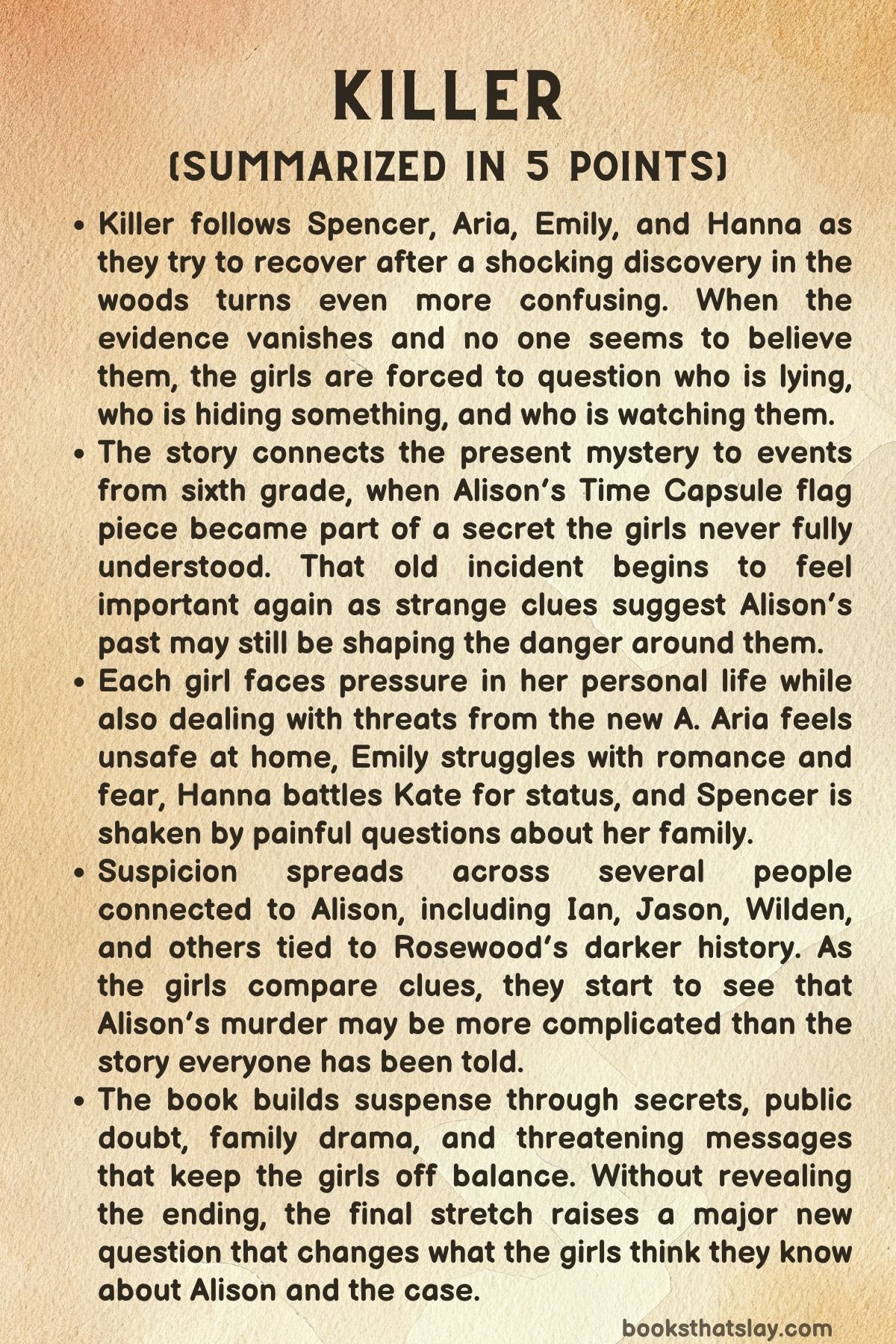
Killer by Sara Shepard is a young adult mystery thriller from the Pretty Little Liars series (6th in the series), centered on four girls trapped between public suspicion, private guilt, and a dangerous stalker who knows too much. Spencer, Aria, Emily, and Hanna are still trying to understand Alison DiLaurentis’s murder when the case takes a darker turn: Ian Thomas, the man accused of killing her, appears dead, then vanishes.
As the girls face threats from the new A, old secrets from Alison’s past begin to surface. Killer is about friendship under pressure, lies that refuse to stay buried, and the fear of not knowing whom to trust.
Summary
Killer begins by looking back to sixth grade, when Spencer, Aria, Emily, and Hanna were not yet Alison DiLaurentis’s chosen circle. Alison was the girl everyone watched, feared, and wanted to impress.
During a Rosewood Day Time Capsule game, she bragged that she had already found a flag piece, making it seem like she was once again ahead of everyone else. Spencer, Aria, Emily, and Hanna separately sneak into Alison’s backyard, each hoping to steal the flag and gain some power over her.
Instead, they discover one another hiding there.
While they are near the DiLaurentis house, they notice trouble inside. Alison appears to be arguing with someone, and Jason, her older brother, storms out in anger.
When Alison comes outside, she tells the girls that her flag piece has already been stolen. Soon after this strange incident, Alison suddenly drops her old friends, Naomi and Riley, and begins spending time with Spencer, Aria, Emily, and Hanna.
Aria secretly has the stolen flag piece, but she never admits it. The memory suggests that the flag may have carried a clue connected to Alison’s later death.
In the present, the four girls are still shaken by what they found in the woods behind Spencer’s house: Ian Thomas’s dead body. Ian had been accused of killing Alison, but before his trial he told Spencer he was innocent and claimed he had uncovered an important secret.
When Spencer, Aria, Emily, Hanna, and Officer Wilden return to the clearing, Ian’s body is gone. Wilden treats their story with doubt and suggests Ian may not have been dead at all.
The girls are certain they saw his body, but without proof, they look unstable and dishonest.
The police search the woods, yet no body appears. The situation grows worse when the media turns against the girls.
Instead of being treated as witnesses, they become the story. Reporters and viewers begin to suggest they invented Ian’s death for attention or to keep themselves connected to Alison’s murder case.
Ian’s family then receives a message supposedly from him, saying he is safe and innocent. To the public, this makes the girls seem even less believable.
To the girls, it feels like someone is carefully controlling what everyone sees.
The new A continues to torment them with messages that prove A knows what happened in the woods. Spencer later receives instant messages from someone claiming to be Ian.
The person uses Ian’s private middle name, Elizabeth, which makes the contact feel impossible to dismiss. At the same time, A warns Spencer that something about the case is wrong and that she needs to figure it out.
Spencer is left questioning whether Ian is alive, whether someone is pretending to be him, or whether the truth is being hidden by someone close to the investigation.
Each girl faces pressure in her personal life as the mystery deepens. Aria moves in with her father, Byron, and his pregnant fiancée, Meredith, because her mother’s boyfriend, Xavier, has been behaving inappropriately toward her.
This move does not bring much comfort. Byron and Meredith live near Spencer’s woods, keeping Aria physically close to the place where Ian’s body disappeared.
She feels boxed in by family tension, fear, and the growing sense that Alison’s old secrets are still active around them.
Aria also has an unsettling encounter with Jason DiLaurentis at the train station. Jason flirts with her, which both attracts and alarms her, but he suddenly runs off when a news report says Ian’s body was a hoax.
His strange behavior makes Aria wonder what he knows. Later, she checks Alison’s old Time Capsule flag piece and notices a suspicious mark that seems to point toward Jason.
This pulls the past and present together in a way that makes Jason look increasingly important.
Emily’s life also changes. She grows closer to Isaac and eventually loses her virginity to him.
Their relationship offers her tenderness and escape, but it quickly becomes complicated when Isaac’s mother seems to understand what happened and silently blames Emily. Emily is also frightened by Jason after he explodes at her over a tiny dent in his car.
His rage feels far larger than the situation deserves. As Emily thinks about Alison, Jason, and the missing pieces of the case, she becomes convinced that Jason’s past matters.
Clues suggest he may once have stayed at Radley, a mental hospital, which raises even more questions about what the DiLaurentis family kept hidden.
Hanna’s main battle is social. She is locked in a rivalry with Kate, her future stepsister, as they compete for status and for Mike Montgomery’s attention.
Hanna finds another Time Capsule flag piece, which makes her think back to Alison’s original stolen flag. She begins to wonder whether Naomi and Riley, Alison’s former friends, may have been involved in stealing it before Alison replaced them with the four girls.
Hanna cannot prove anything, but the memory makes the old friendship shift seem less random. Her competition with Kate grows more intense, though Mike eventually reveals that he understood both girls were fighting over him.
Spencer is pulled into a different kind of crisis when she starts investigating whether she might be adopted. A message from Olivia Caldwell, a woman claiming to be her birth mother, leads Spencer to New York.
Spencer wants answers about who she is and why her family treats her with such coldness, but Olivia turns out to be a scammer who tricks her out of money. Spencer returns humiliated and hurt.
At home, things are no better. Her family blames her for the public scandal surrounding Ian, and the situation worsens after someone paints KILLER and LIAR on their property.
As the girls keep investigating, they uncover more links among Jason, Ian, Wilden, Radley, and Alison. Wilden’s behavior continues to seem suspicious, especially because he delays action and appears unwilling to take the girls seriously.
The more the girls learn, the less they believe Ian’s disappearance is simple. It seems possible that someone removed his body, sent fake messages, and used the public’s dislike of the girls to hide the truth.
Near the end of Killer, Aria finds a major piece of evidence while crossing the woods to meet the others: Ian’s Rosewood Day class ring. The ring proves Ian really was in the woods, supporting what the girls saw and challenging the official story that his death was a lie.
Before the girls can fully process this, someone sets the woods on fire using accelerant. The fire turns the investigation into a fight for survival.
As the girls flee, Aria finds a trapped girl who says she was lured there by a note. Aria rescues her from the flames.
When the soot clears from the girl’s face, Spencer, Aria, Emily, and Hanna are stunned. The girl looks exactly like Alison.
This discovery changes everything they thought they knew about Alison’s death, Ian’s secret, and A’s game. Killer ends with the mystery wider than before, leaving the girls facing the possibility that the truth about Alison is far stranger and more dangerous than they ever imagined.
Characters
Spencer Hastings
Spencer is one of the most anxious and intellectually driven characters in Killer. She responds to danger by investigating it, trying to turn fear into evidence and confusion into a pattern she can understand.
After seeing Ian’s body disappear from the woods, Spencer becomes trapped between what she knows she saw and what everyone else is willing to believe. This makes her character especially tense because she is not only fighting A’s threats but also fighting public doubt, police suspicion, and her own family’s disappointment.
Her need to prove the truth becomes deeply personal, especially because Ian had contacted her before his death and claimed he had uncovered an important secret.
Spencer’s emotional vulnerability is shown most clearly through the Olivia Caldwell storyline. Her fear that she may be adopted reveals how unstable her identity feels beneath her polished, high-achieving surface.
She wants certainty, belonging, and some explanation for why she feels so disconnected from her family. Olivia’s scam hurts Spencer because it exploits exactly what she is most desperate for: a sense of origin and acceptance.
This makes Spencer a tragic figure in the book because even her intelligence cannot protect her from emotional manipulation. Her character shows how easily the search for truth can become tangled with the search for love.
Aria Montgomery
Aria is a thoughtful, observant, and emotionally conflicted character whose role in the story often connects the past and present mysteries. Her secret possession of Alison’s stolen Time Capsule flag piece from sixth grade makes her more important to the mystery than she initially appears.
She carries a hidden connection to Alison’s past, and that secret creates a quiet layer of guilt around her. Aria’s character is shaped by secrecy, discomfort, and the feeling that she is always living too close to danger.
In the present, Aria’s home life becomes another source of pressure. Moving in with Byron and Meredith is supposed to help her escape Xavier, but it does not truly give her safety or peace.
Instead, she ends up physically closer to the woods and to the mystery surrounding Ian’s disappearance. Her encounter with Jason shows her attraction to danger and uncertainty, because Jason is charming one moment and frightening or evasive the next.
Aria also plays a crucial role near the end when she examines Alison’s old flag piece, finds Ian’s class ring, and helps rescue the girl from the fire. Her character combines sensitivity with courage, and although she often seems unsure of herself, she repeatedly moves toward the truth when it matters.
Emily Fields
Emily is one of the most emotionally open characters in the book, and her sensitivity makes both love and fear feel especially intense for her. Her relationship with Isaac gives her a chance to experience tenderness and intimacy, but it also brings shame, judgment, and vulnerability.
After she loses her virginity to him, Isaac’s mother’s reaction makes Emily feel silently accused. This moment shows how Emily often absorbs other people’s disapproval deeply, even when they do not directly confront her.
Emily’s connection to the mystery grows stronger through her encounters with Jason. His sudden rage over the dent in his car frightens her and pushes her to think more seriously about his possible connection to Alison’s death.
Emily is not as outwardly calculating as Spencer, but she has strong instincts, and those instincts become important as she begins to suspect that Jason’s past at Radley may matter. Her character represents emotional truth in the story.
She may be frightened, but she does not easily dismiss what she feels or notices. This makes her both vulnerable and perceptive.
Hanna Marin
Hanna is socially sharp, insecure, and more emotionally wounded than she first appears. Her rivalry with Kate reveals how much Hanna still depends on popularity and social approval to feel powerful.
She wants control over her image, her relationships, and her place in Rosewood’s social world, but Kate threatens all of that. Their competition over Mike is not only about romance; it is also about status, validation, and Hanna’s fear of being replaced.
At the same time, Hanna’s memories of the Time Capsule flag show that she is more than a social schemer. She begins to connect the present mystery to the girls’ sixth-grade past, especially through her suspicion that Naomi and Riley may have been involved in stealing Alison’s flag piece.
Hanna’s character works well because she combines vanity and courage, insecurity and intelligence. She can be dramatic and competitive, but she is also loyal to her friends and increasingly willing to face frightening truths.
Her growth comes from learning that popularity cannot protect her from A, from the past, or from the consequences of secrets.
Alison DiLaurentis
Alison is the central mystery around whom the story revolves. Even though she is presumed dead for most of the book, her influence controls the lives of Spencer, Aria, Emily, and Hanna.
In the sixth-grade flashback, Alison already appears powerful, secretive, and manipulative. She enjoys being the center of attention, brags about finding a Time Capsule flag piece, and then abruptly changes her friend group by abandoning Naomi and Riley for the four main girls.
This shows how Alison treats friendship as something she can rearrange for her own purposes.
Alison’s character is fascinating because she is both victim and force of control. Her death creates fear, suspicion, and grief, but her past behavior also left behind many enemies and unresolved secrets.
The stolen flag suggests that even small childhood games around Alison carried deeper meanings. By the end, the appearance of a girl who looks exactly like Alison completely destabilizes what the girls thought they knew.
Alison’s character therefore represents the danger of appearances. Whether present through memory, evidence, or resemblance, she remains the figure who makes every answer feel uncertain.
Ian Thomas
Ian is one of the most ambiguous characters in the story. He had been accused of killing Alison, yet before his trial he tells Spencer that he is innocent and that he has discovered a major secret.
This makes him difficult to read because the girls have reason to fear him, but they also have reason to believe he may have been silenced. His dead body appearing and then disappearing turns him from a suspected villain into another piece of the larger mystery.
Ian’s character adds moral uncertainty to the book. If he is guilty, then his disappearance may seem like another manipulation.
If he is innocent, then his death suggests that someone even more dangerous is controlling the situation. The messages supposedly from Ian complicate this further, especially when the sender proves knowledge of private information.
Ian becomes less important as a person than as a symbol of the unstable truth surrounding Alison’s murder. His character shows that in this story, being accused does not necessarily mean being the real threat.
A
A is the hidden force of surveillance, fear, and psychological control. This version of A knows what the girls saw in the woods and uses that knowledge to threaten them when no one else believes them.
A’s power comes not only from secrets but from timing. The messages arrive when the girls are already frightened, confused, or publicly humiliated, making them feel watched at their weakest moments.
A functions as both villain and manipulator of truth. Rather than simply exposing secrets, A reshapes reality around the girls.
Ian’s missing body, the fake message to his family, the media’s suspicion, and the clues that appear at just the right moments all create the feeling that someone is controlling the entire story from behind the scenes. A’s character is terrifying because A does not need to appear physically to dominate the girls’ lives.
The threat is constant because it can come through a message, a clue, a trap, or a public accusation.
Officer Wilden
Officer Wilden is a suspicious authority figure whose behavior makes the girls feel even less safe. When Ian’s body disappears, Wilden doubts the girls and suggests that Ian may have only been injured.
Instead of helping them feel protected, he makes them feel judged and dismissed. His skepticism contributes to the public idea that the girls may have invented the story for attention.
Wilden’s character is important because he represents corrupted or unreliable authority. The girls are already being hunted by A, but Wilden’s attitude makes the official investigation feel dangerous too.
His delays and suspicious behavior suggest that he may know more than he admits, or that he is at least unwilling to act honestly. In the story, Wilden makes the girls’ isolation worse because they cannot fully trust the person who should be helping them.
Jason DiLaurentis
Jason is one of the most unsettling characters in Killer because he shifts between charm, anger, secrecy, and possible danger. In the sixth-grade flashback, he storms out of the DiLaurentis house after a fight, immediately placing him near one of the earliest mysteries involving Alison.
In the present, his flirtation with Aria shows a softer and more attractive side, but his abrupt escape after the news report makes him seem deeply suspicious.
Jason’s frightening confrontation with Emily over a small dent in his car reveals how unstable he can be. His connection to Radley makes him even more mysterious, suggesting that his past may hold secrets linked to Alison, Ian, and the larger mystery.
Jason’s character is effective because he is never easy to place completely on one side. He might be damaged, dangerous, misunderstood, or all three.
His presence keeps the story tense because every interaction with him feels like it could reveal affection, violence, or hidden knowledge.
Byron Montgomery
Byron is Aria’s father, and his role in the story is tied mostly to Aria’s complicated home life. By allowing Aria to move in with him and Meredith, he appears to offer her an escape from Xavier’s inappropriate behavior.
However, the move does not truly solve Aria’s problems. Instead, it places her in another uncomfortable environment, especially because Meredith is pregnant and the new household has its own emotional tension.
Byron’s character represents imperfect parental protection. He is not shown as deliberately cruel, but he is also not fully aware of the danger and discomfort surrounding Aria.
His decisions affect her deeply, even when he may not understand the full consequences. Through Byron, the story shows how adults can fail to protect teenagers not only through malice, but through blindness, distraction, or emotional distance.
Meredith
Meredith is Byron’s pregnant fiancée, and her presence complicates Aria’s sense of belonging. She is part of the household Aria moves into, but she does not make that home feel entirely comfortable or safe.
Her pregnancy also symbolizes the way Byron’s life is moving forward into a new family structure, while Aria is still struggling with fear, secrecy, and instability.
Meredith’s character is important because she intensifies Aria’s emotional displacement. Aria is not simply moving into her father’s house; she is entering a space where she may feel like an outsider.
Meredith does not need to be an obvious antagonist to create tension. Her role shows how family changes can quietly deepen a character’s loneliness, especially when that character is already carrying secrets and fear.
Xavier
Xavier is a disturbing figure in Aria’s life because his inappropriate behavior forces her to leave her mother’s home. Even though he is not central to the Alison mystery, he creates a different kind of threat: one inside the domestic world.
His presence shows that danger in the story does not only come from A, the woods, or the investigation. It can also come from adults who abuse trust and make a home feel unsafe.
Xavier’s character helps explain Aria’s emotional state. She is not only frightened by the mystery surrounding Ian and Alison; she is also trying to escape a personal situation that makes her feel cornered.
His role makes Aria’s move to Byron’s house feel less like a choice and more like an act of survival. He adds to the book’s larger theme that the girls are often surrounded by adults who either threaten them directly or fail to protect them properly.
Isaac
Isaac is Emily’s love interest and represents intimacy, tenderness, and emotional risk. Through him, Emily experiences a relationship that feels meaningful and physically significant.
Her decision to lose her virginity to him is an important moment in her personal development because it shows her desire for closeness and trust.
However, Isaac’s role is not only romantic. His relationship with Emily also exposes her to judgment, especially through his mother’s reaction.
Isaac becomes part of Emily’s conflict between private desire and public shame. His character matters because he allows the story to explore Emily as more than a girl trapped in mystery.
She is also someone trying to understand love, sexuality, and the consequences of being emotionally open with another person.
Isaac’s Mother
Isaac’s mother is a minor but meaningful character because of the pressure she places on Emily without needing to say much. Her silent blame after realizing what happened between Emily and Isaac makes Emily feel judged and exposed.
This reaction deepens Emily’s shame and discomfort, even though the situation is personal and intimate.
Her character represents social and moral judgment. She does not function as a major villain, but she contributes to the emotional pressure surrounding Emily.
In a story already full of secrets, Isaac’s mother reminds the reader that not all threats are dramatic or mysterious. Some come through disapproval, silence, and the feeling of being watched by someone who has already decided what to think.
Kate
Kate is Hanna’s stepsister-to-be and one of her strongest social rivals. She challenges Hanna’s control over popularity, status, and attention, especially when Mike becomes part of their competition.
Kate’s character brings out Hanna’s insecurity because she threatens the image Hanna works so hard to maintain.
Kate is not simply a rival for the sake of drama. She exposes how fragile Hanna’s confidence can be.
Around Kate, Hanna becomes more competitive, defensive, and desperate to prove herself. This makes Kate important because she forces Hanna to confront the parts of herself that still depend on approval from others.
Their rivalry shows how social power can become its own battlefield, even while larger dangers are unfolding around them.
Mike Montgomery
Mike is connected most strongly to Hanna and Kate’s rivalry. His attention becomes something both girls compete for, which turns him into a symbol of validation.
When he admits that he knew they were both competing for him, it changes the dynamic by showing that he is not as unaware as they may have believed.
Mike’s character adds a lighter but still revealing layer to the story. Through him, Hanna’s need to win becomes obvious, and Kate’s competitiveness becomes sharper.
He is not central to the murder mystery, but his role matters because he brings out important traits in the characters around him. He shows how teenage relationships in the book are often shaped by pride, performance, and the desire to be chosen.
Olivia Caldwell
Olivia Caldwell is a manipulative and damaging character because she uses Spencer’s emotional vulnerability for personal gain. By claiming to be Spencer’s birth mother, she offers Spencer the possibility of belonging and answers.
Spencer wants to believe her because the idea of adoption gives her a possible explanation for why she feels alienated from her family.
Olivia’s betrayal is cruel because it targets Spencer’s deepest insecurity. She does not merely steal money; she steals hope.
Her character shows that not every threat in the story comes from the central mystery. Some people exploit pain in ordinary, selfish ways.
Olivia’s scam leaves Spencer devastated and reinforces the book’s idea that truth is difficult to find because lies often appear in the form of exactly what someone wants most.
Naomi
Naomi is part of Alison’s former social circle, and her role is important because she belongs to the period before Spencer, Aria, Emily, and Hanna became Alison’s chosen friends. Alison abruptly dropping Naomi and Riley shows how easily Alison could discard people.
This makes Naomi a reminder of Alison’s social cruelty and of the resentment that may have existed before the main girls fully understood Alison’s power.
Naomi also becomes connected to the mystery through Hanna’s suspicion that she and Riley may have had something to do with stealing Alison’s original flag piece. Whether or not Naomi is guilty, her presence suggests that Alison’s past had more layers than the girls realized.
Naomi’s character helps widen the mystery beyond the main group and shows that Alison’s influence damaged more people than just her closest friends.
Riley
Riley, like Naomi, represents Alison’s life before she chose Spencer, Aria, Emily, and Hanna as her new inner circle. Her rejection by Alison hints at how painful and humiliating Alison’s friendship could be.
Being dropped by Alison was not just a social change; it was a loss of status and closeness in a world where Alison had enormous power.
Riley’s possible connection to the stolen Time Capsule flag makes her part of the unresolved past. She may be minor in the present action, but she matters because she reminds the reader that childhood events in the story were never innocent.
The flag game, Alison’s shifting friendships, and the secrets surrounding that time all suggest that the roots of the mystery began long before the girls understood what was happening.
Themes
Truth, Manipulation, and Public Doubt
Truth becomes unstable when evidence disappears, authority figures hesitate, and public opinion turns against the girls. The vanished body makes their eyewitness account look false, even though they know what they saw.
This creates a painful gap between personal truth and socially accepted truth. The media and police response show how easily a story can be reshaped when people in power dismiss young women as dramatic, confused, or attention-seeking.
A’s messages make this even worse because they mix real clues with intimidation, forcing the girls to question every source of information. In Killer, truth is not simply hidden; it is actively controlled.
The girls are trapped in a world where proof can be removed, messages can be faked, and reputations can be damaged before facts are confirmed. Their struggle is not only to solve Alison’s mystery but also to make others believe that their fear and knowledge are real.
Guilt and the Weight of Secrets
Secrets from the past continue to shape the girls’ present choices, especially because each secret carries guilt. Aria’s hidden possession of Alison’s Time Capsule flag piece is not just a small childhood betrayal; it becomes tied to a larger mystery involving Alison’s death.
Spencer’s investigation into her identity exposes her longing for belonging, but also leaves her vulnerable to deception. Hanna’s memories of rivalry and social competition show how old jealousies can grow into suspicion.
Emily’s fear around Jason and Radley reveals how personal unease can become part of a broader search for answers. The novel shows guilt as something that does not stay private.
It returns through threats, clues, and accusations, forcing the characters to face what they once avoided. Their secrets make them easier for A to control, because A understands that shame can be as powerful as evidence.
Fear, Surveillance, and Psychological Control
Fear in Killer comes from the constant feeling of being watched. A does not only threaten the girls with danger; A studies their private lives and attacks them at moments when they already feel weak.
This creates a form of psychological control where the girls begin to doubt their surroundings, their relationships, and even their own judgment. The missing body, the suspicious messages, the fire in the woods, and the strange links to Radley all build a sense that danger is nearby but difficult to name.
Each girl experiences this pressure differently: Aria feels trapped by Xavier and the woods near Byron’s house, Emily becomes alarmed by Jason’s rage, Hanna struggles with social humiliation, and Spencer is shaken by family rejection and Olivia’s scam. Fear works by isolating them, but it also pushes them back toward one another as they realize that survival depends on shared trust.
Identity, Appearance, and Hidden Selves
Identity is shown as something unstable, shaped by family, social image, memory, and deception. Spencer’s belief that she might be adopted reveals her fear that her place in her own family has always been uncertain.
Hanna’s conflict with Kate shows how identity can become a performance, especially in social spaces where popularity and desirability matter. Aria’s movement between households reflects her discomfort with the roles adults force onto her, particularly when she is expected to tolerate unsafe behavior quietly.
Emily’s relationship with Isaac brings intimacy, but also judgment, showing how personal growth can be shadowed by shame imposed by others. The final appearance of a girl who looks exactly like Alison turns identity into a central mystery rather than a fixed fact.
The characters are surrounded by people who may not be who they seem, and the past itself becomes harder to understand because appearances keep misleading them.