Inherent Vice Summary, Characters and Themes
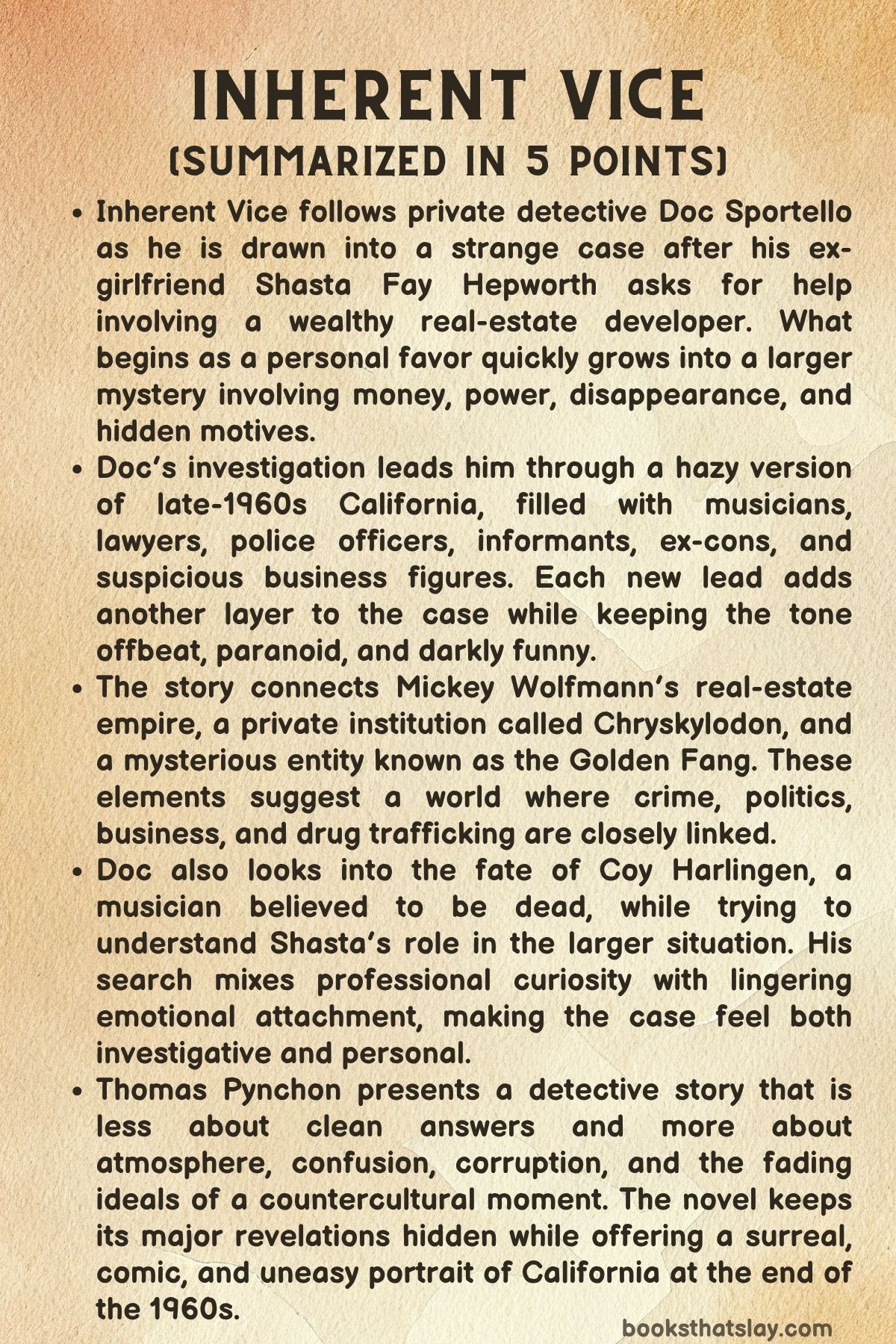
Inherent Vice by Thomas Pynchon is a strange, comic, and shadowy detective novel set in Southern California at the end of the 1960s. It follows private investigator Doc Sportello, a laid-back hippie sleuth whose work pulls him through real-estate schemes, police pressure, drug networks, missing people, surf musicians, and old romantic trouble.
The book mixes crime fiction with countercultural confusion, showing a world where money, power, law enforcement, and crime often seem to share the same rooms. At its center is Doc’s attempt to understand what happened to a vanished developer, his former lover Shasta, and a mysterious force called the Golden Fang.
Summary
Inherent Vice begins when private investigator Larry “Doc” Sportello receives a late-night visit from his former girlfriend, Shasta Fay Hepworth. She has been out of his life for more than a year, so her sudden arrival immediately brings back old feelings and suspicion.
Shasta tells Doc that she is now involved with Mickey Wolfmann, a rich and powerful real-estate developer. According to her, Mickey’s wife, Sloane Wolfmann, and Sloane’s lover, Riggs Warbling, may be plotting to have Mickey declared mentally unfit and placed in an institution.
Their goal, Shasta believes, is to take control of Mickey’s fortune.
Doc is drawn into the case partly because he still cares about Shasta and partly because the story sounds too strange to ignore. He reaches out to his Aunt Reet, who knows the real-estate world well.
She warns him that Mickey Wolfmann is not an ordinary businessman. He is wealthy, erratic, well connected, and protected by dangerous men, including Aryan Brotherhood bodyguards.
Mickey is also linked to Channel View Estates, a new development that has destroyed older neighborhoods in the name of profit.
Soon after, Doc is hired by Tariq Khalil, a Black ex-convict who wants him to find Glen Charlock. Glen is one of Mickey’s Aryan Brotherhood bodyguards and owes Tariq money from their time in prison.
Tariq also tells Doc that his former neighborhood has been bulldozed for Mickey’s Channel View Estates, giving the case a wider social edge. What first seemed like a private romantic and financial scheme now begins to involve race, prison history, real estate, and the cost of development.
Doc follows the lead to Channel View Estates and visits Chick Planet Massage, where he asks two women, Jade and Bambi, about Glen. The visit goes wrong fast.
Doc blacks out and later wakes up at the construction site. Detective Christian “Bigfoot” Bjornsen of the LAPD is standing over him.
Glen Charlock is dead nearby, Mickey Wolfmann has disappeared, and Doc’s car is found close to the body. Bigfoot treats Doc as a suspect and questions him hard, but eventually lets him go.
His release is not exactly mercy; Bigfoot seems to hope Doc will lead the police to whoever is really behind the killing and Mickey’s disappearance.
As Doc tries to clear himself and understand the case, he learns that Shasta has also vanished. Her disappearance deepens the mystery and makes Doc more personally invested.
Around the same time, another woman, Hope Harlingen, hires him for a different matter. Hope believes that her husband, Coy Harlingen, may still be alive even though he was reported dead from a heroin overdose.
Coy had played saxophone in a surf band called the Boards, and Hope’s doubts are strengthened by a strange bank deposit that appeared after his supposed death.
Doc’s inquiries into Coy begin to connect with his search for Mickey and Shasta. Musicians and contacts suggest that Coy may have survived and may be hiding in plain sight.
His old band, the Boards, seems to know more than they admit. Doc also learns that Coy had links to Shasta, which makes the cases feel less separate and more like parts of a larger arrangement.
Doc then turns his attention back to Mickey’s household. Pretending to represent a psychiatric clinic, he visits the Wolfmann mansion and meets Sloane and Riggs.
There he notices clues connected to Chryskylodon, a private mental institution that may have financial ties to Mickey. While snooping in Mickey’s bedroom, Doc finds a set of custom erotic neckties showing women from Mickey’s life.
The collection includes Sloane and another woman named Luz, but Shasta is missing from it. This absence bothers Doc because it suggests that Shasta’s place in Mickey’s world may not be what she claimed, or that someone has carefully removed signs of her.
Doc also talks with Penny Kimball, a deputy district attorney with whom he has a complicated personal connection. He tells her Shasta’s story, but Penny is guarded and appears to know more than she wants to say.
Through Penny, Doc is drawn into a meeting with federal agents. They question him about Tariq, Mickey’s disappearance, and other figures connected to the case.
The presence of federal agents suggests that the trouble around Mickey is bigger than a murder investigation.
Jade later reappears and apologizes to Doc for helping the police place him at the crime scene. She warns him about something called the Golden Fang.
At first, the Golden Fang sounds like a boat, but it soon becomes much more confusing. Coy Harlingen appears alive in the parking lot and confirms that he has been hiding.
He asks Doc to check on Hope and their daughter, Amethyst, but not to tell them he is alive. Coy explains that he is trapped in a role he cannot easily escape.
He is being used as an informant and political plant by powerful people. He also says the Golden Fang is tied to dangerous forces.
With help from his lawyer Sauncho Smilax, Doc sees the schooner Golden Fang in San Pedro. Sauncho explains that the vessel has a strange history.
It had once been a Canadian fishing schooner called Preserved, but it later took on a darker identity, with unclear ownership and suspected smuggling connections. Doc’s friend Fritz searches the ARPAnet and finds links between the Golden Fang, intelligence operations, heroin, anti-Communist activity, money laundering, and Shasta’s departure from the country.
Doc also has a drug-influenced vision of Shasta aboard the ship, alive but under pressure.
The Golden Fang becomes the main symbol of the case’s hidden structure. It seems to be a ship, a business network, a drug operation, and perhaps a larger system that joins crime, finance, medicine, and government influence.
Massage parlors, real-estate money, private clinics, heroin routes, and political manipulation all appear to run through it in some way. Doc cannot pin it down as one thing because it keeps changing shape depending on where he looks.
Doc continues investigating the Boards by visiting their house in Topanga while pretending to be a music journalist. The band’s world is full of paranoia, surveillance, drugs, and evasions.
Coy’s presence around them confirms that his death was staged, but it also shows how little freedom he has. He is alive, yet unable to return to his family or live openly.
His situation mirrors the larger mood of the novel, where people can disappear without fully dying and survive without truly being free.
Doc also learns more about what happened at Channel View Estates. Footage of the incident shows that Glen Charlock was killed by masked gunmen, not by accident or random violence.
Clancy Charlock, Glen’s widow, leads Doc to Boris Spivey, another bodyguard. Boris explains that Mickey had recently changed.
He had begun thinking about giving away his fortune and using his money to repair some of the damage caused by his developments. This frightened people around him, including those who benefited from his wealth.
The kidnapping was arranged because Mickey’s new plans threatened too many interests.
Boris also reveals that Puck Beaverton, another guard, was supposed to cooperate with the kidnappers, but he switched shifts with Glen. As a result, Glen was the one present during the raid and was killed.
This makes Glen’s death both planned and accidental: the attack was organized, but the wrong man may have paid the price.
Shasta sends Doc a postcard from a remote Pacific island. Her message is apologetic and mysterious.
She suggests that she did not intend for events to turn out as they did, but she does not fully explain her role. The postcard also refers to an old Ouija-board episode from her past with Doc.
Following that memory and the address connected to it, Doc discovers a bizarre building shaped like a golden fang. This turns out to be another face of the organization he has been chasing.
Inside this strange headquarters, Doc meets Dr. Rudy Blatnoyd and crosses paths with Japonica Fenway, a troubled former runaway connected to Chryskylodon. The place links dentistry, medicine, money, and control in a way that makes the Golden Fang feel even more unsettling.
It is not only a criminal network but also a system that absorbs people, profits from their weaknesses, and hides behind respectable fronts.
By the end of the book, Doc has not solved everything, but the shape of the mystery has become clearer. Mickey’s disappearance is tied to his attempt to change how his fortune would be used.
Shasta’s involvement remains uncertain, mixing guilt, survival, and possible manipulation. Coy is alive but trapped by the forces that control him.
Chryskylodon, the Golden Fang, drug trafficking, real-estate power, and law enforcement all appear to be connected in a shadowy structure that Doc can sense but not fully expose.
The excerpt closes with Doc retrieving his repaired car and running into Tito Stavrou, who offers lunch and asks for advice. This ending keeps the story moving in the loose, unsettled rhythm of Inherent Vice.
Every answer opens another lead, and every lead suggests a wider corruption beneath the sunny surface of California life.
Characters
Doc Sportello
Doc Sportello is the central figure of Inherent Vice, and his role as a private detective places him at the middle of nearly every mystery, disappearance, and deception in the book. He is not a traditional hard-boiled detective with emotional distance and strict control; instead, he is scattered, drug-influenced, deeply intuitive, and often guided as much by memory and feeling as by evidence.
His investigation begins because of Shasta, but it gradually grows into something much larger, involving real estate corruption, police manipulation, political paranoia, drug networks, and the strange power of the Golden Fang. Doc’s strength lies in his openness to contradiction.
He listens to ex-cons, musicians, addicts, lawyers, police officers, and fugitives without immediately dismissing them, which allows him to see connections that more rigid characters miss.
Doc is also emotionally vulnerable, especially where Shasta is concerned. Her return unsettles him because she represents both desire and loss, a connection to a past that cannot be recovered.
Even when he suspects she may be hiding things from him, he continues to follow the trail because his feelings for her remain unresolved. This makes him both sympathetic and exposed.
His detective work is never only professional; it is personal, nostalgic, and haunted by the knowledge that the world around him is changing. Through Doc, the book presents a character trying to make sense of a society where freedom, love, and countercultural ideals are being absorbed or destroyed by money, surveillance, addiction, and institutional power.
Shasta Fay Hepworth
Shasta Fay Hepworth is one of the most elusive and important characters in the book. She enters the story as Doc’s former girlfriend, but she is never simply a romantic figure from his past.
Her sudden visit pulls Doc into the larger mystery, and her involvement with Mickey Wolfmann places her at the intersection of desire, wealth, manipulation, and danger. Shasta seems frightened when she first comes to Doc, warning him about a possible plot against Mickey, yet her later disappearance makes her motives difficult to read.
She may be a victim, a participant, a witness, or some combination of all three.
Shasta’s absence is as powerful as her presence. Much of the investigation is shaped by what Doc does not know about her: where she has gone, what she truly wants, and whether she intended to involve him in something dangerous.
The fact that Mickey’s erotic necktie collection includes other women but not Shasta suggests that she occupies a different emotional or symbolic position in his life. She is not merely one more possession in Mickey’s world, yet she is still caught within systems controlled by men, money, and secrecy.
Her postcard from a Pacific island adds to her mystery, revealing regret without fully explaining responsibility. Shasta represents the painful instability of memory and desire: Doc wants to understand her, but she remains beyond complete interpretation.
Mickey Wolfmann
Mickey Wolfmann is a wealthy real-estate developer whose disappearance drives much of the plot. At first, he appears to be a familiar figure of power: rich, exploitative, protected by violent bodyguards, and responsible for developments like Channel View Estates, which erase older communities in the name of profit.
His wealth gives him influence over banks, institutions, and people, making him a symbol of the forces reshaping California. He is connected to real estate, psychiatric institutions, and possibly the Golden Fang’s financial network, which makes him much more than a missing man.
He becomes a doorway into the hidden machinery of power.
Yet Mickey is not presented as only a villain. The revelation that he had begun thinking about giving away his fortune complicates his character.
This change frightens those around him because it threatens the system that depends on his money and his predictable greed. If Mickey truly wanted to repair some of the harm he caused, then his disappearance becomes not just a crime but a reaction against moral awakening.
His character shows how dangerous repentance can be when a person’s wealth supports too many corrupt interests. Mickey’s tragedy lies in the fact that once he becomes unpredictable to the people who profit from him, he becomes disposable.
Bigfoot Bjornsen
Detective Bigfoot Bjornsen is one of Doc’s most important antagonistic counterparts. As an LAPD detective, he represents official authority, but he is far from a clean or stable symbol of justice.
He harasses Doc, manipulates him, and treats him as both suspect and useful tool. When Doc wakes up near Glen Charlock’s body, Bigfoot immediately occupies a position of power over him, yet his decision to release Doc also shows his tactical intelligence.
He understands that Doc may lead him toward deeper truths, even if he refuses to treat him with respect.
Bigfoot’s relationship with Doc is tense, comic, and strangely dependent. He looks down on Doc’s lifestyle and methods, but he also recognizes that Doc has access to people and subcultures the police cannot easily reach.
Bigfoot’s aggression often feels personal, as though Doc’s existence irritates him because it represents a kind of freedom he cannot allow himself. At the same time, Bigfoot is not entirely foolish; he is observant, calculating, and aware that the official version of events may not be the whole truth.
His character embodies the uneasy overlap between law enforcement, performance, resentment, and institutional control.
Coy Harlingen
Coy Harlingen is one of the most tragic characters in the story because he is alive but forced to live as though he were dead. Officially, he is believed to have died from a heroin overdose, but Doc discovers that Coy has survived and is being used by powerful people as an informant and political plant.
His false death separates him from Hope and their daughter Amethyst, making his survival feel almost like another form of imprisonment. Coy is trapped between addiction, state control, and his longing for family.
Coy’s character reveals the human cost of the political paranoia running through the book. He is not simply hiding; he is being managed, moved, and used.
His connections to the Boards, Shasta, and the Golden Fang make him part of the larger conspiracy, but emotionally his story remains focused on loss. His request that Doc check on Hope and Amethyst without revealing that he is alive shows both his love and his helplessness.
Coy wants to return to ordinary life, but the systems controlling him make that nearly impossible. He becomes a figure of erased identity, a man whose existence has been taken over by forces that benefit from keeping him invisible.
Hope Harlingen
Hope Harlingen is defined by grief, suspicion, and emotional endurance. She comes to Doc because she refuses to fully accept the official story of Coy’s death.
Her belief that something is wrong shows that she is more perceptive than the authorities or other people may assume. She notices the strange bank deposit after Coy’s supposed death and follows her instinct that the truth has been hidden from her.
In this way, Hope helps open one of the book’s most important emotional mysteries.
Hope’s importance lies not only in her role as Coy’s wife but also in what she represents: the people left behind when conspiracies and institutions consume individual lives. She is raising Amethyst while carrying the pain of Coy’s absence, and the uncertainty surrounding his fate prevents her from properly mourning or moving forward.
Her character brings emotional seriousness to a plot filled with absurdity and paranoia. Through Hope, the story shows that hidden political games and criminal networks do not only affect those directly involved; they also damage families, relationships, and the possibility of trust.
Amethyst Harlingen
Amethyst Harlingen is Coy and Hope’s daughter, and though she is not a major active force in the investigation, her presence gives Coy’s story emotional weight. She represents the life Coy has been forced to abandon and the innocence damaged by the choices and schemes of adults.
Coy’s concern for her shows that his identity as a father remains central to him, even when his public identity has been erased. Amethyst becomes a quiet reminder of what is at stake beyond drugs, money, and conspiracies.
Her role also deepens Hope’s character. Hope is not only a grieving wife but also a mother trying to protect her child from confusion and loss.
Amethyst’s existence makes Coy’s false death more painful because it is not merely a disappearance from society; it is a disappearance from a family that needs him. In the book, she symbolizes the future that characters like Coy are denied, and her vulnerability contrasts with the corruption and manipulation surrounding the adults.
Tariq Khalil
Tariq Khalil is an ex-con who hires Doc to find Glen Charlock, an Aryan Brotherhood member who owes him money. His role initially seems like a separate job, but it quickly becomes part of the larger mystery surrounding Mickey Wolfmann, Channel View Estates, and Glen’s death.
Tariq’s history with Glen reveals the strange and uneasy connections formed in prison, where racial divisions and criminal alliances exist side by side. His demand for repayment is personal, but it also leads Doc directly into the dangerous space where Mickey’s business interests and violent protection networks overlap.
Tariq also connects the mystery to the destruction of neighborhoods. His old community has been bulldozed for Mickey’s development, which gives his character a broader social significance.
He is not merely a client looking for money; he is someone whose life has been shaped by incarceration, racial conflict, and real-estate displacement. Through Tariq, the story shows how powerful men like Mickey affect people far below them economically and socially.
His presence brings the consequences of development into sharper focus, grounding the conspiracy in material loss.
Glen Charlock
Glen Charlock is dead early in the story, but his death is one of the key events that drives the investigation. As one of Mickey Wolfmann’s Aryan Brotherhood bodyguards, he is associated with violence, intimidation, and racial hatred.
Yet the circumstances of his death reveal that he is also a pawn in a much larger scheme. At first, his body near Doc makes Doc look suspicious, but later evidence shows that Glen was murdered by masked gunmen during the operation involving Mickey’s disappearance.
Glen’s character is important because he represents how easily violent men can themselves become expendable. He works as protection for Mickey, but he is not truly protected by the system he serves.
The shift-switch involving Puck Beaverton leaves Glen in the wrong place at the wrong time, turning him into a casualty of a plan he may not have fully understood. His death exposes the organized nature of Mickey’s disappearance and shows that the people surrounding wealth and power are often sacrificed when secrecy must be preserved.
Sloane Wolfmann
Sloane Wolfmann is Mickey’s wife and one of the first figures Shasta identifies as a possible threat to him. She is suspected of plotting with Riggs Warbling to have Mickey committed so they can gain control of his fortune.
Whether or not every detail of this suspicion is straightforward, Sloane clearly belongs to a world of wealth, manipulation, and hidden motives. Her connection to Chryskylodon makes her part of the institutional side of the mystery, where psychiatric treatment may be used as a tool of control rather than healing.
Sloane’s character reflects the cold logic of moneyed relationships in the book. Marriage, desire, and financial interest are entangled in ways that make genuine emotion difficult to separate from strategy.
Her relationship with Riggs suggests betrayal, but the larger issue is her possible willingness to use Mickey’s mental state against him. Sloane is not given the same emotional vulnerability as characters like Hope or Shasta; instead, she is presented as someone positioned close to wealth and therefore close to danger.
Her importance comes from the way she helps reveal that private domestic arrangements can become part of larger financial and institutional schemes.
Riggs Warbling
Riggs Warbling is Sloane Wolfmann’s lover and an early suspect in the possible plan to institutionalize Mickey. His character is less developed than Sloane’s, but his role is still significant because he represents opportunism within Mickey’s wealthy circle.
If Sloane wants access to Mickey’s fortune, Riggs appears to be aligned with that ambition. He is part of the atmosphere of betrayal surrounding Mickey before the disappearance occurs.
Riggs also helps establish the theme of people trying to profit from another person’s instability. He is not a powerful mastermind in the same way the Golden Fang seems powerful, but he belongs to the web of smaller exploiters who gather around wealth.
His presence in the Wolfmann household suggests that Mickey’s personal life is already compromised before the larger conspiracy becomes visible. In this way, Riggs contributes to the sense that Mickey is surrounded by people who may value his money more than his life.
Aunt Reet
Aunt Reet is one of Doc’s most useful sources of information. Her knowledge of real estate allows her to explain Mickey Wolfmann’s power, reputation, and financial connections.
She helps Doc understand that Mickey is not just a rich eccentric but a major developer whose actions affect neighborhoods, banks, and institutions. Her insight gives Doc’s investigation a practical foundation, especially when the case begins moving through savings-and-loan interests and Chryskylodon.
Aunt Reet also represents a form of grounded intelligence that balances Doc’s more chaotic style. Where Doc often moves through intuition, chance encounters, and altered states, Aunt Reet gives him concrete context.
She knows how money and property work, and that knowledge is essential in a story where real estate is tied to corruption and social destruction. Her character shows that family connections can be investigative resources, and her warnings about Mickey help widen the scope of the case from a romantic favor for Shasta into a broader inquiry into power.
Jade
Jade is one of the women Doc meets at Chick Planet Massage, and she becomes more important after Doc realizes he was manipulated around the time Glen Charlock was killed. She later apologizes for her role in helping place him at the scene, which complicates her character.
Jade is not simply deceptive; she appears to be someone caught inside a dangerous network and trying to survive within it. Her warning about the Golden Fang helps push Doc toward the central mystery.
Jade’s role shows how people on the margins are often pressured into serving larger forces. She works in a space connected to fronts, drugs, policing, and surveillance, and her actions suggest fear as much as guilt.
Her apology to Doc gives her a degree of moral awareness, even if she cannot fully undo the harm done to him. She becomes one of the characters who reveals information indirectly, not through official confession but through hints, warnings, and moments of uneasy honesty.
Bambi
Bambi appears alongside Jade at Chick Planet Massage and is part of the scene that leads to Doc’s blackout and his awakening near Glen Charlock’s body. Her role is smaller than Jade’s, but she contributes to the atmosphere of staged seduction, manipulation, and danger surrounding Chick Planet.
The massage parlor is not simply a place of pleasure or vice; it functions as one of the many fronts through which hidden networks operate.
Bambi’s character matters because she helps establish the way Doc is lured into vulnerability. He enters asking questions, but he quickly loses control of the situation.
Like many minor figures in the book, Bambi may not fully command the forces around her, yet she participates in a setting designed to confuse and compromise people. Her presence adds to the sense that the case operates through surfaces: erotic performance, false hospitality, and sudden violence hidden beneath ordinary encounters.
Penny Kimball
Penny Kimball is a deputy district attorney and one of Doc’s romantic connections. Her position gives her access to official knowledge, but her relationship with Doc places her in a complicated moral space.
She listens to him, warns him, and seems to know more than she openly admits. Unlike Bigfoot, she does not simply oppose Doc, but she is still connected to institutions that may be watching, managing, or using him.
Penny’s character is important because she blurs the line between intimacy and authority. She is personally close to Doc, yet professionally tied to the legal system.
Her caution suggests that she understands the dangers surrounding the case, but her ability to help him is limited by her role. She steers him toward federal agents, which may be protective, manipulative, or both.
Penny represents the ambiguous nature of people inside official systems: she may care about Doc, but she cannot stand entirely outside the structures that threaten him.
Sauncho Smilax
Sauncho Smilax is Doc’s lawyer and a key source of information about the Golden Fang schooner. His legal knowledge and maritime interests help Doc understand that the Golden Fang is not only a rumor or criminal name but also a physical vessel with a strange history.
Sauncho’s explanation of the schooner’s past adds another layer to the mystery, connecting the case to smuggling, ownership records, and hidden movement across borders.
Sauncho brings a comic but useful intelligence to the story. He is not a heroic investigator, yet he helps translate obscure legal and nautical details into clues Doc can use.
His presence also shows how Doc’s world depends on informal networks of eccentric specialists. Sauncho’s value lies in his ability to notice significance where others might see only paperwork or maritime trivia.
Through him, the Golden Fang becomes more concrete and more frightening.
Fritz Drybeam
Fritz Drybeam is important because he gives Doc access to ARPAnet searches, allowing the investigation to move into technological and intelligence-related territory. His work connects the Golden Fang to smuggling, heroin, anti-Communist activity, intelligence operations, and Shasta’s possible departure from the country.
Fritz’s role shows that hidden power is not only found in streets, mansions, and institutions; it also exists in data, records, and networks.
Fritz represents a newer kind of investigator, one who can follow electronic traces rather than physical ones. In the world of Inherent Vice, where paranoia often feels exaggerated but repeatedly proves justified, Fritz’s searches provide disturbing confirmation that the conspiracy has deep and wide connections.
He helps expand the story beyond local crime into something international and political. His character may not dominate the emotional plot, but he is essential to revealing the scale of the forces Doc is facing.
Boris Spivey
Boris Spivey is another of Mickey Wolfmann’s bodyguards, and his information helps clarify what happened during Mickey’s disappearance. Unlike Glen, Boris survives long enough to explain that Glen’s death was tied to a planned operation and that Puck Beaverton was supposed to cooperate with the kidnappers.
Boris reveals that Mickey’s decision to give away his fortune created fear among those around him, making Mickey’s disappearance appear less like random violence and more like a response to a threat against financial interests.
Boris’s character is significant because he brings insider knowledge from the world of Mickey’s security detail. He is close enough to violence to understand how the operation worked, but he is also outside the deepest controlling forces.
His revelations help shift Doc’s understanding of the case. Mickey was not taken merely because he was rich; he may have been taken because he had begun to act against the expectations of wealth.
Boris therefore becomes a practical witness to the moral and financial stakes of the plot.
Puck Beaverton
Puck Beaverton is a dangerous and morally suspect figure whose actions contribute to Glen Charlock’s death. He was supposed to cooperate with the kidnappers during the raid on Mickey, but by switching shifts with Glen, he leaves Glen to be killed instead.
This makes him a figure of betrayal, cowardice, or calculation. Puck’s role shows how treachery operates within the violent networks surrounding Mickey.
Puck is important because he demonstrates that the conspiracy depends not only on distant masterminds but also on smaller acts of self-preservation and betrayal. He does not need to control the whole plot to cause great damage; a single shift change helps determine who lives and dies.
His character reflects the brutal logic of the world Doc investigates, where loyalty is fragile and people close to power often survive by sacrificing someone else.
Clancy Charlock
Clancy Charlock is Glen’s widow, and her role helps connect Doc to Boris Spivey. Although she appears in relation to Glen’s death, she also gives the dead body at the center of the case a human connection.
Glen may have been a violent Aryan Brotherhood bodyguard, but Clancy’s presence reminds the reader that his death leaves consequences behind. She helps move the investigation forward while also grounding it in personal loss.
Clancy’s character complicates the emotional field of the story. It would be easy to treat Glen only as a criminal casualty, but Clancy’s widowhood makes his death part of a wider human network.
Her function in the plot is practical, yet her presence also shows how violence spreads beyond its immediate target. She stands at the edge of the conspiracy, not as a mastermind or investigator, but as someone affected by the aftermath.
Japonica Fenway
Japonica Fenway is a troubled former runaway connected to Chryskylodon, and her appearance near the Golden Fang’s tooth-shaped headquarters strengthens the link between institutional control, wealthy families, and unstable young people. She is unpredictable, damaged, and darkly comic, but beneath that comic energy is a sense of real vulnerability.
Her connection to Chryskylodon suggests that the institution gathers people who can be labeled unstable and then managed by systems beyond their control.
Japonica’s character shows how rebellion and confinement exist side by side. As a runaway, she suggests resistance to family and social control, but her connection to psychiatric treatment shows how that resistance can be contained or pathologized.
She belongs to the book’s broader world of people who have slipped out of ordinary social categories and become vulnerable to exploitation. Her presence around Dr. Blatnoyd also adds to the unsettling mixture of medicine, sexuality, danger, and absurdity surrounding the Golden Fang.
Dr. Rudy Blatnoyd
Dr. Rudy Blatnoyd is connected to the bizarre tooth-shaped building associated with the Golden Fang, and his role adds a grotesque medical dimension to the mystery. As a doctor, he should represent care or authority, but in the world of the story, medical figures and institutions are often tied to control, corruption, and exploitation.
His association with Japonica and the Golden Fang makes him seem less like a healer and more like part of a strange professional network serving hidden interests.
Blatnoyd’s character reflects the book’s suspicion of respectable surfaces. A doctor’s title normally suggests legitimacy, but here it becomes part of the unsettling atmosphere of false respectability surrounding criminal or institutional power.
His presence near the Golden Fang headquarters connects dentistry, medicine, business, and menace in a surreal way. He helps show that corruption does not always appear in obviously criminal form; sometimes it wears the language and status of a profession.
Luz
Luz appears through Mickey Wolfmann’s erotic custom necktie collection, where she is depicted alongside other women connected to him. Even though her role is limited, her inclusion in the collection is revealing.
She helps show Mickey’s tendency to turn women into objects of display, fantasy, and possession. The contrast between Luz’s presence in the collection and Shasta’s absence makes Shasta’s position more mysterious and distinctive.
Luz’s significance is therefore symbolic. She is part of the evidence Doc finds while snooping through Mickey’s bedroom, and her image helps expose Mickey’s private world of desire and control.
Through Luz, the story suggests that wealth does not only operate through land and money; it also shapes intimate relationships, turning people into trophies or private symbols. Her character may remain peripheral, but her presence in Mickey’s collection helps define the emotional and sexual environment around him.
Lourdes
Lourdes is one of the stewardesses mentioned during the federal questioning of Doc. Though she does not occupy a major visible role in the events described, her name indicates that the investigation has expanded beyond Doc’s immediate circle into air travel, movement, and possibly the larger transportation routes connected to the Golden Fang.
Her inclusion among the federal agents’ questions suggests that she may be part of a network the authorities are tracking.
Lourdes’s importance lies in what her mention implies. She belongs to the wider pattern of people who may be connected to smuggling, travel, or hidden movement between places.
In a story where ships, postcards, islands, and disappearances matter, even a briefly mentioned stewardess can suggest a larger system of passage and secrecy. Her character adds to the sense that Doc has entered a case whose edges extend far beyond Los Angeles.
Motella
Motella, like Lourdes, is mentioned in connection with federal questioning, which places her within the wider investigative atmosphere surrounding Mickey’s disappearance and the Golden Fang. Her role is not deeply developed in the events, but her inclusion alongside Lourdes suggests that the authorities see her as relevant to the movement of people, information, or contraband.
She is part of the larger network of names that make the case feel increasingly expansive.
Motella’s character functions as a sign of hidden connections. The federal agents’ interest in her indicates that Doc’s local investigation overlaps with broader concerns.
She may not shape the emotional center of the book, but her presence helps create the sense that many minor figures are attached to routes and operations that Doc only partly understands. Like several peripheral characters, she contributes to the atmosphere of conspiracy by suggesting that every name may lead to another hidden channel.
Tito Stavrou
Tito Stavrou appears near the end of the events when Doc retrieves his repaired car and Tito offers to buy him lunch and ask his advice. His role suggests the continuing, open-ended nature of Doc’s world.
Even after major discoveries about Mickey, Shasta, Coy, and the Golden Fang, another person appears with another possible lead or problem. Tito’s arrival keeps the story moving outward rather than toward neat closure.
Tito’s character represents the constant pull of new cases and connections in Doc’s life. He appears as part of the informal social network through which information, favors, and mysteries circulate.
His offer of lunch gives the moment a casual tone, but the request for advice hints that Doc is never fully free from investigation. Tito helps reinforce the idea that in this book, mystery is not a single puzzle to be solved but a condition of the world Doc inhabits.
Themes
Corruption, Power, and Hidden Control
In Inherent Vice, power rarely appears openly; it hides behind real estate deals, private clinics, police pressure, drug networks, and business fronts. Mickey Wolfmann’s disappearance is not only a crime mystery but also a sign of how rich men, institutions, and criminal groups operate behind public life.
Channel View Estates represents this world clearly: a development project built over destroyed neighborhoods, turning other people’s loss into profit. Tariq’s connection to the land shows that corruption is not abstract; it affects homes, communities, and memory.
The Golden Fang expands this idea further because it is not just one object or organization. It seems to be a ship, a cartel, a business network, and a symbol of how crime and respectability can share the same face.
Doc’s investigation keeps showing that official systems are not separate from illegal ones. Police, developers, doctors, smugglers, and informants all seem connected by money and control, creating a world where truth is difficult to locate because every institution has something to hide.
Loss, Nostalgia, and the End of an Era
The story carries a strong sense that a freer, more hopeful time is fading. Doc belongs to the countercultural world of beach communities, music, drugs, loose friendships, and informal trust, but that world is being pushed aside by property development, surveillance, organized crime, and police authority.
His memories of Shasta are part of this larger feeling of loss. She is not only an ex-lover but also a reminder of a past that now feels unstable and unreachable.
The destroyed neighborhoods, the strange fate of Coy Harlingen, and the shifting identities of people around Doc all suggest that nothing stays whole for long. Even music and youth culture are shown under pressure from manipulation and fear.
Nostalgia here is not simple sweetness; it is mixed with suspicion and grief. Characters remember what life once seemed to promise, but the present keeps proving that those promises were fragile.
The past remains emotionally powerful, yet it cannot protect anyone from the forces changing the world around them.
Identity, Disappearance, and Uncertainty
Many characters live under false appearances, vanish from ordinary life, or become difficult to define. Shasta disappears after setting the plot in motion, Mickey is missing after apparently changing his values, and Coy is officially dead while secretly alive.
These disappearances create mystery, but they also reveal how unstable identity can become in a world shaped by fear and control. Coy’s situation is especially painful because he is alive but unable to return openly to his wife and daughter.
His survival becomes a kind of imprisonment. Doc, too, is repeatedly forced into uncertain roles: suspect, investigator, witness, outsider, and unwilling participant in other people’s schemes.
The confusion around the Golden Fang adds to this theme because even the central object of the investigation keeps changing meaning. Is it a ship, a cartel, a company, or something larger?
The lack of clear answers creates a world where people can be erased, renamed, used, or hidden, and where knowing the truth requires moving through layers of performance and deception.
Love, Loyalty, and Moral Responsibility
Doc’s actions are often guided less by professional duty than by personal loyalty. His care for Shasta pulls him into danger, but his concern is not limited to her.
He also tries to help Hope, Coy, Amethyst, Tariq, and others who have been damaged by systems much larger than themselves. This gives the detective role an emotional and moral weight.
In Inherent Vice, solving the case is not only about finding criminals; it is about protecting small human bonds in a world that treats people as disposable. Doc may seem casual, distracted, or drug-influenced, yet he repeatedly shows compassion toward people who are frightened, lost, or trapped.
His loyalty is complicated because the people he helps are often withholding information or making risky choices. Still, he continues searching because he recognizes their vulnerability.
The novel suggests that moral responsibility does not always appear as grand heroism. Sometimes it appears as checking on a child, listening to a desperate woman, following a dangerous clue, or refusing to stop caring when the truth becomes inconvenient.