All In by Jennifer Lynn Barnes Summary, Characters and Themes
All In by Jennifer Lynn Barnes is a fast-paced young adult mystery thriller about Cassie Hobbes and the Naturals, a group of gifted teenagers trained by the FBI to read people, patterns, lies, emotions, and crime scenes. Set mainly in Las Vegas, the book follows Cassie as she investigates a calculated serial killer while also facing shocking news about her long-missing mother.
The story mixes criminal profiling, psychological tension, personal trauma, and team loyalty. At its core, All In is about found family, survival, and the terrible cost of secrets passed down through generations. It’s the 3rd book in The Naturals series by the author.
Summary
All In begins with a killer whose mind is ruled by numbers. This unidentified murderer thinks in patterns, sequences, and control.
To them, life can be measured and arranged: breaths, steps, strands of hair, victims, timing. Murder is not chaos in their mind; it is structure.
They believe they are becoming someone important, someone chosen, and numbers are the language of that transformation.
Cassie Hobbes is spending New Year’s Eve with her family, away from the FBI’s Naturals program, when her estranged father, Vincent Battaglia, arrives with devastating news. A body has been found, and it may be Cassie’s missing mother, Lorelai Hobbes.
With the remains is a silver necklace with a red stone, something Cassie recognizes. Though shaken, Cassie refuses to take the necklace because it is evidence.
The discovery tears open the central wound of her life: her mother vanished years ago, leaving Cassie with questions, grief, and the memory of their private phrase, “no matter what,” which meant “I love you.”
Cassie returns to the Naturals determined to get access to her mother’s case file. Judd, the team’s guardian, understands her pain because his own daughter, Scarlett, was murdered.
He warns Cassie that obsession will not heal her, but he agrees to let her see the files on one condition: she will not work the case alone.
The Naturals are soon sent to Las Vegas to help with a new investigation. Three people have died in three days, and the deaths first looked like accidents.
Alexandra Ruiz drowned in a casino pool, Sylvester Wilde died during a magic act, and Eugene Lockhart was killed with an arrow. Each victim had a strange number marked on the wrist, and the word “tertium,” meaning “third,” connects the crimes.
The team realizes they are dealing with a serial killer whose pattern is still unfolding.
Cassie reunites with Dean, Lia, Sloane, and Michael, though Michael has returned from a difficult visit with his abusive father. Their personal problems follow them into the case.
Sloane, usually brilliant with numbers, reacts badly to Las Vegas and especially to the Majesty Resort, where Michael has arranged luxury accommodations. Cassie later learns why: Aaron Shaw, the casino owner’s son, is Sloane’s half-brother, and he does not know she exists.
Sloane’s father, Grayson Shaw, abandoned her and kept her away from his other family.
As the team studies the murders, Sloane begins to see meaning in the numbers on the victims’ wrists. At first, the figures seem random, but she recognizes the Fibonacci sequence.
The killer is not only choosing victims by date; he is placing crime scenes across Las Vegas in a mathematical spiral. The pattern points inward, toward the Majesty hotel.
A fourth victim, actress Camille Holt, is found strangled with her own necklace. The murder is messier than the others, and Cassie profiles that the killer had to improvise when Camille fought back.
The number carved into Camille after death confirms Sloane’s theory. The killer’s plan is complex, but not flawless.
While the Las Vegas case grows darker, Cassie faces the evidence in her mother’s case. With Dean beside her, she opens the files.
The remains were found wrapped in a royal blue shawl, holding a flower, and placed in a coffin marked with a strange symbol: seven circles arranged in a heptagon with a cross in the center. Cassie wonders whether her mother knew her killer, and whether the burial suggests ritual, remorse, or something worse.
The team’s investigation expands to suspects around the casino world: Tory Howard, a magician; Beau Donovan, her foster brother; Thomas Wesley, a poker player; Camille Holt; Daniel de la Cruz; and others. Tory lies during questioning, Beau gives her a false alibi, and Aaron Shaw’s connection to Camille and Tory draws attention.
Meanwhile, Sloane grows increasingly upset as her personal history with the Shaw family becomes impossible to ignore.
Sloane eventually maps the murders and predicts the next location: the Grand Ballroom at the Majesty. The FBI stakes it out, but nothing happens.
Sloane insists the pattern is right, only incomplete. When she later realizes the murder dates themselves follow the Fibonacci sequence, the case takes a frightening turn.
The killer is not planning a short spree. The murders are part of a larger design involving nine victims.
The Naturals discover that similar murder patterns have appeared before. One case from years earlier involved nine victims killed according to the same sequence.
Then Sloane’s database search finds nearly a dozen unsolved serial murder cases from around the world, stretching back to the 1950s and possibly earlier. The team realizes they are not chasing only one killer.
They have uncovered signs of a secret, multi-generational cult whose members commit ritualized murders in cycles.
This discovery connects to Judd’s past. One Fibonacci date is May 8, the day his daughter Scarlett was murdered by a killer known as Nightshade.
Nightshade’s method involved sending victims a white nightshade flower before killing them with poison. The team learns that Nightshade is linked to the same hidden network.
Lia, who has her own buried trauma, reveals enough to suggest she was raised by a cult. She explains that the current killer is probably not a true member, because the cult would have killed him for exposing their secrets.
Instead, the Las Vegas killer seems like an outsider trying to earn acceptance. He knows the rituals and wants the Masters, the leaders of the cult, to recognize him.
The killer’s next target appears to be Michael. He has been marked with a rash-like number, likely delivered through poison ivy while he was under hypnotic suggestion during Tory Howard’s magic show.
Michael volunteers to act as bait, hoping to stop the killer and save another victim. The plan becomes even more dangerous when the team realizes Nightshade is also nearby and may be targeting Judd.
During a major poker tournament in the Grand Ballroom, the FBI watches Michael closely. But Cassie realizes the killer has used Michael as a decoy.
The true target is Aaron Shaw. The power goes out, and in the confusion Aaron is murdered.
Cassie identifies the killer as Beau Donovan, who used the chaos and the FBI’s focus on Michael to reach Aaron.
Beau is arrested, but the FBI lacks the murder weapon. The Naturals race to prove his guilt before he can be released.
Sloane, grieving the half-brother she barely knew, hacks security footage. The team tracks Beau’s movement through the panicked crowd and realizes he likely planted the weapon on another guest.
Tory, devastated by Aaron’s death and loyal to Beau, refuses to cooperate at first. Sloane speaks to her, and Cassie and Dean describe Beau’s profile: resentful, performative, desperate for significance, and obsessed with spirals.
Tory breaks down and admits Beau used to draw spirals constantly as a child. She also reveals his traumatic past: he was found abandoned in the desert as a young boy and did not speak for years.
In interrogation, Beau becomes agitated when agents connect him to the old cult murders. He tears open his shirt and reveals the same symbol carved into his chest that Cassie saw in the photo of her mother’s coffin.
Before he can reveal more, he convulses and dies from poison. Someone has silenced him.
Cassie realizes the flower found with the supposed remains of her mother was not real but origami. She also remembers seeing Nightshade in Las Vegas with a woman and a little girl.
The team pieces together more of the cult’s structure. There are seven leaders called the Seven Masters, a prophetess called the Pythia, and a child known as Nine.
Beau, abandoned and desperate to belong, was trying to complete the murders to claim his place.
Nightshade is captured, but not before poisoning Agent Briggs. He will only speak to Cassie.
In interrogation, he tells her the poison is rare snake venom and that antivenom can be found at a zoo. He also reveals a terrible truth about the cult: unworthy children are abandoned, and each new Pythia must kill the previous one to take her place.
Before Cassie leaves, he gives her a hotel room number.
Cassie and the FBI raid the room. Inside they find a murdered woman and a silent little girl named Laurel.
The girl has a locket containing a recent photograph of herself with Cassie’s mother, Lorelai. Laurel says her other name is Nine.
Cassie understands the truth at last. The body everyone believed was her mother’s was not Lorelai.
It belonged to the previous Pythia, killed by Cassie’s mother. Lorelai is alive, trapped in the cult as the current Pythia.
At the end of All In, Cassie, her father, and the Naturals attend a false funeral under Lorelai’s name. The lie protects Laurel, now in FBI custody, and keeps the cult from realizing how much the FBI knows.
Cassie is left with grief, anger, and a new purpose. Her mother is alive but imprisoned by the Masters.
Surrounded by the Naturals, the family she has chosen, Cassie vows to find the cult, expose its leaders, and bring her mother home.
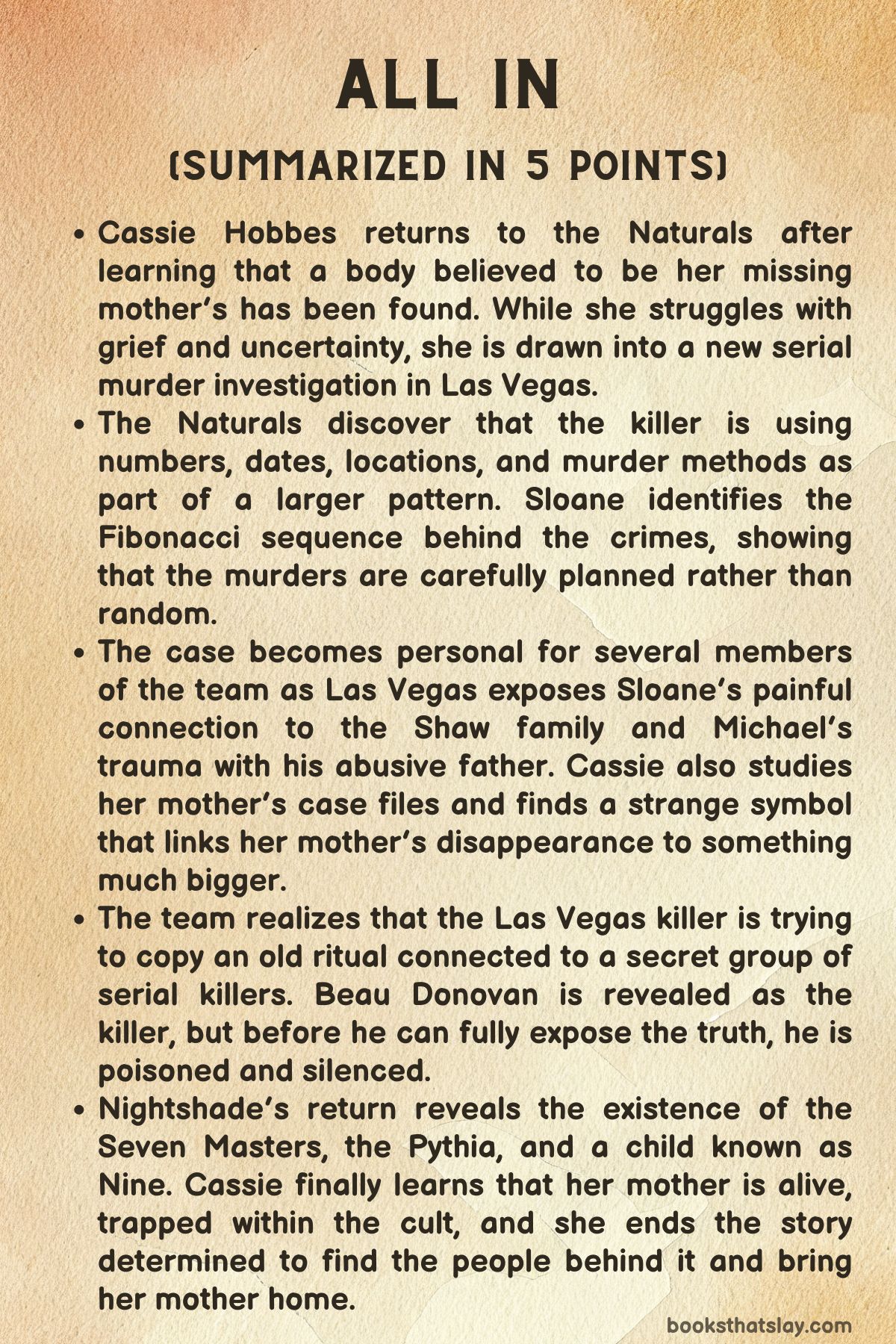
Characters
Cassie Hobbes
Cassie Hobbes is the emotional center of the story and the character through whom the investigation becomes deeply personal. As a Natural profiler, she has an unusual ability to read people, understand motives, and imagine the mind behind a crime.
In All In, that gift becomes both a strength and a burden. The Las Vegas murders demand her professional focus, but the discovery of a body believed to be her mother’s forces her to confront grief she has never fully been able to close.
Cassie is intelligent, observant, and disciplined, yet she is not untouched by fear. Her struggle comes from trying to remain useful to the team while privately falling apart.
She wants answers about her mother, but every answer opens a more dangerous question. Her growth comes through trust: she lets Dean help her, allows the team to see her pain, and learns that strength does not mean handling trauma alone.
By the end, Cassie is no longer only chasing closure. She has a larger mission: to expose the cult, protect Laurel, and rescue her mother.
Dean Redding
Dean Redding is quiet, controlled, and deeply shaped by his father’s crimes. As the son of a serial killer, Dean constantly fears that understanding violent minds means being too close to becoming one himself.
His connection with Cassie gives him a place where he can be seen without being judged. He is careful with her grief because he knows what it means to carry darkness that other people cannot easily understand.
Dean’s role in the investigation is marked by patience and precision. He does not rush to emotional conclusions; instead, he studies behavior, ritual, and motive.
His relationship with Cassie also shows his softer side. He offers comfort without trying to take control of her pain, and that makes him one of the most emotionally steady figures in the story.
Dean’s conflict is internal rather than loud. He is fighting the belief that blood determines destiny, and his loyalty to Cassie and the team proves that he is defined by his choices, not by his father.
Michael Townsend
Michael Townsend is charming, reckless, and emotionally wounded. His ability to read emotions makes him highly perceptive, but it also means he cannot easily escape the pain around him or within himself.
His abusive father has left him with anger, shame, and a dangerous need to confront harm directly. When he sees a child being mistreated, his reaction is immediate and physical because the scene reflects his own history.
Michael often uses humor and confidence to hide vulnerability, but the mask slips throughout the story. His decision to become bait for the killer is heroic, but it is also self-destructive.
He wants to save others, yet part of him does not seem to value his own safety enough. His dynamic with Lia reveals another side of him: wounded, defensive, and desperate to be understood.
Michael’s arc shows how trauma can turn courage into risk when a person believes pain is something they deserve.
Lia Zhang
Lia Zhang is sharp, secretive, and often deliberately difficult to read. As a Natural lie detector, she understands deception better than anyone else on the team, but she also uses deception as protection.
Her teasing, provocation, and bold claims are not just personality traits; they are survival tools. Lia has a history tied to cult abuse, and while she rarely explains herself plainly, her reactions reveal that the case cuts close to her past.
She is fiercely loyal, though her loyalty rarely looks gentle. When Cassie is struggling, Lia does not comfort her in a traditional way.
Instead, she tells Cassie that the team needs her to hold steady because everyone else is breaking in different ways. That bluntness may seem harsh, but it comes from Lia’s understanding of how fragile the group has become.
Her vulnerability appears in flashes, especially when her former identity, Sadie, is mentally associated with the person she used to be. Lia represents the cost of surviving manipulation and the difficulty of admitting that survival left scars.
Sloane Tavish
Sloane Tavish is one of the most important characters in the Las Vegas investigation because the killer’s pattern depends on numbers, dates, maps, and sequences. Her mind works with extraordinary speed, and she is able to see connections that others miss.
Yet Sloane is not presented simply as a genius. Las Vegas is painful for her because it brings her close to the father who rejected her and the half-brother who does not know her.
Her stress appears through erratic behavior, compulsive number recitation, and shoplifting, showing how emotional overload affects her. Sloane’s discovery of the Fibonacci pattern proves her brilliance, but her emotional journey is just as important.
Meeting Aaron gives her the possibility of family, only for that hope to be violently taken away. Her grief after Aaron’s death is raw because she loses not only a brother but also the chance to know him.
Sloane’s strength lies in the way she keeps thinking, keeps solving, and keeps fighting even when the case hurts her personally.
Judd Hawkins
Judd Hawkins is the guardian of the Naturals, but his role is far more than practical supervision. He is a protector, mentor, and grieving father.
The murder of his daughter Scarlett has shaped his life, making him deeply aware of how obsession can consume someone. Because of that, he recognizes the danger in Cassie’s need to solve her mother’s case.
He does not dismiss her pain, but he tries to keep her from being destroyed by it. Judd’s past becomes central when Nightshade returns, proving that he has never fully escaped the violence that took Scarlett from him.
His protective instincts sometimes make him strict, especially when the team takes risks, but his anger usually comes from fear for them. Judd represents adult grief carried with dignity.
He cannot undo his own loss, so he tries to prevent the young people under his care from being harmed in the same way.
Agent Briggs
Agent Briggs is one of the FBI agents responsible for the Naturals program, and he functions as both investigator and authority figure. He trusts the team’s gifts more than many adults would, but he still has to balance that trust with procedure, safety, and responsibility.
Briggs is practical, serious, and focused on results, yet he is not emotionally detached. His willingness to involve the Naturals shows that he values their abilities, but he also understands the danger of putting teenagers near active killers.
His poisoning by Nightshade raises the stakes near the end of the story and shows how vulnerable even trained professionals are against the cult’s methods. Briggs’s presence gives the investigation official structure, while his injury reminds the team that the threat they face is larger and more ruthless than a single murderer.
Agent Sterling
Agent Sterling is composed, observant, and often more controlled in her emotions than the teenagers around her. She recognizes Cassie’s distress early and discreetly gives her access to her mother’s case files, showing that she can be compassionate without abandoning professionalism.
Sterling is also important because she understands how to apply pressure during interrogation. Her confrontation with Beau is calculated to break through his performance and expose his need for recognition.
She does not simply ask questions; she studies pride, fear, and weakness. Sterling’s role often places her between the official FBI world and the Naturals’ more instinctive style of investigation.
She is cautious, but she is not dismissive. Her ability to listen to the team’s insights makes her a valuable adult ally.
Beau Donovan
Beau Donovan is the central Las Vegas killer and one of the most disturbing figures in the novel. At first, he appears as Tory Howard’s foster brother and a possible liar connected to the casino suspects.
Over time, his true nature emerges: he is resentful, controlled, theatrical, and desperate to be accepted by the cult he believes should claim him. Beau’s abandoned childhood gives context to his obsession, though it does not excuse his crimes.
Found in the desert as a child and left emotionally damaged, he grows into someone who turns rejection into ritual. He kills not only to satisfy violence but to prove worth.
His use of patterns, spirals, dates, and methods shows a mind that needs murder to feel meaningful. Beau’s tragedy is that his longing to belong has been corrupted into brutality.
He wants to be chosen, and he is willing to destroy innocent people to make that happen.
Nightshade
Nightshade is a chilling figure because he represents the older, more established evil behind the present case. Unlike Beau, who is trying to earn entry, Nightshade already understands the cult’s world and operates with calm confidence.
His use of poison, symbols, and psychological threats makes him feel controlled and experienced. He also has a personal connection to Judd through Scarlett’s murder, which gives his return emotional force.
Nightshade’s danger is not only physical. He knows how to unsettle people by giving partial truths, making threats, and forcing others into impossible choices.
His conversation with Cassie reveals crucial information about the cult, but even that help feels manipulative. He is a messenger, murderer, and gatekeeper to a larger mystery.
Through him, the story expands from a Las Vegas serial case into a hidden history of ritual violence.
Lorelai Hobbes
Lorelai Hobbes, Cassie’s mother, is absent for most of the story but shapes nearly every major emotional turn. For much of the novel, Cassie believes Lorelai may be dead, and that possibility forces her to process a grief she has long feared.
The memories Cassie has of her mother are loving but incomplete, especially because Lorelai worked as a psychic and lived close to secrets Cassie does not yet understand. The final revelation changes everything: Lorelai is alive and connected to the cult as the current Pythia.
This does not make her a villain in Cassie’s eyes; instead, it suggests captivity, coercion, and survival under terrible conditions. Lorelai becomes both a mystery and a rescue mission.
Her role is powerful because she is not present as a speaking character for most of the plot, yet her absence drives Cassie’s choices and the future direction of the series.
Laurel
Laurel is a small but crucial character whose appearance changes the meaning of the entire story. She is quiet, frightened, and caught inside a system of violence she is too young to understand fully.
Her other name, Nine, connects her directly to the cult’s structure and reveals that children are not just victims in this world but symbols within its hierarchy. Through Laurel, Cassie learns that the body buried under her mother’s name is not Lorelai.
Laurel’s locket becomes proof that Lorelai is alive. As a child under FBI protection, Laurel also becomes someone Cassie wants to protect from the cult’s reach.
She represents innocence trapped inside inherited horror, and her survival gives Cassie a reason to continue fighting beyond personal grief.
Aaron Shaw
Aaron Shaw is Sloane’s half-brother and one of the novel’s most tragic characters. When he first appears, he seems polished, wealthy, and emotionally guarded, shaped by the world of his father’s casino empire.
His connection to Sloane is complicated because he has lived with privileges and family recognition she was denied. Yet Aaron is not cruel to her.
Once he learns who she is, he shows signs of wanting to be different from their father. His gift to Sloane and his note suggest that he wants to build a connection, or at least offer kindness.
This makes his death especially painful. Aaron becomes the victim of both Beau’s personal jealousy and the larger ritual pattern.
For Sloane, losing him means losing the possibility of a sibling relationship just as it begins.
Grayson Shaw
Grayson Shaw is the owner of the Majesty and Sloane’s estranged father. He represents wealth, control, and emotional cowardice.
His treatment of Sloane is deeply damaging because he does not merely neglect her; he actively arranges her distance from his public family. His decision to push her into the Naturals program to keep her away reveals how easily he uses institutions to manage personal inconvenience.
He dismisses Sloane’s theory, refuses to take her seriously, and prioritizes reputation and control over truth. His failure to listen has consequences, especially when the predicted danger reaches his own family.
Grayson is not the main villain, but his selfishness and denial create emotional harm that mirrors the larger story’s concern with families that abandon, exploit, or silence children.
Tory Howard
Tory Howard is a magician whose lies and evasions make her suspicious early in the investigation. She is skilled at performance, misdirection, and self-protection, which makes it difficult for the team to know how much she is hiding.
Her relationship with Aaron gives her emotional depth because her secrecy is partly tied to love and fear. Tory’s loyalty to Beau also blinds her.
She wants to believe in him, perhaps because of their shared foster history and the bond they formed as outsiders. Her eventual breakdown after hearing Beau’s profile is an important moment because it shows the painful collapse of denial.
Tory is not innocent of lying, but she is also manipulated by someone she trusted. Her character shows how love, guilt, and loyalty can keep a person from seeing danger clearly.
Scarlett Hawkins
Scarlett Hawkins is Judd’s murdered daughter, and though she is dead before the main events, her presence is deeply felt. Her murder by Nightshade explains much of Judd’s grief, caution, and protectiveness.
Scarlett also connects the Naturals’ current case to the older cult pattern, making her death part of a larger history of ritual violence. In Cassie’s nightmare, Scarlett appears as a voice of fear and survival, showing how the dead remain active in the minds of the living.
Scarlett represents the personal cost of the cult’s long history. She is not just a past victim; she is the reason Judd understands what Cassie risks when grief becomes tied to investigation.
Vincent Battaglia
Vincent Battaglia, Cassie’s father, has a strained relationship with her, but his role in the story is important because he brings news about the body believed to be Lorelai’s. His presence forces Cassie to confront family pain outside the Naturals program.
He is not the emotional anchor that Cassie’s grandmother or team members are, but he is connected to her earliest life and to the unresolved wound of her mother’s disappearance. His updates about the forensic evidence intensify Cassie’s grief and make the personal case feel unavoidable.
Vincent’s character shows how biological family can be present yet emotionally complicated, especially when years of absence, pain, and mistrust stand between parent and child.
Cassie’s Grandmother
Cassie’s grandmother represents warmth, stability, and the idea of home. Her house is described as loving and safe, a contrast to the danger and emotional intensity of the Naturals program.
Cassie’s goodbye to her grandmother matters because it shows what she is leaving behind when she returns to the case: comfort, family, and a life that might have been simpler. The grandmother’s role is not large in terms of plot, but it is emotionally grounding.
She reminds readers that Cassie is still a teenager who needs care, not only a gifted profiler working with the FBI.
Camille Holt
Camille Holt is a victim whose life and personality complicate the investigation. She is described as a method actress fascinated by trauma, and other characters suggest she could be manipulative and difficult.
These traits make her a person with enemies, which initially broadens the suspect field. Yet her death also reveals important information about the killer.
Because she fights back, the murder becomes messier, forcing the killer to improvise. Camille’s role is therefore both personal and investigative.
She is not treated as a perfect victim, but the story still makes clear that her flaws do not lessen the horror of her murder.
Thomas Wesley
Thomas Wesley is one of the poker-related suspects and serves as a useful example of the misleading paths in the investigation. He appears suspicious because of his proximity to the casino world and his possible connection to other suspects, but he is also skilled at presenting himself carefully.
His interactions with the FBI push attention toward Tory Howard, especially by raising the idea of hypnosis. Thomas’s role helps create the atmosphere of Las Vegas as a place full of performance, bluffing, and hidden motives.
He is less emotionally central than other characters, but he contributes to the mystery’s uncertainty.
Daniel de la Cruz
Daniel de la Cruz is another person of interest whose presence broadens the suspect pool. As a professor, he adds an intellectual angle to the investigation, especially in a case driven by patterns, history, and symbolism.
Lia’s approach to him shows how the Naturals test people not only through evidence but through conversation and behavioral reactions. Daniel’s role is mainly structural: he helps create a field of plausible suspects while the true killer remains hidden behind performance and misdirection.
Alexandra Ruiz, Sylvester Wilde, Eugene Lockhart, and Victor McKinney
The early victims and attacked figures define the killer’s pattern before the team understands its full meaning. Alexandra Ruiz, Sylvester Wilde, and Eugene Lockhart seem at first to have died in separate accidents, but the numbers on their wrists and the methods of death reveal a controlled design.
Their deaths establish the killer’s obsession with sequence and ritual. Victor McKinney’s attack later complicates the case because the number on his wrist does not fit the established Fibonacci pattern.
That inconsistency helps the team realize Beau has created a copycat act to distract investigators. These characters are not explored deeply as individuals, but their roles are essential to exposing the structure behind the crimes in All In.
Themes
Trauma and the Long Shadow of the Past
Trauma shapes nearly every major character, not as a single memory but as an ongoing force that affects choices, relationships, and self-worth. Cassie’s unresolved grief over her mother’s disappearance makes the investigation intensely personal, especially when she believes the remains have finally been found.
Dean lives with the fear that his father’s violence has marked him in some permanent way. Michael’s abuse makes him reactive to signs of cruelty, especially when he sees a child being threatened.
Sloane’s abandonment by her father leaves her desperate for recognition but terrified of rejection. Lia’s history with cult control teaches her to hide vulnerability behind performance and lies.
Even Judd’s protectiveness is rooted in the murder of his daughter. The novel shows that trauma does not create one predictable response.
Some characters become guarded, some reckless, some obsessive, and some painfully controlled. Healing is not presented as simple closure.
Instead, survival depends on connection, honesty, and the willingness to be helped. The team matters because they give one another a place where pain can exist without becoming the whole person.
Pattern, Control, and the Danger of Meaning
Numbers and patterns dominate the murder case, but the story questions what happens when meaning becomes detached from morality. The killer sees numbers as purity, order, and destiny.
The Fibonacci sequence, dates, locations, and repeated methods give his crimes structure, allowing him to imagine murder as achievement rather than brutality. This obsession reflects a larger danger within the cult, where ritual turns violence into tradition and gives killers a language for justifying harm.
Sloane also sees patterns, but her relationship to them is different. For her, numbers are a way to understand reality and save lives.
The contrast between Sloane and Beau is important: both recognize structure, but one uses it to protect while the other uses it to dominate. All In shows that patterns are not inherently meaningful in a moral sense.
People choose what they do with them. A sequence can solve a crime, but it can also become a mask for ego, cruelty, and the desire to feel chosen.
Found Family and Chosen Loyalty
The Naturals are not connected by blood, but their loyalty to one another becomes stronger than many biological family ties in the story. Cassie’s mother is missing, her father is emotionally complicated, and her sense of home is split between her grandmother and the team.
Sloane’s biological father rejects her, while Aaron’s brief kindness offers a glimpse of the family bond she was denied. Michael’s father is abusive, making the team’s concern for him far more meaningful than anything he receives at home.
Dean fears his inherited connection to a killer, but his chosen relationships help him define himself differently. Lia pretends to need no one, yet her actions show fierce attachment to the group.
The team does not always comfort one another gently. They argue, provoke, push, and sometimes misread each other, but they keep showing up.
This theme gains strength because the novel places chosen family beside damaged biological families. Blood ties can be loving, absent, dangerous, or corrupted.
Chosen loyalty, however, is built through action. The Naturals protect one another not because they must, but because they decide to.
Secrecy, Power, and Generational Violence
The cult’s existence reveals how secrecy allows violence to survive across generations. Its rituals, titles, symbols, and cycles turn murder into inheritance.
The Masters preserve power by hiding behind history, manipulating children, abandoning those they consider unworthy, and forcing others into roles they did not choose. Beau’s crimes show one effect of that system: a rejected child grows into a man desperate to be accepted by the very structure that discarded him.
Laurel shows another effect: a child treated not as a person but as a symbolic position called Nine. Lorelai’s fate reveals the horror of coercion inside the cult, where becoming Pythia requires killing the previous Pythia.
The secrecy is not only about avoiding law enforcement. It is about controlling identity, memory, and destiny.
People inside the system are given names and roles that reduce their humanity. The novel treats generational violence as something maintained through silence and ritual, but also as something that can be challenged when survivors speak, investigate, and refuse to protect the system’s lies.