All I Really Need to Know I Learned in Kindergarten Summary and Analysis
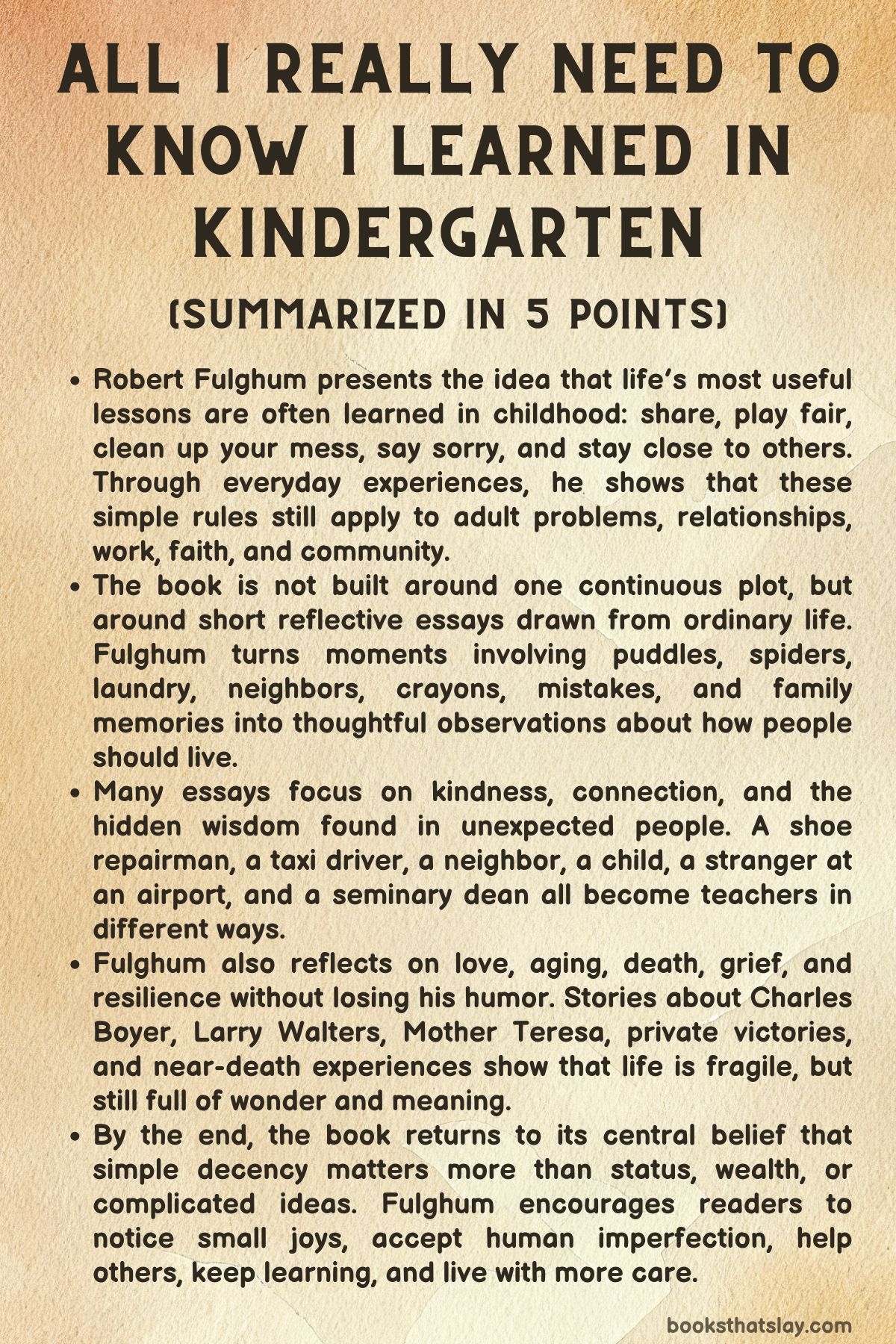
All I Really Need to Know I Learned in Kindergarten by Robert Fulghum is a reflective essay collection built on a simple idea: the basic lessons of childhood are enough to guide a decent human life. Fulghum writes about everyday scenes—laundry, puddles, spiders, neighbors, mistakes, gifts, grief, faith, aging, and small acts of kindness—and turns them into moral observations.
The book is not a traditional story with one plot. It is a series of personal memories, comic incidents, and philosophical reflections that ask readers to value simplicity, generosity, curiosity, community, and joy in ordinary life.
Summary
All I Really Need to Know I Learned in Kindergarten begins with Fulghum looking back on the surprising life of the book itself. The original essay, built around the basic rules children learn early in life, became far more widely loved than he expected.
In the anniversary edition, he reflects on how those ideas have continued to travel through readers, theaters, conversations, and classrooms. He remains convinced that the deepest truths are often the simplest ones: share, play fair, clean up your own mess, say sorry, live a balanced life, and stay close to others when facing the wider world.
From there, the book expands into a series of essays that test this belief against ordinary experience. Fulghum treats childhood lessons not as childish ideas, but as distilled wisdom.
A seed growing in a paper cup teaches children about life and death. Hide-and-seek becomes a way of thinking about loneliness, secrecy, and the need to be found.
Fairy tales lead him to question whether happy endings prepare children for reality or protect them from it. The book repeatedly shows that simple lessons grow more serious with age, because adulthood gives them higher stakes.
Many essays begin with comic or minor incidents and end in larger reflection. A neighbor screaming after walking through a spiderweb makes Fulghum imagine the spider’s point of view and admire its endurance.
A child wanting to splash in a puddle becomes a missed chance for adults to rediscover harmless joy. A cobbler who refuses to repair worthless shoes becomes, in Fulghum’s imagination, a spiritual teacher.
Later, he reveals the real man behind that story, Eli Angel, whose wisdom, generosity, marriage, and family life gave substance to the invented figure.
The book also gives close attention to human connection. Fulghum writes about love through public examples and domestic comedy.
The story of Charles Boyer and his wife Patricia becomes a meditation on devotion and grief. Noisy raccoons under a cottage make him think about the messiness of love and the strange way affection often coexists with irritation.
A homemade Valentine made by his children, a “gummy lump” of craft materials and affection, means more to him than any polished store-bought gift. Across these essays, love is presented not as neat romance but as care, memory, effort, and shared absurdity.
Several pieces celebrate people who refuse to merely accept the limits placed before them. Larry Walters, the lawn-chair pilot, ties helium balloons to a chair and flies into the sky because, as he says, a person cannot just sit there.
Fulghum later corrects his earlier version of Larry’s story, adding the darker facts of the dangerous flight and Larry’s later death by suicide. This correction does not erase Larry’s daring, but it makes the portrait more honest.
The related essay on the Montgolfier brothers’ balloon launch connects such individual imagination to the history of flight, showing how bold ideas depend on dreamers, risk-takers, witnesses, and supporters.
Fulghum often finds meaning in chores and domestic routines. Laundry gives him a sense of order and contact with the elements.
Medicine cabinets reveal private hopes, habits, and vulnerabilities. Jumper cables teach him that goodwill is not enough without knowledge, and his failures as a helper become lessons in preparation.
Moving out of a house exposes the hidden dust and debris of life, but even that dirt becomes meaningful when he imagines it as a mixture of human remains and cosmic dust. Vacuum cleaners, dandelions, leaves, snow, and haircuts all become ways of thinking about order, disorder, care, and the habits that bind people together.
His past as a minister and teacher shapes many of the essays. Working as a bartender during seminary becomes an unexpected education in human nature.
Asking for financial help teaches him that need is not shameful and that a good life must include room for joy and generosity. Confessions about youthful mistakes show that everyone carries embarrassment, and that sharing such stories can bring relief.
Stories about Mother Teresa, his father’s relationship to the Salvation Army, and a Vietnamese refugee singing Christmas carols all explore the complicated relationship between belief, action, gratitude, and moral commitment.
The book values people who do not fit easy categories. A girl in a children’s game insists she is a mermaid, and Fulghum makes a place for her beside him.
A New York taxi driver, bold and wounded and funny, becomes another kind of mermaid—someone uniquely adapted to a difficult environment. At a music festival in Weiser, Idaho, differences fade as people gather around sound.
At the Buffalo Tavern, a dancer transforms a bar crowd into a temporary community united against sadness and mortality. These moments suggest that belonging is not created by sameness, but by shared participation.
Fulghum also writes about aging, memory, and mortality. High school reunions, near-death experiences, secret anniversaries of sobriety, and reflections on grandfathers all remind him that life is brief and fragile.
He imagines the grandfather he never had, then later considers what it means to become a grandfather himself. He celebrates small victories—the saved glass, the revived car, the underdog win—as reasons to keep noticing the world.
Death is always near in the book, but Fulghum’s response is not despair. His answer is attention, humor, music, kindness, and celebration.
Nature and science appear throughout the collection as sources of wonder and humility. Fulghum thinks about wildflower names, designer water, mushrooms, moths, tectonic plates, dinosaurs, and the census.
He laughs at human attempts to classify and control everything, while also respecting curiosity and discovery. Mushrooms and dust become signs of renewal.
Moths, first dismissed as ugly, reveal beauty when examined closely. Population counts become a way to think about individuality and the traces each person leaves behind.
The natural world reminds him that humans are both important to one another and small within a much larger order.
The later essays return to neighbors, especially Mr. Washington, an older Black man whose discipline, humor, neat yard, jazz, and sayings leave a lasting mark on Fulghum. Their friendship is full of contrast: one values order, the other tolerates wildness; one sprays dandelions, the other defends them; one rakes and shovels, the other lets nature take its course.
Yet their differences become a source of affection and wisdom. Mr. Washington teaches, by example, that life is a gamble best played with trust, caution, laughter, and style.
By the end, Fulghum revisits the lessons that began the book and finds that they still hold. His later reflections do not replace the kindergarten credo; they deepen it.
He sees the world as connected, imperfect, funny, mortal, and shared. He accepts that writing, learning, and living are never truly finished.
The final movement treats endings as beginnings, suggesting that every conclusion sends a person back into life with renewed attention. All I Really Need to Know I Learned in Kindergarten closes as it began: with faith in simple decency, ordinary wonder, and the lifelong task of learning how to live well with others.
Key People
Robert Fulghum
Robert Fulghum is the central presence in All I Really Need to Know I Learned in Kindergarten, not as a conventional protagonist moving through a single storyline, but as an observer, participant, teacher, minister, husband, father, neighbor, and aging man trying to make sense of ordinary life. His character is defined by curiosity and moral attentiveness.
He notices what many people overlook: a spider rebuilding its web, a child staring at a puddle, a shoebox Valentine, a noisy raccoon, a dead-end street, a laundromat, or the contents of a medicine cabinet. Through these observations, he reveals a mind that is both playful and serious.
He is willing to laugh at himself, especially when he fails at practical tasks, misunderstands something, or behaves impulsively. Yet beneath the humor is a steady ethical concern: how should people treat one another, how should they live with wonder, and how can adulthood recover the clarity of childhood wisdom?
Fulghum’s voice is warm, conversational, self-questioning, and often comic, but it is also shaped by his background as a minister. He repeatedly turns daily experience into reflection on mortality, kindness, community, humility, and grace.
Fulghum’s Wife
Fulghum’s wife appears as a grounding figure in many of his reflections. She is practical, intelligent, medically trained, and often positioned as a contrast to his more whimsical or speculative temperament.
Because she is a physician, she represents discipline, scientific thinking, and responsibility, especially in essays dealing with health, mortality, and certification. Her presence often pulls Fulghum back from fantasy into reality, but she is not treated as merely corrective.
Their marriage is shown through small tensions, comic disagreements, shared memories, and mutual endurance. In the raccoon essay, domestic irritation becomes part of the larger mystery of love.
In the cuckoo clock episode, the flawed object matters less than the laughter and companionship it creates between them. She helps reveal Fulghum’s understanding of marriage as something made from habit, patience, humor, care, and the ability to keep living together through ordinary absurdities.
Elias Schwartz and Eli Angel
Elias Schwartz, later revealed to be based on Eli Angel, is one of the most memorable figures because he represents quiet wisdom hidden in an ordinary occupation. At first, Fulghum imagines him as a reincarnated spiritual leader because of the calm authority with which he judges a pair of old shoes unworthy of repair.
His note about things not worth doing becomes a small philosophical lesson, suggesting that wisdom can arrive from a shoe repair shop as easily as from a temple. When Fulghum later explains that the real man was Eli Angel, the comic invention gains emotional depth.
Eli is revealed as an Orthodox Jewish immigrant, multilingual, generous, learned, and deeply respected. His character matters because he embodies goodness without performance.
He does not need public recognition to live wisely. His legacy continues through his family and his shop, showing how gentleness and integrity can remain present after a person’s death.
Rachael Angel
Rachael Angel gives emotional weight to the story of Eli Angel. Her early life is marked by illness and uncertainty, since she rejects Eli’s proposal at first because she believes cancer will prevent her from living long or having children.
Her eventual marriage, survival, and motherhood make her character a symbol of life exceeding expectation. She also becomes the keeper of Eli’s memory.
When she hears how Fulghum’s fictionalized version of her husband has traveled through readers’ imaginations, she is comforted by the fact that his quiet goodness has reached people far beyond their local community. Rachael’s importance lies in her connection to love, endurance, and remembrance.
Through her, the reader sees how private lives can gain unexpected afterlives through storytelling.
Mr. Washington
Mr. Washington is one of the richest figures in the collection because he functions as neighbor, friend, contrast, and teacher. He is older, disciplined, proud of his home, serious about yard care, fond of sayings, and equipped with a strong personal philosophy.
His careful lawn and tidy house stand in contrast to Fulghum’s more relaxed attitude toward nature and household order. Yet the difference between them does not create hostility; it creates conversation.
Mr. Washington sees life as a gamble, but not in a reckless sense. His wisdom lies in balancing trust with caution, humor with realism, and hope with practical awareness.
He teaches through behavior rather than lectures. Whether he is spraying dandelions, discussing odds, caring for his home, or sharing laughter, he represents a model of dignity and self-possession.
In All I Really Need to Know I Learned in Kindergarten, he also broadens the idea of education by showing that some of the most valuable lessons come from neighbors who live by their own tested codes.
Larry Walters
Larry Walters is presented first as a comic hero of impossible longing: a man who wants to fly and decides to do it by tying balloons to a lawn chair. His act is ridiculous, dangerous, brave, and deeply human.
Fulghum admires him because he refuses passive resignation. Larry’s statement that a person cannot just sit there becomes a declaration against despair and inaction.
However, the later correction to his story complicates him. His flight was more dangerous than Fulghum first described, and his later death by suicide brings sadness into what might otherwise have remained a comic legend.
Larry becomes a figure of imagination and pain at once. He shows that the same person can contain daring, absurdity, loneliness, and despair.
His character prevents the book’s optimism from becoming shallow, because his story admits that dreams do not always save people, even when they make them unforgettable.
Donnie
Donnie is a young deaf boy who asks to rake Fulghum’s leaves for money. At first, Fulghum is reluctant and somewhat cynical, but Donnie’s seriousness and pride gradually change the tone of the encounter.
Donnie works carefully, returns to finish the job, and treats the task with dignity. His character represents earnestness, responsibility, and the ability of children to surprise adults who think they already understand the situation.
Fulghum’s response to Donnie reveals his own growth in the essay: he moves from hesitation to respect. The later note that Donnie thrives and runs a horticultural business makes the early scene feel like a glimpse of a life already forming around patience, work, and care for growing things.
The Mermaid Girl
The young girl who insists she is a mermaid is a brief but powerful character. During a children’s game built around fixed categories, she refuses to choose an identity that does not fit her.
Her question about where she should stand becomes a test of the adult world. Fulghum’s answer, that she should stand beside him, is an act of acceptance.
She represents everyone who does not fit the available boxes and still deserves a place in the game. Her character is not developed through biography, but through symbolic force.
She brings out one of Fulghum’s clearest values: community must make room for the unusual, the self-defined, and the imaginative.
The New York Taxi Driver
The taxi driver in New York is bold, funny, wounded, and fully alive within the chaos of the city. She refuses Fulghum’s requested direction because traffic makes it impractical, then turns the ride into a conversation full of humor and personal truth.
Her pink jacket, black turban, direct speech, and emotional honesty make her vivid. She is not sentimentalized; she is tough because life has required toughness.
When Fulghum offers her money, she resists the simplicity of the gesture, making clear that her burdens cannot be solved so easily. Yet the encounter still matters.
She becomes another version of the mermaid figure: someone unusual, adaptive, and fitted to a difficult environment in a way others might not understand.
The Seminary Dean
The seminary dean is an important mentor figure because he helps Fulghum reinterpret difficulty as education. When Fulghum worries that bartending might look improper for a seminary student, the dean sees it as excellent training for ministry.
He recognizes that real spiritual work happens among people in ordinary places, not only in formal religious settings. Later, when Fulghum asks for financial help, the dean teaches him that need is not a moral failure.
His rejection of Fulghum’s first budgets because they leave no room for joy is especially revealing. The dean’s wisdom is practical and humane.
He understands that a person cannot serve others well while denying his own need for pleasure, books, generosity, and ordinary happiness.
Charles Boyer
Charles Boyer appears as a public figure whose private love matters more than his glamorous image. Known for romance on screen, he is presented by Fulghum as a man whose true devotion belonged to his wife, Patricia.
His care for her during illness shows love as service and presence rather than performance. His death soon after hers is treated not as a subject for judgment, but as evidence of the devastating depth of attachment.
Boyer’s character allows Fulghum to think about love as something that can become inseparable from life itself. He represents the frightening power of devotion when the beloved person is gone.
Patricia Boyer
Patricia Boyer is central to Charles Boyer’s portrait even though she is seen mostly through his love for her. Her illness and death reveal the endurance of their marriage.
She is not simply a tragic figure; she is the person whose presence gave shape and meaning to Boyer’s emotional life. Through Patricia, Fulghum reflects on what it means to be loved over decades, through fame, aging, illness, and final dependency.
Her character stands for the quiet center of a life that outsiders may misunderstand if they know only the public image.
Mother Teresa
Mother Teresa appears as a figure who unsettles Fulghum. He does not present himself as simply admiring her without conflict.
Instead, he admits frustration with her piety and with the way her image confronts him. That complexity makes his portrayal more interesting.
She becomes a moral challenge rather than a saintly decoration. Her life forces him to consider what one committed person can do with limited resources, steady conviction, and a refusal to ignore suffering.
Even when he does not fully agree with her worldview, he cannot dismiss the force of her action. She represents uncomfortable moral seriousness, the kind that makes observers question the gap between their beliefs and their behavior.
Fulghum’s Father
Fulghum’s father is remembered as pragmatic, skeptical, and resistant to religious dogma. His contrast with Fulghum’s devout mother creates tension, especially around Christmas.
Yet his yearly work ringing bells for the Salvation Army complicates any simple understanding of belief. He may not accept Christian doctrine, but he acts out of gratitude because the organization once helped his family after a fire.
His character shows that goodness does not always speak in religious language. He represents loyalty, memory, and action as forms of belief.
Fulghum’s father matters because he teaches that what people do may reveal their values more clearly than what they claim to believe.
Fulghum’s Mother
Fulghum’s mother appears through the religious contrast with his father. She is devout, committed to Christian belief, and part of the family tension around faith.
While she is not developed as extensively as his father, her presence helps define the household atmosphere in which Fulghum grew up. She represents inherited faith, ritual, and moral seriousness.
Her role is important because it shows Fulghum being shaped by competing models: formal belief on one side and practical charity on the other. The mature Fulghum seems to draw from both.
Hong Duc
Hong Duc, the Vietnamese refugee who arrives in a Santa mask to sing Christmas carols, is a character of unexpected joy. His appearance comes when Fulghum feels cynical about the holiday season, and his sincerity breaks through that mood.
Hong Duc’s role is brief, but his effect is large. He shows how celebration can arrive from an unexpected source and how traditions can be renewed by people who adopt them with openness and delight.
His character also carries the background of displacement and survival, making his cheerfulness more meaningful than simple holiday comedy.
P.M. Menon
P.M. Menon is presented as a figure of integrity, self-made achievement, and generational kindness. His life is shaped by a small act of help received in youth, when a stranger gives him money and asks only that he pass the kindness on.
Menon turns that instruction into a personal ethic. His character is important because he shows how moral influence can travel across time without institutions, fame, or force.
A small gift becomes a lifelong obligation to help others. Through Menon, Fulghum presents generosity as a chain of human responsibility.
The Stranger at the Bombay Airport
The man who helps Fulghum at the Bombay airport continues Menon’s legacy. His kindness is not random; it is part of a story passed from one person to another.
By assisting Fulghum and explaining why, he becomes proof that one good act can survive in altered forms long after its first moment. His character shows how stories can carry ethics across cultures and generations.
He also reminds the reader that help often arrives in modest ways, at moments when a person is tired, confused, or vulnerable.
The Child at the Puddle
The child who wants to run through puddles represents spontaneous joy before adult caution suppresses it. His desire is simple, physical, and harmless, but his mother’s concern pulls him away.
In Fulghum’s imagined version of the scene, adults join him and recover their own lost playfulness. In reality, they do not.
The child’s character therefore becomes a measure of missed opportunity. He shows how often adults deny children joy in the name of order, and how often they deny themselves the same joy.
The Mother at the Puddle
The mother in the puddle scene represents the difficult position of adulthood, especially parenthood. She must teach discipline, cleanliness, and social behavior, yet she is also close enough to childhood to remember the pleasure of splashing through water.
In Fulghum’s imagined version, she smiles and joins the play. In the actual version, she pulls the child away.
Her character is not condemned; she is treated with sympathy. She embodies the conflict between responsibility and delight, a conflict that runs through much of Fulghum’s work.
The Man Who Steps into the Puddle
The man who steps into the puddle exists in Fulghum’s imagined revision of reality, but he is still meaningful as a character. He represents the adult who breaks the spell of restraint and gives others permission to enjoy a harmless moment.
His action is small, but in Fulghum’s imagined scene it changes everyone around him. He shows how one person’s willingness to look foolish can free others from self-consciousness.
The Godson
Fulghum’s godson, introduced through crayons, represents the discovery of creative power. Once he realizes that he can make a mark, he experiences the joy of expression.
His excitement reminds Fulghum that creativity begins before technical skill, before judgment, and before ambition. The godson’s character is important because he returns the adult imagination to its simplest beginning: the wonder of color, motion, and self-made marks.
Through him, crayons become symbols of peace, play, and human possibility.
The Former Student
The former student who confesses the ruined family Bible represents the long life of guilt and embarrassment. His youthful mistake has stayed with him for years, not because it is catastrophic, but because it was hidden.
By confessing it to Fulghum, he seeks release. His character shows how small acts of concealment can grow large in memory.
He also brings out Fulghum’s own willingness to answer confession with confession, suggesting that shame is eased when people admit their shared foolishness.
The English Teacher and His Wife
The stranded English teacher and his wife are comic partners in Fulghum’s failed attempt to help with jumper cables. They represent educated incompetence in a practical situation, which is part of the humor.
Their presence turns a roadside problem into a lesson about the gap between good intentions and actual knowledge. The wife’s later gift of foolproof jumper cables is especially revealing.
Rather than simply being annoyed, she responds with practical generosity. Together, they show that embarrassment can become instruction when met with humor.
The Bartender’s Patrons
The patrons Fulghum meets while bartending during seminary form a collective character. They are ordinary people carrying loneliness, desire, humor, anger, need, and confession.
Through them, Fulghum learns that ministry is not abstract. It takes place in conversation, listening, and contact with people as they are.
The patrons represent the world outside institutions, where human nature is unguarded and lessons arrive without formal structure.
The Indigenous Dancer at the Buffalo Tavern
The Indigenous man at the Buffalo Tavern is quiet and unassuming before he begins to dance. Once he does, he transforms the energy of the room.
His dance becomes a shared act of defiance against mortality, sadness, and isolation. He does not need speech or status to lead the crowd into joy.
His character shows how art, movement, and presence can create temporary community among strangers.
The Biker’s Girlfriend
The biker’s girlfriend becomes part of the Buffalo Tavern scene when she dances with the Indigenous man. Her participation helps shift the event from individual performance to communal celebration.
She represents openness to the unexpected. By joining the dance, she helps dissolve social boundaries within the tavern.
Her role is small, but she helps turn observation into participation.
The Weiser Policeman
The banjo-playing policeman at the fiddlers’ festival represents the book’s faith in shared joy. His official role might suggest authority and order, but his music places him inside the same community as everyone else.
He helps Fulghum show how music can reduce social distance. His character is cheerful, grounded, and symbolic of a space where people gather not around status, but around sound.
The Man from Wisconsin
The man from Wisconsin, with his shirt about tectonic plate movement, brings comic skepticism into the science essays. He is curious, amused, and caught between scientific ideas and family teasing.
His conversation with Fulghum allows the essay to examine why scientific truth can seem less believable than fantasy. He represents the ordinary person trying to make sense of vast, strange explanations about the natural world.
The Man’s Wife from Wisconsin
The wife from Wisconsin remains skeptical in the discussion of tectonic plates, birds, dinosaurs, and strange scientific claims. Her skepticism is comic but also recognizable.
She represents the human resistance to ideas that seem too odd to accept, even when they are supported by science. Her character helps Fulghum explore the difficulty of explaining reality when reality itself can sound absurd.
Clucky-Lucky
Clucky-Lucky, the oversized chicken, is one of the book’s comic animal figures. By drinking beer from slug traps and eating cat food made from chicken, she becomes a bizarre example in Fulghum’s reflection on birds and dinosaurs.
Her character is absurd, but she serves a purpose: she makes scientific speculation vivid and funny. Clucky-Lucky turns abstract evolutionary thinking into an unforgettable image.
The Raccoons
The raccoons under the cottage operate almost like comic characters in a domestic drama. Their loud mating rituals interrupt sleep and force Fulghum to think about love, conflict, and animal need.
They are not sentimental animals; they are noisy, disruptive, and physical. Their importance lies in the way they mirror human relationships.
Through them, Fulghum sees that love can be messy, inconvenient, passionate, and difficult to understand.
The Spider
The spider whose web is destroyed becomes a quiet emblem of endurance. Fulghum imagines the spider’s point of view after a human accidentally destroys its carefully made home.
The spider does not complain or surrender; it rebuilds. Its character is simple but powerful.
It represents resilience, patience, and the ancient capacity of life to continue after disruption.
The Moth
The moth begins as an unwanted creature drawn to a lantern, dismissed by children as ugly or bothersome. When one child later examines a moth more closely, its beauty becomes visible.
The moth’s character is therefore tied to perception. It shows that prejudice often comes from distance, habit, or lack of attention.
Once seen closely, what seemed worthless becomes delicate and strange.
The Imagined Grandfather
The imagined grandfather is a figure Fulghum creates out of longing. Because he did not have a close relationship with his own grandfathers, he invents the kind of elder he wishes he had known: wise, cosmic, playful, and able to explain the stars.
This character represents guidance, continuity, and the human need for older voices that make the universe feel less lonely. Later, when Fulghum becomes a grandfather himself, the imagined figure becomes a model for the person he hopes to be.
Mary’s Father
Mary’s father, imagined as the maternal grandfather of Jesus, is treated with humor and sympathy. Fulghum imagines him as an ordinary man faced with an extraordinary family crisis.
His disbelief, worry, and eventual pride make him human. The character matters because he brings a sacred story into domestic terms.
He allows Fulghum to think about awe through the eyes of a confused parent and grandfather trying to understand events beyond normal explanation.
Themes
Childhood Wisdom as a Guide for Adult Life
The central moral structure of All I Really Need to Know I Learned in Kindergarten rests on the belief that early lessons remain useful long after childhood ends. Sharing, cleaning up, apologizing, playing fairly, resting, learning, and staying close to others may sound simple, but Fulghum treats them as the foundation of ethical life.
The point is not that adulthood is easy, or that childhood rules solve every problem without effort. Rather, the book suggests that adult complexity often hides simple moral failures.
People hurt one another because they forget to share power, attention, money, space, and care. They damage communities because they do not clean up the messes they make.
They isolate themselves because they hide too well and refuse to be found. Fulghum’s essays repeatedly return adult situations to childhood principles, not to make them smaller, but to make them clearer.
A dead car battery, a lost opportunity at a puddle, a difficult request for help, a neighborly disagreement, or a confession of embarrassment all become tests of basic decency. The theme is powerful because it challenges the assumption that wisdom must be sophisticated to be serious.
Fulghum argues that moral maturity may depend less on learning new rules than on remembering the old ones with greater honesty.
The Sacred Value of Ordinary Life
Fulghum consistently treats ordinary experience as worthy of attention. Laundry, dust, shoes, crayons, dandelions, haircuts, water, mushrooms, medicine cabinets, and broken clocks all become occasions for reflection.
This does not mean he exaggerates their importance beyond recognition; instead, he trains the reader to notice how much meaning is already present in daily life. Doing laundry gives a sense of temporary order in a disorderly world.
A homemade Valentine becomes more precious than an expensive gift because it carries the evidence of love. A shoe repairman becomes a spiritual teacher.
A puddle becomes a chance for adults to recover joy. Even household dirt becomes connected to bodies, time, and the cosmos.
This theme depends on Fulghum’s ability to move between humor and seriousness without making ordinary life feel artificial. He does not need grand events to ask large questions.
The ordinary world is enough because it contains need, memory, embarrassment, kindness, loss, and wonder. By focusing on familiar objects and minor incidents, Fulghum suggests that meaning is not rare.
It is available to anyone willing to slow down, look carefully, and accept that the small things surrounding us are part of the larger education of being human.
Human Connection, Kindness, and Community
The book repeatedly shows that people survive and grow through connection. Fulghum values the kindness of strangers, the wisdom of neighbors, the patience of mentors, the honesty of old friends, and the unpredictable grace of brief encounters.
A stranger’s loan to P.M. Menon becomes a chain of generosity that reaches across years and countries. A seminary dean teaches Fulghum that asking for help is not weakness, and that a life without joy is not a fully human life.
Mr. Washington’s neighborly presence becomes a long education in dignity, difference, and good humor. A taxi driver, a child who calls herself a mermaid, a bartender’s patrons, a dancing stranger in a tavern, and a Vietnamese refugee singing carols all show that community is built through recognition.
Fulghum is especially interested in people who might be overlooked because they are ordinary, eccentric, poor, young, old, grieving, or socially unexpected. His moral universe rejects isolation as a final answer.
People may need privacy, but they also need to be found, heard, helped, and welcomed. Kindness in these essays is usually practical rather than grand.
It appears as a ride, a gift, a repair, a conversation, a song, a place to stand, or money given at the right time. These small gestures become the real architecture of community.
Mortality, Resilience, and the Choice to Keep Living Fully
Awareness of death runs through the collection, but Fulghum does not treat mortality only as tragedy. It becomes a reason to pay attention, laugh, dance, forgive, create, and act.
The spider rebuilds after its web is destroyed. Larry Walters flies because he cannot bear simply sitting still, even though his story later carries sorrow.
Charles Boyer’s grief after Patricia’s death reveals the depth and danger of love. Near-death experiences remind Fulghum that life is fragile at every moment.
The Buffalo Tavern scene turns dancing into a temporary answer to death. Mushrooms, dust, leaves, snow, and compost all suggest that decay is also part of renewal.
This theme gives the book emotional weight because its cheerfulness is not naive. Fulghum knows that people get sick, age, lose loved ones, make mistakes, and die.
His answer is not denial. His answer is participation.
Listen to music, splash in puddles, help when possible, accept help when necessary, mark private victories, celebrate small wins, and keep learning. Resilience in the book is rarely heroic in a dramatic sense.
More often, it is the modest courage to rebuild, return, apologize, laugh again, or notice beauty after disappointment. Mortality sharpens Fulghum’s love for ordinary life rather than diminishing it.