All My Puny Sorrows Summary, Characters and Themes
All My Puny Sorrows by Miriam Toews is a tragicomic novel about love, mental illness, family loyalty, and the limits of saving another person. At its center are two sisters: Yolandi, a struggling writer with a chaotic personal life, and Elfrieda, a gifted concert pianist who wants to die.
The novel follows Yoli as she tries to keep Elf alive while also managing her children, divorce, lovers, memories, and grief. Written with sharp humor and deep sadness, the book asks what love can do when the person you love most refuses life itself.
Summary
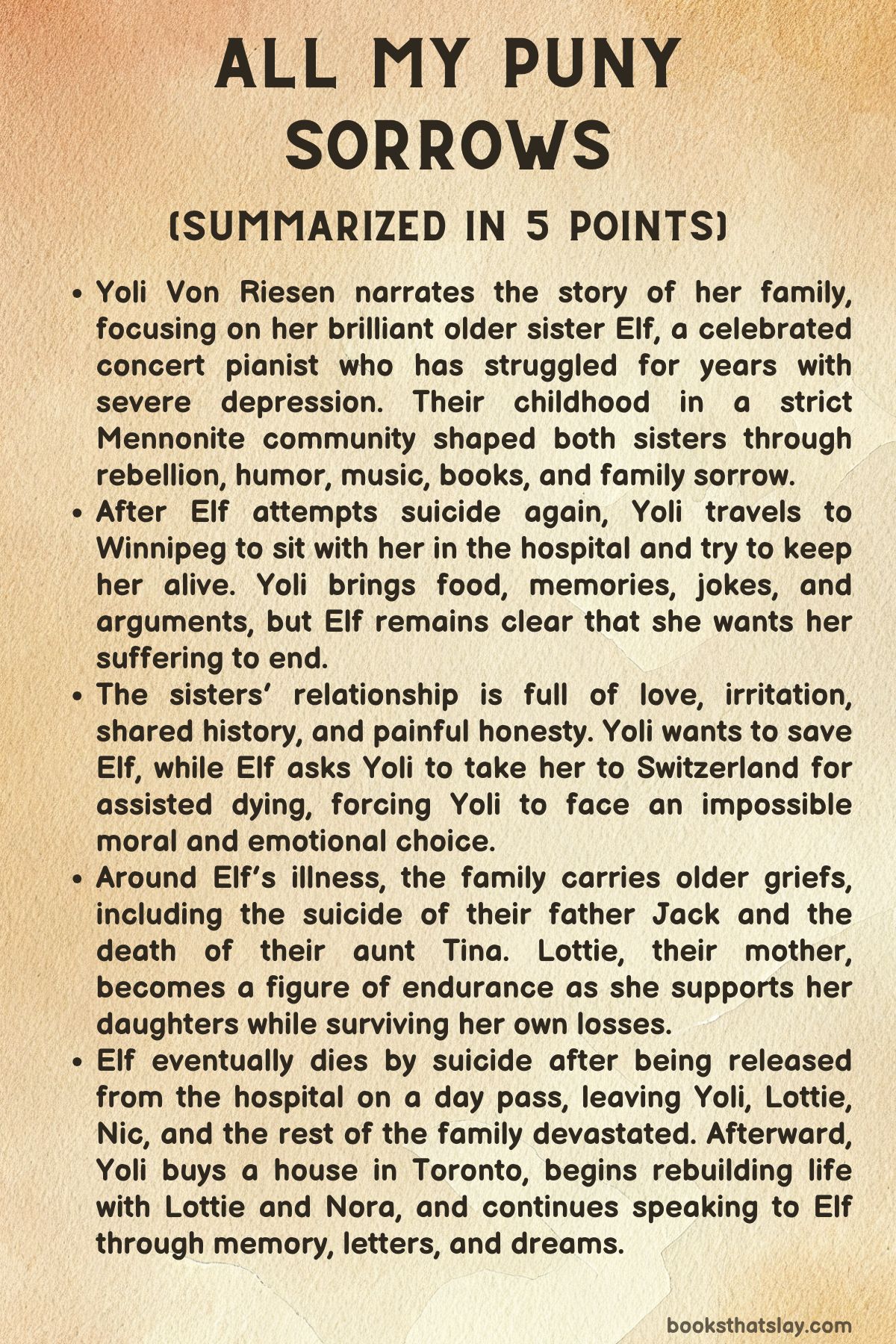
Yolandi Von Riesen, known as Yoli, narrates the story of her family, especially her bond with her older sister, Elfrieda, known as Elf. They grew up in East Village, a strict Canadian Mennonite community where rules, religion, obedience, and silence shaped daily life.
Their parents, Jack and Lottie, were loving but unusual by the standards of their community. Jack was curious, rebellious, and thoughtful; Lottie was warm, capable, and quietly strong.
The family’s life was marked early by a mix of humor, defiance, and sadness.
One vivid memory from Yoli’s childhood is the day their old house was moved away on the back of a truck after Jack sold it. The family watched it go, then spent a strange few days traveling before settling into their new home.
Elf, already dramatic and brilliant, hated camping and complained through the trip. Back in East Village, she began writing “AMPS,” short for “all my puny sorrows,” a phrase from a Coleridge poem.
The phrase became a private symbol for her sorrow, wit, and resistance.
Elf’s talent as a pianist set her apart. Music was forbidden or frowned upon in their Mennonite world, especially for women, yet Elf played with force and genius.
When church elders came to confront Jack and Lottie about sending Elf to university and allowing her to play piano, Elf responded by playing a loud, powerful Rachmaninoff piece. The elders left defeated.
Elf eventually escaped East Village through music, performing in Europe while Yoli stayed closer to home.
As adults, the sisters’ lives have taken very different paths. Elf becomes a famous concert pianist, married to Nic, loved by audiences and admired by musicians.
Yoli becomes a writer, best known for a children’s series about a rodeo girl, while struggling to write a more serious novel. She has two children, Will and Nora, from different relationships, and is going through a divorce from Dan.
She also has complicated romantic relationships with men including Radek and Finbar. Her life is messy, funny, unstable, and full of unfinished business.
Despite Elf’s success, she suffers from severe depression and repeatedly tries to die by suicide. Their father, Jack, also died by suicide years earlier, a loss that shadows the family.
Tina, Lottie’s sister, has also lost a daughter, Leni, to suicide. These deaths create a painful family history that Yoli cannot ignore.
Elf’s despair feels both individual and inherited, but the novel never reduces it to one simple cause.
In the present, Yoli travels to Winnipeg after Elf makes another suicide attempt and is admitted to a psychiatric ward. Elf is weak, injured, and refusing to eat.
Yoli sits with her, talks too much, brings gifts, tells memories, makes jokes, and tries every possible method to pull her sister back toward life. Elf is often irritated by Yoli’s efforts.
She does not want comfort, lessons, or hopeful speeches. She wants Yoli to understand that she is tired of existing.
The hospital scenes are tense and darkly comic. Yoli becomes frustrated with doctors, psychiatrists, nurses, chaplains, and hospital systems that seem unable to treat Elf as a full human being.
Some staff members are kind, especially Janice, while others seem cold, dismissive, or clueless. Yoli is furious that Elf’s suffering is treated as either a medical problem to be managed or a moral failure to be corrected.
At the same time, she is terrified that if Elf is released, she will try again.
Elf eventually asks Yoli to take her to Switzerland, where assisted dying is legal under certain circumstances. This request horrifies Yoli.
She loves Elf and wants her alive, yet she also sees the depth of Elf’s pain. Elf does not ask Nic or Lottie because she believes only Yoli might understand.
Yoli begins researching assisted death in Switzerland and Mexico, wondering whether mental illness can be considered terminal and whether helping Elf would make her a murderer. She discusses the idea with Julie, her old friend from East Village, but Julie warns against it.
Yoli’s inner life becomes increasingly chaotic. She moves between hospital rooms, Lottie’s apartment, Julie’s porch, Nic’s house, and her own memories.
She drinks, smokes, reads, researches assisted dying, argues with doctors, talks to her children, answers messages from Dan, and tries to keep everyone from falling apart. She is often funny even when she is devastated.
Her humor becomes a survival tool, a way of staying upright when the situation is unbearable.
Lottie, meanwhile, proves to be one of the strongest figures in the story. She has survived the Mennonite community, Jack’s death, Elf’s illness, and many other losses.
She once became a social worker and therapist, secretly helping Mennonite women even though the community disapproved. She is practical, loving, and unsentimental in the best way.
Yoli gradually realizes that Lottie has endured more than anyone and still keeps choosing life.
After another severe suicide attempt, Elf is hospitalized again, this time with serious injuries after drinking bleach and cutting herself. The family gathers: Yoli, Lottie, Nic, Tina, Julie, and others.
Elf survives, but her condition is grave. During this period, Tina has a cardiac event and later dies after surgery.
Her death adds another layer of grief and forces Yoli and Lottie to travel for the funeral while Elf remains in the hospital.
Before leaving, Yoli forms a secret plan. She decides that when Elf is discharged, she will bring her to Toronto, spend time with her, and then possibly take her to Zurich.
She does not fully accept the plan, but she begins preparing for it. She seeks money, considers writing another Rodeo Rhonda book for the advance, and imagines the trip in painful detail.
The decision tears her apart because helping Elf die feels both like betrayal and obedience to love.
But Elf never goes to Toronto. The hospital gives her a day pass to celebrate her birthday at home.
Nic picks her up, they go to lunch, and then Elf asks him to get books from the library. While he is gone, she leaves.
The police later find her body on a train track. Her death echoes Jack’s death and confirms Yoli’s fear that Elf had been planning her own ending all along.
The family is left shattered. A birthday cake arrives after Elf is already dead, creating one of the book’s most painful scenes.
Nic gives Yoli a story Elf wrote, which ends with repeated goodbyes. Yoli later learns that Elf left her life insurance money and a monthly allowance so she can stay home and finish her book.
This gift reveals Elf’s care for Yoli, even as her death leaves Yoli furious, broken, and guilty.
Yoli uses the money to buy a fixer-upper house in Toronto. Lottie moves in with her and Nora.
The three women try to create a new life together, with Lottie on the ground floor, Yoli above, and Nora in the attic. Their life is ordinary and strange at once: repairs, walks, conversations, church visits, memories, dreams, and sudden waves of grief.
Yoli rereads Elf’s letters, talks to Nic, drinks too much at times, and even prank calls the Winnipeg hospital in anger.
Christmas arrives, but the family cannot pretend to be cheerful. Lottie has a heart scare and is taken to the hospital, where she tells Yoli she knows about the prank calls and tells her to stop.
Yoli spends Christmas in loneliness and grief, drinking over the phone with Julie. In the months that follow, she begins writing letters to Elf, telling her about life after her death and expressing regret over Zurich.
The novel ends not with simple healing, but with an imagined version of the trip Yoli never took. In a dream, she and Elf fly to Zurich, share a peaceful final evening, and go together toward the clinic.
The dream gives Yoli a kind of private goodbye. She cannot save Elf, and she cannot undo what happened, but she can continue loving her, remembering her, and carrying her voice forward.
Characters
Yolandi Von Riesen
Yolandi Von Riesen, or Yoli, is the narrator and emotional center of All My Puny Sorrows. She is funny, restless, self-critical, loving, distracted, angry, and deeply loyal.
Her life often appears disordered: she is going through a divorce, raising two children, managing complicated romantic relationships, and struggling with her writing career. Yet beneath that disorder is a fierce attachment to the people she loves, especially her sister Elf.
Yoli’s voice moves quickly between memory, fear, jokes, frustration, and grief, showing a mind trying to survive unbearable pressure. She often talks too much around Elf because silence frightens her; words become her way of fighting death.
She is not always graceful in crisis. She drinks, snaps at strangers, makes impulsive choices, and sometimes resents Elf for causing so much pain.
These flaws make her human rather than simply heroic. Yoli wants to save Elf, but she is also forced to confront the painful truth that love cannot always overrule another person’s suffering.
Her eventual consideration of taking Elf to Switzerland shows how far her loyalty can go. She does not want Elf to die, but she wants to understand her, and that conflict defines much of her character.
Elfrieda Von Riesen
Elfrieda Von Riesen, known as Elf, is Yoli’s older sister, a brilliant concert pianist whose public success contrasts sharply with her private despair. She is intelligent, elegant, witty, rebellious, and artistically gifted, but she is also consumed by a suffering that others cannot fully reach.
As a child, she resists the restrictions of the Mennonite community through music, literature, humor, and defiance. Her piano playing becomes both her escape and her identity, allowing her to leave East Village and enter the larger world.
Yet fame, marriage, travel, and artistic achievement do not free her from her wish to die. Elf’s depression is not presented as a simple sadness that can be cured by love, success, or encouragement.
She often understands the beauty of life, but cannot bear living inside it. Her request that Yoli take her to Switzerland reveals both trust and desperation.
She believes Yoli might be the only person who can hear what she is truly asking. Elf’s final actions are devastating because they show that she has been quietly planning her exit even while those around her continue hoping.
She is not defined only by her illness, though. Her humor, talent, love for Yoli’s children, literary intelligence, and fierce individuality remain central to who she is.
Lottie Von Riesen
Lottie Von Riesen is Yoli and Elf’s mother, and one of the strongest figures in the novel. She has lived through religious judgment, her husband’s suicide, Elf’s repeated suicide attempts, Tina’s death, and the long strain of caring for a family marked by grief.
Despite this, she remains active, practical, witty, and emotionally generous. Lottie is not sentimental in a shallow way; her strength comes from endurance and action.
She becomes a social worker and therapist, helping Mennonite women even when her community disapproves. This shows her quiet rebellion against systems that silence pain.
As a mother, she loves Elf deeply but cannot save her, and the novel shows the particular agony of a parent watching a child suffer beyond reach. Lottie also becomes a mirror for Yoli.
At first, Yoli may see herself as the one carrying the family crisis, but over time she understands that Lottie has been surviving for much longer. When Lottie moves to Toronto after Elf’s death, she does not erase the grief, but she helps form a new family structure with Yoli and Nora.
Her survival is not triumphant; it is daily, stubborn, and deeply moving.
Jack Von Riesen
Jack Von Riesen, Yoli and Elf’s father, is present mostly through memory, but his influence is powerful. He is gentle, thoughtful, intellectually curious, and quietly rebellious against the strict Mennonite world around him.
He builds the family’s first house, encourages Elf’s education, and supports her piano playing despite community disapproval. His desire to open an independent library shows his belief in books, thought, and freedom.
At the same time, Jack carries a private despair that eventually leads to his death by suicide. His silence before death becomes an important pattern for Yoli, who later recognizes similar withdrawal in Elf.
Jack’s death haunts the family not only as a personal loss but as part of a larger question about inherited sorrow, mental illness, and the limits of family protection. He is not portrayed as weak or selfish.
Instead, he appears as a loving man who could not survive his own suffering. His memory deepens Yoli’s fear for Elf because she has already seen someone she loves move beyond reach.
Nic
Nic, Elf’s husband, is patient, loving, rational, and deeply devoted. He approaches Elf’s illness differently from Yoli.
Where Yoli is emotional, chaotic, and driven by instinct, Nic often believes in practical care, medical treatment, and structured plans. He wants to arrange homecare, communicate with doctors, manage Elf’s career obligations, and believe that she might recover enough to perform again.
His hope is not foolish; it comes from years of loving someone whose illness rises and recedes. Nic’s relationship with Elf is tender but also marked by helplessness.
He loves her enough to keep trying, but he cannot enter the place where her despair lives. His kindness is visible in small acts, such as protecting the teenagers with the canoe, caring for Lottie and Yoli, and staying connected after Elf’s death.
When Elf sends him away to the library before taking her life, the moment is especially painful because it shows how even his devotion cannot guard her at every second. Nic represents the sorrow of the spouse who loves fully but cannot save.
Lottie’s Sister Tina
Tina is Lottie’s sister and part of the extended family network shaped by grief. She has lost her daughter Leni to suicide, which gives her presence in the story a painful echo of Jack and Elf.
Tina understands family sorrow not as an idea but as lived experience. Her arrival in Winnipeg to support Lottie and Yoli shows the importance of women gathering around crisis, even when they cannot fix it.
Tina is warm, reassuring, and emotionally perceptive. When Yoli is ashamed after behaving badly toward a stranger, Tina offers a forgiving and almost spiritual response, suggesting that forgiveness can arrive quietly across time.
Her own sudden illness and death deepen the novel’s sense that life is unstable and that families are often forced to absorb one blow before recovering from the previous one. Tina’s death also interrupts Yoli’s plan for Elf and adds another layer of guilt, urgency, and helplessness.
Julie
Julie is Yoli’s best friend from East Village, and she serves as a witness to Yoli’s past and present. Their friendship is built on shared history, humor, drinking, memory, and honesty.
Julie gives Yoli a place where she can speak without performing competence. On Julie’s porch, Yoli can admit fear, anger, confusion, and exhaustion.
Julie does not always agree with Yoli, especially about the idea of taking Elf to Switzerland, but her disagreement does not break the friendship. She functions as a grounding presence, someone who knows the religious and cultural background that shaped the Von Riesen family.
Julie also reflects the lasting effect of East Village on those who left it or survived it. She understands the absurdity, damage, and strange intimacy of that world.
Her role is not to solve Yoli’s problems but to sit beside her while they remain unsolved.
Nora
Nora is Yoli’s daughter, a young dancer whose life continues alongside the family crisis. She is affectionate, active, and emotionally connected to her mother, but she also has her own needs and struggles.
Her dance injury and calls to Yoli remind readers that Yoli is not only Elf’s sister; she is also a mother responsible for children who still need her. Nora’s presence creates tension in Yoli’s life because Yoli is constantly pulled between Winnipeg and Toronto, between caring for Elf and caring for her daughter.
Nora also represents continuity after loss. After Elf’s death, she lives with Yoli and Lottie in the Toronto house, becoming part of a new three-generation household.
Her presence helps keep Yoli tied to the future, even when Yoli is overwhelmed by memory and grief.
Will
Will is Yoli’s son, living his own life away from her but still emotionally important. His time in Toronto with Nora while Yoli is in Winnipeg shows the practical family arrangements that happen around crisis.
Will’s relationship with Yoli is tender and direct, especially when they talk before he returns to New York. He is less central than Nora in the later household, but he helps show Yoli’s identity as a mother.
His presence also reminds readers that grief does not pause ordinary responsibilities. Yoli cannot give herself fully to Elf’s crisis without also worrying about her children, their travel, their safety, and their emotional lives.
Will’s character gives the story a wider family frame beyond the bond between the sisters.
Dan
Dan is Yoli’s estranged husband and Nora’s father. His relationship with Yoli is unstable, shifting between anger, affection, resentment, and unfinished attachment.
Their divorce is another source of stress during Elf’s illness, but it is not simply background noise. Dan represents one of the many ways Yoli’s life is in transition.
Her marriage is ending while she is also facing the possible loss of her sister. The matching tattoo she wants removed becomes a symbol of a bond that once mattered but now needs to be painfully undone.
Dan’s messages often interrupt Yoli’s hospital days, showing how personal crises rarely arrive neatly one at a time. He also helps reveal Yoli’s complicated emotional habits: she can be loving, impulsive, defensive, and uncertain all at once.
Radek
Radek is one of Yoli’s lovers, a gentle man who offers her comfort and attention during a time of great distress. His presence gives Yoli moments of physical escape, but he also complicates her emotional life.
When he reveals admiration for Elf, Yoli feels hurt, showing how even in casual or secondary relationships she is sensitive to comparison with her sister. Radek’s fascination with Elf’s music reinforces Elf’s public aura as a remarkable artist, while also making Yoli feel momentarily unseen.
His role is not as central as Nic’s or Dan’s, but he helps show Yoli’s search for tenderness, distraction, and recognition while her family life is collapsing.
Finbar
Finbar is another figure in Yoli’s romantic life, and his importance is partly practical. As a lawyer, he becomes someone Yoli contacts when she begins thinking seriously about assisted death and the legal consequences of helping Elf.
His presence shows how Yoli’s personal relationships blur into the crisis around Elf. She does not move through this situation in a clean, organized way; she reaches toward whoever might offer information, affection, distraction, or support.
Finbar also reflects Yoli’s restlessness. Her romantic life is not presented as simple moral failure but as part of her attempt to feel alive and held while facing grief.
Claudio
Claudio is Elf’s agent, and he represents the outside world that knows Elf as a brilliant pianist rather than as a suffering sister, wife, or daughter. He cares for Elf and is kind when he visits her, but he also has a professional connection to her career and upcoming tour.
His concern about the tour creates tension because Yoli and Nic are trying to manage Elf’s illness while the music world still expects performance. Claudio’s plea that Yoli keep Elf alive because she is special reveals both affection and limitation.
He recognizes Elf’s greatness, but he cannot fully understand the private reality of her despair. Through him, the novel shows the gap between public admiration and private suffering.
In All My Puny Sorrows, Elf’s fame cannot protect her from the pain that those closest to her witness every day.
Janice
Janice, one of Elf’s nurses, stands out because she treats Elf with unusual humanity. She does not shame Elf for being ill or for wanting her suffering to end.
Her compassion contrasts with other medical and religious figures who respond with judgment, dismissal, or professional distance. Janice cannot solve Elf’s illness, but she offers a form of care that matters because it recognizes Elf’s dignity.
For Yoli, Janice becomes one of the few people in the hospital who seems to understand that Elf is not a problem to be handled but a person in pain. Her role is small but important because she shows what humane care can look like within an imperfect system.
The Mennonite Elders and Religious Figures
The Mennonite elders and later religious visitors represent the restrictive community from which the Von Riesen family emerges. They disapprove of Elf’s education, her music, women reading, therapy, and forms of independence that threaten their authority.
Their presence helps explain why Jack, Lottie, Elf, and Yoli all develop forms of rebellion. The community’s judgment around suicide also adds pain to the family’s grief, especially when people frame death by suicide as sin rather than suffering.
These figures are not developed as complex individuals, but they matter as representatives of a social and religious structure that prizes obedience over freedom. Elf’s defiance of them through music, poetry, and bodily refusal becomes one of her strongest forms of resistance.
Themes
Love and the Limits of Saving Someone
Love in this novel is active, urgent, and often powerless. Yoli’s love for Elf makes her fly across the country, sit in hospital rooms, bring gifts, tell stories, argue with doctors, and imagine impossible solutions.
Nic’s love makes him plan care, protect Elf’s career, and keep hoping that treatment and routine might restore her desire to live. Lottie’s love is quieter but deeper than almost anyone’s, shaped by decades of endurance.
Yet none of this love can finally save Elf. That is the painful truth at the center of the story.
The novel does not suggest that love is meaningless because it fails to prevent death. Instead, it shows that love has limits but still matters within those limits.
Yoli cannot give Elf the will to live, but she can witness her suffering, remember her fully, and keep speaking to her after death through letters and dreams. Love becomes less about rescue and more about presence.
The emotional struggle comes from accepting that being devoted to someone does not grant control over their life. Yoli’s deepest torment is that the person she loves most asks not to be saved, but to be understood.
Mental Illness, Suicide, and the Failure of Easy Answers
Elf’s depression is presented as severe, enduring, and resistant to simple explanation. Her life contains many things that others might imagine should make her want to live: artistic success, marriage, family, intelligence, beauty, travel, admiration, and love.
Yet none of these cancels her despair. This forces the reader to confront the difference between external fortune and internal suffering.
The novel resists the comforting idea that the right speech, doctor, medication, memory, or family intervention can always prevent suicide. At the same time, it does not dismiss treatment or care.
It shows the frustration of a medical system that sometimes appears procedural rather than humane, and it questions religious judgments that turn suffering into moral failure. Yoli’s anger at psychiatrists, hospital policies, and careless comments comes from her need for someone to take Elf’s pain seriously without reducing her to a case file.
All My Puny Sorrows also connects Elf’s suffering to family history through Jack and Leni, but it does not make inheritance the only explanation. The result is a difficult, honest portrayal of mental illness as something that can be witnessed, treated, and loved around, but not always mastered.
Sisters, Memory, and Shared Identity
Yoli and Elf’s relationship is built from childhood memories, private jokes, arguments, admiration, resentment, and fierce attachment. Yoli does not simply love Elf; she has shaped much of her identity around being Elf’s sister.
Elf is the brilliant one, the artist, the rebel, the person Yoli admires and sometimes envies. Yoli is the talker, the caretaker, the comic witness, the one who keeps trying to pull Elf back through language.
Their conversations often move between tenderness and irritation because they know each other too well to speak politely for long. Memory becomes Yoli’s main way of keeping Elf alive.
She tells childhood stories in the hospital even when Elf asks her to stop, because the past feels like evidence that Elf once belonged to life. After Elf dies, memory becomes even more important.
Yoli rereads letters, recalls scenes, dreams alternate endings, and writes to Elf as though conversation can continue beyond death. The sisters’ bond survives because it was never only based on physical presence.
It lived in language, humor, music, shared rebellion, and the old knowledge of having come from the same strange family and place.
Rebellion Against Religious and Social Control
The Von Riesen family’s history is shaped by their resistance to the restrictive Mennonite community of East Village. Jack and Lottie challenge expectations by supporting education, music, books, therapy, and independence.
Elf’s piano playing becomes a direct act of defiance against a culture that fears women’s freedom and artistic expression. When she plays loudly in response to the elders’ visit, she refuses to argue on their terms; she answers authority with art.
Lottie’s later work as a therapist also challenges the community’s suspicion of emotional openness. The novel repeatedly shows how systems of control can make suffering worse by demanding silence, obedience, and shame.
Religious judgment around suicide is especially damaging because it adds guilt to grief and treats pain as sin. Yet the novel does not portray rebellion as simple escape.
Even after leaving East Village, Yoli, Elf, and Lottie carry its effects with them. Its language, rules, fears, and habits remain inside their memories.
Their resistance is therefore ongoing. It appears in music, writing, jokes, anger, therapy, chosen family, and the refusal to let outsiders define the meaning of their sorrow.