Nine Dragons Summary, Characters and Themes
Nine Dragons is a crime thriller by Michael Connelly and part of the long-running Harry Bosch series (14th book of the series).
The book follows LAPD detective Harry Bosch as a murder case in Los Angeles turns into a far more personal crisis. What begins as the killing of a Chinese American liquor-store owner leads Bosch toward triad activity, family betrayal, and a terrifying threat involving his daughter Maddie in Hong Kong. The novel combines careful police work with urgent family danger, showing Bosch as both a stubborn investigator and a father willing to cross any line to protect his child.
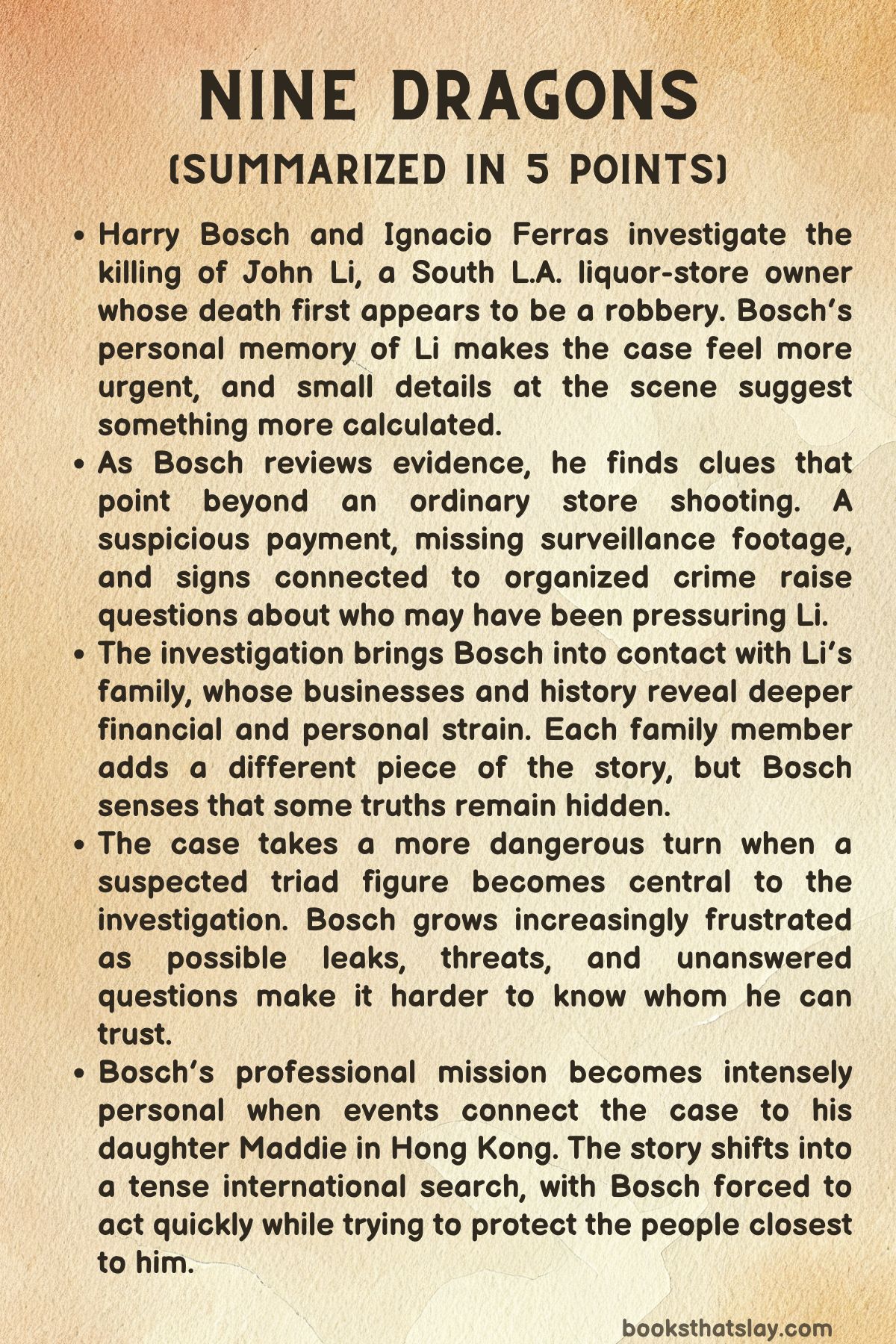
Summary
Harry Bosch is called to investigate the murder of John Li, the owner of Fortune Liquors in South Los Angeles. At first, the case appears to be a robbery gone wrong. Li has been shot behind the counter, the cash register has been emptied, and the store’s surveillance disc has been taken. Bosch’s partner, Ignacio Ferras, is distracted by personal matters and is not eager to stay long, but Bosch quickly senses that the scene deserves close attention.
Several details trouble him. The killer has removed the surveillance evidence with care, no shell casings are found, and valuable liquor remains untouched. The crime looks staged, as if someone wanted the police to accept a simple explanation and move on. Bosch is not the kind of detective who accepts easy answers when the evidence feels wrong.
The case also touches Bosch personally. Years earlier, during the Los Angeles riots, John Li had shown him a small act of kindness by giving him his last cigarette. Bosch remembers that moment and feels he owes the dead man more than routine effort. When he meets Li’s son, Robert, Bosch promises that he will find the person responsible. That promise gives the case a deeper pull for him.
Detective David Chu from the Asian Gang Unit joins the investigation to help with language, culture, and possible gang connections. Bosch and Chu speak with Li’s family. Li’s wife says she had gone home to get dinner and returned to find her husband dead. The detectives also learn that Li had recently threatened a young shoplifter with a gun, but Bosch doubts the killing was a simple act of revenge. The missing surveillance disc and the careful cleanup point toward someone more organized.
Bosch reviews older surveillance recordings from the store and finds an important clue. On footage from a week before the murder, an Asian man enters the store, buys items, and receives $216 from John Li. Chu recognizes the amount as meaningful because 108 has triad associations, and $216 could suggest a doubled protection payment. The man also appears to have a tattoo connected to triad groups. This shifts the investigation away from robbery and toward organized crime.
The detectives learn that John Li had been paying protection money for years. The payments also covered Robert Li’s newer store in the Valley. Business had become difficult, and Robert had urged his father to stop paying. This gives Bosch a possible motive: if Li had resisted the triad, he may have been killed as a warning.
The autopsy strengthens Bosch’s belief that the crime scene had been manipulated. John Li had managed to hide a spent shell casing in his mouth before he died. Bosch sees this as a final act of courage. Li used his last moments to preserve evidence the killer had tried to remove. Ballistics point to a nine-millimeter Glock. Bosch also asks his daughter Maddie, who lives in Hong Kong with her mother, Eleanor Wish, to translate tattoos found on Li’s ankles. Maddie explains that the words refer to luck, money, love, and family, giving Bosch a clearer sense of Li as a man defined by loyalty and survival.
Chu identifies the man in the surveillance footage as Bo-Jing Chang, a suspected triad associate. Bosch and Chu begin watching him. Their surveillance shows Chang visiting Robert Li’s store and demanding that payments continue. When Chang appears ready to leave the country, Bosch has him arrested at the airport for John Li’s murder.
Chang refuses to cooperate during questioning. Bosch suspects he knows more than he is saying. Soon, Bosch receives a terrifying message from Maddie’s phone. The video shows his daughter bound and captive in Hong Kong. Bosch believes the triad has kidnapped her to force him to release Chang or abandon the case. In that moment, the investigation becomes personal in the worst possible way.
Bosch loses control in the interrogation room and attacks Chang, desperate for answers about Maddie. He is stopped before he can seriously harm him, but the incident shows how completely the threat to his daughter has shaken him. Bosch contacts Eleanor in Hong Kong and learns Maddie vanished after going to a mall. Fearing that police involvement could put Maddie in greater danger, Bosch decides to fly to Hong Kong himself.
Before leaving Los Angeles, Bosch has the video examined. Reflections and background sounds suggest Maddie is being held in Kowloon, near Nathan Road. Bosch also searches Chang’s apartment and finds a gun, but it does not match the weapon used to kill John Li. The search does not give him the clear answer he wants, but he continues because time is running out.
In Hong Kong, Bosch reunites with Eleanor and works with her security contact, Sun Yee. The clues lead them to the crowded district connected with the meaning of Kowloon, or “nine dragons.” Bosch obtains an illegal weapon, accepting the risk because he believes force may be necessary to save Maddie. Their search leads them to Chungking Mansions, a vast, crowded building on Nathan Road where someone could easily hide a captive.
Bosch and Eleanor enter the building and follow the trail. The situation becomes deadly when thieves confront them, and Eleanor is killed. Her death devastates Bosch, but he cannot stop. Maddie is still missing, and every lost minute could cost his daughter’s life. Bosch continues the search with Sun Yee and follows the evidence to Dennis Ho, the owner of North Star Imports.
Bosch discovers that Maddie is being moved and that she may be taken away by boat. He reaches her just in time, finding her trapped in the trunk of Dennis Ho’s Mercedes. Bosch kills Ho and rescues Maddie. The rescue saves his daughter, but it comes after a chain of deaths and mistakes that leave lasting damage. Bosch returns to Los Angeles with Maddie, while Chinese authorities attempt to pursue action against him. His half-brother, lawyer Mickey Haller, helps prevent the matter from going further.
Back in Los Angeles, Bosch and Chu realize that Maddie’s abduction was not actually connected to John Li’s murder in the way Bosch had believed. The triad angle had misled the investigation. The real answer lies inside the Li family. Evidence begins to point toward Robert Li and his friend Eugene Lam.
Lam eventually reveals that the murder was part of a family plan. Mia Li, John Li’s daughter, wanted to free herself from the burden of caring for her parents. Robert helped shape the idea of making the killing look like a triad-related crime. What Bosch first saw as organized crime turns out to be an act of betrayal hidden behind the appearance of gang violence.
The case ends in more tragedy. Ferras tries to arrest Robert on his own, wanting to prove himself and act independently of Bosch. Instead, he is killed by Mia, who then takes her own life. Bosch is left with the cost of the investigation: John Li, Eleanor, Ferras, and others are dead, and the truth offers little comfort.
After Ferras’s funeral, Maddie confesses a painful secret. Her kidnapping began as a staged plan with friends because she wanted her mother to let her live with Bosch. But the plan went terribly wrong when one of the people involved arranged to sell her to criminals. Maddie blames herself for the deaths that followed, especially Eleanor’s. Bosch comforts her as best he can. He does not deny that mistakes were made, but he tells her they will face the consequences together and find a way to live with what happened.
By the end of Nine Dragons, Bosch has solved John Li’s murder and saved Maddie, but victory feels heavy. The case exposes how easily assumptions can lead even a skilled detective in the wrong direction. It also changes Bosch’s life as a father. Maddie’s move into his world brings responsibility, guilt, and a new kind of bond. Bosch remains a detective driven by justice, but the book makes clear that his hardest battles are not only with killers. They are also with fear, loss, and the people he loves most.
Characters
Harry Bosch
Harry Bosch is the central moral force of the book, a detective driven by instinct, memory, duty, and personal loyalty. In Nine Dragons, his investigation begins as a murder case but quickly becomes deeply personal because John Li is not just another victim to him.
Bosch remembers Li from the past, and that memory gives the case an emotional weight that shapes his actions. He is shown as observant and suspicious in the best sense of a detective: he notices what does not fit, such as the missing surveillance disc, the lack of shell casings, the untouched liquor, and the strange details around the cash register.
These clues reveal Bosch’s strength as an investigator, because he does not accept the simplest explanation when the scene feels staged or incomplete.
Bosch is also defined by his sense of promise. When he tells Robert Li that he will find the killer, the promise becomes more than a professional statement; it becomes a personal obligation.
His determination is admirable, but the book also shows how easily that determination can become rage when someone he loves is threatened. Maddie’s kidnapping pushes Bosch beyond the controlled discipline of police work and exposes the vulnerable father beneath the detective’s hard exterior.
His attack on Chang shows how fear can overpower judgment, but it also reveals the depth of his love for his daughter. Bosch is not presented as flawless.
He is intense, impulsive, and sometimes reckless, yet his flaws come from the same source as his strengths: his refusal to let evil go unanswered.
Ignacio Ferras
Ignacio Ferras serves as Bosch’s partner, but his role also highlights the contrast between Bosch’s consuming dedication and the more ordinary human pressures faced by other detectives. Ferras is introduced while trying to leave early for family reasons, which immediately places him in a different emotional position from Bosch.
He has responsibilities outside the job, and his desire to attend to them makes him seem more grounded in everyday life. This does not make him weak or careless; rather, it shows that not every character is built to live entirely inside the demands of police work the way Bosch does.
Ferras also helps reveal Bosch’s personality by contrast. Where Bosch becomes absorbed by the case and follows every unsettling detail, Ferras appears less central to the investigation’s deeper movement.
His presence reminds the reader that police work is not only about dramatic breakthroughs and personal crusades; it is also a job carried out by people with families, schedules, fatigue, and private obligations. In that way, Ferras’s character adds realism to the story and emphasizes how unusual Bosch’s level of obsession and emotional investment truly is.
John Li
John Li is the murder victim, but he is not treated as merely a plot device. Even after death, his character has a strong presence in the story.
Bosch remembers him from years earlier, when Li gave him his last cigarette during a difficult moment connected to the riots. That memory gives Li dignity and humanity before the investigation even fully begins.
He becomes a symbol of quiet endurance: a store owner who has survived hardship, supported his family, and lived under the pressure of criminal extortion for years.
Li’s final act, placing the spent casing in his mouth before dying, reveals courage and intelligence. Even while mortally wounded, he tries to preserve evidence and speak through the only means left to him.
This action makes him an active participant in the search for justice, not simply a helpless victim. The tattoos on his ankles, representing luck, money, love, and family, also deepen his character.
They suggest a man shaped by practical hopes and personal loyalties. Li’s life appears to have been defined by struggle, sacrifice, and devotion to family, and his death exposes the hidden fear and control that the triad has held over him.
Robert Li
Robert Li is a conflicted figure because he represents both family loyalty and the pressure of financial survival. As John Li’s son, he is grieving, but he is also connected to the family business and to the difficult choices surrounding the triad payments.
His admission that his father had been paying protection money for years reveals a family trapped between fear and resistance. Robert’s more upscale Valley store suggests ambition and a desire to move beyond the family’s older circumstances, but that progress is still shadowed by the same criminal forces that controlled his father’s life.
Robert’s urging that his father stop paying the triad makes him important to the moral tension of the story. On one level, his position seems reasonable: the businesses are struggling, and endless payments only deepen the family’s vulnerability.
On another level, his advice may have helped create danger, even if unintentionally. This makes Robert a character marked by guilt, frustration, and helplessness.
He wants to protect the family’s future, but he cannot fully protect the family from the consequences of standing up to organized crime. His grief is therefore complicated by the knowledge that the family’s struggle over money and fear may be tied to his father’s death.
Mrs. Li
Mrs. Li is a quiet but important character whose grief adds emotional weight to the murder investigation. She is the person who finds her husband dead after returning from getting dinner, and that detail makes the killing feel painfully domestic.
Her absence from the store at the time of the shooting is ordinary and innocent, but it also becomes part of the tragedy: she leaves for a simple family errand and returns to a destroyed life. Through her, the book shows the human cost of violence on those left behind.
Mrs. Li also represents the silence and fear surrounding the family’s situation. Her need for translation through David Chu suggests both a language barrier and a deeper separation from the police world Bosch inhabits.
She is not presented as someone who drives the investigation forward through bold action, but her presence matters because she embodies the sorrow of a family that has lived under pressure for years. Her character reminds the reader that crime damages more than the immediate victim; it leaves spouses, children, and households permanently altered.
Mia Li
Mia Li is John Li’s daughter, and her character reflects the guardedness within the Li family. She confirms family details but claims not to know about the triad, which creates uncertainty around how much she truly understands.
Her denial may be genuine, especially if the family tried to shield her from the uglier realities of the business. It may also suggest the kind of silence that grows in families living under threat, where people avoid speaking directly about danger because naming it makes it feel even more real.
Mia’s role is subtle, but it helps show how the triad’s influence reaches into family life without always being openly discussed. She stands as part of the younger generation affected by decisions made by parents and older relatives.
Her limited knowledge, or her unwillingness to speak, gives her a sense of vulnerability. She is not at the center of the action, yet her presence helps complete the portrait of the Li family as one shaped by grief, fear, loyalty, and secrets.
David Chu
David Chu is a useful and complicated figure in the investigation. As a detective from the Asian Gang Unit, he brings knowledge Bosch does not have, especially regarding language, triad symbolism, and the meaning of the $216 payment.
His explanation of the double triad payment and the tattoo connected to triad groups helps shift the case away from a simple robbery theory and toward organized crime. In this sense, Chu is essential because he provides cultural and investigative context that Bosch needs in order to understand what is really happening.
At the same time, Chu’s character creates tension because he does not always operate in a way Bosch approves of. His decision to involve Monterey Park detectives without Bosch’s approval suggests either initiative or a lack of loyalty, depending on how one reads his actions.
Bosch’s concern about a leak also casts suspicion over the investigation’s wider circle, making Chu’s role feel less straightforward. He is not simply a helpful expert; he is part of the uncertainty surrounding the case.
His character adds complexity by showing that even within law enforcement, cooperation can be uneasy, trust can be fragile, and different detectives may have different instincts about how to handle a case.
Bo-Jing Chang
Bo-Jing Chang is the visible face of the triad threat in the story. Identified as a member of the Yung Kim triad, he is connected to the protection payments and becomes a major suspect in John Li’s murder.
His appearance on surveillance footage, his tattoo, and his later visit to Robert’s store all make him seem menacing and deeply involved in the extortion scheme. Chang represents the kind of criminal pressure that hides behind routine business transactions, turning ordinary stores into places of fear and control.
Chang is also important because he becomes the object of Bosch’s fury once Maddie is kidnapped. His refusal to talk makes him feel cold and unreachable, and his silence intensifies the sense that he belongs to a larger organization more dangerous than one man.
Whether he is the actual killer or part of a wider network, his character functions as a symbol of organized intimidation. He does not need long speeches to seem threatening; his power comes from association, silence, and the fear that others act on his behalf.
Maddie Bosch
Maddie Bosch is Bosch’s daughter, and her kidnapping transforms the story from a murder investigation into a personal crisis. Before she appears directly in danger, she helps Bosch by translating the tattoos on John Li’s ankles, which shows her intelligence and her connection to both her father and the Hong Kong setting.
She is not just a distant family member; she becomes part of the investigative thread before becoming the emotional center of the crisis.
Once Maddie is shown bound in the video message, she becomes the clearest representation of Bosch’s vulnerability. The threat against her exposes the cost of Bosch’s work and the danger of confronting powerful criminals.
Maddie’s role is emotionally powerful because she is innocent in the conflict yet used as leverage against her father. Her kidnapping forces Bosch to act not only as a detective seeking justice but as a father willing to cross boundaries to save his child.
Through Maddie, the book shows that Bosch’s deepest fear is not professional failure but personal loss.
Eleanor Wish
Eleanor Wish is Bosch’s ex-wife and Maddie’s mother, and she brings emotional history and urgency to the Hong Kong portion of the story. Her connection to Bosch is complicated by their past, but Maddie’s disappearance forces them into a shared crisis.
Eleanor’s presence reminds the reader that Bosch’s life is not only shaped by police work but also by broken relationships, family bonds, and unresolved emotional ties. She is not merely a former spouse; she is someone who understands Bosch personally and shares the same desperate need to find their daughter.
Eleanor also adds practical strength to the search. She is in Hong Kong, she knows the local situation better than Bosch, and she has access to help through Sun Yee.
Her role balances emotional distress with action. Like Bosch, she is frightened, but she does not collapse under that fear.
Her decision to move with Bosch toward danger shows courage and maternal determination. In the story, Eleanor becomes both a partner in the rescue effort and a reminder of the family Bosch is trying to hold onto.
Sun Yee
Sun Yee is Eleanor’s security man, and his role is practical but significant. He helps connect Bosch and Eleanor to the local environment of Hong Kong, where Bosch is operating outside his normal jurisdiction and without the full support of official police channels.
Sun Yee’s presence gives the search a sense of local knowledge and logistical support. He belongs to the world Bosch has entered, a world that is unfamiliar, crowded, and dangerous.
Sun Yee also helps emphasize Bosch’s outsider status. In Los Angeles, Bosch knows the rules, streets, procedures, and institutions.
In Hong Kong, he needs guidance, weapons, local movement, and interpretation of places like Wan Chai, Kowloon, Nathan Road, and Chungking Mansions. Sun Yee’s character therefore functions as a bridge between Bosch’s determination and the foreign terrain he must navigate.
Though not as emotionally central as Bosch, Maddie, or Eleanor, he contributes to the rescue effort by making action possible in a place where Bosch cannot rely on his usual authority.
Themes
Duty, Obsession, and the Cost of Justice
Harry Bosch treats the killing of John Li as more than a routine liquor-store murder because the case carries a personal memory and a moral obligation. Li once showed him a small act of kindness during a violent moment in the past, and Bosch’s promise to Robert turns the investigation into a debt he feels bound to repay.
This sense of duty gives Bosch focus, but it also pushes him toward obsession. He refuses to accept the easy explanation of robbery because the details do not satisfy him: the missing surveillance disc, the untouched liquor, the lack of shell casings, and Li’s final effort to preserve evidence all suggest something deeper.
In Nine Dragons, justice is shown as something that demands patience, instinct, and sacrifice, but Bosch’s pursuit also shows how dangerous moral certainty can become. When Maddie is threatened, his professional discipline begins to collapse, and the detective who usually follows evidence becomes a father driven by fear.
The theme shows that justice can be noble, but when it becomes personal, it can blur judgment and expose the people closest to the seeker of truth.
Family as Motivation and Vulnerability
Family shapes nearly every major decision in the story. John Li’s family business is not just a store but a shared burden, tied to loyalty, survival, and fear.
Robert wants to protect the newer store and move away from the old payments, while Li continues carrying the weight of the threats that have followed him for years. Mia’s silence and Mrs. Li’s grief reveal how crime does not only harm the victim; it unsettles the entire family structure.
Bosch’s own family connection becomes even more urgent when Maddie is taken. His role as a father overtakes his role as a detective, and the case shifts from professional investigation to personal rescue.
The kidnapping exposes family as Bosch’s greatest source of purpose and his greatest weakness. He can face armed criminals, violent streets, and foreign danger, but the image of Maddie bound and helpless breaks through his usual control.
Through both the Li family and Bosch’s relationship with Maddie, the narrative presents family as a force that gives people reason to fight, while also making them vulnerable to manipulation, guilt, and fear.
Crime, Fear, and Hidden Power
The killing begins with the appearance of an ordinary robbery, but the investigation slowly reveals a wider system of control built on fear. The protection payments show how organized crime can become part of daily life, especially for small business owners who feel they have no safe way to resist.
John Li has paid for years, not because he accepts criminal authority, but because refusal could endanger his family and livelihood. The amount of $216, the tattoo, and Chang’s demand at Robert’s store all point to a criminal world that operates through symbols, routines, and intimidation.
The most disturbing part of this power is its reach. The danger moves from a South L.A. liquor store to Bosch’s daughter in Hong Kong, showing that the organization’s influence crosses borders and personal boundaries.
Fear becomes a weapon stronger than direct violence because it pressures victims into silence before a shot is ever fired. The theme also questions how visible crime really is: what looks like a single murder may be only the surface of a much larger system built to keep people obedient.
Cultural Distance and the Limits of Control
Bosch is skilled in reading crime scenes, suspects, and patterns, but this case forces him into spaces where his usual control is limited. Language, cultural codes, tattoos, triad symbols, and the geography of Hong Kong all require him to depend on others for meaning.
Chu’s translations, Maddie’s help with the ankle tattoos, and later the clues from the kidnapping video all show that truth is not always available through instinct alone. Bosch must interpret a world where details carry meanings he does not immediately understand.
This does not make him weak, but it does challenge his confidence. His methods, shaped by Los Angeles policing, become strained when the danger shifts overseas and involves criminal networks rooted in traditions and locations unfamiliar to him.
Nine Dragons uses this cultural distance to increase tension, but it also reveals Bosch’s limitations. He is determined and experienced, yet he cannot solve everything by force or suspicion.
The theme shows that control is fragile when a person enters unfamiliar territory, and survival depends on learning quickly, trusting selectively, and accepting that every clue may carry a meaning beyond its surface.