My Soul to Take Summary, Characters and Themes
My Soul to Take by Rachel Vincent is a young adult paranormal novel about Kaylee Cavanaugh, a teenage girl who discovers that her terrifying urge to scream around certain people is not a panic disorder but a supernatural gift tied to death. As girls around her begin dying without clear medical causes, Kaylee is forced to question her family, her past, and her own identity
The story mixes high school life with reapers, soul songs, hidden bargains, and dangerous family secrets. At its center, My Soul to Take is about learning the truth after years of protection, fear, and silence. It’s the 1st book of the Soul Screamers series.
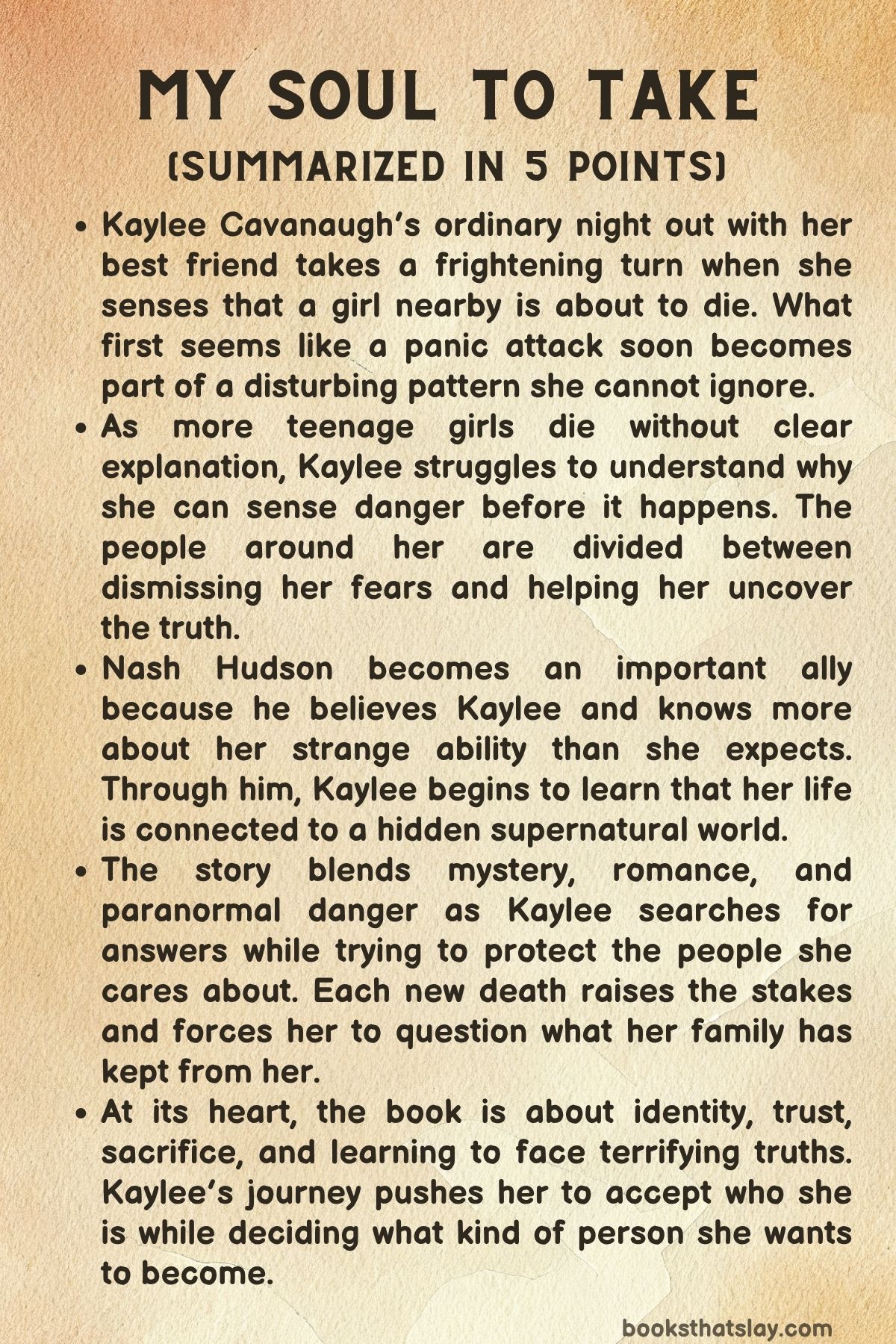
Summary
Kaylee Cavanaugh begins the story as an ordinary teenage girl with one terrible secret: sometimes, without warning, she is overcome by a crushing sense of sorrow and an uncontrollable need to scream. These episodes have made the adults in her life think she is emotionally unstable.
She has already been hospitalized once because of them, and she fears being sent back if anyone believes the attacks have returned.
One night, Kaylee sneaks into a club called Taboo with her best friend, Emma. Emma’s older sister Traci helps them get in, and for a while the night feels exciting and risky in the normal teenage way.
Kaylee is surprised when Nash Hudson, a popular senior she has admired from a distance, notices her and dances with her. She cannot understand why someone like Nash would be interested in her, but his attention makes the night feel unreal in a good way.
Then everything changes. Kaylee sees a dark shadow around a red-haired girl named Heidi Anderson.
At the same time, she is hit by an overwhelming wave of grief and a desperate need to scream. It feels as if death is pressing against her from all sides.
Nash does not laugh at her or run from her. Instead, he helps her outside and calms her in the alley.
Kaylee tells him something she barely understands herself: she knows the girl is going to die.
The next morning, Kaylee learns that Heidi was found dead in the club bathroom. The news shocks her, but it also confirms what she feared.
Her strange attacks are connected to real deaths. Instead of treating her as unstable, Nash takes her seriously.
That makes Kaylee trust him, and the two begin to spend more time together.
Soon, more teenage girls die in sudden and unexplained ways. Alyson Baker collapses at a theater.
Meredith Cole, a girl from Kaylee’s school, dies during a dance-team demonstration. Before Meredith’s death, Kaylee again sees the shadow that warns her something terrible is about to happen.
She cannot stop it, and the school erupts into panic after Meredith collapses. Kaylee feels trapped between fear of what she is seeing and fear that no one will believe her.
When she tries to talk to Aunt Val, who has raised her with Uncle Brendon, Val dismisses the problem as another panic episode. Her reaction hurts Kaylee because it brings back memories of being drugged and hospitalized.
Kaylee knows her experiences are real, but the adults around her have spent years treating them like symptoms of illness.
Nash finally gives Kaylee an explanation that changes her life. He tells her she is not fully human.
She is a bean sidhe, a banshee, born with the ability to sense approaching death and sing for souls as they leave the body. Nash is also a bean sidhe, though male bean sidhes have different abilities.
His voice can influence people, calm them, and help guide souls. This explains why he has been able to steady Kaylee when no one else could.
Nash introduces Kaylee to Tod, a grim reaper who works at a hospital. Tod knows how death is supposed to function.
Souls are collected according to lists, and reapers are meant to follow those lists. The deaths of the teenage girls do not seem normal to him.
They look suspicious, as if someone is taking souls that should not yet be taken.
Kaylee’s uncle Brendon is drawn into the truth, and so is her father, Aiden, who has been absent for most of her life. Kaylee learns that her family has known what she is all along.
They kept the truth from her because they thought ignorance would protect her. She also learns that her mother was a bean sidhe.
This discovery makes Kaylee’s past feel even more painful, because everyone around her has been hiding important pieces of her own life.
At Meredith’s memorial, Kaylee senses another coming death. This time it is Emma.
The realization terrifies her. Emma is not just another girl at school; she is Kaylee’s best friend and one of the few people who has always stood by her.
Nash helps Kaylee hold back her scream until the right moment. When Emma dies, Kaylee releases her soul song while Nash helps guide Emma’s soul back into her body.
The attempt works. Emma revives, but the victory is not clean.
Another girl, Julie Duke, dies instead. Kaylee sees a female reaper watching them and realizes that a replacement soul has been taken.
Someone is making sure a young soul is collected even when the intended victim is saved. Tod later identifies this as soul poaching.
He warns them that the matter should be handled by Levi, his superior, but Kaylee cannot easily stand aside while girls continue dying.
As the danger grows, Kaylee’s father arrives and reveals the deepest secret of all. Kaylee herself died as a child in the car crash that killed her mother.
Her mother gave up her own life and soul to bring Kaylee back. Kaylee has been living because her mother paid the ultimate price for her.
This truth leaves Kaylee shaken. Her life is not simply her own; it was bought through sacrifice.
Kaylee also learns more about bean sidhes, including the fact that they age slowly and live under rules humans never see. The people who raised her were not only hiding a family history.
They were hiding an entire world. Kaylee struggles with anger, grief, and confusion, but she also begins to understand why the adults were afraid.
Knowledge in this world carries danger.
The crisis becomes personal when Kaylee sees the death-shadow around Sophie, her cousin. Sophie has often been cruel to Kaylee, but Kaylee still does not want her to die.
Aunt Val panics in a way that reveals she knows more than she has admitted. She calls out to the reaper by name: Marg.
Kaylee realizes that Val made a bargain with Marg. Val wanted youth and beauty, and in return she promised young, beautiful souls to Belphegore through Marg.
Whether Val fully understood what she was doing or lost control of the bargain, the result has been the same: innocent girls have died. Marg has already taken several souls, and now she comes for Sophie.
Kaylee fights to save her cousin. She sings to hold Sophie’s soul while Nash, Brendon, and Aiden try to guide it back.
Marg resists them, determined to claim what she believes she is owed. Harmony, Nash’s mother, arrives and adds her strength to the effort, helping bind Sophie’s soul long enough for them to keep fighting.
Kaylee acts with desperate courage and attacks Marg with a skillet, trying to interrupt her hold.
In the end, Val makes a final choice. Terrified of losing Sophie, she offers herself in Sophie’s place.
Marg accepts and disappears. Sophie’s soul returns to her body, and she survives.
Val is gone, leaving behind the terrible truth of what her bargain cost other families.
After the danger passes, Kaylee is left with grief, anger, and a clearer understanding of her world. Sophie is alive, but the deaths cannot be undone.
Kaylee knows that Val’s choices destroyed innocent lives. She also knows that her own life came from her mother’s sacrifice, and that truth changes how she sees herself.
Nash reassures Kaylee that the immediate nightmare is over, but Kaylee is not fully at peace. Marg and Belphegore may still be threats, and the supernatural world is far larger and darker than she once imagined.
Still, Kaylee has changed. She no longer sees herself as broken or crazy.
She knows what she is, what her voice can do, and what her mother gave for her.
By the end of My Soul to Take, Kaylee accepts that she has been given time at a terrible cost. Her mother died so she could live, and Kaylee decides that the only way to honor that gift is to live with courage, purpose, and responsibility.
Characters
Kaylee Cavanaugh
Kaylee Cavanaugh is the central character of My Soul to Take, and her journey is built around fear, confusion, grief, and self-discovery. At the beginning of the book, she sees herself as an ordinary girl with terrifying episodes she cannot control.
Her screams, her visions of shadows, and her overwhelming sense of death make her believe something is wrong with her mind, especially because the adults around her have previously treated her experiences as panic attacks or emotional instability. This makes Kaylee a deeply sympathetic character because she is not only facing supernatural danger but also struggling against the belief that she may be broken.
Her fear feels very human, and her courage grows gradually rather than appearing all at once.
Kaylee’s strength comes from her compassion. Even before she understands what she is, she reacts strongly to the suffering and deaths of the girls around her.
She does not ignore what she sees, even when no one believes her. Her instinct is always to protect, warn, and save others, which becomes especially clear when Emma’s life is threatened.
Kaylee’s soul song is not just a supernatural ability; it reflects the depth of her emotional nature. She feels death before others do, and this forces her to carry a burden that most people cannot understand.
Her character also develops through the painful discovery of family secrets. Learning that she is a bean sidhe changes her understanding of herself, but learning that she once died as a child and was brought back through her mother’s sacrifice changes her entire sense of existence.
This truth gives Kaylee a heavier emotional responsibility. She realizes that her life was not simply preserved by chance; it was paid for with her mother’s life and soul.
By the end of the story, Kaylee becomes more mature because she accepts that survival is not enough. She wants to live in a way that honors the sacrifice made for her, which gives her character a strong moral and emotional resolution.
Nash Hudson
Nash Hudson begins as the popular senior who notices Kaylee at the club, but he quickly becomes much more than a romantic interest. His importance lies in the fact that he believes Kaylee when others dismiss her.
Instead of treating her fear as madness, he recognizes it as something real. This makes him a source of emotional safety for Kaylee at a time when she feels isolated and frightened.
His calmness in the alley after Kaylee senses Heidi’s death shows that he understands her experience in a way no ordinary person could.
As a male bean sidhe, Nash serves as Kaylee’s guide into the supernatural world. He explains parts of her identity, helps her understand her abilities, and supports her when her power threatens to overwhelm her.
His voice has influence, and his ability to guide souls gives him a protective role in the book. However, Nash is not simply powerful; he is careful with Kaylee.
His patience matters because Kaylee has spent years being doubted, controlled, or medically silenced. Nash gives her belief before he gives her explanations, and that makes their bond emotionally meaningful.
Nash also represents partnership. During Emma’s near-death, he does not take over from Kaylee but works with her.
Kaylee’s soul song and Nash’s guidance combine to save Emma, showing that their connection is both emotional and supernatural. His reassurance at the end of the story helps Kaylee feel that the immediate nightmare has ended, but his presence also suggests that her new life will not be faced alone.
Nash’s character brings warmth, trust, and steadiness into a plot filled with death and betrayal.
Emma
Emma is Kaylee’s best friend and one of the most important emotional anchors in the story. She begins as the lively friend who sneaks into Taboo with Kaylee and shares in the excitement of a forbidden night out.
Her role may seem ordinary at first, but that ordinariness is exactly what makes her important. Emma represents the normal teenage life Kaylee wants to hold onto: friendship, dancing, school, secrets, and small acts of rebellion.
Through Emma, the reader sees what Kaylee has to lose if the supernatural world fully takes over her life.
Emma’s importance grows sharply when she becomes one of the intended victims. At Meredith’s memorial, Kaylee senses death around Emma, and the threat becomes personal in a way it had not been before.
The earlier deaths are horrifying, but Emma’s danger forces Kaylee to act with complete emotional urgency. Emma’s near-death proves that the crisis is not distant or random; it can reach directly into Kaylee’s closest relationships.
This moment also shows the depth of Kaylee’s love for her friend, because Kaylee fights desperately to hold Emma’s soul and bring her back.
Emma’s survival is also morally complicated because another girl, Julie Duke, dies instead. This does not make Emma responsible, but it places her revival within the darker rules of the supernatural conflict.
Her character therefore becomes connected to one of the book’s central questions: what is the cost of saving one life? Emma remains innocent, but her rescue exposes the disturbing reality of replacement souls and soul poaching.
She is important not because she understands the entire supernatural situation, but because her life gives Kaylee a personal reason to fight.
Tod
Tod is a grim reaper who adds mystery, knowledge, and tension to the story. Unlike Kaylee, who is still discovering the supernatural world, Tod already understands its systems and rules.
His work at the hospital places him close to death, and his knowledge of soul collection makes him a key figure in uncovering the truth behind the girls’ sudden deaths. He confirms that souls are supposed to be collected according to lists, which helps Kaylee and Nash realize that the deaths are not natural or properly ordered.
Tod’s personality gives him a sharper edge than many of the other characters. He is not simply comforting or gentle; he often brings uncomfortable truths.
His warnings about soul poaching and his advice to let Levi handle the matter show that he understands the danger better than Kaylee does. He knows that supernatural systems have authorities, consequences, and limits.
This makes him useful, but it also makes him somewhat unsettling because he is part of a world where death is managed almost like a profession.
Tod’s role also deepens the moral structure of the story. Through him, death is shown not as random chaos but as something governed by rules.
When those rules are broken, the result is unnatural and dangerous. Tod helps reveal that the true threat is not simply that girls are dying, but that their souls are being stolen outside the proper order.
His character gives the book a wider supernatural framework and helps Kaylee understand that her powers belong to a much larger system.
Aunt Val
Aunt Val is one of the most morally troubling characters in the book because she is both a guardian figure and a source of betrayal. At first, she appears to be an adult who is concerned about Kaylee’s mental health, but her concern is shaped by denial, fear, and control.
When Kaylee tries to tell her what is happening, Val treats it like another panic episode, reminding Kaylee of the hospitalization and medication that made her feel powerless in the past. This makes Val an emotionally damaging presence even before her deeper secret is revealed.
Val’s obsession with youth and beauty becomes the root of the central betrayal. Her bargain with Marg exposes her vanity and desperation.
She wanted to preserve her appearance and was willing to enter a supernatural agreement without fully understanding or controlling its consequences. The horror of her character lies in the fact that her desire for beauty leads to the deaths of young girls.
Even if she does not seem fully prepared for the exact cost, she still participates in a bargain that treats souls as payment.
Yet Val is not written as purely emotionless. Her panic when Sophie is marked for death shows that she does love her daughter.
This love does not erase her wrongdoing, but it complicates her. She is selfish and reckless, but when the consequences finally reach Sophie, Val chooses to sacrifice herself instead.
Her final act suggests a desperate attempt at redemption, though it comes after terrible damage has already been done. Val’s character shows how selfish desires can become destructive when a person refuses to face the moral cost of what they want.
Sophie
Sophie is Kaylee’s cousin, and much of her character is shaped by cruelty, privilege, and insecurity. She is often harsh toward Kaylee, and her behavior makes her difficult to like.
Sophie represents the kind of everyday social pain Kaylee faces even before the supernatural danger becomes clear. While Kaylee is struggling with fear, identity, and family secrets, Sophie often adds humiliation or hostility, making Kaylee’s home life more emotionally strained.
However, Sophie becomes more than just the cruel cousin when death marks her. Once Kaylee sees the shadow around Sophie, the reader is forced to see her not only as an antagonist in Kaylee’s daily life but as a vulnerable girl whose soul is in danger.
This shift is important because it tests Kaylee’s compassion. Kaylee does not decide that Sophie deserves death because she has been cruel.
Instead, she fights to save her. This reveals Kaylee’s moral strength while also giving Sophie a more human place in the story.
Sophie’s near-death also exposes the consequences of Val’s bargain in the most personal way possible. Val’s desire for youth and beauty finally threatens her own daughter, turning Sophie into the living proof that selfish bargains cannot be controlled.
Sophie survives, but her survival comes at the cost of Val’s disappearance. In this way, Sophie functions as both a victim and a turning point.
Her danger forces the truth into the open and brings the central conflict to its emotional climax.
Brendon
Brendon, Kaylee’s uncle, is an important family figure because he represents the hidden supernatural heritage that has shaped Kaylee’s life without her knowledge. As a bean sidhe, he understands far more than he initially reveals.
His secrecy is frustrating because Kaylee has suffered for years without knowing the truth about herself, but his silence also appears connected to a desire to protect her. This makes him a complicated guardian rather than a simple source of wisdom.
Brendon’s role becomes stronger once the truth begins to emerge. He helps Kaylee understand that her abilities are not signs of madness but part of her identity.
His presence also shows that Kaylee belongs to a family with deep supernatural roots. This matters because Kaylee’s isolation begins to break down when she realizes that there are people around her who understand what she is, even if they failed to tell her sooner.
During the crisis involving Sophie, Brendon becomes active in the attempt to save her soul. His participation shows his loyalty to the family and his knowledge of bean sidhe abilities.
He is not the emotional center of the story, but he is part of the support system that helps Kaylee face the truth. Brendon’s character reflects the book’s tension between protection and honesty: he wants to keep Kaylee safe, but the family’s secrecy has also left her unprepared.
Aiden
Aiden, Kaylee’s absent father, is a deeply significant character because his return brings some of the most painful truths in the story. His absence has shaped Kaylee’s life, leaving her to grow up without the guidance of a parent who understood what she was.
When he finally appears, he brings answers, but those answers are emotionally overwhelming. He reveals that Kaylee died as a child in the crash that killed her mother and that her mother sacrificed herself to bring Kaylee back.
Aiden’s character is marked by grief and guilt. His absence suggests that he has not known how to face the consequences of the past or how to be present for Kaylee after such a devastating loss.
Yet his return also shows that he is not indifferent. He becomes part of the effort to help Kaylee understand her identity and her history.
His explanations are painful, but they are necessary because Kaylee cannot fully understand herself without knowing the truth about her mother’s sacrifice.
In the final conflict, Aiden helps in the attempt to guide Sophie’s soul back, showing that he is still connected to the responsibilities of his kind and his family. His role is not only to reveal the past but also to re-enter Kaylee’s present.
Through Aiden, the story explores the damage caused by absence, the burden of grief, and the difficulty of telling the truth after years of silence.
Marg
Marg is the female reaper who becomes one of the major supernatural threats in the book. Her role is frightening because she operates through bargains, replacement souls, and the manipulation of death’s rules.
When Kaylee sees her after Emma is saved and Julie Duke dies instead, Marg becomes connected to the disturbing idea that one life can be exchanged for another. This makes her presence feel cold and predatory.
Marg’s actions reveal the danger of soul poaching. She does not simply collect souls in the proper order; she takes them as part of a corrupt arrangement.
Her connection to Belphegore gives her actions an even darker purpose, suggesting that the stolen souls are part of something larger and more sinister than personal cruelty. Marg is dangerous because she understands the supernatural rules well enough to exploit them.
In the climax, Marg fights to take Sophie’s soul, making the conflict immediate and physical as well as spiritual. Kaylee’s attack on her with a skillet is important because it shows Kaylee refusing to remain helpless in the face of supernatural power.
Marg’s disappearance after Val offers herself does not make her feel completely defeated. Instead, she remains a lingering threat, connected to Kaylee’s fear that the nightmare may not truly be over.
Marg represents corruption, predation, and the terrifying cost of bargains made with forces beyond human control.
Harmony
Harmony, Nash’s mother, plays a smaller but important role as a knowledgeable and capable adult within the supernatural world. Her arrival during the attempt to save Sophie helps shift the situation from desperate struggle to possible rescue.
She understands what needs to be done and helps bind Sophie’s soul, showing both skill and authority. Unlike Val, whose adult choices create danger, Harmony’s presence brings stability and protection.
Harmony also expands the sense of bean sidhe community. Through her, Kaylee’s world becomes larger than her immediate family and Nash.
Harmony shows that there are experienced figures who know how to use their abilities responsibly. Her role contrasts with the secrecy and panic of Kaylee’s household.
Where Val hides and bargains, Harmony acts with clarity.
Although she is not the emotional focus of the story, Harmony’s character matters because she represents mature supernatural knowledge used for the right purpose. She helps save Sophie and supports the younger characters in a moment when their powers alone may not be enough.
Her presence reinforces the idea that Kaylee’s abilities can be guided, strengthened, and used to protect life rather than merely react to death.
Kaylee’s Mother
Kaylee’s mother is not physically present in the main events of the story, but she is one of the most emotionally powerful figures in the book. Her sacrifice shapes Kaylee’s entire life.
She died in the crash and gave up her own life and soul to bring Kaylee back, which makes her love both extraordinary and tragic. Even though Kaylee does not interact with her directly, the truth of her sacrifice changes Kaylee’s understanding of herself.
Her character represents unconditional maternal love taken to its highest and most painful form. She does not merely die protecting Kaylee; she gives up her soul so Kaylee can live.
This makes Kaylee’s existence feel sacred and heavy at the same time. Kaylee must live with the knowledge that her life came at a cost that can never be repaid in any simple way.
The memory of Kaylee’s mother becomes a moral force by the end of My Soul to Take. Kaylee decides that she must live in a way that earns the time her mother gave her.
This does not mean Kaylee can undo the sacrifice, but it gives her a purpose. Kaylee’s mother therefore remains central to the emotional meaning of the story, even in absence.
Her love becomes the foundation for Kaylee’s growth, courage, and sense of responsibility.
Traci
Traci is Emma’s sister and plays a brief but important role in setting the story in motion. She helps Kaylee and Emma get into Taboo, which leads to Kaylee’s first major encounter with the death-shadow surrounding Heidi.
Although Traci is not deeply involved in the supernatural conflict, her action creates the situation where Kaylee’s hidden abilities begin to surface in a public and undeniable way.
Traci’s character belongs more to the ordinary teenage world than the supernatural one. She represents the casual risk-taking and excitement surrounding the club scene.
Her help seems harmless at first, but the night becomes the beginning of Kaylee’s transformation. Because of Traci, Kaylee enters a place where death, attraction, fear, and revelation collide.
While Traci does not undergo major development, she is still useful to the structure of the story. She helps connect Kaylee and Emma to the first death in the chain of events.
Her small role shows how ordinary choices can place characters at the edge of extraordinary danger.
Heidi Anderson
Heidi Anderson is the first girl whose death Kaylee senses, and her role is crucial because she proves that Kaylee’s vision is real. When Kaylee sees the shadow around her at Taboo and becomes overwhelmed by grief and the urge to scream, Heidi becomes the first clear sign that Kaylee’s episodes are connected to death rather than madness.
Her death transforms Kaylee’s fear from private anxiety into a terrifying truth.
Heidi is not developed as a full character in the same way Kaylee, Nash, or Emma are, but her presence matters symbolically. She represents the beginning of the pattern of young girls dying suddenly without obvious cause.
Her death also brings Nash and Kaylee closer because Nash takes Kaylee seriously after the incident. Through Heidi, the story begins moving from mystery into supernatural danger.
Heidi’s role is tragic because she is mostly seen through the shadow of her approaching death. She becomes one of the innocent victims caught in a bargain she did not make and a supernatural system she did not understand.
Her death gives the story its first major shock and establishes the emotional weight of Kaylee’s power.
Alyson Baker
Alyson Baker is another victim in the chain of unnatural deaths. Her collapse at a theater shows that Heidi’s death was not an isolated incident.
Through Alyson, the pattern becomes harder to ignore, and the danger begins to feel wider and more deliberate. Her death helps build the mystery that Kaylee, Nash, and Tod must investigate.
Like the other victims, Alyson is important less for her personal development and more for what her death reveals about the threat. She is a young girl whose life is taken suddenly, and that suddenness emphasizes the cruelty of the soul poaching.
The lack of an obvious cause makes her death especially disturbing because it suggests that ordinary explanations cannot protect anyone.
Alyson’s role adds pressure to Kaylee’s growing awareness. Each death makes it clearer that something is wrong with the natural order.
Alyson helps move the story from one frightening incident to a larger crisis, showing that Kaylee’s ability is not only personal but urgently necessary.
Meredith Cole
Meredith Cole’s death is especially important because it happens at Kaylee’s school, bringing the supernatural crisis directly into Kaylee’s everyday world. When Meredith dies during a dance-team demonstration, the danger is no longer limited to clubs, theaters, or distant news reports.
It enters a familiar place filled with classmates and witnesses, creating panic and chaos.
Kaylee sees Meredith’s shadow beforehand but cannot save her, which makes Meredith’s death emotionally painful for Kaylee. This moment strengthens Kaylee’s sense of helplessness.
She has the ability to sense death, but she does not yet fully understand how to prevent it. Meredith therefore becomes a symbol of Kaylee’s unfinished knowledge and the heavy guilt that comes with seeing danger before others do.
Meredith’s death also pushes the plot toward deeper investigation. It makes the pattern impossible for Kaylee to dismiss and increases the urgency of Nash’s explanations.
Through Meredith, the story shows that knowledge without control can be a burden. Kaylee knows something terrible is coming, but she has not yet learned how to fight it.
Julie Duke
Julie Duke is the girl who dies when Emma is saved, and her role is one of the most morally painful in the story. She becomes the replacement soul taken after Kaylee and Nash succeed in bringing Emma back.
Julie’s death reveals that saving one person within a corrupted supernatural bargain can cause another innocent person to pay the price.
Julie’s character is tragic because she is not personally involved in Kaylee’s choices or Val’s bargain. She becomes a victim of the cruel mechanics of soul poaching.
Her death complicates what might otherwise have been a simple victory. Emma lives, but Julie dies, and that exchange forces Kaylee to understand that the supernatural world is governed by consequences she cannot ignore.
Julie’s role deepens the moral seriousness of the book. Her death shows that good intentions are not always enough when larger forces are manipulating life and death.
Kaylee’s desire to save Emma is understandable and loving, but Julie’s death reveals the terrible cost hidden beneath the rescue. This makes Julie one of the most important victims because her death changes the meaning of survival itself.
Belphegore
Belphegore is not present in the same direct way as Marg or Val, but the character’s influence hangs over the bargain that drives the deaths. Belphegore represents the darker power behind the exchange of youth, beauty, and souls.
The fact that Val’s bargain is connected to Belphegore makes the threat feel larger than one selfish woman or one corrupt reaper.
As a figure associated with the promised souls, Belphegore gives the story a sense of deeper supernatural corruption. The stolen souls are not random; they are payment.
This makes the deaths feel even more horrifying because the victims are treated as currency in a bargain for beauty. Belphegore’s role exposes the ugliness beneath Val’s desire to remain young and attractive.
Belphegore also remains a lingering danger because the story does not reduce the threat to something completely solved. Even after Sophie survives and Val disappears, Kaylee worries that Marg and Belphegore may still be threats.
This keeps the ending from feeling entirely safe. Belphegore represents the unresolved darkness beyond the immediate conflict and suggests that Kaylee’s supernatural life may continue to involve dangers far beyond what she has already faced.
Themes
Identity and Self-Acceptance
Kaylee’s struggle is rooted in the fear that what makes her different also makes her broken. Her screams, visions, and overpowering grief have been treated as symptoms of instability, so she has learned to distrust her own mind.
As the truth comes out, she discovers that these frightening experiences are not signs of madness but proof of a hidden supernatural identity. This changes the way she sees herself.
Instead of being a girl who needs to be controlled, medicated, or dismissed, she becomes someone with a powerful role in the boundary between life and death. My Soul to Take shows that self-acceptance often begins when a person receives the truth about themselves, even if that truth is frightening.
Kaylee does not immediately become confident; her acceptance is gradual and painful. She must face the fact that her life has been shaped by secrets, sacrifice, and powers she never asked for.
Yet by the end, she begins to understand that her identity is not a curse alone. It is also a responsibility and a source of strength.
The Cost of Secrets
Secrecy protects Kaylee only on the surface. Her family hides the truth about bean sidhes, her mother’s sacrifice, her childhood death, and the rules governing souls, believing that silence will keep her safe.
Instead, their secrecy leaves her confused, isolated, and vulnerable. Because she does not understand her abilities, she fears herself and accepts other people’s explanations that she is unstable.
The adults around her may act from love, but their choices deny her the knowledge she needs to protect herself and others. This theme becomes especially important when Val’s hidden bargain is exposed.
Her secret is not protective but selfish, and it causes innocent girls to die. The contrast between Kaylee’s family’s silence and Val’s bargain shows that secrets can have different motives but still cause harm.
In My Soul to Take, truth is painful, but ignorance is more dangerous. Once Kaylee learns the hidden history of her life, she can finally make informed choices.
The novel suggests that protection built on silence often fails because it prevents growth, trust, and responsibility.
Sacrifice and the Value of Life
Kaylee’s life is surrounded by sacrifice long before she understands it. Her mother gave up her own life and soul so Kaylee could live, making Kaylee’s existence both a gift and a burden.
This revelation forces Kaylee to think about life not as something ordinary, but as something bought at an enormous cost. Her response is not simple happiness.
She feels grief, guilt, and pressure because she knows someone else lost everything for her future. The later events with Emma and Sophie deepen this theme.
Kaylee fights to save people because she now understands that every soul matters, not just in a magical sense but in a deeply personal one. Val’s actions create a cruel opposite to real sacrifice.
She treats young lives as payment for beauty and youth, reducing others to objects that can be traded. Kaylee’s mother, by contrast, gives herself freely out of love.
Through this contrast, the story argues that sacrifice has meaning only when it protects life rather than consumes it. Kaylee’s final resolve shows her desire to honor the life she was given.
Trust, Love, and Emotional Support
Kaylee’s bond with Nash is important because he believes her before she fully believes herself. When others see her fear as a panic attack or instability, Nash listens without judgment.
His support gives Kaylee the courage to speak honestly about what she senses and to consider that her experiences may have meaning. Trust becomes a form of emotional survival.
Kaylee has spent years being doubted, so being believed changes her ability to act. Her relationships with Brendon, Aiden, Tod, and Harmony also expand her understanding of the supernatural world, though these relationships are complicated by past silence.
Love in the story is not perfect or free from mistakes. Kaylee’s family loves her, but they also hide painful truths.
Nash cares for her, but he also introduces her to a world filled with danger and rules she does not yet understand. The theme shows that support is strongest when it includes honesty.
Kaylee does not need people to protect her from every truth; she needs people who stand beside her while she faces those truths. Trust helps her move from fear into action.