The Demon King Summary, Characters and Themes
The Demon King by Cinda Williams Chima is a fantasy novel set in the Seven Realms, a world shaped by old magic, clan traditions, royal politics, and the lasting fear of the Demon King. The story follows Han Alister, a former street thief trying to survive honestly, and Princess Raisa ana’Marianna, a restless heir who wants to understand the lives of her people.
Their separate paths reveal corruption, forbidden magic, dangerous ambition, and secrets tied to ancient power. The book blends court intrigue with street-level danger, building a world where identity, loyalty, and power can change everything.
Summary
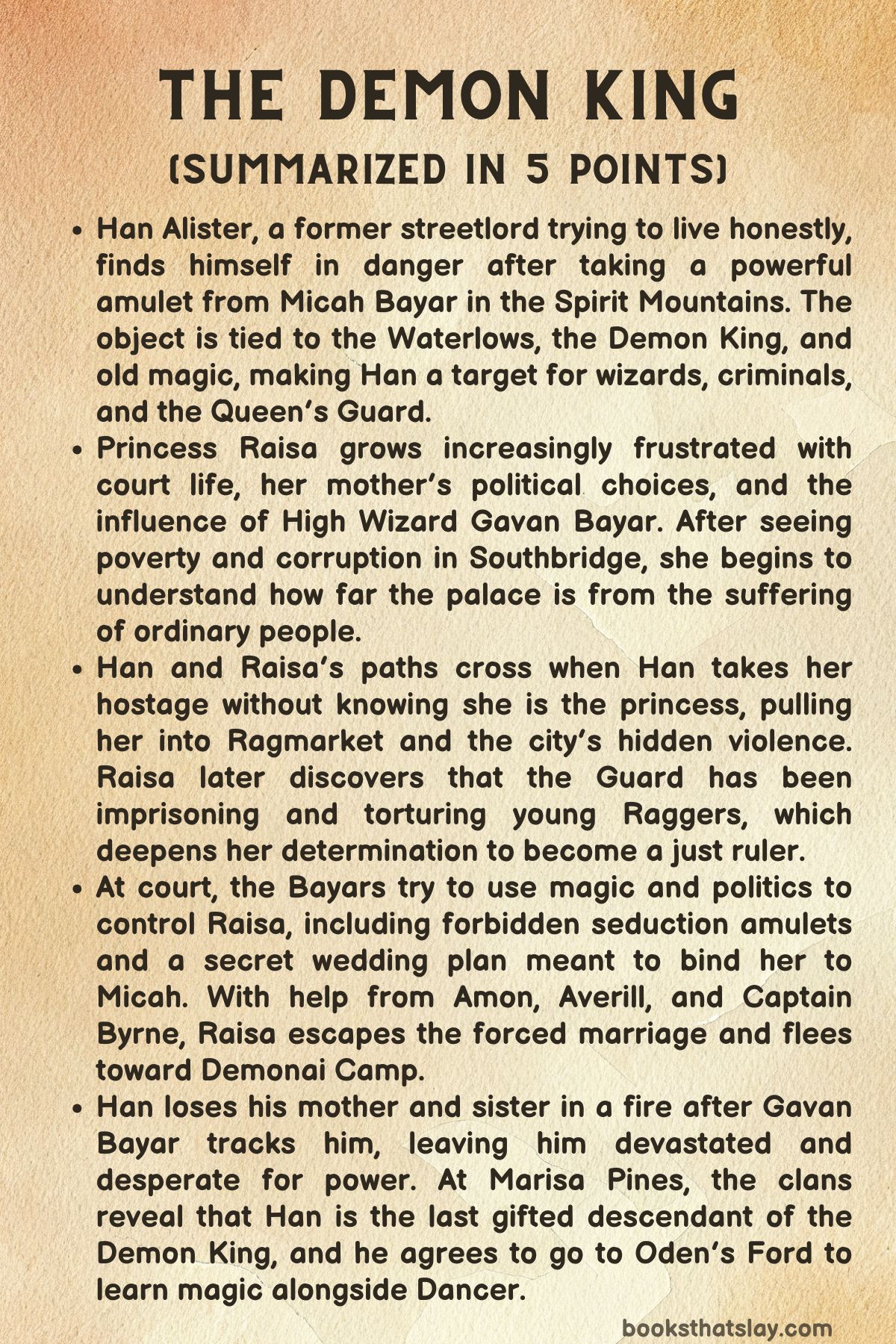
Han Alister is trying to leave his old life behind. Once known as Cuffs, a feared streetlord in Fellsmarch, he now wants to support his mother and younger sister, Mari, without returning to crime.
While gathering plants in the Spirit Mountains with his clan friend Fire Dancer, Han has a poor day of foraging and decides to hunt deer. Before he and Dancer can shoot, a strange magical fire races down the mountain and drives the herd away.
The fire is followed by three young wizards: Micah Bayar and his cousins Arkeda and Miphis. Since wizard magic is forbidden in the mountains under clan law, Dancer confronts them.
The argument worsens when Micah insults the clans and Dancer’s birth. Han steps in before Dancer attacks, threatens Micah with an arrow, and forces him to hand over his amulet.
Though Dancer warns him that keeping a wizard’s amulet is dangerous, Han takes it.
At the same time, Princess Raisa is with her mother, Queen Marianna, her sister Mellony, High Wizard Gavan Bayar, and Captain Byrne during a royal hunt. Raisa is restless at court and uneasy about the queen’s closeness to Bayar.
The same magical fire traps the royal party in a canyon. Micah and his cousins arrive, claiming they came across the blaze by accident.
Gavan Bayar uses his amulet, drawing power from the boys through a silver chain, to push the fire back and summon rain. He is praised as a hero, though Captain Byrne notices that the fire seems unnatural.
Han and Dancer return to Marisa Pines, where Dancer’s mother, Willo, becomes worried when she learns Micah Bayar was involved. Han overhears signs that Dancer may be hiding a dangerous secret.
Back at court, Raisa learns that Amon Byrne, her childhood friend, has returned from military school. Their bond is still strong, but their positions are changing.
Amon is sworn into temporary service with the Queen’s Guard, and Raisa sees that court life is becoming more controlled by politics and alliances.
Han visits Lucius Frowsley, a blind distiller who knows secrets. Lucius identifies the amulet as a Waterlow artifact connected to Alger Waterlow, the Demon King, and the Breaking, the disaster that shattered the old order.
He warns Han to hide it and avoid the Bayars. In Fellsmarch, Han is attacked by Shiv Connor and the Southies.
When Shiv unwraps the amulet, green light bursts out and knocks everyone down. Han escapes, but soon the Queen’s Guard starts hunting him after several Southies are found tortured and murdered.
Raisa begins to challenge her mother about marriage, power, and the High Wizard’s influence. Her grandmother Elena gives her the Running Wolves ring and urges her to pay attention to signs.
Amon tells Raisa about poverty, hunger, corruption, and violence in the poorer parts of the city. Wanting to help, Raisa disguises herself and sneaks out with jewelry she hopes to sell for relief money.
At Southbridge Temple, she meets her father, Averill, and Speaker Jemson. Han, hiding there from the Guard, panics when Amon recognizes him.
He takes Raisa hostage, not knowing she is the princess, locks the others away, and drags her into Ragmarket.
Han hides Raisa in a cellar, but she escapes in his clothes and is cornered by the Raggers. Han saves her, and she learns that the Raggers deny killing the Southies.
Several of their own people have also been arrested. Raisa, using the name Rebecca, insists on investigating.
She enters the Southbridge Guardhouse pretending to visit her sister and is taken below by Sergeant Gillen. There she discovers that Han was telling the truth: the Guard has been secretly imprisoning and torturing young Raggers.
Gillen tries to use Raisa to frighten a prisoner into confessing, but Raisa fights back. With the prisoners’ help, she knocks Gillen down, burns him with a torch, and helps take control of the cell block.
Amon searches desperately for Raisa while Captain Byrne hides her disappearance from the queen to protect her future. Han tells Amon that Raisa entered the guardhouse, and Amon arrives with cadets.
He negotiates with Raisa and the prisoners, pretends to remove them under guard, and then releases them once they are away. Han thanks Raisa in his own sharp way and vanishes.
Raisa returns to the castle furious that the crimes of the Guard may be covered up.
Han learns that he is being hunted and decides to leave Fellsmarch. He says goodbye to his mother and Mari, then fakes his death by leaving bloody clothes near the river.
On his way out, he is attacked by cloaked magical figures who are hunting Shiv Connor. Han’s silver cuffs absorb their magic, allowing him to survive.
Later, Shiv begs Han to call off the “demons,” even offering loyalty, but Han cannot help him.
At Marisa Pines, Han feels out of place as clan life moves on. Bird prepares to join the Demonai warriors, while Dancer becomes more unhappy.
During a naming ceremony, Bird is accepted as a Demonai candidate. Then Dancer’s secret is exposed: his father was a wizard, and Dancer has inherited magic.
The clans decide Dancer must go to Oden’s Ford to learn control, though some Demonai distrust him.
At court, Raisa attends Micah and Fiona Bayar’s grand name day celebration. Micah gives her intense attention, and Raisa feels a powerful attraction that does not seem natural.
Amon and Averill interrupt before Micah can take her away. Averill discovers that Raisa’s necklace and Micah’s ring are paired seduction amulets, forbidden devices meant to bind Raisa to Micah.
Raisa is treated by Elena and told that the jewelry was part of a plot, though she believes Micah may not have known the full truth.
Raisa is confined before her own name day. Amon undergoes the Byrne family ritual and is magically bound to protect the Gray Wolf line.
On Raisa’s name day, her father fails to arrive, making her uneasy. After the celebration, Micah leads her to the queen’s rooms, where Queen Marianna, Gavan Bayar, Fiona, and a priest have arranged a secret wedding between Raisa and Micah.
Raisa refuses. Amon intervenes, and Averill and Captain Byrne arrive alive after surviving an attack meant to stop them.
Raisa escapes the castle with Amon and rides toward Demonai Camp.
Han returns to Fellsmarch because Mari is gravely ill. Desperate for money, he tries to sell the stolen amulet, but Gavan Bayar finds him.
Han stabs Bayar and escapes, only to discover the stable where his mother and sister live burning. The Raggers stop him from rushing into the fire.
His mother and Mari are dead. Sick with grief and fever, Han is taken back to Marisa Pines by Willo.
There, the clans reveal the truth. Dancer is not the only one with magic.
Han is the last gifted descendant of Alger Waterlow, the Demon King. His silver cuffs were made to suppress and absorb his power.
Han is shaken by the discovery, but his losses have changed him. He agrees to go to Oden’s Ford with Dancer, not because he wants glory, but because he wants power enough to protect himself, face his enemies, and never be helpless again.
Characters
Han Alister
Han Alister is one of the central characters in The Demon King, and his journey is shaped by survival, guilt, anger, and the slow discovery of a power he does not yet understand. At the beginning of the book, Han is trying to leave behind his old life as a streetlord and support his mother and sister honestly.
This makes him a deeply sympathetic character because his roughness comes from hardship rather than cruelty. He is clever, quick-thinking, and brave, but he is also impulsive, especially when he feels threatened or cornered.
His decision to take Micah Bayar’s amulet shows both his courage and his tendency to underestimate the danger of forces larger than street politics.
Han’s character becomes more complex as the story connects his personal struggles with the larger history of the realm. He does not begin as someone seeking greatness; he wants food, safety, and dignity for his family.
Yet the world repeatedly denies him those simple needs. The deaths of his mother and sister are a turning point because they strip away the last pieces of ordinary life he was trying to protect.
His grief hardens him, but it also gives him a clearer purpose. When he learns that he is the gifted descendant of the Demon King, the revelation does not feel like a triumph.
It feels like another burden placed on someone who has already lost too much.
Han is also important because he stands between different worlds. He belongs partly to the streets, partly to the clans, and eventually partly to the magical history he has been taught to fear.
His silver cuffs symbolize this divided identity: they restrain him, protect him, and hide the truth of what he is. By the end of the book, Han has changed from a desperate survivor into someone beginning to understand that power may be necessary if he wants to stop being helpless.
His decision to go to Oden’s Ford is not only about learning magic; it is about reclaiming control over a life that has been shaped by poverty, violence, and secrets.
Princess Raisa ana’Marianna
Princess Raisa is one of the most important characters in the story because she represents both royal privilege and a growing moral awareness of the suffering outside the palace. At first, Raisa is restless and frustrated by court life.
She dislikes being treated as a political object, especially when her marriage becomes a matter of strategy rather than choice. Her rebelliousness can seem youthful at times, but it comes from a strong instinct that something is wrong in the kingdom and in her own household.
She senses the danger of Gavan Bayar’s influence over Queen Marianna even before she fully understands the political threat.
Raisa’s growth is especially clear when she leaves the safety of the castle and sees the poverty, corruption, and violence in Southbridge and Ragmarket. Her disguise as “Rebecca” allows her to witness what ordinary people endure, and this changes her understanding of leadership.
She is no longer simply a princess resisting marriage; she becomes a future ruler learning that justice requires courage and direct action. Her confrontation with Mac Gillen in the guardhouse shows her bravery under pressure.
Even when frightened, she fights back and helps the prisoners, proving that her compassion is not passive.
Raisa’s character is also defined by her desire to choose her own destiny. The attempted forced marriage to Micah Bayar is a major violation of her freedom and her political future.
Her refusal to submit shows her strength, while her escape with Amon marks a decisive break from the control of the queen and the Bayars. In The Demon King, Raisa becomes more than a royal daughter; she begins to understand what it means to be responsible for a kingdom.
Her journey is one of awakening, as she moves from sheltered frustration to active resistance.
Fire Dancer
Fire Dancer is Han’s clan friend and one of the most emotionally conflicted characters in the book. He is loyal to Han, but he also carries a hidden identity that makes his place among the clans fragile.
At the beginning of the story, Dancer appears confident and proud, especially when he confronts Micah Bayar and the other young wizards for trespassing and using magic in the mountains. His anger in that scene reveals his deep connection to clan laws and traditions, but it also hints at the personal pain he feels because of insults about his parentage.
Dancer’s secret makes him a tragic figure in a quieter way. He has inherited wizard magic from his father, which places him in a painful position among people who distrust wizards.
His misery grows because he knows that what he is may separate him from the life he has known. The discovery of his magic forces the clans to send him to Oden’s Ford, not because he has chosen that path freely, but because uncontrolled power is dangerous.
His story reflects the book’s larger conflict between identity, bloodline, and social belonging.
Dancer also functions as a contrast to Han. For much of the story, it seems that Dancer may be the one burdened with dangerous magical inheritance, while Han appears to be merely a streetwise survivor.
The final revelation reverses this expectation, but Dancer’s struggle remains important. He shows how painful it can be to live between two worlds, especially when both sides may reject part of who he is.
Amon Byrne
Amon Byrne is Raisa’s childhood friend, protector, and emotional anchor. He is disciplined, honorable, and deeply loyal, but his loyalty is complicated by his personal feelings for Raisa.
His return from military school brings stability into Raisa’s life at a time when court politics are becoming increasingly dangerous. Unlike many people around her, Amon treats Raisa as a person rather than as a prize, symbol, or political tool.
This makes his relationship with her one of trust and honesty.
Amon’s role becomes more serious after he is bound by the Byrne family ritual to protect the Gray Wolf line. This magical duty strengthens what was already true about him: he is willing to put Raisa’s safety above his own desires.
However, the binding also adds sadness to his character because it limits the possibility of a normal emotional relationship with her. He cannot simply be a young man in love; he must become a sworn guardian whose life is shaped by duty.
Amon is also practical and courageous. When Raisa disappears, he searches for her with urgency but also with enough control to act wisely.
In the guardhouse crisis, he negotiates with Raisa and the prisoners rather than responding with blind force. This shows that he understands leadership and restraint.
Amon’s strength lies not only in fighting ability but in judgment, loyalty, and self-command.
Micah Bayar
Micah Bayar is a proud, charming, and dangerous young wizard whose character remains morally uncertain for much of the book. His first major appearance shows his arrogance clearly.
He trespasses in the Spirit Mountains, uses forbidden magic, and insults the clans when challenged. This makes him seem entitled and reckless, especially because he relies on his rank and magical status to protect him from consequences.
His confrontation with Han reveals both his confidence and his vulnerability, since Han is able to force him to surrender his amulet.
At court, Micah appears in a different light. He is polished, attractive, and socially skilled, especially in the way he draws Raisa’s attention.
His behavior toward her is intense and seductive, but the discovery of the paired amulets complicates the question of how much he personally understands. Raisa believes he may not have known the full plot, which prevents him from being a simple villain.
Still, whether he is fully aware or partly manipulated, Micah benefits from the Bayars’ ambition and occupies a dangerous position in their plans.
Micah represents the seductive face of power. He is not as openly controlling as his father, but he carries the same privilege and potential for manipulation.
His attraction to Raisa may contain genuine feeling, ambition, enchantment, or a mixture of all three. This uncertainty makes him an intriguing character because he is both a possible victim of his family’s schemes and a participant in a system that seeks to control others.
Gavan Bayar
Gavan Bayar, the High Wizard, is one of the most threatening figures in the book. He is powerful, politically influential, and skilled at presenting himself as a savior while hiding darker motives.
His handling of the magical fire during the royal hunt shows his public image clearly. He uses impressive magic to protect the party and receives praise for saving them, yet the unnatural behavior of the fire suggests that the situation may be more suspicious than it appears.
Gavan’s power is therefore not only magical but also theatrical; he understands how to shape appearances.
His influence over Queen Marianna makes him especially dangerous. He is not merely a court official but someone who seems to have deep access to the queen’s trust and decisions.
The secret plan to marry Raisa to Micah reveals the extent of his ambition. By attempting to bind the royal line to the Bayar family, Gavan threatens both Raisa’s freedom and the political balance of the kingdom.
He is calculating, patient, and willing to use manipulation rather than open force when it serves him better.
Gavan’s conflict with Han adds another layer to his villainy. He recognizes the danger of the amulet and pursues Han with deadly seriousness.
His presence turns Han’s personal survival story into part of a much larger magical and political struggle. Gavan is frightening because he operates through institutions, family loyalty, magic, and public respectability all at once.
Queen Marianna
Queen Marianna is a complicated ruler whose weaknesses create serious danger for the kingdom and for her daughter. She is not presented as purely evil, but she is politically vulnerable, emotionally influenced, and too dependent on Gavan Bayar.
Her closeness to the High Wizard worries Raisa because it suggests that the queen’s judgment may be compromised. As a ruler, Marianna appears more concerned with court stability and dynastic arrangements than with the suffering of common people or the independence of her heir.
Her treatment of Raisa reveals a major flaw in her character. She views Raisa’s marriage primarily as a political tool and seems willing to force her daughter into a union that Raisa clearly rejects.
This shows how queenship has hardened or narrowed her maternal instincts. Instead of protecting Raisa’s future, she becomes part of a plan that threatens to trap her.
Her actions also show how power can make family relationships cold and strategic.
Marianna’s character is important because she represents a failing center of authority. The kingdom is not endangered only by obvious villains; it is also endangered by a queen who cannot or will not see the manipulation around her.
Her weakness allows others to act through her, making her both responsible and manipulated.
Averill
Averill, Raisa’s father, is a wise and protective figure who stands between the royal court and the clans. He understands political danger more clearly than many others and acts decisively when Raisa is threatened.
His discovery that Raisa’s necklace and Micah’s ring are forbidden seduction amulets shows his alertness and knowledge. He is not easily deceived by appearances, especially when the Bayars are involved.
Averill’s role as a father is deeply important. Unlike Queen Marianna, he respects Raisa’s will and recognizes the danger of forcing her into a political marriage.
His attempted return to stop the secret wedding shows both courage and devotion. The attack meant to prevent him from arriving proves that his enemies see him as a serious obstacle.
His survival and arrival at the critical moment help save Raisa from being trapped.
He also represents a broader connection to clan wisdom and older traditions. Through him, Raisa has access to a different understanding of power than the one offered by the court.
Averill’s presence reminds the story that leadership should be guided by memory, warning signs, and moral responsibility.
Captain Byrne
Captain Byrne is a disciplined and loyal commander whose character is defined by duty, caution, and protection of the royal line. As Amon’s father, he passes on not only military expectations but also the heavy responsibility of guarding the Gray Wolf line.
He is observant, as shown when he notices that the magical fire during the royal hunt behaves unnaturally. This makes him stand out as someone who does not accept public explanations too easily.
His handling of Raisa’s disappearance shows his political intelligence. Rather than immediately exposing the crisis and risking damage to Raisa’s reputation or succession, he tries to manage the situation quietly.
This choice may seem frustrating, especially because crimes are being hidden, but it comes from a protective understanding of how fragile royal legitimacy can be. He is a man trained to think beyond the immediate moment.
Captain Byrne is also brave and dependable. His survival after the attack meant to stop him and Averill from interfering in the secret wedding reinforces his loyalty.
He is not a flashy character, but his steadiness is essential. He represents the old code of service, where personal safety matters less than duty to the crown.
Elena
Elena, Raisa’s grandmother, is a source of wisdom, warning, and ancestral strength. She gives Raisa the Running Wolves ring and advises her to trust signs, which shows her connection to older traditions and deeper forms of knowledge.
Unlike many court figures, Elena understands that danger may reveal itself indirectly, through symbols, instincts, and patterns. Her guidance helps Raisa pay attention to what others dismiss.
Elena also provides emotional and magical protection. After the incident with the seduction amulets, Raisa is treated by Elena, which shows that her grandmother is not merely symbolic but actively important to Raisa’s survival.
She helps preserve Raisa’s independence when others are trying to take it away. Her role is quiet but powerful, rooted in memory and spiritual authority.
As a character, Elena represents continuity. She connects Raisa to the Gray Wolf heritage and to a vision of queenship that is stronger than court politics.
Her influence helps Raisa become more alert, more grounded, and more aware of her responsibility.
Willo
Willo is Fire Dancer’s mother and one of the nurturing yet secretive figures in the clan world. She cares deeply for Dancer and Han, but she also carries knowledge that she does not reveal immediately.
Her concern when she learns that Micah Bayar was involved in the mountain confrontation shows that she understands the danger surrounding wizards and magical artifacts. She is protective because she knows more than Han does.
Her questioning of Dancer about flying rowan hints at the hidden problem of his inherited magic. This makes Willo a mother caught between love and fear.
She wants to protect her son, but she cannot erase what he is. Her secrecy may frustrate others, but it comes from a desire to shield Dancer from rejection and danger.
Willo also helps Han after the deaths of his mother and sister. By taking him back to Marisa Pines when he is broken and feverish, she becomes part of the support system that keeps him alive.
Her character combines healing, maternal care, and difficult knowledge.
Digging Bird
Digging Bird is a clan girl whose path reflects courage, discipline, and belonging. Her acceptance as a Demonai warrior candidate is an important moment because it shows her commitment to a demanding and dangerous tradition.
She is not central to court politics, but she matters within the clan world because she represents the next generation of Demonai strength.
Bird’s presence also highlights Han’s discomfort at Marisa Pines. While she seems to be moving toward a clear identity and purpose, Han feels increasingly out of place.
Her progress makes his uncertainty more visible. She belongs to the path opening before her, while Han does not yet understand the path opening before him.
As a character, Bird adds texture to the clan community. She shows that strength in the story is not limited to royalty, wizards, or street fighters.
It also exists in discipline, training, and acceptance of communal responsibility.
Lucius Frowsley
Lucius Frowsley is a blind distiller and information source who plays an important guiding role in Han’s story. He identifies the amulet as a Waterlow artifact and connects it to the Demon King and the Breaking.
This knowledge shifts the amulet from being merely stolen treasure to being an object of historical and magical danger. Lucius understands enough to warn Han that he is involved in something far beyond street rivalries.
His blindness does not make him powerless; instead, he is perceptive in other ways. He sees the meaning of events more clearly than many sighted characters.
His warning to hide the amulet and avoid the Bayars is practical, urgent, and wise. Han does not fully understand the warning at first, but Lucius’s advice proves important.
Lucius represents the kind of knowledge that survives outside official power. He is not a court wizard or noble, yet he understands truths that powerful people would rather control.
His role is brief but significant because he helps connect Han’s personal danger to the larger history of the realm.
Shiv Connor
Shiv Connor is a street rival whose fear reveals how dangerous the magical conflict around Han has become. At first, Shiv appears as an enemy from Han’s old life, leading the Southies in an ambush.
His attempt to take or examine the amulet leads to a burst of green light, showing that he is meddling with forces he does not understand. This moment changes Shiv from a threatening gang figure into someone caught in a much larger and more terrifying situation.
Later, Shiv becomes frightened and desperate when cloaked magical figures hunt him. His plea for Han to call off the “demons” shows how badly he misunderstands what is happening.
He believes Han has control over the forces pursuing him, which ironically increases Han’s reputation for power even though Han himself feels helpless. Shiv’s fear gives the reader a sense of how Han’s legend can grow beyond the truth.
Shiv is not a noble or heroic character, but he is useful to the story because he shows the street-level consequences of magical politics. People like Shiv live by violence and intimidation, yet even they are powerless when hidden magical forces begin moving through the city.
Fiona Bayar
Fiona Bayar is part of the Bayar family’s political and magical world, and her presence at key moments shows her involvement in the family’s ambitions. She appears at the lavish name day party and later in the queen’s apartments during the attempted secret wedding.
This places her close to the plan to bind Raisa to Micah, making her more than a background noble.
Fiona’s character reflects the polished danger of the Bayars. Like Micah, she belongs to a family that understands charm, status, and manipulation.
Her role in the secret wedding scene suggests loyalty to her family’s schemes, even when those schemes threaten Raisa’s freedom. She represents the younger generation of Bayar power alongside Micah.
Though she is less developed than Micah or Gavan, Fiona helps show that the Bayar threat is not limited to one individual. It is a family network, supported by shared ambition and willingness to use forbidden methods.
Mellony
Mellony is Raisa’s sister and part of the royal family, though she plays a smaller role in the events described. Her presence in the royal hunting party emphasizes the public and family setting in which the magical fire threatens the court.
She is part of the world Raisa is expected to inhabit: royal, protected, and shaped by ceremony.
Mellony’s importance lies partly in contrast. Raisa is restless, politically alert, and increasingly rebellious, while Mellony remains more in the background of royal life.
This contrast helps make Raisa’s unusual independence clearer. Raisa is not simply a princess following the expected path; she is someone who questions that path.
Even with limited action, Mellony contributes to the sense of family stakes surrounding the succession and the Gray Wolf line. Her existence reminds the reader that Raisa’s choices affect not only herself but the broader royal household.
Mari
Mari, Han’s younger sister, represents the innocence and vulnerability Han is trying to protect. Much of Han’s desire to live honestly comes from his responsibility to Mari and their mother.
She is not a major actor in the political plot, but emotionally she is central to Han’s motivation. His love for her shows the softer side of a character who often appears tough and guarded.
Mari’s illness deepens the desperation in Han’s storyline. His return to the city and attempt to sell the amulet are driven by the need to save her.
This makes his choices understandable even when they are dangerous. He is not seeking wealth for pride; he is trying to keep his family alive.
Her death in the stable fire is one of the most devastating events in the book. It destroys Han’s hope that he can protect his loved ones through ordinary effort.
Mari’s loss becomes part of the pain that pushes Han toward accepting his magical destiny.
Han’s Mother
Han’s mother is a quiet but important figure because she represents the family life Han is struggling to preserve. Her presence gives meaning to his attempts to leave behind crime and survive honestly.
She is part of the fragile domestic world that stands in contrast to street violence, court intrigue, and ancient magic.
Although she does not dominate the action, her importance is emotional. Han’s sense of responsibility is rooted in his love for her and Mari.
Their poverty makes clear that Han’s choices are shaped by necessity as much as personality. He lives in a world where love alone cannot keep people safe.
Her death in the fire marks the collapse of Han’s old life. After losing both his mother and sister, Han no longer has the same reason to cling to ordinary survival.
Her loss intensifies his grief and helps explain why his later desire for power is tied to helplessness and rage.
Speaker Jemson
Speaker Jemson is associated with Southbridge Temple and represents a more compassionate side of public life. When Raisa comes to the temple seeking a way to help the poor, Jemson is part of the environment where concern for suffering is taken seriously.
His presence contrasts with the corruption of the Southbridge Guard.
Jemson’s role becomes more dramatic when Han takes Raisa hostage and locks him and the others in the study. This moment places him at the intersection of Raisa’s idealistic mission and Han’s desperate survival.
He is not a warrior or political schemer, but his setting and position matter because the temple becomes a place where different social worlds collide.
As a character, Jemson helps show that the kingdom still contains people and institutions with moral purpose. Even so, his limited power also shows that compassion alone cannot defeat corruption when guards, nobles, and wizards abuse authority.
Mac Gillen
Mac Gillen is one of the clearest examples of local corruption and cruelty in the book. As a guardhouse authority figure, he abuses his power by imprisoning and torturing young Raggers.
His actions prove that the danger in the kingdom does not come only from high politics or magic. Ordinary officials can also become monsters when no one holds them accountable.
His treatment of Raisa, whom he believes to be “Rebecca,” reveals his brutality and arrogance. He thinks he can use her to frighten Sarie into confessing, which shows how comfortable he is with intimidation.
He does not expect resistance from someone he sees as powerless. Raisa’s fight against him is therefore significant because it overturns his assumption of control.
Gillen is important because he forces Raisa to confront the reality of injustice directly. Through him, she sees that corruption is not an abstract problem.
It has victims, rooms, chains, and names. His defeat in the cell block becomes one of Raisa’s first real acts of resistance against the broken systems of the kingdom.
Sarie
Sarie is one of the imprisoned young Raggers and represents the victims of the Guard’s hidden crimes. Her presence in the guardhouse gives a human face to the suffering Raisa discovers.
She is not merely part of a crowd of prisoners; she is someone Gillen tries to use and frighten, which makes the cruelty of the situation more personal.
Sarie’s role matters because she helps expose the truth Han had been trying to tell. The Raggers are being blamed and brutalized, while the real corruption lies within the Guard.
Her imprisonment confirms that the city’s poorest people are easy targets for officials who assume no one powerful will defend them.
Through Sarie, the story emphasizes the vulnerability of young people trapped by poverty and prejudice. Her character strengthens Raisa’s moral awakening and shows why the princess’s future rule must be different from the current system.
Arkeda
Arkeda is one of Micah Bayar’s cousins and part of the young wizard group that appears in the Spirit Mountains. Though less individually developed than Micah, Arkeda contributes to the scene that reveals wizard arrogance and disregard for clan law.
Being present during the forbidden use of magic makes Arkeda part of the trespass and conflict.
Arkeda’s importance lies in association. Along with Micah and Miphis, Arkeda shows that young wizards have been raised with a sense of privilege that allows them to violate boundaries.
Their panic during the magical fire also reveals that they are not fully in control of the forces around them.
As a minor character, Arkeda helps build the atmosphere of tension between wizards and clans. The character’s role supports the larger conflict between magical power and the laws meant to restrain it.
Miphis
Miphis, like Arkeda, is one of Micah’s cousins and belongs to the group of young wizards involved in the mountain incident. Miphis helps show that Micah’s behavior is not isolated.
The young wizards move together as a privileged group, entering forbidden spaces and using magic where it is not allowed.
Miphis’s presence during both the confrontation and the later panic over the fire suggests the recklessness of young magical elites. They may have status and training, but they are still vulnerable when events exceed their understanding.
This makes them dangerous not only because they have power, but because they may use it carelessly.
Although Miphis is a minor figure, the character helps reinforce one of the book’s central tensions: magic in the wrong hands can harm others even before it becomes openly malicious.
The Raggers
The Raggers function as a collective character representing the poor, criminalized, and marginalized people of Ragmarket. At first, they seem threatening, especially when Raisa is cornered by them.
However, the story complicates this impression by revealing that they deny killing the Southies and that their own people have been arrested and abused. This challenges easy assumptions about guilt and criminality.
Their role is important in Han’s world because they belong to the same harsh urban environment that shaped him. They understand survival, reputation, and street justice.
When they stop Han from running into the burning stable, they prevent him from dying in a moment of grief, even though they are not gentle or sentimental figures.
As a group, the Raggers expose the injustice of a society that blames the powerless while protecting corrupt authorities. They are rough and dangerous, but they are also victims of a system that treats them as disposable.
The Southies
The Southies are another street group and serve as rivals to Han and the Raggers. Their ambush of Han shows the continuing danger of his old street life, even after he tries to leave it behind.
They represent the violence and territorial conflict of Fellsmarch’s poorer districts.
The deaths and torture of several Southies become a major turning point because Han is blamed for crimes he did not commit. Their victimization reveals that street gangs are being used in a larger and darker game.
The Southies may be violent themselves, but they are still vulnerable to powers far beyond them.
As a collective presence, the Southies help show how easily the poor can be manipulated, murdered, and used as evidence in false accusations. Their conflict with the Raggers also creates the confusion that allows the real criminals to remain hidden for a time.
Themes
Power and Its Abuse
The Demon King presents power as something dangerous when it is protected by status instead of morality. The High Wizard and the Bayars operate from the center of court life, but their influence is not shown as noble or trustworthy.
Their magic, wealth, and political closeness to the queen allow them to shape events, hide wrongdoing, and place others in danger while still appearing respectable. This becomes especially clear through the magical fire, the false heroism surrounding it, the use of forbidden amulets, and the secret attempt to force Raisa into marriage.
Power also appears in smaller but equally cruel forms through the Southbridge Guard, who use their authority to imprison, threaten, and torture poor youths. The theme shows that corruption is not limited to villains with magic; it can exist wherever people are given control without accountability.
True power, by contrast, is connected to responsibility. Raisa, Amon, Han, and the prisoners resist systems that treat ordinary lives as disposable, suggesting that power becomes honorable only when it protects the vulnerable.
Identity and Hidden Inheritance
Identity is unstable throughout the story because many characters are forced to live between who they seem to be and who they truly are. Han tries to leave behind his past as a streetlord and become an honest son and brother, yet the city continues to recognize him through old names, old enemies, and old suspicions.
His silver cuffs, which once seem like a personal mystery, later reveal a deeper truth about his magical inheritance. Dancer faces a similar crisis when his wizard blood is exposed, forcing him to confront a part of himself that his clan fears.
Raisa also struggles with identity, though in a different way. As princess, she is expected to behave as a political object, especially in matters of marriage, but her experiences outside the palace awaken her sense of personal duty.
The theme suggests that identity is not simply inherited through blood, rank, or reputation. It is tested through choices, especially when the truth about oneself carries danger, shame, or responsibility.
Social Inequality and Injustice
The contrast between palace life and the streets exposes a society divided by comfort, hunger, and fear. Raisa’s world is filled with ceremonies, hunts, jewelry, and marriage politics, while Southbridge and Ragmarket are marked by poverty, violence, and desperation.
Her disguise as “Rebecca” is important because it removes the protection of royal identity and forces her to experience the world as common people do. Once she crosses into the poorer parts of the city, she sees that suffering is not accidental; it is maintained by corrupt guards, neglectful leadership, and a court that prefers appearances over truth.
Han’s life also reflects this inequality. He wants to support his family honestly, but poverty keeps pushing him toward danger, suspicion, and impossible choices.
The deaths of his mother and sister give this theme its sharpest emotional force, showing how powerless the poor can be when surrounded by violence and indifference. The story argues that justice cannot exist when rulers remain distant from the people they claim to protect.
Choice, Duty, and Moral Courage
Characters are repeatedly placed in situations where safety depends on silence, but conscience demands action. Raisa could remain protected inside court life, yet she chooses to leave the castle, investigate suffering, and resist a marriage arranged for political control.
Her courage is not only physical; it is moral because she questions the people who are supposed to guide her, including her mother and powerful court figures. Amon’s duty is also complicated.
His loyalty to the Gray Wolf line becomes magical and permanent, but even before that, he chooses to protect Raisa while balancing secrecy, honor, and command. Han’s choices come from a harsher place.
He often acts out of survival, but he still protects Dancer, rescues Raisa, refuses to submit to intimidation, and eventually accepts the need to understand his magic. The theme shows that duty is not blind obedience.
Real duty requires judgment, sacrifice, and the courage to oppose authority when authority becomes unjust. Moral courage often begins when characters stop accepting the roles others have assigned to them.